
 100% FREE ACCESS
12th Standard Syllabus & Materials
12th Standard
TN 12th Computer Applications மின்னணு தரவு பரிமாற்றம் Sample Question Papers Study Material - QB365 Set A
NEW12th Standard
TN 12th Computer Applications மின் - வணிக பாதுகாப்பு அமைப்புகள் Sample Question Papers Study Material - QB365 Set A
NEW12th Standard
TN 12th Computer Applications மின்னணு செலுத்தல் முறைகள் Sample Question Papers Study Material - QB365 Set A
NEW12th Standard
TN 12th Computer Applications மின் - வணிகம் Sample Question Papers Study Material - QB365 Set A
NEW12th Standard
TN 12th Computer Applications திறந்த மூல கருத்துருக்கள் Sample Question Papers Study Material - QB365 Set A
NEW12th Standard
TN 12th Computer Applications வலையமைப்பு வடமிடல் Sample Question Papers Study Material - QB365 Set A

Published on: 01/06/2021
QB365 provides detailed and simple solution for every Book back Questions in class 12 Physics Subject. It will helps to get more idea about question pattern in every book back questions with solution.
Download Tamil Nadu 12th Standard Physics question papers, model tests, one-mark questions, important questions, and public exam papers in PDF format. Free study materials and answer keys for TN State Board students.
Questions + Answers key
Take MCQ Physics Test1.
An object is placed at a certain distance from a convex lens of focal length 20 cm. Find the object distance if the image obtained is magnified 4 times.
2.
For the given capacitor configuration
(a) Find the charges on each capacitor
(b) potential difference across them
(c) energy stored in each capacitor
3.
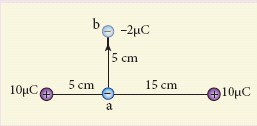
A point charge of +10 μC is placed at a distance of 20 cm from another identical point charge of +10 μC. A point charge of -2 μC is moved from point a to b as shown in the figure. Calculate the change in potential energy of the system? Interpret your result.
4.
The total number of electrons in the human body is typically in the order of 1028. Suppose, due to some reason, you and your friend lost 1% of this number of electrons. Calculate the electrostatic force between you and your friend separated at a distance of 1m. Compare this with your weight. Assume mass of each person is 60 kg and use point charge approximation.
5.
Two cells each of 5V are connected in series with a 8 Ω resistor and three parallel resistors of 4 Ω, 6 Ω, and 12 Ω. Draw a circuit diagram for the above arrangement. Calculate
(i) the current drawn from the cells
(ii) current through each resistor
6.
The resistance of a nichrome wire at 20oC is 10 Ω. If its temperature coefficient of resistanc is 0.004oC, find its resistance of the wire at boiling point of water. Comment on the result.
7.
A water molecule has an electric dipole moment of 6.3 x 10⁻³⁰ Cm. A sample contains 1022 water molecules, with all the dipole moments aligned parallel to the external electric field of magnitude 3 x 10⁵ NC-1. How much work is required to rotate all the water molecules from θ = 0° to 90°?
8.
A small telescope has an objective lens of focal length 125 cm and an eyepiece of focal length 2 cm.
(a) What is the magnification of the telescope?
(b) What is the separation between the objective and the eyepiece?
(c) What is the angular separation between two stars when viewed through this telescope if they subtend 1' for bare eye?
9.
Find the minimum thickness of a film of refractive index 1.25, which will strongly reflect the light of wavelength 589 nm. Also find the minimum thickness of the film to be anti-reflecting.
10.
A 200 turn circular coil of radius 2 cm is placed co-axially within a long solenoid of 3 cm radius. If the turn density of the solenoid is 90 turns per cm, then calculate mutual inductance of the coil and the solenoid.
11.
Compute the work done and power delivered by the Lorentz force on the particle of charge q moving with velocity \(\vec { v } \). Calculate the angle between Lorentz force and velocity of the charged particle and also interpret the result.
12.
An ideal transformer has 460 and 40,000 turns in the primary and secondary coils respectively. Find the voltage developed per turn of the secondary if the transformer is connected to a 230 V AC mains. The secondary is given to a load of resistance 104 Ω. Calculate the power delivered to the load.
13.
A parallel plate capacitor filled with mica having εr = 5 is connected to a 10 V battery. The area of the parallel plate is 6 cm2 and separation distance is 6 mm.
(a) Find the capacitance and stored charge.
(b) After the capacitor is fully charged, the battery is disconnected and the dielectric is removed carefully.
Calculate the new values of capacitance, stored energy and charge.
14.
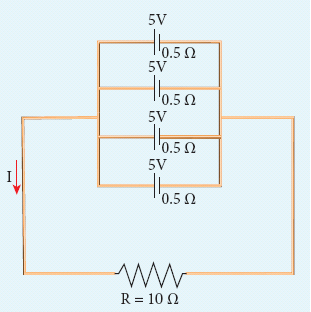
For the given circuit
Find
i) Equivalent emf
ii) Equivalent internal resistance
iii) Total current (I)
iv) Potential difference across each cell
v) Current from each cell
1.
\(\frac{1}{f}=\frac{1}{v}-\frac{1}{u} \)
\(m=\frac{-v}{u}=-4, f=20 \mathrm{~cm} \text { (Given) } \)
V = 4u
\(\frac{1}{f} =\frac{1}{4 u}-\frac{1}{u} \)
\(=\frac{1-4}{4 u}=\frac{-3}{4 u} \)
\(\frac{1}{f} =\frac{-3}{4 u} \)
4u = -3 x f
\(u=\frac{-3}{4} \times 20=-15 \mathrm{~cm}\)
2.
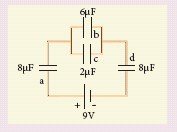
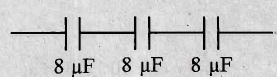
Cp = Cb + Cc
\(C_{P}=6+2=8 \mu \mathrm{F} \)
\(\frac{1}{C_{s}}=\frac{1}{C_a}+\frac{1}{C_p}=\frac{1}{C_d} \)
\(C_{s}=\frac{1}{8}+\frac{1}{8}+\frac{1}{8}=\frac{3}{8} \)
\(\therefore C_{s}=\frac{8}{3} \mu \mathrm{F} \)
Total capacitance \(C_{s}=\frac{8}{3} \times 10^{-6} \mathrm{~F} \)
Total Charge, \(Q=C_{s} V=\frac{8}{3} \times 10^{-6} \times 9 \)
\(Q_{a}=24 \mu C\)
(a) Charge on capacity \(Q_{a}=24 \mu C\) .....(1)
Charge on capacitor \(Q_{b}=24 \times \frac{6}{8}=18 \mu \mathrm{C} \) ..............(2)
Charge on capacitor \(Q_{c}=24 \times \frac{2}{8}=6 \mu \mathrm{C} \) ..............(3)
Charge on capacitor \(Q_{d}=24 \times \frac{8}{8}=24 \mu \mathrm{C} \) ..............(4)
(b) Potential difference across \(C_{a} \ is\ V_{a}=\frac{Q_{a}}{C_{a}} \)
\(=\frac{24}{8}=3 \mathrm{~V} \) ...(5)
Potential difference across \(C_{b}\ is \ V_{b}=\frac{Q_{b}}{C_{b}} \)
\(=\frac{18}{6}=3 \mathbf{V}\) ........(6)
Potential difference across \(C_{c}\ is \ V_{c}=\frac{Q_{c}}{C_{c}}=\frac{6}{2}=3 \mathrm{~V} \) ......(7)
Potential difference across \(C_{d}\ is \ V_{d}=\frac{Q_{d}}{C_{d}} \)
\(=\frac{24}{8}=3 \mathbf{V} \) ....(8)
(c) Energy stored in each capacitor \(U=\frac{1}{2} C V^{2}\)
Energy stored in \(\mathrm{C}_{\mathrm{a}} \text { is } U_{a}=\frac{1}{2} C_{a} V_{a}^{2}\)
\(U_{\mathrm{a}}=\frac{1}{2} \times 8 \times 10^{-6} \times 3 \times 3=36 \mu \mathrm{J}\) ....(9)
Energy stored in \(C_{b}\ is \ U_{b}=\frac{1}{2} C_{b} V_{b}^{2} \)
\(U=\frac{1}{2} \times 6 \times 10^{-6} \times 3 \times 3 \)
\(=27 \mu \mathrm{J} \) ........(10)
Energy stored in Ce is \(U_{c} =\frac{1}{2} C_{c} V_{c}^{2} \)
\(=\frac{1}{2} \times 2 \times 10^{-6} \times 3 \times 3=9 \mu \mathrm{J} \) ......(11)
Energy stored in Cd is \(U_{d} =\frac{1}{2} C_{d} V_{d}^{2} \)
\(U_d=\frac{1}{2} \times 8 \times 10^{-6} \times 3 \times 3 \)
\(=36 \times 10^{-6} \mathrm{~J}=36 \mu \mathrm{J} \) .........(12)
3.
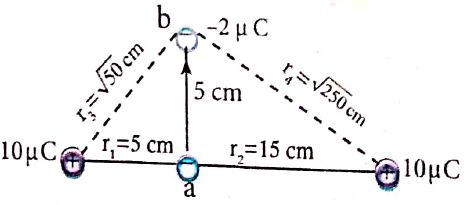
\(W =\left(V_{b}-V_{a}\right) q\left[where\ V=\frac{K Q}{r}\right] \)
To find Vb :
\(V_b=\frac{kQ}{r_3}+\frac{kQ}{r_4}\)
\(V_{b} =\frac{K \times 10 \times 10^{-6}}{\sqrt{50 \times 10^{-4}}}+\frac{K \times 10 \times 10^{-6}}{\sqrt{250 \times 10^{-4}}} \)
\(V_{b} =\frac{K \times 10^{-5}}{\sqrt{50} \times 10^{-2}}+\frac{K \times 10^{-5}}{\sqrt{250} \times 10^{-2}} \)
\(=K \times 10^{-3}\left[\frac{1}{\sqrt{50}}+\frac{1}{\sqrt{250}}\right] \)
\(=9 \times 10^{9} \times 10^{-3}\left[\frac{1}{\sqrt{50}}+\frac{1}{\sqrt{250}}\right] \)
Vb = 1842002 V
To find Va :
\(V_a=\frac{kQ}{r_1}+\frac{kQ}{r_2}\)
\(V_{a} =\frac{K \times 10 \times 10^{-6}}{\sqrt{5 \times 10^{-2}}}+\frac{K \times 10 \times 10^{-6}}{\sqrt{15 \times 10^{-2}}} \)
Va = 2400000 V
\(\therefore W_{D} =\left(V_{b}-V_{a}\right) q=(1842002-2400000)( -2 \times 10^{-6} )\)
W = +1.12J
Positive sign implies that to move the charge - 2 μC external work is required.
4.
Distance of separation r = 1 m
Number of electron in human body = 1028
Charge appeared on my friend and me, q = 1% of charge on 1028 electrons
q \(=10^{28} \times 1 / 100 \)
q = 1.6 x 10⁷ C
Force between us \( \mathrm{F}_{\mathrm{e}} =\mathrm{Kq}^{2} / \mathrm{r}^{2} \)
\(\left.=\frac{9 \times 10^{9} \times\left(1.6 \times 10^{7}\right)^{2}}{(1)^{2}} \quad \text { (as } \mathrm{r}=1 \mathrm{~m}\right)\)
= 9 x 2.56 x 109 x 1014
Fe = 23.04 x 10²³ N
Mass of each person m1 = m2 = m = 60 kg
Weight of each person W = mg = 60 x 9.8
W = 588N
Fe / W = \(\frac{23.04\times10^{23}}{588} = 3.9 \times 10^{21}=(or)F_e= 3.9 \times 10^{21}W\)
5.
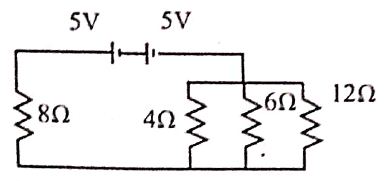
Circuit Diagram:
Here, 2 cells are in series,
\(\therefore \varepsilon_{\mathrm{tot}} =\varepsilon+\varepsilon=2 \varepsilon \)
\(\varepsilon_{\mathrm{tot}} =10 \mathrm{~V}\)
Here 4, 6 and 12 are in parallel
\(\therefore \frac{1}{\mathrm{R}_{\mathrm{p}}} =\frac{1}{\mathrm{R}_1}+\frac{1}{\mathrm{R}_1}+\frac{1}{\mathrm{R}_1}=\frac{1}{4}+\frac{1}{6}+\frac{1}{12} \)
\(\mathrm{R}_{\mathrm{p}} =2 \Omega\)
Now, the circuit becomes,
(i) current drawn from the cell (through the circuit) is,
\(\mathrm{I}=\frac{\mathrm{V}}{\mathrm{R}_{\mathrm{s}}}=\frac{10}{8+2}=1 \mathrm{~A}\)
Potential drop across the parallel combination of 3 resistors is \(\mathrm{V}^{\prime}=1 R_P=1 \times 2=2 \mathrm{~V}\)
(ii) Current through 8 resistor is I =1 A
\((\because 8 \Omega, 2 \Omega \text { in series) }\)
Current through \(\mathrm{R}=4 \Omega \ is, \mathrm{I}=\frac{\mathrm{V}^{\prime}}{\mathrm{R}}=\frac{2}{4}=0.5 \mathrm{~A}\)
Current through \(\mathrm{R}=6 \Omega \ is, \mathrm{I}=\frac{\mathrm{V}^1}{\mathrm{R}}=\frac{2}{6}=0.33 \mathrm{~A}\)
Current through \(\mathrm{R}=12 \Omega \ is, \mathrm{I}=\frac{\mathrm{V}^1}{\mathrm{R}}=\frac{2}{12}=0.17 \mathrm{~A}\)
6.
At To = 20oC, resistance R0 = 10 \(\Omega \)
\(\alpha\) = 0.004/oC, At To = 100oC R100 = ? (at boiling point of water)
RT = R0[1 + \(\left.(\alpha( T-T_{0}\right))\)]
R100 = 10 [1 + (0.004 x (100 - 20))]
= 10 [1 + 0.32] = 10 x 1.32 = 13.2 \(\Omega \)
∴ Resistance at boiling point of water R100 = 13.2 \(\Omega \)
(i.e) Rr = 13.2 \(\Omega \)
Comment : As the temperature increases, the resistance of the wire also increases.
7.
When the water molecules are aligned in the direction of the electric field, it has minimum potential energy. The work done to rotate the dipole from θ = 0° to 90° is equal to the potential energy difference between these two configurations.
W = ΔU = U(90°) - U(0°)
From the equation U =−pE cosθ = −\(\hat p.\hat E\) ,
we write U = − pE cosθ, Next, we calculate the work done to rotate one water molecule from θ = 0° to 90°.
For one water molecule
W = - pE cos90o + pE cos0o = pE
W= 6.3 x 10-30 x 3 x 105 = 18.9 x 10⁻²⁵J
For 1022 water molecules, the total work done is
Wtot = 18.9 x 10-25 x 1022 = 18.9 x 10⁻³J
8.
fo = 125 cm; fe = 2 cm; m = ? L = ?; θi = ?
(a) Equation for magnification of telescope,
\(m=\cfrac { { f }_{ o } }{ { f }_{ e } } \)
Substituting, \(m=\cfrac { 125 }{ 2 } =62.5\)
(b) Equation for approximate length of telescope, L = fo+ fe
Substituting, L = 125 + 2 = 127 cm = 1.27 m
(c) Equation for angular magnification,\(m=\cfrac { { \theta }_{ 1 } }{ { \theta }_{ 0 } } \)
Rewriting, \({ \theta }_{ 1 }=m\times { \theta }_{ 0 }\)
Substituting,
\({ \theta }_{ i }=62.5\times 1'=62.5'=\cfrac { 62.5 }{ 60 } =1.04^{ o }\) = 1o2'30''
9.
λ = 589 nm = 589 x 10−9 m
For the film to have strong reflection, the reflected waves should interfere constructively. The least optical path difference introduced by the film should be λ/2. The optical path difference between the waves reflected from the two surfaces of the film is 2μd. Thus, for strong reflection, 2μd = λ/2 [As given in equation 6.145. with n = 1]
Rewriting, \(d=\frac{\lambda}{4 \mu}\)
Substituting, \(d=\frac{589 \times 10^{9}}{4 \times 1.25}=117.8 \times 10^{-9}\)
d = 117.8 x 10-9 = 117.8 nm
For the film to be anti-reflecting, the reflected rays should interfere destructively. The least optical path difference introduced by the film should be λ. The optical path difference between the waves reflected from the two surfaces of the film is 2μd. For strong reflection, 2μd = λ [As given in equation 6.146. with n = 1]
Rewriting, \(d=\cfrac { \lambda }{ 2\mu } \)
Substituting, \(d=\cfrac { 589\times { 10 }^{ 9 } }{ 2\times 1.25 } =235.6\times { 10 }^{ -9 }\)
d = 235.6 x 10-9 = 235.6 nm
10.
No of turns of small solenoid, N2 = 200
Radius of small solenoid r = 2 cm = 2 x 10⁻² m
Area of small solenoid, A2= πr2 = 3.14 x 4 x 10-4 m2
Turn density of long solenoid, \(\frac { { N }_{ 1 } }{ l } =90\times10^2m^{-1}, M=?\)
M = μ0\(\frac { { N }_{ 1 } }{ l } \)N2A2
=4 x 3.14 x 10-7 x 90 x 102 x 200 x 3.14 x 4 x 10-4 = 2.84 x 10⁻³ H
M = 2.84 mH
11.
For a charged particle moving on a magnetic field, \(\vec { F } \)= q(\(\vec { v } \)x\(\vec { B } \))
The work done by the magnetic field is
\(W=\int { \overset { \rightarrow }{ F } .{ d \vec r } =\int { \overset { \rightarrow }{ F } .\overset { \rightarrow }{ v } dt } } \)
\(W=q\int { \left( \overset { \rightarrow }{ v } \times \overset { \rightarrow }{ B } \right) } .\overset { \rightarrow }{ v } dt=0\)
Since \(\overset { \rightarrow }{ v } \times \overset { \rightarrow }{ B } \) is perpendicular to \(\vec { v } \) and hence \(\left( \overset { \rightarrow }{ v } \times \overset { \rightarrow }{ B } \right) .\overset { \rightarrow }{ v } =\overset { \rightarrow }{ 0 } \)
This means that Lorentz force does no work on the particle. From work-kinetic energy theorem, (Refer section 4.2.6, XI th standard Volume I)
\(\frac { dw }{ dt } =p=0\)
Since \(\overset { \rightarrow }{ F } .\overset { \rightarrow }{ v } =0\Rightarrow \overset { \rightarrow }{ F } \ and \ \overset { \rightarrow }{ v } \) are perpendicular to each other. The angle between Lorentz force and velocity of the charged particle is 90o. Thus Lorentz force changes the direction of the velocity but not the magnitude of the velocity. Hence Lorentz force does no work and also does not alter kinetic energy of the particle.
12.
NP = 460 turns; NS = 40,000 turns
VP = 230 V; RS = 104 Ω
(i) Secondary voltage,
\({ V }_{ s }=\frac { { V }_{ p }{ N }_{ s } }{ { N }_{ p } } =\frac { 230\times 40,000 }{ 460 } \)
= 20,000V
Secondary voltage per turn,\(\frac { { V }_{ S } }{ { N }_{ S } } =\frac { 20,000 }{ 40,000 } =0.5V\)
(ii) Power delivered
= \({ V }_{ s }{ I }_{ s }=\frac { { V }_{ s }^{ 2 } }{ { R }_{ s } } =\frac { 20,000\times 20,000 }{ { 10 }^{ 4 } } =40kW\)
13.
(a) The capacitance of the capacitor in the presence of dielectric is
C = \(\frac { { \varepsilon }_{ r }{ \varepsilon }_{ 0 }A }{ d } =\frac { 5\times 8.85\times 10^{ -12 }\times 6 \times 10^{-4}}{ 6\times 10^{ -3 } } \)
= 44.25 x 10⁻¹³F = 4.425 pF
The stored charge is
Q = CV = 44.25 x 10-13 x 10
= 442.5 x 10⁻¹³C = 44.25pC
The stored energy is
\(U=\frac { 1 }{ 2 } \) CV2 = \(\frac { 1 }{ 2 } \) x 44.25 x 10-13 x 100
= 2.21 x 10⁻¹⁰ J
(b) After the removal of the dielectric, since the battery is already disconnected the total charge will not change. But the potential difference between the plates increases. As a result, the capacitance is decreased.
New capacitance is
C0=\(\frac { C }{ { \varepsilon }_{ r } } =\frac { 44.25\times 10^{ -12 } }{ 5 } \)
= 0.885 x 10⁻¹² F = 0.885 pF
The stored charge remains same and 44.25 pC. Hence newly stored energy is
U0 =\(\frac { { Q }^{ 2 } }{ 2{ C }_{ 0 } } =\frac { { Q }^{ 2 }{ \varepsilon }_{ r } }{ 2C } =\varepsilon _{ r }U\)
= 5 x 2.21 x 10-10J = 11.05 x 10⁻¹⁰J
The increased energy is ΔU = (11.05 - 2.21) x 10-10 J = 8.84 x 10⁻¹⁰ J
When the dielectric is removed, it experiences an inward pulling force due to the plates. To remove the dielectric, an external agency has to do work on the dielectric which is stored as additional energy. This is the source for the extra energy 8.84 x 10⁻¹⁰ J.
14.
i) Equivalent emf ξeq = 5 V
ii) Equivalent internal resistance,
\({ R }_{ eq }=\frac { r }{ n } =\frac { 0.5 }{ 4 } =0.125\Omega \)
iii) total current, \(I=\frac { \xi }{ { R }_{ 5 }+\frac { r }{ n } } \)
\(I=\frac { 5 }{ 10+0.125 } =\frac { 5 }{ 10.125 } \)
I ≈ 0.5 A
iv) Potential difference across each cell
V = IR = 0.5 x 10 = 5 V
v) Current from each cell, \(I'=\frac { I }{ n } \)
\(I'=\frac { 0.5 }{ 4 } =0.125A\)

12th Standard Syllabus & Materials
12th Standard
TN 12th Computer Applications களப்பெயர் முறைமை (DNS) Sample Question Papers Study Material - QB365 Set A
NEW12th Standard
TN 12th Computer Applications வலையமைப்பு எடுத்துக்காட்டுகள் மற்றும் நெறிமுறைகள் Sample Question Papers Study Material - QB365 Set A
NEW12th Standard
TN 12th Computer Applications கணினி வலையமைப்பு ஓர் அறிமுகம் Sample Question Papers Study Material - QB365 Set A
NEW12th Standard
TN 12th Computer Applications PHP-உடன் MySQL-ஐ இணைத்தல் Sample Question Papers Study Material - QB365 Set A



Tamilnadu Stateboard 12th Standard Subjects

Maths

Chemistry
Physics

Biology

Computer Science

Business Maths and Statistics

Economics

Commerce

Accountancy

History

Computer Applications
Biology
Computer Technology
Computer Applications
Computer Science
Business Maths and Statistics
Commerce
Economics
Maths
Chemistry
Physics
Computer Technology
History
Accountancy

Tamil

English

French
Tamilnadu Stateboard Standards



