
 100% FREE ACCESS
12th Standard Syllabus & Materials
12th Standard
TN 12th Computer Applications மின்னணு தரவு பரிமாற்றம் Sample Question Papers Study Material - QB365 Set A
NEW12th Standard
TN 12th Computer Applications மின் - வணிக பாதுகாப்பு அமைப்புகள் Sample Question Papers Study Material - QB365 Set A
NEW12th Standard
TN 12th Computer Applications மின்னணு செலுத்தல் முறைகள் Sample Question Papers Study Material - QB365 Set A
NEW12th Standard
TN 12th Computer Applications மின் - வணிகம் Sample Question Papers Study Material - QB365 Set A
NEW12th Standard
TN 12th Computer Applications திறந்த மூல கருத்துருக்கள் Sample Question Papers Study Material - QB365 Set A
NEW12th Standard
TN 12th Computer Applications வலையமைப்பு வடமிடல் Sample Question Papers Study Material - QB365 Set A

Published on: 13/05/2022
QB365 provides detailed and simple solution for every Creative Questions in class 12 Physics Subject. It will helps to get more idea about question pattern in
every Creative questions with solution.
Download Tamil Nadu 12th Standard Physics question papers, model tests, one-mark questions, important questions, and public exam papers in PDF format. Free study materials and answer keys for TN State Board students.
Questions + Answers key
Take MCQ Physics Test1.
What are Airy's discs?
2.
What is principal axis of the mirror?
3.
List out the laws of photoelectric effect. (or) Write any three Laws of Photoelectric Effect
4.
Write the two ways of preparing the nano materials.
5.
Show that the decay rate 'R' of a sample of a radionuclide is related to the number of radioactive nuclei 'N' at the same instant by the expression R = λN.
6.
Write the frequency source of production and uses of Ultraviolet radiation.
7.
What are the types of magnets? Give example.
8.
What is the phase relationship between current & voltage in an inductive? Draw
(i) Phosor diagram and
(ii) wave diagram.
9.
How does one can understand the temperature dependence of resistivity of a conductor?
10.
What is principle used in Microwave oven? Explain.
1.
(i) Similar to a rectangular slit, when a circular aperture or opening (like a lens or the iris of our eye) forms an image of a point object, the image formed will not be a point but a diffraction pattern of concentric circles that become fainter while moving away from the center as shown in Figure. These are known as Airy's discs
\(asin\theta =1.22\lambda \)
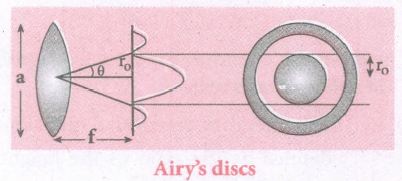
(ii) Here, the numerical value 1.22 comes for central "maximum formed by circular apertures.
For small angles, sin θ = θ
\(a\theta =1.22\lambda \)
Rewriting further,
\(\theta =\cfrac { 1.22\lambda }{ a } \ and \cfrac { { r }_{ o } }{ f } =\cfrac { 1.22\lambda }{ a } \)
\({ r }_{ o }=\cfrac { 1.22\lambda f }{ a } \)
2.
(i) The line joining the pole and the centre of curyature is called the principal axis of the mirror.
(ii) The light ray travelling along the principal axis towards the mirror after reflection travels back along the same principal axis. It is also called optical axis.
3.
Laws of photoelectric effect:
(i) For a given surface, the emission of photoelectrons takes place only if the frequency of incident light is greater than a certain minimum frequency called the threshold frequency.
(ii) For a given frequency of incident light, the number of photoelectrons emitted is directly proportional to the intensity of the incident light. The saturation current is also directly proportional to the intensity of incident light.
(iii) Maximum kinetic energy of the photoelectrons is independent of the intensity of the incident light.
(iv) Maximum kinetic energy of the photoelectrons from a given metal is directly proportional to the frequency of incident light.
(v) There is no time lag between the incidence of light and the ejection of photoelectrons.
4.
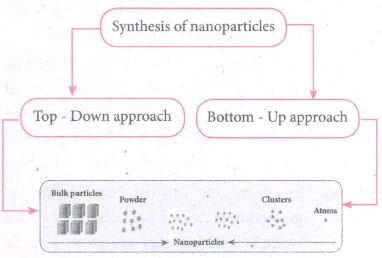
There are two ways of preparing the nanomateials, top down and bottom up approaches
5.
Rate of disintegration of a radioactive sample,
R = \(\frac{dN}{dt}\)
According to radioactive decay law
- \(\frac{dN}{dt}\) ∝ N
- \(\frac{dN}{dt}\) = λN or R = λN
6.
It is produced by Sun, arc, and ionized gases. The wavelength range is 6 x 10⁻¹⁰m to 4 x 10⁻⁷m and the frequency range is 5 x 10¹⁷Hz to 7 x 10¹⁴Hz. It has less penetrating power. It can be absorbed by atmospheric ozone and harmful to human body. It is used to destroy bacteria, sterilizing the surgical instruments, burglar alarm, detect the invisible writing, finger prints and also in the study of molecular structure.
7.
(i) Magnets are classified into natural magnets and artificial magnets.
(ii) For example, iron, cobalt, nickel, etc. are natural magnets.
(iii) Strengths of natural magnets are very weak and the shapes of the magnet are irregular.
(iv) Artificial magnets are made by us in order to have desired shape and strength.
(v) If the magnet is in the form of rectangular shape or cylindrical shape, then it is known as bar magnet.
8.
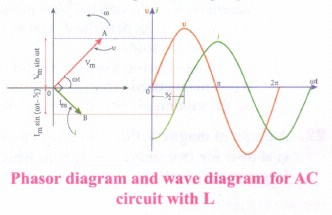
Current lags behind the applied voltage \(\frac{\pi}{2}\) in an inductive circuit. This fact is depicted in the phasor diagram. In the wave diagram also, it is seen that current lags the voltage by 90°.
9.
(i) For conductors a is positive. If the temperature of a conductor increases, the average kinetic energy of electrons in the conductor increases. This results in more frequent collisions and hence the resistivity increases.
(ii) The graph of the Even though, the resistivity of conductors like metals varies linearly for a wide range of temperatures, there also exists a nonlinear region at very low temperatures.
(iii) The resistivity approaches some finite value as the temperature approaches absolute zero.
(iv) As the resistance is directly proportional to the resistivity of the material, we can also write the resistance of a conductor at temperature T °C as
\({ R }_{ T }=R\left[ 1+\alpha \left( T-{ T }_{ 0 } \right) \right] \)
\(\alpha =\cfrac { { R }_{ T }-{ R }_{ 0 } }{ { R }_{ 0 }\left( T-{ T }_{ 0 } \right) } =\cfrac { 1\Delta R }{ { R }_{ 0 }\Delta T } \)
\(\alpha =\cfrac { 1 }{ { R }_{ 0 } } \cfrac { \Delta R }{ \Delta T } \)
where \(\Delta R={ R }_{ 1 }-{ R }_{ 0 }\) is a change in resistance during the changing temperature \(\Delta T=T-{ T }_{ 0 }\)
10.
(i) Microwave oven works on the principle of torque acting on an electric dipole. The food we consume has water molecules which are permanent electric dipoles.
(ii) Oven produces microwaves that are oscillating electromagnetic fields and produce torque on the water molecules.
(iii) Due to this torque on each water molecule, the molecules rotate very fast and produce thermal energy. Thus, heat generated is used to cook the food.

12th Standard Syllabus & Materials
12th Standard
TN 12th Computer Applications களப்பெயர் முறைமை (DNS) Sample Question Papers Study Material - QB365 Set A
NEW12th Standard
TN 12th Computer Applications வலையமைப்பு எடுத்துக்காட்டுகள் மற்றும் நெறிமுறைகள் Sample Question Papers Study Material - QB365 Set A
NEW12th Standard
TN 12th Computer Applications கணினி வலையமைப்பு ஓர் அறிமுகம் Sample Question Papers Study Material - QB365 Set A
NEW12th Standard
TN 12th Computer Applications PHP-உடன் MySQL-ஐ இணைத்தல் Sample Question Papers Study Material - QB365 Set A



Tamilnadu Stateboard 12th Standard Subjects

Maths

Chemistry
Physics

Biology

Computer Science

Business Maths and Statistics

Economics

Commerce

Accountancy

History

Computer Applications
Biology
Computer Technology
Computer Applications
Computer Science
Business Maths and Statistics
Commerce
Economics
Maths
Chemistry
Physics
Computer Technology
History
Accountancy

Tamil

English

French
Tamilnadu Stateboard Standards



