
 100% FREE ACCESS
12th Standard Syllabus & Materials
12th Standard
TN 12th Computer Applications மின்னணு தரவு பரிமாற்றம் Sample Question Papers Study Material - QB365 Set A
NEW12th Standard
TN 12th Computer Applications மின் - வணிக பாதுகாப்பு அமைப்புகள் Sample Question Papers Study Material - QB365 Set A
NEW12th Standard
TN 12th Computer Applications மின்னணு செலுத்தல் முறைகள் Sample Question Papers Study Material - QB365 Set A
NEW12th Standard
TN 12th Computer Applications மின் - வணிகம் Sample Question Papers Study Material - QB365 Set A
NEW12th Standard
TN 12th Computer Applications திறந்த மூல கருத்துருக்கள் Sample Question Papers Study Material - QB365 Set A
NEW12th Standard
TN 12th Computer Applications வலையமைப்பு வடமிடல் Sample Question Papers Study Material - QB365 Set A

Published on: 13/05/2022
QB365 provides detailed and simple solution for every Creative Questions in class 12 Physics Subject. It will helps to get more idea about question pattern in
every Creative questions with solution.
Download Tamil Nadu 12th Standard Physics question papers, model tests, one-mark questions, important questions, and public exam papers in PDF format. Free study materials and answer keys for TN State Board students.
Questions + Answers key
Take MCQ Physics Test1.
The eyepiece and objective of a microscope having focal lengths of 0.03 m and 0.04 m respectively are separated by a distance 0.2 m. Now the eyepiece and the objective are to be interchanged such that the angular magnification of the instrument remains the same. What is the separation between the lenses?
2.
For the same angle of incidence, the angle of refraction in two media A and Bare 25° and 35° respectively. In which one of the two media is the speed of light lesser?
3.
Explain the production of x-rays.
4.
Write the application of alpha decay in smoke detectors.
5.
A parallel plate capacitor is charged by an external ac source straight the displacement current inside the capacitor is the same as the current charging the capacitor.
6.
Describe the motion of a charged particle in a uniform magnetic field.
7.
A potential difference of 3 V is applied across a conductor through which the 5 A of current is flowing. Determine the resistance of the conductor.
8.
Derive an expression for the RMS value of AC.
9.
Explain the variation of resistivity of conductor and semiconductor with change in temperature.
10.
An electron is released from the bottom plate (E = 104 Nc-1) Find the velocity of the electron when it reaches plate B. (e/m = 1.76 x 10¹¹ Ckg-1).
1.
Given data:
In first case, fe.= 0.03 m
f0= 0.04 m , L = 0.2 m
\(m=\cfrac { L }{ { f }_{ o } } \left( 1+\cfrac { 0.25 }{ { f }_{ o } } \right) \)
For m to be the same in both cases,
= \(\cfrac { L }{ 0.03 } \left( 1+\cfrac { 0.25 }{ 0.04 } \right) \)
= \(\cfrac { 0.2 }{ 0.04 } \left( 1+\cfrac { 0.25 }{ 0.04 } \right) \)
= \(\cfrac { L }{ 0.03 } \times \cfrac { 29 }{ 4 } =\cfrac { 0.2 }{ 0.04 } \times \cfrac { 28 }{ 3 } \)
\(L=\cfrac { 5.6 }{ 29 } =0.193m\)
2.
Formula.
\(\mu =\cfrac { sini }{ sinr } =\cfrac { { v }_{ 1 } }{ { v }_{ 2 } } \)
\(\cfrac { { \mu }_{ A } }{ { \mu }_{ B } } =\cfrac { \frac { sini }{ { sinr }_{ A } } }{ \frac { sini }{ { sinr }_{ B } } } =\cfrac { { sinr }_{ B } }{ { sinr }_{ A } } =\cfrac { \frac { { v }_{ 1 } }{ { v }_{ 2 } } }{ \frac { { v }_{ 1 } }{ { v }_{ B } } } \)
\(\cfrac { { sinr }_{ B } }{ { sinr }_{ A } } =\cfrac { { v }_{ B } }{ { v }_{ A } } \)
\(r_{\mathrm{A}}<r_{\mathrm{B}} \sin r_{\mathrm{A}}<\sin r_{\mathrm{B}} \Rightarrow v_{\mathrm{A}}<v_{\mathrm{B}}\)
Speed of light in A is lesser.
3.
i) X-rays are produced in x-ray tube which is essentially a discharge tube.
ii) A tungsten filament F is heated to incandescence by a battery. As a result, electrons are emitted from it by thermionic emission.
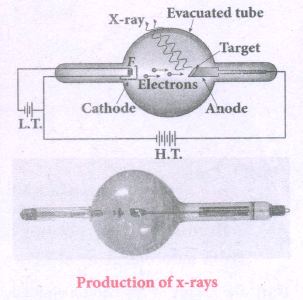
iii) The electrons are accelerated to high speeds by the voltage applied between the filament F and the anode.
iv) The target materials like tungsten, molybdenum are embedded in the face of the solid copper anode.
v) The face of the target is inclined at an angle with respect to the electron beam so that x-rays can leave the tube through its side.
vi) When high-speed electrons strike the target, they are decelerated suddenly and lose their kinetic energy.
vii) As a result, x-ray photons are produced. Since most of the kinetic energy of the bombarding electrons gets converted into heat, targets' made of high-melting-point metals and a cooling system are usually employed.
4.
(i) The smoke detector uses around 0.2 mg of a man-made weak radioactive isotope called americium \((_{ 95 }^{ 241 }{ Am })\)
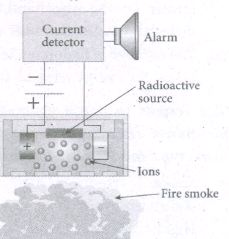
(ii) This radioactive source is placed between two oppositely charged metal plates and α radiations from \(_{ 95 }^{ 241 }{ Am }\) continuously ionize the nitrogen, oxygen molecules in the air space between the plates
(iii) As a result, there will be a continuous flow of small steady currents in the circuit.
(iv) If smoke enters, the radiation is being absorbed by the smoke particles rather than air molecules.
(v) As a result, the ionization and along with it the current is reduced. This drop-in current is detected by the circuit and the alarm starts.
(vi) The radiation dosage emitted by americium is very much less than the safe level, so it can be considered harmless.
5.
Electric field between the capacitor plates
\(E=\frac { \sigma }{ \varepsilon _{ 0 } } =\frac { q }{ \varepsilon _{ 0 }A } \)
Where q is the charge accumulated on the positive plate.
The electric flux through this plate
\({ \phi }_{ E }=EA=\frac { q }{ \varepsilon _{ 0 }A } .A=\frac { q }{ \varepsilon _{ 0 } } \)
∴ Displacement current
\(\\ { I }_{ d }=\varepsilon _{ 0 }.\frac { d\phi }{ dt } =\varepsilon _{ 0 }\frac { d }{ dt } \left[ \frac { q }{ \varepsilon _{ 0 } } \right] =\frac { dq }{ dt } \)
\(\frac { dq }{ dt } \) is the rate at which charge flows to a positive plate through the conducting wire.
Id = Ic
i.e. displacement current between the capacitor plates = conduction current through the wire.
6.
(i) Consider a charged particle of charge 'q' having mass m enters into a region of a uniform magnetic field \(\vec { B } \) with velocity \(\vec { v } \).
(ii) Such that velocity is perpendicular to the magnetic field and velocity \(\vec{v}\).
(iii) The charged particle moves in a circular orbit.
(iv) Lorentz force.
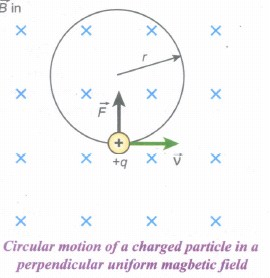
\(\vec { F } =q(\vec { v } \times \vec { B } )\)
In magnitude F = qVB
(v) This Lorentz force acts as centripetal force for the particle to execute circular motion. Therefore,
qvB = m\(\frac { { v }^{ 2 } }{ r } \)
The radius of the circular path is
r = \(\frac { mv }{ qB } =\frac { p }{ qB } \) ..........(1)
(vi) where p = mv is the magnitude of the linear momentum of the particle. Let T be the time taken by the particle to finish one complete circular motion, then
T = \(\frac { 2\pi r }{ v } \) .............(2)
Hence substituting (1) in (2), we get,
T = \(\frac { 2\pi m }{ qB } \) .............(3)
(vii) Equation (3) is called the cyclotron period. The reciprocal of time period is the frequency f, which is
f = \(\frac { 1 }{ T } \)
f = \(\frac { qB }{ 2\pi m } \) ...........(4)
In terms of angular frequency ω,
ω = 2πf = \(\frac { q }{ m } \)B ...........(5)
(viii) Equations (4) and equation (5) are called cyclotron frequency or gyrofrequency.
(ix) Time period and frequency depend only on charge-to-mass ratio (specific charge) and independent of velocity or radius.
7.
Potential difference V = 3 V
Current, I = 5 A
By Ohms law, \(R=\cfrac { V }{ I } =\cfrac { 3 }{ 5 } =0.6\Omega \)
8.
(i) The term RMS refers to time-varying sinusoidal currents and voltages and is not used in DC systems.
(ii) The root mean square value of an alternating current is defined as the square root of the mean of the squares of all currents over one cycle. It is denoted by IRMS. For alternating voltages, the RMS value is given by IVRM.
(iii) The alternating current i = Im sin ωt or i = Im sin θ, is represented graphically in Figure. The corresponding squared current wave is also shown by the dotted lines.
(iv) The sum of the squares of all currents over one cycle is given by the area of one cycle of the squared wave. Therefore,
IRMS = \(\sqrt{\frac{Area \ of \ one \ cycle \ of \ squared \ wave}{Base\ length \ of \ one\ cycle}}\) ....(1)
(v) An elementary area of thickness dθ is considered in the first half-cycle of the squared current wave as shown in Figure. Let i2 be the mid-ordinate of the element. Area of the element = i2dθ
Area of one cycle of squared.
wave = \(\int _{ 0 }^{ 2\pi }{ { i }^{ 2 }d\theta } \)
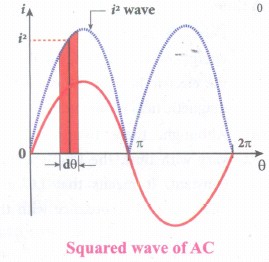
= \(\int _{ 0 }^{ 2\pi }{ { { I }^{ 2 } }_{ m } } { sin }^{ 2 }\theta d\theta ={ { I }^{ 2 } }_{ m }\int _{ 0 }^{ 2\pi }{ { sin }^{ 2 }\theta d\theta } \)
= \({ { I }^{ 2 } }_{ m }\int _{ 0 }^{ 2\pi }{ \left[ \frac { 1-cos2\theta }{ 2 } \right] d\theta } \)
since \({ sin }^{ 2 }\theta =\frac { 1-cos2\theta }{ 2 } \)
= \(\frac { { { I }^{ 2 } }_{ m } }{ 2 } \left[ \int _{ 0 }^{ \pi }{ id\theta } =\int _{ 0 }^{ \pi }{ { I }_{ m }cos2\theta d\theta } \right] \)
= \(\frac { { { I }^{ 2 } }_{ m } }{ 2 } { \left[ \theta -\frac { sin2\theta }{ 2 } \right] }_{ 0 }^{ 2\pi }\)
= \(\frac { { { I }^{ 2 } }_{ m } }{ 2 } \left[ \left( 2\pi -\frac { sin2\times 2\pi }{ 2 } \right) -\left( 0-\frac { sin0 }{ 2 } \right) \right] \)
= \(\frac { { { I }^{ 2 } }_{ m } }{ 2 } \times \pi ={ { I }^{ 2 } }_{ m }\pi \) [∵ sin 0 = sin 4π = 0]
Substituting this in equation (1), we get
\(\sqrt { \frac { { { I }^{ 2 } }_{ m }\pi }{ 2\pi } } =\frac { { { I }^{ 2 } }_{ m } }{ \sqrt { 2 } } \) [Base length of cone cycle is 2π]
IRMS = 0.707 Im
9.
(i) The resistivity of a material is dependent on temperature. The resistivity of a conductor increases with increase in temperature according to the expression
\({ \rho }_{ r }={ \rho }_{ 0 }[I+\alpha (T-{ T }_{ 0 })\)
(ii) Where PT is the resistivity of a conductor at ToC, is the resistivity of the conductor at some reference temperature To (usually at 20°C), and a is the temperature coefficient of resistivity.
(iii) It is defined as the ratio of increase in resistivity per degree rise in temperature to its resistivity at To
From equation (1), we can write
\({ \rho }_{ r }-{ \rho }_{ 0 }=\alpha { \rho }_{ 0 }(T-{ T }_{ 0 })\)
\(\therefore \alpha =\cfrac { { \rho }_{ r }-{ \rho }_{ 0 } }{ { \rho }_{ 0 }(T-{ T }_{ 0 }) } =\cfrac { \Delta \rho }{ { \rho }_{ 0 }\Delta T } \)
where \(\Delta \rho ={ \rho }_{ r }-{ \rho }_{ 0 }\) is change in resistivity for a change in temperature \(\Delta T=T-{ T }_{ 0 }\) Its unit is per oC \(\alpha \) of conductor:
(iv) For conductors a is positive. If the temperature of a conductor increases, the average kinetic energy of electrons in the conductor increases. This results in more frequent collisions and hence the resistivity increases.
(v) The graph of the Even though, the resistivity of conductors like metals varies linearly for wide range of temperatures, there also exists a nonlinear region at very low temperatures.
(vi) The resistivity approaches some finite values the temperature approaches absolute zero
(vii) As the resistance is directly proportional to the resistivity of the material, we can also write the resistance of a conductor at temperature T °C as
\({ R }_{ T }={ R }_{ 0 }\left[ 1+\left( T-{ T }_{ 0 } \right) \right] \)
\(\alpha =\cfrac { { R }_{ T }-{ R }_{ 0 } }{ { R }_{ 0 }\left( T-{ T }_{ 0 } \right) } =\cfrac { I }{ { R }_{ 0 } } \cfrac { \Delta R }{ \Delta T } \)
\(\alpha =\cfrac { I }{ { R }_{ 0 } } \cfrac { \Delta R }{ \Delta T } \)
where \(\Delta R={ R }_{ r }-{ R }_{ 0 }\) is the change in resistance during the change in temperature \(\Delta T=T-{ T }_{ 0 }\)
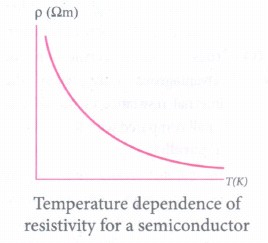
(viii) An of semiconductors For semiconductors, the resistivity decreases with increase in temperature. As the temperature increases, more electrons will be liberated from their atoms. Hence the current increases and therefore the resistivity decreases. A semiconductor with a negative temperature coefficient of resistance is called a thermistor.
10.
Given: Electric field strength E = 104 NC-1 between the plates
Distance of separation between the plates = 2 cm
= 2 x 10⁻² m.
Velocity of the electron when it reaches B = V = ?
To find:
According to equation of motion V = u2 + 2as
u - initial velocity = 0; a \(=\frac { F }{ m } =\frac { Ee }{ m } =E\left( \frac { e }{ m } \right) \)
Formula: V2 = 2as
Solution:
\(V=\sqrt { 2\times { 10 }^{ 4 }\times 1.76\times { 10 }^{ 11 }\times 2\times { 10 }^{ -2 } } \)
\(V=7.04\times { 10 }^{ 13 }=\sqrt { 0.704\times { 10 }^{ 14 } } \)
\(V=0.84{ 10 }^{ 7 }{ ms }^{ -1 }\)

12th Standard Syllabus & Materials
12th Standard
TN 12th Computer Applications களப்பெயர் முறைமை (DNS) Sample Question Papers Study Material - QB365 Set A
NEW12th Standard
TN 12th Computer Applications வலையமைப்பு எடுத்துக்காட்டுகள் மற்றும் நெறிமுறைகள் Sample Question Papers Study Material - QB365 Set A
NEW12th Standard
TN 12th Computer Applications கணினி வலையமைப்பு ஓர் அறிமுகம் Sample Question Papers Study Material - QB365 Set A
NEW12th Standard
TN 12th Computer Applications PHP-உடன் MySQL-ஐ இணைத்தல் Sample Question Papers Study Material - QB365 Set A



Tamilnadu Stateboard 12th Standard Subjects

Maths

Chemistry
Physics

Biology

Computer Science

Business Maths and Statistics

Economics

Commerce

Accountancy

History

Computer Applications
Biology
Computer Technology
Computer Applications
Computer Science
Business Maths and Statistics
Commerce
Economics
Maths
Chemistry
Physics
Computer Technology
History
Accountancy

Tamil

English

French
Tamilnadu Stateboard Standards



