
 100% FREE ACCESS
12th Standard Syllabus & Materials
12th Standard
TN 12th Computer Applications மின்னணு தரவு பரிமாற்றம் Sample Question Papers Study Material - QB365 Set A
NEW12th Standard
TN 12th Computer Applications மின் - வணிக பாதுகாப்பு அமைப்புகள் Sample Question Papers Study Material - QB365 Set A
NEW12th Standard
TN 12th Computer Applications மின்னணு செலுத்தல் முறைகள் Sample Question Papers Study Material - QB365 Set A
NEW12th Standard
TN 12th Computer Applications மின் - வணிகம் Sample Question Papers Study Material - QB365 Set A
NEW12th Standard
TN 12th Computer Applications திறந்த மூல கருத்துருக்கள் Sample Question Papers Study Material - QB365 Set A
NEW12th Standard
TN 12th Computer Applications வலையமைப்பு வடமிடல் Sample Question Papers Study Material - QB365 Set A

Published on: 13/05/2022
QB365 provides detailed and simple solution for every Creative Questions in class 12 Physics Subject. It will helps to get more idea about question pattern in
every Creative questions with solution.
Download Tamil Nadu 12th Standard Physics question papers, model tests, one-mark questions, important questions, and public exam papers in PDF format. Free study materials and answer keys for TN State Board students.
Questions + Answers key
Take MCQ Physics Test1.
What is the focal length of a convex lens (μ = 1.5) with radii of curvature R.
2.
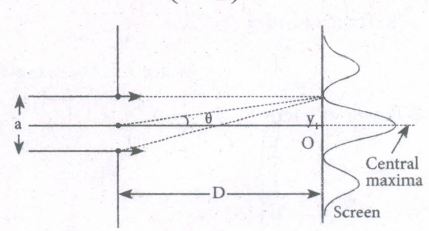
A Parallel beam of light of 500 nm falls on a narrow slit and be resulting diffraction pattern is observed on a screen 1m away. It is observed that the first minimum is at a distance of 2.5 mm from the centre of the screen. Calculate the width of the slit.
3.
Calculate the momentum of electrons if their wavelength is 2 Ă. Given: h = 6.626 x 10⁻³⁴ Is and m = 9.1 x 10⁻³¹ kg.
4.
What is RADAR? Explain its function. State its applications
5.
Explain Chain reaction.
6.
A plane Electromagnetic wave travels in vacuum along z - direction. What can you say about the directions of electric and magnetic field vectors? If the frequency of the wave is 30 MHz. What is its wavelength?
7.
A cyclotron's frequency is 8 μHz. What should be the operating magnetic field for accelerating protons? If the radius of its dees is 50cm. Calculate the k.E (is μeV) of the proton beam produced by the accelerator.
8.
The magnetic flux through a coil perpendicular to the plane is given by Φ = 5t3 +4t2 +2t calculate the induced emf through the coil at t = 2S
9.
Two metallic wires P1 & P2 of the same material & same length but different cross sectional areas A1 & A2 are joined together & connected to a source of emf. Find the ratio of the drift velocities of free electrons in the two wires when they are connected
(i) in series &
(ii) in parallel.
10.
Calculate the potential at a point P due to charge of 5 x 10⁻⁷Clocated 11cm away.
1.
From the lens maker's formula,
\(\cfrac { 1 }{ f } =\left( \mu -1 \right) \left( \frac { 1 }{ { R }_{ 1 } } -\frac { 1 }{ { R }_{ 2 } } \right) \)
Here, μ = 1.5; R1 = R2 and =-R
\(\therefore \cfrac { 1 }{ f } =\left( 1.5-1 \right) \left( \cfrac { 1 }{ R } -\cfrac { 1 }{ -R } \right) =0.5\times \cfrac { 2 }{ R } =\cfrac { 1 }{ R } \)
or f = R.
2.
Formula:
From the condition of diffraction,
a sin θ= nλ.. (for minima)
= \(\left( n+\cfrac { 1 }{ 2 } \right) \lambda \)
Provided n = 1, 2, 3 ... and n = 0 for central
maximum
From the condition of minima
a sin θ = λ. (n = 1)
Since the value of λ. is nm, so
\(a.\theta =\lambda \Rightarrow a.\cfrac { y }{ D } =\lambda \left[ amgle=\cfrac { arc }{ radius } \right] \)
= 2 x 10⁻⁴ m.
3.
Momentum, \(p=\frac { h }{ \lambda } =\frac { { 6.626\times 10 }^{ -34 } }{ 2\times { 10 }^{ -10 } } kg{ \quad ms }^{ -1 }\)
4.
(i) Radar basically stands for Radio Detection and Ranging System.
(ii) It is one of the important applications of communication systems' and is mainly used to sense, detect, and locate distant objects like aircraft, ships, spacecraft, etc.
(iii) The angle, range, or velocity of the objects that are invisible to the human eye can be determined.
(iii) Radar uses electromagnetic waves for communication. The electromagnetic signal is initially radiated into space by an antenna in all directions.
(iv) When this signal strikes the targeted object, it gets reflected or reradiated in many directions.
(v) This reflected (echo) signal is received by the radar antenna which in turn is delivered to the receiver.
(vi) Then, it is processed and amplified to determine the geographical statistics of the object. The range is determined by calculating the time taken by the signal to travel from RADAR to the target and back.
Applications :
Radars find extensive applications in almost all fields.
(i) In military, it is used for locating and detecting the targets.
(ii) It is used in navigation systems such as ship borne surface search, air search and weapons guidance systems.
(iii) To measure precipitation .rate and wind speed in meteorological observations, Radars are used.
(iv) It is employed to locate and rescue people in emergency situations.
5.
Chain reaction :
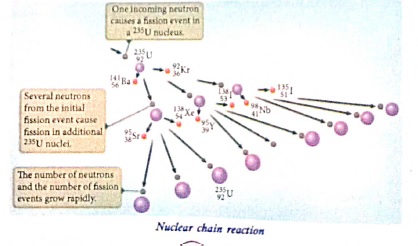
(i) When one \({ }_{92}^{235} \mathrm{U}\) Unucleus undergoes fission,the energy released might be small. But from each fission reaction, three neutrons are released.
(ii) These three neutrons can cause further fission in three other \({ }_{92}^{235} \mathrm{U}\) nuclei which in turn produce nine neutrons. These nine neutrons initiate fission in another 27 \({ }_{92}^{235} \mathrm{U}\) nuclei and so on.
(iii) This process is called a chain reaction and the number of neutrons goes on increasíng almost in geonetric progression. There are two kinds of chain reactions :
(a) uncontrolled chain rcaction
(b) controlled chain reaction.
(a) uncontrolled chain rcaction :
The number of neutrons multiplies indefinitely and the entire amount of energy released in a fraction of second.
Example : Atom bomb.
(b) controlled chain reaction :
The average number of neutrons released in each stage is kept as one such that it is possible to store the released energy.
Example : Nuclear reactor.
6.
E and B vectors must be in x and y directions.
Formula: We know \(\lambda =\frac { v }{ \gamma } =\frac { 3\times { 10 }^{ 8 } }{ 30\times { 10 }^{ 6 } } \)
λ = 10m.
7.
The cyclotron's frequency v = 18 μHz
= 8 x 10⁶ Hz
The mass of the proton m = 1.67 x 10⁻²⁷ kg
The charge of the proton q = 1.6 x 10⁻¹⁹C
Radius of the dees r = 50 cm = 50 x 10-2 m
Magnetic field B = ?
k.E of the proton k.E = ?
Magnetic field B = \(\frac { 2\pi mv }{ q } \)
B = \(\frac { 2\times 3.14\times 1.67\times 10^{ -27 }\times 8\times 10^{ 6 } }{ 1.6\times 10^{ -19 } } \)
= \(\frac { 83.90\times 10^{ -21 } }{ 1.6\times 10^{ -19 } } \)
= 52.438 x 10⁻²
B = 0.524T
k.E = \(\frac { 1 }{ 2 } \) mv2
v = rω = r x 2πv
= 0.5 x 2 x 3.14 x 8 x 106
= 25.12 x 10⁶ m/s
k.E = \(\frac { 1 }{ 2 } \) x 1.67 x 10-27 x (25.12 x 106)2
=\(\frac { 41.95\times 10^{ -21 }\times 25.12\times 10^{ 6 } }{ 2 } \)
= 526.89 x 10⁻¹⁵ J (or) 5.269 x 10⁻¹³J
To convert J into MeV
= \(\frac { 526.89\times 10^{ -15 } }{ 1.6\times 10^{ -19 } } \) = 3.29 x 10⁶ eV
k.E = 3.29 x 10⁶ MeV
8.
Given:
We know that e = -\(\frac { d\Phi }{ dt } \)
e = \(\frac{d}{dt}\) (5t3 + 4t2 + 2t)
e = 15t2 + 8t + 2
for t = 2s, e = 15 x (2)2 + 8 (2) + 2
e = 78V
9.
(i) In series the circuit remains the same
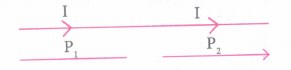
\(\therefore I=neA_{ 1 }{ V }_{ d_{ 1 } }=n{ A }_{ 2 }{ ev }_{ { d }_{ 2 } }\)or \(\cfrac { { vd }_{ 1 } }{ { vd }_{ 2 } } =\cfrac { { A }_{ 2 } }{ { A }_{ 1 } } \)
(ii) In parallel the potential difference is the same but the circuits are different
\(V={ I }_{ 1 }{ R }_{ 1 }=n{ A }_{ 1 }{ ev }_{ d_{ 1 } }\times \cfrac { \rho l }{ { A }_{ 1 } } ={ n }_{ 1 }e\rho v_{ d_{ 1 } }l\)
\(V={ I }_{ 2 }{ R }_{ 2 }={ n }_{ 1 }e\rho { v }_{ { d }_{ 1 } }l\) \(\left[ \because { R }_{ 1 }=\cfrac { \rho l }{ { A }_{ 1 } } \right] \)
Now I1R1 = I2R2 \(\therefore \cfrac { { V }_{ d_{ 1 } } }{ { V }_{ d_{ 2 } } } =1\)
10.
\(V=\frac { q }{ 4\pi { \varepsilon }_{ 0 }r } \)
\(F=\frac { { q }_{ 1 }{ q }_{ 2 } }{ { r }^{ 2 } } \)
= 40.9kV

12th Standard Syllabus & Materials
12th Standard
TN 12th Computer Applications களப்பெயர் முறைமை (DNS) Sample Question Papers Study Material - QB365 Set A
NEW12th Standard
TN 12th Computer Applications வலையமைப்பு எடுத்துக்காட்டுகள் மற்றும் நெறிமுறைகள் Sample Question Papers Study Material - QB365 Set A
NEW12th Standard
TN 12th Computer Applications கணினி வலையமைப்பு ஓர் அறிமுகம் Sample Question Papers Study Material - QB365 Set A
NEW12th Standard
TN 12th Computer Applications PHP-உடன் MySQL-ஐ இணைத்தல் Sample Question Papers Study Material - QB365 Set A



Tamilnadu Stateboard 12th Standard Subjects

Maths

Chemistry
Physics

Biology

Computer Science

Business Maths and Statistics

Economics

Commerce

Accountancy

History

Computer Applications
Biology
Computer Technology
Computer Applications
Computer Science
Business Maths and Statistics
Commerce
Economics
Maths
Chemistry
Physics
Computer Technology
History
Accountancy

Tamil

English

French
Tamilnadu Stateboard Standards



