
 100% FREE ACCESS
12th Standard Syllabus & Materials
12th Standard
TN 12th Computer Applications மின்னணு தரவு பரிமாற்றம் Sample Question Papers Study Material - QB365 Set A
NEW12th Standard
TN 12th Computer Applications மின் - வணிக பாதுகாப்பு அமைப்புகள் Sample Question Papers Study Material - QB365 Set A
NEW12th Standard
TN 12th Computer Applications மின்னணு செலுத்தல் முறைகள் Sample Question Papers Study Material - QB365 Set A
NEW12th Standard
TN 12th Computer Applications மின் - வணிகம் Sample Question Papers Study Material - QB365 Set A
NEW12th Standard
TN 12th Computer Applications திறந்த மூல கருத்துருக்கள் Sample Question Papers Study Material - QB365 Set A
NEW12th Standard
TN 12th Computer Applications வலையமைப்பு வடமிடல் Sample Question Papers Study Material - QB365 Set A

Published on: 13/05/2022
QB365 provides detailed and simple solution for every Creative Questions in class 12 Physics Subject. It will helps to get more idea about question pattern in
every Creative questions with solution.
Download Tamil Nadu 12th Standard Physics question papers, model tests, one-mark questions, important questions, and public exam papers in PDF format. Free study materials and answer keys for TN State Board students.
Questions + Answers key
Take MCQ Physics Test1.
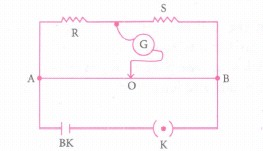
In a meter bridge, the balancing length is found to be 40 cm from end A. If the resistance of 10 \(\Omega \) is connected in series with R, balancing length is obtained 60 em from A. calculate the value R & S.
2.
The lengths & radii of three wires of the same metal in the radio 2: 3 : 4 & 3 : 4: 5 respectively. They are joined in parallel & included in a circuit having a 5 A current. Find current in each wire.
3.
A conductor of length I is connected to d.c. source of potential V. If the length of the conductor is doubled by treating it, keeping V constant, explain how do the following factors vary in the conductor
(i) Drift velocity.
(ii) Resistor
(iii) Resistivity.
4.
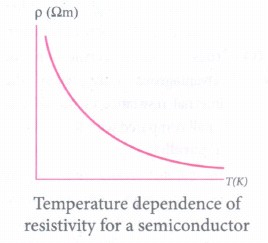
Explain the variation of resistivity of conductor and semiconductor with change in temperature.
5.
Calculate the effect internal resistance in series and parallel.
1.
According to Wheatstone bridge \(\cfrac { P }{ Q } =\cfrac { R }{ S } \)
\(\cfrac { R }{ S } =\cfrac { OA }{ OB } =\cfrac { 40 }{ 60 } \)
\(\cfrac { R }{ S } =\cfrac { OA }{ OB } =\cfrac { 40 }{ 60 } \)
If resistance 10 \(\Omega \) connected in series with R, the balance length is 60 cm.
\(\cfrac { R+10 }{ S } =\cfrac { 60 }{ 40 } \Rightarrow 2R+20=3S\)
From (1) & (2) \(\Rightarrow \left[ \cfrac { 4S }{ 3 } +20=3S \right] \)
45 + 60 = 95
55 = 60
\(S=\cfrac { 60 }{ 5 } =12\)
\(2\times \cfrac { 2S }{ 3 } +20=3S\)
\(s=12\Omega \)
From equation (1)
\(R=2\times \cfrac { 12 }{ 3 } =8\Omega \)
\(R=8\Omega \)
2.
Let R1, R2, R3be the resistance of the wires
Then \({ R }_{ 1 }:{ R }_{ 2 };R_{ 3 }=l\cfrac { 1_{ 1 } }{ { r }_{ 1 }^{ 2 } } :\cfrac { { l }_{ 2 } }{ { r }_{ 2 }^{ 2 } } :\cfrac { { l }_{ 3 } }{ { r }_{ 3 }^{ 2 } } =\cfrac { 2 }{ 9 } :\cfrac { 3 }{ 16 } ;\cfrac { 4 }{ 25 } \)
The ratio of the circuits in the three wires must be inverse of the above ratio \(\left[ \because I=\cfrac { V }{ R } i.eI\alpha \cfrac { I }{ R } \right] \)
\(\therefore { I }_{ 1 }:{ I }_{ 2 }:{ I }_{ 3 }=\cfrac { 9 }{ 2 } :\cfrac { 16 }{ 3 } :\cfrac { 25 }{ 4 } =54:64:75\)
As total current = 5A [54 + 64+ 75 = 193]
\(\therefore { I }_{ 1 }=\cfrac { 5\times 54 }{ 193 } =1.40;{ I }_{ 2 }=\cfrac { 5\times 64 }{ 193 } =1.66A\)
\({ I }_{ 3 }=\cfrac { 5\times 75 }{ 193 } =1.94A\)
3.
(i) Drift velocity \({ u }_{ d }=\cfrac { ev }{ ml } .\tau \)
When I am doubled, drift velocity, become \(\cfrac { 1 }{ 2 } \) times the original vd
(ii) Resistor \(R=\rho .\cfrac { l }{ A } \)
Resistor becomes doubled i.e. 2 times the original resistors.
(iii) Resistivity is not affected.
4.
(i) The resistivity of a material is dependent on temperature. The resistivity of a conductor increases with increase in temperature according to the expression
\({ \rho }_{ r }={ \rho }_{ 0 }[I+\alpha (T-{ T }_{ 0 })\)
(ii) Where PT is the resistivity of a conductor at ToC, is the resistivity of the conductor at some reference temperature To (usually at 20°C), and a is the temperature coefficient of resistivity.
(iii) It is defined as the ratio of increase in resistivity per degree rise in temperature to its resistivity at To
From equation (1), we can write
\({ \rho }_{ r }-{ \rho }_{ 0 }=\alpha { \rho }_{ 0 }(T-{ T }_{ 0 })\)
\(\therefore \alpha =\cfrac { { \rho }_{ r }-{ \rho }_{ 0 } }{ { \rho }_{ 0 }(T-{ T }_{ 0 }) } =\cfrac { \Delta \rho }{ { \rho }_{ 0 }\Delta T } \)
where \(\Delta \rho ={ \rho }_{ r }-{ \rho }_{ 0 }\) is change in resistivity for a change in temperature \(\Delta T=T-{ T }_{ 0 }\) Its unit is per oC \(\alpha \) of conductor:
(iv) For conductors a is positive. If the temperature of a conductor increases, the average kinetic energy of electrons in the conductor increases. This results in more frequent collisions and hence the resistivity increases.
(v) The graph of the Even though, the resistivity of conductors like metals varies linearly for wide range of temperatures, there also exists a nonlinear region at very low temperatures.
(vi) The resistivity approaches some finite values the temperature approaches absolute zero
(vii) As the resistance is directly proportional to the resistivity of the material, we can also write the resistance of a conductor at temperature T °C as
\({ R }_{ T }={ R }_{ 0 }\left[ 1+\left( T-{ T }_{ 0 } \right) \right] \)
\(\alpha =\cfrac { { R }_{ T }-{ R }_{ 0 } }{ { R }_{ 0 }\left( T-{ T }_{ 0 } \right) } =\cfrac { I }{ { R }_{ 0 } } \cfrac { \Delta R }{ \Delta T } \)
\(\alpha =\cfrac { I }{ { R }_{ 0 } } \cfrac { \Delta R }{ \Delta T } \)
where \(\Delta R={ R }_{ r }-{ R }_{ 0 }\) is the change in resistance during the change in temperature \(\Delta T=T-{ T }_{ 0 }\)
(viii) An of semiconductors For semiconductors, the resistivity decreases with increase in temperature. As the temperature increases, more electrons will be liberated from their atoms. Hence the current increases and therefore the resistivity decreases. A semiconductor with a negative temperature coefficient of resistance is called a thermistor.
5.
(i) Suppose n cells, each of emf volts and internal resistance r ohms are connected in series with an external resistance R as shown in Figure
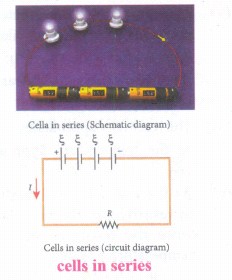
(ii) The total emf of the battery = nr
The total resistance in the circuit = nr + R
By Ohm's law, the current in the circuit is
\(I=\cfrac { total\ emf }{ total\ resistance } =\cfrac { n\xi }{ nr+5 } \)
Case (a) If r << R, then
\(I=\cfrac { n\xi }{ R } ={ nl }_{ 1 }\)
where II is the current due to a single cell
\(\left( { I }_{ 1 }=\cfrac { \xi }{ R } \right) \)
(iii) Thus, if r is negligible when compared to R the current supplied by the battery is n times that supplied by a single cell
Case (b) If >> R, \(I=\cfrac { n\xi }{ nr } =\cfrac { \xi }{ r } \)
(iv) It is the current due to a single cell. That is, current due to the whole battery is the same as that due to a single cell and hence there is no advantage in connecting several cells.
(v) Thus series connection of cells is advantageous only when the effective internal resistance of the cells is negligibly small compared with R. Cells in parallel
(i) In parallel connection all the positive terminals of the cells are connected to one point and all the negative terminals to a second point. These two points form the positive and negative terminals of the battery.
(ii) Let n cells be connected in parallel between the points A and B and a resistance R is connected between the points A and B as shown in Figure. Let be the emf and r the internal resistance of each cell.
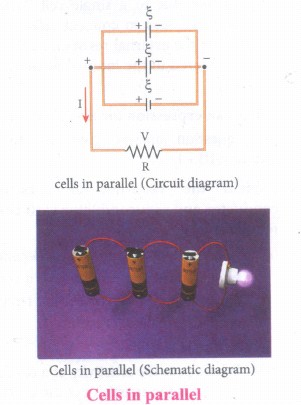
(iii) The equivalent internal resistance of the battery is \(\cfrac { 1 }{ { { r }_{ eq } } } =\cfrac { 1 }{ r } +\cfrac { 1 }{ r } +...\cfrac { 1 }{ r } (netrms)=\cfrac { n }{ r } \)
So \(\cfrac { 1 }{ { r }_{ eq } } =\cfrac { r }{ n } \) and the total resistance in the circuit = \(R+\cfrac { r }{ n } \) The total emf is the potential difference between the points A and B, which is equal to \(\xi \) The current in the circuit is given by
\(I=\cfrac { \xi }{ \frac { r }{ n } +R } \)
\(I=\cfrac { n\xi }{ r+nR } \)
Case (a) If >> R,\(I=\cfrac { n\xi }{ r } ={ nl }_{ 1 }\)
Case (b) If < \(I=\cfrac { \xi }{ R } \)
where II is the current due to a single cell and is equal to \(\cfrac { \xi }{ r } \) when R is negligible. Thus, the current through the external resistance due to the whole battery is n times the current due to a single cell.

12th Standard Syllabus & Materials
12th Standard
TN 12th Computer Applications களப்பெயர் முறைமை (DNS) Sample Question Papers Study Material - QB365 Set A
NEW12th Standard
TN 12th Computer Applications வலையமைப்பு எடுத்துக்காட்டுகள் மற்றும் நெறிமுறைகள் Sample Question Papers Study Material - QB365 Set A
NEW12th Standard
TN 12th Computer Applications கணினி வலையமைப்பு ஓர் அறிமுகம் Sample Question Papers Study Material - QB365 Set A
NEW12th Standard
TN 12th Computer Applications PHP-உடன் MySQL-ஐ இணைத்தல் Sample Question Papers Study Material - QB365 Set A



Tamilnadu Stateboard 12th Standard Subjects

Maths

Chemistry
Physics

Biology

Computer Science

Business Maths and Statistics

Economics

Commerce

Accountancy

History

Computer Applications
Biology
Computer Technology
Computer Applications
Computer Science
Business Maths and Statistics
Commerce
Economics
Maths
Chemistry
Physics
Computer Technology
History
Accountancy

Tamil

English

French
Tamilnadu Stateboard Standards



