
 100% FREE ACCESS
12th Standard Syllabus & Materials
12th Standard
TN 12th Computer Applications மின்னணு தரவு பரிமாற்றம் Sample Question Papers Study Material - QB365 Set A
NEW12th Standard
TN 12th Computer Applications மின் - வணிக பாதுகாப்பு அமைப்புகள் Sample Question Papers Study Material - QB365 Set A
NEW12th Standard
TN 12th Computer Applications மின்னணு செலுத்தல் முறைகள் Sample Question Papers Study Material - QB365 Set A
NEW12th Standard
TN 12th Computer Applications மின் - வணிகம் Sample Question Papers Study Material - QB365 Set A
NEW12th Standard
TN 12th Computer Applications திறந்த மூல கருத்துருக்கள் Sample Question Papers Study Material - QB365 Set A
NEW12th Standard
TN 12th Computer Applications வலையமைப்பு வடமிடல் Sample Question Papers Study Material - QB365 Set A

Published on: 13/05/2022
QB365 provides detailed and simple solution for every Book back Questions in class 12 Physics Subject. It will helps to get more idea about question pattern in every book back questions with solution.
latest Book back QuestionsDownload Tamil Nadu 12th Standard Physics question papers, model tests, one-mark questions, important questions, and public exam papers in PDF format. Free study materials and answer keys for TN State Board students.
Questions + Answers key
Take MCQ Physics Test1.
Explain why photoelectric effect cannot be explained on the basis of wave nature of light.
2.
Briefly explain the principle and working of electron microscope.
3.
4.
Obtain Einstein’s photoelectric equation with necessary explanation.
5.
For the photoelectric emission from cesium, show that wave theory predicts that
i) maximum kinetic energy of the photoelectrons (Kmax) depends on the intensity I of the incident light.
ii) Kmax does not depend on the frequency of the incident light and
iii) the time interval between the incidence of light and the ejection of photoelectrons is very long.
For the sake of simplicity, the following standard assumptions can be made when light is incident on the given material.
a) Light is absorbed in the top atomic layer of the metal
b) For a given element, each atom absorbs an equal amount of energy and this energy is proportional to its cross-sectional area A.
c) Each atom gives this energy to one of the electrons.
(Given: The work function for cesium is 2.14 eV and the power absorbed per unit area is 1.60 x 10⁻⁶ Wm-2 which produces a measurable photocurrent in cesium.)
1.
From Maxwell's theory we learnt that light is an electromagnetic wave consisting of coupled electric and magnetic oscillations that move with the speed of light and exhibit typical wave behaviour. Let us try to explain the experimental observations of photoelectric effect using wave picture of light.
(i) When light is incident on the target, there is a continuous supply of energy to the electrons in the metal surface.
(ii) According to wave theory, light of greater intensity should impart greater kinetic energy to the liberated electrons (Here, intensity of light is the energy delivered per unit area per unit time). But this does not happen. The experiments show that maximum kinetic energy of the photoelectrons does not depend on the intensity of the incident light.
(iii) According to wave theory, if a sufficiently intense beam of light is incident on the surface, electrons will be liberated from the surface of the target, however low the frequency of the radiation is. From the experiments, we know that photoelectric emission is not possible below a certain minimum frequency. Therefore, the wave theory fails to explain the existence of threshold frequency.
(iv) Since the energy of light is spread across the wavefront, the electrons which receive energy from it are large in number. Each electron needs considerable amount time (a few hours) to get energy sufficient to overcome the work function and to get liberated from the surface. But experiments show that photoelectric emission is almost instantaneous process (the time lag is less than 10-9 s after the surface is illuminated) which could not be explained by wave theory.
Thus, the experimental observations of photoelectric emission could not be explained on the basis of the wave theory of light.
2.
Principle:
(i) The wave nature of the electron is used in the construction of microscope called electron microscope.
(ii)The resolving power of a microscope is inversely proportional to the wavelength of the radiation used for illuminating the object under study.
(iii) Higher magnification as well as higher resolving power can be obtained by employing the waves of shorter wavelengths.
(iv) De Broglie's wavelength of electron is very much less than (a few thousand less) that of the visible light being used in optical microscopes.
(v) As a result, the microscopes employing de Broglie waves of electrons have very much higher resolving power than optical microscope.
(vi) Electron microscopes giving magnification more than 2,00,000 times are common in research laboratories.
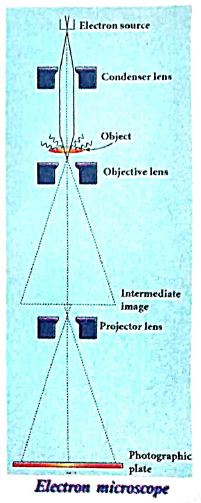
Working:
(i) The construction and working of an electron microscope is similar to that of an optical microscope except that in electron microscope focussing of electron beam is done by the electrostatic or magnetic lenses.
(ii) The electron beam passing across a suitably arranged either electric or magnetic fields undergoes divergence or convergence thereby focussing of the beam is done.
(iii) The electrons emitted from the source are accelerated by high potentials.
(iv) The beam is made parallel by magnetic condenser lens; When the beam passes through the sample whose magnified image is needed, the beam carries the image of the sample.
(v) With the help of magnetic objective lens and magnetic projector lens system, the magnified image is obtained on the screen. These electron microscopes are being used in almost all brands of science.
3.
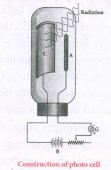
4.
(i) When a photon of energy hv is incident on a metal surface, it is completely absorbed by a single electron and the electron is ejected.
(ii) In this process, a part of the photon energy is used for the ejection of the electrons from the metal surface (photoelectric work function Φ0) and the remaining energy as the kinetic energy of the ejected electron. From the law of conservation of energy,
\(\\ \\ \\ hv=\phi { _{ 0 }+\cfrac { 1 }{ 2 } { mv }^{ 2 } }\) ......(1)
(iii) where m is the mass of the electron and v its velocity.
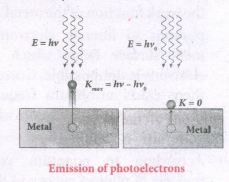
(iv) If we reduce the frequency of the incident light is reduced, the speed or kinetic energy of photo electrons is also reduced. At some frequency v0 of incident radiation, the photo electrons are ejected with almost zero kinetic energy.
Then the equation becomes.
\({ hv }_{ 0 }=\phi _{ 0 }\) ......(2)
(v) Where v0 is the threshold frequency. B rewriting the equation, we get
\(hv={ hv }_{ o }+\cfrac { 1 }{ 2 } { { mv }^{ 2 } }\) ......(3)
The equation is known as einstein's photoelectric equation.
(vi) If the electron does not lose energy by internal collisions, then it is emitted with maximum kinetic energy Kmax. Then
\({ K }_{ max }=\cfrac { 1 }{ 2 } { mv }^{ 2 }_{ max }\) ......(4)
(vii) where vmaxis the maximum velocity of max the electron ejected. The equation (1) is rearranged as follows:
\({ K }_{ max }=hv-{ \phi }_{ 0 }\)
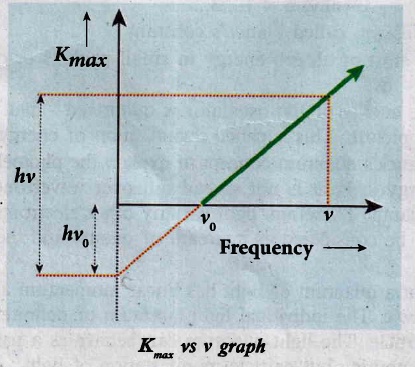
A graph between maximum kinetic energy Kmax of the photoelectron and frequency v of the incident light is a straight line.
5.
i) According to wave theory, the energy in a light wave is spread out uniformly and continuously over the wavefront.
The energy absorbed by each electron in time t is given by
E = IAt
With this energy absorbed, the most energetic electron is released with Kmax by overcoming the surface energy barrier or work function ϕ0 and this is expressed as
Kmax = IAt - ϕ0 (1)
Thus, wave theory predicts that for a unit time, at low light intensities when IA < ϕ0 no electrons are emitted. At higher intensities, when IA ≥ ϕ0, electrons are emitted. This implies that the higher the light intensity, the greater will be Kmax.
Kmax is dependent only on the intensity under given conditions - that is, by suitably increasing the intensity, one can produce a photoelectric effect even if the frequency is less than the threshold frequency. So the concept of threshold frequency does not even exist in wave theory.
ii) According to wave theory, the intensity of a light wave is proportional to the square of the amplitude of the electric field \(({ E }_{ 0 }^{ 2 })\). The amplitude of this electric field increases with increasing intensity and imparts an increasing acceleration and kinetic energy to an electron.
Now I is replaced with a quantity proportional to \(({ E }_{ 0 }^{ 2 })\) in equation (1). This means that Kmax should not depend at all on the frequency of the classical light wave which again contradicts the experimental results.
(iii) If an electron accumulates light energy just enough to overcome the work function, then it is ejected out of the atom with zero kinetic energy. Therefore, from equation (1),
0 = IAt - ϕ0
t = \(\frac { { \phi }_{ 0 } }{ IA } =\frac { \phi _{ 0 } }{ I(\pi r^{ 2 }) } \)
By taking the atomic radius r = 1.0 x 10⁻¹⁰ m and substituting the given values of I and ϕ0, we can estimate the time interval as
t = \(\frac { 2.14\times 1.6\times 10^{ -19 } }{ 1.60\times 10^{ -6 }\times 3.14\times (1\times 10^{ -10 })^{ 2 } } \)
= 0.68 x 10⁷ s ≈ 79 days.
Thus, wave theory predicts that there is a large time gap between the incidence of light and the ejection of photoelectrons but the experiments show that photoemission is an instantaneous process.

12th Standard Syllabus & Materials
12th Standard
TN 12th Computer Applications களப்பெயர் முறைமை (DNS) Sample Question Papers Study Material - QB365 Set A
NEW12th Standard
TN 12th Computer Applications வலையமைப்பு எடுத்துக்காட்டுகள் மற்றும் நெறிமுறைகள் Sample Question Papers Study Material - QB365 Set A
NEW12th Standard
TN 12th Computer Applications கணினி வலையமைப்பு ஓர் அறிமுகம் Sample Question Papers Study Material - QB365 Set A
NEW12th Standard
TN 12th Computer Applications PHP-உடன் MySQL-ஐ இணைத்தல் Sample Question Papers Study Material - QB365 Set A



Tamilnadu Stateboard 12th Standard Subjects

Maths

Chemistry
Physics

Biology

Computer Science

Business Maths and Statistics

Economics

Commerce

Accountancy

History

Computer Applications
Biology
Computer Technology
Computer Applications
Computer Science
Business Maths and Statistics
Commerce
Economics
Maths
Chemistry
Physics
Computer Technology
History
Accountancy

Tamil

English

French
Tamilnadu Stateboard Standards



