
 100% FREE ACCESS
12th Standard Syllabus & Materials
12th Standard
TN 12th Maths Applications of Matrices and Determinants Sample Question Papers Study Material - QB365 Set A
NEW12th Standard
TN 12th Computer Applications மின்னணு தரவு பரிமாற்றம் Sample Question Papers Study Material - QB365 Set A
NEW12th Standard
TN 12th Computer Applications மின் - வணிக பாதுகாப்பு அமைப்புகள் Sample Question Papers Study Material - QB365 Set A
NEW12th Standard
TN 12th Computer Applications மின்னணு செலுத்தல் முறைகள் Sample Question Papers Study Material - QB365 Set A
NEW12th Standard
TN 12th Computer Applications மின் - வணிகம் Sample Question Papers Study Material - QB365 Set A
NEW12th Standard
TN 12th Computer Applications திறந்த மூல கருத்துருக்கள் Sample Question Papers Study Material - QB365 Set A

Published on: 13/05/2022
QB365 provides detailed and simple solution for every Creative Questions in class 12 Physics Subject. It will helps to get more idea about question pattern in
every Creative questions with solution.
Download Tamil Nadu 12th Standard Physics question papers, model tests, one-mark questions, important questions, and public exam papers in PDF format. Free study materials and answer keys for TN State Board students.
Questions + Answers key
Take MCQ Physics Test1.
What is the phase difference between
(i) the voltage across L and C in an LCR circuit connected to an a.c source
(ii) applied a.c voltage and current in LCR circuit at resonance?
2.
Give and explain the mechanical analogy of LC oscillations by qualitative treatment.
3.
What is the phase relation between current and emf in an AC circuit containing a cpacitor only? Sketch a graph showing the variation the reactance of a capacitor with frequency.
4.
How does the capacitive reactance depend on frequency? & What is the reactance of a capacitor at hertz to the study at?
5.
What is Phasort and How to draw phasor diagram.
1.
(i) 1800 (or) π radian
(ii) Zero.
2.
(i) The electromagnetic oscillations of LC system can be compared with the mechanical oscillations of a spring-mass system.
(ii) There are two forms of energy involved in LC oscillations. One is electrical energy of the charged capacitor; the other magnetic energy of the inductor carrying current.
(iii) Likewise, the mechanical energy of the spring-mass system exists in two forms; the potential energy of the compressed or extended spring and the kinetic energy of the mass. The Table lists these two pairs of energy.
(iv) By examining, the analogies between the various quantities can be understood and these correspondences.
(v) The angular frequency of oscillations of a spring-mass is given by equation
\(\omega =\sqrt { \frac { k }{ m } } \)
k ⟶ \(\frac { 1 }{ C } \) and m ⟶ L. Therefore, the angular frequency of LC oscillations is given by
ω = \(\frac { 1 }{ \sqrt { LC } } \)
3.
Current lags behind the applied voltage by \(\frac{\pi}{2}\) in an inductive circuit.
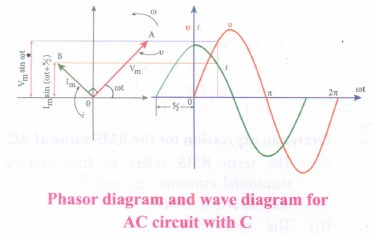
4.
Current leads the applied voltage by \(\frac{\pi}{2}\) in a capacitive circuit.
This is the resistance offered by the capacitor, called capacitive reactance (Xc). It measured in ohm.
\({ X }_{ c }=\frac { 1 }{ \omega C } \)
The capacitive reactance (Xc) varies inversely as the frequency. For a steady current, f = 0
∴\({ X }_{ c }=\frac { 1 }{ \omega C } -\frac { 1 }{ 2\pi fC } =\frac { 1 }{ 0 } =\infty \)
Thus a capacitive circuit offers infinite resistance to the steady current.
5.
Phasor: A sinusoidal alternating voltage (or current) can be represented by a vector that rotates about the origin in an anti-clockwise direction at a constant angular velocity ω. Such a rotating vector is called a phasor. A phasor is drawn in such a way that
(i) the length of the line segment equals the peak value Vm (or Im) of the alternating voltage (or current)
(ii) its angular velocity w is equal to the angular frequency of the alternating voltage (or current)
(iii) the projection of phasor on any vertical axis gives the instantaneous value of the alternating voltage (or current)
(iv) the angle between the phasor and the axis of reference (positive x-axis) indicates the phase of the alternating voltage (or current).
The notion of phasors is introduced to analyze the phase relationship between voltage and current in different AC circuits.
Phasor diagram
The diagram which shows various phasors and their phase relations is called the phasor diagram.

12th Standard Syllabus & Materials
12th Standard
TN 12th Computer Applications வலையமைப்பு வடமிடல் Sample Question Papers Study Material - QB365 Set A
NEW12th Standard
TN 12th Computer Applications களப்பெயர் முறைமை (DNS) Sample Question Papers Study Material - QB365 Set A
NEW12th Standard
TN 12th Computer Applications வலையமைப்பு எடுத்துக்காட்டுகள் மற்றும் நெறிமுறைகள் Sample Question Papers Study Material - QB365 Set A
NEW12th Standard
TN 12th Computer Applications கணினி வலையமைப்பு ஓர் அறிமுகம் Sample Question Papers Study Material - QB365 Set A



Tamilnadu Stateboard 12th Standard Subjects

Maths

Chemistry
Physics

Biology

Computer Science

Business Maths and Statistics

Economics

Commerce

Accountancy

History

Computer Applications
Biology
Computer Technology
Computer Applications
Computer Science
Business Maths and Statistics
Commerce
Economics
Maths
Chemistry
Physics
Computer Technology
History
Accountancy

Tamil

English

French
Tamilnadu Stateboard Standards



