
 100% FREE ACCESS
12th Standard Syllabus & Materials
12th Standard
TN 12th Computer Applications மின்னணு தரவு பரிமாற்றம் Sample Question Papers Study Material - QB365 Set A
NEW12th Standard
TN 12th Computer Applications மின் - வணிக பாதுகாப்பு அமைப்புகள் Sample Question Papers Study Material - QB365 Set A
NEW12th Standard
TN 12th Computer Applications மின்னணு செலுத்தல் முறைகள் Sample Question Papers Study Material - QB365 Set A
NEW12th Standard
TN 12th Computer Applications மின் - வணிகம் Sample Question Papers Study Material - QB365 Set A
NEW12th Standard
TN 12th Computer Applications திறந்த மூல கருத்துருக்கள் Sample Question Papers Study Material - QB365 Set A
NEW12th Standard
TN 12th Computer Applications வலையமைப்பு வடமிடல் Sample Question Papers Study Material - QB365 Set A

Published on: 13/05/2022
QB365 provides detailed and simple solution for every Creative Questions in class 12 Physics Subject. It will helps to get more idea about question pattern in
every Creative questions with solution.
Download Tamil Nadu 12th Standard Physics question papers, model tests, one-mark questions, important questions, and public exam papers in PDF format. Free study materials and answer keys for TN State Board students.
Questions + Answers key
Take MCQ Physics Test1.
The instantaneous current and voltage of an a.c circuit are given by i = 10 sin 314t A and V = 50 sin (314t + π/2)V. What is the power dissipation in the circuit?
2.
In an a.c circuit R = 4Ω; z = 5Ω, Vrms = 200V and Irms = 1.5A calculate the average power consumed over a full cycle.
3.
Explain the mutual induction between two long solenoids. Obtain an expression for the mutual inductance.
4.
Write the analogies between electrical and mechanical quantities
5.
Straight in LC oscillations, the sum of energies stored in capacitor & the inductors is constant in time.
1.
Phase difference between V and i = \(\frac{\pi}{2}\)red
∴ Paverage = \(\frac { { V }_{ m }{ I }_{ m } }{ 2 } \). cos Φ = \(\frac { 50\times 10 }{ 2 } \) cos 0o
2.
P Average = Vrms. Irms. cost
= Vrms. Irms. \(\frac{R}{z}\)
= 200 x 1.5 x \(\frac45\)
Paverage = 240W.
3.
(i) S1 and S2 are two long solenoids each length l. The solenoid S2 is wound closely over the solenoid S1.
(ii) N1 and N2 are the number of turns in the solenoids S1 and S2 respectively. Both the solenoids are considered to have the same area of cross-section A as they are closely wound together.
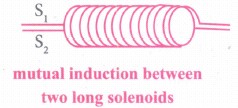
(iii) I1 is the current flowing through the solenoid S1 The magnetic field B1 produced at any point inside the solenoid S1 due to the current I1 is
\({ B }_{ 1 }={ \mu }_{ o }\frac { { N }_{ i } }{ l } { I }_{ 1 }\) ...(1)
(iv) The magnetic flux linked with each turn of S2 is equal to B1A.
Total magnetic flux linked with solenoid S2 having N2 turns is
Φ2 = \(\frac { { \mu }_{ o }{ N }_{ 1 }N_{ 2 }{ AI }_{ 1 } }{ l } \) ...(2)
But Φ2 = MI1 ...(3)
where M is the coefficient of mutual induction between S1 and S2
From equations (2) and (3),
MI1 = \(\frac { { \mu }_{ o }{ N }_{ 1 }N_{ 2 }{ AI }_{ 1 } }{ l } \); M = \(\frac { { \mu }_{ o }{ N }_{ 1 }N_{ 2 }A }{ l } \)
(v) If the core is filled with a magnetic material of permeability μ,
M = \(\frac { { \mu }_{ o }{ N }_{ 1 }N_{ 2 }A }{ l } \)
4.
|
Electrical system |
Mechanical system |
|---|---|
| Charge q | Displacement x |
| Current i = \(\frac { dq }{ dt } \) | Velocity v = \(\frac { dx }{ dt } \) |
| Inductance L | Mass m |
| Reciprocal of capacitance \(\frac { 1 }{ C } \) | Force constant k |
| Electrical energy = \(\frac { 1 }{ 2 } \left( \frac { 1 }{ C } \right) { q }^{ 2 }\) | Potential energy = \(\frac { 1 }{ 2 } k{ x }^{ 2 }\) |
| Magnetic energy = \(\frac { 1 }{ 2 } \) Li2 | Kinetic energy = \(\frac { 1 }{ 2 } \) mv2 |
| Electromagnetic energy = \(U=\frac { 1 }{ 2 } \left( \frac { 1 }{ C } \right) { q }^{ 2 }\) + \(\frac12\)Li2 | Mechanic energy E = \(\frac { 1 }{ 2 } k{ x }^{ 2 }\) + \(\frac { 1 }{ 2 } \) mv2 |
5.
(i) During LC oscillations in LC circuits, the energy of the system oscillates between the electric field of the capacitor and the magnetic field of the inductor.
(ii) Although these two forms of energy vary with time, the total energy remains constant. It means that LC oscillations take place in accordance with the law of conservation of energy.
Total energy, U= UE + UB = \(\frac { { q }^{ 2 } }{ 2C } +\frac { 1 }{ 2 } { Li }^{ 2 }\)
(iii) consider 3 different stages of LC oscillations and calculate the total energy of the system.
Case (i) When the charge in the capacitor, q Qm = and the current through the inductor, i = 0, the total energy is given by
\(U=\frac { { { Q }_{ m } }^{ 2 } }{ 2C } +0=\frac { { { Q }_{ m } }^{ 2 } }{ 2C } \)
The total energy is wholly electrical
Case (ii) When charge = 0; current = Im, the total energy is
\(U=0+\frac { 1 }{ 2 } { { Li }^{ 2 } }_{ m }=\frac { 1 }{ 2 } { { Li }^{ 2 } }_{ m }\)
\(=\frac { L }{ 2 } \times \left( \frac { { { Q }_{ m } }^{ 2 } }{ LC } \right) { Q }_{ m }\omega =\frac { { Q }_{ m } }{ \sqrt { LC } } \)
= \(\frac { { { Q }_{ m } }^{ 2 } }{ 2C } \)
Case (ii) When charge = 0 ; current = Im the total energy is
\(U=0+\frac { 1 }{ 2 } { { Li }^{ 2 } }_{ m }=\frac { 1 }{ 2 } { { Li }^{ 2 } }_{ m }\)
\(=\frac { L }{ 2 } \times \left( \frac { { { Q }_{ m } }^{ 2 } }{ LC } \right) \) since Im= \({ Q }_{ m }\omega =\frac { { Q }_{ m } }{ \sqrt { LC } } \)
= \(\frac { { { Q }_{ m } }^{ 2 } }{ 2C } \)
Case (iii) When charge = q; current = t. the total energy is
U = \(\frac { { q }^{ 2 } }{ 2C } +\frac { 1 }{ 2 } { Li }^{ 2 }\)
(iv) Since q = Qm = cos ωt, i = \(\frac { dq }{ dt } ={ Q }_{ m }=\omega \) sin ωt. The negative sign in current indicates that the charge in the capacitor decreases with time.
\(U=\frac { { { Q }_{ m } }^{ 2 }{ cos }^{ 2 }\omega t }{ 2C } +\frac { { { L{ \omega }^{ 2 }Q }_{ m } }^{ 2 }{ sin }^{ 2 }\omega t }{ 2 } \)
\(U=\frac { { { Q }_{ m } }^{ 2 }{ cos }^{ 2 }\omega t }{ 2C } +\frac { { { L{ \omega }^{ 2 }Q }_{ m } }^{ 2 }{ sin }^{ 2 }\omega t }{ 2LC } \)
since \({ \omega }^{ 2 }=\frac { 1 }{ LC } \)
= \(\frac { { { Q }_{ m } }^{ 2 } }{ 2C } { (cos }^{ 2 }\omega t+{ sin }^{ 2 }\omega t)\)
\(U=\frac { { { Q }_{ m } }^{ 2 } }{ 2C } \)
From the above three cases, it is clear that the total energy of the system remains constant.

12th Standard Syllabus & Materials
12th Standard
TN 12th Computer Applications களப்பெயர் முறைமை (DNS) Sample Question Papers Study Material - QB365 Set A
NEW12th Standard
TN 12th Computer Applications வலையமைப்பு எடுத்துக்காட்டுகள் மற்றும் நெறிமுறைகள் Sample Question Papers Study Material - QB365 Set A
NEW12th Standard
TN 12th Computer Applications கணினி வலையமைப்பு ஓர் அறிமுகம் Sample Question Papers Study Material - QB365 Set A
NEW12th Standard
TN 12th Computer Applications PHP-உடன் MySQL-ஐ இணைத்தல் Sample Question Papers Study Material - QB365 Set A



Tamilnadu Stateboard 12th Standard Subjects

Maths

Chemistry
Physics

Biology

Computer Science

Business Maths and Statistics

Economics

Commerce

Accountancy

History

Computer Applications
Biology
Computer Technology
Computer Applications
Computer Science
Business Maths and Statistics
Commerce
Economics
Maths
Chemistry
Physics
Computer Technology
History
Accountancy

Tamil

English

French
Tamilnadu Stateboard Standards



