
 100% FREE ACCESS
12th Standard Syllabus & Materials
12th Standard
TN 12th Computer Applications மின்னணு தரவு பரிமாற்றம் Sample Question Papers Study Material - QB365 Set A
NEW12th Standard
TN 12th Computer Applications மின் - வணிக பாதுகாப்பு அமைப்புகள் Sample Question Papers Study Material - QB365 Set A
NEW12th Standard
TN 12th Computer Applications மின்னணு செலுத்தல் முறைகள் Sample Question Papers Study Material - QB365 Set A
NEW12th Standard
TN 12th Computer Applications மின் - வணிகம் Sample Question Papers Study Material - QB365 Set A
NEW12th Standard
TN 12th Computer Applications திறந்த மூல கருத்துருக்கள் Sample Question Papers Study Material - QB365 Set A
NEW12th Standard
TN 12th Computer Applications வலையமைப்பு வடமிடல் Sample Question Papers Study Material - QB365 Set A

Published on: 01/06/2021
QB365 provides detailed and simple solution for every Book back Questions in class 12 Physics Subject. It will helps to get more idea about question pattern in every book back questions with solution.
Download Tamil Nadu 12th Standard Physics question papers, model tests, one-mark questions, important questions, and public exam papers in PDF format. Free study materials and answer keys for TN State Board students.
Questions + Answers key
Take MCQ Physics Test1.
Discuss briefly the experiment conducted by Hertz to produce and detect electromagnetic spectrum.
2.
Consider a parallel plate capacitor which is connected to an 230 V RMS value and 50 Hz frequency. If the separation distance between the plates of the capacitor and area of the plates are 1 mm and 20 cm2 respectively. Calculate the displacement current at t = 1 s.
3.
Explain the types of emission spectrum.
4.
5.
Write down Maxwell equations in integral form.
1.
i) Maxwell's prediction was experimentally confirmed by Heinrich Rudolf Hertz in 1888. The experimental set up used is shown in Figure.
ii) It consists of two metal electrodes which are made of small spherical metals. These are connected to larger spheres and the ends of them are connected to induction coil with very large number of turns. This is to produce very high electromotive force (emf).
iii) Since the coil is maintained at very high potential, air between the electrodes gets ionized and spark (spark means discharge of electricity) is produced.
iv) The gap between electrode (ring type - not completely closed and has a small gap in between) kept at a distance also gets spark. This implies that the energy is transmitted from electrode to the receiver (ring electrode) as a wave, known as electromagnetic waves.
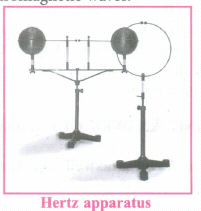
v) If the receiver is rotated by 90° - then no spark is observed by the receiver. This confirms that electromagnetic waves are transverse waves as predicted by Maxwell.
vi) Hertz detected radio waves and also computed the speed of radio waves which is equal to the speed of light (3 x 10⁸m S-1).
2.
Potential difference between the plates of the capacitor,
\(V=V_{\max } \sin 2 \pi f t\)
\(=230 \sqrt{2} \sin (2 \pi \times 50 t)\)
\(\therefore V=325 \sin 100 \pi t\)
d = 1 mm = 1 x 10⁻³ m
A = 20 cm2 = 20 x 10–4 m2
Displacement current, \(i_{d}=\epsilon_{0} \frac{d \Phi_{E}}{d t}=\epsilon_{\circ} \frac{d(\mathrm{EA})}{d t}\)
\(\therefore i_{d}=\frac{\epsilon_{0} A}{d}\left[\frac{d V}{d t}\right] \quad\left[\because E=\frac{V}{d}\right]\)
\(=\frac{\epsilon_{0} A}{d}(325)(100 \pi) \cos 100 \pi t\)
\(=\left(\begin{array}{l} 8.85 \times 10^{-12} \times 20 \times 10^{-4} \times 325 \\ \times 100 \times 3.14 \times \cos (100 \pi \times 1) \end{array}\right) /\left(1 \times 10^{-3}\right)\)
\(\begin{aligned}=1.81 \times 10^{-6} \mathrm{~A}=1.81 \mu \mathrm{A}[\because \cos (100 \pi \times 1)=1] \end{aligned}\)
3.
Emission spectra:
When the spectrum of self luminous source is taken, we get emission spectrum. Each source has its own characteristic emission spectrum. The emission spectrum can be divided into three types:
(i) Continuous emission spectra (or continuous spectra) :
(a) If the light from incandescent lamp (filament bulb) is allowed to pass through prism (simplest spectroscope), it splits into seven colours.
(b) Thus, it consists of wavelengths containing all the visible colours ranging from violet to red (in the figure). Examples: spectrum obtained from carbon arc, incandescent solids.
(ii) Line emission spectrum (or line spectrum) :
(a) Suppose light from hot gas is allowed to pass through a prism, line spectrum is observed. Line spectra are also known as discontinuous spectra. The line spectra consists of sharp lines of definite wavelengths or frequencies.
(b) Such spectra arise due to excited atoms of elements. These lines are the characteristics of the element and are different for different elements. Examples: spectra of atomic hydrogen, helium, etc.
(iii) Band emission spectrum (or band spectrum) :
(a) Band spectrum consists of several number of very closely spaced spectral lines which overlapped together forming specific bands which are separated by dark spaces.
(b) This spectrum has a sharp edge at one end and fades out at the other end. Such spectra arise when the molecules are excited.
(c) Band spectrum is the characteristic of the molecule hence, the structure of the molecules can be studied using their band spectra. Examples, spectra of hydrogen gas, ammonia gas in the discharge tube, etc.
4.
5.
MaxWell's equations in integral form
i) Gauss law in electricity, \(\oint _s\vec{E} \vec{d} A=\frac{Q_{\text {enclosed }}}{\varepsilon_{o}}\)
ii) Gauss law in magnetism \(\oint _s \vec{B} \cdot \vec{d} A=0\)
iii) Faraday's law \(\oint_l \vec E. \vec {d l}=-\frac{d \phi _B}{d t}\)
iv) Ampere-Maxwell's law \(\oint_l \vec {B}. \vec {d l}=\mu_{o} i_c+\mu_{o} \varepsilon_{o} \frac{d}{d t} \oint_s \vec{E} \cdot {d} \vec A\)

12th Standard Syllabus & Materials
12th Standard
TN 12th Computer Applications களப்பெயர் முறைமை (DNS) Sample Question Papers Study Material - QB365 Set A
NEW12th Standard
TN 12th Computer Applications வலையமைப்பு எடுத்துக்காட்டுகள் மற்றும் நெறிமுறைகள் Sample Question Papers Study Material - QB365 Set A
NEW12th Standard
TN 12th Computer Applications கணினி வலையமைப்பு ஓர் அறிமுகம் Sample Question Papers Study Material - QB365 Set A
NEW12th Standard
TN 12th Computer Applications PHP-உடன் MySQL-ஐ இணைத்தல் Sample Question Papers Study Material - QB365 Set A



Tamilnadu Stateboard 12th Standard Subjects

Maths

Chemistry
Physics

Biology

Computer Science

Business Maths and Statistics

Economics

Commerce

Accountancy

History

Computer Applications
Biology
Computer Technology
Computer Applications
Computer Science
Business Maths and Statistics
Commerce
Economics
Maths
Chemistry
Physics
Computer Technology
History
Accountancy

Tamil

English

French
Tamilnadu Stateboard Standards



