
 100% FREE ACCESS
12th Standard Syllabus & Materials
12th Standard
TN 12th Computer Applications மின்னணு தரவு பரிமாற்றம் Sample Question Papers Study Material - QB365 Set A
NEW12th Standard
TN 12th Computer Applications மின் - வணிக பாதுகாப்பு அமைப்புகள் Sample Question Papers Study Material - QB365 Set A
NEW12th Standard
TN 12th Computer Applications மின்னணு செலுத்தல் முறைகள் Sample Question Papers Study Material - QB365 Set A
NEW12th Standard
TN 12th Computer Applications மின் - வணிகம் Sample Question Papers Study Material - QB365 Set A
NEW12th Standard
TN 12th Computer Applications திறந்த மூல கருத்துருக்கள் Sample Question Papers Study Material - QB365 Set A
NEW12th Standard
TN 12th Computer Applications வலையமைப்பு வடமிடல் Sample Question Papers Study Material - QB365 Set A

Published on: 13/05/2022
QB365 provides detailed and simple solution for every Book back Questions in class 12 Physics Subject. It will helps to get more idea about question pattern in every book back questions with solution.
latest Book back QuestionsDownload Tamil Nadu 12th Standard Physics question papers, model tests, one-mark questions, important questions, and public exam papers in PDF format. Free study materials and answer keys for TN State Board students.
Questions + Answers key
Take MCQ Physics Test1.
Explain the formation of depletion region and barrier potential in PN junction diode.
2.
Fiber optic communication is gaining popularity among the various transmission media -justify.
3.
Give the applications of lCT in mining and agriculture sectors.
4.
Explain the ground wave propagation and space wave propagation of electromagnetic waves through space.
5.
Explain the ampitude modulation with necessary diagrams.
1.
i) Formation of depletion layer
(i) A single piece of semiconductor crystal is suitably doped such that its one side is p-type semiconductor and the other side is n-type semiconductor.
(ii) The contact surface between the two sides is called p-n junction. Whenever p-n junction is formed, some of the free electrons diffuse from the n-side to the p-side while the holes from the P-Side to the n-side.
(iii) The diffusion of charge carriers happens due to the fact that the n-side has higher electron concentration and the p-side has higher hole concentration.
(iv) The diffusion of the majority charge carriers across the junction gives rise to an electric current, called diffusion current.
(v) When an electron leaves the n-side, a pentavalent atom in the n-side becomes a positive ion.
(vi) The free electron migrating into p-side recombines with a hole present in a trivalent atom near the junction and the trivalent atom becomes a negative ion. Since such ions are bonded to the neighbouring atoms in the crystal lattice, they are unable to move.
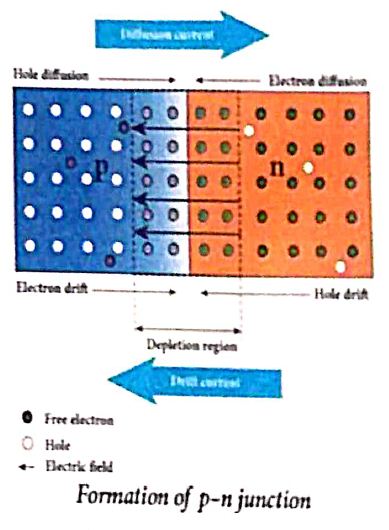
(vii) As the diffusion process continues, a laver of positive ions and a layer of negative ions are created on either side of the junction accordingly.
(viii) The thin region near the junction which is free from charge carriers (free electrons and holes) is called depletion region.
(ix) An electric field is set up between the positively charged layer in the n-side and the negatively charged layer in the p-side in the depletion region.
(x) This electric field makes electrons in the p-side drift into the n-side and the holes in the n-side into the p-side.
(xi) The electric current produced due to the motion of the minority charge carriers by the electric field is known as drift current. The diffusion current and drift current flow in opposite directions.
(xii) Though drift current is less than diffusion current initially, equilibrium is reached between them at a particular time.
(xiii) With each electron (or hole) diffusing across the junction, the strength of the electric field increases thereby increasing the drift current till the two currents become equal
(xiv)Hence at equilibrium, there is no net electric current across the junction. Thus, a p-n junction is formed.
ii) Junction potential or barrier potential
.JPG)
(i) The movement of charge carriers across the junction takes place only to a certain point beyond which the depletion layer acts like a barrier to further diffusion of free charges across the junction.
(ii) This is due to the fact that the immobile ions on both sides establish an electric potential difference across the junction.
(iii) Therefore, an electron trying to diffuse into the interior of the depletion region encounters a wall of negative ions repelling it backwards.
(iv) If the free electron has enough energy, it can break through the wall and enter into the p-region, where it can recombine with a hole and create another negative ion.
(v) The strength of the electric potential difference across the depletion region keeps on increasing with the crossing of each electron until equilibrium is reached, at this point, the internal repulsion of the depletion layer stops further diffusion of free electrons across the junction.
(vi) The difference in potential across the depletion layer is called the barrier potential (Vb).
(vii) At 25°C, this barrier potential is approximately 0.7 V for silicon and 0.3 V for germanium.
2.
Fiber optic communication:
(i) The method of transmitting information from one place to another in terms of light pulses through an optical fiber is called fiber optic communication. It works on the principle of total internal reflection.
Applications:
(ii) Optical fiber system has a number of applications namely, international communication, inter-city communication, data links, plant and traffic control and defense applications.
(iii) Fiber cables are very thin and weigh lesser than copper cables.
(iv) This system has much larger band width. This means that its information carrying capacity is larger.
(v) Fiber optic system is immune to electrical interferences.
(vi) Fiber optic cables are cheaper than copper cables.
3.
a) Agriculture:
The implementation of information and communication technology (lCT) in agriculture sector enhances productivity, improves the living standards of farmers and overcomes the challenges and risk factors.
i) Increasing food productivity and farm management.
ii) To optimize the use of water; seeds and fertilizers etc.
iii) Sophisticated technologies that include robots, temperature and moisture sensors, aerial images, and GPS technology can be used.
iv) Geographic information systems are extensively used in farming to decide the suitable place for the species to be planted.
b) Fisheries:
i) Satellite vessel monitoring system helps to identify fishing zones
ii) Use of barcodes helps to identify time and date of catch, species name, quality of fish
c) Mining:
i) ICT in mining improves operational efficiency, remote monitoring, and disaster locating system.
ii) Information and communication technology provide audio-visual warnings to the trapped underground miners.
iii) It helps 10 connect remote sites.
4.
a) Ground wave propagation:
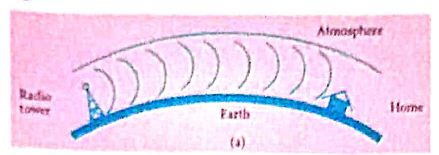
i) If the electromagnetic waves transmitted by the transmitter glide over the surface of the Earth to reach the receiver, then the propagation is called ground wave propagation.
ii) The corresponding waves are called ground waves or surface waves.
iii) Both transmitting and receiving antennas must be close to the Earth's surface.
iv) It is used in local broadcasting, radio navigation, for ship-to-ship, ship-to-shore communication and mobile communication.
b) Space wave propagation:
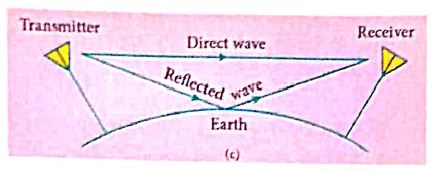
i) The process of sending and receiving information signal through space is called space wave communication.
ii) The frequency range for this mode of propagation is above 30 MHz to 400 GHz.
iii) These waves travel in a straight line from the transmitter to the receiver. Hence, it is used for a line of sight (LOS) communication.
iv) Television telecast, satellite communication and RADAR type of communication are based on space wave propagation
v) Range or distance (d) of coverage of propagation depends on height (h) of the antenna given by the equation d = \(\sqrt{2hR}\) where R is radius of the earth, which is R = 6400 km.
5.
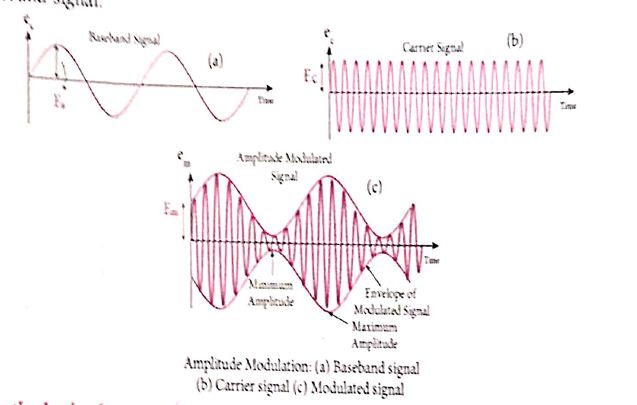
(i) If the amplitude of the carrier signal is modified according to the instantaneous amplitude of the baseband signal, then it is called amplitude modulation Here the frequency and the phase, of the carrier signal remain constant. Amplitude modulation is used in radio and TV broadcasting.
(ii) The signal shown in Figure (a) is the baseband signal that carries information. Figure(b) show the high-frequency carrier signal and Figure (c) gives amplitude modulated signal. We can see that amplitude of the carrier wave is modified in proportion to the amplitude or the baseband signal.

12th Standard Syllabus & Materials
12th Standard
TN 12th Computer Applications களப்பெயர் முறைமை (DNS) Sample Question Papers Study Material - QB365 Set A
NEW12th Standard
TN 12th Computer Applications வலையமைப்பு எடுத்துக்காட்டுகள் மற்றும் நெறிமுறைகள் Sample Question Papers Study Material - QB365 Set A
NEW12th Standard
TN 12th Computer Applications கணினி வலையமைப்பு ஓர் அறிமுகம் Sample Question Papers Study Material - QB365 Set A
NEW12th Standard
TN 12th Computer Applications PHP-உடன் MySQL-ஐ இணைத்தல் Sample Question Papers Study Material - QB365 Set A



Tamilnadu Stateboard 12th Standard Subjects

Maths

Chemistry
Physics

Biology

Computer Science

Business Maths and Statistics

Economics

Commerce

Accountancy

History

Computer Applications
Biology
Computer Technology
Computer Applications
Computer Science
Business Maths and Statistics
Commerce
Economics
Maths
Chemistry
Physics
Computer Technology
History
Accountancy

Tamil

English

French
Tamilnadu Stateboard Standards



