
 100% FREE ACCESS
12th Standard Syllabus & Materials
12th Standard
TN 12th Maths Applications of Matrices and Determinants Sample Question Papers Study Material - QB365 Set A
NEW12th Standard
TN 12th Computer Applications மின்னணு தரவு பரிமாற்றம் Sample Question Papers Study Material - QB365 Set A
NEW12th Standard
TN 12th Computer Applications மின் - வணிக பாதுகாப்பு அமைப்புகள் Sample Question Papers Study Material - QB365 Set A
NEW12th Standard
TN 12th Computer Applications மின்னணு செலுத்தல் முறைகள் Sample Question Papers Study Material - QB365 Set A
NEW12th Standard
TN 12th Computer Applications மின் - வணிகம் Sample Question Papers Study Material - QB365 Set A
NEW12th Standard
TN 12th Computer Applications திறந்த மூல கருத்துருக்கள் Sample Question Papers Study Material - QB365 Set A

Published on: 13/05/2022
QB365 provides detailed and simple solution for every Creative Questions in class 12 Physics Subject. It will helps to get more idea about question pattern in
every Creative questions with solution.
Download Tamil Nadu 12th Standard Physics question papers, model tests, one-mark questions, important questions, and public exam papers in PDF format. Free study materials and answer keys for TN State Board students.
Questions + Answers key
Take MCQ Physics Test1.
Write the applications of mobile communication.
2.
For a BJT circuit shown, assume that the 'β' of the transistor is very large and VBE= 0.7 V. The mode of operation.
3.
For a BJT, the common - base current gain α = 0.98 and the collector base junction reverse bias saturation ICU = 0.6μA. This BJT is connected in the common emitter mode and operated in the active region with a base drive current ID= 20 μA. The collector current IC for this mode of operating is
4.
Write any two distinguishing features between Insulators, Metals and semiconductors and insulators an the basis of energy band diagrams.
5.
Explain and classify transistor as an oscillator.
1.
(i) It is used for personal communication and cellular phones offer voice and data connectivity with high speed.
(ii) Transmission of news across the globe is done within a few seconds.
(iii) Using Internet of Things (UIT), it is made possible to control various devices from a single device. Example: home automation using a mobile phone.
(iv) It enables smart classrooms, online availability of notes, monitoring student activities etc. in the field of education.
2.
VBE =0.7V
Input junction is a forward biased.
Since,
VBE = 0.7V
VCE = VBE+ VCB
VCB = VCE-VBE
To determine VCB we find IC
\({ I }_{ C }\cong { I }_{ C }\frac { 2-{ V }_{ BE } }{ { R }_{ 2 } } =\frac { 2-0.7 }{ 1k\Omega } \)
IC = 1.3mA
VCE = VCC - IC (R1 + R2)
= 10 - 1.3mA (10K + 1K)
VCE = - 4.3 V
VCE =-4.3V-0.7
VCB = - 5V
3.
α = 0.98
ICu = 0.6 μA
\(\alpha =\frac { \beta }{ 1+\beta } \)
(or)
\(0.98=\frac { 1 }{ \frac { 1 }{ \beta } +1 } \)
β = 49
ICEO = (1 + β)ICBO
= (1 + 49) x 0.6μA
ICEO = 30 μA
= (1 + 49) x 0.6 μA
ICEO = 30 μA
IC = βIB+ ICEO
= 49 x 20 μA + 30 μA
IC = 1.01 mA
4.
Insulators:
(i) The valence band and the conduction band are separated by a large energy gap.
(ii) The forbidden energy gap is approximately 6 eV in insulators.
(iii) The gap is very large that electrons from valence band cannot move into conduction band even on the application of strong external electric field or the increase in temperature.
Metals
(i) In metals, the valence band and conduction band overlap.
(ii) Hence, electrons can move freely into the conduction band which results in a large number of free electrons in the conduction band.
Semiconductors
(i) In semiconductors, there exists a narrow forbidden energy gap (E < 3eV) between - g the valence band and the conduction band.
(ii) Free electrons are small in number, the conductivity of the semiconductors is not as high as that of the conductors.
5.
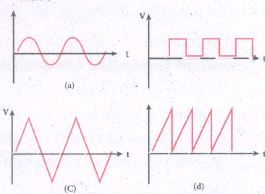
(i) An oscillator basically converts de energy into ac energy of high frequency ranging from a few Hz to several MHz.
(ii) There are two types of oscillators
a) Sinusoidal
b) Non-sinusoidal.
(iii) Sinusoidal oscillators generate oscillations in the form of sine wave at constant amplitude and frequency.
(iv) Non-sinusoidal oscillators generate complex non-sinusoidal waveforms like square wave, Triangular - wave or Sawtooth -wave
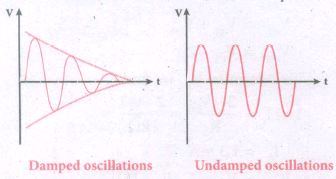
(v) Sinusoidal oscillations can be of two types:
a) Damped
b) undamped.
(vi) If the amplitude of the electrical oscillations decreases with time due to energy loss, is called damped oscillations
(vii) The amplitude of the electrical oscillations remains constant with time in undamped oscillations.

12th Standard Syllabus & Materials
12th Standard
TN 12th Computer Applications வலையமைப்பு வடமிடல் Sample Question Papers Study Material - QB365 Set A
NEW12th Standard
TN 12th Computer Applications களப்பெயர் முறைமை (DNS) Sample Question Papers Study Material - QB365 Set A
NEW12th Standard
TN 12th Computer Applications வலையமைப்பு எடுத்துக்காட்டுகள் மற்றும் நெறிமுறைகள் Sample Question Papers Study Material - QB365 Set A
NEW12th Standard
TN 12th Computer Applications கணினி வலையமைப்பு ஓர் அறிமுகம் Sample Question Papers Study Material - QB365 Set A



Tamilnadu Stateboard 12th Standard Subjects

Maths

Chemistry
Physics

Biology

Computer Science

Business Maths and Statistics

Economics

Commerce

Accountancy

History

Computer Applications
Biology
Computer Technology
Computer Applications
Computer Science
Business Maths and Statistics
Commerce
Economics
Maths
Chemistry
Physics
Computer Technology
History
Accountancy

Tamil

English

French
Tamilnadu Stateboard Standards



