
 100% FREE ACCESS
12th Standard Syllabus & Materials
12th Standard
TN 12th Computer Applications மின்னணு தரவு பரிமாற்றம் Sample Question Papers Study Material - QB365 Set A
NEW12th Standard
TN 12th Computer Applications மின் - வணிக பாதுகாப்பு அமைப்புகள் Sample Question Papers Study Material - QB365 Set A
NEW12th Standard
TN 12th Computer Applications மின்னணு செலுத்தல் முறைகள் Sample Question Papers Study Material - QB365 Set A
NEW12th Standard
TN 12th Computer Applications மின் - வணிகம் Sample Question Papers Study Material - QB365 Set A
NEW12th Standard
TN 12th Computer Applications திறந்த மூல கருத்துருக்கள் Sample Question Papers Study Material - QB365 Set A
NEW12th Standard
TN 12th Computer Applications வலையமைப்பு வடமிடல் Sample Question Papers Study Material - QB365 Set A

Published on: 13/05/2022
QB365 provides detailed and simple solution for every Book back Questions in class 12 Physics Subject. It will helps to get more idea about question pattern in every book back questions with solution.
latest Book back QuestionsDownload Tamil Nadu 12th Standard Physics question papers, model tests, one-mark questions, important questions, and public exam papers in PDF format. Free study materials and answer keys for TN State Board students.
Questions + Answers key
Take MCQ Physics Test1.
Obtain Gauss law from Coulomb’s law.
2.
Obtain an expression for potential energy due to a collection of three point charges which are separated by finite distances.
3.
Explain dielectrics in detail and how an electric field is induced inside a dielectric.
4.
Discuss the various properties of conductors in electrostatic equilibrium.
5.
Obtain the expression for electric field due to an charged infinite plane sheet.
1.
Gauss law:
(i) A positive point charge Q is surrounded by an imaginary sphere of radius r as shown in Figure. then the total electric flux through the closed surface of the sphere is
\(\Phi_E =\oint { \vec { E } .d\vec { A } =\oint { Ed } Acos\theta } \) .....(1)
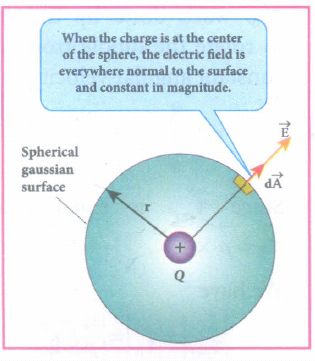
(ii) The electric field of the point charge is directed radially outward at all points on the surface of the sphere. Therefore, the direction of the area element \(d\vec { A } \) is along the electric field \(\vec { E } \) and θ = 0o.
\(\\ \Phi_E =\oint { EdA } \) Since cos0o = 1 ......(2)
iii) E is uniform on the surface of the sphere,
\(\\ \Phi_E=E\oint { dA } \) .......(3)
Substituting for \(\oint { dA=4{ \pi r }^{ 2 } } \) and \(E=\frac { 1 }{ 4\pi { \varepsilon }_{ 0 } } \frac { Q }{ { r }^{ 2 } } \) in eqn (3), we get
\(\therefore \phi E=4{ \pi r }^{ 2 }E\)
\({ \phi }_{ E }=\frac { 1 }{ 4\pi { \varepsilon }_{ 0 } } \frac { Q }{ { r }^{ 2 } } \times { 4\pi r }^{ 2 }=4\pi \frac { 1 }{ 4\pi { \varepsilon }_{ 0 } } Q\)
\({ \phi }_{ E }=\frac { Q }{ { \varepsilon }_{ 0 } } \) .....(4)
The equation (4) is called as Gauss's law.
2.
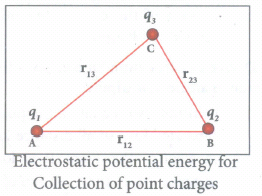
To calculate the total electrostatic potential energy, we use the following procedure. We bring all the charges one by one and arrange them according to the configuration as shown in Figure.
a) Bringing a charge q1 from infinity to the point A requires no work, because there are no other charges already present in the vicinity of charge q1.
b) To bring the second charge q2 to the point B, work must be done against the electric field created by the charge q1. So the work done on the charge q2 is W = q2 V1B. Here V1B is the electrostatic potential due to the charge q1 at point B.
\(U_I=\frac{1}{4\piε_o}\frac{q_1q_2}{r_{12}}\) .....(1)
Note that the expression is same when q2 is brought first and then q1 later.
c) Similarly to bring the charge q3 to the point C, work has to be done against the total electric field due to both the charges q1 and q2. So the work done to bring the charge q3 = q3 (V1C + V2C). Here V1C is the electrostatic potential due to charge q1 at point C and V2C is the electrostatic potential due to charge q2 at point C.
The electrostatic potential is
\(U_{II}=\frac{1}{4\piε_o}(\frac{q_1q_2}{r_{13}}+\frac{q_2q_3}{r_{23}})\) .....(2)
d) Adding equations (1) and (3), the total electrostatic potential energy for the system of three charges q1, q2 and q3 is
U = UI + UII
\(U=\frac{1}{4\piε_o}(\frac{q_1q_2}{r_{12}}+\frac{q_2q_3}{r_{13}}+\frac{q_2q_3}{r_{23}})\) ....(3)
3.
Dielectrics or insulators:
(a) A dielectric is a non-conducting material and has no free electrons. The electrons in a dielectric are bound within the atoms Example : Ebonite, glass and mica are some examples of dielectrics.
(b) A dielectric is made up of either polar molecules or non-polar molecules.
Non-polar molecules:
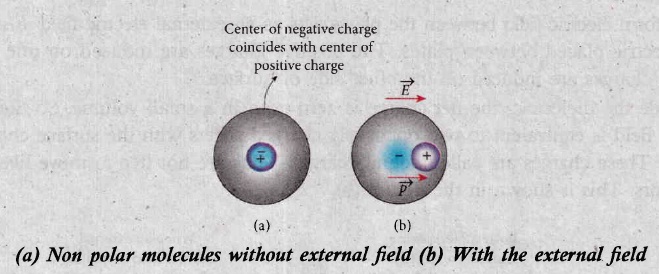
(a) A non-polar molecule is one in which centers of positive and negative charges coincide. As a result, it has no permanent dipole moment. Examples of non-polar molecules are hydrogen (H2), oxygen (O2) and carbon dioxide (CO2) etc.
(b) When an external electric field is applied, the centres of positive and negative charges are separated by a small distance which induces dipole moment in the direction of the external electric field. Then the dielectric is said to be polarized by an external electric field. This is shown in Figure.
Polar molecules
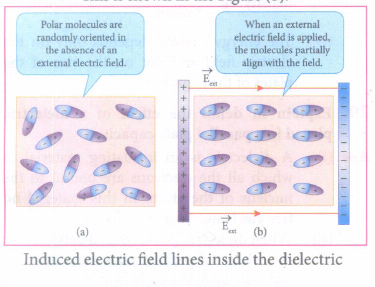
(a) In polar molecules, the centres of the positive and negative charges are separated even in the absence of an external electric field. They have a permanent dipole moment. Due to thermal motion, the direction of each dipole moment is oriented randomly (Figure (a)). Hence the net dipole moment is zero in the absence of an external electric field. Examples of polar molecules are H2O, N2O, HCl, NH3.
(b) When an external electric field is applied, the dipoles inside the polar molecule tend to align in the direction of the electric field. Hence a net dipole moment is induced in it. Then the dielectric is said to be polarized by an external electric field (Figure (b).
.jpg)
Polarisation:
(a) In the presence of an external electric field, the dipole moment is induced in the dielectric material. Polarisation P is defined as the total dipole moment per unit volume of the dielectric. For most dielectrics (linear isotropic), the Polarisation is directly proportional to the strength of the external electric field. This is written as
\(\vec{P}=\chi_{e} \vec{E}_{e x t}\) .....(2)
where \(\chi_{e}\) is a constant called the electric susceptibility which is a characteristic of each dielectric.
Induced Electric Field inside the dielectric:
(i) When an external electric field is applied on a conductor, the charges are aligned in such a way that an internal electric field is created which cancels the external electric field. But in the case of a dielectric, which has no free electrons, the external electric field only realigns the charges so that an internal electric field is produced.
(ii) The magnitude of the internal electric field is smaller than that of external electric field. Therefore the net electric field inside the dielectric is not zero but is parallel to an external electric field with magnitude less than that of the external electric field.
For example let us consider a rectangular dielectric slab placed between two oppositely charged plates (capacitor) as shown in the Figure (c).
(iii) The uniform electric field between the plates acts as an external electric field \(\vec { E } \)ext which polarizes the dielectric placed between plates. The positive charges are induced on one side surface and negative charges are induced on the other side of surface.
(iv) But inside the dielectric, the net charge is zero even in a small volume. So the dielectric in the external field is equivalent to two oppositely charged sheets with the surface charge densities +σb and -σb. These charges are called bound charges. They are not free to move like free electrons in conductors. This is shown in the Figure (c).
(v) For example, the charged balloon after rubbing sticks onto a wall. The reason is that the negatively charged balloon is brought near the wall, it polarizes induces opposite charges on the surface of the wall, which attracts the balloon.
4.
A conductor at electrostatic equilibrium has the following properties:
(i) The electric field is zero everywhere inside the conductor. This is true regardless of whether the conductor is solid or hollow:
(a) This is an experimental fact. Suppose the electric field is not zero inside the metal, then there will be a force on the mobile charge carriers due to this electric field.
(b) As a result, there will be a net motion of the mobile charges, which contradicts the conductors being in electrostatic equilibrium. Thus the electric field is zero everywhere inside the conductor. We can also understand this fact by applying an external uniform electric field on the conductor.
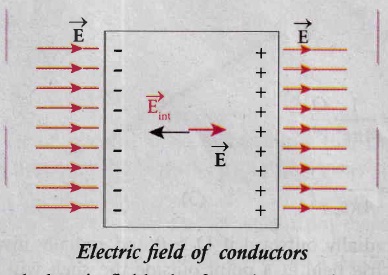
(c) Before applying the external electric field, the free electrons in the conductor are uniformly distributed in the conductor. When an electric field is applied, the free electrons accelerate to the left causing the left plate to be negatively charged and the right plate to be positively charged as shown in Figure.
(d) Due to this realignment of free electrons, there will be an internal electric field created inside the conductor which increases until it nullifies the external electric field.
(e) Once the external electric field is nullified the conductor is said to be in electrostatic equilibrium. The time taken by a conductor to reach electrostatic equilibrium is in the order of 10-16 s, which can be taken as almost instantaneous.
(ii) There is no net charge inside the conductors. The charges must reside only on the surface of the conductors:
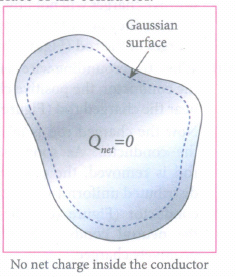
(a) We can prove this property using Gauss law. Consider an arbitrarily shaped conductor as shown in Figure. A Gaussian surface is drawn the conductor such that it is very close to the surface of the conductor.
(b) Since the electric field is zero everywhere inside the conductor, the net electric flux is also zero over this Gaussian surface. From Gauss's law, this implies that there is no net charge inside the conductor.
(c) Even if some charge is introduced inside the conductor, it immediately reaches the surface of the conductor.
(iii) The electric field outside the conductor is perpendicular to the surface of the conductor and has a magnitude of \(\frac { \sigma }{ { \varepsilon }_{ 0 } } \) is the surface charge density at that point:
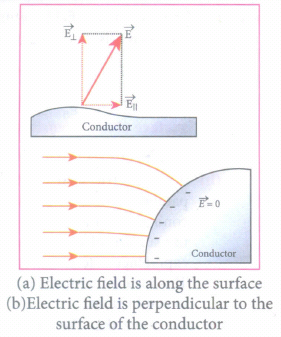
(a) If the electric field has components parallel to the surface of the conductor, then free electrons on the surface of the conductor would experience acceleration (Figure a).
(b) This means that the conductor is not in equilibrium. Therefore at electrostatic equilibrium, the electric field must be perpendicular to the surface of the conductor. This is shown in Figure (b).
(c) We now prove that the electric field has magnitude \(\frac { \sigma }{ { \varepsilon }_{ 0 } } \) just outside the conductor's surface.
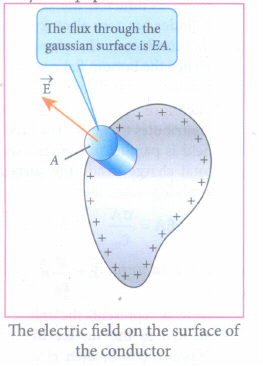
(d) Consider a small cylindrical Gaussian surface, as shown in the Figure. One-half of this cylinder is embedded inside the conductor.
(e) Since electric field is normal to the surface of the conductor, the curved part of the cylinder has zero electric flux.
(f) Also inside the conductor, the electric field is zero. Hence the bottom flat part of the Gaussian surface has no electric flux.
(g) Therefore the top flat surface alone contributes to the electric flux. The electric field is parallel to the area vector and the total charge inside the surface is σA. By applying Gaus's law,
\(EA=\frac { \sigma A }{ { \varepsilon }_{ 0 } } \)
In vector form, \(\vec { E } =\frac { \sigma }{ { \varepsilon }_{ 0 } } \hat { n } \) ....(1)
(h) Where \(\hat { n } \) represents the unit vector outward normal to the surface of the conductor. Suppose \(\sigma\) < 0, then electric field points inward perpendicular to the surface.
(iv) The electrostatic potential has the same value on the surface and inside of the conductor :
(a) We know that the conductor has no parallel electric component on the surface which means that charges can be moved on the surface without doing any work.
(b) This is possible only if the electrostatic potential is constant at all points on the surface and there is no potential difference between any two points on the surface.
(c) Since the electric field is zero inside the conductor, the potential is the same as the surface of the conductor. Thus at electrostatic equilibrium, the conductor is always at equipotential.
5.
Electric field due to charged infinite plane sheet:
(i) Consider an infinite plane sheet of charges with uniform surface charge density σ. (Charge per unit area). Let P be a point at a distance of r from the sheet as shown in the Figure.
(ii) Since the plane is infinitely large, the electric field should be same at all points equidistant from the plane and radially directed outward at all points. A cylindrical-shaped Gaussian surface of length 2r and two flat surfaces is chosen such that the infinite plane sheet passes perpendicularly through the middle part of the Gaussian surface.
Total electric flux linked with the cylindrical surface,
\({ \phi }_{ E }=\int { \vec { E } .d\vec { A } } \)
\(=\int _{ Curved\ surface }^{ }{ \vec { E } .d\vec { A } } +\int _{ P }^{ }{ \vec { E } .d\vec { A } + } \int _{ P^{'} }^{ }{ \vec { E } .d\vec { A } } =\frac { { Q }_{ encl } }{ { \varepsilon }_{ 0 } } \quad ...(1)\)
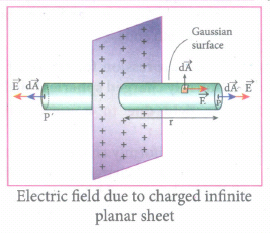
(iii) The electric field is perpendicular to the area element at all points on the curved surface and is parallel to the surface areas at P and P ' (Figure). Then, applying Gauss's law.
\({ \phi }_{ E }=\int _{ p }^{ }{ EdA+ } \int _{ p' }^{ }{ EdA= } \frac { { Q }_{ encl } }{ { \varepsilon }_{ 0 } } \quad ...(2)\)
Since the magnitude of the electric field at these two equal flat surfaces is uniform, E is taken out of the integration and Qncel is given by Qencl = σA, we get
\(2E\int _{ p }^{ }{ dA=\frac { \sigma A }{ { \varepsilon }_{ 0 } } } \)
The total area of surface either at P or P'
\(\int _{ p }^{ }{ dA=A } \)
Hence \(2EA=\frac { \sigma A }{ { \varepsilon }_{ 0 } }\) or \(E=\frac { \sigma }{ 2{ \varepsilon }_{ 0 } } \quad \quad \quad \quad ...(3)\)
In vector \(\vec { E } =\frac { \sigma }{ 2{ \varepsilon }_{ 0 } } \hat { n } \quad \quad \quad \quad ...(4)\)
(iv) Here \(\hat { n } \) is the outward unit vector normal to the plane. Note that the electric field due to an infinite plane sheet of charge depends on the surface charge density and is independent of the distance r.
(v) The electric field will be the same at any point farther away from the charged plane.
(vi) Equation (4) implies that if σ > 0 the electric field at any point P is outward perpendicular \(\hat { n } \) to the plane and if σ < 0 the electric field points inward perpendicularly (\(-\hat { n } \)) to the plane.

12th Standard Syllabus & Materials
12th Standard
TN 12th Computer Applications களப்பெயர் முறைமை (DNS) Sample Question Papers Study Material - QB365 Set A
NEW12th Standard
TN 12th Computer Applications வலையமைப்பு எடுத்துக்காட்டுகள் மற்றும் நெறிமுறைகள் Sample Question Papers Study Material - QB365 Set A
NEW12th Standard
TN 12th Computer Applications கணினி வலையமைப்பு ஓர் அறிமுகம் Sample Question Papers Study Material - QB365 Set A
NEW12th Standard
TN 12th Computer Applications PHP-உடன் MySQL-ஐ இணைத்தல் Sample Question Papers Study Material - QB365 Set A



Tamilnadu Stateboard 12th Standard Subjects

Maths

Chemistry
Physics

Biology

Computer Science

Business Maths and Statistics

Economics

Commerce

Accountancy

History

Computer Applications
Biology
Computer Technology
Computer Applications
Computer Science
Business Maths and Statistics
Commerce
Economics
Maths
Chemistry
Physics
Computer Technology
History
Accountancy

Tamil

English

French
Tamilnadu Stateboard Standards



