
 100% FREE ACCESS
12th Standard Syllabus & Materials
12th Standard
TN 12th Maths Applications of Matrices and Determinants Sample Question Papers Study Material - QB365 Set A
NEW12th Standard
TN 12th Computer Applications மின்னணு தரவு பரிமாற்றம் Sample Question Papers Study Material - QB365 Set A
NEW12th Standard
TN 12th Computer Applications மின் - வணிக பாதுகாப்பு அமைப்புகள் Sample Question Papers Study Material - QB365 Set A
NEW12th Standard
TN 12th Computer Applications மின்னணு செலுத்தல் முறைகள் Sample Question Papers Study Material - QB365 Set A
NEW12th Standard
TN 12th Computer Applications மின் - வணிகம் Sample Question Papers Study Material - QB365 Set A
NEW12th Standard
TN 12th Computer Applications திறந்த மூல கருத்துருக்கள் Sample Question Papers Study Material - QB365 Set A

Published on: 01/06/2021
QB365 provides detailed and simple solution for every Book back Questions in class 12 Physics Subject. It will helps to get more idea about question pattern in every book back questions with solution.
Download Tamil Nadu 12th Standard Physics question papers, model tests, one-mark questions, important questions, and public exam papers in PDF format. Free study materials and answer keys for TN State Board students.
Questions + Answers key
Take MCQ Physics Test1.
Calculate the number of electrons in one coulomb of negative charge.
2.
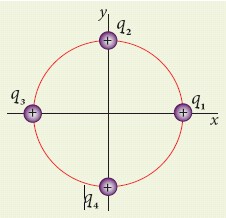
Consider four equal charges q1, q2, q3 and q4 = q = +1 μC located at four different points on a circle of radius 1m, as shown in the figure. Calculate the total force acting on the charge q1 due to all the other charges.
3.
Calculate the electrostatic force and gravitational force between the proton and the electron in a hydrogen atom. They are separated by a distance of 5.3 x 10⁻¹¹ m. The magnitude of charges on the electron and proton are 1.6 x 10⁻¹⁹ C. Mass of the electron is me = 9.1 x 10⁻³¹ kg and mass of proton is mp = 1.6 x 10⁻²⁷ kg.
4.
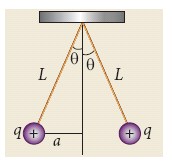
Two small-sized identical equally charged spheres, each having mass 1 g are hanging in equilibrium as shown in the figure. The length of each string is 10 cm and the angle θ is 30° with the vertical. Calculate the magnitude of the charge in each sphere. (Take g = 10 ms−2)
5.
Consider two point charges q1 and q2 at rest as shown in the figure.
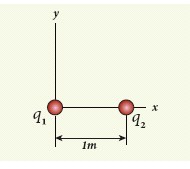
They are separated by a distance of 1m. Calculate the force experienced by the two charges for the following cases:
(a) q1 = +2μC and q2 = +3μC
(b) q1 = +2μC and q2 = -3μC
(c) q1= +2μC and q2 = -3μC kept in water (εr = 80)
1.
According to the quantisation of charge
q = ne
Here q = 1C. So the number of electrons in 1 coulomb of charge is
n = \(\frac { q }{ e } =\frac { 1C }{ 1.6\times 10^{ -19 } } \) = 6.25 x 10¹⁸ electrons
2.
According to the superposition principle, the total electrostatic force on charge q1 is the vector sum of the forces due to the other charges,
\(\vec { { F }_{ 1 }^{ tot } } =\bar { { F }_{ 12 } } +\bar { { F }_{ 13 } } +\bar { F_{ 14 } } \)
The following diagram shows the direction of each force on the charge q1.
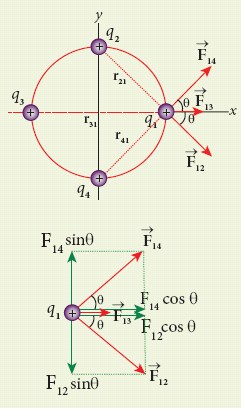
The charges q2 and q4 are equi-distant from q1. As a result the strengths (magnitude) of the forces \(\vec { { F }_{ 12 } } \) and \(\vec { { F }_{ 14 } } \) are the same even though their directions are different. Therefore the vectors representing these two forces are drawn with equal lengths. But the charge q3 is located farther compared to q2 and q4. Since the strength of the electrostatic force decreases as distance increases, the strength of the force \(\vec { { F }_{ 13 } } \) is lesser than that of forces \(\vec { { F }_{ 12 } } \) and \(\vec { { F }_{ 14 } } \). Hence the vector representing the force \(\vec { { F }_{ 13 } } \) is drawn with smaller length compared to that for forces \(\vec { { F }_{ 12 } } \) and \(\vec { { F }_{ 14 } } \).
From the figure, r21 =\(\sqrt { 2 } \) m = r41 and r31 = 2m
The magnitudes of the forces are given by
F13 = \(\frac { kq^{ 2 } }{ r_{ 31 }^{ 2 } } =\frac { 9\times 10^{ 9 }\times 10^{ -12 } }{ 4 } \)
F13 = 2.25 x 10⁻³ N
F12 = \(\frac { kq^{ 2 } }{ r_{ 31 }^{ 2 } } ={ F }_{ 14 }=\frac { 9\times 10^{ 9 }\times 10^{ -12 } }{ 2 } \)
= 4.5 x 10⁻³N
From the figure, the angle θ = 450. In terms of the components, we have
\(\vec { { F }_{ 12 } } ={ F }_{ 12 }cos\theta \hat { i } -{ F }_{ 12 }sin\theta \hat { j } \)
= 4.5 x 10⁻³ x \(\frac { 1 }{ \sqrt { 2 } } \hat { i-4.5\times { 10 }^{ -3 }\times \frac { 1 }{ \sqrt { 2 } } \hat { j } } \)
\(\vec { { F }_{ 13 } } =F_{ 13 }\hat { i } \) = 2.25 x 10⁻³ N\(\hat { i } \)
\(\vec { { F }_{ 14 } } ={ F }_{ 14 }cos\theta \hat { i } +{ F }_{ 14 }sin\theta \hat { j } \)
= 4.5 x 10⁻³ x \(\frac { 1 }{ \sqrt { 2 } } \hat { i+4.5\times { 10 }^{ -3 }\times \frac { 1 }{ \sqrt { 2 } } \hat { j } } \)
Then the total force on q1 is,
\(\vec { { F }_{ 1 }^{ tot } }={ (F }_{ 12 }cos\theta \hat { i } -{ F }_{ 12 }sin\theta \hat { j } )+{ F }_{ 13 }\hat { i } +{ (F }_{ 14 }cos\theta \hat { i } +{ F }_{ 14 }sin\theta \hat { j } )\)
\(\vec { { F }_{ 1 }^{ tot } } =({ F }_{ 12 }cos\theta +F_{13}+{ F }_{ 14 }cos\theta )\hat { i } +(-{ F }_{ 12 }sin\theta +{ F }_{ 14 }sin\theta )\)\(\hat { j } \)
Since F12 = F14, the j th component is zero.
Hence we have
\(\vec { { F }_{ 1 }^{ tot } } =({ F }_{ 12 }cos\theta +F_{13}+{ F }_{ 14 }cos\theta )\hat { i } \)
substituting the values in the above equation,
\(\left( \frac { 4.5 }{ \sqrt { 2 } } +2.25+\frac { 4.5 }{ \sqrt { 2 } } \right) \times10^{-3}\hat { i }=(4.5\sqrt { 2 } +2.25)\times 10^{-3}\hat { i } \)
\(\vec { { F }_{ 1 }^{ tot } } \) = 8.61 x 10⁻³ N\(\hat { i } \)
The resultant force is along the positive x-axis.
3.
The proton and the electron attract each other. The magnitude of the electrostatic force between these two particles is given by
\(F_e=\frac { ke^{ 2 } }{ { r }^{ 2 } } =\frac { 9\times 10^{ 9 }\times (1.6\times 10^{ -19 })^{ 2 } }{ (5.3\times 10^{ -11 })^{ 2 } } \)
=\(\frac { 9\times 2.56 }{ 28.09 } \) x 10-7 = 8.2 x 10⁻⁸ N
The gravitational force between the proton and the electron is attractive. The magnitude of the gravitational force between these particles is
FG = \(\frac { G{ m }_{ e }{ m }_{ p } }{ { r }^{ 2 } } \)
= \(\frac { 6.67\times 10^{ -11 }\times 9.1\times 10^{ -31 }\times 1.6\times 10^{ -27 } }{ (5.3\times 10^{ -11 })^{ 2 } } \)
= \(\frac { 97.11 }{ 28.09 } \) x 10-47 = 3.4 x 10-47N
The ratio of the two forces \(\frac { { F }_{ e } }{ F_{ G } } =\frac { 8.2\times 10^{ -8 } }{ 3.4\times 10^{ -47 } } \)
= 2.41 x 1039
Note that Fe ≈ 1039 FG
The electrostatic force between a proton and an electron is enormously greater than the gravitational force between them. Thus the gravitational force is negligible when compared with the electrostatic force in many situations such as for small size objects and in the atomic domain. This is the reason why a charged comb attracts an uncharged piece of paper with greater force even though the piece of paper is attracted downward by the Earth. This given figure is shown in below.
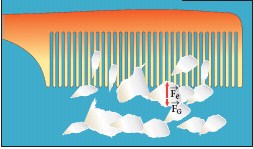
Electrostatic attraction between a comb and pieces of papers
4.
If the two spheres are neutral, the angle between them will be 0o when hanged vertically. Since they are positively charged spheres, there will be a repulsive force between them and they will be at equilibrium with each other at an angle of 30° with the vertical. At equilibrium, each charge experiences zero net force in each direction. We can draw a free-body diagram for one of the charged spheres and apply Newton’s second law for both vertical and horizontal directions.
The free-body diagram is shown below
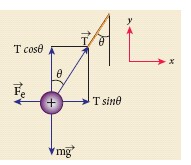
In the x-direction, the acceleration of the charged sphere is zero.
Using Newton’s second law \((\vec { { F }_{ tot }= } m\vec { a } )\), we have
T sinθ\(\hat { i } \) - Fe\(\hat { i } \) =0
T sinθ = Fe ......(1)
Here T is the tension acting on the charge due to the string and Fe is the electrostatic force between the two charges.
In the y-direction also, the net acceleration experienced by the charge is zero
Tcosθ\(\hat { j } \) - mg\(\hat { j } \) = 0
Tcosθ = mg ..(2)
By dividing equation (1) by equation (2),
tanθ = \(\frac { { F }_{ e } }{ mg } \) .....(3)
Since they are equally charged, the magnitude of the electrostatic force is
\({ F }_{ e }=k\frac { { q }^{ 2 } }{ { r }^{ 2 } } \) where k=\(\frac { 1 }{ 4\pi { \varepsilon }_{ 0 } } \)
Here r = 2a = 2Lsinθ. By substituting these values in equation (3),
tanθ = k\(\frac { { q }^{ 2 } }{ mg(2Lsin\theta )^{ 2 } } \) ..........(4)
Rearranging the equation (4) to get q
q = 2 Lsinθ\(\\ \sqrt { \frac { mgtan\theta }{ k } } \)
= 2 x 0.1 x sin 30o x \(\sqrt { \frac { 10^{ -3 }\times 10\times { tan30 }^{ 0 } }{ 9\times 10^{ 9 } } } \)
q = 8.01 x 10⁻⁸C = 80.1 nC
5.
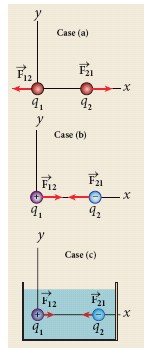
(a) q1 = +2 μC, q2 = +3 μC, and r = 1m. Both are positive charges. so the force will be repulsive.
Force experienced by the charge q2 due to q1 is given by
\(\vec { { F }_{ 21 } } =\frac { 1 }{ 4\pi { \varepsilon }_{ 0 } } \frac { { q }_{ 1 }{ q }_{ 2 } }{ { r }^{ 2 } } \hat { r_{ 12 } } \)
Here \(\hat { r_{ 12 } } \) is the unit vector from q1 to q2. Since q2 is located on the right of q1, we have
\(\hat { r_{ 12 } } =\hat { i } \), and \(\frac { 1 }{ 4\pi { \varepsilon }_{ 0 } }=9 \times10^9\) so that
\(\vec { { F }_{ 21 } } =\frac { 9\times 10^{ 9 }\times 2\times 10^{ -6 }\times 3\times 10^{ -6 } }{ 1^{ 2 } } \hat { i } \)
= 54 x 10-3 N\(\hat { i } \)
According to Newton’s third law, the force experienced by the charge q1 due to q2 is \(\vec { { F }_{ 12 } } =-\vec { { F }_{ 21 } } \) Therefore,
\(\vec { F_{ 12 } } \)= 54 x 10-3 N\(\hat { i } \)
The directions of \(\vec { { F }_{ 21 } } \) and \(\vec { { F }_{ 12 } } \) are shown in the figure (case (b)).
(b) q1 = +2 μC, q2 = –3 μC, and r = 1m. They are unlike charges. So the force will be attractive.
Force experienced by the charge q2 due to q1 is given by
\( \vec{F}_{21} =\frac{9 \times 10^{9} \times\left(2 \times 10^{-6}\right) \times\left(-3 \times 10^{-6}\right)}{1^{2}} \hat{r}_{12} \)
\(=-54 \times 10^{-3} \mathrm{~N} \hat{i}\left(\mathrm{Using} \hat{r}_{12}=\hat{i}\right)\)
The charge q2 will experience an attractive force towards q1 which is in the negative x direction.
According to Newton’s third law, the force experienced by the charge q1 due to q2 is \(\vec{F}_{12}=-\vec{F}_{21}\) Therefore,
\(\vec{F}_{12}=54 \times 10^{-3} \widehat{i} \mathrm{~N}\)
The directions of \(\vec{F}_{21} \text { and } \vec{F}_{12}\) are shown in the figure (case (b)).
(c) If these two charges are kept inside the water, then the force experienced by q2 due to q1
\(\vec { { F }_{ 21 }^{ W } } =\frac { 1 }{ 4\pi { \varepsilon }_{ 0 } } \frac { { q }_{ 1 }{ q }_{ 2 } }{ { r }^{ 2 } } \hat { r_{ 12 } } \)
since ε = εrε0,
we have \(\vec { { F }_{ 21 }^{ W } } =\frac { 1 }{ 4\pi { { \varepsilon }_{ r }\varepsilon }_{ 0 } } \frac { { q }_{ 1 }{ q }_{ 2 } }{ { r }^{ 2 } } \hat { r_{ 12 } } =\frac { \vec { F_{ 21 } } }{ { \varepsilon }_{ r } } \)
Therefore,
\(\vec { { F }_{ 21 }^{ W } } =\frac { 54\times { 10 }^{ -3 }N }{ 80 } \hat { i } \) = -0.675 x 10⁻³ N\(\hat { i } \)

12th Standard Syllabus & Materials
12th Standard
TN 12th Computer Applications வலையமைப்பு வடமிடல் Sample Question Papers Study Material - QB365 Set A
NEW12th Standard
TN 12th Computer Applications களப்பெயர் முறைமை (DNS) Sample Question Papers Study Material - QB365 Set A
NEW12th Standard
TN 12th Computer Applications வலையமைப்பு எடுத்துக்காட்டுகள் மற்றும் நெறிமுறைகள் Sample Question Papers Study Material - QB365 Set A
NEW12th Standard
TN 12th Computer Applications கணினி வலையமைப்பு ஓர் அறிமுகம் Sample Question Papers Study Material - QB365 Set A



Tamilnadu Stateboard 12th Standard Subjects

Maths

Chemistry
Physics

Biology

Computer Science

Business Maths and Statistics

Economics

Commerce

Accountancy

History

Computer Applications
Biology
Computer Technology
Computer Applications
Computer Science
Business Maths and Statistics
Commerce
Economics
Maths
Chemistry
Physics
Computer Technology
History
Accountancy

Tamil

English

French
Tamilnadu Stateboard Standards



