
 100% FREE ACCESS
12th Standard Syllabus & Materials
12th Standard
TN 12th Maths Applications of Matrices and Determinants Sample Question Papers Study Material - QB365 Set A
NEW12th Standard
TN 12th Computer Applications மின்னணு தரவு பரிமாற்றம் Sample Question Papers Study Material - QB365 Set A
NEW12th Standard
TN 12th Computer Applications மின் - வணிக பாதுகாப்பு அமைப்புகள் Sample Question Papers Study Material - QB365 Set A
NEW12th Standard
TN 12th Computer Applications மின்னணு செலுத்தல் முறைகள் Sample Question Papers Study Material - QB365 Set A
NEW12th Standard
TN 12th Computer Applications மின் - வணிகம் Sample Question Papers Study Material - QB365 Set A
NEW12th Standard
TN 12th Computer Applications திறந்த மூல கருத்துருக்கள் Sample Question Papers Study Material - QB365 Set A

Published on: 18/06/2021
QB365 provides detailed and simple solution for every Creative Questions in class 12 Physics Subject. It will helps to get more idea about question pattern in
every Creative questions with solution.
Download Tamil Nadu 12th Standard Physics question papers, model tests, one-mark questions, important questions, and public exam papers in PDF format. Free study materials and answer keys for TN State Board students.
Questions + Answers key
Take MCQ Physics Test1.
Define and derive an expression for the energy density in parallel plate capacitor.
2.
What is dielectrics or insulators.
3.
Deduce electric flus for closed surfaces.
4.
How is electric flux is related to electric field.
5.
Define potential difference and derive.
1.
Energy stored in the capacitor
\(U=\frac { 1 }{ 2 } { Cv }^{ 2 }\quad \quad ...(1)\)
This is rewritten as using \(C=\frac { { \varepsilon }_{ 0 }A }{ d } \& Ed=V\)
\(U=\frac { 1 }{ 2 } \left( \frac { { \varepsilon }_{ 0 }A }{ d } \right) { (Ed })^{ 2 }=\frac { 1 }{ 2 } { \varepsilon }_{ 0 }(Ad)\quad { E }^{ 2 }...(2)\)
where Ad = volume of the space between the capacitor plates. The energy stored per unit volume of space is defined as energy density \({ U }_{ E }=\frac { U }{ Volume } \) From equation (4),
We get
\({ u }_{ E }=\frac { 1 }{ 2 } { \varepsilon }_{ 0 }{ E }^{ 2 }\quad \quad \quad \quad \quad ...(3)\)
(iv) The energy density depends only on the electric field and not on the size of the plates of the capacitor.
2.
(i) A dielectric is a non-conducting material and has no free electrons. The electrons in a dielectric are bound within the atoms. Ebonite, glass and mica are some examples of dielectrics.
(ii) When an external electric field is applied, the electrons are not free to move anywhere but they are realigned in a specific way. A dielectric is made up of either polar molecules or non-polar molecules.
3.
(i) A closed surface is present in the region of the non-uniform electric field as shown in Figure (a). The total electric flux over this closed surface is written as
\({ \Phi }_{ E }=\oint { \overset { \rightarrow }{ E } } .d\overset { \rightarrow }{ A } \quad \quad \quad \quad ...(1)\)
(ii) Note the difference between equations \({ \Phi }_{ E }=\int { \overset { \rightarrow }{ E } . } d\overset { \rightarrow }{ A } \) and (1). The integration in equation (1) is a closed surface integration and for each areal element, the outward normal is the direction of d\(\overset { \rightarrow }{ A } \) as shown in the Figure (b).
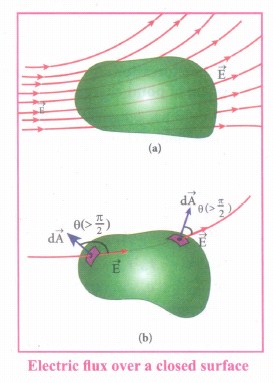
(iii) The total electric flux over a closed surface can be negative, positive or zero. In the Figure (b), it is shown that in one area element, the angle between d\(\overset { \rightarrow }{ A } \) and \(\overset { \rightarrow }{ E } \) is less than 90°, then the electric flux is positive and in another areal element, the angle between d\(\overset { \rightarrow }{ A } \) and \(\overset { \rightarrow }{ E } \) is greater than 90°, then the electric flux is negative.
(iv) In general, the electric flux is negative if the electric field lines enter the closed surface and positive if the electric field lines leave the closed surface.
4.
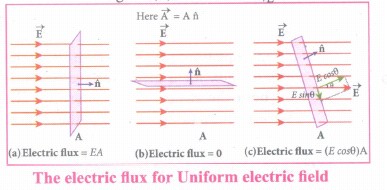
(i) Consider a uniform electric field in a region of space. Let us choose an area A normal to the electric field lines as shown in Figure (a). The electric flux for this case is
ΦE = EA ...(1)
(ii) Suppose the same area A is kept parallel to the uniform electric field, then no electric field lines pierce through the area A , as shown in Figure (b). The electric flux for this case is zero.
ΦE = 0 ...(2)
(iii) If the area is inclined at an angle 8 with the field, then the component of the electric field perpendicular to the area alone contributes to the electric flux. The electric field component parallel to the surface area will not contribute to the electric flux. This is shown in Figure (c). For this case, the electric flux
ΦE = (E cos θ) A ....(3)
(iv) Further, θ is also the angle between the electric field and the direction normal to the area. Hence in general, for uniform electric field, the electric flux is defined as
\({ \Phi }_{ E }=\overset { \rightarrow }{ E } .\overset { \rightarrow }{ A } \)= EA cos θ
Here, note that \(\overset { \rightarrow }{ A } \) is the area vector \(\overset { \rightarrow }{ A } \)= A\(\hat{n}\)
(v) Its magnitude is simply the area A and the direction is along the unit vector \(\hat{n}\) perpendicular to the area as shown in Figure. Using this definition for flux \({ \Phi }_{ E }=\overset { \rightarrow }{ E } .\overset { \rightarrow }{ A } \), equations (1) and (2) can be obtained as special cases.
In Figure (a), θ = 0° so\({ \Phi }_{ E }=\overset { \rightarrow }{ E } .\overset { \rightarrow }{ A } \) = EA
In Figure (b),θ = 90o so \({ \Phi }_{ E }=\overset { \rightarrow }{ E } .\overset { \rightarrow }{ A } \)= 0
5.
(i) The potential energy difference per unit charge is given by
\(\frac { \Delta U }{ q' } =\frac { q'\int _{ R }^{ P }{ (-\overset { \rightarrow }{ E } ) } .d\overset { \rightarrow }{ r } }{ q' } =\int _{ R }^{ P }{ \overset { \rightarrow }{ E } } .d\overset { \rightarrow }{ r } \quad ...(1)\)
(ii) The above equation (1) is independent of q'. The quantity \(\frac { \Delta U }{ q' } =\int _{ R }^{ P }{ \overset { \rightarrow }{ E } } .d\overset { \rightarrow }{ r } \) is called electric potential difference between P and R and is denoted as VP - VR = ∆V.
(iii) In other words the electric potential difference is also defined as the work done by an external force to bring unit positive charge from point R to point P.
\({ V }_{ p }-{ V }_{ R }=\Delta V=\int _{ R }^{ P }{ \overset { \rightarrow }{ E } } .d\overset { \rightarrow }{ r } \)
(iv) The electric potential energy difference can be written as ∆U = q' ∆V.

12th Standard Syllabus & Materials
12th Standard
TN 12th Computer Applications வலையமைப்பு வடமிடல் Sample Question Papers Study Material - QB365 Set A
NEW12th Standard
TN 12th Computer Applications களப்பெயர் முறைமை (DNS) Sample Question Papers Study Material - QB365 Set A
NEW12th Standard
TN 12th Computer Applications வலையமைப்பு எடுத்துக்காட்டுகள் மற்றும் நெறிமுறைகள் Sample Question Papers Study Material - QB365 Set A
NEW12th Standard
TN 12th Computer Applications கணினி வலையமைப்பு ஓர் அறிமுகம் Sample Question Papers Study Material - QB365 Set A



Tamilnadu Stateboard 12th Standard Subjects

Maths

Chemistry
Physics

Biology

Computer Science

Business Maths and Statistics

Economics

Commerce

Accountancy

History

Computer Applications
Biology
Computer Technology
Computer Applications
Computer Science
Business Maths and Statistics
Commerce
Economics
Maths
Chemistry
Physics
Computer Technology
History
Accountancy

Tamil

English

French
Tamilnadu Stateboard Standards



