
 100% FREE ACCESS
12th Standard Syllabus & Materials
12th Standard
TN 12th Maths Applications of Matrices and Determinants Sample Question Papers Study Material - QB365 Set A
NEW12th Standard
TN 12th Computer Applications மின்னணு தரவு பரிமாற்றம் Sample Question Papers Study Material - QB365 Set A
NEW12th Standard
TN 12th Computer Applications மின் - வணிக பாதுகாப்பு அமைப்புகள் Sample Question Papers Study Material - QB365 Set A
NEW12th Standard
TN 12th Computer Applications மின்னணு செலுத்தல் முறைகள் Sample Question Papers Study Material - QB365 Set A
NEW12th Standard
TN 12th Computer Applications மின் - வணிகம் Sample Question Papers Study Material - QB365 Set A
NEW12th Standard
TN 12th Computer Applications திறந்த மூல கருத்துருக்கள் Sample Question Papers Study Material - QB365 Set A

Published on: 13/05/2022
QB365 provides detailed and simple solution for every Creative Questions in class 12 Physics Subject. It will helps to get more idea about question pattern in
every Creative questions with solution.
Download Tamil Nadu 12th Standard Physics question papers, model tests, one-mark questions, important questions, and public exam papers in PDF format. Free study materials and answer keys for TN State Board students.
Questions + Answers key
Take MCQ Physics Test1.
Write the special features of Gauss law.
2.
Derive an expression for electric flus in a non uniform electric field and an arbitrarily shaped area.
3.
Derive the expressions for the potential energy of a system of point charges.
4.
What is principle used in Microwave oven? Explain.
5.
Deduce an expression for the electric field due to the system of point charges.
1.
(i) The total electric flux through the closed surface depends only on the charges enclosed by the surface and the charges present outside the surface will not contribute to the flux and the shape of the closed surface which can be chosen arbitrarily.
(ii) The total electric flux is independent of the location of the charges inside the closed surface.
(iii) To arnve at equation \(\Phi =\oint { \overset { \rightarrow }{ E } .d\overset { \rightarrow }{ A } } =\frac { { Q }_{ encl } }{ { \varepsilon }_{ 0 } } \) is chosen a spherical surface. This imaginary surface is called a Gaussian surface. The shape of the Gaussian surface to be chosen depends on the type of charge configuration and the kind of symmetry existing in that charge configuration. The electric field is spherically symmetric for a point charge, therefore spherical Gaussian surface is chosen. cylindrical and planar Gaussian surfaces can be chosen for other kinds of charge configurations.
(iv) In the L.H.S of equation \(\Phi =\oint { \overset { \rightarrow }{ E } .d\overset { \rightarrow }{ A } } =\frac { { Q }_{ encl } }{ { \varepsilon }_{ 0 } } \) the electric field \(\overset { \rightarrow }{ E } \) is due to charges present inside and outside the Gaussian surface but the charge Qencl denotes the charges which lie only inside the Gaussian surface.
(v) The Gaussian surface cannot pass through any discrete charge but it can pass through continuous charge distributions. It is because, very close to the discrete charges, the electric field is not well defined.
(vi) Gauss law is another form of Coulomb's law and it is also applicable to the charges in motion. Because of this reason, Gauss law is treated as much more general law than Coulomb's law.
2.
(i) Suppose the electric field is not uniform and the area A is not flat (Figure), then the entire area is divided into n small area segments \(\Delta { \overset { \rightarrow }{ A } }_{ 1 },\Delta { \overset { \rightarrow }{ A } }_{ 2 },\Delta { \overset { \rightarrow }{ A } }_{ 3 }.....\Delta { \overset { \rightarrow }{ A } }_{ n },\) such that each area element is almost flat and the electric field through each area element is considered to be uniform.
(ii) The electric flux for the entire area A is approximately written as
\({ \Phi }_{ E }={ \overset { \rightarrow }{ E } }_{ 1 }.\Delta { \overset { \rightarrow }{ A } }_{ 1 },{ \overset { \rightarrow }{ E } }_{ 2 }.\Delta { \overset { \rightarrow }{ A } }_{ 2 },{ \overset { \rightarrow }{ E } }_{ 3 }.\Delta { \overset { \rightarrow }{ A } }_{ 3 }.....{ \overset { \rightarrow }{ E } }_{ n }.\Delta { \overset { \rightarrow }{ A } }_{ n },\)
\(\sum _{ i=1 }^{ n }{ { \overset { \rightarrow }{ E } }_{ 1 }.\Delta { \overset { \rightarrow }{ A } }_{ 1 } } \quad \quad \quad ....(1)\)
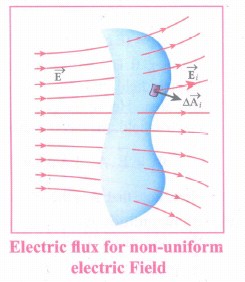
(iii) By taking the limit \({ \overset { \rightarrow }{ A } }_{ 1 }\rightarrow 0\) (for all i) the summation in equation (1) becomes integration. The total electric flux for the entire area is given by
\({ \Phi }_{ E }=\int { { \overset { \rightarrow }{ E } } } .d\overset { \rightarrow }{ A } \quad\quad ....(2)\)
(iv) From Equation (2), it is clear that the electric flux for a given surface depends on both the electric field pattern on the surface area and orientation of the surface with respect to the electric field.
3.
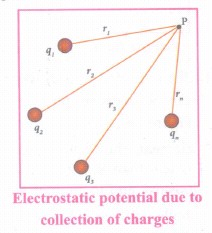
(i) The electric potential at a point P due to a collection of charges q1, q2, q3, ···qn is equal to sum of the electric potentials due to individual charges.
\({ V }_{ tot }=\frac { k{ q }_{ 1 } }{ { r }_{ 1 } } +\frac { { kq }_{ 2 } }{ { r }_{ 2 } } +\frac { { kq }_{ 3 } }{ { r }_{ 3 } } +...\frac { { kq }_{ n } }{ { r }_{ n } } =\frac { 1 }{ 4\pi { \varepsilon }_{ 0 } } { \sum { } }_{ i=1 }^{ n }\frac { { q }_{ i } }{ { r }_{ i } } \)
(ii) where r1, r2, r3 .... rn are the distances of q1, q2, q3 ..... qn respectively from P(Figure).
4.
(i) Microwave oven works on the principle of torque acting on an electric dipole. The food we consume has water molecules which are permanent electric dipoles.
(ii) Oven produces microwaves that are oscillating electromagnetic fields and produce torque on the water molecules.
(iii) Due to this torque on each water molecule, the molecules rotate very fast and produce thermal energy. Thus, heat generated is used to cook the food.
5.
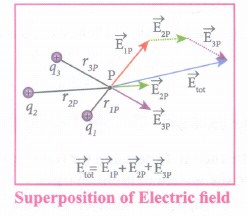
(i) Suppose a number of point charges are distributed in space, to find the electric field at some point P due to this collection of point charges, superposition principle is used.
(ii) The electric field due to a collection of point charges at an arbitrary point is simply equal to the vector sum of the electric fields created by the individual point charges. This is called superposition of electric fields.
(iii) Consider a collection of point charges q1, q2, q3,,....qn located at various points in space. The total electric field at some point P due to all these n charges is given by
\({ \overset { \rightarrow }{ E } }_{ tot }={ \overset { \rightarrow }{ E } }_{ 1 }+{ \overset { \rightarrow }{ E } }_{ 2 }+{ \overset { \rightarrow }{ E } }_{ 3 }+......+{ \overset { \rightarrow }{ E } }_{ n }\quad ...(1)\)
\({ \overset { \rightarrow }{ E } }_{ tot }=\frac { 1 }{ 4\pi { \varepsilon }_{ 0 } } \left\{ \frac { { q }_{ 1 } }{ { r }_{ 1p }^{ 2 } } { \hat { r } }_{ 1p }+\frac { { q }_{ 2 } }{ { r }_{ 2p }^{ 2 } } { \hat { r } }_{ 2p }+\frac { { q }_{ 3 } }{ { q }_{ 3p }^{ 2 } } { \hat { r } }_{ 3p }+...\frac { { q }_{ n } }{ { r }_{ nP }^{ 2 } } { \hat { r } }_{ nP } \right\} (2)\)
(ill) Here r1p, r2p,r3p,········rnP are the distances between the point P and the charges q1P, q2P, q3p..... qnP respectively. Also \({ \hat { r } }_{ 1p },{ \hat { r } }_{ 2p },{ \hat { r } }_{ 3p }\quad ......{ \hat { r } }_{ nP }\) are the unit vectors directed from q1p, q2p,q3p ...... qnP respectively to P. Equation (2) can be re-written as,
\({ \overset { \rightarrow }{ E } }_{ tot }=\frac { 1 }{ 4\pi { \varepsilon }_{ 0 } } \sum _{ i=1 }^{ n }{ \left( \frac { { q }_{ i } }{ { r }_{ ip }^{ 2 } } \hat { r } ip \right) } ....(3)\)
(iv) For example in Figure, the resultant electric field due to three point charges q1,q2,q3, at point P is shown
Note that the relative lengths of the electric field vectors for the charges depend on relative distances of the charges to the point P.

12th Standard Syllabus & Materials
12th Standard
TN 12th Computer Applications வலையமைப்பு வடமிடல் Sample Question Papers Study Material - QB365 Set A
NEW12th Standard
TN 12th Computer Applications களப்பெயர் முறைமை (DNS) Sample Question Papers Study Material - QB365 Set A
NEW12th Standard
TN 12th Computer Applications வலையமைப்பு எடுத்துக்காட்டுகள் மற்றும் நெறிமுறைகள் Sample Question Papers Study Material - QB365 Set A
NEW12th Standard
TN 12th Computer Applications கணினி வலையமைப்பு ஓர் அறிமுகம் Sample Question Papers Study Material - QB365 Set A



Tamilnadu Stateboard 12th Standard Subjects

Maths

Chemistry
Physics

Biology

Computer Science

Business Maths and Statistics

Economics

Commerce

Accountancy

History

Computer Applications
Biology
Computer Technology
Computer Applications
Computer Science
Business Maths and Statistics
Commerce
Economics
Maths
Chemistry
Physics
Computer Technology
History
Accountancy

Tamil

English

French
Tamilnadu Stateboard Standards



