
 100% FREE ACCESS
12th Standard Syllabus & Materials
12th Standard
TN 12th Computer Applications மின்னணு தரவு பரிமாற்றம் Sample Question Papers Study Material - QB365 Set A
NEW12th Standard
TN 12th Computer Applications மின் - வணிக பாதுகாப்பு அமைப்புகள் Sample Question Papers Study Material - QB365 Set A
NEW12th Standard
TN 12th Computer Applications மின்னணு செலுத்தல் முறைகள் Sample Question Papers Study Material - QB365 Set A
NEW12th Standard
TN 12th Computer Applications மின் - வணிகம் Sample Question Papers Study Material - QB365 Set A
NEW12th Standard
TN 12th Computer Applications திறந்த மூல கருத்துருக்கள் Sample Question Papers Study Material - QB365 Set A
NEW12th Standard
TN 12th Computer Applications வலையமைப்பு வடமிடல் Sample Question Papers Study Material - QB365 Set A

Published on: 01/06/2021
QB365 provides detailed and simple solution for every Book back Questions in class 12 Physics Subject. It will helps to get more idea about question pattern in every book back questions with solution.
Download Tamil Nadu 12th Standard Physics question papers, model tests, one-mark questions, important questions, and public exam papers in PDF format. Free study materials and answer keys for TN State Board students.
Questions + Answers key
Take MCQ Physics Test1.
Explain the principle and working of a moving coil galvanometer.
2.
Discuss the working of cyclotron in detail.
3.
Obtain the magnetic field at a point on the equatorial line of a bar magnet.
4.
Deduce the relation for the magnetic field at a point due to an infinitely long straight conductor carrying current using Biot-Savart law.
5.
Compute the torque experienced by a magnetic needle in a uniform magnetic field.
1.
Principle : When a current carrying loop is placed in a uniform magnetic field it experiences a torque.
Construction : A moving coil galvanometer consists of a rectangular coil PQRS of insulated thin copper wire. The coil contains a large number of turns wound over a light metallic frame. A cylindrical soft-iron core is placed symmetrically inside the coil as shown in Figure. The rectangular coil is suspended freely between two pole pieces of a horse-shoe magnet.
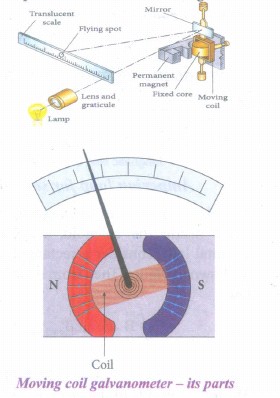
The upper end of the rectangular coil is attached to one end of fine strip of phosphor bronze and the lower end of the coil is connected to a hair spring which is also made up of phosphor bronze. In a fine suspension strip, a small plane mirror is attached in order to measure the deflection of the coil with the help of lamp and scale arrangement. The other end of the mirror is connected to a torsion head. In order to pass electric current through the galvanometer, the suspension strip and the spring S are connected to terminals.
Working : Consider a single turn of the rectangular coil PQRS whose length be l and breadth b. PQ = RS = l and QR = SP = b.
Let I be the electric current flowing through the rectangular coil PQRS as shown in Figure. The horse-shoe magnet has hemi - spherical magnetic poles which produces a radial magnetic field. Due to this radial field, the sides QR and SP are always parallel to the magnetic field B and experience no force. The sides PQ and RS are always parallel to the magnetic field and experience force in opposite directions. Due to this, torque is produced.
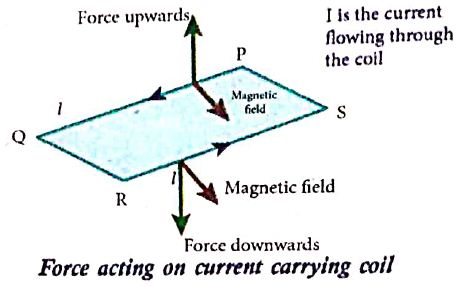
For single turn, the deflection torque is,
て = bF = bBIl = (lb)BI
て = ABI
since, area of the coil A = lb
For coil with N turns, we get
て = NABI ........(1)
Due to this deflecting torque, the coil gets twisted and restoring torque (also known as restoring couple) is developed. Hence the moment of restoring couple is proportional to the amount of twist θ. Thus
て = Kθ ............(2)
where K is the restoring couple per unit twist or torsional constant of the spring.
At equilibrium, the deflection couple is equal to the restoring couple. Therefore by comparing equations (1) and (2), we get,
NABI = Kθ
⇒ I =\(\frac { K }{ NAB } \) θ ...........(3)
(or) I = Gθ
where G = \(\frac { K }{ NAB } \) is called galvanometer constant or current reduction factor of the galvanometer.
Since, suspended moving coil galvanometer is very sensitive, we have to handle with high care while doing experiments. Most of the galvanometer we use are pointer type moving coil galvanometer.
2.
Cyclotron:
Device used to accelerate the charged particles to gain large kinetic energy.
Principle:
When a charged particle moves perpendicular to the magnetic field, it experiences magnetic Lorentz force.
Construction:
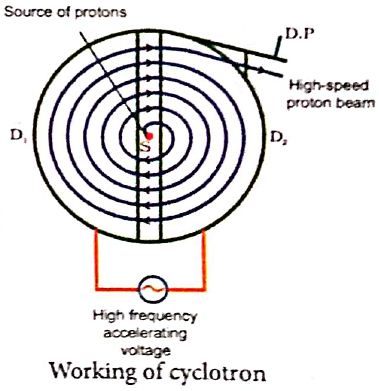
(i) The particles are allowed to move in between two semi-circular metal containers called Dees (hollow D - shaped objects).
(ii) The uniform magnetic field is controlled by an electromagnet. The direction of magnetic field is normal to the plane of the Dees.
(iii) Source is kept between two Dees.
(vi) Dees are connected to high frequency alternating potential difference.
Working:
(i) The ion ejected from source is positively charged.
(ii) It is accelerated towards negative potential Dees
(iii) This ion undergoes a circular path.
(iv) At this time, the polarities of the Dees are reversed, so that the ion is now accelerated towards Dee-2 with a greater velocity. For this circular motion, the centripetal force of the charged particle q is provided by Lorentz force.
\(\frac { m{ v }^{ 2 } }{ r } \) = qvB
⇒ r = \(\frac { m }{ qB } \)v ........(1)
⇒ r ∝ v
(v) If radius of the circular paths, increases, velocity also increases particles undergo spiral path with increasing radius.
(vi) When the frequency f at which the positive ion ciculates in the magnetic field must be equal to the constant frequency of the electrical oscillator fosc. This is called Resonance condition.
From equation, f = \(\frac { qB }{ 2\pi m } \) we have
fosc = \(\frac { qB }{ 2\pi m } \),
The time period of oscillation is
T = \(\frac { 2\pi m }{ qB } \)
The kinetic energy of the charged particle is,
KE = \(\frac { 1 }{ 2 } mv^{ 2 }=\frac { { q }^{ 2 }B^{ 2 }{ r }^{ 2 } }{ 2m } \) ........(2)
Limitations:
(i) The speed of ion is limited.
(ii) Electron cannot be accelerated.
(iii) Uncharged particles cannot be accelerated.
3.
(i) Consider a bar magnet NS and pole strength qm and distance 2l.
(ii) Let C be point along the equatorial line.
(iii) The magnetic field at a point C (lines along the equatorial line) at a distance r from the geometrical center O of the magnet can be computed by keeping unit north pole (qmC = 1 A m) at C.
\(\vec { { B }_{ N } } =-{ B }_{ N }cos\theta \hat { i } +{ B }_{ N }sin\theta \hat { j } \) .....(1)
where BN = \(\frac { { \mu }_{ 0 } }{ 4\pi } \frac { { q }_{ m } }{ r^{ '2 } } \)
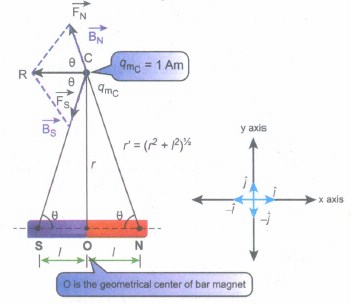
The magnetic field at C due to south pole is,
\(\vec { { B }_{ s } } =-{ B }_{ s }cos\theta \hat { i } -{ B }_{ s }sin\theta \hat { j } \) .....(2)
where Bs = \(\frac { { \mu }_{ 0 } }{ 4\pi } \frac { { q }_{ m } }{ r^{ '2 } } \)
From equations (1) and (2), the net magnetic field at point C due to dipole is \(\vec { { B } } =\vec { { B }_{ N } } +\vec { { B }_{ S } } \).
\(\vec { { B } } =-({ B }_{ N }+{ B }_{ S })cos\theta \hat { i } \) Since, BN = BS
\(\vec { { B } } =-\frac { { 2\mu }_{ 0 } }{ 4\pi } \frac { { q }_{ m } }{ r'^{ 2 } } cos\theta \hat { i } =-\frac { 2{ \mu }_{ 0 } }{ 4\pi } \frac { { q }_{ m } }{ ({ r }^{ 2 }+l^{ 2 }) } cos\theta \hat { i } \) ....(3)
In a right angle triangle NOC, as shown in the figure,
cosθ=\(\frac { adjacent }{ hypotenuse } =\frac { 1 }{ r' } =\frac { 1 }{ ({ r }^{ 2 }+{ l }^{ 2 })^{ \frac { 1 }{ 2 } } } \) .........(4)
Substituting equation (4) in equation (3) we get
\(\vec { B } =-\frac { { \mu }_{ 0 } }{ 4\pi } \frac { { q }_{ m }\times (2l) }{ ({ r }^{ 2 }+{ l }^{ 2 })^{ \frac { 3 }{ 2 } } } \hat { i } \) ........(5)
Since, magnitude of magnetic dipole moment is \(|\vec { { p }_{ m } } |\) = pm = qm. 2l and substituting in equation (5), we get the magnetic field at a point C is
\( { { \vec B }_{ equatorial } } =-\frac { { \mu }_{ 0 } }{ 4\pi } \frac { { p }_{ m } }{ ({ r }^{ 2 }+{ l }^{ 2 })^{ \frac { 3 }{ 2 } } } \hat { i } \) ........(6)
If the distance between two poles in a bar magnet are small (looks like short magnet) when compared to the distance between geometrical center O of bar magnet and the location of point C i.e., r >>l, then,
(r2 + l2)3\2 ≈ r3 ..........(7)
Therefore, using equation (7) in equation (6), we get
\( { { \vec B }_{ equatorial } } =-\frac { { \mu }_{ 0 } }{ 4\pi } \frac { { p }_{ m } }{ r^{ 3 } } \hat { i } \)
In general, the magnetic field at equatorial point is given by
\({ { \vec B }_{ equatorial } } =-\frac { { \mu }_{ 0 } }{ 4\pi } \frac { { \vec p }_{ m } }{ r^{ 3 } } \) Since pm\(\hat { i } =\vec { { p }_{ m } } \), .......(8)
4.
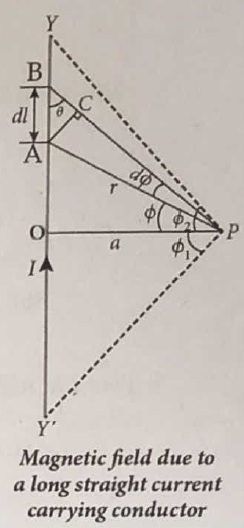
Let YY' be an infinitely long straight conductor carry current I. In order to calculate magnetic field at a point P which is at a distance a from the wire, let us consider a small line element dl (segment AB).
According to Biot Savart law, the magnetic field at a point P due to current element Idl is,
\({ d \vec B } =\frac { { \mu }_{ 0 } }{ 4\pi } \frac { { Idl sin \theta} }{ { r }^{ 2 } }\hat n \).
To apply trigonometry, draw a perpendicular AC to the line BP as shown in Figure.
In triangle ΔABC, \(\sin \theta=\frac{\mathrm{AC}}{\mathrm{AB}}\)
∴ AC = AB sinθ
\(\text { But, } A B =d l \Rightarrow A C=d l \sin \theta\)
Let dΦ be the angle subtended between AP and BP
ie., \(\angle \mathrm{APB}=\angle \mathrm{APC}=d \phi\)
In a triangle \(\triangle \mathrm{APC}, \sin (d \phi) \simeq A C / A P\)
Since, dΦ is very small, \(\sin (d \phi) \simeq d \phi\)
But, \(\mathrm{AP} =r \Rightarrow A C=r d \phi \)
\(\therefore \mathrm{AC} =d l \sin \theta=r d \phi \)
\(\therefore d \vec{B} =\frac{\mu_0}{4 \pi} \frac{I}{r^2}(r d \phi) \hat{n}=\frac{\mu_0}{4 \pi} \frac{I d \phi}{r} \hat{n}\)
Let Φ be the angle between AP and OP
\(\text {In a } \triangle \mathrm{OPA}, \cos \phi =\frac{\mathrm{OP}}{\mathrm{AP}}=\frac{\mathrm{a}}{\mathrm{r}} \)
\(r =\frac{a}{\cos \phi} \)
\(\text {Now, } d \vec{B} =\frac{\mu_0}{4 \pi} \frac{I}{a / \cos \phi} d \phi . \hat{n} \)
\(d \vec{B} =\frac{\mu_0 I}{4 \pi a} \cos \phi d \phi \hat{n}\)
The total magnetic field at P due to the conductor YY' is
\(\vec { B } = \int _{- \Phi _{ 1 } }^{ { \Phi }_{ 2} }d\vec B =\int _{ -\Phi _{ 1 } }^{ { \Phi }_{ 2 } }\frac { { \mu }_{ 0 }I }{ 4\pi a }{ cos\phi d\phi } \hat { n }\)
\(=\frac { { \mu }_{ 0 }I }{ 4\pi a }[{ sin\phi ]^{\phi_2} _{\phi_-1}} \hat { n }\)
\( \vec{B}=\frac { { \mu }_{ 0 }I }{ 4\pi a } (sin{ \Phi }_{ 1 }+sin{ \Phi }_{ 2 })\hat { n } \)
For infinitely long conductor, Φ1 = Φ2 = 90o
\(\therefore \vec{B}=\frac { { \mu }_{ 0 }I }{ 4\pi a } \times 2\hat{n}\Rightarrow\vec { B } =\frac { { \mu }_{ 0 }I }{ 2\pi a } \hat { n } \)
5.
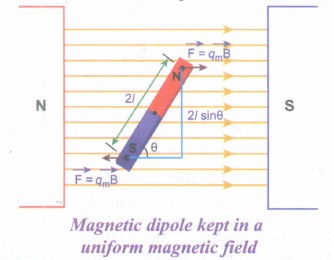
i) Consider a bar magnet of length 2l and pole strength qm
ii) Force experienced by the magnet at each pole is qm B (equal) in opposite direction.
iii) So, magnet experiences a torque.
The force experienced by north pole,
\(\vec { { F }_{ N } } ={ q }_{ m }\vec { B } \)
The force experienced by south pole,
\(\vec { { F }_{ S } } =-{ q }_{ m }\vec { B } \)
∴ The net force acting on the dipole is,
\(\vec { F } =\vec { { F }_{ N } } +\vec { F_{ S } } =\vec { 0 } \)
The moment of force or torque experienced by north and south pole about point O is,
\(\vec { \tau } =\vec { ON } \times \vec { { F }_{ N } } +\vec { OS } \times \vec { { F }_{ S } } \)
\(\vec { \tau } =\vec { ON } \times { q }_{ m }\vec { B } +\vec { OS } \times (-{ q }_{ m }\vec { B } )\)
By using right hand cork screw rule, we conclude that the total torque is pointing into the paper. Since the magnitudes \(|\vec { ON } |=|\vec { OS } |=l\) and \(|{ q }_{ m }\vec { B } |=|-{ q }_{ m }\vec { B } |\).
The magnitudes of total torque about point O is
ፒ = l x qmB sinθ + l x qmB sinθ
ፒ = 2l x qmB sinθ
ፒ = pmB sinθ (∴ qm x 2l = pm)
In vector notation, \(\vec { \tau } =\vec { { p }_{ m } } \times \vec { B } \).

12th Standard Syllabus & Materials
12th Standard
TN 12th Computer Applications களப்பெயர் முறைமை (DNS) Sample Question Papers Study Material - QB365 Set A
NEW12th Standard
TN 12th Computer Applications வலையமைப்பு எடுத்துக்காட்டுகள் மற்றும் நெறிமுறைகள் Sample Question Papers Study Material - QB365 Set A
NEW12th Standard
TN 12th Computer Applications கணினி வலையமைப்பு ஓர் அறிமுகம் Sample Question Papers Study Material - QB365 Set A
NEW12th Standard
TN 12th Computer Applications PHP-உடன் MySQL-ஐ இணைத்தல் Sample Question Papers Study Material - QB365 Set A



Tamilnadu Stateboard 12th Standard Subjects

Maths

Chemistry
Physics

Biology

Computer Science

Business Maths and Statistics

Economics

Commerce

Accountancy

History

Computer Applications
Biology
Computer Technology
Computer Applications
Computer Science
Business Maths and Statistics
Commerce
Economics
Maths
Chemistry
Physics
Computer Technology
History
Accountancy

Tamil

English

French
Tamilnadu Stateboard Standards



