
 100% FREE ACCESS
12th Standard Syllabus & Materials
12th Standard
TN 12th Maths Applications of Matrices and Determinants Sample Question Papers Study Material - QB365 Set A
NEW12th Standard
TN 12th Computer Applications மின்னணு தரவு பரிமாற்றம் Sample Question Papers Study Material - QB365 Set A
NEW12th Standard
TN 12th Computer Applications மின் - வணிக பாதுகாப்பு அமைப்புகள் Sample Question Papers Study Material - QB365 Set A
NEW12th Standard
TN 12th Computer Applications மின்னணு செலுத்தல் முறைகள் Sample Question Papers Study Material - QB365 Set A
NEW12th Standard
TN 12th Computer Applications மின் - வணிகம் Sample Question Papers Study Material - QB365 Set A
NEW12th Standard
TN 12th Computer Applications திறந்த மூல கருத்துருக்கள் Sample Question Papers Study Material - QB365 Set A

Published on: 13/05/2022
QB365 provides detailed and simple solution for every Creative Questions in class 12 Physics Subject. It will helps to get more idea about question pattern in
every Creative questions with solution.
Download Tamil Nadu 12th Standard Physics question papers, model tests, one-mark questions, important questions, and public exam papers in PDF format. Free study materials and answer keys for TN State Board students.
Questions + Answers key
Take MCQ Physics Test1.
Two long and parallel street wires carrying current of 2A and 5A in the opposite direction are separated by a distance of 1 cm, Find the nature and magnitude of the magnetic force between them.
2.
Deduce the expression for the torque \(\vec { \tau } \) when \(\hat { n } \) unit vector n is at an angle 8 with the field.
3.
Describe the motion of a charged particle in a uniform magnetic field.
4.
Explain magnetic dipole moment of a revolving electron.
5.
Drive an expression of Potential energy of a bar magnet in a uniform magnetic field.
1.
Current I1 = 2A ; I2 = 5A
Two wires are separated by a distance a = 1 cm
= 1 x 10⁻²m
The force between two parallel wires per unit length
F =?
F = \(\frac { { \mu }_{ 0 } }{ 2\pi } .\frac { { I }_{ 1 }{ I }_{ 2 } }{ a } \)
= 2 x 10⁻⁷ x \(\frac { 2\times 5 }{ 1\times { 10 }^{ -2 } } \)
F = 20 x 10-5 N
This force is repulsive F = 20 x 10-5 N.
2.
In the general case, the unit normal vector \(\hat { n } \) and magnetic field \(\vec { B } \) is with an angle 8 as shown in Figure.
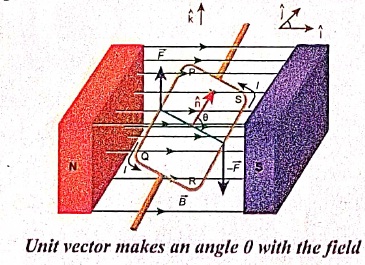
(a) The force on section PQ
\(\vec { i } =a\hat { j } \) and \(\vec { B } =B\hat { i } \)
\(\vec { { F }_{ PQ } } =\vec { Il } \times \vec { B } =IaB(\hat { j } \times \hat { j } )=-IaB\hat { k } \)
Since the unit vector normal to the plane \(\hat { n } \) is along the direction of .\(\vec { k } \)
(b) The force on section QR
\(\vec { l } =bcos\left( \frac { \pi }{ 2 } -\theta \right) \hat { i } -sin\left( \frac { \pi }{ 2 } -\theta \right) \hat { k } \)
\(\vec { { F }_{ QR } } =\vec { Il } \times \vec { B } =-IbB\left( \frac { \pi }{ 2 } -\theta \right) \hat { j } \)
\(\vec { { F }_{ QR } } =-IbBcos\theta \hat { j } \)
(c) The force on section RS
\(\vec { l } =a\hat { j } \) and \(\vec { B } =B\hat { i } \)
\(\vec { { F }_{ RS } } =\vec { Il\times \vec { B } } =IaB(\hat { j } \times \hat { j } )=-IaB\hat { k } \)
Since the unit vector normal to the plane is along the direction of \(\hat { k } \).
(d) The force on section SP
\(\vec { l } =bcos\left( \frac { \pi }{ 2 } -\theta \right) \hat { i } +sin\left( \frac { \pi }{ 2 } +\theta \right) \hat { k } \quad \vec { B } =B\hat { i } \)
\(\vec { { F }_{ SP } } =\vec { Il } \times \vec { B } =IbBsin\left( \frac { \pi }{ 2 } -\theta \right) \hat { j } \)
\(\vec { { F }_{ SP } } =-IbBcos\theta \hat { j } \)
The net force on the rectangular loop is
\(\vec { { F }_{ net } } =\vec { { F }_{ PQ } } +\vec { { F }_{ QR } } +\vec { { F }_{ RS } } +\vec { { F }_{ SP } } \)
\({ F }_{ net }=IaB\hat { k } -IbBcos\theta \hat { j } -IaB\hat { k } +IbBcos\theta \hat { j } \)
\(\vec { { F }_{ net } } =\vec { 0 } \)
Hence, the net force on the rectangular loop in this configuration is also zero. Notice that the force on section QR and SP is not zero here. But, they have equal and opposite effects, but we assume that the loop to be rigid, so no deformation. So, no torque was produced by these two sections.
Even though the forces PQ and RS also are equal and opposite, they are not collinear. So these two forces constitute a couple as shown in Figure (a). Hence the net torque produced by these two forces about the axis of the rectangular loop is given by
\(\vec { { \tau }_{ net } } =baBIsin\theta \hat { k } =ABIsin\theta \hat { k } \)
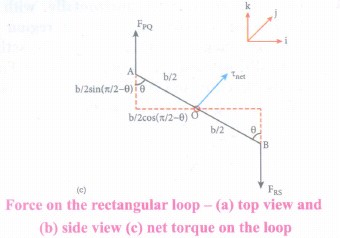
\(\vec { OA } =\frac { b }{ 2 } cos\left( \frac { \pi }{ 2 } -\theta \right) (-\hat { i } )+\frac { b }{ 2 } cos\left( \frac { \pi }{ 2 } -\theta \right) (-\hat { k } )\)
=\(\frac { b }{ 2 } (-sin\theta \hat { i } +cos\theta \hat { k } )\)
\(\vec { OB } =\frac { b }{ 2 } cos\left( \frac { \pi }{ 2 } -\theta \right) (\hat { i } )+\frac { b }{ 2 } cos\left( \frac { \pi }{ 2 } -\theta \right) (\hat { k } )\)
=\(\frac { b }{ 2 } (-sin\theta \hat { i } +cos\theta \hat { k } )\)
\(\vec { OA } \times \vec { { F }_{ PQ } } =\left\{ \frac { b }{ 2 } (-sin\theta \hat { i } +cos\theta \hat { k } \right\} \times \left\{ IaB\hat { k } \right\} \)
= \(\frac { 1 }{ 2 } IabBsin\theta \hat { j } \)
\(\vec { OA } \times \vec { { F }_{ RS } } =\left\{ \frac { b }{ 2 } (sin\theta \hat { i } +cos\theta \hat { k } \right\} \times \left\{ -IaB\hat { k } \right\} \)
= \(\frac { 1 }{ 2 } IabBsin\theta \hat { j } \)
The net torque \(\vec { \tau _{ net } } =IaBsin\theta \hat { j } \) ..........(1)
Note that the net torque is in the positive y-direction which tends to rotate the loop in a clockwise direction about the y axis. If the current is passed in the other way (P⟶S⟶R⟶Q⟶P), then total torque will point in the negative y-direction which tends to rotate the loop in an anticlockwise direction about the y-axis.
Another important point is to note that the torque is less in this case compared to the earlier case (where the \(\hat { n } \) is perpendicular to the magnetic field \(\vec { B } \)). It is because the perpendicular distance is reduced between the forces \(\vec { { F }_{ PQ } } \) and \(\vec { { F }_{ RS } } \) in this case.
The equation (1) can also be rewritten in terms of magnetic dipole moment \(\vec { { p }_{ m } } =I\vec { A } =Iab\hat { n } \)
\(\vec { \tau _{ net } } =\vec { p } \times \vec { B } \).
3.
(i) Consider a charged particle of charge 'q' having mass m enters into a region of a uniform magnetic field \(\vec { B } \) with velocity \(\vec { v } \).
(ii) Such that velocity is perpendicular to the magnetic field and velocity \(\vec{v}\).
(iii) The charged particle moves in a circular orbit.
(iv) Lorentz force.
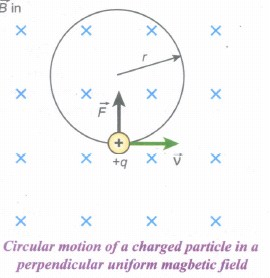
\(\vec { F } =q(\vec { v } \times \vec { B } )\)
In magnitude F = qVB
(v) This Lorentz force acts as centripetal force for the particle to execute circular motion. Therefore,
qvB = m\(\frac { { v }^{ 2 } }{ r } \)
The radius of the circular path is
r = \(\frac { mv }{ qB } =\frac { p }{ qB } \) ..........(1)
(vi) where p = mv is the magnitude of the linear momentum of the particle. Let T be the time taken by the particle to finish one complete circular motion, then
T = \(\frac { 2\pi r }{ v } \) .............(2)
Hence substituting (1) in (2), we get,
T = \(\frac { 2\pi m }{ qB } \) .............(3)
(vii) Equation (3) is called the cyclotron period. The reciprocal of time period is the frequency f, which is
f = \(\frac { 1 }{ T } \)
f = \(\frac { qB }{ 2\pi m } \) ...........(4)
In terms of angular frequency ω,
ω = 2πf = \(\frac { q }{ m } \)B ...........(5)
(viii) Equations (4) and equation (5) are called cyclotron frequency or gyrofrequency.
(ix) Time period and frequency depend only on charge-to-mass ratio (specific charge) and independent of velocity or radius.
4.
(i) Electron revolves around a nucleus in a circular orbit of radius R.
(ii) Circulating electron is like a current in a circular loop.
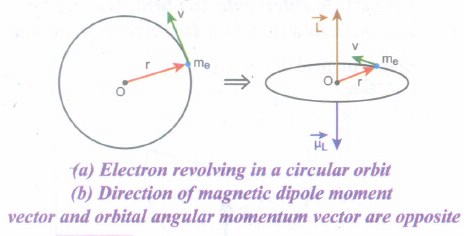
\(\vec { { \mu }_{ L } } =I\vec { A } \) ......(1)
In magnitude,
μL = IA
If T is the time period of an electron, the current due to the circular motion of the electron is
I = \(\frac { -e }{ T } \) ....(2)
where -e is the charge of an electron. If R is the radius of the circular orbit and v is the velocity of the electron in the circular orbit, then
T = \(\frac { 2\pi R }{ v } \) ..(3)
Using equation (2) and equation (3) in equation (1), we get
μL = \(\frac { e }{ \frac { 2\pi R }{ v } } \pi { R }^{ 2 }=\frac { evR }{ 2 } \) ....(4)
where A = πR2 is the area of the circular loop. By definition, the angular momentum of the electron about O is
\(\vec { L } =\vec { r } \times \vec { p } \)
In magnitude
L = Rp = mvR ...(5)
Using equation (4) and equation (5), we get
\(\frac { { \mu }_{ L } }{ L } =-\frac { \frac { evR }{ 2 } }{ mvR } =\frac { e }{ 2m } \Rightarrow \vec { { \mu }_{ L } } =\frac { e }{ 2m } \vec { L } \) ....(6)
The negative sign indicates that the magnetic moment and angular momentum are in opposite directions.
In magnitude
\(\frac{\mu_L}{L}=\frac{e}{2 m}=\frac{1.60 \times 10^{-19}}{2 \times 9.11 \times 10^{-31}}=0.0878 \times 10^{12} \mathrm{C} \mathrm{kg}^{-1}\)
\(\frac{\mu_L}{L}=8.78 \times 10^{10} \mathrm{C} \mathrm{kg}^{-1}=\text { constant }\)
The ratio \(\frac{\mu_L}{L}\) is aconstant known as Gyro-magnetic ratio \(\left(\frac{e}{2 m}\right)\).
According to Bohr quantization
\(\mathrm{L}=\mathrm{nh} / 2 \pi\)
\(\mu_L=\left(\frac{e}{2 m}\right) \mathrm{L}=\frac{\pi e h}{4 \pi m} \)
On substiting known values
\(\mu_L=9.27 \times 10^{-24} \mathrm{~A} \mathrm{~m}^2\)
The minimum magnetic moment can be obtained by substituting n = 1
\(\mu_2=9.27 \times 10^{-24} \mathrm{~A} \mathrm{~m}^2=9.27 \times 10^{-24} \mathrm{~J} \mathrm{~T}^{-1}\)
where, \(\mu_B=\frac{c h}{4 \pi m}=9.27 \times 10^{-24} \mathrm{~A} \mathrm{~m}^2\) is called Bohr magneton. which is used to measure atomic magnetic moments.
5.
When a bar magnet (magnetic dipole) of dipole moment \(\vec { { p }_{ m } } \) is held at an angle θ with the direction of a uniform magnetic field \(\vec { { B } } \), as shown in Figure the magnitude of the torque acting on the dipole is
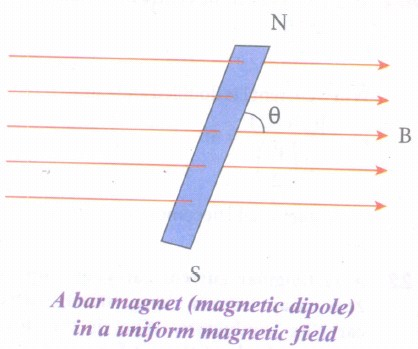
\(|\vec { \tau _{ B } } |=|\vec { { p }_{ m } } ||\vec { B } |sin\theta \)
If the dipole is rotated through a very small angular displacement dθ against the torque ፒB at constant angular velocity, then the work done by external torque \((\vec { { \tau }_{ ext } } )\) for this small angular displacement is given by
dW = \(|\vec { { { \tau }_{ ext } } } |\) dθ
Since the bar magnet to be moved at constant angular velocity, it implies \(|\vec { { \tau }_{ B } } |=|\vec { \tau _{ ext } } |\)
dW = PmB sinθ dθ
Total work done in rotating the dipole from θ' to θ is
W =\(\int _{ \theta ' }^{ \theta }{ \tau d\theta } =\int _{ \theta ' }^{ \theta }{ p_{ m } } Bsin\theta d\theta ={ p }_{ m }B[-cos\theta d\theta ]_{ \theta ' }^{ \theta }\)
W = pmB(cosθ - cosθ')
This work done is stored as potential energy in bar magnet at an angle θ when it is rotated from θ' to θ and it can be written as
U = pmB(cosθ - cosθ') .........(1)
In fact, equation (1) gives the difference in potential energy between the angular positions θ' and θ. We can choose the reference point θ' = 90°, so that second term in the equation becomes zero and the equation (1) can be written as
U = -pmB(cosθ) ............(2)
The potential energy stored in a bar magnet in a uniform magnetic field is given by
U = -\(\vec { { p }_{ m } } .\vec { B } \) ............(3)
Case 1
(i) If θ = 0°, then
U = PmB (cos00) = - PmB
(ii) If θ = 180°, then
U = PmB (cos 180°) = pmB
We can infer from the above two results, the potential energy of the bar magnet is minimum when it is aligned along the external magnetic field and maximum when the bar magnet is aligned anti-parallel to an external magnetic field.

12th Standard Syllabus & Materials
12th Standard
TN 12th Computer Applications வலையமைப்பு வடமிடல் Sample Question Papers Study Material - QB365 Set A
NEW12th Standard
TN 12th Computer Applications களப்பெயர் முறைமை (DNS) Sample Question Papers Study Material - QB365 Set A
NEW12th Standard
TN 12th Computer Applications வலையமைப்பு எடுத்துக்காட்டுகள் மற்றும் நெறிமுறைகள் Sample Question Papers Study Material - QB365 Set A
NEW12th Standard
TN 12th Computer Applications கணினி வலையமைப்பு ஓர் அறிமுகம் Sample Question Papers Study Material - QB365 Set A



Tamilnadu Stateboard 12th Standard Subjects

Maths

Chemistry
Physics

Biology

Computer Science

Business Maths and Statistics

Economics

Commerce

Accountancy

History

Computer Applications
Biology
Computer Technology
Computer Applications
Computer Science
Business Maths and Statistics
Commerce
Economics
Maths
Chemistry
Physics
Computer Technology
History
Accountancy

Tamil

English

French
Tamilnadu Stateboard Standards



