
 100% FREE ACCESS
12th Standard Syllabus & Materials
12th Standard
TN 12th Maths Applications of Matrices and Determinants Sample Question Papers Study Material - QB365 Set A
NEW12th Standard
TN 12th Computer Applications மின்னணு தரவு பரிமாற்றம் Sample Question Papers Study Material - QB365 Set A
NEW12th Standard
TN 12th Computer Applications மின் - வணிக பாதுகாப்பு அமைப்புகள் Sample Question Papers Study Material - QB365 Set A
NEW12th Standard
TN 12th Computer Applications மின்னணு செலுத்தல் முறைகள் Sample Question Papers Study Material - QB365 Set A
NEW12th Standard
TN 12th Computer Applications மின் - வணிகம் Sample Question Papers Study Material - QB365 Set A
NEW12th Standard
TN 12th Computer Applications திறந்த மூல கருத்துருக்கள் Sample Question Papers Study Material - QB365 Set A

Published on: 13/05/2022
QB365 provides detailed and simple solution for every Creative Questions in class 12 Physics Subject. It will helps to get more idea about question pattern in
every Creative questions with solution.
Download Tamil Nadu 12th Standard Physics question papers, model tests, one-mark questions, important questions, and public exam papers in PDF format. Free study materials and answer keys for TN State Board students.
Questions + Answers key
Take MCQ Physics Test1.
A concave lens is kept in contact with a convex lens of focal length 20 cm. The combination behaves as a convex lens of focal length 50 cm. Find the power of concave lens.
2.
Draw a plot showing the variation of power of a lens with the wavelength of the incident light.
3.
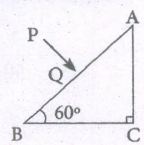
A ray PQ incident normally on the refracting face BA is refracted in the prism BAC made of material of refractive index 1.5. Complete the path of the ray through the prism. From which face will the ray emerge? Justify your answer.
4.
An object is placed 40 cm from a convex lens of focal length 30 cm, If a concave lens of focal length 50 cm is introduced between the convex lens and the image formed such that it is 20 cm from the convex lens, find the change in the position of the image.
5.
(I) Calculate the distance of an object of height h from a concave mirror of radius of curvature 20 cm, so as to obtain a real image of magnification 2. Find the location of image also.
(ii) Using mirror formula, explain why does a convex mirror always produce a virtual image.
1.
\(\cfrac { 1 }{ F } =\cfrac { 1 }{ { f }_{ 1 } } +\cfrac { 1 }{ { f }_{ 2 } } \)
\(\cfrac { 1 }{ 50 } =\cfrac { 1 }{ 20 } +\cfrac { 1 }{ { { f }_{ 2 } } } \quad f=-\cfrac { 100 }{ 3 } cm\)
\({ P }_{ 2 }=\cfrac { 100 }{ -\frac { 100 }{ 3 } } \)
D = -3D.
2.
Formula:
Refractive index = \(A+\cfrac { B }{ { \lambda }^{ 2 } } \)
where λ is the wavelength.
Power of a lens \(P=\cfrac { 1 }{ f } =\left( { n }_{ g }-1 \right) \left( \cfrac { 1 }{ { { R }_{ 1 } } } -\cfrac { 1 }{ { R }_{ 2 } } \right) \)
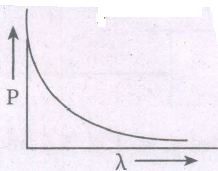
Clearly, the power of a lens (ng - 1). This implies that the power of a lens decreases with the increase in wavelength \(\left( P\infty \cfrac { 1 }{ { \lambda }^{ 2 } } nearly \right) \) The plot is shown in the figure alongside.
3.
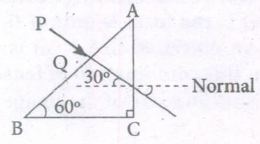
For face AB, ∠i = 0°,∠r = ·0° the ray will pass through AB undeflected
Now, at face AC
Formula.
Here,\({ \quad i }_{ c }={ sin }^{ -1 }\left( \cfrac { 1 }{ \mu } \right) \)
= \({ sin }^{ -1 }\left( \cfrac { 2 }{ 3 } \right) ={ sin }^{ -1 }\left( 0.66 \right) \)
∠i on face AC is 30o which is less than ∠ie.
Hence, the ray get refracted.
And, applying Snell's law at face AC
\({ sin30 }^{ o }\times \cfrac { 3 }{ 2 } =sinr\times 1\)
\(\Rightarrow sinr=\cfrac { 1 }{ 2 } \times \cfrac { 3 }{ 2 } \)
\(\Rightarrow r={ sin }^{ -1 }\left( \cfrac { 3 }{ 4 } \right) ={ sin }^{ -1 }(0.75)\)
And, dearly r > i, as ray passes from denser to rarer medium.
4.
For the convex lens
Formula :\(\cfrac { 1 }{ { f }_{ 1 } } =\cfrac { 1 }{ { v }_{ 1 } } -\cfrac { 1 }{ { u }_{ 1 } } \)
\(\cfrac { 1 }{ +30 } =\cfrac { 1 }{ { v }_{ 1 } } -\cfrac { 1 }{ { u }_{ 1 } } \)
\(\cfrac { 1 }{ { v }_{ 1 } } =\cfrac { 1 }{ 30 } -\cfrac { 1 }{ 40 } =\cfrac { 1 }{ 120 } \)
vI = 120 cm a real image is formed.
On introducing a concave lens
f2 = 50cm and u2 = 120 - 20 = +100 cm from the concave lens
\(\cfrac { 1 }{ { f }_{ 2 } } =\cfrac { 1 }{ { v }_{ 2 } } -\cfrac { 1 }{ { u }_{ 2 } } \)
\(\cfrac { 1 }{ -50 } =\cfrac { 1 }{ { v }_{ 2 } } -\cfrac { 1 }{ +100 } \)
\(\therefore \cfrac { 1 }{ { v }_{ 2 } } =\cfrac { 1 }{ 580 } +\cfrac { 1 }{ 100 } =\cfrac { 1 }{ 100 } \)
v2 = -100cm
5.
R = -20 cm and M = -2
Focal length \(f=\cfrac { R }{ 2 } =-10cm\)
Magnification \(M=\cfrac { -v }{ u } =-2\)
\(\therefore v=2u\)
Using mirror formula
\(\cfrac { 1 }{ v } +\cfrac { 1 }{ u } =\cfrac { 1 }{ f } \Rightarrow \cfrac { 1 }{ 2u } +\cfrac { 1 }{ u } =-\cfrac { 1 }{ 10 } \)
\(\cfrac { 3 }{ 2u } =-\cfrac { 1 }{ 10 } \Rightarrow u=-15\)
v = 2 (-15) = -30 cm
(iii) \(\cfrac { 1 }{ v } +\cfrac { 1 }{ u } =\cfrac { 1 }{ f } \)
Using sign convention for convex mirror we get
f > 0, U < 0
ஃFrom the formula:
\(\cfrac { 1 }{ v } =\cfrac { 1 }{ f } -\cfrac { 1 }{ u } \)
As f is positive and u is negative, v is always positive, hence the image is always virtual.

12th Standard Syllabus & Materials
12th Standard
TN 12th Computer Applications வலையமைப்பு வடமிடல் Sample Question Papers Study Material - QB365 Set A
NEW12th Standard
TN 12th Computer Applications களப்பெயர் முறைமை (DNS) Sample Question Papers Study Material - QB365 Set A
NEW12th Standard
TN 12th Computer Applications வலையமைப்பு எடுத்துக்காட்டுகள் மற்றும் நெறிமுறைகள் Sample Question Papers Study Material - QB365 Set A
NEW12th Standard
TN 12th Computer Applications கணினி வலையமைப்பு ஓர் அறிமுகம் Sample Question Papers Study Material - QB365 Set A



Tamilnadu Stateboard 12th Standard Subjects

Maths

Chemistry
Physics

Biology

Computer Science

Business Maths and Statistics

Economics

Commerce

Accountancy

History

Computer Applications
Biology
Computer Technology
Computer Applications
Computer Science
Business Maths and Statistics
Commerce
Economics
Maths
Chemistry
Physics
Computer Technology
History
Accountancy

Tamil

English

French
Tamilnadu Stateboard Standards



