
 100% FREE ACCESS
12th Standard Syllabus & Materials
12th Standard
TN 12th Maths Applications of Matrices and Determinants Sample Question Papers Study Material - QB365 Set A
NEW12th Standard
TN 12th Computer Applications மின்னணு தரவு பரிமாற்றம் Sample Question Papers Study Material - QB365 Set A
NEW12th Standard
TN 12th Computer Applications மின் - வணிக பாதுகாப்பு அமைப்புகள் Sample Question Papers Study Material - QB365 Set A
NEW12th Standard
TN 12th Computer Applications மின்னணு செலுத்தல் முறைகள் Sample Question Papers Study Material - QB365 Set A
NEW12th Standard
TN 12th Computer Applications மின் - வணிகம் Sample Question Papers Study Material - QB365 Set A
NEW12th Standard
TN 12th Computer Applications திறந்த மூல கருத்துருக்கள் Sample Question Papers Study Material - QB365 Set A

Published on: 13/05/2022
QB365 provides detailed and simple solution for every Creative Questions in class 12 Physics Subject. It will helps to get more idea about question pattern in
every Creative questions with solution.
Download Tamil Nadu 12th Standard Physics question papers, model tests, one-mark questions, important questions, and public exam papers in PDF format. Free study materials and answer keys for TN State Board students.
Questions + Answers key
Take MCQ Physics Test1.
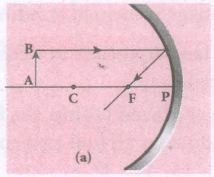
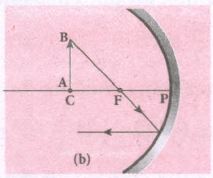
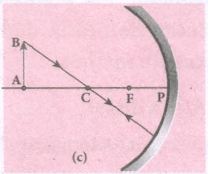
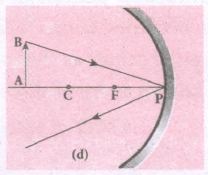
Draw and explain the image formation in spherical mirrors.
2.
A double convex lens made of glass of refractive index 1.5 has both radii of curvature 20 cm each. Find the focal length of the lens. If an object is placed at a distance of 15cm from this lens, find the position of the image formed.
3.
What is the focal length of a convex lens (μ = 1.5) with radii of curvature R.
4.
Lightly falls from glass (μ = 1.5) to air. Find the angle of incidence for which the angle of deviation is 90o.
5.
Calculate the angle of dispersion between red and violet colours produced by a flint glass prism of refracting angle of 600. Given μv = 1.633 and = μr 1.622.
1.
The image can be located by graphical construction. To locate the point of an image, a minimum of two rays must meet at that point.
(i) A ray parallel to the principal axis after reflection will pass through or appear to pass through the principle focus. (Figure(a))
(ii) A ray passing through or appear to pass through the principal focus after reflection will travel parallel to the principal axis. (Figure(b) )
(iii) A ray passing through the center of curvature retraces its path after reflection as it is a case of normal incidence. (Figure(c))
(iv) A ray falling on the pole will get reflected as per the law of reflection keeping the principal axis as normal. (Figure( d))
2.
\(\cfrac { 1 }{ f } =\left( { n }_{ 2 }-1 \right) \left( \cfrac { 1 }{ { R }_{ 1 } } -\cfrac { 1 }{ { R }_{ 2 } } \right) \)
= \(\left( 1.5-1 \right) \left( \cfrac { 1 }{ 20 } -\cfrac { 1 }{ -20 } \right) =\cfrac { 1 }{ 20 } \)
or f = 20 cm
Using \(\cfrac { 1 }{ v } -\cfrac { 1 }{ -f } =\cfrac { 1 }{ f } \) ,we get
\(\cfrac { 1 }{ v } -\cfrac { 1 }{ -15 } =\cfrac { 1 }{ 20 } \)
v = -60 cm.
3.
From the lens maker's formula,
\(\cfrac { 1 }{ f } =\left( \mu -1 \right) \left( \frac { 1 }{ { R }_{ 1 } } -\frac { 1 }{ { R }_{ 2 } } \right) \)
Here, μ = 1.5; R1 = R2 and =-R
\(\therefore \cfrac { 1 }{ f } =\left( 1.5-1 \right) \left( \cfrac { 1 }{ R } -\cfrac { 1 }{ -R } \right) =0.5\times \cfrac { 2 }{ R } =\cfrac { 1 }{ R } \)
or f = R.
4.
\(sin{ i }_{ c }=\cfrac { 1 }{ \mu } =\cfrac { 1 }{ 1.5 } =0.667\\ \)
or ic= 41.8o
Deviation = 90o - i = 90o - 41.8o = 48.2o
This si the maximum attainable deviation in refraction. So, the given data favours total internal reflection.
In reflection, deviation = 180o - 2i
or 90o = 180o - 2i or 2i = 90o or i = 45o
or i = 45o
5.
For minimum deviation position
\({ \mu }_{ red }=\cfrac { sin\left( \frac { A+{ \delta }_{ red } }{ 2 } \right) }{ sin\frac { A }{ 2 } } \)
or \(sin\left( \cfrac { A+{ { \delta }_{ red } } }{ 2 } \right) ={ n }_{ red }\)
\(sin\cfrac { 2 }{ A } =1.622\times 0.5=0.811\)
\(\therefore \cfrac { 60+{ \lambda }_{ red } }{ 2 } ={ 54 }^{ o }12'\)
\({ \delta }_{ red }={ 108 }^{ o }24'-{ 60 }^{ o }={ 48 }^{ o }24'\)
Similarly, \(sin\left( \cfrac { A+{ \delta }_{ viloet } }{ 2 } \right) =1.663\times 0.5'\)
= 0.8315 or \(\cfrac { { 60 }^{ o }+{ \delta }_{ viloet } }{ 2 } =56^{ o }15'\)
\({ \delta }_{ viloet }=112^{ o }30'-{ 60 }^{ ' }={ 52 }^{ o }30'\)
\(\therefore { \delta }_{ violet }-{ \delta }_{ red }=\left( 52-30' \right) -\left( 48^{ o }24' \right) ={ 4 }^{ o }6'\)
It is not advisable to use the formula,
\({ \delta }_{ v }-{ \delta }_{ r }=\left( { \mu }_{ v }-{ \mu }_{ r } \right) \) in the above solution.

12th Standard Syllabus & Materials
12th Standard
TN 12th Computer Applications வலையமைப்பு வடமிடல் Sample Question Papers Study Material - QB365 Set A
NEW12th Standard
TN 12th Computer Applications களப்பெயர் முறைமை (DNS) Sample Question Papers Study Material - QB365 Set A
NEW12th Standard
TN 12th Computer Applications வலையமைப்பு எடுத்துக்காட்டுகள் மற்றும் நெறிமுறைகள் Sample Question Papers Study Material - QB365 Set A
NEW12th Standard
TN 12th Computer Applications கணினி வலையமைப்பு ஓர் அறிமுகம் Sample Question Papers Study Material - QB365 Set A



Tamilnadu Stateboard 12th Standard Subjects

Maths

Chemistry
Physics

Biology

Computer Science

Business Maths and Statistics

Economics

Commerce

Accountancy

History

Computer Applications
Biology
Computer Technology
Computer Applications
Computer Science
Business Maths and Statistics
Commerce
Economics
Maths
Chemistry
Physics
Computer Technology
History
Accountancy

Tamil

English

French
Tamilnadu Stateboard Standards



