
 100% FREE ACCESS
12th Standard Syllabus & Materials
12th Standard
TN 12th Maths Applications of Matrices and Determinants Sample Question Papers Study Material - QB365 Set A
NEW12th Standard
TN 12th Computer Applications மின்னணு தரவு பரிமாற்றம் Sample Question Papers Study Material - QB365 Set A
NEW12th Standard
TN 12th Computer Applications மின் - வணிக பாதுகாப்பு அமைப்புகள் Sample Question Papers Study Material - QB365 Set A
NEW12th Standard
TN 12th Computer Applications மின்னணு செலுத்தல் முறைகள் Sample Question Papers Study Material - QB365 Set A
NEW12th Standard
TN 12th Computer Applications மின் - வணிகம் Sample Question Papers Study Material - QB365 Set A
NEW12th Standard
TN 12th Computer Applications திறந்த மூல கருத்துருக்கள் Sample Question Papers Study Material - QB365 Set A

Published on: 13/05/2022
QB365 provides detailed and simple solution for every Book back Questions in class 12 Physics Subject. It will helps to get more idea about question pattern in every book back questions with solution.
latest Book back QuestionsDownload Tamil Nadu 12th Standard Physics question papers, model tests, one-mark questions, important questions, and public exam papers in PDF format. Free study materials and answer keys for TN State Board students.
Questions + Answers key
Take MCQ Physics Test1.
What are the possible harmful effects of usage of Nanoparticles? Why?
2.
Discuss the applications of Nanomaterials in various fields.
3.
Comment on the recent advancement in medical diagnosis and therapy.
4.
Elaborate any two types of Robots with relevant examples.
5.
Discuss the functions of key components in Robots?
1.
Possible harmful effects of nanoparticles:
(i) They may easily get absorbed onto the surface of living organisms as dimensions of the nano particles are the same as that of biological molecules such as proteins.
(ii) They readily enter the tissues and fluids of the body and distort their functions
(iii) Nano particles can also cross cell membranes so that, interaction with living systems is affected
(iv) It is also possible for the inhaled nanoparticles to reach the blood, to reach other sites such as the liver, heart or blood cells.
2.
Materials made up of particles sizes of 1-100 made up nm differ in their properties from the materials made up of bulk particles. Thus, nano materials find wide range of applications
Automotive industry :
(i) Lightweight construction
(ii) Painting (fillers, base coat, clear coat)
(iii) Catalysts
(iv) Tires (fillers)
(v) Sensors
(vi) Coatings for wind-screen and car bodies.
Chemical industry :
(i) Fillers for paint systems
(ii) Coating systems based on nanocomposites
(iii) Impregnation of papers
(iv) Switchable adhesives
(v) Magnetic fluids
Engineering :
(i) Wear protection for tools and machines (anti blocking coatings, scratch resistant coatings on plastic parts etc.)
(ii) Lubricant-free bearings.
Electronic industry :
(i) Data memory
(ii) Displays
(iii) Laser diodes
(iv ) Glass fibres
(v) Optical switches
(vi) Filters (lR-blocking)
(vii) Conductive, antistatic coatings.
Construction :
(i) Construction materials
(ii) Thermal insulation
(iii) Flame retardants
(iv) Surface-functionalised building materials for wood, floors, stone, facades, tiles, roof tiles, etc.
(v) Facade coating
(v) Groove mortar.
Medicine :
(i) Drug delivery systems
(ii) Active agents
(iii) Contrast medium
(iv) Medical rapid tests
(v) Prostheses and implants
(vi) Antimicrobial agents and coatings
(vii) Agents in cancer therapy.
Textile/fabrics/non-wovens :
(i) Surface-processed textiles
(ii) smart clothes.
Energy :
(i) Fuel cells
(il) Solar cells
(iii) Batteries
(iv) Capacitors.
Cosmetics :
(i) Sun protection
(ii) Lipsticks
(iii) Skin creams
(iv) Tooth paste.
Food and drinks :
(i) Package materials
(ii) Storage life sensors
(iii) Additives
(iv) Clarification of fruit juices.
Household :
(i) Ceramic coatings for irons
(ii) Orders catalyst
(iii) Cleaner for glass, ceramic, floor, windows.
Sports/Outdoor :
(i) Ski wax
(ii) Antifogging of glasses /goggles
(iii) Antifouling coating for ships /boats
(iv) Reinforced tennis rackets and balls.
3.
The innovation in medical diagnosis has taken leaps and bounds due to integration of technology and basic physics. A few of such advancements are discussed below:
Virtual reality :
Medical virtual reality is effectively used to stop the brain from processing pain and cure soreness in the hospitalized patients. Virtual reality has enhanced surgeries by the use of 3D models by surgeons to plan operations. It helps in the treatment of Autism, Memory loss, and Mental illness.
Precision medicine (or) customised health care :
In this approach, individual variability in genes, environment and life style for each person are aken into account for disease treatment and prevention. Hence, it is possible to customise health care. Medical decisions, treatments, practices or products and others are tailored to the individual patient.
Health wearables :
It is a device used for tracking a wearer's vital signs or health and fitness related data, location, ete. Medical wearables with artificial intelligence and big data provide an added value to healthcare with a focus on diagnosis, treatment, patient monitoring and prevention.
Artificial organs :
An artificial organ is an engineered device or tissue that is implanted or integrated into a human. It is possible to interface it with living tissue or to replace a natural organ. It duplicates or augments a specific function or functions of human organs so that the patient may return to a normal life as soon as possible.
3D Printing :
Advanced 3D printer systems and materials assist physicians in a range of operations in the medical field from audiology, dentistry orthopedics and other applications
Wireless brain sensors :
Wireless brain sensors monitor intracranial pressure and temperature and then are absorbed by the body. Hence there is no need for surgery to remove these devices.
Robotic surgery :
Robotic surgery is robotically assisted surgery helps to overcome the limitations of pre-existing minimally-invasive surgical procedures and to enhance the capabilities of surgeons performing open surgery.
Smart inhalers :
Inhalers are the main treatment option for asthma. Smart inhalers use bluetooth technology to detect inhaler use, remind patients when to take their medication and gather data to help guide care.
4.
a) Human Robot :
Robots are made to resemble humans in appearance and replicate the human activities like walking, lifting, and sensing, etc.
The important part of human Robots are :
(i) Power conversion unit : Robots are powered by batteries, solar power, and hydraulics.
(ii) Actuators: It converts energy into movement. The majority of the actuators produce rotational or linear motion.
(iii) Pneumatic Air Muscles : They are devices that can contract and expand, when air is pumped inside.
(iv) Muscle wires : They are thin strands of wire made of shape memory alloys. They can contract by 5% when electric current is passed through them.
(v) Sensors: Generally used in task environments as it provides information of real-time knowledge.
(vi) Electric motors : Different types of motors are used. The most often used ones are AC motor, Brushed DC motor, Brushless DC motor, Geared DC motor etc,. They are used to actuate the parts of the robots like wheels, arms, fingers, legs, sensors, camera, weopons, systems, etc.
(vii) Robot locomotion : It provides different types of movement to the Robot. They are,
(a) Legged.
(b) Wheeled.
(c) Combination of Legged and Wheeled Locomotion.
(d) Tracked slip/skid.
(viii) Controller : lt is known as the "brain" which is run by a computer program. It gives commands for the moving parts to perform the job.
(vi) Piezo Motors and Ultrasonic Motors : It is used for industrial robots.
(x) Artificial Intelligence : The artificial intelligence is introduced into robots to bring in human like behavior in robots. Now they work on,
(a) Face recognition.
(b) Providing response to player's actions in computer games.
(c) Taking decisions based on previous actions.
(d) To regulate the traffic by analyzing the density of traffic on roads.
(e) Translate words from one language to another.
b) Industrial Robots :
There are six types of industrial robots.
(i) Cartesian.
(ii) Selective Compliance Assembly Robot Arm (SCARA).
(iii) Cylindrical.
(iv) Delta.
(v) Polar.
(vi) Vertically articulated.
Again six-axis robots are ideal for Are Welding, Spot Welding, Material Handling and Machine Tending and other applications. They can work for 24 x 7, stronger and faster than humans. However, humans cannot be replaced by robots in decision making.
5.
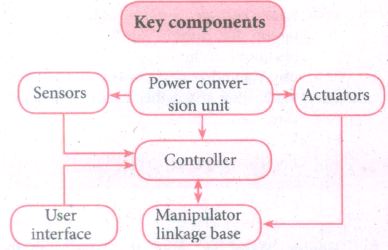
The key components in Robots are power conversion unit, actuators, controller, sensors, manipulators and necessary software.
The following diagram clearly explains the functions of the key components.
Most Robots are composed of 3 Main parts:
i) The controller:
It is known as the 'brain' which is run by computer program. It gives commands for the moving parts to perform the job.
ii) Sensors:
It tells the robot about its surroundings. It helps to determine the sizes and shapes of the objects around, distance between the objects and directions as well.
iii) Mechanical parts:
It makes the robot to move, grab, turn and lift. It consists of motors, pistons, grippers, wheels and gears.

12th Standard Syllabus & Materials
12th Standard
TN 12th Computer Applications வலையமைப்பு வடமிடல் Sample Question Papers Study Material - QB365 Set A
NEW12th Standard
TN 12th Computer Applications களப்பெயர் முறைமை (DNS) Sample Question Papers Study Material - QB365 Set A
NEW12th Standard
TN 12th Computer Applications வலையமைப்பு எடுத்துக்காட்டுகள் மற்றும் நெறிமுறைகள் Sample Question Papers Study Material - QB365 Set A
NEW12th Standard
TN 12th Computer Applications கணினி வலையமைப்பு ஓர் அறிமுகம் Sample Question Papers Study Material - QB365 Set A



Tamilnadu Stateboard 12th Standard Subjects

Maths

Chemistry
Physics

Biology

Computer Science

Business Maths and Statistics

Economics

Commerce

Accountancy

History

Computer Applications
Biology
Computer Technology
Computer Applications
Computer Science
Business Maths and Statistics
Commerce
Economics
Maths
Chemistry
Physics
Computer Technology
History
Accountancy

Tamil

English

French
Tamilnadu Stateboard Standards



