
 100% FREE ACCESS
12th Standard Syllabus & Materials
12th Standard
TN 12th Maths Applications of Matrices and Determinants Sample Question Papers Study Material - QB365 Set A
NEW12th Standard
TN 12th Computer Applications மின்னணு தரவு பரிமாற்றம் Sample Question Papers Study Material - QB365 Set A
NEW12th Standard
TN 12th Computer Applications மின் - வணிக பாதுகாப்பு அமைப்புகள் Sample Question Papers Study Material - QB365 Set A
NEW12th Standard
TN 12th Computer Applications மின்னணு செலுத்தல் முறைகள் Sample Question Papers Study Material - QB365 Set A
NEW12th Standard
TN 12th Computer Applications மின் - வணிகம் Sample Question Papers Study Material - QB365 Set A
NEW12th Standard
TN 12th Computer Applications திறந்த மூல கருத்துருக்கள் Sample Question Papers Study Material - QB365 Set A

Published on: 13/05/2022
QB365 provides detailed and simple solution for every Book back Questions in class 12 Physics Subject. It will helps to get more idea about question pattern in every book back questions with solution.
latest Book back QuestionsDownload Tamil Nadu 12th Standard Physics question papers, model tests, one-mark questions, important questions, and public exam papers in PDF format. Free study materials and answer keys for TN State Board students.
Questions + Answers key
Take MCQ Physics Test1.
Mention different parts of spectrometer and explain the preliminary adjustments.
2.
Explain the experimental determination of refractive index of the material of the prism using spectrometer.
3.
Obtain the equation for resolving power of optical instruments.
4.
Discuss the experiment to determine the wavelength of monochromatic light using diffraction grating.
5.
Explain about compound microscope and obtain the equation for the magnification.
1.
i) The spectrometer is an optical instrument used to analyse the spectra of different sources of light, to measure the wavelength of different colours and to measure the refractive indices of materials of prisms.
ii) It basically consists of three parts namely. They are (i) collimator, (ii) prism table and (iii) Telescope
Adjustments of the spectrometer
(i) The following adjustments must be done in a spectrometer before doing the experiment.
(a) Adjustment of the eyepiece:
The telescope is turned towards an illuminated surface and the eyepiece is moved to and fro until the cross wires are clearly seen.
(b) Adjustment of the telescope:
The telescope is adjusted to' receive parallel rays by turning it towards a distant object and adjusting the distance between the objective lens and the eyepiece to get a clear image on the cross wire.
(c) Adjustment of the collimator:
The telescope is brought in line with the collimator. The distance between the illuminated slit and the lens of the collimator is adjusted until a clear image of the slit is seen at the cross wire.
(d) Levelling the prism table:
The prism table is brought to the horizontal level by adjusting the levelling screws and it is ensured by using sprit level.
2.
The preliminary adjustments of the spectrometer are done. The refractive index of the prism can be determined by measuring the angle of the prism (A) and the angle of minimum deviation (D).
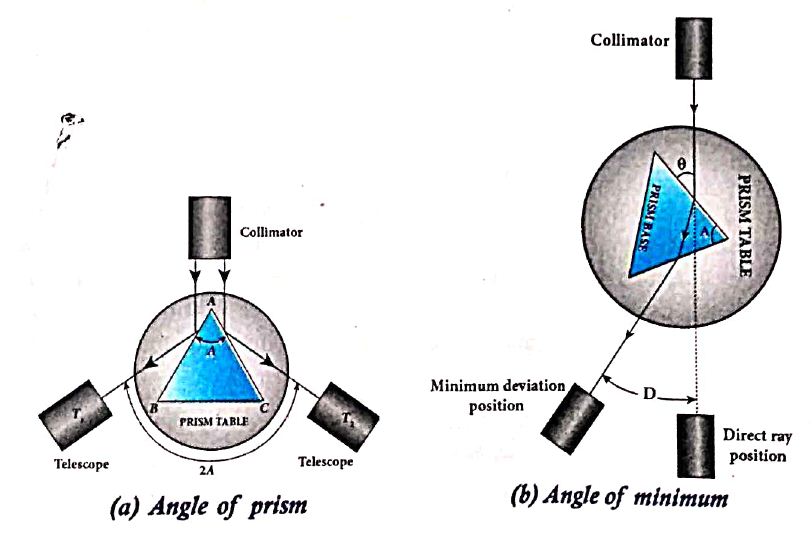
i) Angle of the prism (A):
(i) The prism is placed on the prism table with its refracting angle (A) facing the collimator as shown in Figure (a).
(ii) The slit is illuminated by sodium light (monochromatic light)
(iii)The parallel rays coming from the collimator fall on the two faces AB and AC and get reflected.
(iv) The telescope is rotated to the position T1 and T2 to capture the reflected rays and the two reading are noted
(v) The difference between these two readings gives the angle rotated by the telescope, which is twice the angle of the prism.
(vi) Half of this value gives the angle of the prism A.
ii) Angle of minimum deviation (D):
(i) The prism is placed on the prism table so that the light from the collimator falls on a refracting face, and the refracted image is observed through the telescope as shown in Figure.
(ii) The prism table is now rotated so that the angle of deviation decreases.
(iii) A stage comes when the image stops and returns on further rotation of the prism table.
(iv) This is ensured by looking through the telescope simultaneously. The reading in this position gives the minimum deviation position.
(v) Now, the prism is removed and the telescope is turned to receive the direct ray and the reading is noted.
(vi) The difference between the two readings gives the angle of minimum deviation D.
(vii) The refractive index of the material of the prism n is calculated using the formula,
\(\\ n=\cfrac { sin\left( \frac { A+D }{ 2 } \right) }{ sin\left( \frac { A }{ 2 } \right) } \) ..................(1)
The refractive index of a liquid may be determined in the same way using a hollow glass prism filled with the given liquid.
3.
(i) The effect of diffraction has an adverse effect in the sharpness of the image tormed.
(ii) There is always a spread of central maximum in the image for every point of the object, for every point of the object acts as a point source.
(iii) The condition for central maximum (or first minimum) produced by rectangular slit is given by the equation,
\(a \sin \theta=\lambda\) ....(1)
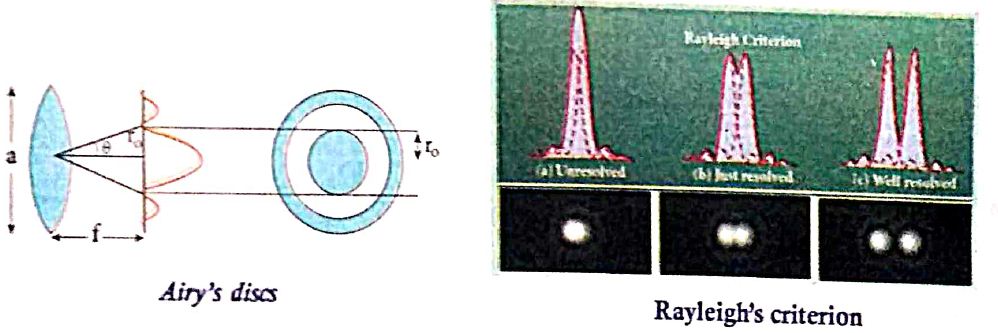
(iv) But, a circular slit (aperture) produces diffraction pattern of concentric circles as shown in Figure.
(v) These are known as Airy's discs. Most of the optical instruments form images of objects only through the circular slits.
(vi) The condition for central maximum (or) first minimum for circular slit is,
\(\text { a } \sin \theta=1.22 \lambda\) .....(2)
(vii) Here, the numerical value 1.22 appears in the expression for central maximum (or) first minimum formed by circular slits.
For small angles,\(sin\theta = \theta\), the above equation becomes,
\(a\theta = 1.22\lambda\)
Rewriting further,
\(\theta=\frac{1.22 \lambda}{a}\) ......(3)
Form thegeometry, \(\theta=\frac{r_0}{f}\)
Substituting for in equation (3) and rearranging gives
\(r_0=\frac{1.22 \lambda f}{a}\) ....(4)
(viii) For example, let two point-sources of light close to cach other form image on a screen. The diffraction pattern of one point-source may overlap with another and produce a blurred image (or) un-resolved image as shown in Figure (a). To obtain a quality image (or) well resolved image, the two point-sources must be kept apart in such a way that their diffraction patterns do not overlap as shown in Figure (c).
(ix) According to Rayleigh's criterion, the two points on an image are said to be just resolved when the central maximum of one diffraction pattern coincides with the first minimum of the other and vice-versa as shown in Figure (b).
4.
(i) The wavelength of a spectral line can be very accurately determined with the help of a diffraction grating. For that we need to use an instrument called spectrometer.
(ii) The slit of collimator is illuminated by a monochromatic light, whose wavelength is to be determined.
(iii) The telescope is brought in line with collimator to view the image of the slit.
(iv) The given plane transmission grating is then mounted on the prism table with its plane perpendicular to the incident beam of light coming from the collimator.
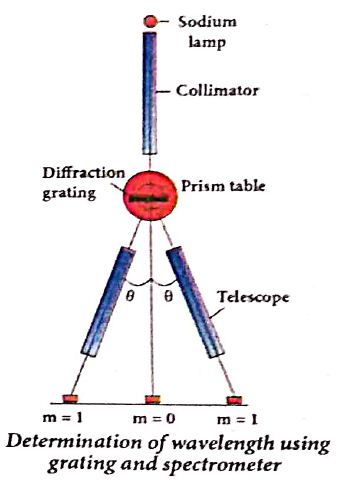
(v)The telescope is turned to one side until the first order diffraction image of the slit coincides with the vertical cross wire of the eye piece.
(vi) The reading of the position of the telescope is noted.
(vii) Similarly the first order diffraction image on the other side is made to coincide with the vertical cross wire and corresponding reading is noted.
(viii) The difference between two positions gives 2θ. Half of its value gives θ, the diffraction angle for first order maximum as shown in Figure.
The wavelength of light is calculated from the equation.
\(\\ \lambda =\cfrac { sin\theta }{ Nm } \)
(ix) Here, N is the number of rulings per metre in the grating and m is the order of the diffraction image.
5.
(i) It forms a real, inverted and magnified image of the object. This serves as the object for the lens close to the eye called as eyepiece.
(ii) The eyepiece serves as a simple microscope that produces finally an enlarged and virtual image.
(iii) The first inverted image formed by the objective is to be adjusted within the focus of the eyepiece so that the final image is formed nearly at infinity (or) at the near point.
(iv) The final image is inverted with respect to the object
Magnification of compound microscope:
(i) From the ray diagram, the linear magnification due to the objective is,
\({ M }_{ 0 }=\cfrac { h' }{ h } \) ..............(1)
From the Figure,\(tan\beta =\cfrac { h }{ { f }_{ 0 } } =\cfrac { h' }{ L } \) then
\(\cfrac { h' }{ h } =\cfrac { L }{ { f }_{ 0 } } \) ...............(2)
\({ m }_{ 0 }=\cfrac { L }{ { f }_{ 0 } } \) ..............(3)
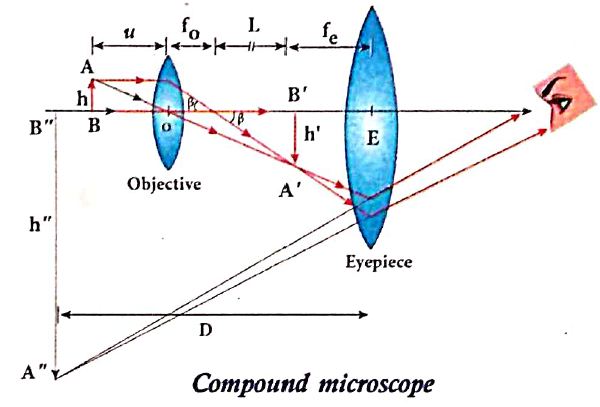
(ii) Here, the distance L is between the first focal point of the eyepiece to the second focal point of the objective. This is called the tube length of the microscope as f0 and fe are comparatively smaller than L.
(iii) If the final image is formed at (near point focussing); the magnification (me) of the eyepiece is,
\({ m }_{ e }=1+\cfrac { D }{ { f }_{ e } } \) ..............(4)
The total magnification m in near point focusing is,
\(m={ m }_{ 0 }{ m }_{ e }\left( \cfrac { L }{ { f }_{ 0 } } \right) \left( 1+\cfrac { D }{ { f }_{ e } } \right) \) ...............(5)
If the final image is formed at infinity (normal focusing), the magnification me of the eyepiece is,
\({ m }_{ e }=\cfrac { D }{ { f }_{ e } } \) ......................(6)
The total magnification m in normal focusing is,
\(m=m_{ 0 }{ m }_{ e }=\left( \cfrac { L }{ { f }_{ 0 } } \right) \left( \cfrac { D }{ { f }_{ e } } \right) \) ....................(7)

12th Standard Syllabus & Materials
12th Standard
TN 12th Computer Applications வலையமைப்பு வடமிடல் Sample Question Papers Study Material - QB365 Set A
NEW12th Standard
TN 12th Computer Applications களப்பெயர் முறைமை (DNS) Sample Question Papers Study Material - QB365 Set A
NEW12th Standard
TN 12th Computer Applications வலையமைப்பு எடுத்துக்காட்டுகள் மற்றும் நெறிமுறைகள் Sample Question Papers Study Material - QB365 Set A
NEW12th Standard
TN 12th Computer Applications கணினி வலையமைப்பு ஓர் அறிமுகம் Sample Question Papers Study Material - QB365 Set A



Tamilnadu Stateboard 12th Standard Subjects

Maths

Chemistry
Physics

Biology

Computer Science

Business Maths and Statistics

Economics

Commerce

Accountancy

History

Computer Applications
Biology
Computer Technology
Computer Applications
Computer Science
Business Maths and Statistics
Commerce
Economics
Maths
Chemistry
Physics
Computer Technology
History
Accountancy

Tamil

English

French
Tamilnadu Stateboard Standards



