
 100% FREE ACCESS
12th Standard Syllabus & Materials
12th Standard
TN 12th Computer Applications மின்னணு தரவு பரிமாற்றம் Sample Question Papers Study Material - QB365 Set A
NEW12th Standard
TN 12th Computer Applications மின் - வணிக பாதுகாப்பு அமைப்புகள் Sample Question Papers Study Material - QB365 Set A
NEW12th Standard
TN 12th Computer Applications மின்னணு செலுத்தல் முறைகள் Sample Question Papers Study Material - QB365 Set A
NEW12th Standard
TN 12th Computer Applications மின் - வணிகம் Sample Question Papers Study Material - QB365 Set A
NEW12th Standard
TN 12th Computer Applications திறந்த மூல கருத்துருக்கள் Sample Question Papers Study Material - QB365 Set A
NEW12th Standard
TN 12th Computer Applications வலையமைப்பு வடமிடல் Sample Question Papers Study Material - QB365 Set A

Published on: 13/05/2022
QB365 provides detailed and simple solution for every Book back Questions in class 12 Physics Subject. It will helps to get more idea about question pattern in every book back questions with solution.
latest Book back QuestionsDownload Tamil Nadu 12th Standard Physics question papers, model tests, one-mark questions, important questions, and public exam papers in PDF format. Free study materials and answer keys for TN State Board students.
Questions + Answers key
Take MCQ Physics Test1.
Discuss the experiment to determine the wavelength of different colours using diffraction grating.
2.
Discuss the diffraction at a grating and obtain the condition for the mth maximum.
3.
Discuss the interference in thin films and obtain the equations for constructive and destructive interference for transmitted and reflected light.
4.
Obtain the equation for resultant intensity due to interference of light.
5.
Prove law of reflection using Huygens’ principle.
1.
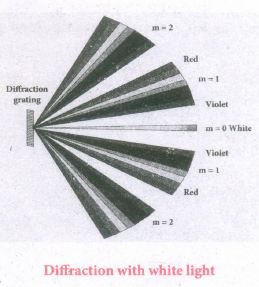
(i) Thediffraction pattern for white light consists of a white central maximum and on both side continuous coloured diffraction pattenrs are formed.
(ii) The central maximum is white as all the colours constructively meet at centre with no path difference. As \(\theta\) increases, the path difference fuifills the condition for maxima of different orders for all colours from violet to red.
(iii) It produces a spectrum of diffraction pattern from violet to red on either side of central maximum as shown in Figure.
(iv) By measuring the angle at which these colours appear for various orders of diffraction, the wavelength of different colours could be calculated using the formula.
\(\lambda =\cfrac { sin\theta }{ Nm } \)
(v) Here, N is the number of rulings per metre in the grating and m is the order of the diffraction image.
2.
(i) Gratting has multiple slits with equal widths of size comparable to the wavelength of diffracting light.
(ii) Grating is a plane sheet of transparent material on which opaque rulings are made with a fine diamond pointer.
(iii) The modern commercial grating contains about 6000 lines per centimeter. The rulings act as obstacles having a definite width b and the transparent space between the rulings act as slit of width a.
(iv) The combined width of a ruling and a slit is called Gratting element (e = a + b).
(v) points on slit separated by a distance equal to the grating element are called corresponding points.
(vi) A plane transmission grating is represented by AB in Figure. Let a plane wavefront of monochromatic light with wavelength λ be incident on the grating.
(vii) As the width of the slits is comparable to that of wavelength, the incident light undergoes diffraction.
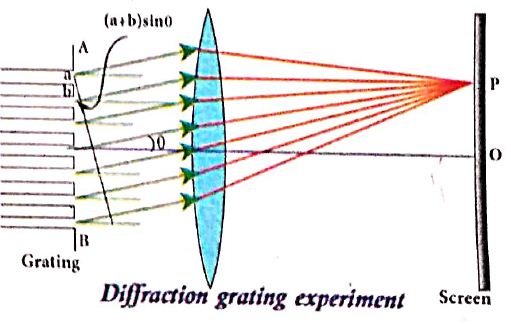
(viii) A diffraction pattern is obtained on the screen when the diffracted waves are focused on a screen using a convex lens.
(ix) Let us consider a point P at an angle θ with the perpendicular drawn from the center of the grating to the screen.
(x) The path difference ઠ between the diffracted waves from one pair of corresponding points is,
\(\delta =(a+b)sin\theta \) ........(1)
This path difference is the same for any pair of corresponding points. The point P on the screen will be maximum, when
ઠ= m λ where m = 0,1,2,3 ........(2)
Combining the above two equations, we get,
(a + b) sin θ = mλ ...............(3)
Here, m is called order of diffraction.
Condition for mth order maximum :
(i) On the side of central maxima different higher orders of diffraction maxima are formed at different angular positions. If we take,
\(N=\cfrac { 1 }{ a+b } \) .................(4)
(ii) Then, N gives the number of grating elements or rulings drawn per unit width of the grating. Normally, this number N is specified on the grating itself. Now, the equation becomes,
\(\cfrac { 1 }{ N } sin\theta =m\lambda \) (or) \(sin\theta =Nm\lambda \) ...............(5)
3.
For transmitted light :
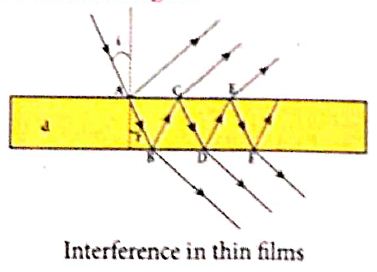
(i) The light transmitted may interfere to produce a resultant intensity. Consider the path difference between the two light waves transmitted from B and D.
(ii) The two waves moved together and remained in phase up to B where splitting occurred.
The extra path travelled by the wave transmitted from D is the path inside the film, BC + CD.
(iii) If we approximate the incidence to be nearly normal (i = 0), then the points B and D are very close to each other.
(iv) The extra distance travelled by the wave is approximately twice thickness of the film, BC + CD = 2d. As this extra path is traversed inside the medium of refractive index m, the optical path difference is, d = 2μd.
(v) The condition for constructive interference in transmitted ray is,
\(2\mu d=n\lambda \) .....(1)
(vi) Similarly, the condition for destructive interference in transmitted ray is,
\(2\mu d=\left( 2n-1 \right) \cfrac { \lambda }{ 2 } \) .....(2)
For reflected light:
(i) It is experimentally and theoretically proved that a wave while travelling in a rarer medium and getting reflected by a denser medium, undergoes a phase change of π.
(ii) Hence, an additional path difference of \(\cfrac { \lambda }{ 2 } \) should be considered for reflected light.
(iii) Let us consider the 2 path difference between the light waves reflected by the upper surface at A and the other wave coming out at C after passing through the film.
(iv) The additional path travelled by wave coming out from C is the path inside the film, AB + BC. For nearly normal incidence this distance could be approximated as, AB + BC = 2d.
(v) As this extra path is travelled in the medium of refractive index μ, the optical path difference is, ઠ = 2μd.
(vi)The condition for constructive interference for reflected ray is,
\(2\mu d+\cfrac { \lambda }{ 2 } =n\lambda \) (or) \(2\mu d=\left( 2n-1 \right) \cfrac { \lambda }{ 2 } \) .....(3)
(vii) The additional path difference \(\cfrac { \lambda }{ 2 } \) is due to the phase change of π in rarer to denser reflection taking place at A.
(viii) The condition for destructive interference for reflected ray is
\(2\mu d+\cfrac { \lambda }{ 2 } =\left( 2N+1 \right) \cfrac { \lambda }{ 2 } \) (or) \(2\mu d=n\lambda \) ....(4)
4.
Let us Consider two light waves from the two sources SI and S2 meeting at a point P as shown in figure
The wave from SI at an instant t at P is,
y1= a1 sin ω t ...................(1)
The wave form S2 at an instant t at P is,
y2= a2 sin (ωt + Φ) .............(2)
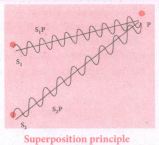
The two waves have different amplitudes al and a2 , same angular frequency ω, and a phase difference of \(\phi\)
y = y1 + y2 = a1 = a\sin ωt + a1sin2 (ωt + Φ) ............(3)
The simplification of the above equation by using trigonometric identities,
\(y=Asin\left( \omega t+\theta \right) \) ..............(4)
where, \(A=\sqrt { { a }_{ 1 }^{ 2 }+{ a }_{ 2 }^{ 2 }+2{ a }_{ 1 }{ a }_{ 2 }cos\phi } \) ..................(5)
\(\theta ={ tan }^{ -1 }\cfrac { { a }_{ 2 }sin\phi }{ { a }_{ 1 }+{ a }_{ 2 }cos\phi } \) ..................(6)
The resultant amplitude is maximum,
\({ A }_{ max }=\sqrt { \left( { a }_{ 1 }+{ a }_{ 2 } \right) ^{ 2 } } \) ; When Φ = 0,± 2π , ± 4π... ................(7)
The resultant amplitude is minimum
\({ A }_{ min }=\sqrt { \left( { a }_{ 1 }+{ a }_{ 2 } \right) ^{ 2 } } \); When Φ = ±π, ± 3π, ± 5π..., ............(8)
The intensity of light is proportional to square of amplitude,
I ∝ A2 ...........(9)
Now, equation (5) becomes,
\(1\infty { I }_{ 1 }+I_{ 2 }+2\sqrt { { I }_{ 1 }{ { I }_{ 2 } } } cos\phi \) ..........(10)
In equation (10) if the phase difference, f = 0, ± 2π, ± 4π ... , it corresponds to the condition for maximum intensity of light called as constructive interference.
The resultant maximum intensity is
\({ I }_{ max }\propto \left( { a }_{ 1 }+{ a }_{ 2 } \right) ^{ 2 }\propto { I }_{ 1 }{ I }_{ 2 }+2\sqrt { { \quad I }_{ 1 }{ I }_{ 2 } } \) ...............(11)
In equation (10) if the phase difference, Φ = ±π, ±3π, ± 5π ... , it corresponds to the condition for minimum intensity of light called destructive interference.
The resultant minimum intensity is,
\({ I }_{ min }\propto \left( { a }_{ 1 }+{ a }_{ 2 } \right) \propto { I }_{ 1 }+{ I }_{ 2 }2\sqrt { { I }_{ 1 }{ I }_{ 2 } } \) ................(12)
As a special case, if a1 = a2 = a, then equation (5) becomes
\(A=\sqrt{2 a^{2}+2 a^{2} \cos \phi} =\sqrt{2 a^{2}(1+\cos \theta)} \)
\(=\sqrt{2 a^{2} 2 \cos ^{2}\left(\frac{\phi}{2}\right)} \)
\(\mathrm{A}=2 \mathrm{a} \cos (\phi / 2) \) ........(13)
\(\mathrm{I} \alpha 4 \mathrm{a}^{2} \cos ^{2}(\phi / 2)\left[\therefore \mathrm{I} \alpha \mathrm{A}^{2}\right] \) ..............(14)
\(\mathrm{I}=4 \mathrm{I}_{0} \cos ^{2}(\phi / 2)\left[\therefore \mathrm{I}_{0} \alpha \mathrm{a}^{2}\right] \) ...............(15)
\(\mathrm{I}_{\max }=4 \mathrm{I}_{0} \text { when, } \phi=0, \pm 2 \pi, \pm 4 \pi \ldots . \) ...............(16)
\(\mathrm{I}_{\min }=0 \text { when, } \phi=\pm \pi, \pm 3 \pi, \pm 5 \pi \ldots . \) .............(17)
5.
(i) Let us consider a parallel beam of light, incident on a reflecting plane surface such as a plane mirror XY.
(ii) The incident wavefront is AB and the reflected waterfront is A'B'.
(iii) These wavefronts are perpendicular to the incident rays L, M and reflected rays L', M', respectively.
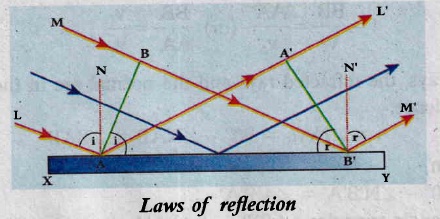
(i) The incident rays, the reflected rays and the normal are in the same plane.
(ii) Angle of incidence, ∠i = ∠NAL = 90°- ∠NAB = ∠BAB'
Angle of reflection ∠r = ∠N'B'M = 90°- ∠N'B'A'= ∠A'B'A
(a) For the two right angle triangles, ∆ABB' and ∆B'A'A, the two right angles, ∠B and ∠A' are equal, (∠B and ∠A' = 90°); the two sides., AA' and BB' are equal, (AA' = BB'); the side AB' is common
(b) Thus the two triangles are congruent. As per the property of congruency, the two angles, ∠BAB' and ∠A'B'A must also be equal.
i = r
Hence, the laws of reflection are proved.

12th Standard Syllabus & Materials
12th Standard
TN 12th Computer Applications களப்பெயர் முறைமை (DNS) Sample Question Papers Study Material - QB365 Set A
NEW12th Standard
TN 12th Computer Applications வலையமைப்பு எடுத்துக்காட்டுகள் மற்றும் நெறிமுறைகள் Sample Question Papers Study Material - QB365 Set A
NEW12th Standard
TN 12th Computer Applications கணினி வலையமைப்பு ஓர் அறிமுகம் Sample Question Papers Study Material - QB365 Set A
NEW12th Standard
TN 12th Computer Applications PHP-உடன் MySQL-ஐ இணைத்தல் Sample Question Papers Study Material - QB365 Set A



Tamilnadu Stateboard 12th Standard Subjects

Maths

Chemistry
Physics

Biology

Computer Science

Business Maths and Statistics

Economics

Commerce

Accountancy

History

Computer Applications
Biology
Computer Technology
Computer Applications
Computer Science
Business Maths and Statistics
Commerce
Economics
Maths
Chemistry
Physics
Computer Technology
History
Accountancy

Tamil

English

French
Tamilnadu Stateboard Standards



