
 100% FREE ACCESS
12th Standard Syllabus & Materials
12th Standard
TN 12th Maths Applications of Matrices and Determinants Sample Question Papers Study Material - QB365 Set A
NEW12th Standard
TN 12th Computer Applications மின்னணு தரவு பரிமாற்றம் Sample Question Papers Study Material - QB365 Set A
NEW12th Standard
TN 12th Computer Applications மின் - வணிக பாதுகாப்பு அமைப்புகள் Sample Question Papers Study Material - QB365 Set A
NEW12th Standard
TN 12th Computer Applications மின்னணு செலுத்தல் முறைகள் Sample Question Papers Study Material - QB365 Set A
NEW12th Standard
TN 12th Computer Applications மின் - வணிகம் Sample Question Papers Study Material - QB365 Set A
NEW12th Standard
TN 12th Computer Applications திறந்த மூல கருத்துருக்கள் Sample Question Papers Study Material - QB365 Set A

Published on: 13/05/2022
QB365 provides detailed and simple solution for every Creative Questions in class 12 Physics Subject. It will helps to get more idea about question pattern in
every Creative questions with solution.
Download Tamil Nadu 12th Standard Physics question papers, model tests, one-mark questions, important questions, and public exam papers in PDF format. Free study materials and answer keys for TN State Board students.
Questions + Answers key
Take MCQ Physics Test1.
Prove the laws of reflection using Huygen's principle.
2.
Light of wavelength 5000 Å falls on a plane reflecting surface. What are the wavelength and frequency of reflected light? For what angle of incidence is the reflected ray normal to the incident ray?
3.
Two polaroids are set in crossed positions. A third polaroid is placed between the two making an angle e with the pass axis of the first polaroid. Write the expression for the intensity of light transmitted from the second polaroid. In what orientations will the transmitted intensity be
(i) minimum and
(ii) maximum.
4.
The eyepiece and objective of a microscope having focal lengths of 0.03 m and 0.04 m respectively are separated by a distance 0.2 m. Now the eyepiece and the objective are to be interchanged such that the angular magnification of the instrument remains the same. What is the separation between the lenses?
5.
An optical instrument used for angular magnification has a 25 D objective and a 20D eyepiece. The tube length is 25 cm when the eye is least strained. (a) Whether it is a microscope or a telescope? (b) What is the angular magnification produced?
1.
(i) Consider a parallel beam of light, incident on a reflecting plane surface such as a plane mirror XY as shown in Figure.
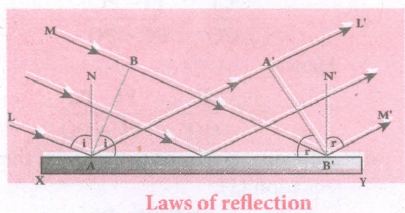
(ii) The incident wavefront is AB and the reflected wavefront is A'B' in the same medium. These wavefronts are perpendicular to the incident rays L, M and reflected rays L', M' respectively.
(iii) By the time point A of the incident wavefront touches the reflecting surface, point B is yet to travel a distance BB' to touch the reflecting surface a B'.
(iv) When point B falls on the reflecting surface at H', point A would have reached A.
(v) This is applicable to all the points on the wavefront. Thus, the reflected wavefront A'B' emanates as a plane wavefront. The two normals Nand N' are considered at the points where the rays Land Mfallon the reflecting surface.
(vi) As reflection happens in the same medium, the speed of light is the same before and after the reflection.
(vii) Hence, the time is taken for the ray to travel from B to B' is the same as the time taken for the ray to travel from A to A'.
(viii) Thus, the distance BB' is equal to the distance AA'; (A~A' = BB').
(a) The incident rays, the reflected rays, and the normal are in the same plane.
(b) Angle of incidence,\(\angle i=\angle NAL={ 90 }^{ o }-\angle NAB=\angle BAB'\)
Angle of reflection,
∠r= ∠N' B' M' = 900 - ∠N' B' A' = A' B' A'
(ix) For the two right-angle triangles, ΔABB' and ΔB' A' A', the right angles, ∠B and ∠A' are equal, (∠B and∠A = 900); the two sides, ∠A' and ∠B' are equal, (AA'= BB'); the side AB' is common.
(x) Thus, the two triangles are congruent. As per the property of congruency, the two angles, ∠BAB' and A' B' A' must also be equal.
i = r
Hence, the laws of reflection are proved.
2.
Reflection does not change wavelength.
Frequency remains unchanged both in reflection and refraction
ஃ λ = 5000 Å. Again \(v=\cfrac { c }{ \lambda } =\cfrac { 3\times { 10 }^{ 8 } }{ 5000\times { 10 }^{ -10 } } Hz\)
= 6 x 10¹⁴ Hz
Again i = rand i + r = 90°.
ஃ i = 45°.
3.
Let polaroids P1 and P3 be in a crossed positions.
Let the polaroid P2 make an angle e with the pass axis of polaroid Pr
Let I1 be the intensity of polarised light emerging our of P1 Then intensity of light after passing through P2 will I2 = I1cos2θ
Since P3 and P, are in crossed position, therefore, the angle made by P2 with P3 is \(\left( \cfrac { \pi }{ 2 } -\theta \right) \)
∴ The intensity of light coming out of P3 is
\({ I }_{ 3 }={ I }_{ 2 }{ cos }^{ 2 }\left( \cfrac { \pi }{ 2 } -\theta \right) \)
or \({ I }_{ 3 }={ I }_{ 2 }{ cos }^{ 2 }{ sin }^{ 2 }\theta =\theta ={ I }_{ 1 }\left( \cfrac { 1 }{ 2 } sin20 \right) ^{ 2 }\)
If I0 is the intensity of the unpolarised light falling on PI' then \({ I }_{ 1 }=\cfrac { { I }_{ o } }{ 2 } \)
\(\therefore { I }_{ 3 }=\cfrac { { I }_{ o } }{ 2 } \left( \cfrac { 1 }{ 2 } sin20 \right) ^{ 2 }\)
(i) Minimum outcoming intensity is zero.
(ii) Maximum outcoming intensity is received
when \(\theta =\cfrac { \pi }{ 4 } \)
\(\therefore \left( { I }_{ 3 } \right) _{ max }=\cfrac { { I }_{ o } }{ 2 } \left( \cfrac { 1 }{ 2 } \right) ^{ 2 }=\cfrac { { I }_{ o } }{ 8 } \)
4.
Given data:
In first case, fe.= 0.03 m
f0= 0.04 m , L = 0.2 m
\(m=\cfrac { L }{ { f }_{ o } } \left( 1+\cfrac { 0.25 }{ { f }_{ o } } \right) \)
For m to be the same in both cases,
= \(\cfrac { L }{ 0.03 } \left( 1+\cfrac { 0.25 }{ 0.04 } \right) \)
= \(\cfrac { 0.2 }{ 0.04 } \left( 1+\cfrac { 0.25 }{ 0.04 } \right) \)
= \(\cfrac { L }{ 0.03 } \times \cfrac { 29 }{ 4 } =\cfrac { 0.2 }{ 0.04 } \times \cfrac { 28 }{ 3 } \)
\(L=\cfrac { 5.6 }{ 29 } =0.193m\)
5.
(a) \({ f }_{ o }=\cfrac { 100 }{ 25 } cm=4cm\)
\({ f }_{ e }=\cfrac { 100 }{ 20 } cm=5cm\)
Since f0
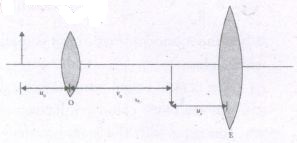
(b) \(m=\cfrac { { { v }_{ o } } }{ { u }_{ o } } .\cfrac { D }{ { f }_{ e } } \)

12th Standard Syllabus & Materials
12th Standard
TN 12th Computer Applications வலையமைப்பு வடமிடல் Sample Question Papers Study Material - QB365 Set A
NEW12th Standard
TN 12th Computer Applications களப்பெயர் முறைமை (DNS) Sample Question Papers Study Material - QB365 Set A
NEW12th Standard
TN 12th Computer Applications வலையமைப்பு எடுத்துக்காட்டுகள் மற்றும் நெறிமுறைகள் Sample Question Papers Study Material - QB365 Set A
NEW12th Standard
TN 12th Computer Applications கணினி வலையமைப்பு ஓர் அறிமுகம் Sample Question Papers Study Material - QB365 Set A



Tamilnadu Stateboard 12th Standard Subjects

Maths

Chemistry
Physics

Biology

Computer Science

Business Maths and Statistics

Economics

Commerce

Accountancy

History

Computer Applications
Biology
Computer Technology
Computer Applications
Computer Science
Business Maths and Statistics
Commerce
Economics
Maths
Chemistry
Physics
Computer Technology
History
Accountancy

Tamil

English

French
Tamilnadu Stateboard Standards



