
 100% FREE ACCESS
12th Standard Syllabus & Materials
12th Standard
TN 12th Computer Applications மின்னணு தரவு பரிமாற்றம் Sample Question Papers Study Material - QB365 Set A
NEW12th Standard
TN 12th Computer Applications மின் - வணிக பாதுகாப்பு அமைப்புகள் Sample Question Papers Study Material - QB365 Set A
NEW12th Standard
TN 12th Computer Applications மின்னணு செலுத்தல் முறைகள் Sample Question Papers Study Material - QB365 Set A
NEW12th Standard
TN 12th Computer Applications மின் - வணிகம் Sample Question Papers Study Material - QB365 Set A
NEW12th Standard
TN 12th Computer Applications திறந்த மூல கருத்துருக்கள் Sample Question Papers Study Material - QB365 Set A
NEW12th Standard
TN 12th Computer Applications வலையமைப்பு வடமிடல் Sample Question Papers Study Material - QB365 Set A

Published on: 01/08/2019
Download Tamil Nadu 12th Standard History question papers, model tests, one-mark questions, important questions, and public exam papers in PDF format. Free study materials and answer keys for TN State Board students.
Questions + Answers key
Take MCQ History Test1.
Gandhi set out on the March and reached Dandi on _____
6th April 1930
6th March 1930
4th April 1939
4th March 1930
2.
After returning from South Africa Gandhi launched his first successful Satyagraha in
Kheda
Dandi
Champaran
Bardoli
3.
The Home Rule Movement in south India was started by
Tilak
Annie Besant
B.P. Wadia
Col. H.S. Olcott
4.
Who was called the ‘Grand Old Man of India?
Bala Gangadhar Tilak
M.K. Gandhi
Dadabhai Naoroji
Subhash Chandra Bose
5.
Find the odd one.
William Jones
Charles Wilkins
Max Muller
Aurobindo Ghose
6.
Why was the Congress banned in the aftermath of the unsuccessful conclusion of three round table conferences?
7.
What was the impact and significance of the Madras Labour Union?
8.
9.
10.
Sketch the educational career of Dr. B.R. Ambedkar with particular focus on his activism to secure social justice to the depressed classes?
11.
Attempt an account of Swadshi movement in Tamilnadu.
12.
To what extent the repressive and racist policy measures of the British were responsible for the national awakening in India.
13.
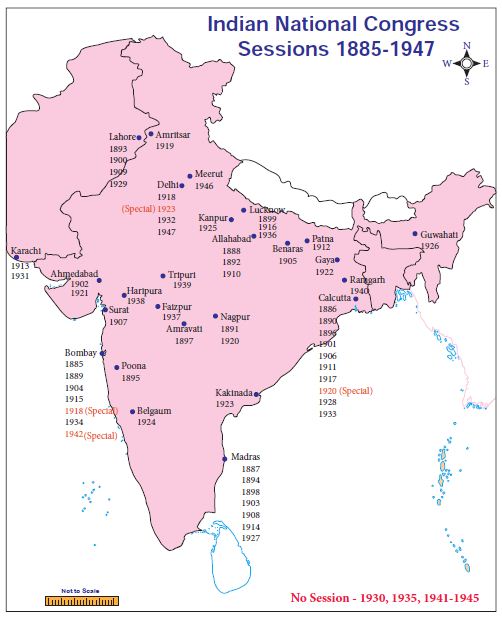
Mark the following on the outline map of India. Venues of Congress Sessions.
1. Bombay
2. Calcutta
3. Madras
4. Ahmedabad
5. Lucknow
6. Kanpur
7. Surat
8. Lahore
9. Poona
10. Allahabad
14.
Who were the local leaders to accompany Gandhiji to Champaran?
15.
Name the book and weekly published by Annie Besant.
16.
What were the repressive measures adopted by the colonial government to crush the nationalist movements?
17.
Identify the leaders of the epicenters of militant nationalism in British India.
1.
(a)
6th April 1930
2.
(c)
Champaran
3.
(b)
Annie Besant
4.
(c)
Dadabhai Naoroji
5.
(d)
Aurobindo Ghose
6.
1) Gandhi attended the Second RTC but the government was adamant and declined to concede his demands.
2) He returned empty handed and the Congress resolved on renewing the civil disobedience movement.
3) The economic depression had worsened the condition of the people in general and of the peasants in particular.
4) There were peasant protests all over the country. The leftists were in the forefront of the struggles of the workers and peasants.
5) The government was determined to crush the movement. All key leaders including Nehru.
7.
1) Madras played a pivotal role in the history of labour movement of India
2) The first trade union in the modem sense, the Madras Labour Union, was formed in 1918 by B.P. Wadia.
3) The union was formed mainly due to the ill-treatment of Indian worker in the Buckingham and Carnatic Mills, Perambur. The working conditions was poor.
4) Short interval for mid-day meal, frequent assaults on workers by the European assistants and inadequate wages led to the formation of this union.
5) This union adopted collective bargaining and used trade unionism as a weapon for class struggle.
8.
9.
10.
1) Dr. Ambedkar came to the centre stage of the struggles of the oppressed world in the 1920's. Born in the then so-called "untouchable" caste called Mahar in Central India as the son of an army man, he was a brilliant student and was the first to matriculate from his community.
2) Ambedkar joined the Elphinston College, with the help of a scholarship and graduated in 1912. With the help of a scholarship from the Maharaja of Barona he went to United States and secured a post-graduate degree, and doctorate, from the columbia University, Then he went to London to study law and economics.
3) Ambedkar's brilliance caught the attention of many. Already in 19'16, he had participated in an international conference of Anthropology and presented a research paper on 'Castes in India', which was published later in the indian Antiquary.
4) The British government which was searching for talents among the downtrodden of India invited him to interact with the Southborough or the Franchise Committee which was collecting evidence on the quantum and qualifications to be fixed for the Indian voters.
5) Ambedkar launched news journals and organizations. Mook Nayak (leader of the dumb) was, the journal to articulate his view. s and the Bahishkrit Hitakarini Sabha (Association for the welfare of excluded) spearheaded his activities. As 'a' member of the Bombay legislative council he worked tirelessly to secure removaL of disabilities imposed on untouchables.
6) He launched the 'Mahad Satyagraha' to establish the civic right of the untouchables to public tanks and wells. Ambedkar's intellectual and public 'activities drew the attention of all concerned.
7) Ambedkar launched two political parties. The first one was the Independent Labour party in 1937 and the second Scheduled Caste Federation in 1942, The colonial government recognizing his struggles and also to balance its support base used the services of Ambedkar. Thus he was made a member of the Defence Advisory Committee in 1942, and a few months later, a minister in the Viceroy's cabinet.
8) The crowning recognition of his services to the nation was electing him as the chairman of the Drafting Committee of the independent India's Constitution. After independence Ambedkar was invited to be a member of the Nehru cabinet.
11.
1) Swadeshi movement in Tamil Nadu, notably in Tirunelveli district, generated a lot of attention and support.
2) While the Swadeshi movement in Tamil Nadu had an all India flavour, with collective anger against the British rule remaining the common thread, it was also underpinned by Tamil - pride and consciousness.
3) There was a deep divide in the Tamilnadu congress between the moderates and the extremists.
Development of Vernacular Oratory.
1) Initially, the movement was more of a reaction to the partition of Bengal and regular meetings were held to protest the partition.
2) The speakers, in such meetings, spoke mostly in the vernacular language to an audience that included students, lawyers, and labourers at that time.
3) The shift from English oratory to vernacular oratory was a significant development of this time; which had a huge impact on the mass politics in Tamil Nadu
4) Swadeshi meetings at the Marina beach in Madras were a regular sight. The Moore Market complex in Madras was another venue utilised for such gatherings. During the period (1905-1907) there are police reports calling students dangerous and their activities as seditious.
V.O.C and Swadeshi Steam Navigation Company (SSNC)
1) The Swadeshi movement in Tamil Nadu came to national attention in 1906 when V.O.Chidambaram mooted the idea of launching a swadeshi shipping venture in opposition to the monopoly of the British in navigation through the coast.
2) In 1906, V.O.C registered a joint stock company called The Swadeshi Steam Navigation Company (SSNC) with a capital of Rs 10 Lakh, divided into 40,000 shares of Rs.25 each. Shares were open only to Indians, Ceylonese and other Asian nationals. V.O.C purchased two steamships, S.S. Gallia and S.S. Lawoe.
The Coral Mill Strike
1) After attending the session of the Indian National Congress at Surat, V.O.C on his return decided to work on building a political organisation.
2) While looking for an able orator, he came across Subramania Siva, a swadeshi preacher. From February to March 1907, both the leaders addressed meetings almost on a daily basis at the beach in Tuticorin, educating the people about swadeshi and the boycott campaign.
3) The meetings were attended by thousands of people. These public gatherings were closely monitored by the administration.
4) In 1908, the abject working and living conditions of the Coral Mill workers attracted the attention of V.O.C and Siva
5) In the next few days, both the leaders addressed the mill workers. In March 1908, the workers of the Coral Cotton Mills, inspired by the address went on strike. It was one of the earliest organised labour agitations in India
Subramania Bharati: Poet and Nationalist
1) The growth of newspapers, both in English and Tamil language, aided the swadeshi movement in Tamil Nadu. G. Subramaniam was one of the first among the leaders to use newspapers to spread the nationalist message across a larger audience.
2) Subramaniam, along with five others, founded The Hindu (in English) and Swadesamitran (which was the first ever Tamil daily).
3) Subramania Bharati became the sub-editor of Swadesamitran around the time (1904) when Indian nationalism was looking for a fresh direction. Bharati was also editing Chakravartini, a Tamil monthly devoted to the cause of Indian women.
12.
1) Indian national movement dates its birth from the 1857 uprising. The outrages committed by the British army after putting down the revolt remained "un-avenged".
2) Even the court-martial law and formalities were not observed Officers who sat on the court martial swore that they would hang their prisoners, guilty or innocent and, if any dared to raise his voice against such indiscriminate vengeance, he was silenced by his angry colleagues.
3) Persons condemned to death after the mockery of a trial were often tortured by soldiers before their execution, while the officers looked on approvingly.
4) It is worth recalling what Elphinstone, Governor of Bombay Presidency, wrote to Sir John Lawrence, future Viceroy of India (1864) about the British siege of Delhi during June- September, 1857'. A wholesale vengeance is being taken without distinction of friend or foe. As regards the looting, we have indeed surpassed Nadirshah.'
Racial Discrimination
1) The English followed a policy of racial discrimination.
2) The systematic exclusion of the Indians from higher official positions came to be looked upon as an anti-Indian policy measure and the resultant discontent of the Indian upper classes led the Indians to revolt against the British rule.
3) When civil service examinations were introduced the age limit was fixed at twenty one. When Indians were making it, with a view to debarring the Indians from entering the civil services, the age limit was reduced to nineteen.
4) Similarly, despite requests from Indian educated middle class to hold the civil service examinations simultaneously in India, the Imperial government refused to concede the request.
13.
14.
Rajendra Prasad, Mazharul Huq, Acharya Kripalani and Mahadeva Desai.
15.
She published a book How India brought for Freedom, a weekly The Commonweal, a daily newspaper New India.
16.
1) The Newspapers (Incitement to Offence) Act, 1908. This act empowered the magistrate to confiscate press property which published objectionable material making it difficult to publish anything critical of British rule.
2) Indian Press Act 1910 made it mandatory for publishers and the printers to deposit a security that could be seized in case they printed 'obnoxious material'.
3) The Indian Criminal Law Amendment Act allowed summary trials and also imposed the prohibition of 'association dangerous to the public peace'.
17.
Aurobindo Ghose, Bal Gangadhar Tilak, Bipin Chandra Pal and Lala Lajpat Rai

12th Standard Syllabus & Materials
12th Standard
TN 12th Computer Applications களப்பெயர் முறைமை (DNS) Sample Question Papers Study Material - QB365 Set A
NEW12th Standard
TN 12th Computer Applications வலையமைப்பு எடுத்துக்காட்டுகள் மற்றும் நெறிமுறைகள் Sample Question Papers Study Material - QB365 Set A
NEW12th Standard
TN 12th Computer Applications கணினி வலையமைப்பு ஓர் அறிமுகம் Sample Question Papers Study Material - QB365 Set A
NEW12th Standard
TN 12th Computer Applications PHP-உடன் MySQL-ஐ இணைத்தல் Sample Question Papers Study Material - QB365 Set A



Tamilnadu Stateboard 12th Standard Subjects

Maths

Chemistry

Physics

Biology

Computer Science

Business Maths and Statistics

Economics

Commerce

Accountancy
History

Computer Applications
Biology
Computer Technology
Computer Applications
Computer Science
Business Maths and Statistics
Commerce
Economics
Maths
Chemistry
Physics
Computer Technology
History
Accountancy

Tamil

English

French
Tamilnadu Stateboard Standards

