
 100% FREE ACCESS
12th Standard Syllabus & Materials
12th Standard
TN 12th Computer Applications மின்னணு தரவு பரிமாற்றம் Sample Question Papers Study Material - QB365 Set A
NEW12th Standard
TN 12th Computer Applications மின் - வணிக பாதுகாப்பு அமைப்புகள் Sample Question Papers Study Material - QB365 Set A
NEW12th Standard
TN 12th Computer Applications மின்னணு செலுத்தல் முறைகள் Sample Question Papers Study Material - QB365 Set A
NEW12th Standard
TN 12th Computer Applications மின் - வணிகம் Sample Question Papers Study Material - QB365 Set A
NEW12th Standard
TN 12th Computer Applications திறந்த மூல கருத்துருக்கள் Sample Question Papers Study Material - QB365 Set A
NEW12th Standard
TN 12th Computer Applications வலையமைப்பு வடமிடல் Sample Question Papers Study Material - QB365 Set A

Published on: 12/02/2020
12th Standard Important Question All Chapter-II-2020
Download Tamil Nadu 12th Standard Economics question papers, model tests, one-mark questions, important questions, and public exam papers in PDF format. Free study materials and answer keys for TN State Board students.
Questions + Answers key
Take MCQ Economics Test
1.
The major objectives of public expenditure are _________.
Economic Growth
Maintenance of Defence
Social Welfare
All of the above
2.
In India, there are more than __________ above one million population.
45 cities
54 towns
54 cities
45 towns
3.
Expand SIDC
State Industrial Development Company
Small Industrial Development Corporation
State Investment Development Corporation
State Industrial Development Corporation
4.
Which of the following institutions is not part of the World Bank community?
IBRD
WTO
IDA
IFC
5.
During stagflation
I. an increase in aggregate spending will eliminate the recession.
II. a decrease in aggregate spending will reduce inflation.
III. government faces contradictory goals.
IV. The central bank decreases money supply to reduce inflation
I and II only
III and IV only
I, II and III only
I, II, III and IV
6.
The name “International Bank for Reconstruction and Development” was first suggested by ___________ to the drafting committee.
China
USA
Japan
India
7.
Unemployment means that
People are not willing to work at the going wage rate
At the going wage rate, there are people who want to work but cannot find work.
There are some people who will not work at the going wage rate
There is excess demand in the labour market
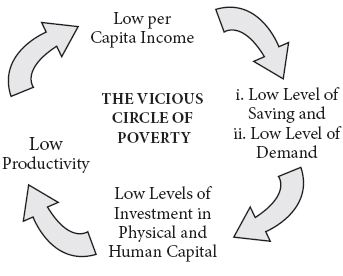
8.
Consider the following diagram
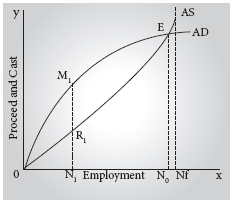
What do you understand about the difference between No – Nf ?
the level of employment
the level of unemployment
the level of underemployment
none of the above
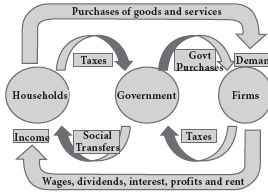
9.
The term 'underdeveloped country' is _____________ one.
relative
absolute
systematic
structural
10.
Consider the following statement and find a suitable answer.
“The increase in GNP is accompanied by decline in share of agriculture in output and employment while those of manufacturing and service sectors increase”
Modern Approach
new welfare approach
neo-classical approach
Traditional Approach
11.
Find the equation of non-linear correlation
Y= a + bx2
Y= a + bx
Y= b – ax
Y= a – by
12.
Sum of all kinds of income received by the individuals from all sources is called ________.
Personal Income
Private Income
Personal Disposable Income
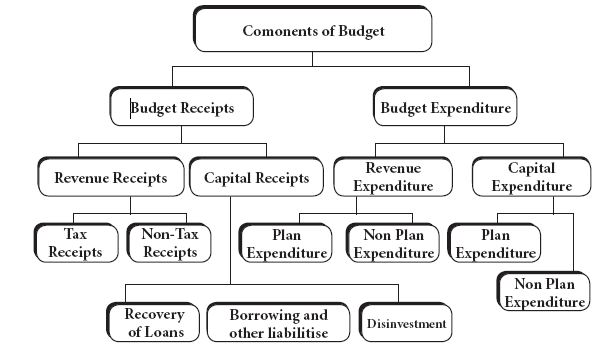
None
13.
Find the positive correlation equation.
Y= a – bx
Y= a + bx
Y= b – ax
Y= a – by
14.
Since 2007__________ every year is celebrated as Statistics Day to commemorate his birth anniversary.
28th of June
29th of July
28th of July
29th of June
15.
In the context of Labour income, which of the following is wrong?
Wages and salaries
fringe benefits
employer’s contribution to social security
state insurance
16.
The Heckscher-Ohlin assumes that _______ are identical between countries
tastes and preferences
technology levels
factor endowments
both (a) and (b)
17.
| 1 | EcoSystem | i. | The presence of harmful or objectionable material to damage water quality. |
| 2 | Pollution | ii. | The increase in temperature of the Earth’s surface, due to greenhouse gases. |
| 3 | Water Pollution | iii. | Residual discharges of contaminants into the natural environment to the air or water |
| 4 | Global warming | iv. | The interacting system of a biological community and its nonliving environmental surroundings. |
(1) – (i) (2) – (ii) (3) – (iv) (4) – (iii)
(1) – (ii) (2) – (iii) (3) – (iv) (4) – (i)
(1) – (iv) (2) – (iii) (3) – (i) (4) – (ii)
(1) – (i) (2) – (ii) (3) – (iii) (4) – (iv)
18.
Absolute advantage is determined by
actual differences in labor productivity between countries
relative differences in labor productivity between countries.
both (a) and (b)
neither (a) nor (b)
19.
When there is a chronic imbalance in the trade balance (more imports than exports), it can theoretically be reduced by means of a package of tax measures
decrease of customs duties
increase of customs duties
stimulating imports.
stimulating exports
20.
Rate of change in savings to change in income:
APS
APC
MPS
MPC
21.
In the linear consumption function C = a + bY, coefficient ‘a’ denotes
MPC
APC
Autonomous consumption
Induced consumption
22.
______________ occur outside of the market i.e. they affect people not directly involved in the production and consumption of a good or service
Fee good
spill-over effects
Public good
private good
23.
If there is _______ in the consumer goods industry, the accelerator principle would not work.
Full capacity
unused or excess capacity
No capacity
None
24.
Assertion: Each individual and organization produce only those goods which ensure high profit.
Reason: Profit is the driving force behind all economic activities in a capitalistic economy
Both A and R are true and R is the correct explanation of A.
Both A and R are true but R is not the correct explanation of A
A is true but R is false
A is false but R is true
25.
Pick basic composition of two sector of model of economy
Y = C + I + G + (X – M)
Y = C + I + G
Y = C + S
Y = C + I
26.
Increasing temperature in the atmosphere leads to Global Warming.
Increase sea level
Melting of polar ice large
Displacement and loss of habitat
Destroying the forest
27.
The IMF has __________ member countries.
180
189
181
111
28.
The population of India has increased from 36.1 crore in 1951 to ___________ crore in 2011
121
131
111
110.5
29.
___________ was set up in July 1982.
ARDC
NABARD
ICICI
Indian Bank
30.
Planning in India is
Centralized planning
Democratic planning
Partial Planning
Indicative planning
31.
GDP by expenditure at ________ price.
Factor price
Market price
Real price
All the above
32.
Commercial banks are institutions that conduct business________.
with profit motive
By accepting the deposits
By Lending loans
all the above
33.
"Commercial banks are the institutions that make short term loans to business and in the process create money" was said by_______
Culbertson
Adam smith
Ricardo
J.M. Keynes
34.
________system is managed by the Central Monetary Authority.
Plastic money
Metallic Standard
Silver standard
Paper currency
35.
"The purchasing power of money" was a book published by________in 1911
J.M. Keynes
Irving Fisher
Adam smith
Ricardo
36.
Identify the stock variable.
Wealth
Income
Foreign exchange
Money
37.
The raw materials of Econometrics are:
Data
Goods
Statistics
Mathematics
38.
The purpose of simple linear regression analysis is to:
Predict one variable from another variable
Replace points on a scatter diagram by a straight -line
Measure the degree to which two variables are linearly associated
Obtain the expected value of the independent random variable for a given value of the dependent variable
39.
The Chair Person of NITI Aayog is
Prime Minister
President
Vice - President
Finance Ministed
40.
Which is not the feature of economic growth?
Concerned with developed nations
Gradual change
Concerned with quantitative aspect
Wider concept
41.
42.
Which one of the following causes of global warming?
Earth gravftation force
Oxygen
Centripetal force
Increasing temperature
43.
The primary purpose of deficit financing is
Economic development
Economic stability
Economic equality
Employment generation
44.
The difference between total expenditure and total receipts including loans and other liabilities is called
Fiscal deficit
Budget deficit
Primary deficit
Revenue deficit
45.
The headquarters of ASEAN is
Jaharta
New Delhi
Colombo
Tokyo
46.
47.
Foreign direct investments not permitted in India
Banking
Atomic energy
Pharmaceutical
Insurance
48.
Trade between two countries is known as ____ trade
External
Internal
Inter-regional
Home
49.
Expansions of ATM
Automated Teller Machine
Adjustment Teller Machine
Automatic Teller mechanism
Any Time Money
50.
NBFI does not have.
Banking license
government approval
Money market approval
Finance ministry approval
51.
When prices rise slowly, we call it
galloping inflation
mild inflation
hyper inflation
deflation
52.
Inflation means
Prices are rising
Prices are falling
Value of money is increasing
Prices are remaining the same
53.
According to Keynes, investment is a function of the MEC and ____.
Demand
Supply
Income
Rate of interest
54.
An increase in the marginal propensity to consume will:
Lead to consumption function becoming steeper
Shift the consumption function upwards
Shift the consumption function downwards
Shift savings function upwards
55.
56.
If every able bodied person who is willing to work at the prevailing wage rate is employed called _______.
Full employment
Under employment
Unemployment
Employment opportunity
57.
The average income of the country is________
Personal Income
Per capita income
Inflation Rate
Disposal Income
58.
Per capita income is obtained by dividing the National income by__________
Production
Population of a country
Expenditure
GNP
59.
Identify the flow variable
money supply
assests
income
foreign exchange reserves
60.
61.
What are the All-India Level Institutions for industrial finance?
62.
Comment on RBI as “Lender of last resort"
63.
Mention the year of establishment of the following organization.
South Asian Association for Regional Cooperation (SAARC), ASEAN and BRICS
64.
What is the key difference between comprehensive and partial plan?
65.
Draw the The Vicious Circle of Poverty
66.
What is Aggregate demand?
67.
“Coefficient of correlation’ – define.
68.
What are the other names of internal trade?
69.
Write a short note on “Indoor Air Pollution”.
70.
Increase in income always leads to an increase in both consumption and saving. – Explain.
71.
Mention the any three Capitalist Learning economies
72.
Draw the circular flow of a three sector economy.
73.
What is Deficit budget?
74.
Write any two long run factors which influencing marginal efficiency of capital?
75.
What is Simple circular flow?
76.
What are the methods of measuring National Income?
77.
What are the two factors depend on MEC?
78.
Write a short note about Keynes theory?
79.
What is Recovery?
80.
What is Trade Cycle?
81.
Write a note on Central Planning?
82.
Who is the controll authority of socialistic economy?
83.
What are the kinds of data?
84.
What is Statistics?
85.
Distinguish between economic growth and development.
86.
State the meaning of environment.
87.
Define public finance.
88.
89.
Mention the functions of agriculture credit department.
90.
What is commodity money?
91.
Define average propensity to consume (APC).
92.
What are the components of aggregate supply ?
93.
List out the assumptions of Say’s law.
94.
Write the formula for calculating GNP.
95.
Define ‘Economic Model'.
96.
Draw the flow chart depicting components of budget
97.
Distinguish between IMF and World Bank
98.
Calculate the standard deviation for the following data by assumed mean method: 43, 48, 65, 57, 31, 60, 37, 48, 78, 59
99.
Write a note of John Maynard Keynes.
100.
Calculate the SD of the following data. 23, 25, 28, 31, 38, 40, 46
101.
List the assumption of Comparative advantage theory of international trade.
102.
How the gross value of the farm output is obtained In India?
103.
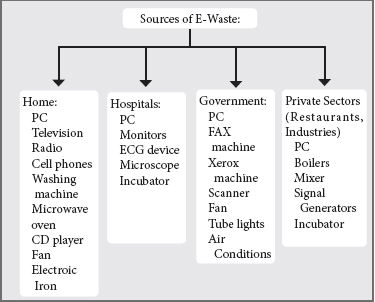
What are the various sources of E-Wastes?
104.
What are the Merits of Socialism?
105.
What are the assumptions of Absolute Cost Advantages?
106.
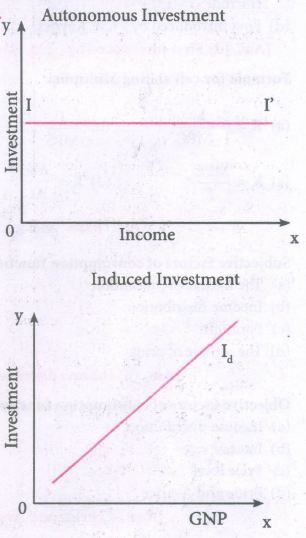
Draw the diagrams for Autonomous investment and induced investment.
107.
What are the six basic characteristics of under developed economy?
108.
List of the role of commercial bank.
109.
Write a note on paper currency standard
110.
Differentiate the economic model with econometric model.
111.
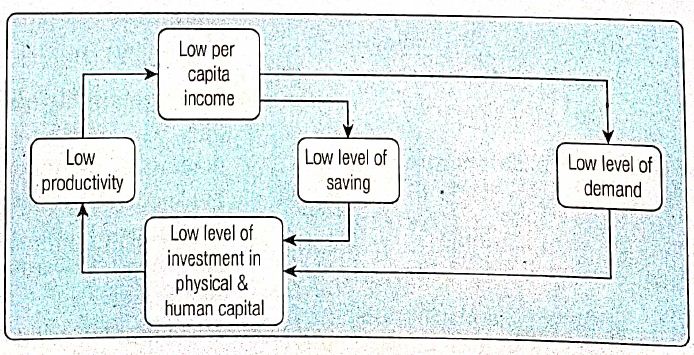
Elucidate major causes of vicious circle of poverty with diagram
112.
Write a note on
a) Climate change and
b) Acid rain
113.
What are the functions of a modern state?
114.
State briefly the functions of SAARC.
115.
Compare the Classical Theory of international trade with Modern Theory of International trade.
116.
Distinguish between money market and capital market.
117.
118.
State the concept of super multiplier.
119.
Explain about aggregate supply with the help of diagram.
120.
121.
Briefly explain the two sector circular flow model.
122.
List the Revenue of State Sources.
123.
Write the History, Administration and Brief Functions of RBI.
124.
Explain Adam Smith’s Theory of Absolute Cost Advantage.
125.
Given the table, calculate GNP, NNP, National Income, Personal Income and Disposable income.
126.
Explain the four sector model of economy with chart.
127.
Explain Marginal propensity to consume and multiplier, with the help of a diagram.
128.
Draw the 7 pillars of NITI Aayog.
129.
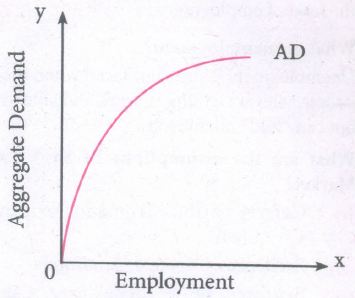
Draw the diagram ADF.
130.
Explain Keynes psychological law of consumption function with diagram.
1.
(d)
All of the above
2.
(c)
54 cities
3.
(d)
State Industrial Development Corporation
4.
(b)
WTO
5.
(d)
I, II, III and IV
6.
(b)
USA
7.
(b)
At the going wage rate, there are people who want to work but cannot find work.
8.
(b)
the level of unemployment
9.
(a)
relative
10.
(d)
Traditional Approach
11.
(a)
Y= a + bx2
12.
(a)
Personal Income
13.
(b)
Y= a + bx
14.
(d)
29th of June
15.
(d)
state insurance
16.
(d)
both (a) and (b)
17.
(c)
(1) – (iv) (2) – (iii) (3) – (i) (4) – (ii)
18.
(a)
actual differences in labor productivity between countries
19.
(b)
increase of customs duties
20.
(c)
MPS
21.
(c)
Autonomous consumption
22.
(b)
spill-over effects
23.
(b)
unused or excess capacity
24.
(a)
Both A and R are true and R is the correct explanation of A.
25.
(d)
Y = C + I
26.
(d)
Destroying the forest
27.
(b)
189
28.
(a)
121
29.
(b)
NABARD
30.
(b)
Democratic planning
31.
(b)
Market price
32.
(d)
all the above
33.
(a)
Culbertson
34.
(d)
Paper currency
35.
(b)
Irving Fisher
36.
(a)
Wealth
37.
(a)
Data
38.
(a)
Predict one variable from another variable
39.
(a)
Prime Minister
40.
(d)
Wider concept
41.
(d)
42.
(d)
Increasing temperature
43.
(a)
Economic development
44.
(a)
Fiscal deficit
45.
(a)
Jaharta
46.
(a)
47.
(b)
Atomic energy
48.
(a)
External
49.
(a)
Automated Teller Machine
50.
(a)
Banking license
51.
(b)
mild inflation
52.
(a)
Prices are rising
53.
(d)
Rate of interest
54.
(a)
Lead to consumption function becoming steeper
55.
(c)
56.
(a)
Full employment
57.
(b)
Per capita income
58.
(b)
Population of a country
59.
(c)
income
60.
(c)
61.
(i) Industrial Finance Corporation of India (IFCI)
(ii) Industrial Credit and Investment Corporation of India (ICICI)
(iii) Industrial Development Bank of India (IDBI)
62.
The banks can borrow from the RBI by keeping eligible securities as collateral at the time of need or crisis, when there is no other source.
63.
1. SAAR - 1985
2. ASEAN - 1967
3. BRICS - 2001
64.
| Comprehensive Plan | Partial Plan |
|---|---|
| General planning which concerns itself with the major issues for the whole economy is known as comprehensive planning | Partial planning is to consider only the few important sectors of the economy |
65.
66.
The amount that households, firms, the governments and the foreign purchasers would like to spend on domestic output.
67.
1. Karl Pearson’s Method is popularly known as Pearson’s coefficient of correlation denoted by the symbol ‘r’.
2. The coefficient of correlation ‘r’ measures the degree of linear relationship between two variables say X and Y. The Formula for computing Karl Pearson’s Coefficient of correlation is:
\(\frac { N\sum { XY } -(\sum { X } )(\sum { Y } ) }{ \sqrt { N{ \sum { X } }^{ 2 }-{ (\sum { X } ) }^{ 2 } } \sqrt { { N\sum { Y } }^{ 2 }-{ (\sum { Y } ) }^{ 2 } } } \)
68.
(i) Domestic trade
(ii) Home trade
(iii) Intra-regional trade
69.
(i) Indoor Air Pollution refers to toxic contaminants that we encounter in our daily lives in our homes, schools, and workplaces.
(ii) For example, cooking and heating with solid fuels on open fires or traditional stoves results in high levels of indoor air pollution.
70.
This means that increased income is unlikely to lead to fall in either consumption or saving. Thus with increased income both consumption and saving increase.
71.
| France | Sweden |
| United States | Japan |
72.
73.
Deficit budget is one where the estimated government expenditure is more than expected revenue
Government s estimated Revenue < Government's proposed Expenditure.
74.
(i) Monetary and fiscal policy
(ii) Technological progress
(iii) Resource availability.
75.
Simple circular flow model is explained without the other components of national income namely savings or investment(I), public expenditure by government (G) and expenditure on net exports(X-M).
76.
i) Production or Value added method.
ii) Income method or Factor Earning method.
iii) Expenditure Method or outlay method.
77.
MEC depends on two factors namely
(i) Prospective yield of capital asset
(ii) Supply price of capital
78.
Keynes theory of employment was based on the view of the short run. According to him, the factors of production such as capital goods, supply of labour, technology and efficiency of labour remain unchanged while determining the level of employment.
79.
An increase in business activities after the lowest point. (ie) depression
80.
The more or less regular upward and downward movement of economic activity over a period of years.
81.
(i) Planning is an integral part of a socialist economy.
(ii) In socialist economy all decisions are undertaken by the Central Planning Authority.
82.
(i) Central planning authority is the controlling authority in a socialistic economy.
(ii) All the decisions are under taken by the central planning authority.
(iii) It means all factors of production are nationalized and managed by public authority.
83.
(i) Based on characteristics there are quantitative and qualitative data.
(ii) Qualitative data is classified as nominal data and rank data.
(iii) Based on the data sources there are primary data and secondary data.
84.
(i) Statistics as a science of estimates and probabilities.
(ii) Statistics is the collection, organisation, presentation, analysis and interpretation of numerical data.
85.
| Economic Growth | Economic Development |
|---|---|
| Deals with the problems of develop ed countries |
Deals with the problems of UDCs (Under Developed Countries) |
| Change is gradual and stead | Change is discontinuous and s spontaneous |
| Means more output | Means not only more output but also its composition. |
| Concerns Quantitative aspects i.e. increase in per capita income | Quantitative as well as Qualitative |
| Narrow Concept | Wider Concept Development = Growth + Change. |
86.
(i) Environment means "all the conditions, circumstances, and influences surrounding and affecting the development of an organism or group of organisms".
(ii) It also means that the complex of physical, chemical and biotic factors that act upon an organism or an ecological community ultimately determine its form and survival.
87.
(i) "Public finance is one of those subjects that lie on the border linè between Economics and Politics. It is concerned with income and expenditure of public authorities and with the adjustment of one to the other". . - Huge Dalton
(ii) Public finance is an investigation into the nature and principles of the state revenue and expenditure - Adam Smith
88.
89.
(i) To maintain an expert staff to study all questions on agricultural credit.
(ii) To provide expert advice to Central and State Government, State Co-operative Banks.
(iii) To finance the rural sector through eligible institutions and to co-ordinate them.
90.
(i) Surplus goods were exchanged for money which in turn was exchanged for other needed goods.
(ii) Goods like furs, skins, salt, rice, wheat, utensils, weapons were used as money
91.
APC is the ratio of consumption expenditure to any particular level of income
APC = \(\frac{C}{Y}\)
92.
(i) Aggregate (desired) consumption expenditure (C)
(ii) Aggregate (desired) private savings (S)
(iii) Net tax payments (T)
(iv) Personal (desired) transfer payments to the foreigners (Rf)
AS = C + S + T + Rf
93.
1. No single buyer or seller can affect the price.
2. Full employment
3. People are motivated by self interest Market forces determine everything right.
4. Perfect competition exists in labour and product market.
5. There is wage price flexibility.
6. Money acts as medium of exchange.
7. Long run analysis.
8. No overproduction or unemployment.
94.
\(\mathrm{GNP}=\mathrm{C}+\mathrm{I}+\mathrm{G}+(\mathrm{X}-\mathrm{M})+(\mathrm{R}-\mathrm{P})\) or \(\mathrm{GNP}_{\mathrm{MP}}=\mathrm{GDP}_{\mathrm{MP}}\) + Net Factor income from Abroad.
95.
(i) A Model is a simplified representation of real situation.
(ii) Economists use models to describe economic activities, their relationships and their behaviour.
96.
97.
| BASIS FOR COMPARISON | IMF | WORLD BANK |
| Meaning | An international organization maintaining the global monetary system is the International Monetary Fund. | A global organization established to finance and advice the developing nations, in order to make them economically developed is World Bank |
| Focus on | Economic Stability | Economic Growth |
| Organizational Structure | It is a single organization with four credit lines | It has two major institutions, namely International Bank for Reconstruction and Development (IBRD) and the International Development Association (IDA). |
| Operations | Provides assistance | Facilitates lending |
| Objective | To deal with all the issues related to the financial sector and macro economics. | To lessen poverty and promote the long term development of the economy. |
98.
| S.No | (X) | D=X-A(A=57) | (X-\(\bar { X } \))2 |
| 1 | 43 | -14 | 196 |
| 2 | 48 | -9 | 87 |
| 3 | 65 | 8 | 64 |
| 4 | 57 | 0 | 0 |
| 5 | 31 | -26 | 679 |
| 6 | 60 | 3 | 9 |
| 7 | 37 | -20 | 400 |
| 8 | 48 | -9 | 81 |
| 9 | 78 | 21 | 441 |
| 10 | 59 | 2 | 4 |
| N-9 | \(\sum { d } =44\) | \(\sum { d }^2 =1952\) |
\(\sigma =\sqrt { \frac { { \sum { d } }^{ 2 } }{ n } -\frac { { (\sum { d } ) }^{ 2 } }{ (n) } } =\sqrt { \frac { 1952 }{ 10 } -\frac { { (-44) }^{ 2 } }{ (10) } } \)
\(=\sqrt { 195.2-19.36 } =\sqrt { 175.84 } =13.26\)
99.
(i) John Maynard Keynes was one of the most influential economists of the 20th century.
(ii) He was born in Cambridge in1883. In addition to his work as an economist he held position as civil servant a director of the Bank of England, and leader of British delegation of negotiators at the Bretton Woods conference at points in his career.
(iii) Economic theory based on his idea is known as Keynesian economics, and remain highly influential today, particularly in the field of macroeconomics.
100.
| X | (X-\(\bar { X } \)) | (X-\(\bar { X } \))2 |
| 13 | -10 | 100 |
| 28 | -8 | 64 |
| 28 | -5 | 25 |
| 31 | -2 | 4 |
| 38 | 5 | 25 |
| 40 | 7 | 49 |
| 46 | 13 | 169 |
\(SD=\sqrt { \frac { \sum { { (x)-\bar { X } ) }^{ 2 } } }{ n } } =7.89\)
| 231 | 436 | |
| \(\bar { X } \) | = | 231/7=33 |
101.
1. There are only two nations and two commodities (2 x 2 model)
2. Labour is the only element of cost of production.
3. All labourers are of equal efficiency
4. Labour is perfectly mobile within the country but perfectly immobile between countries.
5. Production is subject to the law of constant returns
6. Foreign trade is free from all barriers.
7. No change in technology.
8. No transport cost.
9. Perfect competition.
10. Full employment.
11. No government intervention
102.
(i) Total production of 64 agriculture commodities is estimated. The output of each crop is measured by multiplying the area sown by the average yield per hectare.
(ii) The total output of each commodity is valued at market prices.
(iii) The aggregate value of total output of these 64 commodities is taken to measure the gross value of agricultural output.
(iv) The net value of the agricultural output is measured by making deductions for the cost of seed, manures and fertilisers, market charges, repairs and depreciation from the gross value
103.
104.
1. Reduction in Inequalities: No one is allowed to own and use private property to exploit others.
2. Rational Allocation of Resources: The central planning authority allocates the resources in a planned manner. Wastages are minimised and investments are made in a pre planned manner.
3. Absence of Class Conflicts: As inequalities are minimum, there is no conflict between rich and poor class. Society functions in a harmonious manner.
4. End of Trade Cycles: Planning authority takes control over production and distribution of goods and services. Therefore, economic fluctuations can be avoided.
5. Promotes Social Welfare: Absence of exploitation, reduction in economic inequalities, avoidance of trade cycles and increase in productive efficiency help to promote social welfare.
105.
(i) There are two countries and two commodities (2 X 2) model.
(ii) Labour is the only factor of production.
(iii) Labour units are homogeneous.
(iv) Price of commodity is measured by the amount of labour required to produce it.
106.
107.
(1) Primary production
(2) Population Pressures
(3) Underemployment
(4) Economic backwardness
(5) Capital deficiency
(6) Foreign trade orientation
108.
(i) Capital formation
(ii) Creation of credit
(iii) Channelizing the funds
(iv) Encouraging rights type of industries
(v) Banks monetize debt
(vi) Finance to government
(vii) Employment generation
(viii) Bank promote entrepreneurship.
109.
(i) The paper currency standard reffers to the monetary system in which the paper currency notes issued by the treasury of the Central Bank.
(ii) Paper currency is not convertible into any metal.
(iii) Its value is determined independent of the value of gold or any other commodity.
(iv) It also known as managed currency standard.
110.
(i) Models in Mathematical Economics are developed based on Economic Theories, while Econometric Models are developed based on Economic Theories to test the validity of Economic Theories in reality through the actual data.
(ii) Regression Analysis in Statistics does not concentrate more on error term while Econometric Models concentrate more on error terms
111.
(i) The cause for vicious circle of poverty is demand and supply.
(ii) On the supply side, the low level of real income leads to low level of saving and investment and to deficiency of capital.
(iii) Deficiency of capital leads to low productivity and back to low income.
(iv) On the demand-side, low level of real income leads to low demand so investment is less, therefore deficiency of capital, low productivity and low income.
112.
a) Climate change
(i) Climate change refers to seasonal changes over a long period with respect to the growing accumulation of greenhouse gases in the atmosphere.
(ii) Industrial revolution has increased the concentration of carbon dioxide in the atmosphere by 40 %.
(iii) Several parts of the world have experienced warming of coastal waters, high temperatures, a marked change in rainfall patterns and an increased intensity and frequency of storms.
(iv) Sea levels and temperatures are expected to be rising.
b) Acid rain
(i) Acid rain is one of the results of air pollution.
113.
Defence
1. The Government protects the people from external aggression and internal disorder.
2. Through police and military forces it renders protective services.
Judiciary:
1. It provides adequate judicial structure to render justice to all citizens.
Enterprises
1. The regulation and control of private enterprise comes under the government.
Social Welfare:
1. The state provides education, social security, social insurance, health and sanitation for the people.
Infrastructure
1. Modern States build the base for the economic development of the country by creating social and economic infrastructure.
Macro-economic policy
1. The Government follows fiscal policy and monetary policy to achieve macro economic goals.
Social Justice
1. During the process of growth certain sections of the economy gain at the cost of others.
2. Government intervenes with fiscal measures to redistribute income.
Control of Monopoly
1. State intervenes through control of monopolies and restrictive trade practices to curb concentration of economic power.
114.
The main functions of SAARC are as follows.
1) Maintenance of the cooperation in the region.
2) Prevention of common problems associated with the member nations.
3) Ensuring strong relationship among the member nations.
4) Removal of the poverty through various packages of programmes.
5) Prevention of terrorism in the region.
115.
| S.No | Classical Theory of International Trade |
Modern Theory of International Trade |
|---|---|---|
| 1 |
International trade is on the basis of labour theory of value.
|
International trade is on the basis of general theory of value. |
| 2 | It presents a one factor (labour) model. | It presents a multi factor (labour and capital) model. |
| 3 | It attributes the differences in the comparative costs to differences in the productive efficiency of workers in the two countries. |
It attributes the differences in comparative costs to the differences in factor endowments in the two countries. |
116.
| S. No. |
Money Market |
Capital Market |
|---|---|---|
| (1) | Short term funds are loaned and borrowed | Long term funds are loaned and borrowed |
| (2) | It deals with purchase, sale and transfer of short term credit instruments. | It raises capital by dealing in shares, bonds mortgages and other long term investments. |
| (3) | Commercial banks, acceptance houses, Non Banking Financial Institutions and the Central Bank deals with short term funds | Instruments traded in capital market comprise of equity shares, preference. shares, Debentures, bonds and other long term securities. |
117.
118.
(i) Hicks combined multiplier and accelerator to measure the total effect of initial investment on income.
(ii) Both induced consumption and induced investment are combined.
(iii) Also called leverage effect, it may lead the economy to a very high or low level of income propagation.
\(\mathrm{Y}=\mathrm{C}+\mathrm{I}_{\mathrm{A}}+\mathrm{I}_{\mathrm{P}}\)
Y = aggregate income
C = consumption expenditure
IA = autonomous investment
IB = induced private investment
119.
(i) Aggregate supply refers to the value of total output of goods and services produced in an economy in a year ie national product or income.
(ii) The components of aggregate supply are:
(iii) Aggregate (desired) consumption expenditure (C)
(iv) Aggregate (desired) private savings (S)
(v) Net tax payments (T)
(vi) Personal (desired) transfer payments to the foreigners (Rf)
AS = C + S + T + Rf
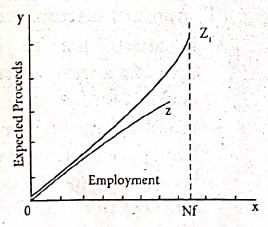
In this figure 2 aggregate supply curves are drawn for the assumption of fixed money wages and variable wages.
Explanation
(i) Z Curve is linear (fixed money wages)
(ii) Z1 curve is non-linear (wage rate increases with employment)
(iii) When full employment level of Nf is reached output cannot be increased by employing more men.
(iv) So aggregate supply curve becomes inelastic (Vertical straight line).
(v) In reality aggregate supply curve will be like Z1 .
(vi) If prices are high and wages low, the producers will employ more labourers.
(vii) 4YAggregate supply is an important factor in determining the level of economic activity.
120.
121.
There are only two sectors - household sector and firm sector.
(i) Household Sector
1. It supplies the factors of production and gets income from the firm sector
2. It buys goods and services with its entire income.
(ii) Firms:
1. It hires factors of production from the household sector.
2. It gets revenue by selling goods and services to the household sectors.
3. The production and sales are equal.
Y = C + I
Y is income
C is consumption
I is investment
122.
1. Capitation tax
2. Duties in respect of succession to agricultural land.
3. Duties of excise on certain goods produced or manufactured in the State, such as alcoholic liquids, opium, etc.
4. Estate duty in respect of agricultural land.
5. Fees in respect of any of the matters in the State List, but not including fees taken in any Court.
6. Land Revenue.
7. Rates of stamp duty in respect of documents other than those specified in the Union List.
8. Taxes on agricultural income.
9. Taxes on land and buildings.
10. Taxes on mineral rights, subject to limitations impose by Parliament relating to mineral development.
11. Taxes on the consumption or sale of electricity.
12. Taxes on the entry of goods into a local area for consumption, use or sale therein.
13. Taxes on the sale and purchase of goods other than newspapers.
14. Taxes on the advertisements other than those published in newspapers.
15. Taxes on goods and passengers carried by road or on inland waterways.
16. Taxes on vehicles.
17. Taxes on animals and boats.
18. Taxes on professions, trades, callings and employments.
19. Taxes on luxuries, including taxes on entertainments, amusements, betting and gambling.
20. Tolls.
123.
History:
(i) Formed on April 1, 1935 in accordance with the RBI Act, 1934
(ii) Nationalized on January 1, 1949 (Fully owned by GOI)
(iii) Headquarter moved from Calcutta to Mumbai in 1937
(iv) Osborne Smith was the first Governor of RBI
Administration:
(i) It is the Central Bank/ Regulator for all bank in India
(ii) Also called “Lender of Last Resort”
(iii) Governors and 4 Deputy Governors along with a central board of directors appointed by the GOI.
Functions:
(i) Issues currency
(ii) Banker to the government. {It collects receipts of funds and makes payments on behalf of the government}
(iv) Regulator of Indian Banking system
(v) Custodian of Forex
(vi) Controller of credit
124.
Adam Smith argued that all nations can be benefitted when there is free trade and specialisation in terms of their absolute cost advantage
The Theory
(i) According to Adam Smith, the basis of international trade was absolute cost advantage.
(ii) Trade between two countries would be mutually beneficial when one country produces a commodity at an absolute cost advantage over the other country which in turn produces another commodity at an absolute cost advantage over the first country.
Assumptions
1. There are two countries and two commodities (2 x 2 model).
2. Labour is the only factor of production
3. Labour units are homogeneous
4. The cost or price of a commodity is measured by the amount of labour required to produce it.
5. There is no transport cost.
Illustration
Absolute cost advantage theory can be illustrated with the help of the following example.
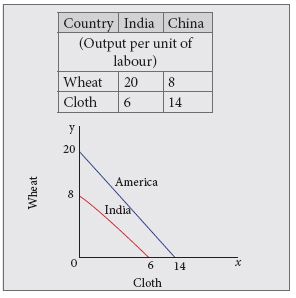
(iii) From the illustration, it is clear that India has an absolute advantage in the production of wheat over China and China has an absolute advantage in the production of cloth over India
(iv) Therefore, India should specialize in the production of wheat and import cloth from China. China should specialize in the production of cloth and import wheat from India
(v) This kind of trade would be mutually beneficial to both India and China.
125.
| Billions of Dollars | |
| GDP | 8,000 |
| Receipts of factor income from the rest of the world | 250 |
| Payment of factor income to the rest of the world | 300 |
| Depreciation | 900 |
| Indirect taxes minus subsidies | 500 |
| Corporate profits minus dividends | 500 |
| Social insurance payments | 700 |
| Personal interest income received from the government and consumers | 300 |
| Transfer payments to persons | 1100 |
| Personal taxes | 1000 |
GNP = 8000 + 250 – 300 = 7950
NNP = 7950 – 900 = 7050
NI = 7050 – 500 = 6550
PI = 6550 – 500 – 700 + 300 + 1100
= 6750
DI = 6750 – 1000
= 5750
126.
(i) In a four-sector economy, in addition households, firms and government, a fourth sector namely, external sector is included.
(ii) In the real life, only four-sector economy exists. This model is composed of four sectors namely,
1. Households
2. Firms
3. Government
4. External Sector
The external sector comprises exports and imports. It is illustrated in the Flow Chart
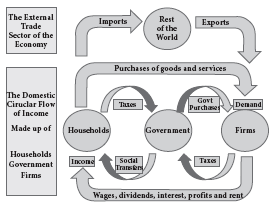
In four-sector economy, expenditure for the entire economy include domestic expenditure (C + I + G) and net exports (X - M). Therefore,
Y = C + I + G + (X - M)
127.
(i) The propensity to consume refers to the portion of income spent on consumption.
MPC = \(\frac{ΔC}{ΔY}\)
(K) = \(\frac{1}{1-MPC}\)
(ii) The multiplier is the reciprocal of one minus marginal propensity to consume.
(iii) Multiplier is 1/MPS
(iv) The multiplier is therefore define as reciprocal of MPS.
(v) Multiplier is inversely related to MPS and directly with MPC.
Numerically, if MPC is 0.75, MPS is 0.25 and K is 4.
Using formula K = \(\frac{1}{1-MPC}\)
⇒\(\frac{1}{1-0.75}\) = 1/0.25 = 4
∴ Multiplier (K) = 4
| MPC | MPS | K |
|---|---|---|
| 1.00 | 1.00 | 1 |
| 0.10 | 1.90 | 1.11 |
| 0.50 | 0.50 | 2.00 |
| 0.75 | 0.25 | 4.00 |
| 0.90 | 0.10 | 10.00 |
| 1.00 | 0.00 | ∝ |
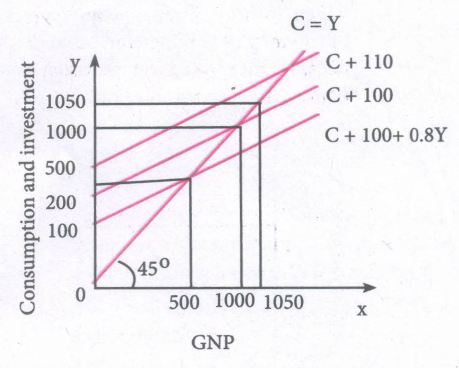
C = 100 + 0.8Y;
I = 10
Y = C + I
= 100 + 0.8 Y +9p00
.JPG)
0.2Y = 1000
∴ Y = 1000
Here, C = 100 + 0.8y
= 100 + 1000 = 900
S = 100 = I
After I is raised by 10, now I = 110
Y = 100 + 0.8y + 110
0.2y = 210
y = \(\frac{210}{0.2}\) = 1050
Here, C = 100 = 0.8 (1050) = 940,
S = 110 = I
(i) It implies the variables in axis-and axis are equal.
(ii) The MPC is assumed to be at 0.8. (C = 100 + 0.8y)
(iii) The aggregate demand (C + I) curve intersects 45° line at point E.
(iv) The new aggregate demand curve is
C + I = 100 + 0.8Y + 100 + 10
Y = \(\frac{210}{0.2}\)
C = 940; S = 110 = Z
128.
7 pillars of effective governance:
NITI AAYOG
| Pro-People | Fulfills aspirations of society as well as individuals |
| Pro-Activity | in anticipation response to citizen needs |
| Participation | involvement of citizenry |
| Empowering | Women in all aspects |
| Inclusion of all | SC, ST, OBC, minorities, gareeb, gaon, kisaan |
| Equality | of opportunity for the youth |
| Transparency | making government visible and responsive. |
129.
130.
Law
According to Keynes, "men are disposed as a rule and on the average to increase their consumption as their income increases but not by as much as the increáse in their income".
Propositions
1. When income increases, consumption expenditure also increases, but by a smaller amount
(a) When income increases from 120 to 180; consumption also increases from 120 to 170 but the increase in consumption is less than the increase in income, 10 is saved.
2. The increased income will be divided in some proportion between consumption expenditure and saving
(a) When income increases to 180 and 240, it is divided between consumption (170 and 220) and saving (10 and 20)
3. Incrcascs in income always lead to in incrcase in both consumption and saving
(a) Increases in income to 180) and 240; lead to increased consumption 170 and 220; increased saving 10 and 20.
(b) It is clear from the widening area below the C curve and the saving gap between 45o line and C curve.
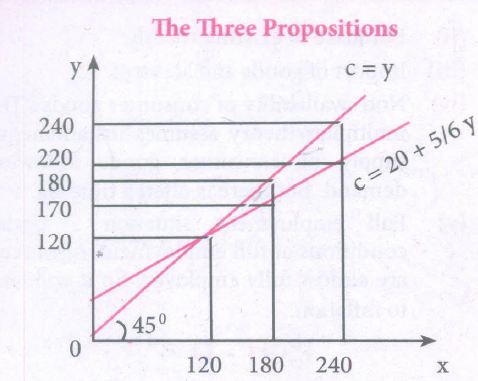
| Y | C | S |
|---|---|---|
| 120 | 120 | 0 |
| 180 | 170 | 10 |
| 240 | 220 | 20 |

12th Standard Syllabus & Materials
12th Standard
TN 12th Computer Applications களப்பெயர் முறைமை (DNS) Sample Question Papers Study Material - QB365 Set A
NEW12th Standard
TN 12th Computer Applications வலையமைப்பு எடுத்துக்காட்டுகள் மற்றும் நெறிமுறைகள் Sample Question Papers Study Material - QB365 Set A
NEW12th Standard
TN 12th Computer Applications கணினி வலையமைப்பு ஓர் அறிமுகம் Sample Question Papers Study Material - QB365 Set A
NEW12th Standard
TN 12th Computer Applications PHP-உடன் MySQL-ஐ இணைத்தல் Sample Question Papers Study Material - QB365 Set A



Tamilnadu Stateboard 12th Standard Subjects

Maths

Chemistry

Physics

Biology

Computer Science

Business Maths and Statistics
Economics

Commerce

Accountancy

History

Computer Applications
Biology
Computer Technology
Computer Applications
Computer Science
Business Maths and Statistics
Commerce
Economics
Maths
Chemistry
Physics
Computer Technology
History
Accountancy

Tamil

English

French
Tamilnadu Stateboard Standards
