
 100% FREE ACCESS
12th Standard Syllabus & Materials
12th Standard
TN 12th Computer Applications மின்னணு தரவு பரிமாற்றம் Sample Question Papers Study Material - QB365 Set A
NEW12th Standard
TN 12th Computer Applications மின் - வணிக பாதுகாப்பு அமைப்புகள் Sample Question Papers Study Material - QB365 Set A
NEW12th Standard
TN 12th Computer Applications மின்னணு செலுத்தல் முறைகள் Sample Question Papers Study Material - QB365 Set A
NEW12th Standard
TN 12th Computer Applications மின் - வணிகம் Sample Question Papers Study Material - QB365 Set A
NEW12th Standard
TN 12th Computer Applications திறந்த மூல கருத்துருக்கள் Sample Question Papers Study Material - QB365 Set A
NEW12th Standard
TN 12th Computer Applications வலையமைப்பு வடமிடல் Sample Question Papers Study Material - QB365 Set A

Published on: 07/03/2020
12th Standard Mathematics English Medium All Chapter Five Marks Book Back and Creative Questions 2020
Download Tamil Nadu 12th Standard Maths question papers, model tests, one-mark questions, important questions, and public exam papers in PDF format. Free study materials and answer keys for TN State Board students.
Questions + Answers key
Take MCQ Maths Test1.
Solve : (x-siny)dy+tanydx=0,y(0)=0
2.
Solve : \(\frac { dy }{ dx } =\left( { sin }^{ 2 }x{ cos }^{ 2 }x+{ xe }^{ x } \right) dx\)
3.
Find the value of ‘c’ for which the area bounded by the curve y=8x2-x5,the lines x=1,x=c and x-axis \(\frac { 16 }{ 3 } \)
4.
Find \(\frac { \partial w }{ \partial u } ,\frac { \partial w }{ \partial v } \) if w=sin-1(x,y) where x=u+v,y=u-v
5.
Find the intervals of concavity and points of inflexion for f(x)=x3-15x2+75x-50.
6.
Sand is pouring from a pipe at the rate of 12 cm3/sec. The falling sand forms a cone on the ground in such a way that the height of the cone is always one-sixth of the radius of the base. How fast is the height of the sand cone increasing, when the height is 4 cm?
7.
If V = log r and r2 = x2 +y2 + z2, then prove that \(\frac { { \partial }^{ 2 }V }{ \partial { x }^{ 2 } } +\frac { { \partial }^{ 2 }V }{ \partial { y }^{ 2 } } +\frac { { \partial }^{ 2 } }{ \partial { z }^{ 2 } } =\frac { 1 }{ { r }^{ 2 } } \)
8.
Let A be Q\{1}. Define ∗ on A by x*y = x + y − xy. Is ∗ binary on A? If so, examine the commutative and associative properties satisfied by ∗ on A.
9.
Establish the equivalence property connecting the bi-conditional with conditional: p ↔️ q ≡ (p ➝ q) ∧ (q⟶ p)
10.
Prove that f(x, y) = x3 - 2x2y + 3xy2 + y3 is homogeneous; what is the degree? Verify Euler's Theorem for f.
11.
Let U(x, y) = ex sin y, where x = st2, y = s2 t, s, t ∈ R. Find \(\frac { \partial U }{ \partial s } ,\frac { \partial U }{ \partial t } \) and evaluate them at s = t = 1.
12.
Find the area of the region bounded between the curves y = sin x and y = cos x and the lines x = 0 and x = \(\pi\)
13.
Evaluate the following integrals using properties of integration:
\(\int _{ 0 }^{ \pi }{ x\left[ { sin }^{ 2 }(sinx)+{ cos }^{ 2 }(cosx) \right] } dx\)
14.
A pot of boiling water at 100o C is removed from a stove at time t = 0 and left to cool in the kitchen. After 5 minutes, the water temperature has decreased to 80o C , and another 5 minutes later it has dropped to 65oC. Determine the temperature of the kitchen.
15.
The velocity v , of a parachute falling vertically satisfies the equation \(\\ \\ \\ \\ \\ \\ \\ v\frac { dv }{ dx } =g\left( 1-\frac { { v }^{ 2 } }{ { k }^{ 2 } } \right) \\ \\ \), where g and k are constants. If v and x are both initially zero, find v in terms of x.
16.
A ladder 17 metre long is leaning against the wall. The base of the ladder is pulled away from the wall at a rate of 5 m/s. When the base of the ladder is 8 metres from the wall.
(i) How fast is the top of the ladder moving down the wall?
(ii) At what rate, the area of the triangle formed by the ladder, wall and the floor is changing?
17.
If \(\left| \overset { \rightarrow }{ A } \right| =\overset { \wedge }{ i } +\overset { \wedge }{ j } +\overset { \wedge }{ k } \) and \(\overset { \wedge }{ i } =\overset { \wedge }{ j } -\overset { \wedge }{ k } \) are two given vector, then find a vector B satisfying the equations \(\overset { \rightarrow }{ A } \times \overset { \rightarrow }{ B } \)= \(\overset { \rightarrow }{ C } \) and \(\overset { \rightarrow }{ A } \).\(\overset { \rightarrow }{ B } \) = 3
18.
Verify that arg(1+i) + arg(1-i) = arg[(1+i) (1-i)]
19.
Verify that 2 arg(-1) ≠ arg(-1)2
20.
The foci of a hyperbola coincides with the foci of the ellipse \(\frac { { x }^{ 2 } }{ 25 } +\frac { y^{ 2 } }{ 9 } =1\). Find the equation of the hyperbola if its eccentricity is 2.
21.
The girder of a railway bridge is a parabola with its vertex at the highest point 15 m above the ends. If the span is 120 m, find the height of the bridge at 24 m from the middle point.
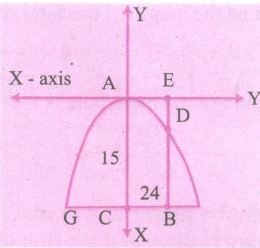
22.
Prove that \({ tan }^{ -1 }\left( \frac { 1-x }{ 1+x } \right) -{ tan }^{ -1 }\left( \frac { 1-y }{ 1+y } \right) ={ sin }^{ -1 }\left( \frac { y-x }{ \sqrt { 1+{ x }^{ 2 } } .\sqrt { 1+{ y }^{ 2 } } } \right)\)
23.
Write the function \(f(x)=\tan ^{-1} \sqrt{\frac{a-x}{a+x}}-a<x<a \)
24.
ABCD is a quadrilateral with \(\overset { \rightarrow }{ AB } =\overset { \rightarrow }{ \alpha } \) and \(\overset { \rightarrow }{ AD } =\overset { \rightarrow }{ \beta } \) and \(\overset { \rightarrow }{ AC } =2\overset { \rightarrow }{ \alpha } +3\overset { \rightarrow }{ \beta } \). If the area of the quadrilateral is λ times the area of the parallelogram with \(\overset { \rightarrow }{ AB } \) and \(\overset { \rightarrow }{ AD } \) as adjacent sides, then prove that \(\lambda =\frac { 5 }{ 2 } \)
25.
Using Gaussian Jordan method, find the values of λ and μ so that the system of equations 2x - 3y + 5z = 12, 3x + y + λz =μ, x - 7y + 8z = 17 has
(i) unique solution
(ii) infinite solutions and
(iii) no solution.
26.
Show that the equations -2x + y + z = a, x - 2y + z = b, x + y -2z = c are consistent only if a + b + c = 0.
27.
Solve: (2x2 - 3x + 1) (2x2 + 5x + 1) = 9x2.
28.
If a, b, c, d and p are distinct non-zero real numbers such that (a2+b2+c2) p2-2 (ab+bc+cd) p+(b2+c2+d2)≤ 0 then prove that a, b, c, d are in G.P and ad = bc
29.
Solve the following system of linear equations by matrix inversion method:
2x + 3y − z = 9, x + y + z = 9, 3x − y − z = −1
30.
Determine the values of λ for which the following system of equations (3λ − 8)x + 3y + 3z = 0, 3x + (3λ − 8)y + 3z = 0, 3x + 3y + (3λ − 8)z = 0. has a non-trivial solution.
31.
Find all cube roots of \(\sqrt { 3 } +i\)
32.
Points A and B are 10 km apart and it is determined from the sound of an explosion heard at those points at different times that the location of the explosion is 6 km closer to A than B. Show that the location of the explosion is restricted to a particular curve and find an equation of it.
33.
Show that the line x−y+4 = 0 is a tangent to the ellipse x2+3y2 = 12 . Also find the coordinates of the point of contact.
34.
Solve \(cos\left( sin^{ -1 }\left( \frac { x }{ \sqrt { 1+{ x }^{ 2 } } } \right) \right) =sin\left\{ cot^{ -1 }\left( \frac { 3 }{ 4 } \right) \right\} \)
35.
If a1, a2, a3, ... an is an arithmetic progression with common difference d, prove that tan\( \left[ tan^{ -1 }\left( \frac { d }{ 1+{ a }_{ 1 }{ a }_{ 2 } } \right) +tan^{ -1 }\left( \frac { d }{ 1+{ a }_{ 2 }{ a }_{ 3 } } \right) +....tan^{ -1 }\left( \frac { d }{ 1+{ a }_{ n }{ a }_{ n-1 } } \right) \right] =\frac { { a }_{ n }-{ a }_{ 1 } }{ 1+{ a }_{ 1 }{ a }_{ n } } \)
36.
Let z1, z2 and z3 be complex numbers such that \(\left| { z }_{ 1 } \right\| =\left| { z }_{ 2 } \right| =\left| { z }_{ 3 } \right| =r>0\) and z1+ z2+ z3 \(\neq \) 0 prove that \(\left| \frac { { z }_{ 1 }{ z }_{ 2 }+{ z }_{ 2 }{ z }_{ 3 }+{ z }_{ 3 }{ z }_{ 1 } }{ { z }_{ 1 }+{ z }_{ 2 }+{ z }_{ 3 } } \right| \) = r
37.
Find all zeros of the polynomial x6- 3x5- 5x4 + 22x3- 39x2- 39x + 135, if it is known that 1+2i and \(\sqrt{3}\) are two of its zeros.
38.
Solve the equation (2x-3) (6x-1) (3x-2) (x-2)-5 = 0
39.
By vector method, prove that cos(α + β) = cos α cos β - sin α sin β
40.
Suppose that f (x) given below represents a probability mass function
| x | 1 | 2 | 3 | 4 | 5 | 6 |
| f(x) | c2 | 2c2 | 3c2 | 4c2 | c | 2c |
Find
(i) the value of c
(ii) Mean and variance.
41.
A retailer purchases a certain kind of electronic device from a manufacturer. The manufacturer, indicates that the defective rate of the device is 5%. The inspector of the retailer randomly picks 10 items from a shipment. What is the probability that there will be
(i) at least one defective item
(ii) exactly two defective items.
42.
Find the local extrema for the following function using second derivative test:
f(x) = x2 e-2x
43.
Find the parametric form of vector equation of a straight line passing through the point of intersection of the straight lines \(\vec { r } =(\hat { i } +\hat { 3j } -\hat { k } )+t(2\hat { i } +3\hat { j } +2\hat { k } )\) and \(\frac { x-2 }{ 1 } =\frac { y-4 }{ 2 } =\frac { z+3 }{ 4 } \) and perpendicular to both straight lines.
1.
\(y={ sin }^{ -1 }(2x),x\in \left[ -\frac { 1 }{ 2 } ,\frac { 1 }{ 2 } \right] \)
2.
\(y=-\frac { 1 }{ 2 } { cos }^{ 2 }x+\frac { { cos }^{ 5 }x }{ 5 } +{ xe }^{ x }-{ e }^{ x }+c\)
3.
c=-1
4.
\( \frac { \partial w }{ \partial u } =\frac { 2u }{ \sqrt { 1-\left( { u }^{ 2 }-{ v }^{ 2 } \right) } } ;\frac { \partial w }{ \partial v } =\frac { -2v }{ \sqrt { 1-\left( { u }^{ 2 }-{ v }^{ 2 } \right) } } \)
5.
(−∞,−2)concave downward
(5,∞)concave upward
Point of inflection is (5, 75)
6.
\(\frac { 1 }{ 48\pi } cm/sec\)
7.
Given r2 = x2 +y2 + z2
log r2 = log (x2 + y2 + z2)
⇒ 2 log r = log (x2 + y2 + z2)
∴ 2V = log (x2 + y2 + z2) [∵ V = log r ]
⇒ V = \(\frac12\) log (x2 + y2 + z2)
\(\frac { \partial V }{ \partial x } =\frac { 1 }{ 2 } \frac { 2x }{ { x }^{ 2 }+{ y }^{ 2 }+{ z }^{ 2 } } =\frac { x }{ { x }^{ 2 }+{ y }^{ 2 }+{ z }^{ 2 } } \)
\(\frac { { \partial }^{ 2 }V }{ \partial { x }^{ 2 } } =\frac { ({ x }^{ 2 }+{ y }^{ 2 }+{ z }^{ 2 })(1)-x(2x) }{ { { (x }^{ 2 }+{ y }^{ 2 }+{ z }^{ 2 }) }^{ 2 } } \)
\(=\frac { { x }^{ 2 }+{ y }^{ 2 }-{ x }^{ 2 } }{ { { (x }^{ 2 }+{ y }^{ 2 }+{ z }^{ 2 }) }^{ 2 } } \)
IIIty \(\frac { { \partial }^{ 2 }V }{ \partial { y }^{ 2 } } =\frac { { x }^{ 2 }+{ y }^{ 2 }-{ y }^{ 2 } }{ { { (x }^{ 2 }+{ y }^{ 2 }+{ z }^{ 2 }) }^{ 2 } } \)
∴ \(\frac { { \partial }^{ 2 }V }{ \partial { z }^{ 2 } } =\frac { { x }^{ 2 }+{ y }^{ 2 }-{ z }^{ 2 } }{ { { (x }^{ 2 }+{ y }^{ 2 }+{ z }^{ 2 }) }^{ 2 } } \)
\(\therefore \frac { { \partial }^{ 2 }V }{ \partial { x }^{ 2 } } +\frac { { \partial }^{ 2 }V }{ \partial { y }^{ 2 } } +\frac { { \partial }^{ 2 }V }{ \partial { z }^{ 2 } } =\frac { { y }^{ 2 }+{ z }^{ 2 }-{ x }^{ 2 }+{ z }^{ 2 }+{ x }^{ 2 }-{ y }^{ 2 }+{ x }^{ 2 }+{ y }^{ 2 }-{ z }^{ 2 } }{ { ({ x }^{ 2 }+{ y }^{ 2 }{ +z }^{ 2 }) }^{ 2 } } \)
= \(\frac { { x }^{ 2 }+{ y }^{ 2 }{ +z }^{ 2 } }{ { ({ x }^{ 2 }+{ y }^{ 2 }{ +z }^{ 2 }) }^{ 2 } } =\frac { 1 }{ { x }^{ 2 }+{ y }^{ 2 }{ +z }^{ 2 } } \)
= \(\frac { 1 }{ { r }^{ 2 } } \)
Hence proved.
8.
given A = {Q\{1}}
A is defined on A by x*y = x+y-xy
Let x,y ≠ 1
∴ x*y = x + y - xy
Now to prove that x + y - xy ≠ 1
Let us assume that x + y - xy = 1
x+y-xy-1 = 0
(x-1)-y(x-1) = 0
(x-1)(1-y) = 0
x =1 or y = 1 which is a false [∵x, y ≠ 1]
∴ is a binary operation on A.
Commutative property:
Let x,y ∈A ⇒ x, y≠1
∴x*y = x+y-xy
and y*x = y+x-yx
⇒x+y = y*x∀x, y∈A
A has commutative property under *
Associative property:
Let x,y,z ∊A ⇒x,y,z≠1
Consider (x*y)*z = (x+y-xy)*z
= x +y~xy +z- (x +y-xy)z
= x +y-xy+ z-xz- yz + xyz
= x +y+z-xy-yz-zx +xyz ...(1)
= x +y+z - yz - x (y + z - yz)
= x +y +z-yz-zy-xz +xyz ..(2)
From (1) & (2), (x*y)*z = x*(y*z)
A has associative property under *.
9.
| p | q | p ➝ q | q⟶ p | p ↔️ q | (p ➝ q) ∧ (q⟶ p) |
| T | T | T | T | T | T |
| T | F | F | T | F | F |
| F | T | T | F | F | F |
| F | F | T | T | T | T |
The entries in the columns corresponding to p ↔ q and ( p ⟶ q) ∧ (q ⟶ p) are identical and hence they are equivalent
10.
Given (x,y) = x3 - 2x2y + 3xy2 + y3 ...(1)
f(tx, ty) = (tx)3 - 2(tx)2 (ty) + 3 (tx) (ty)2 + (ty)3
= t3 x3 - 2t2 x2ty + 3txt2y2+ t3y3
= t3 (x3 - 2x2y + 3xy2 +y3)
f(tx, ty) = t3.f(x, y)
∴ f is a homogeneous function and its degree is 3.
Differentiate (1) partially with respect to 'x' and 'y' we get
\(\frac { \partial f }{ \partial x } { =3 }^{ 2 }-4xy+3{ y }^{ 2 }\)
\(\Rightarrow x\frac { \partial f }{ \partial x } ={ 3x }^{ 2 }-4xy+{ 3xy }^{ 2 }\) ...(2)
\(\frac { \partial f }{ \partial y } =-{ 2x }^{ 2 }+6xy+3{ xy }^{ 2 }\)
\(\Rightarrow y\frac { \partial f }{ \partial y } =-2{ x }^{ 2 }+{ 6xy }^{ 2 }+{ 3y }^{ 3 }\) ...(3)
Adding (2) and (3) we get,
\(x\frac { \partial f }{ \partial x } +y\frac { \partial f }{ \partial y } \) = 3x2 - 4x2y + 3x2y- 2x2y + 6xy2 + 3y3
= 3x2 - 6x2y + 9xy2 + 3y3
= 3 (x3 - 2x2y - 3xy2 +y3)
= 3f [using (1)]
∴ \(x\frac { \partial f }{ \partial x } +y\frac { \partial f }{ \partial y } \) = 3f = nf where 3 is the degree of (x, y)
Hence Euler's theorem is verified.
11.
Given U (x, y) = ex sin y ; x = st2 ; y = s2t
\(\frac { \partial U }{ \partial x } \) = ex sin y ; \(\frac { \partial U }{ \partial y } \) = ex cos y
\(\frac { \partial U }{ \partial x } \) = \({ e }^{ { st }^{ 2 } }\) sin (s2t)
\(\frac { \partial U }{ \partial y } \) = \({ e }^{ { st }^{ 2 } }\) cos (s2t)
\(\frac{dx}{dt}\) = 2st; \(\frac{dy}{dt}\) = s2
\(\frac{dx}{ds}\) = t2; \(\frac{dy}{ds}\) = 2 st
By chain rule
\(\frac { dU }{ ds } =\frac { \partial U }{ \partial x } .\frac { dx }{ ds } +\frac { \partial U }{ \partial y } .\frac { dy }{ ds } \)
= \({ e }^{ { st }^{ 2 } }\). sin (s2t) (t2) + \({ e }^{ { st }^{ 2 } }\) cos(s2t).(2st)
∴ \({ \left( \frac { \partial U }{ \partial s } \right) }_{ (s=t=1) }\) = e1 sin (1) + 2e1 cos (1)
= e [sin (1) + 2 cos (1)] and
\(\frac { dU }{ dt } =\frac { \partial u }{ \partial x } .\frac { dx }{ dt } +\frac { \partial u }{ \partial y } .\frac { dy }{ dt } \)
= \({ e }^{ { st }^{ 2 } }\) . sin (s2t)(2st) + \({ e }^{ { st }^{ 2 } }\) cos (s2t). (s2)
∴ \({ \left( \frac { \partial U }{ \partial t } \right) }_{ (s=t=1) }\) = 2e1 sin (1) + e1 cos (1)
= e [2 sin (1) + cos (1)]
12.
Equation of the given curves are y = sin x ..(1)
Y = cos x ...(2)
from (1) and (2), sin x = cos x
y = sin x
| x | 0 | \(\pi\)/2 |
| y | 0 | 1 |
y = cos x
| x | 0 | \(\pi\)/2 |
| y | 1 | 0 |
\(\Rightarrow x=\frac { \pi }{ 4 } \)
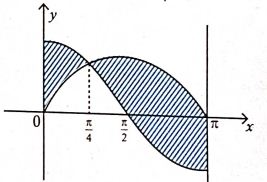
\(\therefore \) Required area = \(2\int _{ \frac { \pi }{ 4 } }^{ \frac { 3\pi }{ 4 } }{ (sinx-cosx)dx } \)
[\(\because\) the area is symmetrical about X - axis]
\(=2{ \left[ -cosx-sinx \right] }_{ \frac { \pi }{ 4 } }^{ \frac { 3\pi }{ 4 } }\)
\(=-2\left[ \left( cos\frac { 3\pi }{ 4 } +sin\frac { 3\pi }{ 4 } \right) -\left( cos\frac { \pi }{ 4 } +sin\frac { \pi }{ 4 } \right) \right] \)
= -2\(\left[ \left( -\frac { 1 }{ \sqrt { 2 } } +\frac { 1 }{ \sqrt { 2 } } \right) -\left( \frac { 1 }{ \sqrt { 2 } } +\frac { 1 }{ \sqrt { 2 } } \right) \right] \)
[cos 135o = cos(180o- 45) = -cos 45o sin135o = sin(180o- 45) = -sin 45o]
\(=-2\left[ \frac { -2 }{ \sqrt { 2 } } \right] =\frac { 4 }{ \sqrt { 2 } } \times \frac { \sqrt { 2 } }{ \sqrt { 2 } } =\frac { 4\sqrt { 2 } }{ 2 } =2\sqrt { 2 } \)
13.
\(Let\ I=\int _{ 0 }^{ \pi }{ x\left[ { sin }^{ 2 }(sinx)+{ cos }^{ 2 }(cosx) \right] } dx\quad ...(1)\)
\(\left[ \because \int _{ 0 }^{ a }{ f(x)dx=\int _{ 0 }^{ a }{ f(a-x)dx } } \right] \)
\(I=\int _{ 0 }^{ \pi }{ (\pi -x) } [{ sin }^{ 2 }(sin(\pi -x))+{ cos }^{ 2 }(cos(\pi -x)]dx\)
\(=\int _{ 0 }^{ \pi }{ (\pi -x)[{ sin }^{ 2 }(sinx)+{ cos }^{ 2 }(-cosx)]dx } \)
\(=\int _{ 0 }^{ \pi }{ (\pi -x)[{ sin }^{ 2 }(sin\quad x)+{ cos }^{ 2 })(cosx)]dx } \)
\([\because cos(-x)=cos\quad x]\)
\(=\int _{ 0 }^{ \pi }{ \pi [{ sin }^{ 2 }(sinx)+{ cos }^{ 2 }(cosx)] } dx\)
\(-\int _{ 0 }^{ \pi }{ x[{ sin }^{ 2 }(sinx)+{ cos }^{ 2 }(cosx)] } dx\)
\(=\int _{ 0 }^{ \pi }{ \pi [{ sin }^{ 2 }(sinx)+{ cos }^{ 2 }(cosx)]dx-I } [from\quad (1)]\)
\(2I=\pi \int _{ 0 }^{ \pi }{ [{ sin }^{ 2 }(sinx)+{ cos }^{ 2 }(cosx)] } dx\)
\(I=\pi \int _{ 0 }^{ \pi /2 }{ \left[ { sin }^{ 2 }(sin\quad x)+{ cos }^{ 2 }(cos\quad x) \right] } dx\quad ...(2)\)
\(I=\pi \int _{ 0 }^{ \pi /2 }{ \left[ { sin }^{ 2 }(sin\frac { \pi }{ 2 } -x)+{ cos }^{ 2 }(cos\frac { \pi }{ 2 } -x) \right] dx } \)
\(I=\pi \int _{ 0 }^{ \pi /2 }{ [{ sin }^{ 2 }(cosx)+{ cos }^{ 2 }(sin\quad x)]dx] } ....(3)\)
Adding (2) and (3) we get,
\(2I=\pi \int _{ 0 }^{ \pi /2 }{ \left[ { sin }^{ 2 }(sinx)+{ cos }^{ 2 }(cosx) \right] dx } +{ sin }^{ 2 }(cosx)+{ cos }^{ 2 }(sin\quad x)]dx\)
\(I=\pi \int _{ 0 }^{ \pi /2 }{ (1+1)dx } \ [\because { sin }^{ 2 }\theta +{ cos }^{ 2 }\theta =1]\)
\(=\pi (2){ [x] }_{ 0 }^{ \frac { \pi }{ 2 } }=2\pi \left[ \frac { \pi }{ 2 } -0 \right] ={ \pi }^{ 2 }\ \)
\( \therefore I=\frac { { \pi }^{ 2 } }{ 2 } \)
14.
Let T represent the temperature of the boiling water and Tm represents the temperature of the kitchen.
By Newton's law of cooling
\(\Rightarrow \int { \frac { dT }{ T-{ T }_{ m } } =K\int { dt } } \)
\(\Rightarrow log(T-{ T }_{ m })=Kt+logC\)
\(\Rightarrow log(T-{ T }_{ m })-logC=Kt\)
\(\Rightarrow log\left( \frac { T-{ T }_{ m } }{ C } \right) =Kt\)
\(\Rightarrow T-{ T }_{ m }={ Ce }^{ Kt } ...(1)\)
when t=0,T=100
\(\therefore 100-{ T }_{ m }={ Ce }^{ 0 }\)
\(\Rightarrow C=100-{ T }_{ m }\)
\(\Rightarrow becomes,\ T-{ T }_{ m }=(100-{ T }_{ m }){ e }^{ Kt }\)
Also when t = 5, T = 80
\(\therefore 80-{ T }_{ m }=(100-{ T }_{ m }){ e }^{ 5K }\)
\(\Rightarrow { e }^{ 5K }=\frac { 80-{ T }_{ m } }{ 100-{ T }_{ m } } ..(2)\)
When t = 10, T = 65
(2) \(\Rightarrow\) 65 - T = (100-Tm)e10K
= (100-Tm)(e5K)2
\(=(100-{ T }_{ m }){ \left( \frac { 80-{ T }_{ m } }{ 100-{ T }_{ m } } \right) }^{ 2 }\)
[using(2)]
\(\Rightarrow 65-{ T }_{ m }=\frac { { (80-{ T }_{ m } })^{ 2 } }{ 100-{ T }_{ m } } \)
\(\Rightarrow\) 6500-65Tm-100Tm+Tm2 = 6400+Tm2-160Tm
\(\Rightarrow\) 6500-6400 = 165Tm-160Tm
\(\Rightarrow\) 100 = 5Tm
\(\\ \Rightarrow { T }_{ m }=\frac { 100 }{ 5 } ={ 20 }^{ o }C\)
Hence the temperature of the kitchen is 20oC
15.
Given \(v\frac { dv }{ dx } =g\left( 1-\frac { { v }^{ 2 } }{ { k }^{ 2 } } \right) =g\left( \frac { { k }^{ 2 }-{ v }^{ 2 } }{ { k }^{ 2 } } \right) \)
On separating the variables we get,
\(\frac { vdv }{ { k }^{ 2 }-{ v }^{ 2 } } =\frac { g }{ { k }^{ 2 } } .dx\)
Multiplying by -2 both sides we get,
\(v\frac { dv }{ dx } =g\left( 1-\frac { { v }^{ 2 } }{ { k }^{ 2 } } \right) =g\left( \frac { { k }^{ 2 }-{ v }^{ 2 } }{ { k }^{ 2 } } \right) \)
\(\frac { -2vdv }{ { k }^{ 2 }-{ v }^{ 2 } } =\frac { -2g }{ { k }^{ 2 } } dx\)
Taking integrating on both sides, we get
\(\int { \frac { -2v }{ { k }^{ 2 }-{ v }^{ 2 } } } =\frac { -2g }{ { k }^{ 2 } } .x+log\quad c\)
\(\Rightarrow log({ k }^{ 2 }-{ v }^{ 2 })=\frac { -2g }{ { k }^{ 2 } } .x+log\quad c\)
\(\Rightarrow log({ k }^{ 2 }-{ v }^{ 2 })-log\quad c=\frac { -2g }{ { k }^{ 2 } } .x\)
\(\Rightarrow log\left( \frac { { k }^{ 2 }-{ v }^{ 2 } }{ c } \right) -\frac { -2gx }{ { k }^{ 2 } } \)
\(\Rightarrow \frac { { k }^{ 2 }-{ v }^{ 2 } }{ e } ={ e }^{ -\frac { -2gx }{ { k }^{ 2 } } }\)
\(\Rightarrow { k }^{ 2 }-{ v }^{ 2 }{ ce }^{ \frac { -2gx }{ { k }^{ 2 } } }...(1)\)
Initial condition:
when v = 0, x = 0 we get
\(
k^2-(0)^2 =C e^{\frac{-2g(0)}{k^2}}
\)
\(k^2 =C e^0 \Rightarrow k^2=C
\)
\((1) \Rightarrow k^2-v^2 =k^2 e^{\frac{-2 x^2}{k^2}}
\)
\(k^2-k^2 e^{\frac{-2 s x}{k^1}} =\mathrm{v}^2
\)
\(k^2\left[1-e^{\frac{-2 s x}{k^2}}\right] =\mathrm{v}^2\)
16.
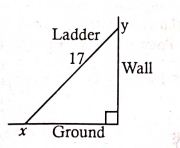
Let AB be the position of the ladder at any time t such that OA = x and OB = y
Then OA2 + OB2 = AB2
⇒ x2 + y2 = 172
Given \(\frac { dx }{ dt } \) = 5 and x = 8
When x = 8, 82 + y2 = 172
⇒ y2 = 289 - 64 = 225
⇒ y = 15
Differentiating (1) with respect to 't' we get,
\(2x\frac { dx }{ dt } +2y\frac { dy }{ dt } =0\)
⇒ 8(5) + 15 \(\frac { dy }{ dt } \) = 0 [∵ x = 8, \(\frac { dx }{ dt } \) = 15, y = 15]
⇒ 40 + 15\(\frac { dy }{ dt } \) = 0
⇒ \(\frac { dy }{ dt } =\frac { -40 }{ 15 } =\frac { -8 }{ 3 } \) m/sec
∴ The rate of top of the ladder moving down the wall is \(\frac{-8}{3}\) m/sec
(ii) The ladder, the wall and the floor forms a right angled triangle.
Area = \(\frac12\)xy
Differentiating with respect to 't' we get,
\(\frac { dA }{ dt } =\frac { 1 }{ 2 } \left[ x\frac { dy }{ dx } +y\frac { dx }{ dt } \right] \)
\(=\frac { 1 }{ 2 } \left[ 8\left( -\frac { 8 }{ 3 } \right) +15(5) \right] \)
= \(\frac { 1 }{ 2 } \left[ \frac { -64 }{ 3 } +75 \right] =\frac { 1 }{ 2 } \)
= \(\frac { 1 }{ 2 } \left[ \frac { -64+225 }{ 3 } \right] =\frac { 1 }{ 2 } \left( \frac { 161 }{ 3 } \right) \)
= \(\frac { dA }{ dt } \) = 26.83 sq.m/sec
17.
Let \(\overset { \rightarrow }{ B } =x\overset { \wedge }{ i } +y\overset { \wedge }{ j } +z\overset { \wedge }{ k } \)
Given \(\overset { \rightarrow }{ A } \times \overset { \rightarrow }{ B } =\overset { \rightarrow }{ C } \Rightarrow \left| \begin{matrix} \overset { \wedge }{ i } \\ 1 \\ x \end{matrix}\begin{matrix} \overset { \wedge }{ j } \\ 1 \\ y \end{matrix}\begin{matrix} \overset { \wedge }{ k } \\ 1 \\ z \end{matrix} \right| =\overset { \wedge }{ j } -\overset { \wedge }{ k } \)
\(\Rightarrow \overset { \wedge }{ i } (z-y)-\overset { \wedge }{ j } (z-x)+\overset { \wedge }{ k } (y-x)\quad \overset { \wedge }{ j } -\overset { \wedge }{ k } \)
Equating the like components on both sides, we get
z - y = 0 .....(1)
x - y = 1 .....(2)
y - x = -1 .....(3)
Also, \(\overset { \rightarrow }{ A } .\overset { \rightarrow }{ B } =3\Rightarrow \left( \overset { \wedge }{ i } +\overset { \wedge }{ j } +\overset { \wedge }{ k } \right) .\left( x\overset { \wedge }{ i } +y\overset { \wedge }{ j } +z\overset { \wedge }{ k } \right) =3\)
⇒ x + y + z = 3 ....(4)
Solving (1), (2), (3) and (4), we get \(x=\frac { 5 }{ 3 } ,y=\frac { 2 }{ 3 } \)and \(z=\frac { 2 }{ 3 } \)
\(\therefore \overset { \rightarrow }{ B } =\frac { 5 }{ 3 } \overset { \wedge }{ i } +\frac { 2 }{ 3 } \overset { \wedge }{ j } +\frac { 2 }{ 3 } \overset { \wedge }{ k } \)
18.
arg(1+i) + arg(1-i) = arg[(1+i) (1-i)]
LHS = arg (1+i) + arg(1-i)
1+i = \(\sqrt { 2 } \left( \frac { 1 }{ \sqrt { 2 } } +\frac { i }{ \sqrt { 2 } } \right) \)
= \(\sqrt { 2 } \left( cos\frac { \pi }{ 4 } +isin\frac { \pi }{ 4 } \right) \)
∴ arg (1+i) = π/4
-1+i =\(\sqrt { 2 } \left( \frac { -1 }{ \sqrt { 2 } } +\frac { i }{ \sqrt { 2 } } \right) \)
= \(\sqrt { 2 } \left( cos3\frac { \pi }{ 4 } +isin3\frac { \pi }{ 4 } \right) \)
∴ (-1+i) = 3\(\frac { \pi }{ 4 } \)
∴ LHS = \(\frac { \pi }{ 4 } +\frac { 3\pi }{ 4 } =\frac { 4\pi }{ 4 } =\pi \)
RHS = arg[(1+i) (-1+i)]
= arg[-1-i + i + i2]
= (-1-i + i-1) = arg(-2)
= arg(2) - (1) = 2 arg(-1)
= 2 (cos π + isin π) = π
∴ LHS = RHS
19.
LHS = 2 arg (-1)
= 2 arg (cos π + i sin π) = 2π
RHS = arg (-1)2 = arg (1)
= arg (cos θ + isin θ) = 0
∴ LHS ≠ RHS
20.
Equation of the ellipse is \(\frac { { x }^{ 2 } }{ 25 } +\frac { y^{ 2 } }{ 9 } =1\)
∴ a2 = 25, b2 = 9
∴ e = \(\sqrt { 1-\frac { { b }^{ 2 } }{ { a }^{ 2 } } } =\sqrt { 1-\frac { 9 }{ 25 } } =\sqrt { \frac { 16 }{ 25 } } =\frac { 4 }{ 5 } \)
Focus is (ae, 0) = \(\left( 5\times \frac { 4 }{ 5 } \right) \) = (4, 0)
Since the focus of the hyperbola coincides with the focus of the ellipse, foci of the hyperbola are (±4,0).
Let A be the length of the semi-transverse axis
∴ Ae - 4 ⇒ 2A = \(\frac { 4 }{ e } =\frac { 4 }{ 2 } =2\) [∵ e = 2]
Let B b th length of the semi conjugate axis
B2 = A2(e2 - 1) = 4(4 - 1) = 12
Equation of the hyperbola is \(\frac { { x }^{ 2 } }{ { A }^{ 2 } } -\frac { { y }^{ 2 } }{ { B }^{ 2 } } =1\)
⇒ \(\frac { { x }^{ 2 } }{ 4 } -\frac { { y }^{ 2 } }{ 12 } =1\)
21.
Let us take the axis AX as the and the tangent AY at A as y-axis.
Equation of the parabola is y2 = 4ax
CA 15, FG = 120
CF = CG= 60
F is (15, 60)
Since F lies on (1), 602 = Aa(15) ∴ ⇒ a = 60
y2 = 240x
When y = 24, 242 = 240(x)
⇒ x = \(\frac { 24\times 24 }{ 240 } \)
x = \(\frac{24}{10}\) = \(\frac{12}{5}\) = 2.4
From the diagram
BD = BE - ED = 15-2.4 = 12.6m.
Hence the required height is 12.6 m.
22.
LHS =\({ tan }^{ -1 }\left( \frac { 1-x }{ 1+x } \right) -{ tan }^{ -1 }\left( \frac { 1-y }{ 1+y } \right) \)
= tan-1(1) - tan-1 (x) - (tan-1(1) - tan-1(y)
\(\left[ \because { tan }^{ -1 }(\frac { x-y }{ 1+xy } )={ tan }^{ -1 }x-{ tan }^{ -1 }y \right] \)
= tan-1(1) - tan-1 (x) - tan-1(1) + tan-1(y)
= tan-1(y) - tan-1(x)
= \({ tan }^{ -1 }\left( \frac { y-x }{ 1+xy } \right) \)
= \({ sin }^{ -1 }\left( \frac { y-x }{ \sqrt { 1+\left( yx \right) ^{ 2 }+\left( y-x \right) ^{ 2 } } } \right) \)
= \({ sin }^{ -1 }\left( \frac { y-x }{ \sqrt { (1+{ x }^{ 2 })(1+{ x }^{ 2 }) } } \right) \)
RHS
23.
Put \(x=a\ cos\theta\)
\(f(x)={ tan }^{ -1 }\sqrt { \frac { a-acos\theta }{ a+acos\theta } } ={ tan }^{ -1 }\sqrt { \frac { 1-cos\theta }{ 1+cos\theta } }\)
= \({ tan }^{ -1 }\sqrt { \frac { 2{ sin }^{ 2 }\frac { \theta }{ 2 } }{ 2{ cos }^{ 2 }\frac { \theta }{ 2 } } } =tan|tan\frac { \theta }{ 2 } |={ tan }^{ -1 }\left( tan\frac { \theta }{ 2 } \right)\)
= \(\frac { \theta }{ 2 }\) \(\left.\Rightarrow 0<\frac{\theta}{2}<\frac{\pi}{2} \therefore\left|\tan \frac{\theta}{2}\right|=\tan \frac{\theta}{2}\right]\)
\(\frac { 1 }{ 2 } .{ cos }^{ -1 }\left( \frac { x }{ a } \right)\)
24.
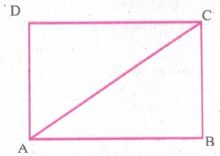
Given \(\overset { \rightarrow }{ AB } =\overset { \rightarrow }{ \alpha } \), \(\overset { \rightarrow }{ AD } =\overset { \rightarrow }{ \beta } \) and \(\overset { \rightarrow }{ AC } =2\overset { \rightarrow }{ \alpha } +3\overset { \rightarrow }{ \beta } \)
Area of the quadrilateral ABCD
∴ = are of ∆ ABC + area of ∆ ACD
\(=\frac { 1 }{ 2 } \left| \overset { \rightarrow }{ AB } \times \overset { \rightarrow }{ AC } \right| +\frac { 1 }{ 2 } \left| \overset { \rightarrow }{ AC } \times \overset { \rightarrow }{ AD } \right| \)
\(=\frac { 1 }{ 2 } \left| \overset { \rightarrow }{ \alpha } \times \left( 2\overset { \rightarrow }{ \alpha } +3\overset { \rightarrow }{ \beta } \right) \right| +\frac { 1 }{ 2 } \left| \left( 2\overset { \rightarrow }{ \alpha } +3\overset { \rightarrow }{ \beta } \right) \times \overset { \rightarrow }{ \beta } \right| \)
\(=\frac { 1 }{ 2 } \left| 2\left( \overset { \rightarrow }{ \alpha } \times \overset { \rightarrow }{ \alpha } \right) +3\left( \overset { \rightarrow }{ \alpha } \times \overset { \rightarrow }{ \beta } \right) \right| +\frac { 1 }{ 2 } \left| 2\left( \overset { \rightarrow }{ \alpha } \times \overset { \rightarrow }{ \beta } \right) +3\left( \overset { \rightarrow }{ \beta } \times \overset { \rightarrow }{ \beta } \right) \right| \)
\(=\frac { 1 }{ 2 } \left| 3\left( \overset { \rightarrow }{ \alpha } \times \overset { \rightarrow }{ \beta } \right) \right| +\frac { 1 }{ 2 } \left| 2\left( \overset { \rightarrow }{ \alpha } \times \overset { \rightarrow }{ \beta } \right) \right| \quad \quad \quad \left[ \because \overset { \rightarrow }{ \alpha } \times \overset { \rightarrow }{ \alpha } =\overset { \rightarrow }{ \beta } \times \overset { \rightarrow }{ \beta } =0 \right] \)
\(=\left( \frac { 3 }{ 2 } +\frac { 2 }{ 2 } \right) \left( \overset { \rightarrow }{ \alpha } \times \overset { \rightarrow }{ \beta } \right) =\left( \frac { 5 }{ 2 } \right) \left| \overset { \rightarrow }{ \alpha } \times \overset { \rightarrow }{ \beta } \right| \quad \quad (1)\)
Now, Area of the parallelogram with \(\overset { \rightarrow }{ AB } \) and \(\overset { \rightarrow }{ AD } \) as
adjacent sides = \(\left| \overset { \rightarrow }{ AB } \times \overset { \rightarrow }{ AD } \right| =\left| \overset { \rightarrow }{ \alpha } \times \overset { \rightarrow }{ \beta } \right| .... (2)\)
From (1) & (2), \(\frac { 5 }{ 2 } \left| \overset { \rightarrow }{ \alpha } \times \overset { \rightarrow }{ \beta } \right| =\lambda \left| \overset { \rightarrow }{ \alpha } \times \overset { \rightarrow }{ \beta } \right| \) [Given]
\(\lambda =\frac { 5 }{ 2 } \)
25.
The augmented matrix [A|B] is \(\left[ \begin{matrix} 2 & -3 & 5 \\ 3 & 1 & \lambda \\ 1 & -7 & 8 \end{matrix}|\begin{matrix} 12 \\ \mu \\ 17 \end{matrix} \right] \)
\(\overset { { R }_{ 1 }\leftrightarrow { R }_{ 3 } }{ \longrightarrow } \left[ \begin{matrix} 1 & -7 & 8 \\ 3 & 1 & \lambda \\ 2 & -3 & 5 \end{matrix}|\begin{matrix} 17 \\ \mu \\ 12 \end{matrix} \right] \)
\(\overset { { R }_{ 2 }\rightarrow { R }_{ 2 }-{ R }_{ 1 }\\ { R }_{ 3 }\rightarrow { R }_{ 3 }-2R_{ 1 } }{ \longrightarrow } \left[ \begin{matrix} 1 & -7 & 8 \\ 0 & 22 & \lambda -51 \\ 0 & 11 & -11 \end{matrix}|\begin{matrix} 17 \\ \mu -51 \\ -22 \end{matrix} \right] \)
\(\overset { { R }_{ 2 }\rightarrow { R }_{ 2 }-2{ R }_{ 3 }\\ { R }_{ 3 }\rightarrow { R }_{ 3 }\div 11 }{ \longrightarrow } \left[ \begin{matrix} 1 & -7 & 8 \\ 0 & 0 & \lambda -2 \\ 0 & 1 & -1 \end{matrix}|\begin{matrix} 17 \\ \mu -7 \\ -2 \end{matrix} \right] \)
\(\overset { { R }_{ 2 }\leftrightarrow { R }_{ 3 } }{ \longrightarrow } \left[ \begin{matrix} 1 & -7 & 8 \\ 0 & 1 & -1 \\ 0 & 0 & \lambda -2 \end{matrix}|\begin{matrix} 17 \\ -2 \\ \mu -7 \end{matrix} \right] \)
Case (i) : when λ ≠ 2,
\(\rho\) ([A|B]) = 3 and \(\rho\)(A) = 3
∴ \(\rho\)([AIB])= \(\rho\)(A) = 3 = the number of unknowns
∴ The system has unique solution
Case (ii) : when λ = 2, μ =7
\(\left[ \begin{matrix} 1 & -7 & 8 \\ 0 & 1 & -1 \\ 0 & 0 & 0 \end{matrix}|\begin{matrix} 17 \\ -2 \\ 0 \end{matrix} \right] \)
Here \(\rho\)(A) = 2 and \(\rho\)([A|B]) = 2
∴ \(\rho\)(A) = \(\rho\)([A|B]) = 2 < number of unknowns
Thus the system is consistent with infinitely many solutions.
Case (iii) : When λ= 2 and μ ≠ 7
\(\rho\) (A) = 2 and \(\rho\) ([A|B]) = 3
∴ \(\rho\) (A) ≠ \(\rho\) ([A|B])
Thus, the given system of equations is inconsistent.
26.
Augmented matrix [A|B] is \(\left[ \begin{matrix} -2 & 1 & 1 \\ 1 & -2 & 1 \\ 1 & 1 & -2 \end{matrix}|\begin{matrix} a \\ b \\ c \end{matrix} \right] \)
[A|B]\(\overset { { R }_{ 1 }\leftrightarrow { R }_{ 2 } }{ \longrightarrow } \left[ \begin{matrix} 1 & -2 & 1 \\ -2 & 1 & 1 \\ 1 & 1 & -2 \end{matrix}|\begin{matrix} b \\ a \\ c \end{matrix} \right] \)
\(\overset { { R }_{ 2 }\rightarrow { R }_{ 2 }+2{ R }_{ 1 }\\ { R }_{ 3 }\rightarrow { R }_{ 3 }+{ R }_{ 1 } }{ \longrightarrow } \left[ \begin{matrix} 1 & -2 & 1 \\ 0 & -3 & 3 \\ 0 & 3 & -3 \end{matrix}|\begin{matrix} b \\ a+2b \\ c-b \end{matrix} \right] \)
\(\overset { { R }_{ 3 }\rightarrow { R }_{ 3 }+{ R }_{ 2 } }{ \longrightarrow } \left[ \begin{matrix} 1 & -2 & 1 \\ 0 & -3 & 3 \\ 0 & 0 & 0 \end{matrix}|\begin{matrix} b \\ c+2b \\ a+b+c \end{matrix} \right] \)
Here \(\rho\) (A) = 2
The given system is consistent only when \(\rho\)([A|B]) = 2\(\rho\)([A|B]) = 2 only if a + b + c = 0 Hence proved.
27.
Given equation is
(2x2 - 3x + 1) (2x2 + 5x + 1) = 9x2 ....(1)
Clearly x = 0 does not satisfy (1),
∴ (1) can be rewritten as
\(\left( 2x+\frac { 1 }{ x } -3 \right) \left( 2x+\frac { 1 }{ x } +5 \right) =9...(2)\)
put \(2x+\frac { 1 }{ x } =y\)
∴ (2)⇒ (y - 3) (y + 5) = 9
⇒ y2+ 2y-15 = 9
or y2+ 2y - 24 = 0
⇒ (y + 6) (y - 4) = 0
⇒ y = -6, -4
Case (i)
When \(y=-6,2x+\frac { 1 }{ x } =-6\)
2x2+6x+1 = 0
\(\Rightarrow =\frac { -6\pm \sqrt { 36-8 } }{ 4 } \)
\(x=-3\pm \frac { \sqrt { 7 } }{ 2 } \)
Case(ii)
When \(y=4,2x+\frac { 1 }{ x } =4\)
⇒ 2x2- 4x+1 = 0
\(x=\frac{4 \pm \sqrt{16-8}}{4}\)
\(x=\frac { 2\pm \sqrt { 2 } }{ 2 } \)
This, the roots are
\(\\ \frac { -3+\sqrt { 7 } }{ 2 } ,\frac { -3-\sqrt { 7 } }{ 2 } ,\frac { 2+\sqrt { 2 } }{ 2 } ,\frac { 2-\sqrt { 2 } }{ 2 } \)
28.
Given equation is (a2+b2+c2) p2-2
(ab+bc+cd) p+(b2+c2+d2) ≤ 0...(1)
(1) can be rewritten as
(a2p2 - 2abp + b2) + (b2p2 - 2bcp + c2) + (c2p2 - 2cdp + d2) ≤ 0
Since a, b, c, d, p∈ R
(ap-b)2 ≥ 0, (bp-c)2 ≥ 0 and (cp-d)2 ≥ 0
∴ (2) will be satisfied only if
ap - b = 0, bp - c = 0, cp - d = 0
\(\Rightarrow \frac { b }{ a } =\frac { c }{ b } =\frac { d }{ c } =p\)
⇒ a, b, c, d are in G.P and ad = bc
29.
2x + 3y - z = 9, x + y + z = 9, 3x - y - z = -1
The matrix form of the system is
\(\left[ \begin{matrix} 2 & 3 & -1 \\ 1 & 1 & 1 \\ 3 & -1 & -1 \end{matrix} \right] \left[ \begin{matrix} x \\ y \\ z \end{matrix} \right] =\left[ \begin{matrix} 9 \\ 9 \\ -1 \end{matrix} \right] \)
⇒ AX = B where A =\(\left[ \begin{matrix} 2 & 3 & -1 \\ 1 & 1 & 1 \\ 3 & -1 & -1 \end{matrix} \right] \)
X =\(\left[ \begin{matrix} x \\ y \\ z \end{matrix} \right] \) and B =\(\left[ \begin{matrix} 9 \\ 9 \\ -1 \end{matrix} \right] \)
⇒ X = A-1N
|A| = \(\left| \begin{matrix} 2 & 3 & -1 \\ 1 & 1 & 1 \\ 3 & -1 & -1 \end{matrix} \right| =2\left| \begin{matrix} 1 & 1 \\ -1 & -1 \end{matrix} \right| -3\left| \begin{matrix} 1 & 1 \\ 3 & -1 \end{matrix} \right| -1\left| \begin{matrix} 1 & 1 \\ 3 & -1 \end{matrix} \right| \)
= 2(-1+1)-3(-1-3)-1(-1-3)
= 0-3(-4) = 12+4 = 16
adj A =\(\left[ \begin{matrix} +\left| \begin{matrix} 1 & 1 \\ -1 & -1 \end{matrix} \right| & -\left| \begin{matrix} 1 & 1 \\ 3 & -1 \end{matrix} \right| & +\left| \begin{matrix} 1 & 1 \\ 3 & -1 \end{matrix} \right| \\ -\left| \begin{matrix} 3 & -1 \\ -1 & -1 \end{matrix} \right| & +\left| \begin{matrix} 2 & -1 \\ 3 & -1 \end{matrix} \right| & -\left| \begin{matrix} 2 & 3 \\ 3 & -1 \end{matrix} \right| \\ +\left| \begin{matrix} 3 & -1 \\ 1 & 1 \end{matrix} \right| & -\left| \begin{matrix} 2 & -1 \\ 1 & 1 \end{matrix} \right| & +\left| \begin{matrix} 2 & 3 \\ 1 & 1 \end{matrix} \right| \end{matrix} \right] \)
=\(\left[ \begin{matrix} +(-1+1) & -(-1-3) & +(-1-3) \\ -(-3-1) & +(2+3) & -(-2-9) \\ +(3+1) & -(2+1) & +(2-3) \end{matrix} \right] ^{ T }\)
=\(\left[ \begin{matrix} 0 & 4 & -4 \\ 4 & 1 & 11 \\ 4 & -3 & -1 \end{matrix} \right] ^{ T }=\left[ \begin{matrix} 0 & 4 & 4 \\ 4 & 1 & -3 \\ -4 & 11 & -1 \end{matrix} \right] \)
∴ A-1 = \(\frac { 1 }{ |A| } adjA\frac { 1 }{ 16 } \left[ \begin{matrix} 0 & 4 & 4 \\ 4 & 1 & -3 \\ -4 & 11 & -1 \end{matrix} \right] \)
∴ X = A-1B = \(\frac { 1 }{ 16 } \left[ \begin{matrix} 0 & 4 & 4 \\ 4 & 1 & -3 \\ -4 & 11 & -1 \end{matrix} \right] \left[ \begin{matrix} 9 \\ 9 \\ -1 \end{matrix} \right] \)
= \(\frac { 1 }{ 16 } \left[ \begin{matrix} 0+36-4 \\ 36+9+3 \\ -36+99+1 \end{matrix} \right] =\frac { 1 }{ 16 } \left[ \begin{matrix} 32 \\ 48 \\ 64 \end{matrix} \right] =\left[ \begin{matrix} 2 \\ 3 \\ 4 \end{matrix} \right] \)
∴ x = 2, y = 3, z = 4
∴ Solution set is {2, 3, 4}
30.
Here the number of unknowns is 3. So, if the system is consistent and has a non-trivial solution, then the rank of the coefficient matrix is equal to the rank of the augmented matrix and is less than 3.
So the determinant of the coefficient matrix should be 0.
Hence we get
\(\left| \begin{matrix} 3\lambda -8 & 3 & 3 \\ 3 & 3\lambda -8 & 3 \\ 3 & 3 & 3\lambda -8 \end{matrix} \right| \) = 0 or \(\left| \begin{matrix} 3\lambda -2 & 3\lambda -2 & 3\lambda -2 \\ 3 & 3\lambda -8 & 3 \\ 3 & 3 & 3\lambda -8 \end{matrix} \right| \) = 0 (by applying R1 ➝ R1 + R2 + R3)
or (3λ - 2) \(\left| \begin{matrix} 1 & 1 & 1 \\ 3 & 3\lambda -8 & 3 \\ 3 & 3 & 3\lambda -8 \end{matrix} \right| \) = 0 (by taking out (3λ − 2) from R1)
or (3λ - 2) \(\left| \begin{matrix} 1 & 1 & 1 \\ 3 & 3\lambda -11 & 3 \\ 3 & 3 & 3\lambda -11 \end{matrix} \right| \) = 0 (by applying R2 ➝ R2 - 3R1, R3 ➝ R3 - 3R1)
or (3λ - 2)(3λ - 11)2 0. So λ = \(\frac { 2 }{ 3 } \) and λ = \(\frac { 11 }{ 3 } \).
We now give an application of system of linear homogeneous equations to chemistry. You are already aware of balancing chemical reaction equations by inspecting the number of atoms present on both sides.
31.
We have to find \((\sqrt{3}+1)^{\frac{1}{3}}\). Let \(z=(\sqrt{3}+i)^{\frac{1}{3}}\). Then \({ z }^{ 3 }=\sqrt { 3 } +i=r\left( cos\theta +isin\theta \right) \)
Then, \(r=\sqrt { 3+1 } =2\) and \(\alpha =\theta =\frac { \pi }{ 6 } \) (\(\because \sqrt{3}+i\) lies in the first quadrant)
Therefore, \({ z }^{ 3 }=\sqrt { 3 } +i=2\left( cos\frac { \pi }{ 6 } +isin\frac { \pi }{ 6 } \right) \)
\(\Rightarrow z=\sqrt [ 3 ]{ 2 } \left( cos\left( \frac { \pi +12k\pi }{ 18 } \right) +isin\left( \frac { \pi +12k\pi }{ 18 } \right) \right) \), k = 0, 1, 2.
Taking k = 0, 1, 2, we get
k = 0, z \(={ 2 }^{ \frac { 1 }{ 3 } }\left( cos\frac { \pi }{ 18 } +sin\frac { \pi }{ 18 } \right) \)
k = 1, \(z={ z }^{ \frac { 1 }{ 3 } }\left( cos\frac { \pi }{ 18 } +sin\frac { \pi }{ 18 } \right) \)
k = 2, \(z={ 2 }^{ \frac { 1 }{ 3 } }\left( cos\frac { 25\pi }{ 18 } +sin\frac { 25\pi }{ 18 } \right) ={ 2 }^{ \frac { 1 }{ 3 } }\left( -cos\frac { 7\pi }{ 18 } -sin\frac { 7\pi }{ 18 } \right) \)
32.
Let P(x, y) be the location of explosion
Given PB - PA = 6
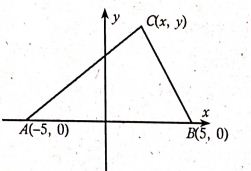
Using distance formula,
\(\sqrt { { (x-5) }^{ 2 }+({ y-0) }^{ 2 } } -\sqrt { ({ x+5 })^{ 2 }+({ y-0) }^{ 2 } } =6\)
\(\Rightarrow \sqrt { { (x-5) }^{ 2 }+({ y })^{ 2 } } -\sqrt { (x+{ 5) }^{ 2 }+({ y) }^{ 2 } } =6\)
Squaring both sides, we get,
(x - 5)2 + y2 + (x + 5)2 + y2
\(-2\sqrt { [(x-{ 5 })^{ 2 }+{ y }^{ 2 }][(x+{ 5 })^{ 2 }+{ y }^{ 2 }] } \) = 36
.JPG)
\(2\sqrt { [(x-{ 5 })^{ 2 }+{ y }^{ 2 }][(x+{ 5 })^{ 2 }+{ y }^{ 2 }] } \)
⇒ 2x2 + 2y2+14
= \(2\sqrt { ({ x }^{ 2 }-10x+25+{ y }^{ 2 })({ x }^{ 2 }+10x+25+{ y }^{ 2 }) } \)
⇒ x2 + y2 + 7
= \(2\sqrt { ({ x }^{ 2 }-10x+25+{ y }^{ 2 })({ x }^{ 2 }+10x+25+{ y }^{ 2 }) } \)
Squaring again,
x4+ y4 + 49 +2x2y2 + 14y2 + 14x2
= (x2 - 10x + 25 + y2) (x2 + 10x + 25 + y2)
.JPG)
⇒ 14y2 + 14x2 = -50x2 + 50y2 + 625 - 49
⇒ 64x2 - 36y2 = 576
\(\div \) 4 we get,
16x2 - 9y = 144
\(\frac { { x }^{ 2 } }{ 9 } -\frac { { y }^{ 2 } }{ 16 } =1\)
Hence the location of explo ion is restricted to a hyperbola whose equation is \(\frac { { x }^{ 2 } }{ 9 } -\frac { { y }^{ 2 } }{ 16 } =1\)
33.
x2+3y2 = 12
\(\div 12\) we get, \(\frac { { x }^{ 2 } }{ 12 } +\frac { { y }^{ 2 } }{ 4 } =1\)
∴ a2 = 12, b2 = 4
The line x-y+ 4 = 0 can be rewritten as y = x+4.
∴ m = 1, c = 4
The condition for y = mx + 4 to be a tangent to the ellipse is c2 = a2m2 + b2
∴ (4)2 = 12(1)2 + 4
⇒ 16 = 12+4
⇒ 16 = 16
Since the condition is satisfied, the line x - y + 4 = 0 is a tangent to the ellipse x2 + 3y2 = 12.
Also, the point of contact is \(\left( -\frac { { a }^{ 2 }m }{ c } ,\frac { { b }^{ 2 } }{ c } \right) \)
\(\Rightarrow \left( -\frac { 12(1) }{ 4 } ,\frac { 4 }{ 4 } \right) \Rightarrow (-3,1)\)
∴The point of contact is (-3, 1).
34.
We know that \(sin^{ -1 }\left( \frac { x }{ \sqrt { 1+{ x }^{ 2 } } } \right) =cos^{ -1 }\left( \frac { x }{ \sqrt { 1+{ x }^{ 2 } } } \right) \)
Thus, \(cos\left( sin^{ -1 }\left( \frac { x }{ \sqrt { 1+{ x }^{ 2 } } } \right) \right) =\frac { 1 }{ \sqrt { 1+x^{ 2 } } } \) ...(1)
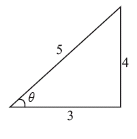
Let \(\cot ^{-1}\left(\frac{3}{4}\right)=\theta\). Then \(\cot \theta=\frac{3}{4}\) and so \(\theta\) is cute.
From the diagram, we get,
Hence \(\sin \left\{\cot ^{-1}\left(\frac{3}{4}\right)\right\}=\sin \theta=\frac{4}{5}\) ................ (2)
Using (1) and (2) in the given equation, we \(\frac { 1 }{ \sqrt { 1+x^{ 2 } } } =\frac { 4 }{ 5 } \) \(\sqrt{1+x^2}=\frac{5}{4}\)
Thus, x = \(\pm\frac{3}{4}\)
35.
Now, \(tan^{ -1 }\left( \frac { d }{ 1+{ a }_{ 1 }{ a }_{ 2 } } \right) =tan^{ -1 }\frac { { a }_{ n }-{ a }_{ 1 } }{ 1+{ a }_{ 1 }{ a }_{ n } } =tan^{ -1 }{ a }_{ 2 }-tan^{ -1 }{ a }_{ 1 }\)
Similarly, \(tan^{ -1 }\left( \frac { d }{ 1+{ a }_{ 1 }{ a }_{ 2 } } \right) =tan^{ -1 }\left( \frac { { a }_{ n }-{ a }_{ 1 } }{ 1+{ a }_{ 1 }{ a }_{ n } } \right) =tan^{ -1 }{ a }_{ 3 }-tan^{ -1 }{ a }_{ 2 }\)
Continuing inductively, we get
\(tan^{ -1 }\left( \frac { d }{ 1+{ a }_{ n }{ a }_{ n-1 } } \right) =tan^{ -1 }\left( \frac { { a }_{ n }-{ a }_{ n-1 } }{ 1+{ a }_{ n }{ a }_{ n-1 } } \right) =tan^{ -1 }{ a }_{ n }-tan^{ -1 }{ a }_{ n-1 }\)
Adding vertically, we get
\(tan^{ -1 }\left( \frac { d }{ 1+{ a }_{ 1 }{ a }_{ 2 } } \right) +tan^{ -1 }\left( \frac { d }{ 1+{ a }_{ 2 }{ a }_{ 3 } } \right) +....+tan^{ -1 }\left( \frac { d }{ 1+{ a }_{ n }{ a }_{ n-1 } } \right) tan[tan^{ -1 }{ a }_{ n }-{ tan }^{ -1 }{ a }_{ 1 }]\\ \)
\(tan\left[ tan^{ -1 }\left( \frac { d }{ 1+{ a }_{ 1 }{ a }_{ 2 } } \right) +tan^{ -1 }\left( \frac { d }{ 1+{ a }_{ 2 }{ a }_{ 3 } } \right) +...+tan^{ -1 }\left( \frac { d }{ 1+{ a }_{ n }{ a }_{ n-1 } } \right) \right] =tan\left[ tan^{ -1 }{ a }_{ n }-tan^{ -1 }a_{ 1 } \right] \)\(=\left[ tan^{ -1 }\left( \frac { { a }_{ n }-{ a }_{ 1 } }{ 1+{ a }_{ 1 }{ a }_{ n } } \right) \right] =\frac { { a }_{ n }-{ a }_{ 1 } }{ 1+{ a }_{ 1 }{ a }_{ n } } \)
36.
Given that \(\left| { z }_{ 1 } \right| =\left| { z }_{ 2 } \right| =\left| { z }_{ 3 } \right| =r\Rightarrow { z }_{ 1 }\bar { { z }_{ 1 } } ={ z }_{ 2 }\bar { { z }_{ 2 } } ={ r }^{ 2 }\)
\(\Rightarrow { z }_{ 1 }=\frac { { r }^{ 2 } }{ \bar { { z }_{ 1 } } } ,{ z }_{ 2 }=\frac { { r }^{ 2 } }{ \bar { { z }_{ 2 } } } ,{ z }_{ 3 }=\frac { { r }^{ 2 } }{ { \bar { z } }_{ 3 } } \)
Therefore \({ z }_{ 1 }+{ z }_{ 2 }+{ z }_{ 3 }=\frac { { r }^{ 2 } }{ { \bar { z } }_{ 1 } } +\frac { { r }^{ 2 } }{ \bar { { z }_{ 2 } } } +\frac { { r }^{ 2} }{ \bar { { z }_{ 3 } } } \)
= \({ r }^{ 2 }\left( \frac { \bar { { z }_{ 2 } } \bar { { z }_{ 3 } } +\bar { { z }_{ 1 } } \bar { { z }_{ 3 } } +\bar { { z }_{ 1 } } { \overline { z } }_{ 2 } }{ \overline { { z }_{ 1 } } \bar { { z }_{ 2 } } \bar { { z }_{ 3 } } } \right) \)
\(\left| { z }_{ 1 }+{ z }_{ 2 }+{ z }_{ 3 } \right| =\left| { r }^{ 2 } \right| \left| \frac { \overline { { z }_{ 2}{ z }_{ 3 }+{ z }_{ 1 }{ z }_{ 3 }+{ z }_{ 1 }{ z }_{ 2 } } }{ \overline { { z }_{ 1 }{ z }_{ 2 }{ z }_{ 3 } } } \right| \) \(\left(\because \bar{z}_{1}+\bar{z}_{2}=\overline{z_{1}+z_{2}}\right)\)
= \({ r }^{ 2 }\frac { \left| { z }_{ 2 }{ z }_{ 3 }+{ z }_{ 1 }{ z }_{ 3 }+{ z }_{ 1 }{ z }_{ 2 } \right| }{ \left| { z }_{ 1 } \right| \left| { z }_{ 2 } \right| \left| { z }_{ 3 } \right| } \) \(\left( \because |z|=|\bar { z } |and\ \left| { z }_{ 1 }{ z }_{ 2 }{ z }_{ 3 } \right| =\left| { z }_{ 1 } \right| \left| { z }_{ 2 } \right| \left| { z }_{ 3 } \right| \right) \)
= \(\left| { z }_{ 1 }+{ z }_{ 2 }+{ z }_{ 3 } \right| ={ r }^{ 2 }\frac { \left| { z }_{ 2 }{ z }_{ 3 }+{ z }_{ 1 }{ z }_{ 3 }+{ z }_{ 1 }{ z }_{ 2 } \right| }{ { r }^{ 3 } } =\frac { \left| { z }_{ 2 }{ z }_{ 3 }+{ z }_{ 1 }{ z }_{ 3 }+{ z }_{ 1 }{ z }_{ 2 } \right| }{ r } \)
\(\frac { \left| { z }_{ 2 }{ z }_{ 3 }+{ z }_{ 1 }{ z }_{ 3 }+{ z }_{ 1 }{ z }_{ 2 } \right| }{ \left| { z }_{ 1 }+{ z }_{ 2 }+{ z }_{ 3 } \right| } \) = r (given that \(z_{1}+z_{2}+z_{3} \neq 0\))
Thus,\(\left| \frac { { z }_{ 2 }{ z }_{ 3 }+{ z }_{ 1 }{ z }_{ 3 }+{ z }_{ 1 }{ z }_{ 2 } }{ { z }_{ 1 }+{ z }_{ 2 }+{ z }_{ 3 } } \right| \) = r
37.
Let f(x) x6-3x5-5x4+22x3-39x2-39x+135
Given (1+2i) is a root \(\Rightarrow\)(-2i) is also a root
Also \(\sqrt3\) is a root \(\Rightarrow\)-\(\sqrt3\) is also a root.
Hence, the factors of f(x) are [x - (1 + 2i)]
[x-(1-2i)] [x\(\sqrt3\)] [x+\(\sqrt3\)]
[(x-1)-2i] [(x-1)+2i] [x-\(\sqrt3\)][x+\(\sqrt3\)]
((x-1)2+22)(x2-3) = (x2-2x+1+4)(x2-3)
\(\Rightarrow\) factor of f(x) is (x2-2x+5)(x2-3)
\(\Rightarrow\)x4-3x2-2x3+6x+5x2-15
\(\Rightarrow\)(x4-3x2-2x3+6x-15) is a factor of f(x)
To find the other factor, let us divide f(x) by
x4 - 2x3 + 2x2 + 6x - 15
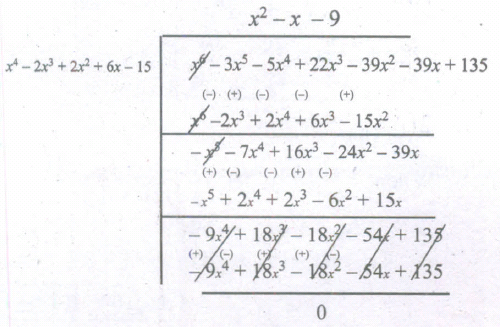
The other factor is x2 - x - 9
\(\Rightarrow x=\frac { 1\pm \sqrt { { (-1) }^{ 2 }-4(1)(-9) } }{ 2 } \left[ \because x=\frac { -b\pm \sqrt { { b }^{ 2 }-4ac } }{ 2a } \right] \)
\(\Rightarrow x=\frac { 1\pm \sqrt { 37 } }{ 2 } \)
Hence the roots are
1 - 2i, 1 + 2i, \(\sqrt { 3 }, -\sqrt { 3 }, \frac { 1+\sqrt { 37 } }{ 2 } ,\frac { 1-\sqrt { 37 } }{ 2 } \).
38.
The given equation is same as
(2x-3)(3x-2)(6x-1)(x-2)-5 = 0
After a computation, the above equation becomes
(6x2-13x+6)(6x2-13x+12)-5 = 0
By taking y = 6x2-13x, the above equation becomes
(y+6)(y+12)-5 = 0
which is same as
y2+18y+7 = 0
Solving this equation, we get y = −1 and y = −7.
Substituting the values of y in y = −6x2-13x, we get
6x2-13x+1 = 0
6x2-13x+7 = 0
Solving these two equations, we get
x = 1, x = \(\frac { 7 }{ 6 } \), x = \(\frac { 13 + \sqrt { 145 } }{ 12 } \) and x = \(\frac { 13-\sqrt { 145 } }{ 12 } \)
as the roots of the given equation.
39.
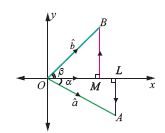
Let \(\hat { a } =\vec { OA } \) and \(\hat { b } =\vec { OB } \) be the unit vectors and which make angles α and β, respectively, with positive x-axis, where A and B are as in the diagram.
Draw AL and BM perpendicular to the x-axis. Then \(\left| \vec { OL } \right| =\left| \vec { OA } \right| \) cos α = cos α, \(\left| \vec { LA } \right| =\left| \vec { OA } \right| \) sin α = sin α
So, \(\vec { OL } =\left| \vec { OL } \right| \)\(\hat { i } \) = cos,α \(\hat { i } \), \(\overrightarrow { LA } \) = sin α (-\(\hat { j } \))
Therefore, \(\hat { a } =\overrightarrow { OA} = \overrightarrow { OL } +\overrightarrow { LA } \) = cos α \(\hat { i } \) - sin α \(\hat { j } \) ..(1)
Similarly \(\hat { b } \) = cos β \(\hat { i } \)+ sin β \(\hat { j } \) ....(2)
The angle between \(\hat { a } \) and \(\hat{b}\) is α + β and so,
\(\hat { a } .\hat { b } =\left| \hat { a } \right| \left| \hat { b } \right| \) cos (α + β) = cos (α + β) ... (3)
On the other hand, from (1) and (2)
\(\hat { a } .\hat { b } =(cos\alpha \hat { i } -sina\hat { j } )(cos\beta \hat { i } -sin\beta \hat { j } )\) = cos α cos β - sin α sin β....(4)
From (3) and (4), we get cos(α + β) = cos α cos β - sin α sin β
40.
(i) Since f (x) is a probability mass function, f (x) ≥ 0 for all x , and d \(\sum_{x} f(x)=1\)
Thus, \(\sum_{x} f(x)=1\)
\(c^{2}+2 c^{2}+3 c^{2}+4 c^{2}+c+2 c=0\)
\(c=\frac{1}{5} \text { or }-\frac{1}{2}\)
Since f x( ) ≥ 0 for all x , the possible value of c is \(\frac{1}{5}\)
Hence, the probability mass function is
| x | 1 | 2 | 3 | 4 | 5 | 6 |
| f(x) | \( \frac{1}{25} \) | \( \frac{2}{25} \) | \( \frac{3}{25} \) | \(\frac{4}{25} \) | \(\frac{1}{5}\) | \( \frac{2}{5}\) |
(ii) To find mean and variance, let us use the following table
| x | f(x) | xf(x) | x2f(x) |
| 1 | \(\cfrac { 1 }{ 25 } \) | \(\cfrac { 2 }{ 25 } \) | \(\cfrac { 1 }{ 25 } \) |
| 2 | \(\cfrac { 2 }{ 25 } \) | \(\cfrac { 4 }{ 25 } \) | \(\cfrac { 8 }{ 25 } \) |
| 3. | \(\cfrac { 3 }{ 25 } \) | \(\cfrac { 9 }{ 25 } \) | \(\cfrac { 27 }{ 25 } \) |
| 4. | \(\cfrac { 4 }{ 25 } \) | \(\cfrac { 16 }{ 25 } \) | \(\cfrac { 64 }{ 25 } \) |
| 5. | \(\cfrac { 1 }{ 5 } \) | \(\cfrac { 5 }{ 5 } \) | \(\cfrac { 25 }{ 5 } \) |
| 6. | \(\cfrac { 2 }{ 25 } \) | \(\cfrac { 12 }{ 5 } \) | \(\cfrac { 72 }{ 5 } \) |
| \(\Sigma f(x)=1\) | \(\Sigma xf(x)=\cfrac { 115 }{ 25 } \) | \({ \Sigma x }^{ 2 }f(x)=\cfrac { 585 }{ 25 } \) |
Mean : \(E(X)=\Sigma xf(x)=\frac { 115 }{ 25 } =4.6\)
Variance : \(V(x)=E\left( x \right) ^{ 2 }=\Sigma { x }^{ 2 }f(x)-\left( \Sigma xf(x) \right) ^{ 2 }\)
= \(\frac { 585 }{ 25 } -\left( \frac { 115 }{ 25 } \right) ^{ 2 }=23.40-21.16=2.24\)
Therefore the mean and variance are 4.6 and 2.24 respectively.
41.
Let p be the probability that indicates the defective rate of an electronic device
n = 10
\(P=5\%=0.05 \)
q = 1 - p
n = 10, p = 0.05, X ~ B(n, p)
P(X = x) = nCx px qn-x, x = 0, 1,2, .., n
(i) Atleast 1 defective item
P(X ≥ 1) = 1 - P(X < 1)
= 1-P(X = 0)
= 1-10C0 (0.05)0 (0.95)10
P(X ≥1) = 1 - (0.95)10
(ii) Exactly two defective items
P(X = 2) =10C2(0.05)2 (0.95)8
42.
f(x) = x2e-2x
f(x) = x2 e-2x
f'(x) = x2 (-2) e-2x + e-2x(2x)
f''(x) = 2xe-2x (1 -x)
f'(x) = 0
⇒ 2x e-2x(1 - x) = 0
⇒ x = 0,1
∴ The critical numbers are x = 0, 1
f"(x) = [x e-2x (-1) + x (-2)e-2x(1-x)+1e-2x(1-x)]
= 2e-2x(-x-2x+2x2+ 1-x)
= 2e-2x(2x2- 4x + 1)
f"(0) = 2(1)(1) = 2 > 0
f"(1) = 2e-2 (2 - 4 + 1)
= 2e-2 (-1)
= \(-{ 2e }^{ 2 }=\frac { -2 }{ { e }^{ 2 } } <0\)
Since f"(0) > 0, there is a local minimum at x = 0.
ஃ(0) = 02 e0 = 0
Since f"(1) < 0, there is a local maximum at x = 1.
\(\therefore f(1)={ 1 }^{ 2 }e^{ -2(1) }={ e }^{ -2 }=\frac { 1 }{ { e }^{ 2 } } \)
43.
The Cartesian equations of the straight line \(\vec { r } =(\hat { i } +\hat { 3j } -\hat { k } )+t(2\hat { i } +3\hat { j } +2\hat { k } )\) is
\(\frac { x-1 }{ 2 } =\frac { y-3 }{ 3 } =\frac { z+1 }{ 2 } \) = s(say)
Then any point on this line is of the form (2s + 1, 3s + 3, 2s -1) ...............(1)
The Cartesian equation of the second line is \(\frac { x-2 }{ 1 } =\frac { y-4 }{ 2 } =\frac { z+3 }{ 4 } =t\) (say)
Then any point on this line is of the form (t + 2, 2t + 4, 4t - 3)....(2)
If the given lines intersect, then there must be a common point. Therefore, for some s, t ∈ R
we have (2s + 1, 3s + 3, 2s −1 ) = (t + 2, 2t + 4, 4t − 3)
Equating the coordinates of x, y and z we get
2s − t = 1, 3s − 2t = 1 and s − 2t = −1.
Solving the first two of the above three equations, we get s = 1 and t = 1. These values of s and t satisfy the third equation. So, the lines are intersecting.
Now, using the value of s in (1) or the value of t in (2), the point of intersection (3,6,1) of these two straight lines is obtained.
If we take \(\vec{b}=(2\hat { i } +3\hat { j } +2\hat { k } )\) and \(\vec{d}=\hat { i } +\hat { 3j } -\hat { k } \),
then \(\vec { b } \times \vec { d } =\left| \begin{matrix} \hat { i } & \hat { j } & \hat { k } \\ 2 & 3 & 2 \\ 1 & 2 & 4 \end{matrix} \right| =8\hat { i } -6\hat { j } +\hat { k } \) is a vector perpendicular to both the given straight lines.
Therefore, the required straight line passing through (3,6,1)
and perpendicular to both the given straight lines is the same as the straight line passing through (3,6,1) and parallel to \(8\hat { i } -6\hat { j } +\hat { k } \). Thus, the equation of the required straight line is
\(\vec { r } =(\hat { 3i } +\hat { 6j } -\hat { k } )+m(8\hat { i } -6\hat { j } +\hat { k } )\), k ∈ R.

12th Standard Syllabus & Materials
12th Standard
TN 12th Computer Applications களப்பெயர் முறைமை (DNS) Sample Question Papers Study Material - QB365 Set A
NEW12th Standard
TN 12th Computer Applications வலையமைப்பு எடுத்துக்காட்டுகள் மற்றும் நெறிமுறைகள் Sample Question Papers Study Material - QB365 Set A
NEW12th Standard
TN 12th Computer Applications கணினி வலையமைப்பு ஓர் அறிமுகம் Sample Question Papers Study Material - QB365 Set A
NEW12th Standard
TN 12th Computer Applications PHP-உடன் MySQL-ஐ இணைத்தல் Sample Question Papers Study Material - QB365 Set A



Tamilnadu Stateboard 12th Standard Subjects
Maths

Chemistry

Physics

Biology

Computer Science

Business Maths and Statistics

Economics

Commerce

Accountancy

History

Computer Applications
Biology
Computer Technology
Computer Applications
Computer Science
Business Maths and Statistics
Commerce
Economics
Maths
Chemistry
Physics
Computer Technology
History
Accountancy

Tamil

English

French
Tamilnadu Stateboard Standards

