
 100% FREE ACCESS
12th Standard Syllabus & Materials
12th Standard
TN 12th Maths Applications of Matrices and Determinants Sample Question Papers Study Material - QB365 Set A
NEW12th Standard
TN 12th Computer Applications மின்னணு தரவு பரிமாற்றம் Sample Question Papers Study Material - QB365 Set A
NEW12th Standard
TN 12th Computer Applications மின் - வணிக பாதுகாப்பு அமைப்புகள் Sample Question Papers Study Material - QB365 Set A
NEW12th Standard
TN 12th Computer Applications மின்னணு செலுத்தல் முறைகள் Sample Question Papers Study Material - QB365 Set A
NEW12th Standard
TN 12th Computer Applications மின் - வணிகம் Sample Question Papers Study Material - QB365 Set A
NEW12th Standard
TN 12th Computer Applications திறந்த மூல கருத்துருக்கள் Sample Question Papers Study Material - QB365 Set A

Published on: 07/03/2020
12th Standard Mathematics English Medium All Chapter Two Marks Book Back and Creative Questions 2020
Download Tamil Nadu 12th Standard Maths question papers, model tests, one-mark questions, important questions, and public exam papers in PDF format. Free study materials and answer keys for TN State Board students.
Questions + Answers key
Take MCQ Maths Test1.
Form the D.E corresponding to y=emx by eliminating 'm'.
2.
Find the order and degree of \(\left( \frac { { d }^{ 2 }y }{ { dx }^{ 2 } } \right) ^{ 2 }+cos\left( \frac { dy }{ dx } \right) =0\)
3.
Find the area bounded by y=x2+2, x-axis, x=1 and x=2.
4.
Find the area of the region bounded by the curve y = sin x and the ordinate x=0 \(x=\frac { \pi }{ 3 } \)
5.
Evaluate \(\int _{ 1 }^{ 2 }{ \frac { { e }^{ x } }{ 1+{ e }^{ 2x } } dx } \)
6.
Determine the domain of concavity of the curve y=2-x2
7.
Find the point at which the curve y-exy+x=0 has a vertical tangent.
8.
IF u(x, y) = x2 + 3xy + y2, x, y, ∈ R, find tha linear appraoximation for u at (2, 1)
9.
Fill in the following table so that the binary operation ∗ on A = {a, b, c} is commutative.
| * | a | b | c |
| a | b | ||
| b | c | b | a |
| c | a | c |
10.
Let p: Jupiter is a planet and q: India is an island be any two simple statements. Give verbal sentence describing each of the following statements.
(i) ¬p
(ii) p ∧ ¬q
(iii) ¬p ∨ q
(iv) p➝ ¬q
(v) p↔q
11.
Determine the order and degree (if exists) of the following differential equations:
\(\frac { { d }^{ 2 }y }{ { dx }^{ 2 } } +3{ \left( \frac { dy }{ dx } \right) }^{ 2 }={ x }^{ 2 }log\left( \frac { { d }^{ 2 }y }{ { dx }^{ 2 } } \right) \)
12.
The temperature T in celsius in a long rod of length 10 m, insulated at both ends, is a function of length x given by T = x(10 − x). Prove that the rate of change of temperature at the midpoint of the rod is zero.
13.
Find value of m so that the function y = emx is a solution of the given differential equation, y''− 5y' + 6y = 0
14.
Find the argument of -2
15.
If (cosθ + i sinθ)2 = x + iy, then show that x2+y2 =1
16.
Find the equation of the hyperbola whose vertices are (0, ±7) and e = \(\frac { 4 }{ 3 } \)
17.
Find the locus of a point which divides so that the sum of its distances from (-4, 0) and (4, 0) is 10 units.
18.
If \({ cot }^{ -1 }\left( \frac { 1 }{ 7 } \right) =\theta \) find the value of cos \(\theta \)
19.
Find the principal value of \({ tan }^{ -1 }\left( \frac { -1 }{ \sqrt { 3 } } \right) \)
20.
Find x If \(x=\sqrt { 2+\sqrt { 2+\sqrt { 2+....+upto\infty } } } \)
21.
Solve 6x - 7y = 16, 9x - 5y = 35 using (Cramer's rule).
22.
Show that the equations 3x + y + 9z = 0, 3x + 2y + 12z = 0 and 2x + y + 7z = 0 have nontrivial solutions also.
23.
Find the Cartesian equation of a line passing through the points A(2, -1, 3) and B(4, 2, 1)
24.
Find the area of the triangle whose vertices are A(3, -1, 2) B(1, -1, -3) and C(4, -3, 1)
25.
If sin ∝, cos ∝ are the roots of the equation ax2 + bx + c-0 (c ≠ 0), then prove that (n + c)2 - b2 + c2
26.
Simplify the following:
i -1924+ i2018
27.
Find the volume of the parallelepiped whose coterminus edges are given by the vectors \(\hat { 2i } -\hat { 3j } +\hat { 4k } \), \(\hat { i } +\hat { 2j } -\hat { k } \) and \(\hat {3 i } -\hat { j } +\hat { 2k } \)
28.
If \(\vec{ a } =\hat { -3i } -\hat { j } +\hat { 5k } \), \(\vec{b}=\hat{i}-\hat{2j}+\hat{k} \), \(\vec{c}=\hat{4j}-\hat{5k} \ \) find\( \ {\vec a } .(\vec { b } \times \vec { c } )\)
29.
Find the vertices, foci for the hyperbola 9x2−16y2 = 144.
30.
Find the inverse (if it exists) of the following:
\(\left[ \begin{matrix} -2 & 4 \\ 1 & -3 \end{matrix} \right] \)
31.
Is cos-1(-x) = \(\pi\)-cos−1(x) true? Justify your answer.
32.
Find z−1, if z = (2 + 3i) (1− i).
33.
Find the principal value of sin-1(2), if it exists.
34.
Find the general equation of the circle whose diameter is the line segment joining the points (−4, −2) and (1, 1) is x2+y2+5x+3y+6=0
35.
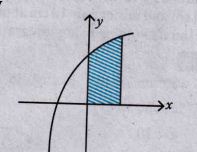
Find, by integration, the volume of the solid generated by revolving about the x-axis, the region enclosed by y = e−2x y = 0, x = 0 and x = 1
36.
If U(x, y, z) = \(\frac { { x }^{ 2 }+{ y }^{ 2 } }{ xy } +3{ z }^{ 2 }y\), find \(\frac { \partial U }{ \partial x } ;\frac { \partial U }{ \partial y } \) and \(\frac { \partial U }{ \partial z } \)
37.
Find the probability mass function and cumulative distribution function of number of girl child in families with 4 children, assuming equal probabilities for boys and girls.
38.
Solve: (2x-1) (x+3) (x-2) (2x+3)+20 = 0
39.
Let f, g : (a, b)→R be differentiable functions. Show that d(fg) = fdg + gdf
40.
An urn contains 5 mangoes and 4 apples. Three fruits are taken at randaom. If the number of apples taken is a random variable, then find the values of the random variable and number of points in its inverse images.
41.
Prove that the function f (x) = x2 + 2 is strictly increasing in the interval (2,7) and strictly decreasing in the interval (−2, 0)
42.
Show that the polynomial 9x9+ 2x5- x4- 7x2+ 2 has at least six imaginary roots.
43.
Reduce the matrix \(\left[ \begin{matrix} 3 & -1 & 2 \\ -6 & 2 & 4 \\ -3 & 1 & 2 \end{matrix} \right] \) to a row-echelon form.
1.
\(x\frac { dy }{ dx } =ylogy\)
2.
order 2;degree not defined
3.
\(\frac { 13 }{ 3 } \)
4.
\(\frac { 1 }{ 2 } \)
5.
\(\frac { 1 }{ 6 } \left[ log\left( \frac { 35 }{ 8 } \right) \right] \)
6.
concave downward everywhere
7.
(1, 0)
8.
Given u(x, y) = x2 + 3xy + y2
u(xo, yo) = u(2,1)
= 22 + 3(2)(1) + 12
= 4 + 6 + 1 = 11
\(\frac { \partial u }{ \partial x } \) = 2x+ 3y
\({ \left( \frac { \partial u }{ \partial x } \right) }_{ (2,1) }\)= 2 + 3 = 5
\(\frac { \partial u }{ \partial y } \) = 3x+ 2y
\({ \left( \frac { \partial u }{ \partial y } \right) }_{ (2,1) }\) = 6 + 2 = 8
Linear approximation
L(x,y) = U(xo, yo) + \({ \left( \frac { \partial u }{ \partial x } \right) }_{ ({ x }_{ 0 },{ y }_{ 0 }) }\) (x - xo) + \({ \left( \frac { \partial u }{ \partial y} \right) }_{ ({ x }_{ 0 }{ ,y }_{ 0 }) }\)(y - yo)
L (x,y) = 11 + 5 (x - 2) + 8 (y - 1)
= 11 + 5x - 10 + 8y - 8
L(x,y) = 5x + 8y - 7
9.
Given * on A is commutative
Given b * a = c ⇒ a * b = c
Given c * a = a ⇒ a * c = a
Given b * c = a ⇒ c * b = a
Hence
| * | a | b | c |
| a | b | c | a |
| b | c | b | a |
| c | a | a | c |
10.
Given p : Jupiter is a planet and
q : India is an island.
(i) ¬p : Jupiter is not a planet.
(ii) p ∧ ¬q : Jupiter is a planet and India is not an island.
(iii) ¬p ∨ q : Jupiter is not a planet or India is an island.
(iv) p➝ ¬q : If Jupiter is a planet then India is not an island.
(v) p↔q : Jupiter is a planet if and only if India is an island.
11.
In the given differential equation, the highest order derivative is \(\frac { { d }^{ 2 }y }{ { dx }^{ 2 } } \) whose power is 1.
Therefore, the given differential equation is of order 2.
The given differential equation is not a polynomial equation in its derivatives and so its degree is not defined.
12.
We are given that, T = 10x − x2
Hence, the rate of change at any distance from one end is given by \(\frac{dT}{dx}=10-2x \)
The mid point of the rod is at x = 5
Substituting x = 5, we get \(\frac{dT}{dx}=0\)
13.
y''− 5y' + 6y = 0 ......(1)
Given y = emx .....(2)
Differentiating cquation (2) w.r.t 'x', we get
\(\frac{dy}{dx} = em^x . m\)
To find the value of m:
Given y" - 5y' + 6y = 0
emx . m2 -5emx+ 6emx = 0
emx [m- 5m +6] = 0
m - 5m + 6 = 0
(m - 3) (m - 2) = 0
m = 3, 2
14.
Let z = -2
z = 2(-1) = 2(cos π + i sin π)
∴ arg(z) = π
15.
(cos θ + i sin θ )2 = cos 2θ + isin 2θ
[By De moivre's theorem]
⇒ cos 2θ + isin 2θ = x + iy
Equating the real and imaginary parts we get,
x = cos 2θ, y = sin 2θ
∴ x2 + y2 = cos22θ + sin22θ = 1
Hence proved
16.
Since the vertices are (0, ±7), equation of the hyperbola is \(\frac { { x }^{ 2 } }{ { a }^{ 2 } } +\frac { { y }^{ 2 } }{ { b }^{ 2 } } =1\)
a = 7 and e = \(\frac { 4 }{ 3 } \)
b2 = a2(e2 - 1) = 49\(\left( \frac { 16 }{ 9 } -1 \right) =49\left( \frac { 16-9 }{ 9 } \right) \)
= \(49\left( \frac { 7 }{ 9 } \right) =\frac { 343 }{ 9 } \)
∴ Equation of the hyperbola is \(\frac { { y }^{ 2 } }{ 49 } -\frac { { x }^{ 2 } }{ \frac { 343 }{ 9 } } =1\)
⇒ \(\frac { { y }^{ 2 } }{ 49 } -\frac { 9{ x }^{ 2 } }{ 343 } =1\)
17.
Let P(x, y) be the movable point.
By focal property of ellipse, PA + PB = 2a
∴ 2a = 10 ⇒ a = 5
Since focus is (4, 0), ae = 4 ⇒ 5e = 4 ⇒ e = \(\frac45\)
Also b2 = a2(1 - e2) = 25\(\left( 1-\frac { 16 }{ 25 } \right) =25\left( \frac { 9 }{ 25 } \right) \) = 9
Equation of ellipse is \(\frac { { x }^{ 2 } }{ { a }^{ 2 } } +\frac { { y }^{ 2 } }{ { b }^{ 2 } } =1\)
\(\frac { { x }^{ 2 } }{ 25 } +\frac { { y }^{ 2 } }{ 9 } =1\)
18.
Given
\({ cot }^{ -1 }\left( \frac { 1 }{ 7 } \right) =0\Rightarrow \theta =\frac { 1 }{ 7 } \)
\(\Rightarrow tan\theta =7\)
\(\Rightarrow sec\theta =\sqrt { 1+{ tan }^{ 2 }\theta } =\sqrt { 1+{ 7 }^{ 2 } } =\sqrt { 50 } =5\sqrt { 2 } \)
\(\Rightarrow cos\theta ={ \frac { 1 }{ 5\sqrt { 2 } } }\)
19.
Let \({ tan }^{ -1 }\left( \frac { -1 }{ \sqrt { 3 } } \right) =y\) where \(\frac{-\pi}{2}<y<\frac{\pi}{2}\)
\(\Rightarrow tan\ y=\frac { -1 }{ 3 } =-tan\frac { \pi }{ 6 } =tan\left( \frac { -\pi }{ 6 } \right) \)
\(y=\frac { -\pi }{ 6 } \) \(\left[ \because \frac { -\pi }{ 6 } \epsilon \left( \frac { -\pi }{ 2 } ,\frac { \pi }{ 2 } \right) \right] \)
The principal value of \({ tan }^{ -1 }\left( \frac { -1 }{ \sqrt { 3 } } \right) =6\)
20.
We have \(x=\sqrt { 2+x } \)
\(\Rightarrow { x }^{ 2 }=2+x \Rightarrow { x }^{ 2 }-x-2=0\)
\(\Rightarrow x=\frac { 1\pm \sqrt { 1+8 } }{ 2 } \Rightarrow x=\frac { 1\pm 3 }{ 2 } \)
\(\Rightarrow x=\frac { 1+3 }{ 2 } ,\frac { 1-3 }{ 2 } \Rightarrow x=2,-1\)
Also x>0, we get x = 2
21.
Δ = \(\left| \begin{matrix} 6 & -7 \\ 9 & -5 \end{matrix} \right| \) = -30 + 63 = 33
Δ1 = \(\left| \begin{matrix} 16 & -7 \\ 35 & -5 \end{matrix} \right| \) = -80 + 245 = 165
Δ2 = \(\left| \begin{matrix} 6 & 16 \\ 9 & 35 \end{matrix} \right| \) = 210 - 144 = 66
∴ x = \(\frac { { \triangle }_{ 1 } }{ \triangle } =\frac { 165 }{ 33 } \) = 5
y = \(\frac { { \triangle }_{ 2 } }{ \triangle } =\frac { 66 }{ 33 } \) = 2
∴ Solution set is { 5, 2}
22.
The matrix form of the system is
\(\left[ \begin{matrix} 3 & 1 & 9 \\ 3 & 2 & 12 \\ 2 & 1 & 7 \end{matrix} \right] \left[ \begin{matrix} x \\ y \\ z \end{matrix} \right] =\left[ \begin{matrix} 0 \\ 0 \\ 0 \end{matrix} \right] \)
AX = B where
A=\(\left[ \begin{matrix} 3 & 1 & 9 \\ 3 & 2 & 12 \\ 2 & 1 & 7 \end{matrix} \right] ,X=\left[ \begin{matrix} x \\ y \\ z \end{matrix} \right] ,B=\left[ \begin{matrix} 0 \\ 0 \\ 0 \end{matrix} \right] \)
|A| =\(\left| \begin{matrix} 3 & 1 & 9 \\ 3 & 2 & 12 \\ 2 & 1 & 7 \end{matrix} \right| =3\left| \begin{matrix} 2 & 12 \\ 1 & 7 \end{matrix} \right| -1\left| \begin{matrix} 3 & 12 \\ 2 & 7 \end{matrix} \right| +9\left| \begin{matrix} 3 & 2 \\ 2 & 1 \end{matrix} \right| \)
= 3 (14 - 12) - 1 (21 -24) + 9 (3 -4)
= 3 (2) -1 (-3) + 9 (-1)
= 6 + 3 - 9 = 9 - 9 = 0
Since |A| = 0, the homogeneous system of equations have non-trivial solutions also.
23.
Given (x1, y1, z1) is (2, -1, 3) (x2, y2, z2) is (4, 2, 1)
Cartesian equation of a line passing through two points is \(\frac { x-{ x }_{ 1 } }{ { x }_{ 2 }-{ x }_{ 1 } } =\frac { y-{ y }_{ 1 } }{ { y }_{ 2 }-{ y }_{ 1 } } =\frac { z-{ z }_{ 1 } }{ { z }_{ 2 }-{ z }_{ 1 } } \)
\(\Rightarrow \frac { x-2 }{ 2 } =\frac { y+1 }{ 3 } =\frac { z-3 }{ -2 } \)
24.
\(\overset { \rightarrow }{ OA } =3\overset { \wedge }{ i } -\overset { \wedge }{ j } +2\overset { \wedge }{ k } \) , \(\overset { \rightarrow }{ OB } =\overset { \wedge }{ i } -\overset { \wedge }{ j } -3\overset { \wedge }{ k } \), \(\overset { \rightarrow }{ OC } =4\overset { \wedge }{ i } -3\overset { \wedge }{ j } +\overset { \wedge }{ k } \)
Area of △ ABC = \(\frac { 1 }{ 2 } \left| \overset { \rightarrow }{ AB } \times \overset { \rightarrow }{ AC } \right| \)
\(\overset { \rightarrow }{ AB } =\overset { \rightarrow }{ OB } -\overset { \rightarrow }{ OA } =\left( \overset { \wedge }{ i } -\overset { \wedge }{ j } -3\overset { \wedge }{ k } \right) -\left( 3\overset { \wedge }{ i } -\overset { \wedge }{ j } +2\overset { \wedge }{ k } \right) =-2\overset { \wedge }{ i } -5\overset { \wedge }{ k } \)
\(\overset { \rightarrow }{ AC } =\overset { \rightarrow }{ OC } -\overset { \rightarrow }{ OA } =\left( 4\overset { \wedge }{ i } -3\overset { \wedge }{ j } +\overset { \wedge }{ k } \right) -\left( 3\overset { \wedge }{ i } -\overset { \wedge }{ j } +2\overset { \wedge }{ k } \right) =\overset { \wedge }{ i } -2\overset { \wedge }{ j } -\overset { \wedge }{ k } \)
\(\therefore \overset { \rightarrow }{ AB } \overset { \rightarrow }{ \times AC } =\left| \begin{matrix} \overset { \wedge }{ i } \\ -2 \\ 1 \end{matrix}\begin{matrix} \overset { \wedge }{ j } \\ 0 \\ -2 \end{matrix}\begin{matrix} \overset { \wedge }{ k } \\ -5 \\ -1 \end{matrix} \right| \)
\(=\overset { \wedge }{ i } \)(0-10) - \(\overset { \wedge }{ j } \) (2+5) + \(\overset { \wedge }{ k } \) (4-0)
\(=10\overset { \wedge }{ i } -7\overset { \wedge }{ j } +4\overset { \wedge }{ k } \)
\(\therefore \left| \overset { \rightarrow }{ AB } \overset { \rightarrow }{ \times AC } \right| =\sqrt { 101+49+16 } =\sqrt { 165 } \)
∴ Area of Δ ABC \(=\frac { 1 }{ 2 } \sqrt { 165 } \) sq. units
25.
Sum of the roots = sin ∝ + cos ∝ = \(\frac{-b}{a}\)
Product of the roots = sin ∝ cos ∝ = \(\frac{c}{a}\)
Now 1 = cos2∝ + sin2 ∝
= (sin ∝ +cos ∝)2 - 2 sin ∝ cos ∝
\(1=\frac { { b }^{ 2 } }{ { a }^{ 2 } } -\frac { 2c }{ a } \Rightarrow 1=\frac { { b }^{ 2 }-2ac }{ { a }^{ 2 } } \)
⇒ a2 = b2 - 2ac ⇒ a2 + 2ac = b2
Adding c2 both sides, a2 +2ac+c2 = b2+c2
⇒ (a+c)2 = b2 + c2
26.
(i)-1924+ (i)2018 = (i)-1924 + 0 + (i)2016 + 2 = (i)0 + (i)2 = 1 - 1 = 0
27.
We know that the volume of the parallelepiped whose coterminus edges are \(\vec { a } ,\vec { b } ,\vec { c } \) is given by |\([\vec { a } ,\vec { b } ,\vec { c } ]\)|. Here, \(\vec { a } =\hat { 2i } -\hat { 3j } +\hat { 4k } ,\vec { b } =\hat { i } +\hat { 2j } -\hat { k } ,\vec { c } =\hat { 3i } -\hat { j } +\hat { 2k } \)
Since \([\vec { a } ,\vec { b } ,\vec { c } ]\) = \(\left| \begin{matrix} 2 & -3 & 4 \\ 1 & 2 & -1 \\ 3 & -1 & 2 \end{matrix} \right| =-7\) , the volume of the given parallelepiped is \(\left| -7 \right| =7\) cubic units.
28.
By the defination of scalar triple product of three vectors,
We find, \(\hat { a } .(\hat { b } \times \hat { c } )\) = \(\left| \begin{matrix} -3 & -1 & 5 \\ 1 & -2 & 1 \\ 0 & 4 & -5 \end{matrix} \right| =-3\)
29.
Reducing 9x2-16y2 = 144 to the standard form,
we have, \(\frac { { x }^{ 2 } }{ 16 }- \frac { { y }^{ 2 } }{ 9 } =1\)
With the transverse axis is along x-axis vertices are (−4, 0) and (4, 0); and c2 = a2+b2 = 16 + 9 = 25, c = 5
Hence the foci are (−5, 0) and (5, 0)
30.
\(\left[ \begin{matrix} -2 & 4 \\ 1 & -3 \end{matrix} \right] \)
Let A = \(\left[ \begin{matrix} -2 & 4 \\ 1 & -3 \end{matrix} \right] \)
|A| = \(\left| \begin{matrix} -2 & 4 \\ 1 & -3 \end{matrix} \right| \)= 6 - 4 = 2 ≠ 0
Since A is nonsingular, A-1 exists
A-1 = \(\frac { 1 }{ |A| } \)
Now, adj A = \(\left[ \begin{matrix} -3 & -4 \\ -1 & -2 \end{matrix} \right] \)
[Interchange the entries in leading diagonal and change the sign of elements in the off diagonal]
∴ A-1 = \(\frac{1}{2}\)\(\left[ \begin{matrix} -3 & -4 \\ -1 & -2 \end{matrix} \right] \).
31.
cos-1(-x) = \(\pi\)-cos−1(x)
Let cos-1(-x) = \(\theta \) ..(1)
\(\Rightarrow -x=cos\theta \)
\(\Rightarrow x=-cos\theta =cos\theta =cos\left( \pi -\theta \right) \)
\(\Rightarrow \pi -\theta ={ cos }^{ -1 }\left( x \right) \)
\(\Rightarrow \theta =\pi -{ cos }^{ -1 }x\) ...(2)
From (1) & (2) \({ cos }^{ -1 }\left( -x \right) =\pi -{ cos }^{ -1 }\left( x \right) \)
\({ cos }^{ -1 }\left( -x \right) =\pi -{ cos }^{ -1 }\left( x \right) \) is true.
32.
We have z = (2+3i)(1−i) = (2+3)+(3−2)i = 5+i
\(\Rightarrow\) \({ z }^{ -1 }=\frac { 1 }{ z } =\frac { 1 }{ 5+i } \)
Multiplying the numerator and denominator by the conjugate of the denominator, we get
\({ z }^{ -1 }=\frac { \left( 5-i \right) }{ \left( 5+i \right) \left( 5-i \right) } =\frac { 5-i }{ { 5 }^{ 2 }+{ I }^{ 2 } } =\frac { 5 }{ 26 } -i\frac { 1 }{ 26 } \)
\(\Rightarrow\)\({ z }^{ -1 }=\frac { 5 }{ 26 } -i\frac { 1 }{ 26 } \)
33.
Since the domain of y = sin-1 is −[11], and 2\(\notin \)[-1, 1], sin−1(2) does not exist.
34.
Equation of the circle with end points of the diameter as (x1, y1) and (x2, y2) given in theorem is
(x−x1)(x−x2)+(y−y1)(y−y2) = 0
(x+4)(x−1)+(y+2)(y−1) = 0
x2 + y2 + 3x + y − 6 = 0 which is the required equation of the circle.
35.
Equation of the given curve is y = e-2x
Required Volume = \(\pi \int _{ 0 }^{ 1 }{ { { (e }^{ -2x }) }^{ 2 }dx } \)
\(=\pi \int _{ 0 }^{ 1 }{ { e }^{ -4x } } dx=\pi { \left[ \frac { { e }^{ -4x } }{ -4 } \right] }_{ 0 }^{ 1 }\)
\(=\frac { -\pi }{ 4 } \left[ { e }^{ -4 }-{ e }^{ -0 } \right] =-\frac { \pi }{ 4 } \left( { e }^{ -4 }-1 \right) \)
\(V=\frac { \pi }{ 4 } (1-{ e }^{ -4 })\) cubic units
36.
Given U(x, y, z) = \(\frac { { x }^{ 2 }+{ y }^{ 2 } }{ xy } +3{ z }^{ 2 }y\)
\(\frac { \partial U }{ \partial x } =\frac { xy(2x)-({ x }^{ 2 }+{ y }^{ 2 })(y) }{ { x }^{ 2 }{ y }^{ 2 } } +0\)
\(=\frac { 2{ x }^{ 2 }y-{ x }^{ 2 }y-{ y }^{ 3 } }{ { x }^{ 2 }{ y }^{ 2 } } =\frac { { x }^{ 2 }y-{ y }^{ 3 } }{ { x }^{ 2 }{ y }^{ 2 } } \)
\(=\frac { y({ x }^{ 2 }-{ y }^{ 2 }) }{ { x }^{ 2 }{ y }^{ 2 } } =\frac { { x }^{ 2 }-{ y }^{ 2 } }{ { x }^{ 2 }y } \)
\(\frac { \partial U }{ \partial y } =\frac { xy(2y)-({ x }^{ 2 }+{ y }^{ 2 })(x) }{ { x }^{ 2 }{ y }^{ 2 } } +3{ z }^{ 2 }\)
= \(\frac { { 2xy }^{ 2 }-{ x }^{ 3 }-{ xy }^{ 2 } }{ { x }^{ 2 }{ y }^{ 2 } } +3{ z }^{ 2 }\)
\(=\frac { { xy }^{ 2 }-{ x }^{ 3} }{ { x }^{ 2 }{ y }^{ 2 } } +3{ z }^{ 2 }\)
\(=\frac { { y }^{ 2 }-{ x }^{ 2 } }{ x{ y }^{ 2 } } +3{ z }^{ 2 }\)
\(\frac { \partial U }{ \partial z } =0+3y(2z)=6yz\)
37.
Let X be the random variable denotes number of| girl child among 4 children
X = {0, 1, 2, 3, 4}
X =2) (0) {BBBB}
X(1) = {GBBB, BGBB, BBGB, BBBG}
X(2) = {GGBB, BBGG, GBGB, BGBG, BGGB, GBBG}
X(3) = {BGGG, GGGB, GBGG, GGBG}
X(4) = {GGGG}
| Values of the random variable | 0 | 1 | 2 | 3 | 4 | Total |
| No. of elements in inverse images | 1 | 4 | 6 | 4 | 1 | 16 |
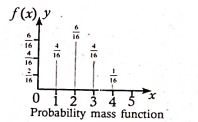
(i) Probability mass function
| x | 0 | 1 | 2 | 3 | 4 | Total |
| f(x) | \(\\ \cfrac { 1 }{16 } \) | \(\cfrac { 4 }{ 16 } \) | \(\cfrac { 6 }{ 16 } \) | \(\cfrac { 4 }{ 16 } \) | \(\\ \cfrac { 1 }{16 } \) | 1 |
(ii) Cumulative distribution function
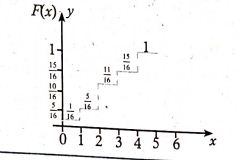
F(x) = p(X ≤ x) = \(\sum_{x_i ≤ x }\)P(X = xi)
P(X<0) = 0 for -\(\infty\) < x < 0
\(F(0)=\frac { 1 }{ 16 } \)
\(F(1)=\frac { 1 }{ 16 } +\frac { 1 }{ 4 } =\frac { 5 }{ 16 } \)
\(F(2)=\frac { 5 }{ 16 } +\frac { 3 }{ 8 } =\frac { 5 }{ 16 } +\frac { 6 }{ 16 } =\frac { 11 }{ 16 } \)
\(F(3)=\frac { 11 }{ 6 } +\frac { 1 }{ 4 } =\frac { 11 }{ 16 } +\frac { 4 }{ 16 } =\frac { 15 }{ 16 } \)
\(F(4)=\frac { 15 }{ 16 } +\frac { 1 }{ 16 } =\frac { 16 }{ 16 } =1\)
\(F(x)=\left\{\begin{array}{lll} \frac{0}{16} & \text { for } & x<0 \\ \frac{1}{16} & \text { for } & x \leq 0 \\ \frac{5}{16} & \text { for } & x \leq 1 \\ \frac{11}{16} & \text { for } & x \leq 2 \\ \frac{15}{16} & \text { for } & x \leq 3 \\ 1 & \text { for } & x \leq 4 \end{array}\right.\)
38.
Rearrange the terms as
(2x-1)(2x+ 3) (x + 3) (x - 2) + 20 = 0
⇒ (4x2 + 6x - 2x- 3)(x2 - 2x + 3x - 6) + 20 = 0
⇒ (4x2 + 4x - 3) (x2 + x - 6) + 20 = 0
put x2+ x = y
⇒ (4y - 3) (y - 6) + 20 = 0
⇒ 4y2 - 24y - 3y + 18 + 20 = 0
⇒ 4y2-27y +38 = 0
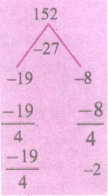
⇒ (y - 2)( 4y - 19) = 0
\(y=2,\frac { 19 }{ 4 } \)
Case (i)
When y = 2
x2+ x = 2
x2 + x - 2 = 0
⇒ (x + 2)(x - 1) = 0
⇒ x = -2, 1
Case (ii)
When \(y=\frac { 19 }{ 4 } ,{ x }^{ 2 }+x=\frac { 19 }{ 4 } \)
\(\Rightarrow { 4x }^{ 2 }+4x=19\)
\(\Rightarrow { 4x }^{ 2 }-4x-19=0\)
\(\Rightarrow x=\frac { -4\pm \sqrt { 16-4(4)(-19) } }{ 8 } \)
\(\Rightarrow x=\frac { -4\pm \sqrt { 16+304 } }{ 8 } \)
\(\Rightarrow x=\frac { -4\pm \sqrt { 320 } }{ 8 } \)
\(\Rightarrow x=\frac { 4\pm 8\sqrt { 5 } }{ 8 } \)
\(\Rightarrow x=\frac { -4(-1\pm 2\sqrt { 5 } ) }{ 8 } \)
\(\frac{-1 \pm 2 \sqrt{5}}{2}\)
Hence the roots are 1, -2, \(\frac{-1 \pm 2 \sqrt{5}}{2}\)
39.
Let f, g : (a, b)→R be differentiable functions and h(x) = f (x)g(x).
Then h being product differentiable functions, is differentiable on (a,b)
So by definition dh = h'(x)dx.
Now by using product rule we have h'(x) = f (x)g'(x) + f'(x)g(x).
Thus dh = h'(x)dx = ( f (x)g'(x) + f''(x)g(x))dx = f (x)g'(x)dx + f '(x)g(x) dx
= f (x)dg + g(x)df = fdg + gdf
40.
Let X be the random variable of getting apples Given 5 mangoes and 4 apples are in an urn
= {0, 1,2,3}
The sample space consists of 9C3 = 84
X = 0, X (3 mangoes) = 5C3 = 10
X = 1, X (2 mangoes and 1 apples) = 5C2 x 4C1 = 40
X = 2, X (1 mangoes and 2 apples) = 5C1 x 4C2 = 30
X = 3, X (apples) = 4C3 = 4
| Values of random variable | 0 | 1 | 2 | 3 | Total |
| No of points in inverse image | 10 | 40 | 30 | 4 | 84 |
41.
We have,
\(f'(x)=2x>0, \forall x\in(2,7)\) and
\(f'(x)=2x>0, \forall x\in(-2,0)\)
and hence the proof is completed.
42.
Clearly there are 2 sign changes for the given polynomial P(x) and hence number of positive roots of P(x) cannot be more than two. Further, as P(-x) = -9x9- 2x5- x4- 7x2+ 2, there is one sign change for P(-x) and hence the number of negative roots cannot be more than one. Clearly 0 is not a root. So maximum number of real roots is 3 and hence there are atleast six imaginary roots.
43.
\(\left[ \begin{matrix} 3 & -1 & 2 \\ -6 & 2 & 4 \\ -3 & 1 & 2 \end{matrix} \right] \overset { \begin{matrix} { R }_{ 2 }\longrightarrow { R }_{ 2 }+2{ R }_{ 1 }, \\ { R }_{ 3 }\longrightarrow { R }_{ 3 }+{ R }_{ 1 } \end{matrix} }{ \longrightarrow } \left[ \begin{matrix} 3 & -1 & 2 \\ 0 & 0 & 8 \\ 0 & 0 & 4 \end{matrix} \right] \overset { { R }_{ 3 }\longrightarrow { R }_{ 3 }-\frac { 1 }{ 2 } { R }_{ 2 } }{ \longrightarrow } \left[ \begin{matrix} 3 & -1 & 2 \\ 0 & 0 & 8 \\ 0 & 0 & 0 \end{matrix} \right] \)
Note
\(\left[ \begin{matrix} 3 & -1 & 2 \\ 0 & 0 & 8 \\ 0 & 0 & 0 \end{matrix} \right] \overset { { R }_{ 2 }\longrightarrow { R }_{ 2 }/8 }{ \longrightarrow } \left[ \begin{matrix} 3 & -1 & 2 \\ 0 & 0 & 1 \\ 0 & 0 & 0 \end{matrix} \right] \).
This is also a row-echelon form of the given matrix.
So, a row-echelon form of a matrix is not necessarily unique.

12th Standard Syllabus & Materials
12th Standard
TN 12th Computer Applications வலையமைப்பு வடமிடல் Sample Question Papers Study Material - QB365 Set A
NEW12th Standard
TN 12th Computer Applications களப்பெயர் முறைமை (DNS) Sample Question Papers Study Material - QB365 Set A
NEW12th Standard
TN 12th Computer Applications வலையமைப்பு எடுத்துக்காட்டுகள் மற்றும் நெறிமுறைகள் Sample Question Papers Study Material - QB365 Set A
NEW12th Standard
TN 12th Computer Applications கணினி வலையமைப்பு ஓர் அறிமுகம் Sample Question Papers Study Material - QB365 Set A



Tamilnadu Stateboard 12th Standard Subjects
Maths

Chemistry

Physics

Biology

Computer Science

Business Maths and Statistics

Economics

Commerce

Accountancy

History

Computer Applications
Biology
Computer Technology
Computer Applications
Computer Science
Business Maths and Statistics
Commerce
Economics
Maths
Chemistry
Physics
Computer Technology
History
Accountancy

Tamil

English

French
Tamilnadu Stateboard Standards

