
 100% FREE ACCESS
12th Standard Syllabus & Materials
12th Standard
TN 12th Computer Applications மின்னணு தரவு பரிமாற்றம் Sample Question Papers Study Material - QB365 Set A
NEW12th Standard
TN 12th Computer Applications மின் - வணிக பாதுகாப்பு அமைப்புகள் Sample Question Papers Study Material - QB365 Set A
NEW12th Standard
TN 12th Computer Applications மின்னணு செலுத்தல் முறைகள் Sample Question Papers Study Material - QB365 Set A
NEW12th Standard
TN 12th Computer Applications மின் - வணிகம் Sample Question Papers Study Material - QB365 Set A
NEW12th Standard
TN 12th Computer Applications திறந்த மூல கருத்துருக்கள் Sample Question Papers Study Material - QB365 Set A
NEW12th Standard
TN 12th Computer Applications வலையமைப்பு வடமிடல் Sample Question Papers Study Material - QB365 Set A

Published on: 29/08/2020
12th Standard Mathematics English Medium Important 2 Mark Book Back Questions (New Syllabus) 2020
Download Tamil Nadu 12th Standard Maths question papers, model tests, one-mark questions, important questions, and public exam papers in PDF format. Free study materials and answer keys for TN State Board students.
Questions + Answers key
Take MCQ Maths Test1.
Find the area enclosed between the parabola y2=4ax and the line x=a, x=9a.
2.
Which one of the following sentences is a proposition?
(i) 4 + 7 =12
(ii) What are you doing?
(iii) 3n ≤ 81, n ∈ N
(iv) Peacock is our national bird
(v) How tall this mountain is!
3.
Write the statements in words corresponding to ¬p, p ∧ q , p ∨ q and q ∨ ¬p, where p is ‘It is cold’ and q is ‘It is raining'.
4.
In each of the following cases, determine whether the following function is homogeneous or not. If it is so, find the degree.
\(U(x,y,z)=xy+sin\left( \frac { { y }^{ 2 }-2{ x }^{ 2 } }{ xy } \right) \)
5.
The time to failure in thousands of hours of an electronic equipment used in a manufactured computer has the density function \(f(x)=\begin{cases} \begin{matrix} { 3e }^{ -3x } & x>0 \end{matrix} \\ \begin{matrix} 0 & elsewhere \end{matrix} \end{cases}\)
Find the expected life of this electronic equipment.
6.
Find df for f(x) = x2 + 3x and evaluate it for
x = 3 and dx = 0.02
7.
Explain why Lagrange’s mean value theorem is not applicable to the following functions in the respective intervals
f(x) = |3x + 1|, x ∈ |-1, 3|
8.
Determine the order and degree (if exists) of the following differential equations:
\(3\left( \frac { { d }^{ 2 }y }{ { dx }^{ 2 } } \right) ={ \left[ 4+{ \left( \frac { dy }{ dx } \right) }^{ 2 } \right] }^{ \frac { 3 }{ 2 } }\)
9.
For each of the following differential equations, determine its order, degree (if exists)
\({ x }^{ 2 }\frac { { d }^{ 2 }y }{ d{ x }^{ 2 } } +{ \left[ 1+{ \left( \frac { dy }{ dx } \right) }^{ 2 } \right] }^{ \frac { 1 }{ 2 } }=0\)
10.
Find the acute angle between the following lines
2x = 3y = −z and 6x = − y = −4z.
11.
Find the principal value of cosec-1\((-\sqrt{2})\)
12.
Find the square roots of −6+8i
13.
Simplify the following
\(\sum _{ n=1 }^{ 10 }{ { i }^{ n+50 } } \).
14.
Find the rank of the following matrices which are in row-echelon form :
\(\left[ \begin{matrix} -2 & 2 & -1 \\ 0 & 5 & 1 \\ 0 & 0 & 0 \end{matrix} \right] \)
15.
Find the period and amplitude of
y = -sin\((\frac{1}{3}x)\)
16.
Find the intercepts cut off by the plane \(\vec { r } .(6\hat { i } +4\hat { j } -3\hat { k } )\) = 12 on the coordinate axes.
17.
If \(\hat { 2i } -\hat { j } +\hat { 3k } ,\hat { 3i } +\hat { 2j } +\hat { k } ,\hat { i } +\hat { mj } +\hat { 4k } \) are coplanar, find the value of m.
18.
Identify the type of the conic for the following equations:
3x2+2y2 = 14
19.
Find the following \(\left| \frac { 2+i }{ -1+2i } \right| \)
20.
Find the principal value of
sec-1\((\frac{2}{\sqrt3})\)
21.
Determine whether x + y − 1 = 0 is the equation of a diameter of the circle x2 + y2 − 6x + 4y + c = 0 for all possible values of c .
22.
If A is a non-singular matrix of odd order, prove that |adj A| is positive
23.
Evaluate the following
\(\int _{ 0 }^{ \frac { \pi }{ 2 } }{ { sin }^{ 2 }x{ cos }^{ 4 }xdx } \)
24.
Evaluate the following limit, if necessary use l ’Hôpital Rule
\(\underset { x\rightarrow \infty }{ lim } \frac { x }{ logx } \)
25.
Solve the following differential equations or show that the solution of
\(\\ \\ \\ \frac { dy }{ dx } =\sqrt { \frac { 1-{ y }^{ 2 } }{ 1-{ x }^{ 2 } } } \)
26.
Find the point on the curve y = x2 − 5x + 4 at which the tangent is parallel to the line 3x + y = 7.
27.
Find the differential equation of the family of all non-vertical lines in a plane.
28.
Represent the complex numbe \(1+i\sqrt { 3 } \) in polar form.
29.
Find the vector and Cartesian form of the equations of a plane which is at a distance of 12 units from the origin and perpendicular to \(6\hat { i } +2\hat { j } -3\hat { k } \)
30.
Write in polar form of the following complex numbers
\(2+i2\sqrt { 3 } \)
31.
Find the rank of the matrix \(\left[ \begin{matrix} 1 & 2 & 3 \\ 2 & 1 & 4 \\ 3 & 0 & 5 \end{matrix} \right] \) by reducing it to a row-echelon form.
32.
Find the monic polynomial equation of minimum degree with real coefficients having 2 -\(\sqrt{3}\)i as a root.
33.
Find all the values of x such that -10\(\pi\)\(\le x\le\)10\(\pi\) and sin x = 0
34.
Evaluate the following integrals using properties of integration:
\(\int _{ -\frac { \pi }{ 2 } }^{ \frac { \pi }{ 2 } }{ ({ x }^{ 5 }+xcos\ x+{ tan }^{ 3 }x+1)dx } \)
35.
A random variable X has the following probability mass function.
| x | 1 | 2 | 3 | 4 | 5 |
| f(x) | k2 | 2k2 | 3k2 | 2k | 3k |
Find
(i) the value of k
(ii) P(2 \(\le\) X < 5)
(iii) P(3 < X )
36.
A six sided die is marked '1' on one face, '3' on two of its faces, and '5' on remaining three faces. The die is thrown twice. If X denotes the total score in two throws, find
(i) the probability mass function
(ii) the cumulative distribution function
(iii) P(4 ≤ X < 10)
(iv) P(X ≥ 6)
37.
Discuss the maximum possible number of positive and negative roots of the polynomial equation 9x9- 4x8+ 4x7- 3x6+ 2x5+ x3+7x2+7x+2 = 0
1.
\(\frac { 208{ a }^{ 2 } }{ 3 } \)
2.
(i) 4 + 7 = 12
it s a proposition as its truth value is F
(ii) What are you doing?
It is a question and not a proposition
(iii) 3n ≤ 81, n ∈ N
It is a proposition as it is true when
n = 1, 2, 3, 4
(iv) Peacock is our national bird. It is a proposition as its truth value is T.
(v) How tall this mountain is!
This is an exclamation, not a proposition.
3.
(1) ¬p: It is not cold.
(2) p ∧ q: It is cold and raining.
(3) p ∨ q: It is cold or raining.
(4) q ∨ ¬p: It is raining or it is not cold
Observe that the statement formula ¬ p has only 1 variable p and its truth table has 2 = ( 21 ) rows. Each of the statement formulae p ∧ q and p ∨ q has two variables p and q. The truth table corresponding to each of them has 4 = (22 ) rows. In general, it follows that if a statement formula involves n variables, then its truth table will contain 2n rows.
4.
Given \(U(x,y,z)=xy+sin\left( \frac { { y }^{ 2 }-2{ x }^{ 2 } }{ xy } \right) \)
\(u(\lambda x,\lambda y,\lambda z)=\lambda x\lambda y+sin\left( \frac { { \lambda }^{ 2 }{ y }^{ 2 }-2{ \lambda }^{ 2 }{ z }^{ 2 } }{ \lambda x\lambda y } \right) \)
\(={ \lambda }^{ 2 }xy+sin\left( \frac { { y }^{ 2 }-2{ x }^{ 2 } }{ xy } \right) \)
≠ λp. u (x, y, z)
There is no common λ
\(\therefore\) It is not homogeneous.
5.
Given \(f(x)=\begin{cases} \begin{matrix} { 3e }^{ -3x } & x>0 \end{matrix} \\ \begin{matrix} 0 & elsewhere \end{matrix} \end{cases}\)
\(E(X)=\int _{ 0 }^{ \infty }{ x.f(x)dx } =\int _{ 0 }^{ \infty }{ x.3.{ e }^{ -3x }dx } \)
= \(3\int _{ 0 }^{ \infty }{ x.{ e }^{ -3x }dx } \left[ \therefore \int _{ 0 }^{ \infty }{ { x }^{ n }{ e }^{ -ax }dx=\cfrac { n! }{ { a }^{ n+1 } } } \right] \)
= \(3\times \frac { 1! }{ { 3 }^{ 2 } } =\frac { 3 }{ 9 } =\frac { 1 }{ 3 } \)
ஃ Expected life of the electronic equipment is = \(\frac { 1 }{ 3 } \)
6.
x = 3 and dx = 0.02
When x = 3 and dx = 0.02,
df = (6 + 3) (0.02)
= 9(0.02) = 0.18
7.
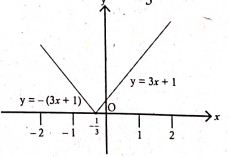
f(x) = |3x + 1|, x ∈ |-1, 3|
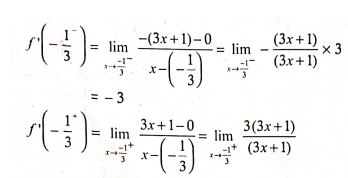
Since \(LHL \neq RHL, f'(-\frac{1}{3})\) does not exist.
Hence, Lagrange's mean value theorem is not applicable.
8.
The given differential equation is \(3\left( \frac { { d }^{ 2 }y }{ { dx }^{ 2 } } \right) ={ \left[ 4+{ \left( \frac { dy }{ dx } \right) }^{ 2 } \right] }^{ \frac { 3 }{ 2 } }\)Squaring both sides, we get
\(9{ \left( \frac { { d }^{ 2 }y }{ { dx }^{ 2 } } \right) }^{ 2 }={ \left[ 4+{ \left( \frac { dy }{ dx } \right) }^{ 2 } \right] }^{ 3 }\)
In this equation, the highest order derivative is \(\frac { { d }^{ 2 }y }{ { dx }^{ 2 } } \) whose power is 2.
Therefore, the given differential equation is of order 2 and degree 2.
9.
\({ x }^{ 2 }\frac { { d }^{ 2 }y }{ d{ x }^{ 2 } } +{ \left[ 1+{ \left( \frac { dy }{ dx } \right) }^{ 2 } \right] }^{ \frac { 1 }{ 2 } }=0\)
The given differential equation is
\({ x }^{ 2 }\left( \frac { { d }^{ 2 }y }{ d{ x }^{ 2 } } \right) \) = -\({ \left[ 1+{ \left( \frac { dy }{ dx } \right) }^{ 2 } \right] }^{ \frac { 1 }{ 2 } }\)
= - \(\sqrt { 1+{ \left( \frac { dy }{ dx } \right) }^{ 2 } } \)
Squaring both sides,
\({ x }^{ 4 }\left( \frac { { d }^{ 2 }y }{ d{ x }^{ 2 } } \right) =1+{ \left( \frac { dy }{ dx } \right) }^{ 2 }\)
The highest derivative is 2 and its power is 2.
∴ Order 2, degree 2.
10.
2x = 3y = −z \(\Rightarrow \frac{x}{3}=\frac{y}{2}=\frac{-z}{6}\) (Dividing by 6 all)
\(\Rightarrow \frac{x-0}{3}=\frac{y-0}{2}=
\frac{z-0}{-6}\)....(1)
6x = -y = -4z \(\Rightarrow \frac{x}{2}=\frac{-y}{12}=\frac{-z}{3} \) (Dividing by 6 all)
\(\Rightarrow \frac{x-0}{2}=\frac{y-0}{-12}=\frac{z-0}{-3}\) ....(2)
From (1) & (2), we get
\(\vec b = 3\vec i+2\vec j- 6\vec k\)and \( \vec d = 2\vec i-12\vec j- 3\vec k\)
Angle between lines (1) and (2) = Angle between \(\vec b\ and\ \vec d\)
Acute angle between lines cos 0 = \(\frac{|\vec b . \vec d|}{|\vec b||\vec d|}
\)
\(\vec b . \vec d \)= (\(\vec b = 3\vec i+2\vec j- 6\vec k\)). (\( 2\vec i-12\vec j- 3\vec k\))
6-24+18 = 0
\( \cos \theta=0 \)
\(\theta=\frac{\pi}{2} \text { or } 90^{\circ}\)
11.
cosec-1\((-\sqrt{2})\)
\(\Rightarrow -\sqrt { 2 } =cosex\theta \)
\(\Rightarrow sin\theta =\frac { -1 }{ \sqrt { 2 } } \)
\(\Rightarrow sin\theta =-sin\frac { \pi }{ 4 } \)
\(\Rightarrow sin\theta =sin\left( \frac { -\pi }{ 4 } \right) \)
\(\Rightarrow sin\theta =sin\left( \frac { -\pi }{ 4 } \right) \)
\(\Rightarrow \theta =-\frac { \pi }{ 4 } \)
\(\therefore\) \(\theta cosec^{ -1 }\left( -\sqrt { 2 } \right) =-\frac { \pi }{ 4 } \)
12.
Let z = -6+8i
|z| =\(\sqrt { (-6)^{ 2 }+8^{ 2 } } \)
= \(\sqrt { 36+64 } =\sqrt { 100 } \) = 10
\(\sqrt { a+ib } =\pm \left( \sqrt { \frac { |z|+a }{ 2 } } +i\frac { b }{ |b| } \sqrt { \frac { |z|-a }{ 2 } } \right) \)
[Here |z| = 10, a = -6, b = 8]
\(\sqrt { -6+8i } \pm \left( \sqrt { \frac { 10-6 }{ 2 } } +i\frac { 8 }{ |8| } \sqrt { \frac { 10+6 }{ 2 } } \right) \)
= \(\pm \left( \sqrt { \frac { 4 }{ 2 } } +i\sqrt { \frac { 16 }{ 2 } } \right) \)
= \(\pm (\sqrt { 2 } +i\sqrt { 8 } )\)
= \(\\ \pm (\sqrt { 2 } +i2\sqrt { 2 } )\)
Aliter :
Square root of -6 + 8i
Let a + ib = - 6 + 8i
a = -6, b = 8
\(|z|=\sqrt{6^{2}+8^{2}}=\sqrt{100}=10\)
\(\sqrt{a+i b}=\pm\left[\sqrt{\frac{\sqrt{a^{2}+b^{2}}+a}{2}}+i \frac{b}{|b|} \sqrt{\frac{\sqrt{a^{2}+b^{2}}-a}{2}}\right]\)
\(=\pm\left[\sqrt{\frac{10-6}{2}}+i \sqrt{\frac{10+6}{2}}\right]\)
\(=\pm[\sqrt{2}+i \quad 2 \sqrt{2}]\)
13.
i1+50 + i2+50 + ....+ i10+50
= i51+ i52+ ....+ i60
Taking i50 common we get,
i50 [i + i2+ i3+ i4) + (i5+ i6+ i7+ i8) + i9+ i10]
= i50[0 + (i4+1+ i4+2+ i4+3+ i4+4) + (i8+1 + i8+2)]
= i50 [0 + 0 + i + i2] [∵ i + i2+ i3+ i4 = 0]
= i50 [i-1] = i48+2(i-1)
= i2(i-1) [∴ i48 = 1]
= -1(i-1) = -i+1 = 1-i
14.
Let A = \(\left[ \begin{matrix} -2 & 2 & -1 \\ 0 & 5 & 1 \\ 0 & 0 & 0 \end{matrix} \right] \). Then A is a matrix of order 3 × 3 and ρ(A) ≤ 3.
The only third order minor is |A| = \(\left| \begin{matrix} -2 & 2 & -1 \\ 0 & 5 & 1 \\ 0 & 0 & 0 \end{matrix} \right| \) = (-2)(5)(0) = 0. So ρ(A) ≤ 2.
There are several second order minors. We find that there is a second order minor, for example, \(\left| \begin{matrix} -2 & 2 \\ 0 & 5 \end{matrix} \right| \) = (-2)(5) = -10 ≠ 0. So, ρ(A) = 2.
Note that there are two non-zero rows. The third row is a zero row.
15.
\(y=-sin\left( { \frac { 1 }{ 3 } x } \right) \)
The amplitude sin x is 1
\(\Rightarrow \) amplitude of \(-sin\left( \frac { 1 }{ 3 } x \right) \) is also 1.
The period of \(-sin\left( \frac { 1 }{ 3 } x \right) \) is \(\frac { 1 }{ 3 } x=2\pi \Rightarrow x=6\pi \)
16.
Vector form of the equation of the plane is
\(\vec { r } .(6\hat { i } +4\hat { j } -3\hat { k } )\) = 12
Let \(\vec { r } =x\hat { i } +y\hat { j } +z\hat { k } \)
\(\Rightarrow (x\hat { i } +y\hat { j } +z\hat { k } ).(6\hat { i } +4\hat { j } -3\hat { k } )=12\)
⇒ 6x + 4y - 3z = 0
Dividing by 12, we get
\(\frac { 6x }{ 12 } +\frac { 4y }{ 12 } +\frac { 3z }{ 12 } =1\)
[\(\because \frac { x }{ a } +\frac { y }{ b } +\frac { z }{ c } =1\) is the equation of the plane in intercept form]
⇒ \(\frac { x }{ 2 } +\frac { y }{ 3 } +\frac { z }{ -4 } =1\)
∴ The x-intercepts of the plane is 2, y intercept is 3 and z-intercept is -4.
17.
Since the given three vectors are coplanar, we have \(\left| \begin{matrix} 2 & -1 & 3 \\ 3 & 2 & 1 \\ 1 & m & 4 \end{matrix} \right| \) = 0 ⇒ m = -3
18.
Here A = 3, C = 2 and F = -14
A ≠ C and A and C are of the same sign.
Hence, the given equation represents an ellipse.
19.
\(\left| \frac { 2+i }{ -1+2i } \right| =\frac { \left| 2+i \right| }{ \left| -1+2i \right| } =\frac { \sqrt { { 2 }^{ 2 }+{ 1 }^{ 2 } } }{ \sqrt { \left( -1 \right) ^{ 2 }+{ 2 }^{ 2 } } } =1\) \(\left( \because \left| \frac { { z }_{ 1 } }{ { z }_{ 2 } } \right| =\left| \frac { { z }_{ 1 } }{ { z }_{ 2 } } \right| ,{ z }_{ 2 }\neq 0 \right) \)
20.
sec-1\((\frac{2}{\sqrt3})\)
Let \({ sec }^{ -1 }\left( { \frac { 2 }{ \sqrt { 3 } } } \right) \)
\(\Rightarrow \frac { 2 }{ \sqrt { 3 } } =sec\theta \Rightarrow cos\theta =\frac { \sqrt { 3 } }{ 2 } \)
\(\Rightarrow cos\theta =cos\left( \frac { \pi }{ 6 } \right) \)
\(\Rightarrow \theta =\frac { \pi }{ 6 } \)
\(\therefore { sec }^{ -1 }\left( \frac { 2 }{ \sqrt { 3 } } \right) =\frac { \pi }{ 6 } \)
21.
Centre of the circle is (3,-2) which lies on x + y − 1 = 0. So the line x + y − 1 = 0 passes through the centre and therefore the line x + y −1 = 0 is a diameter of the circle for all possible values of c .
22.
Let A be a non-singular matrix of order 2m+1, where m = 0, 1, 2,... Then, we get |A| ≠ 0 and, by property (ii), we have |adj A| = |A|(2m+1) − 1 = |A|2m. Since |A|2m is always positive, we get that |adj A| is positive.
23.
\(Let\ I=\int _{ 0 }^{ \pi /2 }{ { sin }^{ 2 }x{ cos }^{ 4 }xdx } \)
\({ I }_{ m,n }=\int _{ 0 }^{ \pi /2 }{ { sin }^{ m } } x{ cos }^{ n }xdx=\frac { n-1 }{ m+n } { I }_{ m,m-2 }n\ge 2\)
\(=\left( \frac { m-1 }{ n+m } \right) \left( \frac { m-3 }{ n+m-2 } \right) \left( \frac { m-5 }{ m+m-4 } \right) ...\frac { 2 }{ n+3 } .\frac { 1 }{ n+1 } \)
Here m = 2, n = 4
\(\therefore I=\frac { 3 }{ 6 } \times \frac { 1 }{ 4 } \times \frac { 1 }{ 2 } \times \frac { \pi }{ 32 } \)
24.
\(\underset { x\rightarrow \infty }{ lim } \frac { x }{ logx } =\frac { \infty }{ \infty } \)
Which is in indeterminate form
∴ By L' Hopital rule we get,
\(\underset { x\rightarrow \infty }{ lim } \frac { \frac { 1 }{ 1 } }{ x } =\underset { x\rightarrow \infty }{ lim } x=\infty \)
25.
Separating the variables we get,
\(\frac { dy }{ \sqrt { 1-{ y }^{ 2 } } } \frac { dx }{ \sqrt { 1-{ x }^{ 2 } } } \)
Taking Integration on both sides, we get
\(\int \frac{d y}{\sqrt{1-y^{2}}}=\int \frac{d x}{\sqrt{1-x^{2}}}\)
sin-1y = sin-1 x + c
26.
Given curve is y = x2 − 5x + 4 and the line is 3x + y = 7
Slope of the tangent to the curve
\({ m }_{ 1 }=\frac { dx }{ dt } \) = 2x - 5
Slope of the line = \({ m }_{ 2}=\frac { dx }{ dt } \) = -3
\(\left[ \because m=\frac { co-efficient \ of \ x }{ co-efficient \ of \ y } \right] \)
Since the tangent of the curve and the lines are parallel, their slopes are equal.
∴ m1 = m2
⇒ 2x - 5 = -3
⇒ 2x = 2
⇒ x = 1
Substituting x = 1 in y = x2 - 5x + 4 we get
y = 12-5(1)+4 = 0
∴ The required point is (1, 0).
27.
General equation of a straight line is
ax + by + c = 0 .......(1)
where a, b, c \(\in\) R.
Since, the lines are non - vertical,we have b \(\neq\) 0
Dividing b' by equation (1),
\(( \frac{a}{b})x+y+(\frac{c}{b}) = 0
\)
\(Ax+y=C = 0, where A = \frac{a}{b}, C = \frac{c}{b}\) .....(2)
Thus, eventhough 3 arbitrary constants (a, b, c) are present in (1), they can be considered as 2 constants only, as above (2).
Differentiating (1) with respect to x
a + b \(\\ \frac { dy }{ dx } =0\)
Differentiating again with respect to 'x' we get,
(b) \(\frac { { d }^{ 2 }y }{ d{ x }^{ 2 } } =0\Rightarrow \frac { { d }^{ 2 }y }{ d{ x }^{ 2 } } =0\quad [\because b\neq 0]\) .....(3)
This is the differential equation of family of all non - vertical lines in a plane.
28.
\(1+i\sqrt { 3 } \)
\(r=||z|=\sqrt { { 1 }^{ 2 }+\left( \sqrt { 3 } \right) ^{ 2 } } \)
|\(\theta ={ tan }^{ -1 }\left( \frac { 1 }{ \sqrt { 3 } } \right) =\frac { \pi }{ 3 } \)
Hence \(ang(z)=\frac { \pi }{ 3 } \)
Therefore, the polar form of \(1+i\sqrt { 3 } \) can be written as
\(1+i\sqrt { 3 } =2\left( cos\frac { \pi }{ 3 } +isin\frac { \pi }{ 3 } \right) \)
\(=2\left( cos\left( \frac { \pi }{ 3 } +2k\pi \right) +isin\left( \frac { \pi }{ 3 } +2k\pi \right) \right) ,k\varepsilon z\).
29.
Let \(\hat { d } =6\hat { i } +2\hat { j } -3\hat { k } \) and p = 12
If \(\hat { d } \) is the unit normal vector in the direction of the vector \(6\hat { i } +2\hat { j } -3\hat { k } \)
then \(\hat { d } =\frac { \hat { d } }{ \left| \hat { d } \right| } =\frac { 1 }{ 7 } (6\hat { i } +2\hat { j } -3\hat { k } )\)
If \(\hat { r } \) is the position vector of an arbitrary point (x, y, z) on the plane, then using \(\vec { r } .\hat { d } =p\), the vector equation of the plane in normal form is \(\vec { r } .\frac { 1 }{ 7 } (6\hat { i } +2\hat { j } -3\hat { k } )=12\)
Substituting \(\vec { r } =x\hat { i } +y\hat { j } +z\hat { k } \) in the above equation, we get \((x\hat { i } +y\hat { j } +z\hat { k } ).\frac { 1 }{ 7 } (6\hat { i } +2\hat { j } -3\hat { k } )=12\)
Applying dot product in the above equation and simplifying, we get 6x + 2y - 3z = 84, which is the Cartesian equation of the required plane.
30.
2 +i2\(\sqrt { 3 } \)
Let 2+i2\(\sqrt { 3 } \) = x + iy = r (cosθ + i sinθ)
r = modulus =\(\\ \sqrt { { x }^{ 2 }+{ y }^{ 2 } } \)
=\(\\ \sqrt { { 2 }^{ 2 }+(2\sqrt { 3 } )^{ 2 } } \)
= \(\sqrt { 4+12 } =\sqrt { 16 } \) = 4
α = tan-1\(\left| \frac { y }{ x } \right| =tan^{ -1 }\left| \frac { 2\sqrt { 3 } }{ 2 } \right| \)
= \(tan^{ -1 }(\sqrt { 3 } )=\frac { \pi }{ 3 } \)
Since the complex number 2+i2 \(\sqrt { 3 } \) lies in the I quadrant, [x, y both +ve] its principal value θ = α = \(\frac { \pi }{ 3 } \)
∴ Its polar form is 2+i2\(\sqrt { 3 } \)
= 4\(\left[ cos\left( 2k\pi +\frac { \pi }{ 3 } \right) +isin\left( 2k\pi +\frac { \pi }{ 3 } \right) \right] ,k\in Z\).
31.
Let A = \(\left[ \begin{matrix} 1 & 2 & 3 \\ 2 & 1 & 4 \\ 3 & 0 & 5 \end{matrix} \right] \). Applying elementary row operations, we get
A \(\overset { \begin{matrix} { R }_{ 2 }\longrightarrow { R }_{ 2 }-2{ R }_{ 1 } \\ { R }_{ 3 }\longrightarrow { R }_{ 3 }-3{ R }_{ 1 } \end{matrix} }{ \longrightarrow } \left[ \begin{matrix} 1 & 2 & 3 \\ 0 & -3 & -2 \\ 0 & -6 & -4 \end{matrix} \right] \overset { { R }_{ 3 }\longrightarrow { R }_{ 3 }-2{ R }_{ 2 } }{ \longrightarrow } \left[ \begin{matrix} 1 & 2 & 3 \\ 0 & -3 & -2 \\ 0 & 0 & 0 \end{matrix} \right] \).
The last equivalent matrix is in row-echelon form. It has two non-zero rows. So, ρ(A) = 2.
32.
Since 2-\(\sqrt{3}\)i is a root of the required polynomial equation with real coefficients, 2 +\(\sqrt{3}\)i is also a root. Hence the sum of the roots is 4 and the product of the roots is 7. Thus x2-4x + 7= 0 is the required monic polynomial equation.
33.
Given sin x = 0
\(\Rightarrow\) sin x = sin 0
\(\Rightarrow\) \(x=n\pi ,n\varepsilon z\)
Since \(-10\pi \le x\le 10\pi \) n can take the values only from -10 to +10.
\(\therefore\) \(x=n\pi ,\) When \(n=0,\pm ,\pm 2,\pm 3,\pm 4,\pm 5,\pm 6,\pm 7,\pm 8,\pm 9,\pm 10\)
34.
\(=\int _{ -\frac { \pi }{ 2 } }^{ \frac { \pi }{ 2 } }{ { x }^{ 5 }dx } +\int _{ -\frac { \pi }{ 2 } }^{ \frac { \pi }{ 2 } }{ xcosx\quad dx+ } \int _{ -\frac { \pi }{ 2 } }^{ \frac { \pi }{ 2 } }{ { tan }^{ 3 }xdx+ } \int _{ -\frac { \pi }{ 2 } }^{ \frac { \pi }{ 2 } }{ dx } \)
\(=0+0+0+{ [x] }_{ -\frac { \pi }{ 2 } }^{ \frac { \pi }{ 2 } }\)
\(=\frac { \pi }{ 2 } -\left( -\frac { \pi }{ 2 } \right) \)
\(=\frac { \pi }{ 2 } +\frac { \pi }{ 2 } \)
\(=\pi \)
\(\\ \\ \\ \\ \\ \because \int { { x }^{ 5 } } dx\) is an odd function \(\int { { x } } \) cos xdx is an odd function \(\int { { tan }^{ 3 } } \)xdx is an odd function
35.
Given probability mass function is
| x | 0 | 1 | 2 | 3 | 4 |
| f(x) | \(\frac{1}{36}\) | \(\frac{2}{36}\) | \(\frac{3}{36}\) | \(\frac{2}{36}\) | \(\frac{3}{36}\) |
(i) Since f(x) is a probability mass function.
\(\sum _{ i=1 }^{ 5 }{ f({ x }_{ i }) } =1\)
⇒ k2 + 2k2 + 3k2 + 2k + 3k = 1
⇒ 6k2 + 5k = 1
⇒ 6k2 + 5k - 1 = 0
⇒ (k + 1) (6k - 1) = 0
⇒ k = -1 or ⇒ \(k=\frac { 1 }{ 6 } \)
⇒ \(k=\frac { 1 }{ 6 } \)
(ii) p(2 ≤ x < 5)
= p(x = 2) + p(x = 3) + p(x = 4)
= 2k2 + 3k2 + 2k = 5k2 + 2k
= \(5\left( \frac { 1 }{ 36 } \right) +2\left( \frac { 1 }{ 6 } \right) \)
= \(\frac { 5 }{ 36 } +\frac { 1 }{ 3 } =\frac { 5+12 }{ 36 } \)
= \(\frac { 17 }{ 36 } \)
(iii) p(3 < x) = p(x > 3)
= p(x = 4) + p(x = 5)
= 2k + 3k = 5k
= \(5\left( \frac { 1 }{ 6 } \right) \)
= \(\frac { 5 }{ 6 } \)
36.
Let X be the thrown random variable denotes the total in two the thrown a die.
Sample space S
| I/II | 1 | 3 | 3 | 5 | 5 | 5 |
| 1 | 2 | 4 | 4 | 6 | 6 | 6 |
| 3 | 4 | 6 | 6 | 8 | 8 | 8 |
| 3 | 4 | 6 | 6 | 8 | 8 | 8 |
| 5 | 6 | 8 | 8 | 10 | 10 | 10 |
| 5 | 6 | 8 | 8 | 10 | 10 | 10 |
| 5 | 6 | 8 | 8 | 10 | 10 | 10 |
n (S) = 36
X = {2, 4, 6, 8, 10}
| Values of the random variable | 2 | 4 | 6 | 8 | 10 | Total |
| No. of elements in inverse images | 1 | 4 | 10 | 12 | 9 | 36 |
\(p(x=2)=\cfrac { 1 }{ 36 } \)
\(p(x=4)=\cfrac { 4 }{ 36 } \)
\(p(x=6)=\cfrac { 10 }{ 36 } \)
\(p(x=8)=\cfrac { 12 }{ 36 } \)
\(p(x=10)=\cfrac { 9 }{ 36 } \)
(i) Probability mass function is
| x | 2 | 4 | 6 | 8 | 10 |
| f(x) | \(\\ \cfrac { 1 }{ 36 } \) | \(\cfrac { 4 }{ 36 } \) | \(\cfrac { 10 }{ 36 } \) | \(\cfrac { 12 }{ 36 } \) | \(\cfrac { 9 }{ 36 } \) |
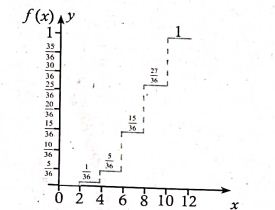
(ii) Cumulative distribution function .
F(x) = p(X ≤ x) = \(\sum_{x_i ≤ x }\)(X = xi)
P(X<2) = 0 for \(\infty\) < x < 2
\(F(2)=\frac { 1 }{ 36 } \)
\(F(4)=\frac { 1 }{ 36 } +\frac { 4 }{ 36 } =\frac { 5 }{ 36 } \)
\(F(6)=\frac { 1 }{ 36 } +\frac { 4 }{ 36 } +\frac { 10 }{ 36 } =\frac { 15 }{ 36 } \)
\(F(8)=\frac { 1 }{ 36 } +\frac { 4 }{ 36 } +\frac { 10 }{ 36 } +\frac { 12 }{ 36 } =\frac { 27 }{ 36 }\)
\(F(10)=\frac { 27 }{ 36 } +\frac { 9 }{ 36 } =\frac { 36 }{ 36 } =1\)
∵ The cumulative distribution function n
\(F(x)=\left\{\begin{array}{lll} 0 & \text { for } & x<2 \\ \frac{1}{36} & \text { for } & x \leq 2 \\ \frac{5}{36} & \text { for } & x \leq 6 \\ \frac{15}{36} & \text { for } & x \leq 8 \\ 1 & \text { for } & x \leq 10 \end{array}\right.\)
(iii) p(4≤ X < 10) = p(x = 4) + p(x = 6) + p(x = 8)
= \(\frac { 4 }{ 36 } +\frac { 10 }{ 36 } +\frac { 12 }{ 36 } +\frac { 26 }{ 36 } =\frac { 13 }{ 18 } \)
(iv) p(x ≥ 6) = p(x = 6) + p(x = 8) + p(x = 10)
= \(\frac { 10 }{ 36 } +\frac { 12 }{ 36 } +\frac { 9 }{ 36 } =\frac { 31 }{ 36 } \)
Sample space = {4 childrens}
37.
Let p(x) = 9x9 - 4x8 + 4x7 - 3x6 + 2x5 + x3 + 7x2 + 7x + 2 = 0
Clearly there are 4 sign changes for the given| polynomial P(x) and hence number of positive roots of P(x) can't be more than four.
hence the number of positive roots of p(x) cannot be more than 4.
p(-x) = 9(-x)9 - 4(-x)8 + 4(-x)7 - 3(-x)6+ 2(-x)5 + (-x)3 + 7 (-x)2 + 7(-x) + 2
There are two sign changes. Hence the number of negative roots can't be more than two.
It has atmost 4 positive roots and atmnost two negative roots.

12th Standard Syllabus & Materials
12th Standard
TN 12th Computer Applications களப்பெயர் முறைமை (DNS) Sample Question Papers Study Material - QB365 Set A
NEW12th Standard
TN 12th Computer Applications வலையமைப்பு எடுத்துக்காட்டுகள் மற்றும் நெறிமுறைகள் Sample Question Papers Study Material - QB365 Set A
NEW12th Standard
TN 12th Computer Applications கணினி வலையமைப்பு ஓர் அறிமுகம் Sample Question Papers Study Material - QB365 Set A
NEW12th Standard
TN 12th Computer Applications PHP-உடன் MySQL-ஐ இணைத்தல் Sample Question Papers Study Material - QB365 Set A



Tamilnadu Stateboard 12th Standard Subjects
Maths

Chemistry

Physics

Biology

Computer Science

Business Maths and Statistics

Economics

Commerce

Accountancy

History

Computer Applications
Biology
Computer Technology
Computer Applications
Computer Science
Business Maths and Statistics
Commerce
Economics
Maths
Chemistry
Physics
Computer Technology
History
Accountancy

Tamil

English

French
Tamilnadu Stateboard Standards

