
 100% FREE ACCESS
12th Standard Syllabus & Materials
12th Standard
TN 12th Computer Applications மின்னணு தரவு பரிமாற்றம் Sample Question Papers Study Material - QB365 Set A
NEW12th Standard
TN 12th Computer Applications மின் - வணிக பாதுகாப்பு அமைப்புகள் Sample Question Papers Study Material - QB365 Set A
NEW12th Standard
TN 12th Computer Applications மின்னணு செலுத்தல் முறைகள் Sample Question Papers Study Material - QB365 Set A
NEW12th Standard
TN 12th Computer Applications மின் - வணிகம் Sample Question Papers Study Material - QB365 Set A
NEW12th Standard
TN 12th Computer Applications திறந்த மூல கருத்துருக்கள் Sample Question Papers Study Material - QB365 Set A
NEW12th Standard
TN 12th Computer Applications வலையமைப்பு வடமிடல் Sample Question Papers Study Material - QB365 Set A

Published on: 29/08/2020
12th Standard Mathematics English Medium Important 2 Mark Creative Questions (New Syllabus) 2020
Download Tamil Nadu 12th Standard Maths question papers, model tests, one-mark questions, important questions, and public exam papers in PDF format. Free study materials and answer keys for TN State Board students.
Questions + Answers key
Take MCQ Maths Test1.
Form the D.E of family of parabolas having vertex at the origin and axis along positive y-axis.
2.
Find the area enclosed between the parabola y2=4ax and the line x=a,x=9a.
3.
Evaluate \(\int _{ 0 }^{ \frac { \pi }{ 2 } }{ log(tanx)dx } =0\)
4.
If w=xyexy find \(\frac { { \partial }^{ 2 }u }{ \partial x\partial y } \)
5.
Prove that the function f(x)=2x2+3x is strictly increasing on \(\left[ -\frac { 1 }{ 2 } ,\frac { 1 }{ 2 } \right] \)
6.
Verify Lagrange’s Mean Value theorem for \(f(x)=\sqrt { x-2 } \) in the interva [2,6]
7.
Solve: x \(\frac{dy}{dx}=x+y\)
8.
In the set of integers under the operation * defined by a * b = a + b - 1. Find the identity element.
9.
Use differentials to find \(\sqrt{25.2}\)
10.
A man 2 m high walks at a uniform speed of 5 km/ hr away from a lamp post 6 m high. Find the rate at which the length of his shadow increases?
11.
Find the modules of (1+ 3i)3
12.
If (cosθ + i sinθ)2 = x + iy, then show that x2+y2 =1
13.
Find the eccentricity of the hyperbola with foci on the x-axis if the length of its conjugate axis is \({ \left( \frac { 3 }{ 4 } \right) }^{ th }\) of the length of its tranverse axis.
14.
Find the equation of the parabola with vertex at the origin, passing through (2, -3) and symmetric about x-axis
15.
Prove that \(2{ tan }^{ -1 }\left( \frac { 2 }{ 3 } \right) ={ tan }^{ -1 }\left( \frac { 12 }{ 5 } \right) \)
16.
Find the principal value of \({ cos }^{ -1 }\left( \frac { -1 }{ 2 } \right) \)
17.
Find x If \(x=\sqrt { 2+\sqrt { 2+\sqrt { 2+....+upto\infty } } } \)
18.
Show that the system of equations is inconsistent. 2x + 5y= 7, 6x + 15y = 13.
19.
Find the equation of the plane containing the line of intersection of the planes x + y + Z - 6 = 0 and 2x + 3y + 4z + 5 = 0 and passing through the point (1, 1, 1)
20.
A force of magnitude 6 units acting parallel to \(\overset { \wedge }{ 2i } -\overset { \wedge }{ 2j } +\overset { \wedge }{ k } \) displaces the point of application from (1, 2, 3) to (5, 3, 7). Find the work done.
1.
\(x\frac { dy }{ dx } =2y\)
2.
\(\frac { { 208a }^{ 2 } }{ 3 } \)
3.
0
4.
\(\frac { { \vartheta }^{ 2 }u }{ \vartheta x\vartheta y } ={ e }^{ xy }\left[ 3xy+1+{ x }^{ 2 }{ y }^{ 2 } \right] \)
5.
f(x) is strictly increasing \(\left[ -\frac { 1 }{ 2 } ,\frac { 1 }{ 2 } \right] \)
6.
c = 3
7.
Given x \(\frac{dy}{dx}=x+y\)
\(\frac{dy}{dx}=\frac{x+y}{x}\) ...(1)
This is a homogeneous differential equation
put y = vx
\(\Rightarrow \frac { dy }{ dx } =v+x\frac { dv }{ dx } \)
∴ (1) becomes,
\(v+x\frac { dv }{ dx } =\frac { x+vx }{ x } =1+v\)
\(\Rightarrow x\frac { dv }{ dx } =1+v-v=1\)
\(\Rightarrow dv=\frac { dx }{ x } \)
\(\Rightarrow \int { dv } =\int { \frac { dx }{ x } } \)
\(\Rightarrow v=log\quad x+c\)
\(\\ \Rightarrow \frac { y }{ x } =log\ x+c[\because v=\frac { y }{ x } ]\)
8.
Let a be any element and e be the identity element.
The a * e = e * a = a
a * e = a ⇒ a + e -1 = a ⇒ e-1 = 0 ⇒ e = 1
∴ The identity element is 1
9.
Let y = f(x) = \(\sqrt x\)
Let xo = 25, dx = 25.2 - 25 = 0.2
y = \(\sqrt x\)
dy = \(\frac{1}{2\sqrt{x}}\) dx
dy = \(\frac{1}{2\sqrt{x}}\) (0.2) = 0.02
∴\(\sqrt{25.2}\) = f(x0) + f'(x0) dx
= \(\sqrt{25}\) + 0.02
= 5 + 0.02 = 5.02
10.
Let AB be the lamp post. Let the man CD be at distance x m from lamp post and y m be the length of his shadow at any time t.
Given \(\frac { dx }{ dt } \) = 5 km / hr = 5000 m/hr
ΔABE and CDE are similar
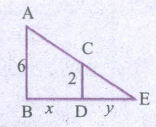
∴ \(\frac { DE }{ CD } =\frac { BE }{ AB } \)
⇒ \(\frac { y }{ 2 } =\frac { x+y }{ 6 } \)
⇒ 6y = 2x+2y
⇒ 4y = 2x
⇒ y = \(\frac { x }{ 2 } \)
⇒ \(\frac { dy }{ dt } =\frac { 1 }{ 2 } \frac { dx }{ dt } =\frac { 1 }{ 2 } \)(5000)
= 2500 m/hr = 2.5 km/hr.
11.
|(1+3i)3| = |1+3i|3 = \(\left[ \sqrt { { 1 }^{ 2 }+{ 3 }^{ 2 } } \right] ^{ 3 }\) =\(\left( \sqrt { 10 } \right) ^{ 3 }\)
=\((\sqrt { 10 } )^{ 3 }=\sqrt { 10 } \times \sqrt { 10 } \times \sqrt { 10 } \times \sqrt { 10 } =10\sqrt { 10 } \).
12.
(cos θ + i sin θ )2 = cos 2θ + isin 2θ
[By De moivre's theorem]
⇒ cos 2θ + isin 2θ = x + iy
Equating the real and imaginary parts we get,
x = cos 2θ, y = sin 2θ
∴ x2 + y2 = cos22θ + sin22θ = 1
Hence proved
13.
Since the foci are one the x-axis, the equation of the hyperbola is \(\frac { { x }^{ 2 } }{ { a }^{ 2 } } +\frac { { y }^{ 2 } }{ { b }^{ 2 } } =1\)
Given conjugate axis = \(\frac34\) (transverse axis)
⇒ 2b = \(\frac34\) (2a) ⇒ b = \(\frac{3a}4\) ⇒ b2 = \(\frac { { 9a }^{ 2 } }{ 16 } \)
∴ e = \(\sqrt { 1-\frac { { b }^{ 2 } }{ { a }^{ 2 } } } =\sqrt { 1-\frac { 9{ a }^{ 2 } }{ { 16a }^{ 2 } } } =\sqrt { 1+\frac { 9 }{ 16 } } =\sqrt { \frac { 25 }{ 16 } } =\frac { 5 }{ 4 } \)
∴ e = \(\frac { 5 }{ 4 } \)
14.
Since the parabola is symmetric about x-axis, it is either open upward or downward.
Let the equation be x2 = 4ay ...(1)
Since (2, -3) lies on the parabola,
22 = 4a(-3) ⇒ a = \(\frac { -1 }{ 3 } \)
Substituting a = \(\frac { -1 }{ 3 } \) in (1) we get,
x2 = 4 \(\left( \frac { -1 }{ 3 } \right) \) y ⇒ 3x2 = -4y. Which is the required equation of the parabola.
15.
LHS = \(2{ tan }^{ -1 }\left( \frac { 2 }{ 3 } \right) \)
= \({ tan }^{ -1 }\left( \frac { 2 }{ 3 } \right) +{ tan }^{ -1 }\left( \frac { 2 }{ 3 } \right) \)
= \({ tan }^{ -1 }\left( \frac { \frac { 2 }{ 3 } +\cfrac { 2 }{ 3 } }{ 1-\left( \frac { 2 }{ 3 } \right) \left( \frac { 2 }{ 3 } \right) } \right) ={ tan }^{ -1 }\left( \frac { \frac { 4 }{ 3 } }{ \frac { 9-2 }{ 9 } } \right) \)
= \({ tan }^{ -1 }\left( \frac { 4 }{ 3 } \times \frac { 9 }{ 7 } \right) ={ tan }^{ -1 }\left( \frac { 12 }{ 7 } \right) \)
= RHS
Hence proved
16.
Let \({ cos }^{ -1 }\left( \frac { -1 }{ 2 } \right) =y\) where \(0\le y\le \pi \)
Then \({ cos }^{ -1 }\left( \frac { -1 }{ 2 } \right) =y\Rightarrow cosy=\frac { -1 }{ 2 } \)
\(\Rightarrow cos\ y=-cos\frac { \pi }{ 3 } =cos\left( \pi -\frac { \pi }{ 3 } \right) =cos\left( \frac { 2\pi }{ 3 } \right) \)
\(\Rightarrow y=\frac { 2\pi }{ 3 } \left[ \because \frac { 2\pi }{ 3 } \in \left[ 0,\pi \right] \right] \)
\(\therefore \) The principal value of \({ cos }^{ -1 }\left( \frac { -1 }{ 2 } \right) \frac { 2\pi }{ 3 } \)
17.
We have \(x=\sqrt { 2+x } \)
\(\Rightarrow { x }^{ 2 }=2+x \Rightarrow { x }^{ 2 }-x-2=0\)
\(\Rightarrow x=\frac { 1\pm \sqrt { 1+8 } }{ 2 } \Rightarrow x=\frac { 1\pm 3 }{ 2 } \)
\(\Rightarrow x=\frac { 1+3 }{ 2 } ,\frac { 1-3 }{ 2 } \Rightarrow x=2,-1\)
Also x>0, we get x = 2
18.
Agumented matrix
[A|B] \(\left[ \begin{matrix} 2 & 5 \\ 6 & 15 \end{matrix}|\begin{matrix} 7 \\ 13 \end{matrix} \right] \overset { { R }_{ 2 }\rightarrow { R }_{ 2 }-3{ R }_{ 1 } }{ \longrightarrow } \left[ \begin{matrix} 2 & 5 \\ 0 & 0 \end{matrix}|\begin{matrix} 7 \\ -8 \end{matrix} \right] \)
Here \(\rho\) (A) = 2 and \(\rho\)([A|B]) = 3
∴ \(\rho\) (a) ≠ \(\rho\) ([AIB])
Hence the system is inconsistent.
19.
The equation of the required plane through the intersection of the given planes is
( x + y + z - 6 ) + λ (2x + 3y + 4z + 5) = 0 ......(1)
This passes through (1, 1, 1)
∴ ( 1+ 1 + z - 6) + λ (2 + 3+ 4 + 5) = 0
⇒ -3 +14λ = 0 \(\Rightarrow \lambda =\frac { 3 }{ 14 } \)
Substituting \(\lambda =\frac { 3 }{ 14 } \) in (1) we get
( x + y + z - 6 )+\(\frac { 3 }{ 14 } \) (2x + 3y + 4z + 5) = 0
⇒ 14( x + y + z - 6 ) +3 (2 + 3+ 4 + 5) = 0
⇒ 20x + 23y + 26z - 69 = 0
20.
\(\overset { \rightarrow }{ F } =\frac { 6\left( \overset { \wedge }{ 2i } -2\overset { \wedge }{ j } +\overset { \wedge }{ k } \right) }{ \sqrt { 4+4+1 } } =\frac { 6 }{ 3 } \left( \overset { \wedge }{ 2i } -2\overset { \wedge }{ j } +\overset { \wedge }{ k } \right) =\overset { \wedge }{ 4i } -4\overset { \wedge }{ j } +2\overset { \wedge }{ k } \)
\(\overset { \rightarrow }{ d } \) = (5, 3, 7) - (1, 2, 3) = (4, 1, 4) =\(\overset { \wedge }{ 4i } +\overset { \wedge }{ j } +4\overset { \wedge }{ k } \)
∴ Work done (w)
= \(\overset { \rightarrow }{ F } .\overset { \rightarrow }{ d } =\left( \overset { \wedge }{ 4i } -4\overset { \wedge }{ j } +2\overset { \wedge }{ k } \right) .\left( \overset { \wedge }{ 4i } +\overset { \wedge }{ j } +4\overset { \wedge }{ k } \right) \)
= 16 - 4 + 8 = 20 units

12th Standard Syllabus & Materials
12th Standard
TN 12th Computer Applications களப்பெயர் முறைமை (DNS) Sample Question Papers Study Material - QB365 Set A
NEW12th Standard
TN 12th Computer Applications வலையமைப்பு எடுத்துக்காட்டுகள் மற்றும் நெறிமுறைகள் Sample Question Papers Study Material - QB365 Set A
NEW12th Standard
TN 12th Computer Applications கணினி வலையமைப்பு ஓர் அறிமுகம் Sample Question Papers Study Material - QB365 Set A
NEW12th Standard
TN 12th Computer Applications PHP-உடன் MySQL-ஐ இணைத்தல் Sample Question Papers Study Material - QB365 Set A



Tamilnadu Stateboard 12th Standard Subjects
Maths

Chemistry

Physics

Biology

Computer Science

Business Maths and Statistics

Economics

Commerce

Accountancy

History

Computer Applications
Biology
Computer Technology
Computer Applications
Computer Science
Business Maths and Statistics
Commerce
Economics
Maths
Chemistry
Physics
Computer Technology
History
Accountancy

Tamil

English

French
Tamilnadu Stateboard Standards

