
 100% FREE ACCESS
12th Standard Syllabus & Materials
12th Standard
TN 12th Computer Applications மின்னணு தரவு பரிமாற்றம் Sample Question Papers Study Material - QB365 Set A
NEW12th Standard
TN 12th Computer Applications மின் - வணிக பாதுகாப்பு அமைப்புகள் Sample Question Papers Study Material - QB365 Set A
NEW12th Standard
TN 12th Computer Applications மின்னணு செலுத்தல் முறைகள் Sample Question Papers Study Material - QB365 Set A
NEW12th Standard
TN 12th Computer Applications மின் - வணிகம் Sample Question Papers Study Material - QB365 Set A
NEW12th Standard
TN 12th Computer Applications திறந்த மூல கருத்துருக்கள் Sample Question Papers Study Material - QB365 Set A
NEW12th Standard
TN 12th Computer Applications வலையமைப்பு வடமிடல் Sample Question Papers Study Material - QB365 Set A

Published on: 29/08/2020
12th Standard Mathematics English Medium Model 2 Mark Book Back Questions (New Syllabus) 2020
Download Tamil Nadu 12th Standard Maths question papers, model tests, one-mark questions, important questions, and public exam papers in PDF format. Free study materials and answer keys for TN State Board students.
Questions + Answers key
Take MCQ Maths Test1.
Determine the truth value of each of the following statements
(i) If 6 + 2 = 5 , then the milk is white.
(ii) China is in Europe or \(\sqrt3\) is an integer
(iii) It is not true that 5 + 5 = 9 or Earth is a planet
(iv) 11 is a prime number and all the sides of a rectangle are equal
2.
Write the statements in words corresponding to ¬p, p ∧ q , p ∨ q and q ∨ ¬p, where p is ‘It is cold’ and q is ‘It is raining'.
3.
Evaluate the following:
\(\int _{ 0 }^{ \infty }{ { x }^{ 5 }{ e }^{ -3x }dx } \)
4.
Find df for f(x) = x2 + 3x and evaluate it for
x = 3 and dx = 0.02
5.
Evaluate :\(\int _{ 0 }^{ 1 }{ [2x] } dx\) where [⋅] is the greatest integer function
6.
Show that y = mx + \(\frac{7}{m}\), m ≠ 0 is a solution of the differential equation xy'+7\(\frac{1}{y'}\)-y = 0.
7.
Find value of m so that the function y = emx is a solution of the given differential equation, y''− 5y' + 6y = 0
8.
Express each of the following physical statements in the form of differential equation.
(i) Radium decays at a rate proportional to the amount Q present.
(ii) The population P of a city increases at a rate proportional to the product of population and to the difference between 5,00,000 and the population.
(iii) For a certain substance, the rate of change of vapor pressure P with respect to temperature T is proportional to the vapor pressure and inversely proportional to the square of the temperature.
(iv) A saving amount pays 8% interest per year, compounded continuously. In addition, the income from another investment is credited to the amount continuously at the rate of Rs. 400 per year.
9.
For each of the following differential equations, determine its order, degree (if exists)
\({ { \left( \frac { { d }^{ 2 }y }{ d{ x }^{ 2 } } \right) } }^{ 2 }+{ \left( \frac { dy }{ dx } \right) }^{ 2 }=xsin\left( \frac { { d }^{ 2 }y }{ d{ x }^{ 2 } } \right) \)
10.
Find centre and radius of the following circles.
x2+y2−x+2y−3 = 0
11.
Find the principal value of \({sin }^{ -1 }\left( sin\left( -\frac { \pi }{ 3 } \right) \right) \)
12.
Evaluate the following if z = 5−2i and w = −1+3i
z w
13.
Find the period and amplitude of y = 4sin(−2x)
14.
Find the acute angle between the planes \(\vec { r } .(2\hat { i } +2\hat { j } +2\hat { k } )\) and 4x-2y+2z = 15.
15.
Show that the vectors \(\hat { i } +\hat { 2j } -\hat { 3k } \), \(\hat { 2i } -\hat { j } +\hat { 2k } \) and \(\hat { 3i } +\hat { j } -\hat { k } \)
16.
Prove that \(\left[ \begin{matrix} \cos { \theta } & -\sin { \theta } \\ \sin { \theta } & \cos { \theta } \end{matrix} \right] \) is orthogonal.
17.
Evaluate the following if z = 5−2i and w = −1+3i
z + w
18.
Construct the truth table for the following statements.
( p V q) V ¬q
19.
A commuter train arrives punctually at a station every half hour. Each morning, a student leaves his house to the train station. Let X denote- the amount of time, in minutes that the student waits for the train from the time he reaches the train station. It is known that the pdf of X is
\(f(x)= \begin{cases}\frac{1}{30} & 0<x<30 \\ 0 & \text { elsewhere }\end{cases}\)
Obtain and interpret the expected value of therandom variable X.
20.
Evaluate the following limit, if necessary use l ’Hôpital Rule
\(\underset { x\rightarrow \infty }{ lim } \frac { x }{ logx } \)
21.
Using the Rolle’s theorem, determine the values of x at which the tangent is parallel to the x -axis for the following functions:
\(f(x)=\sqrt{x}-\frac{x}{3}, x\in [0,9]\)
22.
Find the angle of intersection of the curve y = sin x with the positive x -axis.
23.
Obtain the Cartesian form of the locus of z = x + iy in each of the following cases:
\(\overline { z } =z^{ -1 }\)
24.
Show that the points (2, 3, 4),(−1, 4, 5) and (8,1, 2) are collinear.
25.
Represent the complex number −1−i
26.
If the area of the triangle formed by the vertices z, iz and z + iz is 50 square units, find the value of |z|
27.
Simplify \({ cos }^{ -1 }\left( cos\left( \frac { 13\pi }{ 3 } \right) \right) \)
28.
Find the rank of the matrix \(\left[ \begin{matrix} 1 & 2 & 3 \\ 2 & 1 & 4 \\ 3 & 0 & 5 \end{matrix} \right] \) by reducing it to a row-echelon form.
29.
If y = 4x + c is a tangent to the circle x2 + y2 = 9, find c
30.
Find all values of x such that -6\(\pi\le x \le 6\pi\) and cos x = 0
31.
If α, β, γ and \(\delta\) are the roots of the polynomial equation 2x4 + 5x3 − 7x2 + 8 = 0, find a quadratic equation with integer coefficients whose roots are α + β + γ + \(\delta\) and αβ૪\(\delta\).
32.
A six sided die is marked '1' on one face, '3' on two of its faces, and '5' on remaining three faces. The die is thrown twice. If X denotes the total score in two throws, find
(i) the probability mass function
(ii) the cumulative distribution function
(iii) P(4 ≤ X < 10)
(iv) P(X ≥ 6)
33.
Solve the following system of homogenous equations.
2x + 3y − z = 0, x − y − 2z = 0, 3x + y + 3z = 0
34.
Solve: \(2\sqrt { \frac { x }{ a } } +3\sqrt { \frac { a }{ x } } =\frac { b }{ a } +\frac { 6a }{ b } \)
1.
(i) If 6 + 2 = 5, then the milk is white.
Let p: 6 + 2 = 5 (F)
q: Milk is white (T)
p ➝ q is having the truth value T
(ii) China is in Europe or \(\sqrt3\) is an integer.
p: China is in Europe (F)
q: \(\sqrt3\) is an integer (F)
p v q is having the truth value (F).
(iii) It is not true time 5 + 5 = 9 or Earth is a planet.
Let P: 5 + 5 = 9 is not true (T)
q: Earth is a planet (T
~p ∨ q is having the truth value T
(iv) 11 is a prime number and all the sides of a rectangle are equal.
p:11 is a prime number (T)
q: Allthe sides of arectangle areequal (F)
p ^ q is having the truth value F
2.
(1) ¬p: It is not cold.
(2) p ∧ q: It is cold and raining.
(3) p ∨ q: It is cold or raining.
(4) q ∨ ¬p: It is raining or it is not cold
Observe that the statement formula ¬ p has only 1 variable p and its truth table has 2 = ( 21 ) rows. Each of the statement formulae p ∧ q and p ∨ q has two variables p and q. The truth table corresponding to each of them has 4 = (22 ) rows. In general, it follows that if a statement formula involves n variables, then its truth table will contain 2n rows.
3.
\( \because \int _{ 0 }^{ \infty }{ { x }^{ n }{ e }^{ -ax }dx}=\frac { n! }{ { a }^{ n+1 } } \)
\(n=5,\quad a=3 \)
\(=\frac { 5! }{ { 3 }^{ 6 } } \)
4.
x = 3 and dx = 0.02
When x = 3 and dx = 0.02,
df = (6 + 3) (0.02)
= 9(0.02) = 0.18
5.
\(\int _{ 0 }^{ 1 }{ [2x]dx } =\int _{ 0 }^{ \frac { 1 }{ 2 } }{ [2x] } dx+\int _{ \frac { 1 }{ 2 } }^{ 1 }{ [2x]dx } =\int _{ 0 }^{ \frac { 1 }{ 2 } }{ 0dx+ } \int _{ \frac { 1 }{ 2 } }^{ 1 }{ 1 dx} = 0+[x]^1_{\frac{1}{2}} = 1 -\frac { 1 }{ 2 } =\frac { 1 }{ 2 } \)
6.
The given function is y mx +\(\frac{7}{m}\), where m is an arbitrary constant ....(1)
Differentiating both sides of equation (1) with respect to x, we get y' = m.
Substituting the values of y' and y in the given differential equation
we get xy'\(\frac{1}{y'}\)-y = xm +\(\frac{7}{m}\)- mx -\(\frac{7}{m}\) = 0
Therefore, the given function is a solution of the differential equation xy' + 7\(\frac{1}{y'}\) - y = 0
7.
y''− 5y' + 6y = 0 ......(1)
Given y = emx .....(2)
Differentiating cquation (2) w.r.t 'x', we get
\(\frac{dy}{dx} = em^x . m\)
To find the value of m:
Given y" - 5y' + 6y = 0
emx . m2 -5emx+ 6emx = 0
emx [m- 5m +6] = 0
m - 5m + 6 = 0
(m - 3) (m - 2) = 0
m = 3, 2
8.
(i) If at any time t, The amount of Radium present is Q. The rate at which Q is decreasing \(\frac { dQ }{ dt } \).
This rate of decrease or decay is found to be proportional to Q itself. Hence we have the law, \(\frac { dQ }{ dt } = kQ\). where k is the dt constant of proportionality. Which is a required differential equation.
(ii) The rate of change of population Solution increases with respect to time t, is \(\frac { dp }{ dt } \) & the rate of population is proportional| the product of population is \(\frac { dp }{ dt } \) = kP & the also the difference between 5,00,000 & the population is \(\frac { dp }{ dt } \) = kP (5,00,000 - P) is a required differential equation.
(iii) The rate of change of vapor pressure P with respect to time t is \(\frac { dp }{ dt } \)& the rate of dt increase vapor pressure is P at time T is proportional to the vapor pressure and also is inversely proportional to the square of the temperature is \(\frac { dp }{ dt } \)\(\infty\) P and \(\frac { dp }{ dt } \infty\frac{1}{T^2}\)
Combining the two, we get
\(\frac { dp }{ dt } \infty\frac{p}{T^2} \Rightarrow \frac { dp }{ dt }= k(\frac{p}{T^2})\), where 'k' is constantof proportionality
(iv) Let x be the amount. Amount varies from every year. (ie) Amount varies with respect to time t is \(\frac { dp }{ dt } \) & in addition the income from other source credited Rs. 400 continuously for every year.
\(\frac { dx }{ dt } = \frac{8}{100}\times x + 400\)
\(\Rightarrow\frac{dx}{dt} = \frac{2x}{25}+400\) is a required differential equation.
9.
\({ { \left( \frac { { d }^{ 2 }y }{ d{ x }^{ 2 } } \right) } }^{ 2 }+{ \left( \frac { dy }{ dx } \right) }^{ 2 }=xsin\left( \frac { { d }^{ 2 }y }{ d{ x }^{ 2 } } \right) \)
The highest derivative is 2
∴ Order 2
The given differential equation is not a polynomial equation in its derivative and so its degree is not defined.
10.
Equation of the circle is x2 + y2 - x + 2y - 3 = 0
Here 2g = -1 ⇒ g = \(\frac { -1 }{ 2 } \)
2f = 2 ⇒ f = 1 and c = -3
Centre is (-g, -f) = \(\left( \frac { 1 }{ 2 } ,-1 \right) \)
and r = \(\sqrt { { g }^{ 2 }+{ f }^{ 2 }-c } \)
= \(\sqrt { \frac { 1 }{ 4 } +1+3 } \)
= \(\sqrt { \frac { 1 }{ 4 } +4 } =\sqrt { \frac { 1+16 }{ 2 } } \)
r = \(\sqrt { \frac { 17 }{ 2 } } \) units.
11.
We know that sin-1: [-1, 1] \(\rightarrow \left[ -\frac { \pi }{ 2 } ,\frac { \pi }{ 2 } \right] \)is given by
sin−1x = y if and only if x = sin y for −1\(\le x\le \) and -\(\frac { \pi }{ 2 } \le y \le \frac { \pi }{ 2 } \). Thus,
\({ sin }^{ -1 }\left( sin\left( -\frac { \pi }{ 3 } \right) \right) \) = -\(\frac{\pi}{3}\), since -\(\frac{\pi}{3}\) \(\in \left[ -\frac { \pi }{ 2 } ,\frac { \pi }{ 2 } \right] \)
12.
z w
= (5-2i)(-1+3i)
= -5+15i+2i-6i2
= -5+17i-6(-1)
= -5+17i+6
= 1+17i
13.
y = 4 sin (-2x)
The amplitude of sin x is 1
\(\Rightarrow\) amplitude of sin (-2x) is 1
\(\therefore\) Amplitude 4 sin(-2x) is 4 \(\times\) 1 = 4.
The period of sin \((-2x)is2x=2\pi \Rightarrow =\frac { 2\pi }{ 2 } =\pi \)
14.
The normal vectors of the two given planes \(\vec { r } .(2\hat { i } +2\hat { j } +2\hat { k } )\)= 11 and 4x+2y+2z = 15 are \(\vec { { n }_{ 1 } } =2\hat { i } +2\hat { j } +2\hat { k } \) and \(\vec { { n }_{ 2 } } =4\hat { i } -2\hat { j } +2\hat { k } \) respectively.
If θ is the acute angle between the planes, then we have
\(\theta =cos^{ -1 }\left( \frac { |\vec { { n }_{ 1 } } .\vec { { n }_{ 2 } } | }{ |\vec { { n }_{ 1 } } .\vec { { n }_{ 2 } } | } \right) =cos^{ -1 }\left( \frac { |((2\hat { i } +2\hat { j } +2\hat { k } ).(4\hat { i } -2\hat { j } +2\hat { k } ))| }{ |(2\hat { i } +2\hat { j } +2\hat { k } )||4\hat { i } -2\hat { j } +2\hat { k } | } \right) =cos^{ -1 }\left( \frac { \sqrt { 2 } }{ 3 } \right) \).
15.
Here, \(\vec { a } =\hat { i } +\hat { 2j } -\hat { 3k } \), \(\vec { b } =\hat { 2i } -\hat { j } +\hat { 2k } \), \(\vec { c } =\hat { 3i } +\hat { j } -\hat { k } \)
We know that \(\vec { a } ,\vec { b } ,\vec { c } \) are coplanar if and only if \([\vec { a } ,\vec { b } ,\vec { c } ]\) = 0. Now, \([\vec { a } ,\vec { b } ,\vec { c } ]\) = \(\left| \begin{matrix} 1 & 2 & -3 \\ 2 & -1 & 2 \\ 3 & 1 & -1 \end{matrix} \right| =0\)
Therefore, the three given vectors are coplanar.
16.
Let A = \(\left[ \begin{matrix} \cos { \theta } & -\sin { \theta } \\ \sin { \theta } & \cos { \theta } \end{matrix} \right] \). Then, AT = \({ \left[ \begin{matrix} \cos { \theta } & -\sin { \theta } \\ \sin { \theta } & \cos { \theta } \end{matrix} \right] }^{ T }=\left[ \begin{matrix} \cos { \theta } & \sin { \theta } \\ -\sin { \theta } & \cos { \theta } \end{matrix} \right] \)
So, we get
AAT = \({ \left[ \begin{matrix} \cos { \theta } & -\sin { \theta } \\ \sin { \theta } & \cos { \theta } \end{matrix} \right] }\left[ \begin{matrix} \cos { \theta } & \sin { \theta } \\ -\sin { \theta } & \cos { \theta } \end{matrix} \right] \)
= \(\left[ \begin{matrix} \cos ^{ 2 }{ \theta +\sin ^{ 2 }{ \theta } } & \cos { \theta \sin { \theta } } -\sin { \theta \cos { \theta } } \\ \sin { \theta \cos { \theta -\cos { \theta \sin { \theta } } } } & \sin ^{ 2 }{ \theta } +\cos ^{ 2 }{ \theta } \end{matrix} \right] =\left[ \begin{matrix} 1 & 0 \\ 0 & 1 \end{matrix} \right] \) = I2
Similarly, we get ATA = I2. Hence AAT = ATA = I2 ⇒ A is orthogonal.
17.
(z+w)
= (5-2i) + (-1+3i)
= (5-1) + i(-2+3)
= 4+i(1)
= 4+i
18.
Truth Table for ( p V q) ∧ ~q
| p | q | p V q | ~q | ( p V q) ∧ ~q |
| T | T | T | F | T |
| T | F | T | T | T |
| F | T | T | F | T |
| F | F | F | T | T |
19.
Expected value = \(\mu=\int_{-\infty}^{\infty} x f(x) d x=\int_{-\infty}^0 x(0) d x+\int_0^{30} \frac{x}{30} d x+\int_{30}^{\infty} x(0) d x\)
\(=\int_0^{30} \frac{x}{30} d x=\frac{1}{60}\left[x^2\right]_0^{30}=15\)
Average delay is 15 minutes.
20.
\(\underset { x\rightarrow \infty }{ lim } \frac { x }{ logx } =\frac { \infty }{ \infty } \)
Which is in indeterminate form
∴ By L' Hopital rule we get,
\(\underset { x\rightarrow \infty }{ lim } \frac { \frac { 1 }{ 1 } }{ x } =\underset { x\rightarrow \infty }{ lim } x=\infty \)
21.
a) f(x) is continuous in [0, 9]
b) f(x) is differentiable in (0, 9)
c) f(0) = 0
\(f(9)=\sqrt { 9 } -\frac { 9 }{ 3 } =3-3=0\)
∴ f(0) = f(9)
∴ By Rolle's theorem, there exists C ∈ [0, 9] such that f'(c) = 0
⇒ \({ \frac { 1 }{ 2 } c }^{ \frac { 1 }{ 2 } -1 }-\frac { 1 }{ 3 } =0\)
⇒ \({ \frac { 1 }{ 2 } c }^{ \frac { 1 }{ 2 } -1 }=\frac { 1 }{ 3 } \)
⇒ \(\frac { 1 }{ 2\sqrt { c } } =\frac { 1 }{ 3 } \)
⇒ \(\frac { 1 }{ \sqrt { c } } =\frac { 2 }{ 3 } \)
⇒ \(\sqrt { c } =\frac { 2 }{ 3 } \)
Squaring both sides, c = \(\frac94\) ∈ [0, 9]
22.
The curve y = sin x intersects the positive x -axis. When y = 0 which gives, x =
\( x=n\pi , n=1,2,3,...\)
Now, \(\frac{dy}{dx}=cos x\). The slpoe \(x=n\pi\) are \(cos(n\pi)=(-1)^{n}\).
Hence, the required angle of intersection is m2 = 0
\(tan \theta = \frac{(-1)^n - 0}{1+((-1)^n(0)} = 1 ∀ n\)
23.
\(\overline { z } \) = z-1
⇒ \(\overline { z } \) =\(\frac{1}{z}\)
⇒ z\(\overline { z } \) = 1
⇒ |z|2 = 1
⇒ x2 + y2 = 1 which is the required Cartesian equation.
Aliter :
\( \bar{z} =z^{-1} \)
\(x-i y =\frac{1}{x+i y} \)
\(x-i y =\frac{1}{x+i y} \times \frac{x-i y}{x-i y} \)
\(x-i y =\frac{x-i y}{x^{2}+y^{2}} \)
\(x^{2}+y^{2} =1\)
24.
Let the points be A (2, 3, 4), B (-1, 4, 5) and C (8, 1, 2)
Equation of the line joining A and B is
\(\frac { x-{ x }_{ 1 } }{ { x }_{ 2 }-{ x }_{ 1 } } =\frac { y-{ y }_{ 1 } }{ { y }_{ 2 }-{ y }_{ 1 } } =\frac { z-{ z }_{ 1 } }{ { z }_{ 2 }-{ z }_{ 1 } } \)
⇒ \(\frac { x-2 }{ -1-2 } =\frac { y-3 }{ 4- } =\frac { z-4 }{ 5-4 } \)
⇒ \(\frac { x-2 }{ -3 } =\frac { y-3 }{ 1 } =\frac { z-4 }{ 1 } \)
Substitute the point C (8, 1, 2) in line (1),
\(\frac { 8-2 }{ -3 } =\frac { 1-3 }{ 1 } =\frac { 2-4 }{ 1 } \)
⇒ -2 = -2 = -2
Since the point C satisfies the equation of line joining A and B, all the three points lie on the same line.
Hence the given points are collinear.
25.
Let −1−i = \(r(cos\ \theta +i\ sin\ \theta )\)
We have r = \(\sqrt { { x }^{ 2 }+{ y }^{ 2 } } =\sqrt { { 1 }^{ 2 }+{ 1 }^{ 2 } } =\sqrt { 1+1 } =\sqrt { 2 } \)
\(\alpha =tan^{ -1 }\left| \frac { y }{ x } \right| =tan^{ -1 }1=\frac { \pi }{ 4 } \)
Since the complex number −1−i lies in the third quadrant, it has the principal value,
\(\theta =\alpha -\pi =\frac { \pi }{ 4 } -\pi =-\frac { 3\pi }{ 4 } \)
Therefore,\(-1-i=\sqrt { 2 } \left( cos\left( \frac { 3\pi }{ 4 } \right) +isin\left( \frac { 3\pi }{ 4 } \right) \right) \)
= \(\sqrt { 2 } \left( cos\frac { 3\pi }{ 4 } -isin\frac { 3\pi }{ 4 } \right) \)
\(-1-i=\sqrt { 2 } \left( cos\left( \frac { 3\pi }{ 4 } +2k\pi \right) -isin\left( \frac { 3\pi }{ 4 } +2k\pi \right) \right) \)
Depending upon the various values of k , we get various alternative polar forms.
26.
Area of the triangle formed by the vertices z, iz and Z+ iz is 50 sq. units
Let z = x + iy
Then iz = i(x + iy) = ix + i2y = -y + ix
z + iz = x + iy-y + ix
= (x - y) + i(x + y)
If A denotes the area of the triangle formed by z, iz and z + iz, then
A = \(\frac { 1 }{ 2 }\ \left| \begin{matrix} x & y & 1 \\ x-y & x+y & 1 \\ -y & x & 1 \end{matrix} \right| \)
R2 ⟶ R2-R1-R3, we get
A = \(\frac { 1 }{ 2 }\ \left| \begin{matrix} x & y & 1 \\ 0 & 0 & -1 \\ -y & x & 1 \end{matrix} \right| \)
Expanding along R2 we get
A = \(\frac { 1 }{ 2 }\ \left[ +1\left| \begin{matrix} x & y \\ -y & x \end{matrix} \right| \right] =\frac { 1 }{ 2 } \)(x2+y2)
Given A = 50 sq units
∴ 50 = \(\frac{1}{2}\)(x2+y2) ⇒ 100 = x2+ y2
Then \(\sqrt { { x }^{ 2 }+{ y }^{ 2 } } =\sqrt { 100 } \) = 10
∴ |z| = 10 [∵ |z| = \(\sqrt { { x }^{ 2 }+{ y }^{ 2 } } \)]
AIiter :
Given area of triangle = 50 sq. unit
\(\frac{1}{2}\left|\begin{array}{ccc} x & y & 1 \\ -x-y & x+y & 1 \\ -y & x & 1 \end{array}\right|=50\)
\(\stackrel{R_{2} \rightarrow R_{2}-R_{3}}{\rightarrow} \frac{1}{2}\left|\begin{array}{ccc} x & y & 1 \\ 0 & 0 & -1 \\ -y & x & 1 \end{array}\right|=50\)
\(\left.\frac{1}{2}\left[\begin{array}{cc} x & y \\ -y & x \end{array}\right]\right]\) = 50
\(\frac{1}{2}\left[x^{2}+y^{2}\right]=50\)
\(x^{2}+y^{2}=100\)
\(|z|^{2}=100\)
|z| = 10
27.
\({ cos }^{ -1 }\left( cos\left( \frac { 13\pi }{ 3 } \right) \right) \).
The range of principal values of cos-1x is [0, \(\pi\)].
Since \(\frac{13\pi}{3}\not \in[0,\pi]\), we write \(\frac{13\pi}{3} as \frac{13\pi}{3}=4\pi+\frac{\pi}{3}, whre \frac{\pi}{3}\in[0,\pi]\)
Now, cos\((\frac{13\pi}{3}=cos (4\pi+\frac{\pi}{3})=cos\frac{\pi}{3}\)
Thus,\({ cos }^{ -1 }\left( cos\left( \frac { 13\pi }{ 3 } \right) \right) ={ cos }^{ -1 }\left( cos\left( \frac { \pi }{ 3 } \right) \right) ,\ since\frac { \pi }{ 3 } \in [0,\pi ]\).
28.
Let A = \(\left[ \begin{matrix} 1 & 2 & 3 \\ 2 & 1 & 4 \\ 3 & 0 & 5 \end{matrix} \right] \). Applying elementary row operations, we get
A \(\overset { \begin{matrix} { R }_{ 2 }\longrightarrow { R }_{ 2 }-2{ R }_{ 1 } \\ { R }_{ 3 }\longrightarrow { R }_{ 3 }-3{ R }_{ 1 } \end{matrix} }{ \longrightarrow } \left[ \begin{matrix} 1 & 2 & 3 \\ 0 & -3 & -2 \\ 0 & -6 & -4 \end{matrix} \right] \overset { { R }_{ 3 }\longrightarrow { R }_{ 3 }-2{ R }_{ 2 } }{ \longrightarrow } \left[ \begin{matrix} 1 & 2 & 3 \\ 0 & -3 & -2 \\ 0 & 0 & 0 \end{matrix} \right] \).
The last equivalent matrix is in row-echelon form. It has two non-zero rows. So, ρ(A) = 2.
29.
The condition for the line y = mx + c to be a tangent to the circle x2 + y2 = a2 is c2 = a2(1 + m2) from
Then \(c=\pm \sqrt { 9\left( 1+16 \right) } \)
\(c=\pm 3\sqrt { 17 } \)
30.
cos x = 0
\(\Rightarrow x=\left( 2n+1 \right) \frac { \pi }{ 2 } ,n\varepsilon Z\)
But \(-6\pi \le x\le 6\pi \)
\(\therefore \) n can take values from
\(x=(2n+1)\frac { \pi }{ 2 } ,n=0\pm 1,\pm 2,...\pm 5\), -6
31.
Given polynomial equation is
2x4+ 5x3−7x2 + 8 = 0
Here a = 2, b = 5, c = -7, d = 0, e = 8
By Vieta's formula,
\(\alpha +\beta +\gamma +\delta =\frac { -b }{ a } =\frac { -5 }{ 2 } \)
\(\alpha \beta +\alpha \gamma +\alpha \delta +\beta \gamma +\beta \delta +\gamma \delta =\frac { c }{ a } =\frac { -7 }{ 2 } \)
\(\alpha \beta \gamma +\alpha \beta \delta +\alpha \gamma \delta +\beta \gamma \delta =\frac { -d }{ a } =0\)
\(\alpha \beta \gamma \delta =\frac { e }{ a } =\frac { 8 }{ 2 } =4\)
Given roots of quadratic equation are
∝ + β + ૪ + \(\delta \) and ∝β૪\(\delta \)
∴ sum of the roots = (∝+β+૪+\(\delta \)) (∝β૪\(\delta \))
\(=\left( \frac { -5 }{ 2 } +4 \right) =\frac { -5+8 }{ 2 } =\frac { 3 }{ 2 } \)
\(=\left( \alpha +\beta +\gamma +\delta \right) (\alpha \beta \gamma \delta )\)
\(=\left( \frac { -5 }{ 2 } \right) (4)=\frac { -20 }{ 2 } =-10\)
∴ The required quadratic equation is x2-x
(sum of the roots) + product of the roots = 0
\(\Rightarrow { x }^{ 2 }-x\left( \frac { 3 }{ 2 } \right) -10=0\)
\(\Rightarrow { 2x }^{ 2 }-3x-20=0\)
32.
Let X be the thrown random variable denotes the total in two the thrown a die.
Sample space S
| I/II | 1 | 3 | 3 | 5 | 5 | 5 |
| 1 | 2 | 4 | 4 | 6 | 6 | 6 |
| 3 | 4 | 6 | 6 | 8 | 8 | 8 |
| 3 | 4 | 6 | 6 | 8 | 8 | 8 |
| 5 | 6 | 8 | 8 | 10 | 10 | 10 |
| 5 | 6 | 8 | 8 | 10 | 10 | 10 |
| 5 | 6 | 8 | 8 | 10 | 10 | 10 |
n (S) = 36
X = {2, 4, 6, 8, 10}
| Values of the random variable | 2 | 4 | 6 | 8 | 10 | Total |
| No. of elements in inverse images | 1 | 4 | 10 | 12 | 9 | 36 |
\(p(x=2)=\cfrac { 1 }{ 36 } \)
\(p(x=4)=\cfrac { 4 }{ 36 } \)
\(p(x=6)=\cfrac { 10 }{ 36 } \)
\(p(x=8)=\cfrac { 12 }{ 36 } \)
\(p(x=10)=\cfrac { 9 }{ 36 } \)
(i) Probability mass function is
| x | 2 | 4 | 6 | 8 | 10 |
| f(x) | \(\\ \cfrac { 1 }{ 36 } \) | \(\cfrac { 4 }{ 36 } \) | \(\cfrac { 10 }{ 36 } \) | \(\cfrac { 12 }{ 36 } \) | \(\cfrac { 9 }{ 36 } \) |
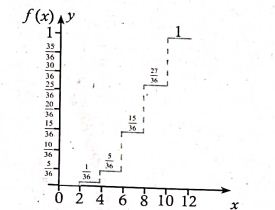
(ii) Cumulative distribution function .
F(x) = p(X ≤ x) = \(\sum_{x_i ≤ x }\)(X = xi)
P(X<2) = 0 for \(\infty\) < x < 2
\(F(2)=\frac { 1 }{ 36 } \)
\(F(4)=\frac { 1 }{ 36 } +\frac { 4 }{ 36 } =\frac { 5 }{ 36 } \)
\(F(6)=\frac { 1 }{ 36 } +\frac { 4 }{ 36 } +\frac { 10 }{ 36 } =\frac { 15 }{ 36 } \)
\(F(8)=\frac { 1 }{ 36 } +\frac { 4 }{ 36 } +\frac { 10 }{ 36 } +\frac { 12 }{ 36 } =\frac { 27 }{ 36 }\)
\(F(10)=\frac { 27 }{ 36 } +\frac { 9 }{ 36 } =\frac { 36 }{ 36 } =1\)
∵ The cumulative distribution function n
\(F(x)=\left\{\begin{array}{lll} 0 & \text { for } & x<2 \\ \frac{1}{36} & \text { for } & x \leq 2 \\ \frac{5}{36} & \text { for } & x \leq 6 \\ \frac{15}{36} & \text { for } & x \leq 8 \\ 1 & \text { for } & x \leq 10 \end{array}\right.\)
(iii) p(4≤ X < 10) = p(x = 4) + p(x = 6) + p(x = 8)
= \(\frac { 4 }{ 36 } +\frac { 10 }{ 36 } +\frac { 12 }{ 36 } +\frac { 26 }{ 36 } =\frac { 13 }{ 18 } \)
(iv) p(x ≥ 6) = p(x = 6) + p(x = 8) + p(x = 10)
= \(\frac { 10 }{ 36 } +\frac { 12 }{ 36 } +\frac { 9 }{ 36 } =\frac { 31 }{ 36 } \)
Sample space = {4 childrens}
33.
2x + 3y − z = 0, x − y − 2z = 0, 3x + y + 3z = 0
Reducing the augmented matrix to row - echelon form we get
[A|0]=\(\left[ \begin{matrix} 2 & 3 & -1 \\ 1 & -1 & -2 \\ 3 & 1 & 3 \end{matrix}|\begin{matrix} 0 \\ 0 \\ 0 \end{matrix} \right] \)
\(\overset { { R }_{ 1 }\leftrightarrow { R }_{ 2 } }{ \longrightarrow } \left[ \begin{matrix} 1 & -1 & -2 \\ 2 & 3 & -1 \\ 3 & 1 & 3 \end{matrix}|\begin{matrix} 0 \\ 0 \\ 0 \end{matrix} \right] \)
\(\overset { { R }_{ 2 }\rightarrow { R }_{ 2 }-2{ R }_{ 1 }\\ { R }_{ 3 }\rightarrow { R }_{ 3 }-3{ R }_{ 1 } }{ \longrightarrow } \left[ \begin{matrix} 1 & -1 & -2 \\ 0 & 5 & 3 \\ 0 & 4 & 9 \end{matrix}|\begin{matrix} 0 \\ 0 \\ 0 \end{matrix} \right] \)
\(\overset { { R }_{ 3 }\rightarrow { R }_{ 3 }-\frac { 4 }{ 5 } { R }_{ 2 } }{ \longrightarrow } \left[ \begin{matrix} 1 & -1 & -2 \\ 0 & 5 & 3 \\ 0 & 0 & \frac { 33 }{ 5 } \end{matrix}|\begin{matrix} 0 \\ 0 \\ 0 \end{matrix} \right] \)
Here \(\rho \)(A) = 3 and \(\rho \)[A|0] = 3
So, \(\rho \)(A) = \(\rho \)(A|0]) = 3 = Number of unknowns Hence, the system is consistent with unique solutions.
Thus, the system has trivial solution only.
x = 0, y = 0, z = 0
34.
Put \(\sqrt { \frac { x }{ a } } =y\Rightarrow 2y+\frac { 3 }{ y } =\frac { b }{ a } +\frac { 6a }{ b } \)
\(\Rightarrow \frac { { 2y }^{ 2 }+3 }{ y } =\frac { { b }^{ 2 }+{ 6a }^{ 2 } }{ ab } \)
\(\Rightarrow ab({ 2y }^{ 2 }+3)=\left( { b }^{ 2 }+{ 6a }^{ 2 } \right) y\)
\(\Rightarrow 2ab{ y }^{ 2 }+3ab-\left( { b }^{ 2 }+{ 6a }^{ 2 } \right) =0\)
\(\Rightarrow 2ab{ y }^{ 2 }-y\left( { b }^{ 2 }+{ 6a }^{ 2 } \right) +3ab=0\)
\(\Rightarrow 2ab{ y }^{ 2 }-{ b }^{ 2 }y-{ 6a }^{ 2 }+3ab=0\)
\(\Rightarrow by(2ay-b)-3a(2ay-b)=0\)
\(\Rightarrow (2ay-b)(by-3a)=0\)
\(\Rightarrow 2ay=b,\ by=3a\)
\(\Rightarrow y=\frac { b }{ 2a } ,y=\frac { 3a }{ b } \)
Case (i) When \(y=\frac { b }{ 2a } \)
\(\Rightarrow \sqrt { \frac { x }{ a } } =\frac { b }{ 2a } \Rightarrow \frac { x }{ a } =\frac { { b }^{ 2 } }{ { 4a }^{ 2 } } \Rightarrow x=\frac { { b }^{ 2 } }{ 4a } \)
Case (ii) When \(y=\frac { 3a }{ b } \)
\(\sqrt { \frac { x }{ a } } =\frac { 3a }{ b } \Rightarrow \frac { x }{ a } =\frac { 9a^{ 2 } }{ { b }^{ 2 } } \Rightarrow x=\frac { { 9a }^{ 3 } }{ { b }^{ 2 } } \)
∴ The roots are \(\frac { { b }^{ 2 } }{ 4a } ,\frac { 9a^{ 3 } }{ b^{ 2 } } \)

12th Standard Syllabus & Materials
12th Standard
TN 12th Computer Applications களப்பெயர் முறைமை (DNS) Sample Question Papers Study Material - QB365 Set A
NEW12th Standard
TN 12th Computer Applications வலையமைப்பு எடுத்துக்காட்டுகள் மற்றும் நெறிமுறைகள் Sample Question Papers Study Material - QB365 Set A
NEW12th Standard
TN 12th Computer Applications கணினி வலையமைப்பு ஓர் அறிமுகம் Sample Question Papers Study Material - QB365 Set A
NEW12th Standard
TN 12th Computer Applications PHP-உடன் MySQL-ஐ இணைத்தல் Sample Question Papers Study Material - QB365 Set A



Tamilnadu Stateboard 12th Standard Subjects
Maths

Chemistry

Physics

Biology

Computer Science

Business Maths and Statistics

Economics

Commerce

Accountancy

History

Computer Applications
Biology
Computer Technology
Computer Applications
Computer Science
Business Maths and Statistics
Commerce
Economics
Maths
Chemistry
Physics
Computer Technology
History
Accountancy

Tamil

English

French
Tamilnadu Stateboard Standards

