
 100% FREE ACCESS
12th Standard Syllabus & Materials
12th Standard
TN 12th Computer Applications மின்னணு தரவு பரிமாற்றம் Sample Question Papers Study Material - QB365 Set A
NEW12th Standard
TN 12th Computer Applications மின் - வணிக பாதுகாப்பு அமைப்புகள் Sample Question Papers Study Material - QB365 Set A
NEW12th Standard
TN 12th Computer Applications மின்னணு செலுத்தல் முறைகள் Sample Question Papers Study Material - QB365 Set A
NEW12th Standard
TN 12th Computer Applications மின் - வணிகம் Sample Question Papers Study Material - QB365 Set A
NEW12th Standard
TN 12th Computer Applications திறந்த மூல கருத்துருக்கள் Sample Question Papers Study Material - QB365 Set A
NEW12th Standard
TN 12th Computer Applications வலையமைப்பு வடமிடல் Sample Question Papers Study Material - QB365 Set A

Published on: 29/08/2020
12th Standard Mathematics English Medium Sample 2 Mark Book Back Questions (New Syllabus) 2020
Download Tamil Nadu 12th Standard Maths question papers, model tests, one-mark questions, important questions, and public exam papers in PDF format. Free study materials and answer keys for TN State Board students.
Questions + Answers key
Take MCQ Maths Test1.
2.
Let us assume that the shape of a soap bubble is a sphere. Use linear approximation to approximate the increase in the surface area of a soap bubble as its radius increases from 5 cm to 5.2 cm. Also, calculate the percentage error.
3.
Evaluate the following limit, if necessary use l ’Hôpital Rule
\(\underset { x\rightarrow 0 }{ lim } \frac { 1-cosx }{ { x }^{ 2 } } \)
4.
Using the Rolle’s theorem, determine the values of x at which the tangent is parallel to the x -axis for the following functions:
f(x) = x2 − x, x ∈ [0, 1]
5.
Construct a cubic equation with roots 1, 1 and −2
6.
Simplify \({ tan }^{ -1 }\left( tan\left( \frac { 3\pi }{ 4 } \right) \right) \)
7.
Find the value of \({ cos }^{ -1 }\left( cos\frac { \pi }{ 7 } cos\frac { \pi }{ 17 } -sin\frac { \pi }{ 7 } sin\frac { \pi }{ 17 } \right) .\)
8.
Find the rank of each of the following matrices:
\(\left[ \begin{matrix} 4 & 3 \\ -3 & -1 \\ 6 & 7 \end{matrix}\begin{matrix} 1 & -2 \\ -2 & 4 \\ -1 & 2 \end{matrix} \right] \)
9.
Find the vector and Cartesian equations of the plane passing through the point with position vector \(4\hat { i } +2\hat { j } -3\hat { k } \) and normal to vector \(2\hat { i } -\hat { j } +\hat { k } \)
10.
Show that \(cot(sin^{ -1 }x)=\frac { \sqrt { 1-x^{ 2 } } }{ x } -1\le x\le 1\)and x \(\neq \) 0
11.
Obtain the Cartesian equation for the locus of z = x + iy in each of the following cases:
|z - 4| = 16
12.
If cot-1\(\frac{1}{7}=\theta\), find the value of cos \(\theta\).
13.
Find a polynomial equation of minimum degree with rational coefficients, having 2 +√3 i as a root.
14.
Obtain the equation of the circles with radius 5 cm and touching x-axis at the origin in general form.
15.
Find a matrix A if adj(A) = \(\left[ \begin{matrix} 7 & 7 & -7 \\ -1 & 11 & 7 \\ 11 & 5 & 7 \end{matrix} \right] \).
16.
Find the area of the region bounded by the curve y = sin x and the ordinate x=0 \(x=\frac { \pi }{ 3 } \)
17.
Write the converse, inverse, and contrapositive of each of the following implication.
If x and y are numbers such that x = y, then x2 = y2
18.
Write each of the following sentences in symbolic form using statement variables p and q.
(i) 19 is not a prime number and all the angles of a triangle are equal.
(ii) 19 is a prime number or all the angles of a triangle are not equal
(iii) 19 is a prime number and all the angles of a triangle are equal
(iv) 19 is not a prime number
19.
Examine the binary operation (closure property) of the following operations on the respective sets (if it is not, make it binary)
a*b = a + 3ab − 5b2; ∀a,b∈Z
20.
In each of the following cases, determine whether the following function is homogeneous or not. If it is so, find the degree.
f(x, y) = x2y + 6x3 + 7
21.
Evaluate the following \(\int _{ 0 }^{ \pi /2 }{ { cos}^{ 7}x\quad dx } \)
22.
Evaluate the following definite integrals:
\(\int _{ 3 }^{ 4 }{ \frac { dx }{ { x }^{ 2 }-4 } } \)
23.
Find differential dy for each of the following function
y = ex2-5x+7 cos (x2 - 1)
24.
Find the differential equation of the family of parabolas y2 = 4ax, where a is an arbitrary constant.
25.
If the volume of a cube of side length x is v = x3. Find the rate of change of the volume with respect to x when x = 5 units.
26.
Find value of m so that the function y = emx is a solution of the given differential equation, y''− 5y' + 6y = 0
27.
Express each of the following physical statements in the form of differential equation.
(i) Radium decays at a rate proportional to the amount Q present.
(ii) The population P of a city increases at a rate proportional to the product of population and to the difference between 5,00,000 and the population.
(iii) For a certain substance, the rate of change of vapor pressure P with respect to temperature T is proportional to the vapor pressure and inversely proportional to the square of the temperature.
(iv) A saving amount pays 8% interest per year, compounded continuously. In addition, the income from another investment is credited to the amount continuously at the rate of Rs. 400 per year.
28.
For each of the following differential equations, determine its order, degree (if exists)
\(\sqrt { \frac { dy }{ dx } } -4\frac { dy }{ dx } -7x=0\)
29.
Find the following \(\left| \overline { (1+i) } (2+3i)(4i-3) \right| \)
30.
Find the modulus of the following complex number \(\frac { 2-i }{ 1+i } +\frac { 1-2i }{ 1-i } \)
31.
Simplify the following
\({ i }^{ 59 }+\frac { 1 }{ { i }^{ 59 } } \)
32.
Find the length of the perpendicular from the point (1, -2, 3) to the plane x - y + z = 5.
33.
Find the volume of the parallelepiped whose coterminous edges are represented by the vectors \(-6\hat { i } +14\hat { j } +10\hat { k } ,14\hat { i } -10\hat { j } -6\hat { k } \) and \(2\hat { i } +4\hat { j } -2\hat { k } \)
34.
Identify the type of conic section for each of the equations.
x2 + y2 + x − y = 0
35.
Find the rank of the following matrices which are in row-echelon form :
\(\left[ \begin{matrix} 2 & 0 & -7 \\ 0 & 3 & 1 \\ 0 & 0 & 1 \end{matrix} \right] \)
36.
If z1= 3 - 2i and z2 = 6 + 4i, find \(\frac { { z }_{ 1 } }{ z_{ 2 } } \) in the rectangular form.
37.
Find the period and amplitude of y = sin 7x
38.
If the probability that a fluorescent light has a useful life of at least 600 hours is 0.9, find the probabilities that among 12 such lights
(i) exactly 10 will have a useful life of at least 600 hours;
(ii) at least 11 will have a useful life of at I least 600 hours;
(iii) at least 2 will not have a useful life of at : least 600 hours.
1.
2.
Recall that surface area of a sphere with radius r is given by S(r) = 4\(\pi \)r3. Note that even though we can calculate the exact change using this formula, we shall try to approximate the change using the linear approximation. So, using (4), we have
Change in the surface area = S(5.2) - S(5) ≈ S'(5)(0.2)
= 8\(\pi \)(5)(0.2)
= 8\(\pi \) cm2
Exact calculation of the change in the surface gives
S(5.2) − S(5) = 108.16\(\pi \)-100\(\pi \) = cm2.
Percentage error = relative error \(\times\)100 = \(\frac { 8.16\pi -8\pi }{ 8.16\pi } \)\(\times\)100 = 1.9607%
3.
\(\underset { x\rightarrow 0 }{ lim } \frac { 1-cosx }{ { x }^{ 2 } } =\frac { 1-cos0 }{ 0 } =\frac { 1-1 }{ 0 } =\frac { 0 }{ 0 } \)
Indeterminate form, Applying L' Hopital rule we get,
\(\underset { x\rightarrow 0 }{ lim } \frac { sinx }{ 2x } =\frac { 1 }{ 2 } \underset { x\rightarrow 0 }{ lim } \frac { sinx }{ x } \)\(\left[ \because \underset { x\rightarrow 0 }{ lim } \frac { sinx }{ x } =1 \right] \)
\(=\frac { 1 }{ 2 } \times 1\)
= \(\frac12\)
4.
Given f(x) = x2 − x, x ∈ [0, 1]
(i) f(x) is continuous in [0, 1]
(ii) f(x) is differentiable in (0, 1)
(iii) f(0) = 02 - 0 = 0
f(1) = 12-1 = 1-1 = 0
∴ f(0) = f(1)
By Rolle's theorem, there exists C ∈ [0, 1] such that
f'(c) = 0
⇒ 2c - 1 = 0
⇒ 2c = 1
⇒ c = \(\frac12\) ∈ [0, 1]
5.
Here ∝ = 1, β = 1 and ૪ = -2
∴ The required cubic equation is
x3-(1+1-2)x2(1-2-2)x-(1)(1)(-2) = 0
x3- 0x2-3x+2 = 0
x3-3x-2 = 0
6.
tan-1\((tan(\frac{3\pi}{4})\)
Observe that \(\frac{3\pi}{4}\) is not in the interval \(\left( -\frac { \pi }{ 2 } ,\frac { \pi }{ 2 } \right) \), the principal range of tan-1 x.
So, we write \(\frac{3\pi}{4}=\pi-\frac{\pi}{4}\)
Now, \(tan\left( \frac { 3\pi }{ 4 } \right) =tan\left( \pi -\frac { \pi }{ 4 } \right) =-tan\frac { \pi }{ 4 } =tan\left( -\frac { \pi }{ 4 } \right) and-\frac { \pi }{ 4 } \left( -\frac { \pi }{ 2 } ,\frac { \pi }{ 2 } \right) \)
Hence, \({ tan }^{ -1 }\left( tan\left( \frac { 3\pi }{ 4 } \right) \right) ={ tan }^{ -1 }\left( tan\left( -\frac { \pi }{ 4 } \right) \right) =-\frac { \pi }{ 4 } ,since-\frac { \pi }{ 4 } \in \left( -\frac { \pi }{ 2 } ,\frac { \pi }{ 2 } \right) \)
7.
\({ cos }^{ -1 }\left( cos\frac { \pi }{ 7 } cos\frac { \pi }{ 17 } -sin\frac { \pi }{ 17 } sin\frac { \pi }{ 17 } \right) .\)
\({ cos }^{ -1 }\left( cos\left( \frac { \pi }{ 7 } +\frac { \pi }{ 17 } \right) \right) \)
\(\left[ \therefore cosA\ cosB-sinA\ sinB=cos(A+B) \right] \)
= \({ cos }^{ -1 }\left( cos\left( \frac { 24\pi }{ 119 } \right) \right) \) \(\left[ \therefore \frac { 24\pi }{ 119 } \varepsilon \left[ 0,\pi \right] \right] \)
= \(\frac { 24\pi }{ 119 } \)
8.
Let A = \(\left[ \begin{matrix} 4 & 3 \\ -3 & -1 \\ 6 & 7 \end{matrix}\begin{matrix} 1 & -2 \\ -2 & 4 \\ -1 & 2 \end{matrix} \right] \). Then A is a matrix of order 3 \(\times\) 4. So ρ(A) ≤ min {3, 4} = 3.
The highest order of minors of A is 3. We search for a non-zero third-order minor of A. But we find that all of them vanish. In fact, we have
\(\left| \begin{matrix} 4 & 3 & 1 \\ -3 & -1 & -2 \\ 6 & 7 & -1 \end{matrix} \right| \) = 0; \(\left| \begin{matrix} 4 & 3 & -2 \\ -3 & -1 & 4 \\ 6 & 7 & 2 \end{matrix} \right| \) = 0; \(\left| \begin{matrix} 4 & 1 & -2 \\ -3 & -2 & 4 \\ 6 & -1 & 2 \end{matrix} \right| \) = 0; \(\left| \begin{matrix} 3 & 1 & -2 \\ -1 & -2 & 4 \\ 7 & -1 & 2 \end{matrix} \right| \) = 0.
So, ρ(A) < 3. Next, we search for a non-zero second-order minor of A.
We find that \(\left| \begin{matrix} 4 & 3 \\ -3 & -1 \end{matrix} \right| \) = -4 + 9 = 5 ≠ 0. So, ρ(A) = 2.
9.
If the position vector of the given point is \(\vec { a } =4\hat { i } +2\hat { j } -3\hat { k } \) and \(\vec { n } =2\hat { i } -\hat { j } +\hat { k } \), then the equation of the plane passing through a point and normal to a vector is given by \((\vec { r } -\vec { a } ).\vec { n } =0\) or \(\vec { r } .\vec { n } =\vec { a } .\vec { n } \)
Substituting \(\vec { a } =4\hat { i } +2\hat { j } -3\hat { k } \) and \(\vec { n } =2\hat { i } -\hat { j } +\hat { k } \) in the above equation, we get
\(\vec { r } .(2\hat { i } -\hat { j } +\hat { k } )=(4\hat { i } +2\hat { j } -3\hat { k } ).(2\hat { i } -\hat { j } +\hat { k } )\)
Thus, the required vector equation of the plane is \(\vec { r } .(2\hat { i } -\hat { j } +\hat { k } )\)= 3. If \(\vec { r } =x\hat { i } +y\hat { j } +z\hat { k } \) then
we get the Cartesian equation of the plane 2x − y + z = 3.
10.
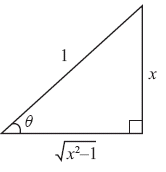
Let sin−1= \(\theta\). Then, x = sin\(\theta\) and x \(\neq\) 0, we get \(\theta \in\left[\frac{-\pi}{2}, 0\right) \cup\left(0, \frac{\pi}{2}\right]\)
Hence, \(\cos \theta \geq 0 \text { and } \)\(\cos \theta=\sqrt{1-\sin ^{2} \theta}=\)\( \sqrt { 1-x^{ 2 } } \)
Thus, \(cot(sin^{ -1 }x)=cot\theta =\frac { \sqrt { 1-x^{ 2 } } }{ x } ,|x|\le1\ and\ x\neq0\)
11.
|z-4| = 16
Given z = x + iy
|z - 4| = 16
⇒ |x + iy - 4| = 16
⇒ |(x- 4) + iy| = 16
⇒ \(\\ \sqrt { (x-4)^{ 2 }+{ y }^{ 2 } } \) = 16
⇒ (x - 4)2 + y2 = 162
[Squaring both sides]
⇒ x2-8x + 16 + y2 = 256
⇒ x2-8x + y2+ 16-256 = 0
⇒ x2-8x + y2-240 = 0 Which is the required Cartesian equation.
The locus of the point is a circle.
12.
By definition, cot-1x\(\in(0,\pi)\)
Therefore, cot-1\((\frac{1}{7})\) = \(\theta\) implies \(\theta \in(0,\pi)\)
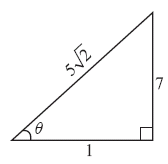
But cot-1\((\frac{1}{7})\) = \(\theta\) implies cot \(\theta\) = \(\frac{1}{7}\) and hence tan \(\theta\) = 7 and \(\theta\) is acute.
Using tan \(\theta\) = \(\frac{7}{1}\), We construct a right triangle as shown .
Then, we have, cos \(\theta\) = \(\frac{1}{5\sqrt2}\).
13.
Since \(2+i\sqrt { 3 } \) is a root of the polynomial equation, its conjugate 2-i\(\sqrt3\) is also a root of the equation:
∴ Sum of the roots \(=2+i\sqrt { 3 } +2-i\sqrt { 3 } =4\)
Product of the roots \(=(2+i\sqrt { 3 } )(2-i\sqrt { 3 } )\)
\(={ 2 }^{ 2 }+{ (\sqrt { 3 } })^{ 2 }\)
\([\because (a+ib)(a-ib)={ a }^{ 2 }+{ b }^{ 2 }]\)
= 4 + 3 = 7
Hence, the polynomial equation of minimum degree with rational co-efficients is
x2 - x (sum of the roots) + product of the roots = 0
\(\Rightarrow { x }^{ 2 }-x(4)+7=0\)
\(\Rightarrow { x }^{ 2 }-4x+7=0\)
14.
Given r = 5 cm

Since the circle touches the x axis, its centre is (0, ±5)
Equation of the circle is (x - h)2 + (y - k)2 = r2
⇒ (x - 0)2 + (y ± 5)2 = 25
\(\Rightarrow x^{2}+y^{2}+\not 25 \pm 10 y=\not 25\)
⇒ x2+y2+10y = 0
15.
First, we find |adj (A)| = \(\left| \begin{matrix} 7 & 7 & -7 \\ -1 & 11 & 7 \\ 11 & 5 & 7 \end{matrix} \right| \) = 7(77 - 35) - 7(-7 - 77) - 7(-5 - 121) = 1764 > 0
So, we get
A = \(\pm \frac { 1 }{ \sqrt { \left| adjA \right| } } \) adj(adj A) = \(\pm \frac { 1 }{ \sqrt { 1764 } } { \left[ \begin{matrix} +\left( 77-35 \right) & -\left( -7-77 \right) & +\left( -5-121 \right) \\ -\left( 49+35 \right) & +\left( 49+77 \right) & -\left( 35-77 \right) \\ +\left( 49+77 \right) & -\left( 49-7 \right) & +\left( 77+7 \right) \end{matrix} \right] }^{ T }\)
= \(\pm \frac { 1 }{ 42 } { \left[ \begin{matrix} 42 & 84 & -126 \\ -84 & 126 & 42 \\ 126 & -42 & 84 \end{matrix} \right] }^{ T }=\pm \left[ \begin{matrix} 1 & -2 & 3 \\ 2 & 3 & -1 \\ -3 & 1 & 2 \end{matrix} \right] \).
16.
\(\frac { 1 }{ 2 } \)
17.
If x and y are numbers such that x = y, then x2 = y2
Converse statement :
If x and y are numbers such that x2 = y2 then x = y
Inverse statement :
If x and y are numbers such that x ≠ y then x2 ≠ y2
Contrapositive statement :
If x and y are numbers such that x2≠ y2 then x ≠ y
18.
Let p: 19 is a prime number.
q: All the angles of a triangle are equal be two simple statements.
(i) 19 is not a prime number and all the angles of a triangle are equal.
~p ∧ q
(ii) 19 is a prime number or all the angles of a triangle are not equal.
p ∧ ~q
(iii) 19 is a prime number and all the angles of a triangle are equal.
p ∧ q
(iv) 19 is not a prime number.
~p.
19.
Since × is binary operation on Z, a,b ∈ Z⇒ a × b = ab∈Z and b × b = b2∈Z ...(1)
The fact that + is binary operation on Z and (1) ⇒ 3ab = (ab + ab + ab) ∈Z and 5b2= (b2+b2+b2+b2+b2)∈Z ...(2)
Also a∈Z and 3ab ∈Z implies a+3ab∈Z ...(3)
(2),(3), the closure property of -on Z yield a * b = (a+3ab-5b2)∈Z. Since a * b belongs to Z, * is a binary operation on Z.
20.
Given f(x, y) = x2y + 6x3 + 7
f(λx, λy) = λ2x2λy + 6λ3x3 + 7
= λ3 x2 y + 6λ3 x3 + 7
≠ λf(x, y)
There is no common λ in this equation.
It is not homogeneous
21.
\({ I }_{ n }=\int _{ 0 }^{ \pi /2 }{ { cos }^{ 7 }xdx=\frac { n-1 }{ n } { I }_{ n-2 },n\ge 2 } \)
\(\therefore { I }_{ 7 }=\int _{ 0 }^{ \pi /2 }{ { cos }^{ 7 }xdx=\frac { 6 }{ 7 } \times \frac { 4 }{ 5 } \times \frac { 2 }{ 3 } \times 1 } =\frac { 16 }{ 35 } \)
22.
\(\int _{ 3 }^{ 4 }{ \frac { dx }{ { x }^{ 2 }-4 } } \)
\(\int _{ 3 }^{ 4 }{ \frac { dx }{ { x }^{ 2 }-4 } } =\int _{ 3 }^{ 4 }{ \frac { dx }{ { x }^{ 2 }-{ 2 }^{ 2 } } } \)
\(\left[ \because \int { \frac { dx }{ { x }^{ 2 }-{ a }^{ 2 } } } =\frac { 1 }{ 2a } log\left| \frac { x-a }{ x+a } \right| +c\right] \)
\(=\frac { 1 }{ 4 } \left[ log\left( \frac { 4-2 }{ 4+2 } \right) -log\left( \frac { 3-2 }{ 3+2 } \right) \right] \)
\(=\frac { 1 }{ 4 } log\left[ \left( \frac { 2 }{ 6 } \right) - log \ \frac { 1 }{ 5 } \right] \\ =\frac { 1 }{ 4 } log\left( \frac { 1 }{ 3 } \times 5 \right) \)
\(=\frac { 1 }{ 4 } log\left( \frac { 5 }{ 3 } \right) \)
23.
Given y = ex2-5x+7 cos (x2 - 1)
Taking differentials,
dy = (ex2-5x+7 (-sin (x2 - 1)(2x)) +cos (x2 - 1) ex2-5x+7 (2x - 5) dx
= ex2-5x+7 [(2x - 5)cos (x2 - 1) - 2x sin (x2 - 1)]dx
24.
The equation of the family of parabolas is given by y2 ax = 4, a is an arbitrary constant. ... (1)
Differentiating both sides of (1) with respect to x , we get 2y\(\frac{dy}{dx}=4a\Rightarrow a=\frac{y}{2}\frac{dy}{dx}\)
Substituting the value of a in (1) and simplifying, we get \(\frac{dy}{dx}=\frac{y}{2x}\) as the required differential equation.
25.
Given v = x3
Differentiating with respect to x we get,
\(\frac { dv }{ dt } \) = 3x2
When x = 5, \(\frac { dv }{ dt } \) = 3(52) = 75
∴ \(\frac { dv }{ dt } \) when x = 5 is 75 units.
26.
y''− 5y' + 6y = 0 ......(1)
Given y = emx .....(2)
Differentiating cquation (2) w.r.t 'x', we get
\(\frac{dy}{dx} = em^x . m\)
To find the value of m:
Given y" - 5y' + 6y = 0
emx . m2 -5emx+ 6emx = 0
emx [m- 5m +6] = 0
m - 5m + 6 = 0
(m - 3) (m - 2) = 0
m = 3, 2
27.
(i) If at any time t, The amount of Radium present is Q. The rate at which Q is decreasing \(\frac { dQ }{ dt } \).
This rate of decrease or decay is found to be proportional to Q itself. Hence we have the law, \(\frac { dQ }{ dt } = kQ\). where k is the dt constant of proportionality. Which is a required differential equation.
(ii) The rate of change of population Solution increases with respect to time t, is \(\frac { dp }{ dt } \) & the rate of population is proportional| the product of population is \(\frac { dp }{ dt } \) = kP & the also the difference between 5,00,000 & the population is \(\frac { dp }{ dt } \) = kP (5,00,000 - P) is a required differential equation.
(iii) The rate of change of vapor pressure P with respect to time t is \(\frac { dp }{ dt } \)& the rate of dt increase vapor pressure is P at time T is proportional to the vapor pressure and also is inversely proportional to the square of the temperature is \(\frac { dp }{ dt } \)\(\infty\) P and \(\frac { dp }{ dt } \infty\frac{1}{T^2}\)
Combining the two, we get
\(\frac { dp }{ dt } \infty\frac{p}{T^2} \Rightarrow \frac { dp }{ dt }= k(\frac{p}{T^2})\), where 'k' is constantof proportionality
(iv) Let x be the amount. Amount varies from every year. (ie) Amount varies with respect to time t is \(\frac { dp }{ dt } \) & in addition the income from other source credited Rs. 400 continuously for every year.
\(\frac { dx }{ dt } = \frac{8}{100}\times x + 400\)
\(\Rightarrow\frac{dx}{dt} = \frac{2x}{25}+400\) is a required differential equation.
28.
\(\sqrt { \frac { dy }{ dx } } -4\frac { dy }{ dx } -7x=0\)
The given differential equation is
\(\sqrt { \frac { dy }{ dx } } =4\frac { dy }{ dx } +7x\)
Squaring both sides,
\(\frac { dy }{ dx } =\quad { \left( 4\frac { dy }{ dx } +7x \right) }^{ 2 }\)
\(16{ \left( \frac { dy }{ dx } \right) }^{ 2 }+{ 49 }x^{ 2 }+56x{ \left( \frac { dy }{ dx } \right) }\)
The highest derivative is 1 and its maximum power is 2.
∴ Order 1, degree 2.
29.
\(\left| \left( \overline { 1+i } \right) \left( 2+3i \right) \left( 4i-3 \right) \right| =\left| \left( \overline { 1+i } \right) \right| \left| 2+3i \right| \left| 4i-3 \right| \) (\(\because \) |z1z2z3|=|z1|z2||z3|)
= |1+i| |2+3i| |-3+4i| \(\left( \because |z|=\left| \overline { z } \right| \right) \)
= \(\left( \sqrt { { 1 }^{ 2 }+{ 1 }^{ 2 } } \right) \left( \sqrt { { 2 }^{ 2 }+{ 3 }^{ 2 } } \right) \left( \sqrt { \left( 3 \right) ^{ 2 }+{ 4 }^{ 2 } } \right) \).
\(=(\sqrt{2})(\sqrt{13})(\sqrt{25})=5 \sqrt{26}\)
30.
\(\frac { 2-i }{ 1+i } +\frac { 1-2i }{ 1-i } \)
Let z = \(\frac { 2-i }{ 1+i } +\frac { 1-2i }{ 1-i } \)
= \(\frac { (2-i)(1-i)+(1-2i)(1+i) }{ (1+i)(1-i) } \)
= \(\frac { 2-2i-i+{ i }^{ 2 }+1+i-2i-2i^{ 2 } }{ { 1 }^{ 2 }-{ i }^{ 2 } } \)
= \(\\ \frac { 2-i-1+1-i+2 }{ 2 } =\frac { 4-4i }{ 2 } \)
= \(\frac { 2(2-2i) }{ 2 } \) = 2 - 2i
∴ |z| = \(\sqrt { { 2 }^{ 2 }+(-2)^{ 2 } } =\sqrt { 4+4 } =\sqrt { 8 } =2\sqrt { 2 } \)
31.
\({ i }^{ 59 }+\frac { 1 }{ { i }^{ 59 } } \)
i4 \(\times\) 14 + 3 + i-(4 \(\times\) 14 + 3)
= (i4)14.i3 + (i4)-14.i-3
= 1.i3+1.i-3 [∵ i4 = 1]
= -i + i [∴ i3 = -i and i-3= i]
= 0
32.
Length of perpendicular from \(\left( { x }_{ 1 },{ y }_{ 1 },{ z }_{ 1 } \right) \) to the plane.
\(ax+by+cz-p=0\left| \frac { { ax }_{ 1 }+{ by }_{ 1 }+{ cz }_{ 1 }-p }{ \sqrt { { a }^{ 2 }+{ b }^{ 2 }+{ c }^{ 2 } } } \right| \)
\(\therefore \) Length of perpendicular from (1, -2, 3) to the plane
\(x-y-z-5=0\ is\ \delta =\left| \frac { 1-(-2)+3-5 }{ \sqrt { { 1 }^{ 2 }+\left( -1 \right) ^{ 2 }+{ 1 }^{ 2 } } } \right| \)
= \(\left| \frac { 1+2+3-5 }{ \sqrt { 1+1+1 } } \right| =\left| \frac { 1 }{ \sqrt { 3 } } \right| \)
= \(\frac { 1 }{ \sqrt { 3 } } \)
33.
Let \(\vec { a } =-6\hat { i } +14\hat { j } +10\hat { k } \), \(\vec { b } =14\hat { i } -10\hat { j } -6\hat { k } \) and \(\vec { c } =2\hat { i } +4\hat { j } -2\hat { k } \)
Volume of the parallelepiped having \(\vec { a } ,\vec { b } \) and \(\vec { c } \) as its co-terminus edges is \(\vec { a } .(\vec { b } \times \vec { c } )\).
∴ \(\vec { a } .(\vec { b } \times \vec { c } )=\left| \begin{matrix} -6 & 14 & 10 \\ 14 & -10 & -6 \\ 2 & 4 & -2 \end{matrix} \right| \)
= \(-6\left| \begin{matrix} -10 & -6 \\ 4 & -2 \end{matrix} \right| -14\left| \begin{matrix} 14 & -6 \\ 2 & -2 \end{matrix} \right| +10\left| \begin{matrix} 14 & -10 \\ 2 & 4 \end{matrix} \right| \)
= -6(20 + 24) - 14(-28 + 12) + 10(56 + 20)
= -6(44) -14(-16) + 10(76)
= -264 + 224 + 760 = 720.
∴ Volume of the required parallelepiped = 720 cubic units.
34.
Here A = 1, B = 0, C = 1, D = 1, E = -1
Here A = C and B = 0 there i no xy term.
Hence, the given equation represent a circle.
35.
Let A = \(\left[ \begin{matrix} 2 & 0 & -7 \\ 0 & 3 & 1 \\ 0 & 0 & 1 \end{matrix} \right] \). Then A is a matrix of order 3 × 3 and ρ(A) ≤ 3
The third order minor |A| = \(\left| \begin{matrix} 2 & 0 & -7 \\ 0 & 3 & 1 \\ 0 & 0 & 1 \end{matrix} \right| \) = (2)(3)(1) = 6 ≠ 0. So, ρ(A) = 3.
Note that there are three non-zero rows.
36.
Using the given value for z1 and z2 the value of \(\frac { { z }_{ 1 } }{ { z }_{ 2 } } =\frac { 3-2i }{ 6+4 } =\frac { 3-2i }{ 6+4i } \times \frac { 6-4i }{ 6-4i } \)
= \(\frac { \left( 18-8 \right) +i\left( 12-12 \right) }{ { 6 }^{ 2 }+{ 4 }^{ 2 } } =\frac { 10-24i }{ 52 } =\frac { 10 }{ 52 } =\frac { 24i }{ 52 } \)
= \(\frac { 5 }{ 26 } -\frac { 6 }{ 13 } i\)
37.
The amplitude of sin x is 1 [Max of sin x curve is 1]
\(\Rightarrow \) amplitude of sin 7x is also 1
If p is the period of the function,
then f(x+p) = f(x)
Since the period of sine function is \(2\pi \)
The period of sin is \(\frac { 2\pi }{ 7 } \)
amplitude = 1
38.
Given n = 12
P = 0.9
(i) P(X = 10) = 12C10(0.9)10(1 - 0.9)2
= 12C10(0.9)10 (0.1)2
(ii) P(X 2: 11) = R(X = 11) + P(X = 12)
= 12C11(0.9)11 (0.1) + 12C12(0.9)12(0.1)6
= 12C (0.9)11 (0.1) + (0.9)12
= 12(0.9)11 (0.1) + (0.9)12
= (0.9)11 ((12)(0.1) + 0.9)
= (0.9)11 (1.2 + 0.9) = (0.9)11 (2.1)
(iii) P( at least 2 will not have a useful life of atleast 600 hours) = 1 - P( atleast 11 will have a useful life of atleast 600 hours)
= 1 - P(X ≥11)
= 1-2.1 (0.9)11

12th Standard Syllabus & Materials
12th Standard
TN 12th Computer Applications களப்பெயர் முறைமை (DNS) Sample Question Papers Study Material - QB365 Set A
NEW12th Standard
TN 12th Computer Applications வலையமைப்பு எடுத்துக்காட்டுகள் மற்றும் நெறிமுறைகள் Sample Question Papers Study Material - QB365 Set A
NEW12th Standard
TN 12th Computer Applications கணினி வலையமைப்பு ஓர் அறிமுகம் Sample Question Papers Study Material - QB365 Set A
NEW12th Standard
TN 12th Computer Applications PHP-உடன் MySQL-ஐ இணைத்தல் Sample Question Papers Study Material - QB365 Set A



Tamilnadu Stateboard 12th Standard Subjects
Maths

Chemistry

Physics

Biology

Computer Science

Business Maths and Statistics

Economics

Commerce

Accountancy

History

Computer Applications
Biology
Computer Technology
Computer Applications
Computer Science
Business Maths and Statistics
Commerce
Economics
Maths
Chemistry
Physics
Computer Technology
History
Accountancy

Tamil

English

French
Tamilnadu Stateboard Standards

