
 100% FREE ACCESS
12th Standard Syllabus & Materials
12th Standard
TN 12th Computer Applications மின்னணு தரவு பரிமாற்றம் Sample Question Papers Study Material - QB365 Set A
NEW12th Standard
TN 12th Computer Applications மின் - வணிக பாதுகாப்பு அமைப்புகள் Sample Question Papers Study Material - QB365 Set A
NEW12th Standard
TN 12th Computer Applications மின்னணு செலுத்தல் முறைகள் Sample Question Papers Study Material - QB365 Set A
NEW12th Standard
TN 12th Computer Applications மின் - வணிகம் Sample Question Papers Study Material - QB365 Set A
NEW12th Standard
TN 12th Computer Applications திறந்த மூல கருத்துருக்கள் Sample Question Papers Study Material - QB365 Set A
NEW12th Standard
TN 12th Computer Applications வலையமைப்பு வடமிடல் Sample Question Papers Study Material - QB365 Set A

Published on: 21/02/2020
12th Standard Mathematics Public Exam Model Question Paper III 2019 - 2020
Download Tamil Nadu 12th Standard Maths question papers, model tests, one-mark questions, important questions, and public exam papers in PDF format. Free study materials and answer keys for TN State Board students.
Questions + Answers key
Take MCQ Maths Test1.
A commuter train arrives punctually at a station every half hour. Each morning, a student leaves his house to the train station. Let X denote- the amount of time, in minutes that the student waits for the train from the time he reaches the train station. It is known that the pdf of X is
\(f(x)= \begin{cases}\frac{1}{30} & 0<x<30 \\ 0 & \text { elsewhere }\end{cases}\)
Obtain and interpret the expected value of therandom variable X.
2.
If w(x, y, z) = x2 y + y2z + z2x, x, y, z∈R, find the differential dw .
3.
Compute the value of 'c' satisfied by Rolle’s theorem for the function \(f(x)=log(\frac{x^{2}+6}{5x})\) in the interval [2, 3]
4.
If \(\overset { \rightarrow }{ a } =\overset { \wedge }{ i } -\overset { \wedge }{ j } ,\overset { \rightarrow }{ b } =\overset { \wedge }{ j } -\overset { \wedge }{ k } ,\overset { \rightarrow }{ c } =\overset { \wedge }{ k } -\overset { \wedge }{ i } \) then find \(\left[ \overset { \rightarrow }{ a } -\overset { \rightarrow }{ b } ,\overset { \rightarrow }{ b } -\overset { \rightarrow }{ c } ,\overset { \rightarrow }{ c } -\overset { \rightarrow }{ a } \right] \)
5.
For what value of t will the system tx +3y - z = 1, x + 2y + z = 2, -tx + y + 2z = -1 fail to have unique solution?
6.
Solve: (x-1)4+(x-5)4 = 82
7.
If α, β and γ are the roots of the cubic equation x3+2x2+3x+4 = 0, form a cubic equation whose roots are, 2α, 2β, 2γ
8.
Solve \(\left( x+2 \right) \frac { dy }{ dx } =x2+4x-9\) .Also find the domain of the function.
9.
Find the area of the region common to the circle x2+y2=16 and the parabola y2=6x.
10.
Prove that f(x, y) = x3 - 2x2y + 3xy2 + y3 is homogeneous; what is the degree? Verify Euler's Theorem for f.
11.
If X is the random variable with distribution function F(x) given by,
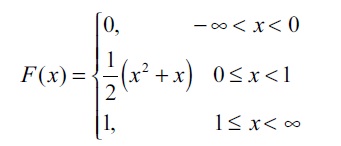
then find (i) the probability density function f(x)
(ii) P(0.3 ≤ X ≤ 0.6)
12.
The equation of electromotive force for an electric circuit containing resistance and self inductance is E = Ri + L\(\frac{di}{dt},\) Where E is the electromotive force is given to the circuit, R the resistance and L, the coefficient of induction. Find the current i at time t when E = 0.
13.
Using the l’Hôpital Rule prove that, \(\underset{x\rightarrow 0^{+}}{lim}(1+x)^{\frac{1}{x}}=e\)
14.
Solve the Linear differential equation:
\(\frac { dy }{ dx } =\frac { { sin }^{ 2 }x }{ 1+{ x }^{ 3 } } -\frac { { 3x }^{ 2 } }{ 1+{ x }^{ 3 } } y\)
15.
If \(\left| \overset { \rightarrow }{ A } \right| =\overset { \wedge }{ i } +\overset { \wedge }{ j } +\overset { \wedge }{ k } \) and \(\overset { \wedge }{ i } =\overset { \wedge }{ j } -\overset { \wedge }{ k } \) are two given vector, then find a vector B satisfying the equations \(\overset { \rightarrow }{ A } \times \overset { \rightarrow }{ B } \)= \(\overset { \rightarrow }{ C } \) and \(\overset { \rightarrow }{ A } \).\(\overset { \rightarrow }{ B } \) = 3
16.
Show that \(\left( \frac { i+\sqrt { 3 } }{ -i+\sqrt { 3 } } \right) ^{ 2\omega }+\left( \frac { i-\sqrt { 3 } }{ i+\sqrt { 3 } } \right) ^{ 2\omega }\) = -1
17.
The foci of a hyperbola coincides with the foci of the ellipse \(\frac { { x }^{ 2 } }{ 25 } +\frac { y^{ 2 } }{ 9 } =1\). Find the equation of the hyperbola if its eccentricity is 2.
18.
Write the function \(f(x)=\tan ^{-1} \sqrt{\frac{a-x}{a+x}}-a<x<a \)
19.
Solve: \({ tan }^{ -1 }\left( \cfrac { x-1 }{ x-2 } \right) +{ tan }^{ -1 }\left( \cfrac { x+1 }{ x+2 } \right) =\cfrac { \pi }{ 4 } \)
20.
For what value of λ, the system of equations x + y + z = 1, x + 2y + 4z = λ, x + 4y + 10z = λ2 is consistent.
21.
Solve the equation (x-2) (x-7) (x-3) (x+2)+19 = 0
22.
Determine the domain of convexity of the function y=ex
23.
Find the area of the region enclosed by the curve y = \(\sqrt x\) + 1, the axis of x and the lines x = 0, x = 4.
24.
Find the locus of a point which divides so that the sum of its distances from (-4, 0) and (4, 0) is 10 units.
25.
Find the rank of the matrix A =\(\left[ \begin{matrix} 4 \\ 7 \end{matrix}\begin{matrix} 5 \\ -3 \end{matrix}\begin{matrix} -6 \\ 0 \end{matrix}\begin{matrix} 1 \\ 8 \end{matrix} \right] \).
26.
Find the Interval for a for which 3x2+2(a2+1) x+(a2-3a+2) possesses roots of opposite sign.
27.
Find the acute angle between the following lines
2x = 3y = −z and 6x = − y = −4z.
28.
Find the principal value of sec−1(−2).
29.
Simplify the following:
i 1729
30.
Identify the type of the conic for the following equations:
(1) 16y2 = −4x2+64
(2) x2+y2 = −4x−y+4
(3) x2−2y = x+3
(4) 4x2−9y2−16x+18y−29 = 0
31.
The differential equation associated with the family of concentric circles having their centres at the origin is _________.
\(\frac { dy }{ dx } =\frac { -x }{ y } \)
\(\frac { dy }{ dx } =\frac { -y }{ x } \)
\(\frac { dy }{ dx } =\frac { x }{ y } \)
\(\frac { dy }{ dx } =\frac { y }{ x } \)
32.
The identity element in the group {R - {1},x} where a * b = a + b - ab is __________
0
1
\(\frac { 1 }{ a-1 } \)
\(\frac { a }{ a-1 } \)
33.
The value of \(\int _{ 0 }^{ \frac { \pi }{ 3 } } { tan } x \ dx\) __________
-log 2
log 2
-log 3
log 3
34.
If the radius of the sphere is measured as 9 cm with an error of 0.03 cm, the approximate error in calculating its volume is _____________
9.72 cm3
0.972 cm3
0.972π cm3
9.72π cm3
35.
\(\underset { x\rightarrow 0 }{ lim } \frac { x }{ tanx } \) is _________
1
-1
0
∞
36.
Determine the truth value of each of the following statements:
(a) 4 + 2 = 5 and 6 + 3 = 9
(b) 3 + 2 = 5 and 6 + 1 = 7
(c) 4 + 5 = 9 and 1 + 2 = 4
(d) 3 + 2 = 5 and 4 + 7 = 11
| (a) | (b) | (c) | (d) |
| F | T | F | T |
| (a) | (b) | (c) | (d) |
| T | F | T | F |
| (a) | (b) | (c) | (d) |
| T | T | F | F |
| (a) | (b) | (c) | (d) |
| F | F | T | T |
37.
Linear approximation for g(x) = cos x at \(x=\frac{\pi}{2}\) is
\(x+\frac{\pi}{2}\)
\(-x +\frac{\pi}{2}\)
\(x - \frac{\pi}{2}\)
\(-x - \frac{\pi}{2}\)
38.
The value of \(\int _{ -4 }^{ 4 }{ \left[ { tan }^{ -1 }\left( \frac { { x }^{ 2 } }{ { x }^{ 4 }+1 } \right) +{ tan }^{ -1 }\left( \frac { { x }^{ 4 }+1 }{ { x }^{ 2 } } \right) \right] dx } \) is
\(\pi\)
\(2\pi\)
\(3\pi\)
\(4\pi\)
39.
If the function \(f(x)=\frac { 1 }{ 12 } \) for a < x < b, represents a probability density function of a continuous random variable X, then which of the following cannot be the value of a and b?
0 and 12
5 and 17
7 and 19
16 and 24
40.
The integrating factor of the differential equation \(\frac{d y}{d x}+P(x) y=Q(x)\) is x, then P(x)
x
\(\frac { { x }^{ 2 } }{ 2 } \)
\(\frac{1}{x}\)
\(\frac{1}{x^2}\)
41.
42.
If a = cos θ + i sin θ, then \(\frac { 1+a }{ 1-a } \) = ___________
cot \(\frac { \theta }{ 2 } \)
cot θ
i cot \(\frac { \theta }{ 2 } \)
i tan\(\frac { \theta }{ 2 } \)
43.
If \({ sin }^{ -1 }x-cos^{ -1 }x=\frac { \pi }{ 6 } \) then ___________
\(\frac { 1 }{ 2 } \)
\(\frac { \sqrt { 3 } }{ 2 } \)
\(\frac { -1 }{ 2 } \)
none of these
44.
If A = [2 0 1] then the rank of AAT is ______
1
2
3
0
45.
If ax2 + bx + c = 0, a, b, c \(\in\) R has no real zeros, and if a + b + c < 0, then __________
c>0
c<0
c=0
c≥0
46.
If 0 ≤ θ ≤ π and the system of equations x + (sinθ)y - (cosθ)z = 0, (cosθ)x - y +z = 0, (sinθ)x + y - z = 0 has a non-trivial solution then θ is
\(\frac { 2\pi }{ 3 } \)
\(\frac { 3\pi }{ 4 } \)
\(\frac { 5\pi }{ 6 } \)
\(\frac { \pi }{ 4 } \)
47.
48.
49.
The equation \(\tan ^{-1} x-\cot ^{-1} x=\tan ^{-1}\left(\frac{1}{\sqrt{3}}\right)\)has
no solution
unique solution
two solutions
infinite number of solutions
50.
If f and g are polynomials of degrees m and n respectively, and if h(x) = (f o g)(x), then the degree of h is
mn
m+n
mn
nm
1.
Expected value = \(\mu=\int_{-\infty}^{\infty} x f(x) d x=\int_{-\infty}^0 x(0) d x+\int_0^{30} \frac{x}{30} d x+\int_{30}^{\infty} x(0) d x\)
\(=\int_0^{30} \frac{x}{30} d x=\frac{1}{60}\left[x^2\right]_0^{30}=15\)
Average delay is 15 minutes.
2.
First let us find wx, wy, and wz
Now wx = 2xy + z2, wy = 2yz +x2 and wz = 2zx + y2.
Thus,by (15), the differential is
dw = (2xy + z2 )dx + (2yz + x2 )dy+ (2zx + y2 )dz.
3.
Observe that, f (2) = 0 = f (3) and f (x) is continuous in the interval [2, 3] and differentiable in (2, 3). Now,
\(f'(x)=\frac{x^{2}-6}{x(x^{2}+6)} \)
Therefore, \(f'{(c)}=0\) gives
\(\frac{c^{2}-6}{c(c^{2}+6)}=0\)
which implies \( c=\pm\sqrt{6}\)
Now c = \(\pm\sqrt{6} \in (2,3).\)
Observe that \(-\sqrt{6}\notin (2,3)\) and hence \(c=\pm\sqrt{6}\) satisfies the Rolle’s theorem.
Rolle’s theorem can also be used to compute the number of roots of an algebraic equation in an interval without actually solving the equation.
4.
\(\overset { \rightarrow }{ a } -\overset { \rightarrow }{ b } \)= \(\overset { \rightarrow }{ a } -\overset { \rightarrow }{ b } =\left( \overset { \wedge }{ i } -\overset { \wedge }{ j } \right) -\left( \overset { \wedge }{ j } -\overset { \wedge }{ k } \right) =\left( \overset { \wedge }{ i } +\overset { \wedge }{ k } \right) \)
\(\overset { \rightarrow }{ b } -\overset { \rightarrow }{ c } =\left( \overset { \wedge }{ j } -\overset { \wedge }{ k } \right) -\left( \overset { \wedge }{ k } -\overset { \wedge }{ i } \right) =\overset { \wedge }{ i } +\overset { \wedge }{ j } -2\overset { \wedge }{ k } \)
\(\overset { \rightarrow }{ c } -\overset { \rightarrow }{ a } =\left( \overset { \wedge }{ k } -\overset { \wedge }{ i } \right) -\left( \overset { \wedge }{ i } -\overset { \wedge }{ j } \right) =-2\overset { \wedge }{ i } +\overset { \wedge }{ j } +\overset { \wedge }{ k } \)
\(\therefore \left[ \overset { \rightarrow }{ a } -\overset { \rightarrow }{ b } ,\overset { \rightarrow }{ b } -\overset { \rightarrow }{ c } ,\overset { \rightarrow }{ c } -\overset { \rightarrow }{ a } \right] =\left| \begin{matrix} 1 \\ 1 \\ -2 \end{matrix}\begin{matrix} 0 \\ 1 \\ 1 \end{matrix}\begin{matrix} 1 \\ -2 \\ 1 \end{matrix} \right| \)
= 1 ( 1 + 2) + 0 + 1( 1+ 2)
= 3 + 3 = 6
5.
\(\Delta = \left| \begin{matrix} t & 3 & -1 \\ 1 & 2 & 1 \\ -t & 1 & 2 \end{matrix} \right| =t\left| \begin{matrix} 2 & 1 \\ 1 & 2 \end{matrix} \right| -3\left| \begin{matrix} 1 & 1 \\ -t & 2 \end{matrix} \right| -\left| \begin{matrix} 1 & 2 \\ -t & 1 \end{matrix} \right| \)
= t(4 - 1) -3 (2 + t) -1(1 + 2t)
= 3t - 6i - 3t - 1 - 2t = - 7 - 2t
The system will fail to have unique solution if
Δ = 0 ⇒ -7-2t = 0 ⇒ -2t = 7 ⇒ t = \(\frac { -7 }{ 2 } \)
∴ t = \(\frac { -7 }{ 2 } \).
6.
Put y = \(\frac { x-1+x-5 }{ 2 } =-3\)
⇒ x = y + 3
∴ (x-1)4+(x-5)4 = 82
⇒ (y+3-1)4+(y+3-5)4 = 82
⇒ (y+2)4+(y-2)4 = 82
⇒ 2(y4+24y2+16) = 82
⇒ y4+24y2+16 = 41
⇒ y4+24y2-25 = 0
⇒ (y2+25)(y2-1) = 0
⇒ y = 土5i, y = 士1
∴ x = 3土5i, 4, 2.
7.
The roots of x3+2x2+3x+4 = 0 are ∝, β, ૪
∴ ∝+β+૪ = -co-efficient of x2 = -2 ...(1)
∝β + β૪ + ૪∝ = co-effficient of x = 3 ....(2)
-∝β૪ = +4 ⇒ ∝β૪ = -4 ...(3)
Form a cubic equation whose roots are 2∝, 2β, 2૪
2∝+2β+2૪ = 2(∝+β+૪) = 2(-2) = -4 [from (1)]
4∝β+4β૪+4૪∝ = 4(∝β+β૪+୪∝) = 4(3) = 12 [from (2)]
(2∝)(2β)(2૪) = 8(∝β૪) = 8(-4) = -32 [from (3)]
∴ The required cubic equation is
x3-(2∝+2β+2૪)x2 + (2∝β+2β૪+2୪∝)x - (2∝)(2β)(2૪) = 0
⇒ x3+(-4)x2+12x+32 = 0
⇒ x3+4x2+12x+32 = 0
8.
\(y=\frac { { x }^{ 2 } }{ 2 } +2x-13log|x+2|+c,x\varepsilon R-\{ 2\} \)
9.
\(\frac { 4 }{ 2 } \left( 4\pi +\sqrt { 3 } \right) \)
10.
Given (x,y) = x3 - 2x2y + 3xy2 + y3 ...(1)
f(tx, ty) = (tx)3 - 2(tx)2 (ty) + 3 (tx) (ty)2 + (ty)3
= t3 x3 - 2t2 x2ty + 3txt2y2+ t3y3
= t3 (x3 - 2x2y + 3xy2 +y3)
f(tx, ty) = t3.f(x, y)
∴ f is a homogeneous function and its degree is 3.
Differentiate (1) partially with respect to 'x' and 'y' we get
\(\frac { \partial f }{ \partial x } { =3 }^{ 2 }-4xy+3{ y }^{ 2 }\)
\(\Rightarrow x\frac { \partial f }{ \partial x } ={ 3x }^{ 2 }-4xy+{ 3xy }^{ 2 }\) ...(2)
\(\frac { \partial f }{ \partial y } =-{ 2x }^{ 2 }+6xy+3{ xy }^{ 2 }\)
\(\Rightarrow y\frac { \partial f }{ \partial y } =-2{ x }^{ 2 }+{ 6xy }^{ 2 }+{ 3y }^{ 3 }\) ...(3)
Adding (2) and (3) we get,
\(x\frac { \partial f }{ \partial x } +y\frac { \partial f }{ \partial y } \) = 3x2 - 4x2y + 3x2y- 2x2y + 6xy2 + 3y3
= 3x2 - 6x2y + 9xy2 + 3y3
= 3 (x3 - 2x2y - 3xy2 +y3)
= 3f [using (1)]
∴ \(x\frac { \partial f }{ \partial x } +y\frac { \partial f }{ \partial y } \) = 3f = nf where 3 is the degree of (x, y)
Hence Euler's theorem is verified.
11.
Given
(i) The probability density function. Differentiating F(x) with respect to 'x' at continuity points of F(x), we get
\(F(x)=\begin{cases} \begin{matrix} 0 & x<0 \end{matrix} \\ \begin{matrix} \frac { 1 }{ 2 } ({ 2x }+1) & 0\le x<1 \end{matrix} \\ \begin{matrix} 1 & x\ge 1 \end{matrix} \end{cases}\)
(ii) \(p(0.3\le X\le 0.6)=\int _{ 0.3 }^{ 0.6 }{ f(x)dx } \)
= \(\int _{ 0.3 }^{ 0.6 }{ \frac { 1 }{ 2 } \left( 2x+1 \right) dx } =\frac { 1 }{ 2 } \left[ \frac { { 2x }^{ 2 } }{ 2 } +x \right] _{ 0.3 }^{ 0.6 }\)
= \(\frac { 1 }{ 2 } \left( { x }^{ 2 }+x \right) _{ 0.3 }^{ 0.6 }=\frac { 1 }{ 2 } \left[ \left( { 0.6 }^{ 2 }+0.6 \right) -\left( { 0.3 }^{ 2 }+0.3 \right) \right] \)
= \(\frac { 1 }{ 2 } \left[ \left( .36.6 \right) \right] -\left( .09+0.3 \right) ]\)
= \(\frac { 1 }{ 2 } \left[ 0.96-.39 \right] =\frac { 0.57 }{ 2 } =0.285\)
= 0.285
12.
Given E = Ri + L \(\frac{di}{dt}\)
\(\frac { E }{ L } =\frac { Ri }{ L } +\frac { di }{ dt } \)
\(\Rightarrow \frac { Ri }{ L } +\frac { di }{ dt } =\frac { E }{ L } \)
This is a linear differential equation
\(Here\quad P=\frac { R }{ L } and\quad Q=\frac { E }{ L } \)
\(\therefore \int { pdt } =\int { \frac { R }{ L } dt } =\frac { R }{ L } t\)
\(\therefore I.F={ e }^{ \int { pdt } }={ e }^{ \frac { Rt }{ L } }\)
\(\therefore\) Solution is i\({ e }^{ \int { pdt } }=\int { Q{ e }^{ \int { pdt } }dt+C } \)
\(\Rightarrow i{ e }^{ \frac { Rt }{ L } }=\int { \frac { E }{ L } . } { e }^{ \frac { Rt }{ L } }dt+C\)
\(\therefore i{ e }^{ \frac { Rt }{ L } }=\frac { E }{ L } \frac { { e }^{ \frac { Rt }{ L } } }{ \frac { R }{ L } } dt+C\)
\(i=\frac { E }{ R } { e }^{ \frac { Rt }{ L } }+C\)
\(i=\frac { E }{ R } +c{ e }^{ -\frac { Rt }{ L } }\)
When E = 0,
\(i=0+c{ e }^{ -\frac { Rt }{ L } }\)
\(\Rightarrow i=c{ e }^{ -\frac { Rt }{ L } }\)
13.
This is an indeterminate of the form \(1^{\infty}\).
Let \(g(x)=(1+x)^{\frac{1}{x}}\). Taking the logarithm, we get
\(log \ g(x)=\frac{log(1+x)}{x}\)
\(\underset{x\rightarrow 0^{+}}{lim} log (g(x))=\underset{x\rightarrow 0^{+}}{lim}(\frac{log(1+x)}{x})\) \((\frac{0}{0})\)
=\(\underset{x\rightarrow0^{+}}{lim}(\frac{\frac{1}{1+x}}{1})\) (by 1’Hôpital Rule)
= 1.
But, \(\underset{x\rightarrow0^{+}}{lim}log g(x)=log(\underset{x\rightarrow 0^{+}}{lim} g(x))\)
Therefore, log\((\underset{x\rightarrow 0^{+}}{lim} g(x))=1\).
Hence by exponentiating, we get, \(\underset{x\rightarrow 0^{+}}{lim}g(x)=e.\)
14.
\(\frac { dy }{ dx } +\frac { { 3x }^{ 2 }y }{ 1+{ x }^{ 3 } } =\frac { { sin }^{ 2 }x }{ 1+{ x }^{ 3 } } \)
This is a linear differential equation
\(\therefore P=\frac { { 3x }^{ 2 } }{ 1+{ x }^{ 3 } } ;Q=\frac { { sin }^{ 2 }x }{ 1+{ x }^{ 3 } } \)
\(\therefore \int { pdx } =\int { \frac { { 3x }^{ 2 } }{ 1+{ x }^{ 3 } } dx } =log(1+{ x }^{ 3 })\)
\(\therefore I.F.={ e }^{ \int { pdx } }={ e }^{ log(1+{ x }^{ 3 }) }=(1+{ x }^{ 3 })\)
\(\therefore\)The solution is \({ ye }^{ \int { pdx } }=\int { Q{ e }^{ \int { pdx } }dx+c } \)
\(\Rightarrow y(1+{ x }^{ 3 })=\int { \frac { { sin }^{ 2 }x }{ 1+{ x }^{ 3 } } (1+{ x }^{ 3 })dx+c } \)
\(cos2x=1-2{ sin }^{ 2 }x\)
\(sin2x=\frac { 1-cos2x }{ 2 } =\int { { sin }^{ 2 }xdx+c } \)
\(\Rightarrow y(1+{ x }^{ 3 })=\int { \frac { 1-cos2x }{ 2 } } dx+c\)
\(\Rightarrow y(1+{ x }^{ 3 })=\frac { x }{ 2 } -\frac { sin2x }{ 4 } +c\)
15.
Let \(\overset { \rightarrow }{ B } =x\overset { \wedge }{ i } +y\overset { \wedge }{ j } +z\overset { \wedge }{ k } \)
Given \(\overset { \rightarrow }{ A } \times \overset { \rightarrow }{ B } =\overset { \rightarrow }{ C } \Rightarrow \left| \begin{matrix} \overset { \wedge }{ i } \\ 1 \\ x \end{matrix}\begin{matrix} \overset { \wedge }{ j } \\ 1 \\ y \end{matrix}\begin{matrix} \overset { \wedge }{ k } \\ 1 \\ z \end{matrix} \right| =\overset { \wedge }{ j } -\overset { \wedge }{ k } \)
\(\Rightarrow \overset { \wedge }{ i } (z-y)-\overset { \wedge }{ j } (z-x)+\overset { \wedge }{ k } (y-x)\quad \overset { \wedge }{ j } -\overset { \wedge }{ k } \)
Equating the like components on both sides, we get
z - y = 0 .....(1)
x - y = 1 .....(2)
y - x = -1 .....(3)
Also, \(\overset { \rightarrow }{ A } .\overset { \rightarrow }{ B } =3\Rightarrow \left( \overset { \wedge }{ i } +\overset { \wedge }{ j } +\overset { \wedge }{ k } \right) .\left( x\overset { \wedge }{ i } +y\overset { \wedge }{ j } +z\overset { \wedge }{ k } \right) =3\)
⇒ x + y + z = 3 ....(4)
Solving (1), (2), (3) and (4), we get \(x=\frac { 5 }{ 3 } ,y=\frac { 2 }{ 3 } \)and \(z=\frac { 2 }{ 3 } \)
\(\therefore \overset { \rightarrow }{ B } =\frac { 5 }{ 3 } \overset { \wedge }{ i } +\frac { 2 }{ 3 } \overset { \wedge }{ j } +\frac { 2 }{ 3 } \overset { \wedge }{ k } \)
16.
LHS = \(\left( \frac { i+\sqrt { 3 } }{ -i+\sqrt { 3 } } \right) ^{ 2\omega }+\left( \frac { i-\sqrt { 3 } }{ i+\sqrt { 3 } } \right) ^{ 2\omega }\)
= \(\left( \frac { \sqrt { 3 } +i }{ \sqrt { 3 } -i } \times \frac { \sqrt { 3 } +i }{ \sqrt { 3 } +i } \right) ^{ 2\omega }+\left( \frac { -\sqrt { 3 } +i }{ \sqrt { 3 } +i } \times \frac { \sqrt { 3 } -i }{ \sqrt { 3 } -1 } \right) ^{ 2\omega }\)
= \(\left( \frac { 3-1+2\sqrt { 3 } i }{ 3+1 } \right) ^{ 2\omega }+\left( \frac { -3+1+2\sqrt { 3 } i }{ 3+1 } \right) ^{ 2\omega }\)
= \(\left( \frac { 2+2\sqrt { 3 } i }{ 4 } \right) ^{ 2\omega }+\left( \frac { -2+2\sqrt { 3 } i }{ 4 } \right) ^{ 2\omega }\)
= \(\left( \frac { 1+\sqrt { 3 } i }{ 2 } \right) ^{ 2\omega }+\left( \frac { -2+2\sqrt { 3 } i }{ 2 } \right) ^{ 2\omega }\)
=\(\left[ -\left( \frac { -1-\sqrt { 3 } i }{ 2 } \right) \right] ^{ 2\omega }+\left[ \frac { -1+\sqrt { 3 } i }{ 2 } \right] ^{ 2\omega }\)
= (-ω2)2ω+(ω)2ω
[∴ ω = \(\frac { -1+i\sqrt { 3 } }{ 2 } \), ω2 = \(\frac { -1-i\sqrt { 3 } }{ 2 } \)]
= ω4ω+ω2ω
= (ω3)133. ω1 + (ω3)66.ω2
= 1.ω+1.ω2 [∴ 1+ω+ω2 = 0 & ω3 = 1]
= ω + ω2
= -1 = RHS
17.
Equation of the ellipse is \(\frac { { x }^{ 2 } }{ 25 } +\frac { y^{ 2 } }{ 9 } =1\)
∴ a2 = 25, b2 = 9
∴ e = \(\sqrt { 1-\frac { { b }^{ 2 } }{ { a }^{ 2 } } } =\sqrt { 1-\frac { 9 }{ 25 } } =\sqrt { \frac { 16 }{ 25 } } =\frac { 4 }{ 5 } \)
Focus is (ae, 0) = \(\left( 5\times \frac { 4 }{ 5 } \right) \) = (4, 0)
Since the focus of the hyperbola coincides with the focus of the ellipse, foci of the hyperbola are (±4,0).
Let A be the length of the semi-transverse axis
∴ Ae - 4 ⇒ 2A = \(\frac { 4 }{ e } =\frac { 4 }{ 2 } =2\) [∵ e = 2]
Let B b th length of the semi conjugate axis
B2 = A2(e2 - 1) = 4(4 - 1) = 12
Equation of the hyperbola is \(\frac { { x }^{ 2 } }{ { A }^{ 2 } } -\frac { { y }^{ 2 } }{ { B }^{ 2 } } =1\)
⇒ \(\frac { { x }^{ 2 } }{ 4 } -\frac { { y }^{ 2 } }{ 12 } =1\)
18.
Put \(x=a\ cos\theta\)
\(f(x)={ tan }^{ -1 }\sqrt { \frac { a-acos\theta }{ a+acos\theta } } ={ tan }^{ -1 }\sqrt { \frac { 1-cos\theta }{ 1+cos\theta } }\)
= \({ tan }^{ -1 }\sqrt { \frac { 2{ sin }^{ 2 }\frac { \theta }{ 2 } }{ 2{ cos }^{ 2 }\frac { \theta }{ 2 } } } =tan|tan\frac { \theta }{ 2 } |={ tan }^{ -1 }\left( tan\frac { \theta }{ 2 } \right)\)
= \(\frac { \theta }{ 2 }\) \(\left.\Rightarrow 0<\frac{\theta}{2}<\frac{\pi}{2} \therefore\left|\tan \frac{\theta}{2}\right|=\tan \frac{\theta}{2}\right]\)
\(\frac { 1 }{ 2 } .{ cos }^{ -1 }\left( \frac { x }{ a } \right)\)
19.
\({ tan }^{ -1 }\left( { \frac { x-1 }{ x-2 } } \right) +{ tan }^{ -1 }\left( \frac { x+1 }{ x+2 } \right) =\frac { \pi }{ 4 }\)
\(\Rightarrow { tan }^{ -1 }\left( \cfrac { \frac { x-1 }{ x-2 } +\frac { x+1 }{ x+2 } }{ 1-\left( \frac { x-1 }{ x-2 } \right) \left( \frac { x+1 }{ x+2 } \right) } \right) =\frac { \pi }{ 4 }\)
\(\begin{aligned}
& \Rightarrow\left(\frac{\frac{(x-1)(x+2)+(x+1)(x-2)}{(x-2)(x+2)-(x-1)(x+1)}}{\frac{(x-2)(x+2)}{(x+2)}}\right)=\tan \frac{\pi}{4}=1 \\
& \Rightarrow \quad \frac{x^2+x-2+x^2-x-2}{\left(x^2-4\right)-\left(x^2-1\right)}=1
\end{aligned}\)
\(\Rightarrow \frac { 2{ x }^{ 2 }-4 }{ { x }^{ 2 }-4-{ x }^{ 2 }+1 } =1\)
\(\Rightarrow\) 2x2- 4 = -3
\(\Rightarrow\) 2x2- 4 = -3
\(\Rightarrow\) 2x2 = -3 + 4 = 1
\(\Rightarrow\) \({ x }^{ 2 }=\frac { 1 }{ 2 }\)
\(\Rightarrow\) \(x=\frac { 1 }{ \sqrt { 2 } }\)
20.
Augmented matrix = [A|B] = \(\left[ \begin{matrix} 1 & 1 & 1 \\ 1 & 2 & 4 \\ 1 & 4 & 10 \end{matrix}|\begin{matrix} 1 \\ \lambda \\ { \lambda }^{ 2 } \end{matrix} \right] \)
[A|B] = \(\overset { { R }_{ 2 }\rightarrow { R }_{ 2 }-{ R }_{ 1 }\\ { R }_{ 3 }\rightarrow { R }_{ 3 }-{ R }_{ 1 } }{ \longrightarrow } \left[ \begin{matrix} 1 & 1 & 1 \\ 0 & 1 & 3 \\ 0 & 3 & 9 \end{matrix}|\begin{matrix} 1 \\ \lambda -1 \\ { \lambda }^{ 2 }-1 \end{matrix} \right] \)
\(\overset { { R }_{ 3 }\rightarrow { R }_{ 3 }-3{ R }_{ 2 } }{ \longrightarrow } \left[ \begin{matrix} 1 & 1 & 1 \\ 0 & 1 & 3 \\ 0 & 0 & 0 \end{matrix}|\begin{matrix} 1 \\ \lambda -1 \\ { \lambda }^{ 2 }-1-3\lambda +3 \end{matrix} \right] \)
⟶ \(\left[ \begin{matrix} 1 & 1 & 1 \\ 0 & 1 & 3 \\ 0 & 0 & 0 \end{matrix}|\begin{matrix} 1 \\ \lambda -1 \\ { \lambda }^{ 2 }-3\lambda +2 \end{matrix} \right] \)
Here \(\rho\)(A) = 2
The given system of equations is consistent only when \(\rho\)([AIB]) = 2
\(\rho\)([AIB]) = 2 only when λ2-3λ + 2 = 0
⇒ (λ-1) (λ-2) = 0 ⇒ λ = 1 or λ = 2
∴ The given system is consistent when the values of A are 1 and 2.
21.
We can solve this fourth degree equation by rewriting it suitably and adopting a technique of substitution. Rewriting the equation as
(x−2)(x−3)(x−7)(x+2)+19 = 0
the given equation becomes
(x2−5x+6)(x2−5x−14)+19 = 0 .
If we take x2 − 5x as y, then the equation becomes (y+6)(y−14)+19 = 0;
that is, y2-8y-65 = 0
Solving this we get solutions y = 13 and y = −5. Substituting this we get two quadratic equations
x2-5x-13 = 0 and x2-5x+5 = 0
which can be solved by usual techniques. The solutions obtained for these two equations together give solutions as \(\frac { 5\pm \sqrt { 77 } }{ 2 } ,\frac { 5\pm \sqrt { 5 } }{ 2 } \).
22.
concave upward everywhere
23.
Given curve is y = \(\sqrt x\) + 1
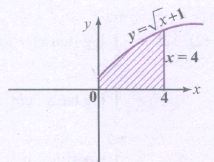
Required area
\(\int _{ 0 }^{ 4 }{ ydx } =\int _{ 0 }^{ 4 }{ (\sqrt { x } +1)dx } \)
\({ \left[ \frac { 2 }{ 3 } { x }^{ \frac { 3 }{ 2 } }+x \right] }_{ 0 }^{ 4 }=\frac { 2 }{ 3 } { (4) }^{ \frac { 3 }{ 2 } }+4\)
\(\frac { 2 }{ 3 } (4)\sqrt { 4 } +4=\frac { 16 }{ 3 } +4\)
\(\frac { 16+12 }{ 3 } =\frac { 28 }{ 3 } \) sq.units
24.
Let P(x, y) be the movable point.
By focal property of ellipse, PA + PB = 2a
∴ 2a = 10 ⇒ a = 5
Since focus is (4, 0), ae = 4 ⇒ 5e = 4 ⇒ e = \(\frac45\)
Also b2 = a2(1 - e2) = 25\(\left( 1-\frac { 16 }{ 25 } \right) =25\left( \frac { 9 }{ 25 } \right) \) = 9
Equation of ellipse is \(\frac { { x }^{ 2 } }{ { a }^{ 2 } } +\frac { { y }^{ 2 } }{ { b }^{ 2 } } =1\)
\(\frac { { x }^{ 2 } }{ 25 } +\frac { { y }^{ 2 } }{ 9 } =1\)
25.
A =\(\left[ \begin{matrix} 4 \\ 7 \end{matrix}\begin{matrix} 5 \\ -3 \end{matrix}\begin{matrix} -6 \\ 0 \end{matrix}\begin{matrix} 1 \\ 8 \end{matrix} \right] \)
\(\overset { { R }_{ 2 }\rightarrow { R }_{ 2 }-2{ R }_{ 1 } }{ \longrightarrow } \left[ \begin{matrix} 4 \\ -1 \end{matrix}\begin{matrix} 5 \\ -3 \end{matrix}\begin{matrix} -6 \\ 12 \end{matrix}\begin{matrix} 1 \\ 6 \end{matrix} \right] \)
\(\overset { { R }_{ 1 }\leftrightarrow { R }_{ 2 } }{ \longrightarrow } \left[ \begin{matrix} -1 \\ 4 \end{matrix}\begin{matrix} -3 \\ 5 \end{matrix}\begin{matrix} 12 \\ -6 \end{matrix}\begin{matrix} 6 \\ 1 \end{matrix} \right] \)
\(\overset { { R }_{ 1 }+(-1){ R }_{ 1 } }{ \longrightarrow } \left[ \begin{matrix} 1 \\ 4 \end{matrix}\begin{matrix} 13 \\ 5 \end{matrix}\begin{matrix} -12 \\ -6 \end{matrix}\begin{matrix} 6 \\ 1 \end{matrix} \right] \)
\(\overset { { R }_{ 2 }\rightarrow { R }_{ 2 }-4{ R }_{ 1 } }{ \longrightarrow } \left[ \begin{matrix} 1 \\ 0 \end{matrix}\begin{matrix} 13 \\ -47 \end{matrix}\begin{matrix} -12 \\ 42 \end{matrix}\begin{matrix} -6 \\ 25 \end{matrix} \right] \)
The equivalent row-echelon matrix hats two non zero rows.
∴ \(\rho\) (A) = 2
26.
The quadratic equation 3x2 + 2(a2 + 1)x + (a2 - 3a + 2)
Will have two roots of opposite sign if it has real roots and the product of the roots is negative.
⇒ 4(a2+1)2-12(a2-3a+2)\(\ge\) 0 and \(\frac { { a }^{ 2 }-3a+2 }{ 3 } <0\)
Both of these conditions are true if
⇒ a2-3a+2< 0
⇒ (a-1)(a-2)< 0
⇒ 1<a<2
27.
2x = 3y = −z \(\Rightarrow \frac{x}{3}=\frac{y}{2}=\frac{-z}{6}\) (Dividing by 6 all)
\(\Rightarrow \frac{x-0}{3}=\frac{y-0}{2}=
\frac{z-0}{-6}\)....(1)
6x = -y = -4z \(\Rightarrow \frac{x}{2}=\frac{-y}{12}=\frac{-z}{3} \) (Dividing by 6 all)
\(\Rightarrow \frac{x-0}{2}=\frac{y-0}{-12}=\frac{z-0}{-3}\) ....(2)
From (1) & (2), we get
\(\vec b = 3\vec i+2\vec j- 6\vec k\)and \( \vec d = 2\vec i-12\vec j- 3\vec k\)
Angle between lines (1) and (2) = Angle between \(\vec b\ and\ \vec d\)
Acute angle between lines cos 0 = \(\frac{|\vec b . \vec d|}{|\vec b||\vec d|}
\)
\(\vec b . \vec d \)= (\(\vec b = 3\vec i+2\vec j- 6\vec k\)). (\( 2\vec i-12\vec j- 3\vec k\))
6-24+18 = 0
\( \cos \theta=0 \)
\(\theta=\frac{\pi}{2} \text { or } 90^{\circ}\)
28.
Let y = sec-1 (-2). Then, sec y = -2
By the definition, the range of the principal value branch of y = sec−1x is [0, \(\pi\)]\{\({{\frac{\pi}{2}}}\)}
Let us find y in [0, \(\pi\)] - {\({{\frac{\pi}{2}}}\)} such that sec y = -2
But, sec y = −2 \(\Rightarrow\) cos y = -\(\frac{1}{2}\)
Now, cos y = -\(\frac { 1 }{ 2 } =-cos\frac { \pi }{ 3 } =cos\left( \pi -\frac { \pi }{ 3 } \right) =cos\frac { 2\pi }{ 3 } \). Therefore, y = \(\frac{2\pi}{3}\)
since \(\frac{2\pi}{3}\in[0,\pi]\)\{\({{\frac{\pi}{2}}}\)}, the principal value of sec-1(-2) is \(\frac{2\pi}{3}\)
29.
i1729 = i1728 i1 = i
30.
| Q.no | Equation | condition | Type of the conic |
| 1 | 16y2 = −4x2+64 | 3 | Ellipse |
| 2 | x2+y2 = −4x−y+4 | 1 | Circle |
| 3 | x2−2y = x+3 | 2 | parabola |
| 4 | 4x2−9y2−16x+18y−29 = 0 | 4 | Hyperbola |
31.
(a)
\(\frac { dy }{ dx } =\frac { -x }{ y } \)
32.
(a)
0
33.
(b)
log 2
34.
(a)
9.72 cm3
35.
(a)
1
36.
(a)
| (a) | (b) | (c) | (d) |
| F | T | F | T |
37.
(b)
\(-x +\frac{\pi}{2}\)
38.
(d)
\(4\pi\)
39.
(d)
16 and 24
40.
(c)
\(\frac{1}{x}\)
41.
(c)
42.
(c)
i cot \(\frac { \theta }{ 2 } \)
43.
(b)
\(\frac { \sqrt { 3 } }{ 2 } \)
44.
(a)
1
45.
(b)
c<0
46.
(d)
\(\frac { \pi }{ 4 } \)
47.
(d)
48.
(a)
49.
(b)
unique solution
50.
(a)
mn

12th Standard Syllabus & Materials
12th Standard
TN 12th Computer Applications களப்பெயர் முறைமை (DNS) Sample Question Papers Study Material - QB365 Set A
NEW12th Standard
TN 12th Computer Applications வலையமைப்பு எடுத்துக்காட்டுகள் மற்றும் நெறிமுறைகள் Sample Question Papers Study Material - QB365 Set A
NEW12th Standard
TN 12th Computer Applications கணினி வலையமைப்பு ஓர் அறிமுகம் Sample Question Papers Study Material - QB365 Set A
NEW12th Standard
TN 12th Computer Applications PHP-உடன் MySQL-ஐ இணைத்தல் Sample Question Papers Study Material - QB365 Set A



Tamilnadu Stateboard 12th Standard Subjects
Maths

Chemistry

Physics

Biology

Computer Science

Business Maths and Statistics

Economics

Commerce

Accountancy

History

Computer Applications
Biology
Computer Technology
Computer Applications
Computer Science
Business Maths and Statistics
Commerce
Economics
Maths
Chemistry
Physics
Computer Technology
History
Accountancy

Tamil

English

French
Tamilnadu Stateboard Standards

