
 100% FREE ACCESS
12th Standard Syllabus & Materials
12th Standard
TN 12th Computer Applications மின்னணு தரவு பரிமாற்றம் Sample Question Papers Study Material - QB365 Set A
NEW12th Standard
TN 12th Computer Applications மின் - வணிக பாதுகாப்பு அமைப்புகள் Sample Question Papers Study Material - QB365 Set A
NEW12th Standard
TN 12th Computer Applications மின்னணு செலுத்தல் முறைகள் Sample Question Papers Study Material - QB365 Set A
NEW12th Standard
TN 12th Computer Applications மின் - வணிகம் Sample Question Papers Study Material - QB365 Set A
NEW12th Standard
TN 12th Computer Applications திறந்த மூல கருத்துருக்கள் Sample Question Papers Study Material - QB365 Set A
NEW12th Standard
TN 12th Computer Applications வலையமைப்பு வடமிடல் Sample Question Papers Study Material - QB365 Set A

Published on: 30/10/2019
Application of Differential Calculus
Download Tamil Nadu 12th Standard Maths question papers, model tests, one-mark questions, important questions, and public exam papers in PDF format. Free study materials and answer keys for TN State Board students.
Questions + Answers key
Take MCQ Maths Test1.
Prove that the function f (x) = x2 + 2 is strictly increasing in the interval (2,7) and strictly decreasing in the interval (−2, 0)
2.
Find the values in the interval (1, 2) of the mean value theorem satisfied by the function f (x) = x − x2 for 1 ≤ x ≤ 2
3.
Find the points on the curve y2 - 4xy = x2 + 5 for which the tangent is horizontal.
4.
A particle moves so that the distance moved is according to the law s(t) = \(s(t)=\frac{t^{3}}{3}-t^{2}+3\). At what time the velocity and acceleration are zero.
5.
A particle is fired straight up from the ground to reach a height of s feet in t seconds, where s(t) = 128t −16t2.
(1) Compute the maximum height of the particle reached.
(2) What is the velocity when the particle hits the ground?
6.
Using the l’Hôpital Rule prove that, \(\underset{x\rightarrow 0^{+}}{lim}(1+x)^{\frac{1}{x}}=e\)
7.
Prove that the ellipse x2 + 4y2 = 8 and the hyperbola x2-2y2 = 4 intersect orthogonally.
8.
A ladder 17 metre long is leaning against the wall. The base of the ladder is pulled away from the wall at a rate of 5 m/s. When the base of the ladder is 8 metres from the wall.
9.
A ladder 17 metre long is leaning against the wall. The base of the ladder is pulled away from the wall at a rate of 5 m/s. When the base of the ladder is 8 metres from the wall.
(i) How fast is the top of the ladder moving down the wall?
(ii) At what rate, the area of the triangle formed by the ladder, wall and the floor is changing?
10.
A camera is accidentally knocked off an edge of a cliff 400 ft high. The camera falls a distance of s =16t2 in t seconds
11.
A camera is accidentally knocked off an edge of a cliff 400 ft high. The camera falls a distance of s =16t2 in t seconds
What is the average velocity with which the camera falls during the last 2 seconds?
12.
Salt is poured from a conveyer belt at a rate of 30 cubic metre per minute forming a conical pile with a circular base whose height and diameter of base are always equal. How fast is the height of the pile increasing when the pile is 10 metre high?
13.
What is the value of the limit \(\lim _{x \rightarrow 0}\left(\cot x-\frac{1}{x}\right) \text { is }\)
0
1
2
∞
14.
The tangent to the curve y2 - xy + 9 = 0 is vertical when
y = 0
\(\\ \\ y=\pm \sqrt { 3 } \)
\(y=\frac { 1 }{ 2 } \)
\(y=\pm 3\)
15.
The abscissa of the point on the curve \(f\left( x \right) =\sqrt { 8-2x } \) at which the slope of the tangent is -0.25 ?
-8
-4
-2
0
16.
The point on the curve 6y = x3 + 2 at which y-coordinate changes 8 times as fast as x-coordinate is
(4, 11)
(4, -11)
(-4, 11)
(-4,-11)
17.
The volume of a sphere is increasing in volume at the rate of 3 πcm3 / sec. The rate of change of its radius when radius is \(\frac { 1 }{ 2 } \) cm
3 cm/s
2 cm/s
1 cm/s
\(\cfrac { 1 }{ 2 } cm/s\)
1.
We have,
\(f'(x)=2x>0, \forall x\in(2,7)\) and
\(f'(x)=2x>0, \forall x\in(-2,0)\)
and hence the proof is completed.
2.
f (1) = 0 and f(2) = -2. Clearly f (x) is defined and differentiable in 1< x <2.
Therefore, by the Mean Value Theorem, there exists a c∈(1, 2) such that by
\(f'(c)=\frac{f(2)-f(1)}{2-1}=1-2c\)
That is \(1-2c= -2 \Rightarrow c= \frac{3}{2}\)
3.
Equation of the given curve is y2 - 4xy = x2 + 5..(1)
Differentiating with respect to 'x' we get,
\(2y\frac { dy }{ dx } -4\left[ x\frac { dy }{ dx } +y(1) \right] =2x\)
⇒ \(2y\frac { dy }{ dx } -4x\frac { dy }{ dx } -4y=2x\)
⇒ \(\frac { dy }{ dx } \) (2y -4x) = 2x + 4y
⇒ \(\frac { dy }{ dx } \) = \(\frac { x+2y }{ y-2x } \)
Since the tangent to the curve is horizontal, \(\frac { dy }{ dx } \) = 0
ஃ \(\frac { x+2y }{ y-2x } \) = 0
⇒ x+ 2y = 0
⇒ x = -2y .....(2)
Substituting (2) in (1) we get,
y2 - 4(-2y)y = (-1y)2 + 5
⇒ y2 + 8y2 = 4y2 + 5
⇒ y2 = 4y2 + 5
⇒ 5y2 = 5
⇒ y2 = 1
⇒ y = 土 1
From (2), When y = 1, x = - 2
When y = -1, x = 2
∴ The required points are (2, -1) and (-2,1)
4.
Distance moved in time 't' is s = \(\frac{t^{3}}{3}-t^{2}+3\)
Velocity at time 't ' is V = \(\frac{ds}{dt}=t^{2}-2t\)
Acceleration at time 't ' is a(t) = \(\frac{dV}{dt}=2t-2\)
Therefore, the velocity is zero when t2 − 2t = 0, that is t = 0, 2. The acceleration is zero when 2t − 2 = 0 . That is at time at time t = 1
5.
(i) At the maximum height, the velocity v(t) of the particle is zero.
Now, we find the velocity of the particle at time t.
\(v(t)=\frac{ds}{dt}=128-32t\)
\(v(t)=0 \Rightarrow 128-32t=0 \Rightarrow t=4.\)
After 4 seconds, the particle reaches the maximum height.
The height at t = 4 is s(4) = 128(4) - 16(4)2 = 256 ft.
(ii) When the particle hits the ground then s = 0 .
s = 0 ⇒ 128t −16t2 = 0
⇒ t = 0, 8 seconds.
The particle hits the ground at t = 8 seconds. The velocity when it hits the ground v(8) = –128 ft /s.
6.
This is an indeterminate of the form \(1^{\infty}\).
Let \(g(x)=(1+x)^{\frac{1}{x}}\). Taking the logarithm, we get
\(log \ g(x)=\frac{log(1+x)}{x}\)
\(\underset{x\rightarrow 0^{+}}{lim} log (g(x))=\underset{x\rightarrow 0^{+}}{lim}(\frac{log(1+x)}{x})\) \((\frac{0}{0})\)
=\(\underset{x\rightarrow0^{+}}{lim}(\frac{\frac{1}{1+x}}{1})\) (by 1’Hôpital Rule)
= 1.
But, \(\underset{x\rightarrow0^{+}}{lim}log g(x)=log(\underset{x\rightarrow 0^{+}}{lim} g(x))\)
Therefore, log\((\underset{x\rightarrow 0^{+}}{lim} g(x))=1\).
Hence by exponentiating, we get, \(\underset{x\rightarrow 0^{+}}{lim}g(x)=e.\)
7.
Let the point of intersection of the two curves be (a,b) . Hence,
\(a^{2}+4b^{2}=8\) and \(a^{2}-2b^{2}=4\) ...(4)
It is enough if we show that the product of the slopes of the two curves evaluated at (a, b) is −1.
Differentiation of \(x^{2}+4y^{2}=8\) with respect x, gives
\(2x+8y=\frac{dy}{dx}=0\).
Therefore \(\frac{dy}{dx}= -\frac{-x}{4y}\),
\((\frac{dy}{dx})_{(a,b)}=m_{1}= -\frac{a}{4b}\)
Differentiation of x2-2y2 = 4 with respect to x, gives
\(2x-4y\frac{dy}{dx}=0\)
Therefore, \(\frac{dy}{dx}=\frac{x}{2y}\),
at \((a,b)(\frac{dy}{dx})=m_{2}= \frac{a}{4b}\).
Therefore, \(m_{1}\times m_{2}=(-\frac{a}{4b})\times (\frac{a}{2b})= -\frac{a^{2}}{8b^{2}}\) ...(5)
Applying the ratio of proportions in (4), we get
\(\frac{a^{2}}{-16-16}=\frac{b^{2}}{-8+4}=\frac{1}{-2-4}\)
Therefore, \(\frac{a^{2}}{b^{2}}=\frac{32}{4}=8\) Substituting in (5), we get \(m_{1}\times m_{2}=-1\) Hence, the curves cut orthogonally.
8.
9.
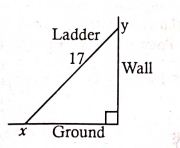
Let AB be the position of the ladder at any time t such that OA = x and OB = y
Then OA2 + OB2 = AB2
⇒ x2 + y2 = 172
Given \(\frac { dx }{ dt } \) = 5 and x = 8
When x = 8, 82 + y2 = 172
⇒ y2 = 289 - 64 = 225
⇒ y = 15
Differentiating (1) with respect to 't' we get,
\(2x\frac { dx }{ dt } +2y\frac { dy }{ dt } =0\)
⇒ 8(5) + 15 \(\frac { dy }{ dt } \) = 0 [∵ x = 8, \(\frac { dx }{ dt } \) = 15, y = 15]
⇒ 40 + 15\(\frac { dy }{ dt } \) = 0
⇒ \(\frac { dy }{ dt } =\frac { -40 }{ 15 } =\frac { -8 }{ 3 } \) m/sec
∴ The rate of top of the ladder moving down the wall is \(\frac{-8}{3}\) m/sec
(ii) The ladder, the wall and the floor forms a right angled triangle.
Area = \(\frac12\)xy
Differentiating with respect to 't' we get,
\(\frac { dA }{ dt } =\frac { 1 }{ 2 } \left[ x\frac { dy }{ dx } +y\frac { dx }{ dt } \right] \)
\(=\frac { 1 }{ 2 } \left[ 8\left( -\frac { 8 }{ 3 } \right) +15(5) \right] \)
= \(\frac { 1 }{ 2 } \left[ \frac { -64 }{ 3 } +75 \right] =\frac { 1 }{ 2 } \)
= \(\frac { 1 }{ 2 } \left[ \frac { -64+225 }{ 3 } \right] =\frac { 1 }{ 2 } \left( \frac { 161 }{ 3 } \right) \)
= \(\frac { dA }{ dt } \) = 26.83 sq.m/sec
10.
11.
12.
Let h and r be the height and the base radius. Therefore h = 2r. Let V be the volume of the salt cone.
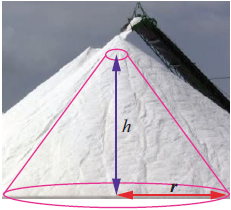
\(V=\frac{1}{3}\pi r^{2}h=\frac{1}{12}\pi h^{3}; \frac{dV}{dt}=30\) mtr3 / min.
Hence, \(\frac{dV}{dt}=\frac{1}{4}\pi h^{2}\frac{dh}{dt}\)
Therefore, \(\frac{dh}{dt}=4 \frac{dV}{dt}.\frac{1}{\pi h^{2}}\)
That is, \(\frac{dh}{dt}=4\times30\times \frac{1}{100 \pi}\)
=\(\frac{6}{5\pi}\) mtr / min.
13.
(a)
0
14.
(d)
\(y=\pm 3\)
15.
(b)
-4
16.
(a)
(4, 11)
17.
(a)
3 cm/s

12th Standard Syllabus & Materials
12th Standard
TN 12th Computer Applications களப்பெயர் முறைமை (DNS) Sample Question Papers Study Material - QB365 Set A
NEW12th Standard
TN 12th Computer Applications வலையமைப்பு எடுத்துக்காட்டுகள் மற்றும் நெறிமுறைகள் Sample Question Papers Study Material - QB365 Set A
NEW12th Standard
TN 12th Computer Applications கணினி வலையமைப்பு ஓர் அறிமுகம் Sample Question Papers Study Material - QB365 Set A
NEW12th Standard
TN 12th Computer Applications PHP-உடன் MySQL-ஐ இணைத்தல் Sample Question Papers Study Material - QB365 Set A



Tamilnadu Stateboard 12th Standard Subjects
Maths

Chemistry

Physics

Biology

Computer Science

Business Maths and Statistics

Economics

Commerce

Accountancy

History

Computer Applications
Biology
Computer Technology
Computer Applications
Computer Science
Business Maths and Statistics
Commerce
Economics
Maths
Chemistry
Physics
Computer Technology
History
Accountancy

Tamil

English

French
Tamilnadu Stateboard Standards

