
 100% FREE ACCESS
12th Standard Syllabus & Materials
12th Standard
TN 12th Computer Applications மின்னணு தரவு பரிமாற்றம் Sample Question Papers Study Material - QB365 Set A
NEW12th Standard
TN 12th Computer Applications மின் - வணிக பாதுகாப்பு அமைப்புகள் Sample Question Papers Study Material - QB365 Set A
NEW12th Standard
TN 12th Computer Applications மின்னணு செலுத்தல் முறைகள் Sample Question Papers Study Material - QB365 Set A
NEW12th Standard
TN 12th Computer Applications மின் - வணிகம் Sample Question Papers Study Material - QB365 Set A
NEW12th Standard
TN 12th Computer Applications திறந்த மூல கருத்துருக்கள் Sample Question Papers Study Material - QB365 Set A
NEW12th Standard
TN 12th Computer Applications வலையமைப்பு வடமிடல் Sample Question Papers Study Material - QB365 Set A

Published on: 09/10/2019
Applications of Vector Algebra
Download Tamil Nadu 12th Standard Maths question papers, model tests, one-mark questions, important questions, and public exam papers in PDF format. Free study materials and answer keys for TN State Board students.
Questions + Answers key
Take MCQ Maths Test1.
Find the distance between the planes \(\vec { r } .(2\hat { i } -\hat { j } -2\hat { k } )\) = 6 and \(\vec { r } .(6\hat { i } -\hat { 3j } -\hat { 6k } )\) = 27
2.
Find the vector and Cartesian equations of the plane passing through the point with position vector \(4\hat { i } +2\hat { j } -3\hat { k } \) and normal to vector \(2\hat { i } -\hat { j } +\hat { k } \)
3.
Find the non-parametric form of vector equation and Cartesian equations of the straight line passing through the point with position vector \(4\hat { i } +3\hat { j } -7\hat { k } \) and parallel to the vector \(2\hat { i } -6\hat { j } +7\hat { k } \).
4.
5.
Forces of magnit \(5\sqrt { 2 } \) and \(10\sqrt { 2 } \) units acting in the directions \(\hat { 3i } +\hat { 4j } +\hat { 5k } \) and \(\hat { 10i } +\hat { 6j } -\hat { 8k } \) respectively, act on a particle which is displaced from the point with position vector \(\hat { 4i } -\hat { 3j } -\hat { 2k } \) to the point with position vector \(\hat { 6i } +\hat { j } -\hat { 3k } \). Find the work done by the forces.
6.
Find the magnitude and the direction cosines of the torque about the point (2, 0, -1) of a force \((\hat { 2i } +\hat { j } -\hat { k } )\), whose line of action passes through the origin
7.
With usual notations, in any triangle ABC, prove by vector method that \(\frac { a }{ sinA } =\frac { b }{ sinB }=\frac { c }{ sinc }\)
8.
With usual notations, in any triangle ABC, prove the following by vector method.
(i) a = b cos C + c cos B
(ii) b = c cos A + a cos C
(iii) c = a cos B + b cos A
9.
Verify whether the line \(\frac { x-3 }{ -4 } =\frac { y-4 }{ -7 } =\frac { z+3 }{ 12 } \) lies in the plane 5x-y+z = 8.
10.
Let \(\vec { a } =\hat { i } +\hat { j } +\hat { k } \), \(\vec { b } =\hat { i } \) and \(\vec { c } ={ c }_{ 1 }\hat { i } +{ c }_{ 2 }\hat { j } +{ c }_{ 3 }\hat { k } \). If \({ c }_{ 1 }=1\) and \({ c }_{ 2 }=2\), find \({ c }_{ 3 }\) such that \(\vec { a } ,\vec { b } \) and \(\vec { c } \) are coplanar.
11.
The volume of the parallelepiped whose coterminus edges are \(7\hat { i } +\lambda \hat { j } -3\hat { k } ,\hat { i } +2\hat { j } -\hat { k } \), \(-3\hat { i } +7\hat { j } +5\hat { k } \) is 90 cubic units. Find the value of λ.
12.
Show that the vectors \(\hat { i } +\hat { 2j } -\hat { 3k } \), \(\hat { 2i } -\hat { j } +\hat { 2k } \) and \(\hat { 3i } +\hat { j } -\hat { k } \)
13.
If \(\vec{ a } =\hat { -3i } -\hat { j } +\hat { 5k } \), \(\vec{b}=\hat{i}-\hat{2j}+\hat{k} \), \(\vec{c}=\hat{4j}-\hat{5k} \ \) find\( \ {\vec a } .(\vec { b } \times \vec { c } )\)
14.
The vector equation in parametric form of a line is \(\vec { r } =(3\hat { i } -2\hat { j } +6\hat { k } )+t(2\hat { i } -\hat { j } +3\hat { k } )\). Find
(i) the direction cosines of the straight line
(ii) vector equation in non-parametric form of the line
(iii) Cartesian equations of the line.
15.
\(\vec { a } =2\hat { i } +3\hat { j } -\hat { k } ,\vec { b } =-\hat { i } +2\hat { j } -4\hat { k } ,\vec { c } =\hat { i } +\hat { j } +\hat { k } \) then find the value of \((\vec { a } \times \vec { b } )\times (\vec { c } \times \vec { d } )\).
16.
If \(\vec { a } =\vec { i } -\vec { j } ,\vec { b } =\hat { i } -\hat { j } -4\hat { k } ,\vec { c } =3\hat { j } -\hat { k } \) and \(\vec { d } =2\hat { i } +5\hat { j } +\hat { k } \)
(i) \((\vec { a } \times \vec { b } )\times (\vec { c } \times \vec { d } )=[\vec { a } ,\vec { b } ,\vec { d } ]\vec { c } -[\vec { a } ,\vec { b } ,\vec { c } ]\vec { d } \)
17.
If the length of the perpendicular from the origin to the plane 2x + 3y + λz =1, λ > 0 is \(\frac{1}{5}\), then the value of λ is
\(2\sqrt { 3 } \)
\(3\sqrt { 2 } \)
0
1
18.
If the distance of the point (1, 1, 1) from the origin is half of its distance from the plane x + y + z + k = 0, then the values of k are
\(\pm 3\)
\(\pm 6\)
-3, 9
3, -9
19.
The distance between the planes x + 2y + 3z + 7 = 0 and 2x + 4y + 6z + 7 = 0
\(\frac { \sqrt { 7 } }{ 2\sqrt { 2 } } \)
\(\frac{7}{2}\)
\(\frac { \sqrt { 7 } }{ 2 } \)
\(\frac { 7 }{ 2\sqrt { 2 } } \)
20.
The coordinates of the point where the line \(\vec { r } =(6\hat { i } -\hat { j } -3\hat { k } )+t(-\hat { i } +4\hat { j } )\) meets the plane \(\vec { r } .(\hat { i } +\hat { j } -\hat { k } )\) = 3 are
(2, 1, 0)
(7, -1, -7)
(1, 2, -6)
(5, -1, 1)
21.
The angle between the line \(\vec { r } =(\hat { i } +2\hat { j } -3\hat { k } )+t(2\hat { i } +\hat { j } -2\hat { k } )\) and the plane \(\vec { r } .(\hat { i } +\hat { j } )+4=0\) is
0°
30°
45°
90°
22.
If \(\vec { a } =2\hat { i } +3\hat { j } -\hat { k } ,\vec { b } =\hat { i } +2\hat { j } -5\hat { k } ,\vec { c } =3\hat { i } +5\hat { j } -\hat { k } ,\) then a vector perpendicular to \(\vec { a } \) and lies in the plane containing \(\vec { b } \) and \(\vec { c } \) is
\(-17\hat { i } +21\hat { j } -97\hat { k } \)
\(17\hat { i } +21\hat { j } -123\hat { k } \)
\(-17\hat { i } -21\hat { j } +97\hat { k } \)
\(-17\hat { i } -21\hat { j } -97\hat { k } \)
23.
Consider the vectors \(\vec { a } ,\vec { b } ,\vec { c } ,\vec { d} \) such that \((\vec { a } \times \vec { b } )\times (\vec { c } \times \vec { d } )\) = \(\vec { 0 } \) Let \({ P }_{ 1 }\) and \({ P }_{ 2 }\) be the planes determined by the pairs of vectors \(\vec { a } ,\vec { b } \) and \(\vec { c } ,\vec { d } \) respectively. Then the angle between \({ P }_{ 1 }\) and \({ P }_{ 2 }\) is
0°
45°
60°
90°
24.
If \(\vec { a } =\hat { i } +\hat { j } +\hat { k } \), \(\vec { b } =\hat { i } +\hat { j } \), \(\vec { c } =\hat { i } \) and \((\vec { a } \times \vec { b } )\times\vec { c } \) = \(\lambda \vec { a } +\mu \vec { b } \), then the value of \(\lambda +\mu \) is
0
1
6
3
25.
If \(\vec { a } .\vec { b } =\vec { b } .\vec { c } =\vec { c } .\vec { a } =0\) , then the value of \([\vec { a } ,\vec { b } ,\vec { c } ]\) is
\(\left| \vec { a } \right| \left| \vec { b } \right| \left| \vec { c } \right| \)
\(\frac{1}{3}\)\(\left| \vec { a } \right| \left| \vec { b } \right| \left| \vec { c } \right| \)
1
-1
26.
If \(\vec{a}\) and \(\vec{b}\) are parallel vectors, then \([\vec { a } ,\vec { c } ,\vec { b } ]\) is equal to
2
-1
1
0
27.
The equation of the plane at a distance p from the origin and perpendicular to the unit normal vector \(\overset { \wedge }{ d } \) is
(1) \(\overset { \rightarrow }{ r } .\overset { \rightarrow }{ d } =p\)
(2) \(\overset { \rightarrow }{ r } .\overset { \wedge }{ d } =p\)
(3) \(\overset { \rightarrow }{ r } .\overset { \rightarrow }{ d } =q\) where \(q=p\left| \overset { \rightarrow }{ d } \right| \)
(4) \(\overset { \rightarrow }{ r } .\frac { \overset { \rightarrow }{ d } }{ \left| d \right| } =p\)
28.
\(\overset { \rightarrow }{ a } ,\overset { \rightarrow }{ b } \) and \(\overset { \rightarrow }{ c } \) are said to be coplanar if
(1) \(\left[ \overset { \rightarrow }{ a } ,\overset { \rightarrow }{ b } ,\overset { \rightarrow }{ c } \right] \)=0
(2) \(\overset { \rightarrow }{ a } ,\overset { \rightarrow }{ b } ,\overset { \rightarrow }{ c } \) lie on the same plane
(3) They are either parallel or intersecting
(4) Skew lines
29.
(1) displacement
(2) length
(3) weight
(4) velocity
1.
Let \(\vec { \mu } \) the position vector of an arbitrary point on the plane \(\vec { r } .(2\hat { i } -\hat { j } -2\hat { k } )\) = 6. Then, we have
\(\vec { \mu } .(2\hat { i } -\hat { j } -2\hat { k } )=6\) .........(1)
If δ is the distance between the given planes, then δ is the perpendicular distance from \(\vec { \mu } \) to the plane
\(\vec { r } .(6\hat { i } -3\hat { j } -6\hat { k} )\) = 27
Therefore, δ = \(\frac { \left| \vec { u } .\vec { n } -p \right| }{ \left| \vec { n } \right| } =\left| \frac { \vec { u } .(6\hat { i } -3\hat { j } -6\hat { k } )-27 }{ \sqrt { 6^{ 2 }+(-{ 3) }^{ 2 }+(-{ 6 })^{ 2 } } } \right| =\left| \frac { 3(\vec { u } .(2\hat { i } -\hat { j } -2\hat { k } ))-27 }{ 9 } \right| =\left| \frac { (3(6)-27 }{ 9 } \right| =1\) unit
2.
If the position vector of the given point is \(\vec { a } =4\hat { i } +2\hat { j } -3\hat { k } \) and \(\vec { n } =2\hat { i } -\hat { j } +\hat { k } \), then the equation of the plane passing through a point and normal to a vector is given by \((\vec { r } -\vec { a } ).\vec { n } =0\) or \(\vec { r } .\vec { n } =\vec { a } .\vec { n } \)
Substituting \(\vec { a } =4\hat { i } +2\hat { j } -3\hat { k } \) and \(\vec { n } =2\hat { i } -\hat { j } +\hat { k } \) in the above equation, we get
\(\vec { r } .(2\hat { i } -\hat { j } +\hat { k } )=(4\hat { i } +2\hat { j } -3\hat { k } ).(2\hat { i } -\hat { j } +\hat { k } )\)
Thus, the required vector equation of the plane is \(\vec { r } .(2\hat { i } -\hat { j } +\hat { k } )\)= 3. If \(\vec { r } =x\hat { i } +y\hat { j } +z\hat { k } \) then
we get the Cartesian equation of the plane 2x − y + z = 3.
3.
Let \(\vec { a } =4\hat { i } +3\hat { j } -7\hat { k } \) and \(\vec { b } =2\hat { i } -6\hat { j } +7\hat { k } \)
Non-parametric form of vector equation of a straight line passing through a point (\(\vec {a} \)) and parallel to a vector (\(\vec { b } \)) is \((\vec { r } -\vec { a } )\times \vec { b } \)
⇒ \([\vec { r } -(4\hat { i } +3\hat { j } -7\hat { k } )]\times (2\hat { i } -6\hat { j } +7\hat { k } )=\vec { 0 } \)
Its cartesian equation is
\(\frac { x-{ x }_{ 1 } }{ { b }_{ 1 } } =\frac { y-{ y }_{ 1 } }{ { b }_{ 2 } } =\frac { z-{ z }_{ 1 } }{ { b }_{ 3 } } \)
⇒ \(\frac { x-4 }{ 2 } =\frac { y-3 }{ -6 } =\frac { z+7 }{ 7 } \)
[∵ (x1, y1, z1) is (4, 3, -7) & (b1, b2, b3) is (2, -6, 7)]
4.
5.
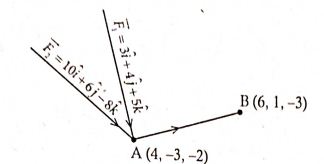
Let \(\vec { { F }_{ 1 } } \) and \(\vec { { F }_{ 2 } } \) be the two forces given
Given \(|\vec { { F }_{ 1 } } |=5\sqrt { 2 } \) and its direction is along \(3\hat { i } +4\hat { j } +5\hat { k } \)
∴ \(\vec { { F }_{ 1 } } =5\sqrt { 2 } \) (unit vector of \(3\hat { i } +4\hat { j } +5\hat { k } \))
= \(5\sqrt { 2 } \frac { (3\hat { i } +4\hat { j } +5\hat { k } ) }{ \sqrt { { 3 }^{ 2 }+{ 4 }^{ 2 }+{ 5 }^{ 2 } } } \) \(\left[ \because \hat { n } =\frac { \vec { n } }{ |\vec { n } | } \right] \)
= \(5\sqrt { 2 } \frac { (3\hat { i } +4\hat { j } +5\hat { k } ) }{ \sqrt { 9+16+25 } } =\frac { 5\sqrt { 2 } (3\hat { i } +4\hat { j } +5\hat { k } ) }{ 5\sqrt { 2 } } \)
= \(3\hat { i } +4\hat { j } +5\hat { k } \)
and \(\vec { { F }_{ 2 } } =10\sqrt { 2 } \) (unit vector of \(10\hat { i } +6\hat { j } -8\hat { k } \))
= \(10\sqrt { 2 } \frac { (10\hat { i } +6\hat { j } -8\hat { k } ) }{ \sqrt { { 10 }^{ 2 }+{ 6 }^{ 2 }+(-8)^{ 2 } } } \)
\(=\frac{10 \sqrt{\not 2}(10 \hat{i}+6 \hat{j}-8 \hat{k})}{10 \sqrt\not {2}}\)
= \(10\hat { i } +6\hat { j } -8\hat { k } \)
∴ Resistant force \(\vec { F } =\vec { { F }_{ 1 } } +\vec { { F }_{ 2 } } \)
=\((3\hat { i } +4\hat { j } +5\hat { k } )+(10\hat { i } +6\hat { j } -8\hat { k } )\)
\(\vec { F } =13\hat { i } +10\hat { j } -3\hat { k } \)
\(\hat { d } \) = displacement to the point - displacement from the point
= \((6\hat { i } +\hat { j } -3\hat { k } )-(4\hat { i } -3\hat { j } -2\hat { k } )\)
= \(2\hat { i } +4\hat { j } -\hat { k } \)
∴ Work done
w = \(\vec { F } .\vec { d } =(13\hat { i } +10\hat { j } -3\hat { k } ).(2\hat { i } +4\hat { j } -\hat { k } )\)
w = 13(2) + 10(4) - 3(-1) = 26 + 40 + 3
w = 69 units.
6.
Let A be the point (2, 0, -1). Then the position vector of A is \(\vec { OA } \) = \(2\hat { i } -\hat { k } \) and therefore \(\vec { r } =\vec { OA } =-2\hat { i } -\hat { k } \)
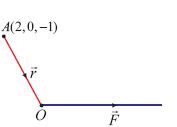
Then the given force is \(\vec{F}=\hat { 2i } +\hat { j } -\hat { k } \) So, the torque is
\(\vec { t } =\vec { r } \times \vec { F } =\left| \begin{matrix} \hat { i } & \hat { j } & \hat { k } \\ -2 & 0 & 1 \\ 2 & 1 & -1 \end{matrix} \right| =-\hat { i } -2\hat { k } \)
The magnitude of the torque = \(\left| -\hat { i } -\hat { 2k } \right| =\sqrt { 5 } \) and the direction cosines of the torque are \(-\frac { 1 }{ \sqrt { 5 } } \), 0 , \(-\frac { 2 }{ \sqrt { 5 } } \)
7.
With usual notations in triangle, ABC let \(\vec { BC } =\vec { a } \), \(\vec { CA } =\vec { b } \) and \(\vec { AB } =\vec { c} \). Then \(|\vec { BC }| =\vec { a } \), \(|\vec { CA } |=\vec { b } \) and \(|\vec { AB }| =\vec { c } \)
Since in ΔABC, \(\vec { BC }+\vec { CA }+\vec { AB}=0\) we have \(\vec { BC }\times(\vec { BC }+\vec { CA }+\vec { AB })=\vec { 0 }\)
Simplifying, we get,
\(\vec { BC }\times\vec { CA }=\vec { AB }\times\vec { BC }\) ....(1)
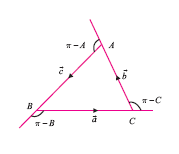
Similarly, since \(\vec { BC }+\vec { CA }+\vec { AB}=\vec 0\), we have
\(\vec {CA} \times (\vec { BC }+\vec { CA }+\vec { AB})=\vec 0\) .... (2)
On Simplification, we obtain \(\vec { BC }\times\vec { CA }=\vec {CA }\times\vec {AB }\)
From equations (1) and (2), we get
\(\vec { AB }\times\vec {BC }\) = \(\vec { CA }\times\vec {AB }\)=\(\vec { BC}\times\vec {CA}\)
So, \(\left| \overrightarrow { AB} \times \overrightarrow { BC } \right| =\left| \overrightarrow { CA } \times \overrightarrow { AB } \right| =\left| \overrightarrow { BC } \times \overrightarrow { CA } \right| \). Then, we get
ca sin(π − B) = bc sin(π - A) = ab sin (π - C)
That is, ca sin B = bc sin A = absinC . Dividing by abc, we get
\(\frac { sinA }{ A } =\frac { sinB }{ b } =\frac { sinC }{ c } \) or \(\frac { a }{ sinA }= \frac { b }{ sinB } =\frac { c }{ sinC } \)
8.
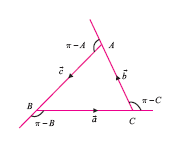
With usual notations in triangle ABC, let \(\vec { BC } =\vec { a } ,\vec { CA } =\vec { b } \) and \(\vec { AB } =\vec { c } \).
Then \(\left| \vec { BC } \right| =a\) , \(\left| \vec { CA } \right| =b\), \(\left| \vec { AB} \right| =c\), and \(\vec { BC } +\vec { CA } +\vec { AB } =\vec { 0 } \)
So, \(\vec { BC } =-\vec { CA } -\vec { AB } \)
Applying dot product, we get
\(\vec { BC } .\vec { BC } =-\vec { BC } .\vec { CA }-\vec { BC }. \vec { AB } \)
⇒ \({ \left| \vec { BC } \right| }^{ 2 }=-\left| \vec { BC } \right| \left| \vec { CA } \right| \) cos(兀-c)-\(\left| \vec { BC } \right| \left| \vec { AB} \right| \)cos(兀-B)
⇒ a2 = ab cos C + ac cos B
Therefore a = b cos C + c cos B
The results (ii) and (iii) are proved in a similar way
9.
Here (x1, y1, z1) = (3, -4, -3) and direction ratios of the given straight line are (a, b, c) = (-4, -7, 12).
Direction ratios of the normal to the given plane are (A, B, C) = (5, -1, 1).
We observe that, the given point (x1, y1, z1) = (3, 4, -3) satisfies the given plane 5x-y+z = 8
Next, aA+bB+cC = (-4)(5)+(-7)(-1)+(12)(1) = -1 \(\neq \) 0.
So, the normal to the plane is not perpendicular to the line.
Hence, the given line does not lie in the plane.
10.
Given \(\vec { a } =\hat { i } +\hat { j } +\hat { k } \), \(\vec { b } =\hat { i } \), \(\vec { c } ={ c }_{ 1 }\hat { i } +{ c }_{ 2 }\hat { j } +{ c }_{ 3 }\hat { k } \)
∴ \(\vec { c } =\hat { i } +2\hat { j } +{ c }_{ 3 }\hat { k } \)
Also, it given that \(\vec { a } ,\vec { b } \) and \(\vec { c } \) are co-planar.
∴ \(\vec { a } .(\vec { b } \times \vec { c } )\)
⇒ \(\left| \begin{matrix} 1 & 1 & 1 \\ 1 & 0 & 0 \\ 1 & 2 & { c }_{ 3 } \end{matrix} \right| \)= 0
⇒ \(1\left| \begin{matrix} 0 & 0 \\ 2 & { c }_{ 3 } \end{matrix} \right| -1\left| \begin{matrix} 1 & 0 \\ 1 & { c }_{ 3 } \end{matrix} \right| +1\left| \begin{matrix} 1 & 0 \\ 1 & 2 \end{matrix} \right| \) = 0
⇒ 1(0-0)-1(c3-0)+1(2-0) = 0
⇒ 0 - c3+2 = 0 ⇒ c3 = 2
∴ c3 = 2
11.
Let \(\vec { a } =7\hat { i } +\lambda \hat { j } -3\hat { k } ,\vec { b } =\hat { i } +2\hat { j } -\hat { k } \) and \(\vec { c } =-3\hat { i } +7\hat { j } -5\hat { k } \)
∴ volume of the parallelepiped
= \(\vec { a } .(\vec { b } \times \vec { c } )\)
Given \(\vec { a } .(\vec { b } \times \vec { c } )\) = 90
⇒ \(\left| \begin{matrix} 7 & \lambda & -3 \\ 1 & 2 & -1 \\ -3 & 7 & 5 \end{matrix} \right| \) = 90
⇒ \(-6\left| \begin{matrix} 2 & -1 \\ 7 & 5 \end{matrix} \right| -\lambda \left| \begin{matrix} 1 & -1 \\ -3 & 5 \end{matrix} \right| -3\left| \begin{matrix} 1 & 2 \\ -3 & 7 \end{matrix} \right| \) = 90
⇒ 7(10+7)-λ(5-3)-3(7+6) = 90
⇒ 7(17)-λ(2)-3(13) = 90
⇒ 119-2λ-39 = 90
⇒ 119-39-90 = 2λ
⇒ -10 = 2λ
⇒ λ = -5
12.
Here, \(\vec { a } =\hat { i } +\hat { 2j } -\hat { 3k } \), \(\vec { b } =\hat { 2i } -\hat { j } +\hat { 2k } \), \(\vec { c } =\hat { 3i } +\hat { j } -\hat { k } \)
We know that \(\vec { a } ,\vec { b } ,\vec { c } \) are coplanar if and only if \([\vec { a } ,\vec { b } ,\vec { c } ]\) = 0. Now, \([\vec { a } ,\vec { b } ,\vec { c } ]\) = \(\left| \begin{matrix} 1 & 2 & -3 \\ 2 & -1 & 2 \\ 3 & 1 & -1 \end{matrix} \right| =0\)
Therefore, the three given vectors are coplanar.
13.
By the defination of scalar triple product of three vectors,
We find, \(\hat { a } .(\hat { b } \times \hat { c } )\) = \(\left| \begin{matrix} -3 & -1 & 5 \\ 1 & -2 & 1 \\ 0 & 4 & -5 \end{matrix} \right| =-3\)
14.
Comparing the given equation with equation of a straight line \(\vec { r } =\vec { a } +t\vec { b } \), we have \(\vec { a } =3\hat { i } -2\hat { j } +6\hat { k } \) and \(\vec { b } =3\hat { i } -2\hat { j } +6\hat { k } \). Therefore,
(i) If \(\vec { b } ={ b }_{ 1 }\hat { i } +{ b }_{ 2 }\hat { j } +{ b }_{ 3 }\hat { k } \), then direction ratios of the straight line are \({ b }_{ 1 },{ b }_{ 2 },{ b }_{ 3 }\). Therefore, direction ratios of the given straight line are proportional to 2, −1,3, and hence the direction cosines of the given straight line are \(\frac { 2 }{ \sqrt { 14 } } ,\frac { -1 }{ \sqrt { 14 } } ,\frac { 3 }{ \sqrt { 14 } } \)
(ii) vector equation of the straight line in non-parametric form is given by \((\vec { r } -\vec { a } )\times \vec { b } =\vec { 0 } \), Therefore, \((\vec{r}-(3\hat { i } -2\hat { j } +6\hat { k } )\times(2\hat { i } -\hat { j } +3\hat { k } )=\vec{0}\)
(iii) Here (x1, y1 ,z1 ) = (3, −2,6) and the direction ratios are proportional to 2, −1,3. Therefore, Cartesian equations of the straight line are \(\frac { x-3 }{ 2 } =\frac { y+2 }{ -1 } =\frac { z-6 }{ 3 } \)
15.
Given \(\vec { a } =2\hat { i } +3\hat { j } -\hat { k } ,\vec { b } =-\hat { i } +2\hat { j } -4\hat { k } ,\vec { c } =\hat { i } +\hat { j } +\hat { k } \)
\(\vec { a } \times \vec { b } =\left| \begin{matrix} \hat { i } & \hat { j } & \hat { k } \\ 2 & 3 & -1 \\ -1 & 2 & -4 \end{matrix} \right| \)
= \(\hat { i } \left| \begin{matrix} 3 & -1 \\ 2 & -4 \end{matrix} \right| -\hat { j } \left| \begin{matrix} 2 & -1 \\ -1 & -4 \end{matrix} \right| +\hat { k } \left| \begin{matrix} 2 & 3 \\ -1 & 2 \end{matrix} \right| \)
= \(\hat { i } (-12+2)-\hat { j } (-8-1)+\hat { k } (4+3)\)
= \(-10\hat { i } +9\hat { j } +7\hat { k } \)
\(\vec { a } \times \vec { c } =\left| \begin{matrix} \hat { i } & \hat { j } & \hat { k } \\ 2 & 3 & -1 \\ 1 & 1 & 1 \end{matrix} \right| =\hat { i } \left| \begin{matrix} 3 & -1 \\ 1 & 1 \end{matrix} \right| -\hat { j } \left| \begin{matrix} 2 & -1 \\ 1 & 1 \end{matrix} \right| +\hat { k } \left| \begin{matrix} 2 & 3 \\ 1 & 1 \end{matrix} \right| \)
= \(\hat { i } (3+1)-\hat { j } (2+1)+\hat { k } (2-3)\)
= \(4\hat { i } -3\hat { j } -\hat { k } \)
∴ \((\vec { a } \times \vec { b } ).(\vec { a } \times \vec { c } )=(-10\hat { i } +9\hat { j } +7\hat { k } ).(4\hat { i } -3\hat { j } -\hat { k } )\)
= -40-27-7 = -74
16.
By definition,
\(\vec { a } \times \vec { b } =\left| \begin{matrix} \hat { i } & \hat { j } & \hat { k } \\ 1 & -1 & 0 \\ 1 & -1 & -4 \end{matrix} \right| =4\hat { i } +4\hat { j } ,\vec { c } \times \vec { d } =\left| \begin{matrix} \hat { i } & \hat { j } & \hat { k } \\ 0 & 3 & -1 \\ 2 & 5 & 1 \end{matrix} \right| =8\hat { i } -2\hat { j } -6\hat { k } \)
\((\vec { a } \times \vec { b } )(\vec { c } \times \vec { d } )=\left| \begin{matrix} \hat { i } & \hat { j } & \hat { k } \\ 4 & 4 & 0 \\ 8 & -2 & -6 \end{matrix} \right| =-24\hat { i } +24\hat { j } -40\hat { k } \) ..............(1)
On the other hand, we have
\([\vec { a }, \vec { b }, \vec { d } ]\vec { c } -[\vec { a } ,\vec { b } ,\vec { c } ]\vec { d } =28(3\vec { j } -\vec { k } )-12(2\hat { i } +5\hat { j } +\hat { k } )=-24\hat { i } +24\hat { j } -40\hat { k } \) ..............(2)
Therefore, from equations (1) and (2), identity (i) is verified.
The verification of identity (ii) is left as an exercise to the reader
17.
(a)
\(2\sqrt { 3 } \)
18.
(d)
3, -9
19.
(a)
\(\frac { \sqrt { 7 } }{ 2\sqrt { 2 } } \)
20.
(d)
(5, -1, 1)
21.
(c)
45°
22.
(d)
\(-17\hat { i } -21\hat { j } -97\hat { k } \)
23.
(a)
0°
24.
(a)
0
25.
(a)
\(\left| \vec { a } \right| \left| \vec { b } \right| \left| \vec { c } \right| \)
26.
(d)
0
27.
(1) \(\overset { \rightarrow }{ r } .\overset { \rightarrow }{ d } =p\)
28.
(4) Skew lines
29.
(4) velocity

12th Standard Syllabus & Materials
12th Standard
TN 12th Computer Applications களப்பெயர் முறைமை (DNS) Sample Question Papers Study Material - QB365 Set A
NEW12th Standard
TN 12th Computer Applications வலையமைப்பு எடுத்துக்காட்டுகள் மற்றும் நெறிமுறைகள் Sample Question Papers Study Material - QB365 Set A
NEW12th Standard
TN 12th Computer Applications கணினி வலையமைப்பு ஓர் அறிமுகம் Sample Question Papers Study Material - QB365 Set A
NEW12th Standard
TN 12th Computer Applications PHP-உடன் MySQL-ஐ இணைத்தல் Sample Question Papers Study Material - QB365 Set A



Tamilnadu Stateboard 12th Standard Subjects
Maths

Chemistry

Physics

Biology

Computer Science

Business Maths and Statistics

Economics

Commerce

Accountancy

History

Computer Applications
Biology
Computer Technology
Computer Applications
Computer Science
Business Maths and Statistics
Commerce
Economics
Maths
Chemistry
Physics
Computer Technology
History
Accountancy

Tamil

English

French
Tamilnadu Stateboard Standards

