
 100% FREE ACCESS
12th Standard Syllabus & Materials
12th Standard
TN 12th Computer Applications மின்னணு தரவு பரிமாற்றம் Sample Question Papers Study Material - QB365 Set A
NEW12th Standard
TN 12th Computer Applications மின் - வணிக பாதுகாப்பு அமைப்புகள் Sample Question Papers Study Material - QB365 Set A
NEW12th Standard
TN 12th Computer Applications மின்னணு செலுத்தல் முறைகள் Sample Question Papers Study Material - QB365 Set A
NEW12th Standard
TN 12th Computer Applications மின் - வணிகம் Sample Question Papers Study Material - QB365 Set A
NEW12th Standard
TN 12th Computer Applications திறந்த மூல கருத்துருக்கள் Sample Question Papers Study Material - QB365 Set A
NEW12th Standard
TN 12th Computer Applications வலையமைப்பு வடமிடல் Sample Question Papers Study Material - QB365 Set A

Published on: 02/09/2022
QB365 provides a detailed and simple solution for every Possible Book Back Questions in Class 12 Maths Subject - Application of Differential Calculus, English Medium. It will help Students to get more practice questions, Students can Practice these question papers in addition to score best marks.
Download Tamil Nadu 12th Standard Maths question papers, model tests, one-mark questions, important questions, and public exam papers in PDF format. Free study materials and answer keys for TN State Board students.
Questions + Answers key
Take MCQ Maths Test1.
Find the local extremum of the function f (x) = x4 + 32x
2.
A garden is to be laid out in a rectangular area and protected by wire fence. What is the largest possible area of the fenced garden with 40 metres of wire.
3.
Find the smallest possible value x2+y2 given that x +y = 10.
4.
5.
Find the absolute extrema of the following function on the given closed interval
f(x) = 3x4-4x3 ;[-1, 2]
6.
For the function f(x) = x2, x∈ [0, 2] compute the average rate of changes in the subintervals [0, 0.5], [0.5, 1], [1, 1.5], [1.5, 2] and the instantaneous rate of changes at the points x = 0.5,1, 1.5, 2
7.
Prove that the function f (x) = x2 + 2 is strictly increasing in the interval (2,7) and strictly decreasing in the interval (−2, 0)
8.
Evaluate: \(\underset{x\rightarrow \infty}{lim}(\frac{e^{x}}{x^{m}}), m\in N\)
9.
Evaluate: : \(\underset{x\rightarrow 0^{+}}{lim}\) x log x.
10.
Evaluate: \(\underset{x\rightarrow \infty}{lim}(\frac{x^{2}+17x+29}{x^{4}})\).
11.
\(\underset{\theta \rightarrow 0}{lim} (\frac{1-cos \ m\theta}{1-cos \ n\theta})\) =1, then prove that, \(m=\pm n\)
12.
Write down the Taylor series expansion, of the function log x about x =1 upto three nonzero terms for x > 0.
13.
Find two positive numbers whose product is 20 and their sum is minimum.
14.
Find the absolute extrema of the following functions on the given closed interval.
\(f(x)=2cosx+sin2x;\left[ 0,\frac { \pi }{ 2 } \right] \)
15.
Find the values in the interval (1, 2) of the mean value theorem satisfied by the function f (x) = x − x2 for 1 ≤ x ≤ 2
16.
Find the absolute extrema of the following functions on the given closed interval.
\(f(x)=6x^{ \frac { 3 }{ 4 } }-3x^{ \frac { 1 }{ 3 } };\left[ -1,1 \right] \)
17.
Prove using the Rolle’s theorem that between any two distinct real zeros of the polynomial \(a_{n}x^{n}+a_{n-1}x^{n-1}+...+a_{1}x+a_{0}\) there is a zero of the polynomial \(na_{n}x^{n-1}+(n-1)a_{n-1}x^{n-2}+...+a_{1}\)
18.
Find the absolute extrem of the following function on the given closed interval
f(x) = x2 -12x + 10; [1, 2]
19.
Find the angle of intersection of the curve y = sin x with the positive x -axis.
20.
Find the points of x the curve y = x3 − 3x2 + x − 2 at which the tangent is parallel to the line y = x
21.
If the mass m(x) (in kilograms) of a thin rod of length x (in metres) is given by, m(x) = \(\sqrt { 3 } x\) then what is the rate of change of mass with respect to the length when it is x = 3 and x = 27 metres.
22.
A point moves along a straight line in such a way that after t seconds its distance from the origin is s = 2t2 + 3t metres.
(i) Find the average velocity of the points between t = 3 and t = 6 seconds.
(ii) Find the instantaneous velocities at t = 3 and t = 6 seconds.
23.
24.
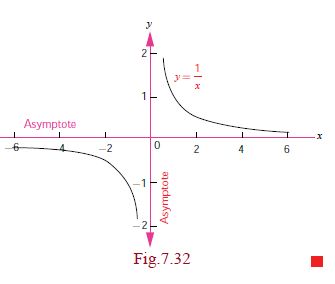
Find the asymptotes of the function f(x) = \(\frac{1}{x}\)
25.
Prove that the function f (x) = x2 − 2x − 3 is strictly increasing in \((2, \infty)\)
26.
Evaluate the limit \(\underset{x\rightarrow 0^{+}}{lim} (\frac{sin \ x}{x^{2}})\)
27.
Evaluate the limit \(\underset{x\rightarrow 0}{lim}(\frac{sin \ mx}{x})\)
28.
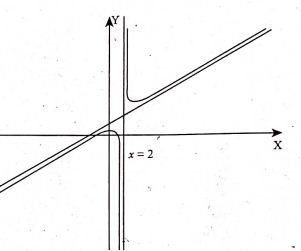
Find the asymptotes of the following curves :\(f(x)=\frac { { x }^{ 2 }+6x-4 }{ 3x-6 } \)
29.
Compute the limit \(\underset{x\rightarrow a}{lim}(\frac{x^{n}-a^{n}}{x-a})\)
30.
Evaluate \(\underset{x\rightarrow 1}{lim}(\frac{x^{2}-3x+2}{x^{2}-4x+3})\).
31.
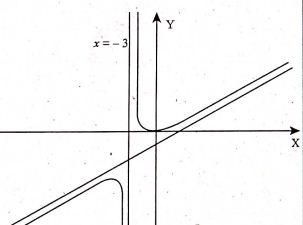
Find the asymptotes of the following curve \(f(x)=\frac { { x }^{ 2 }-6x-1 }{ x+3 } \)
32.
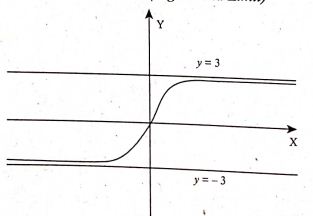
Find the asymptotes of the following curves \(f(x)=\frac { 3x }{ \sqrt { { x }^{ 2 }+2 } } \)
33.
Find the asymptotes of the following curve. \(f(x)=\frac { { x }^{ 2 } }{ { x }^{ 2 }+1 } \)
34.
Find the asymptotes of the following curve \(f(x)=\frac { { x }^{ 2 } }{ { x }^{ 2 }-1 } \)
35.
A stone is dropped into a pond causing ripples in the form of concentric circles. The radius r of the outer ripple is increasing at a constant rate at 2 cm per second. When the radius is 5 cm find the rate of changing of the total area of the disturbed water?
36.
If the volume of a cube of side length x is v = x3. Find the rate of change of the volume with respect to x when x = 5 units.
1.
We have,
f'(x) = 4x3+32 = 0 gives x3 = -8
⇒ x = −2
and f′′(x) = 12 x2
As f''(−2)>0, the function has local minimum at x = −2. The local minimum value is f (−2) = −48
Therefore, the extreme point is (−2, −48) .
2.
Let x be the length of the garden and y be the breadth of the garden.

Given 2 (x +y) = 40
[ஃ length of the wire = 40 Perimeter = 40 m]
⇒ x + y = 20
⇒ y = 20 - x ...(1)
Let f(x) = xy = x (20 - x2) = 20x- xl2
f'(x) = 20 - 2x
f'(x) = 0
⇒ 20-2x = 0
⇒ 20 = 2x
x = 10
ஃ The critical number is 10
f"(x) = -2
Now f"(10) = -2 < 0
ஃ f(x) is minimum at x = 10
When x = 10, y = 20 -10 = 10
ஃ Area = f(x) = xy
= 10(10) = 100m2
ஃ Largest possible area of the garden = 100 m2
3.
Given x + y = 10
⇒ y = 10 -x ...(1)
Let f(x) = x2+y
= x2+ (10 -x)2
= x + 100 +x2- 20x
f(x) = 2x2 - 20x+ 100
f'(x) = 4x - 20
f'(x) = 0
4x-20 = 0
4x = 20
⇒ x = 5
∴The critical number is 5
f"(x) = 4
ஃ f"(5) = 4 > 0
ஃf(x) is minimum when x = 5
When x = 5, y = 10- 5 = 5
[From (1)]
ஃ Smallest possible value of x2+y2
= 52 + 52 = 25 + 25 = 50
4.
5.
Given f(x) = 3x2 - 4x3 ; [-1, 2]
f'(x) = 12x3 - 12x2
f'(x) = 0
⇒12x3- 12x2 = 0
⇒ 12x2(x-1) = 0
⇒ x = 0 or x = 1
Evaluatingf(x) at the end points x = -1, x = 2 and at the critical number x = 0, x = 1 we get
f(-1) = 3(-1)4-4 (-1)3
= 3 + 4 = 7
f(2) = 3(2)4 - 4(23)
= 48 - 32 =16
f(0) = 0
f(1) = 3(1)4 - 4(1)3
= 3 - 4 = -1
From these values, the absolute maximum is 16 at x = 2 and the absolute minimum is -1 which occurs at x = 1.
6.
The average rate of change in an interval [a, b] is \(\frac { f(b)-f(a) }{ b-a } \) whereas, the instantaneous rate of change at a point x is f′(x) for the given function. They are respectively, b + a and 2x.
| a | b | x | Average rate is \(\frac { f(b)-f(a) }{ b-a } \) = b+a | Instantaneous rate is f'(x) = 2x |
| 0 | 0.5 | 0.5 | 0.5 | 1 |
| 0.5 | 1 | 1 | 1.5 | 2 |
| 1 | 1.5 | 1.5 | 2.5 | 3 |
| 1.5 | 2 | 2 | 3.5 | 4 |
7.
We have,
\(f'(x)=2x>0, \forall x\in(2,7)\) and
\(f'(x)=2x>0, \forall x\in(-2,0)\)
and hence the proof is completed.
8.
This is an indeterminate of the form \((\frac{\infty}{\infty})\)
To evaluate this limit, we apply l’Hôpital Rule m times
\(\underset{x\rightarrow \infty}{lim}\frac{e^{x}}{x^{m}}=\underset{x\rightarrow \infty}{lim}\frac{e^{x}}{m!} = \infty\)
9.
This is an indeterminate of the form (0×∞). To evaluate this limit, we first simplify and bring it to the form \((\frac{\infty}{\infty})\) and apply L’Hôpital Rule.
\(\underset{x\rightarrow 0^{+}}{lim}xlog x= \underset{x\rightarrow 0^{+}}{(\frac{log x}{\frac{1}{x}})}\)
\(\underset{x\rightarrow 0^{+}}{lim}(\frac{\frac{1}{x}}{-\frac{1}{x^{2}}})=\underset{x\rightarrow 0^{+}}{lim}(-x)=0.\)
10.
This is an indeterminate of the form \((\frac{\infty}{\infty})\).
To evaluate this limit, we apply l ’Hôpital Rule.
\(\underset{x\rightarrow \infty }{lim}(\frac{x^{2}+17x+29}{x^{4}})=\underset{x\rightarrow \infty}{lim}(\frac{2x+17}{4x^{3}})\)
= \(\underset{x\rightarrow \infty}{lim}(\frac{2}{12x^{2}})=0\)
11.
As this is an indeterminate form \((\frac{0}{0})\) using the l’Hôpital’s Rule
\(\underset{\theta \rightarrow 0}{lim} (\frac{1-cosm\theta}{1-cosn\theta})\)=\(\underset{\theta \rightarrow 0}{lim} (\frac{m-sinm\theta}{n-sinn\theta})\)
\(\underset{\theta\times 0}{lim} \frac{m}{n} (\frac{\frac{sin \ m\theta}{\theta}}{\frac{sin \ n\theta}{\theta}}) =\frac{m^{2}}{n^{2}}\)
Therefore, m2 = n2
That is \(m=\pm n\).
12.
Let f(x) = log x
fl(x) = \(\frac{1}{x}\) = x-1
flI(x) = -1x-2
fIII(x) = 2x-3
fIV(x) = -6 x-4
⇒ f(1) = log 1 = 0
fl(1) = \(\frac11\) = 1
fll(1) = -1
flll(1) = 2
fIV(1) = -6
Taylor series for f(x) at x = 1 is
\(f(x)=f(1)+\frac { { f }^{ 1 }(1) }{ 1! } (x-1)+\frac { { f }^{ II }(1) }{ 2! } ({ x-1) }^{ 2 }+\frac { { f }^{ III }(1) }{ 3! } { (x-1) }^{ 3 }+\).....
log x = \(\frac { 1 }{ 1! } (x-1)+\frac { -1 }{ 2! } { (x-1) }^{ 2 }+\frac { 2 }{ 3! } ({ x-1) }^{ 3 }-\frac { 6 }{ 4! } ({ x-1) }^{ 4 }+..\)
log x = \((x-1)-\frac { 1 }{ 2 } { (x-1) }^{ 2 }+\frac { 1 }{ 3 } { (x-1) }^{ 3 }-\frac { 1 }{ 4 } ({ x-1) }^{ 4 }\)+ ....
13.
Let the two positive numbers be x and y.
Given xy = 20
\(\Rightarrow y=\frac { 20 }{ x } \)
Let f(x) = x+y
\(f(x)=x+\frac { 20 }{ x } \)
\(f'(x)=1-\frac { 20 }{ { x }^{ 2 } } \)
f'(x) = 0
\(\Rightarrow 1-\frac { 20 }{ { x }^{ 2 } } =0\)
\(\Rightarrow 1=\frac { 20 }{ { x }^{ 2 } } \)
\(\Rightarrow { x }^{ 2 }=20\)
\(\Rightarrow x=\pm \sqrt { 20 } \)
\(\Rightarrow x=\pm 2\sqrt { 5 } \)
∴ The critical number are \(2\sqrt { 5 } -2\sqrt { 5 } \)
\(f''(x)=\frac { 40 }{ { x }^{ 3 } } \)
When \(x=2\sqrt { 5 } \)
\(f''\left( x \right) =\frac { 40 }{ \left( 2\sqrt { 5 } \right) ^{ 3 } } >0\)
ஃ f(x) is minimum when \(x=2\sqrt { 5 } \)
When \(x=2\sqrt { 5 } ,y=\frac { 20 }{ 2\sqrt { 5 } } \)
= \(\frac { 10 }{ \sqrt { 5 } } \times \frac { \sqrt { 5 } }{ \sqrt { 5 } } =\frac { 10\sqrt { 5 } }{ 5 } =2\sqrt { 5 } \)
Hence the required positive numbers are \(2\sqrt { 5 } \)
Minimum sum = \(2\sqrt { 5 } \) + \(2\sqrt { 5 } \) = \(4\sqrt { 5 } \)
14.
f'(x) = -2 sin x + 2 cos 2x
f'(x) = 0
\(\Rightarrow\) 2 sin x + 2 cos 2x = 0
\(\Rightarrow\) 2 sin x + 2(1 - 2 sin2x) = 0
\(\Rightarrow\) 4 sin2x + 2 sin x - 2 = 0
\(\Rightarrow\) 4 sin2 x + 2 sin x - 2 = 0
\(\Rightarrow\) 2 sin2 x + sin x-1 = 0
\(\Rightarrow\) (sin x+1) (2sin x-1) = 0
\(\Rightarrow\) \(sinx=-1\ or\ sinx=\frac { 1 }{ 2 } \)
\(\Rightarrow\) \(sinx=-sin\frac { \pi }{ 2 } \) or
\(sinx=sin\frac { \pi }{ 6 } \)
\(\Rightarrow sinx=sin\left( -\frac { \pi }{ 2 } \right) \)
\(sinx=sin\frac { \pi }{ 6 } \)
\(\Rightarrow x=-\frac { \pi }{ 2 } or \ x=\frac { \pi }{ 6 } \)
\(\Rightarrow x=\frac { \pi }{ 6 } \)
\(\\ \\ \\ \\ \\ \\ \left[ \because x=-\frac { \pi }{ 2 }∉ \left[ 0.\frac { \pi }{ 2 } \right] \right] \)
\(\therefore\) The critical number is \(x=\frac { \pi }{ 6 } \)
Evaluating f(x) at the end points x = 0, \(x=\frac { \pi }{ 2 } \) and at the critical number \(x=\frac { \pi }{ 6 } \) we get.
f(0) = 2 cos0 + sin0 = 2
\(f(\frac { \pi }{ 2 } )=2cos\frac { \pi }{ 2 } +sin\pi =0\)
\(f\left( \frac { \pi }{ 6 } \right) =2cos\frac { \pi }{ 2 } +sin\frac { \pi }{ 3 } \)
\(2\left( \frac { \sqrt { 3 } }{ 2 } \right) +\frac { \sqrt { 3 } }{ 2 } =\frac { 3\sqrt { 3 } }{ 2 } \)
From these values, the absolute maximum is \(\frac { 3\sqrt { 3 } }{ 2 } \) which occurs at \(x=\frac { \pi }{ 6 } \) and the absolute minimum is 0 which occurs at \(x=\frac { \pi }{ 2 } \)
15.
f (1) = 0 and f(2) = -2. Clearly f (x) is defined and differentiable in 1< x <2.
Therefore, by the Mean Value Theorem, there exists a c∈(1, 2) such that by
\(f'(c)=\frac{f(2)-f(1)}{2-1}=1-2c\)
That is \(1-2c= -2 \Rightarrow c= \frac{3}{2}\)
16.
\(f'\left( x \right) =6\times \frac { 4 }{ 3 } { x }^{ \frac { 4 }{ 3 } -1 }-3\times \frac { 1 }{ 3 } { x }^{ \frac { 1 }{ 3 } -1 }\)
= \({ 8x }^{ \frac { 1 }{ 3 } }-x^{ \frac { -2 }{ 3 } }\)
f'(x) = 0
\(\Rightarrow{ 8 }x^{ \frac { 1 }{ 3 } }-\frac { 1 }{ { x }^{ \frac { 2 }{ 3 } } } =0\)
\(\Rightarrow \frac { 8x-1 }{ { x }^{ \frac { 2 }{ 3 } } } =0\)
\(\Rightarrow x=\frac { 1 }{ 8 } \)
Thus, the critical number is \(x=\frac { 1 }{ 8 } \)
Evaluating f(x) at the end points = -1
x = 1 and at the critical number x = \(\frac { 1 }{ 8 } \)
we get
\(f(-1)=6(-1)^{ \frac { 4 }{ 3 } }-3\left( -1 \right) ^{ \frac { 1 }{ 3 } }\)
= 6( 1) - 3 (-1) = 6 + 3 = 9
\(f(1)=6(1)^{ \frac { 4 }{ 3 } }-3(1)^{ \frac { 1 }{ 3 } }=6-3=3\)
\(f\left( \frac { 1 }{ 8 } \right) =6\left( \frac { 1 }{ 8 } \right) ^{ \frac { 4 }{ 3 } }-3\left( \frac { 1 }{ 8 } \right) ^{ \frac { 1 }{ 3 } }\)
=\(6\left( { 2 }^{ -3 } \right) ^{ \frac { 4 }{ 3 } }-3\left( 2^{ -3 } \right) ^{ \frac { 1 }{ 3 } }\)
= \(\frac { 6 }{ 16 } -\frac { 3 }{ 2 } =\frac { 3 }{ 8 } -\frac { 3 }{ 2 } \)
= \(\frac { 3-12 }{ 8 } =\frac { -9 }{ 8 } \)
From these values, the absolute maximum is 9 which occurs at x = -1 and the absolute minimum is \(-\frac { 9 }{ 8 } \) which occurs at x = \(\frac { 1 }{ 8 } \)
17.
Let P(x) = \(a_{n}x^{n}+a_{n-1}x^{n-1}+...+a_{1}x+a_{0}\). Let \(\alpha<\beta \) be two real zeros of P(x). Therefore, \(P(\alpha)=P(\beta)=0.\) Since P(x) is continuous in \([\alpha, \beta]\) and differentiable in \((\alpha, \beta)\) by an application of Rolle’s theorem there exists \(\gamma \in (\alpha,\beta)\) such that \(P'(\gamma)=0\). Since,
\(P'(x)=na_{n}x^{n-1}+(n-1)a_{n-1}x^{n-2}+...+a_{1}\) which completes the proof.
18.
f(x) = x2 -12x + 10; [1, 2]
Given f(x) = x2 -12x + 10 ; [1, 2]
f'(x) = 2x - 12
f'(x) = 0
\(\Rightarrow\) 2x-12 = 0
\(\Rightarrow\) 2x = 12
\(\Rightarrow\) x = 6
\(\therefore\) The critical number is 6
Evaluating f (x) at the end points x = 1,
x = 2 and at the critical number x = 6 we get
f(1) = 12-12(1)+10 = -1
f(2) = 22-12(2)+10 = -10
Absolute maximum f(1) = -1
Absolute minimum f(2) = -10
19.
The curve y = sin x intersects the positive x -axis. When y = 0 which gives, x =
\( x=n\pi , n=1,2,3,...\)
Now, \(\frac{dy}{dx}=cos x\). The slpoe \(x=n\pi\) are \(cos(n\pi)=(-1)^{n}\).
Hence, the required angle of intersection is m2 = 0
\(tan \theta = \frac{(-1)^n - 0}{1+((-1)^n(0)} = 1 ∀ n\)
20.
The slope of the line y = x is 1. The tangent to the given curve will be parallel to the line, if the slope of the tangent to the curve at a point is also 1. Hence,
\(\frac{dy}{dx}=3x^{2}-6x+1=1\)
which gives \( 3x^{2}-6x=0\)
Hence, x = 0 and x = 2.
Therefore, at (0, –2) and (2, –4) the tangent is parallel to the line y = x.
21.
Given m (x) = \(\sqrt { 3 } x\) = \(\sqrt { 3 } .{ x }^{ \frac { 1 }{ 2 } }\)
Differentiating with respect to 'x' we get,
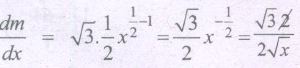
when x = 3, \(\frac { dm }{ dx } =\frac { \sqrt { 3 } }{ 2\sqrt { 3 } } =\frac { 1 }{ 2 } \) Kg/m
when x = 27, \(\frac { dm }{ dx } =\frac { \sqrt { 3 } }{ 2\sqrt { 27 } } \)
\(=\frac{\sqrt{\not 3}}{2(3) \sqrt{\not 3}}=\frac{1}{6} \mathrm{Kg} / \mathrm{m}\)
22.
Given s = 2t2 + 3t
s(3) = 2 \(\times\) 32 + 3 (3)
= 2\(\times\)9+9
= 27 m ....(1)
s(6) = 2\(\times\) 62 + 3 (6)
= 72 + 18 = 90m ... (2)
Average velocity = \(\frac { s(6)-s(3) }{ 6-3 } \)
= \(\frac { 90-27 }{ 3 } \) = 21 m/s
(ii) Instantaneous Velocity V(t) = \(\frac { ds }{ dt } \)
Instantaneous Velocity at t = 3
= V(3) = 15 m/sec
Instantaneous Velocity at t = 6
= V(6) = 27m/sec
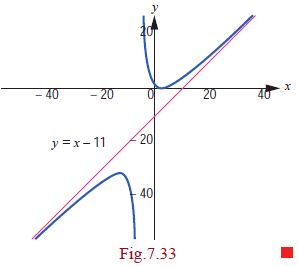
23.
24.
We have,
\(\underset { x\rightarrow { 0 }^{ - } }{ lim } =-\infty \ and\ \underset { x\rightarrow { 0 }^{ x } }{ lim } =\frac { 1 }{ x } =\infty \). Hence, the required vertical asymptote is x = 0 or the y -axis.
As the curve is symmetric with respect to both the axes, y = 0 or the x -axis is also an asymptote.
Hence this (rectangular hyperbola) curve has both the vertical and horizontal asymptotes.
25.
Since f(x) = x2 - 2x - 3 , \(f'(x)=2x-2>0 \forall x\in (2, \infty)\). Hence f (x) is strictly increasing in \((2, \infty)\)
26.
If we directly substitute x = 0 we get an indeterminate form \(\frac{0}{0}\) and hence we apply the l’Hôpital’s rule to evaluate the limit as,
\(\underset{x\rightarrow 0^{+}}{lim}(\frac{sin \ x}{x^{2}})=\underset{x\rightarrow 0^{+}}{lim}(\frac{cos \ x}{2x})=\infty\)
\(\underset{x\rightarrow 0^{-}}{lim}(\frac{sin \ x}{x^{2}})=\underset{x\rightarrow 0^{-}}{lim}(\frac{cos \ x}{2x})=\infty\)
As the left limit and the right limit are not the same we conclude that the limit does not exist.
Remark
One may be tempted to use the l’Hôpital’s rule once again in \(\underset{x\rightarrow 0^{+}}{lim} (\frac{cos \ x}{2x})\) to conclude
\(\underset{x\rightarrow 0^{+}}{lim} (\frac{cos \ x}{2x})\)\(\underset{x\rightarrow 0^{+}}{lim} (\frac{-sin \ x}{2})\)=0
which is not true because it was not an indeterminate form.
27.
If we directly substitute x = 0 we get an indeterminate form \(\frac{0}{0}\) and hence we apply the l’Hôpital’s rule to evaluate the limit as
\(\underset{x\rightarrow 0}{lim}(\frac{sin \ mx}{x})\)=\(\underset{x\rightarrow 0}{lim}(\frac{m\times cos \ mx}{1})\)
= m
The next example tells that the limit does not exist.
28.
Given
\(f(x)=\frac { { x }^{ 2 }+6x-4 }{ 3x-6 } \)
\(\underset { x\rightarrow { 2 }^{ + } }{ lim } \frac { { x }^{ 2 }+6x-4 }{ 3x-6 } =\underset { h\rightarrow 0^{ + } }{ lim } \frac { (2+h)^{ 2 }+6(2+h)-4 }{ 3(2+h)-6 } \)
= \(\underset { h\rightarrow 0^{ + } }{ lim } \frac { (2+h)^{ 2 }+6(2+h)-4 }{ 6+3h-6 } \)
= -∞
ஃ x = 2 is the vertical asymptote,
Also
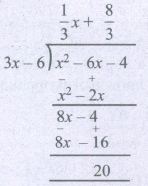
\(\therefore y=\frac { 1 }{ 3 } x+\frac { 8 }{ 3 } \) is the slanting asymptote.
29.
If we put directly x = a we observe that the given function is in an indeterminate form \(\frac00\).
As the numerator and the denominator functions are polynomials they both are differentiable.
Hence by an application of the l’Hôpital Rule we get,
\(\underset{x\rightarrow a}{lim}(\frac{x^{n}-a^{n}}{x-a})\) = \(\underset{x\rightarrow a}{lim}(\frac{n\times x^{n-1}}{1})\)
= \(n \times a^{n-1} \).
30.
If we put directly x = 1 we observe that the given function is in an indeterminate form \(\frac{0}{0}\). As the numerator and the denominator functions are polynomials of degree 2 they both are differentiable.
Hence, by an application of the l’Hôpital Rule, we get
\(\underset{x\rightarrow 1}{lim}(\frac{x^{2}-3x+2}{x^{2}-4x+3})=\underset{x\rightarrow 1}{lime}(\frac{2x-3}{2x-4})\)
= \(\frac{1}{2}\)
Note that this limit may also be evaluated through the factorization of the numerator and denominator as \(\frac{x^{2}-3x+2}{x^{2}-4x+3}=\frac{(x-1)(x-2)}{(x-1)(x-3)}\)
31.
Given \(f(x)=\frac { { x }^{ 2 }-6x-1 }{ x+3 } \)
\(\underset { x\rightarrow -3^{ + } }{ lim } \frac { { x }^{ 2 }-6x-1 }{ x+3 } =\underset { h\rightarrow { 0 }^{ + } }{ lim } \frac { \left( -3+h \right) ^{ 2 }-6(-3+h)-1 }{ -3+h+3 } \)
= \(\underset { h\rightarrow 0^{ + } }{ lim } \frac { 9+{ h }^{ 2 }-6h+18-6h-1 }{ h } \)
= \(\underset { h\rightarrow 0^{ + } }{ lim } \frac { { h }^{ 2 }-12h+26 }{ h } =\infty \)
and \(\underset { x\rightarrow 3^{ - } }{ lim } \frac { { x }^{ 2 }-6x-1 }{ x+3 } =\underset { h\rightarrow { o }^{ + } }{ lim } \frac { \left( -3-h \right) ^{ 2 }-6(-3-h)-1 }{ -3-h+3 } \)
= -∞
ஃx = -3 is the vertical asymptote,
Also
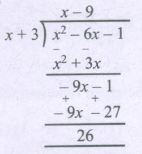
ஃ y = x - 9 is the slanting asymptote,
32.
\(f(x)=\frac { 3x }{ \sqrt { { x }^{ 2 }+2 } } \)
\(\underset { x\rightarrow \infty }{ lim } \frac { 3x }{ \sqrt { { x }^{ 2 }+2 } } =\underset { \frac { 1 }{ x } \rightarrow 0 }{ lim } \frac { 3 }{ \sqrt { 1+\frac { 2 }{ { x }^{ 2 } } } } \)
= \(\frac { 3 }{ \sqrt { 1+0 } } =3\)
ஃy = 3 is the horizontal asymptote.
Also \(\underset { x\rightarrow -\infty }{ lim } \frac { 3x }{ \sqrt { { x }^{ 2 }+2 } } =\underset { \frac { 1 }{ x } \rightarrow { 0 }^{ - } }{ lim } \frac { 3 }{ \sqrt { 1+\frac { 2 }{ { x }^{ 2 } } } } =-3\)
ஃ y = -3 is the horizontal asymptote
33.
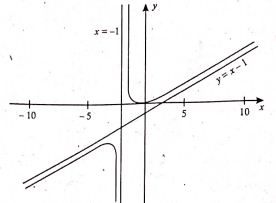
Given \(f(x)=\frac { { x }^{ 2 } }{ { x }^{ 2 }+1 } \)
\(\underset { x\rightarrow { 1 }^{ - } }{ lim } \frac { { x }^{ 2 } }{ x+1 } =\underset { h\rightarrow { o }^{ + } }{ lim } \frac { \left( -1-h \right) ^{ 2 } }{ -1-h+1 } \)
= \(\underset { h\rightarrow 0^{ + } }{ lim } \frac { (1+h)^{ 2 } }{ -h } =-\infty \)
\(\underset { x\rightarrow -1^{ + } }{ lim } \frac { { x }^{ 2 } }{ x+1 } =\underset { h\rightarrow 0^{ + } }{ lim } \frac { (-1+h)^{ 2 } }{ -1+h+1 } \)
= \(\underset { h\rightarrow 0^{ + } }{ lim } \frac { (h-1)^{ 2 } }{ h } =\infty \)
ஃ x = -1 is the vertical asymptote,
Since the numerator's degree is more than the denominator's degree, let us divide x2 by x + 1
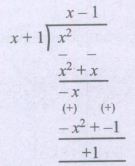
ஃy = x-1 is the slanting asymptote,
34.
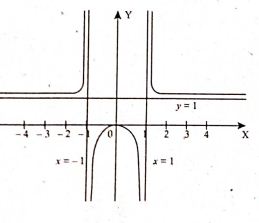
Given \(f(x)=\frac { { x }^{ 2 } }{ { x }^{ 2 }-1 } \)
\(\quad \underset { x\rightarrow 1^{ + } }{ lim } \frac { { x }^{ 2 } }{ { x }^{ 2 }-1 } =\underset { x\rightarrow 1^{ + } }{ lim } \frac { { x }^{ 2 } }{ \left( x+1 \right) \left( x-1 \right) } \)
= \(\underset { h\rightarrow { 0 }^{ + } }{ lim } \frac { \left( 1+h \right) ^{ 2 } }{ \left( 1+h+1 \right) \left( 1+h-1 \right) } \)
= \(\underset { h\rightarrow 0^{ + } }{ lim } \frac { (1+h)^{ 2 } }{ (2+h)(h) } \infty \)
Also \(\underset { x\rightarrow 1^{ - } }{ lim } \frac { { x }^{ 2 } }{ (x+1)/(x-1) } =\underset { h\rightarrow 0^{ + } }{ lim } \frac { \left( 1-h \right) ^{ 2 } }{ \left( 1-h+1 \right) \left( 1-h-1 \right) } \)
= \(\underset { h\rightarrow { 0 }^{ + } }{ lim } \frac { \left( 1-h \right) ^{ 2 } }{ (2-h)(-h) } =-\infty \)
ஃ x = -1 and x = 1are vertical asymptotes,
Also
\(\underset { x-\rightarrow \infty }{ lim } \frac { { x }^{ 2 } }{ { x }^{ 2 }-1 } =\underset { \frac { 1 }{ x } \rightarrow 0 }{ lim } \frac { 1 }{ 1-\frac { 1 }{ { x }^{ 2 } } } =1\)
[Divide numerator and denominator by x2]
ஃ y = 1 is a horizontal asymptote,
35.
Let r be the radius of the ripple and A be the area of the ripple.
GIven \(\frac { dr }{ dt } \) = 2 cm/sec and r = 5 cm ... (1)
We know A = πr2
Differentiating with respect to 't' we get,
\(\frac { dA }{ dt } \) = π(2r).\(\frac { dr }{ dt } \)
= π(2) (5) (2) [using (1)]
\(\frac { dA }{ dt } \) = 20 πsq.cm/sec.
36.
Given v = x3
Differentiating with respect to x we get,
\(\frac { dv }{ dt } \) = 3x2
When x = 5, \(\frac { dv }{ dt } \) = 3(52) = 75
∴ \(\frac { dv }{ dt } \) when x = 5 is 75 units.

12th Standard Syllabus & Materials
12th Standard
TN 12th Computer Applications களப்பெயர் முறைமை (DNS) Sample Question Papers Study Material - QB365 Set A
NEW12th Standard
TN 12th Computer Applications வலையமைப்பு எடுத்துக்காட்டுகள் மற்றும் நெறிமுறைகள் Sample Question Papers Study Material - QB365 Set A
NEW12th Standard
TN 12th Computer Applications கணினி வலையமைப்பு ஓர் அறிமுகம் Sample Question Papers Study Material - QB365 Set A
NEW12th Standard
TN 12th Computer Applications PHP-உடன் MySQL-ஐ இணைத்தல் Sample Question Papers Study Material - QB365 Set A



Tamilnadu Stateboard 12th Standard Subjects
Maths

Chemistry

Physics

Biology

Computer Science

Business Maths and Statistics

Economics

Commerce

Accountancy

History

Computer Applications
Biology
Computer Technology
Computer Applications
Computer Science
Business Maths and Statistics
Commerce
Economics
Maths
Chemistry
Physics
Computer Technology
History
Accountancy

Tamil

English

French
Tamilnadu Stateboard Standards

