
 100% FREE ACCESS
12th Standard Syllabus & Materials
12th Standard
TN 12th Maths Applications of Matrices and Determinants Sample Question Papers Study Material - QB365 Set A
NEW12th Standard
TN 12th Computer Applications மின்னணு தரவு பரிமாற்றம் Sample Question Papers Study Material - QB365 Set A
NEW12th Standard
TN 12th Computer Applications மின் - வணிக பாதுகாப்பு அமைப்புகள் Sample Question Papers Study Material - QB365 Set A
NEW12th Standard
TN 12th Computer Applications மின்னணு செலுத்தல் முறைகள் Sample Question Papers Study Material - QB365 Set A
NEW12th Standard
TN 12th Computer Applications மின் - வணிகம் Sample Question Papers Study Material - QB365 Set A
NEW12th Standard
TN 12th Computer Applications திறந்த மூல கருத்துருக்கள் Sample Question Papers Study Material - QB365 Set A

Published on: 02/09/2022
QB365 provides a detailed and simple solution for every Possible Book Back Questions in Class 12 Maths Subject - Application of Differential Calculus, English Medium. It will help Students to get more practice questions, Students can Practice these question papers in addition to score best marks.
Download Tamil Nadu 12th Standard Maths question papers, model tests, one-mark questions, important questions, and public exam papers in PDF format. Free study materials and answer keys for TN State Board students.
Questions + Answers key
Take MCQ Maths Test1.
A particle is fired straight up from the ground to reach a height of s feet in t seconds, where s(t) = 128t −16t2.
(1) Compute the maximum height of the particle reached.
(2) What is the velocity when the particle hits the ground?
2.
Sketch the graph of the function \(y=\frac { 3x }{ { x }^{ 2 }-1 } \)
3.
A steel plant is capable of producing x tonnes per day of a low-grade steel and y tonnes per day of a high-grade steel, where \(y=\frac { 40-5x }{ 10-x } \). If the fixed market price of low-grade steel is half that of high-grade steel, then what should be optimal productions in low-grade steel and high-grade steel in order to have maximum receipts.
4.
Find the points on the unit circle x2 + y2 = 1 nearest and farthest from (1, 1).
5.
Sketch the curve \(y=\frac { { x }^{ 2 }-3x }{ (x-1) } \)
6.
Sketch the curve y = f (x) = x3−6x-9
7.
Prove that among all the rectangles of the given area square has the least perimeter.
8.
Find the local extrema of the function f(x) = 4x6 − 6x4
9.
Find the intervals of monotonicity and local extrema of the function \(f(x)=\frac{x }{1+x^{2}}\)
10.
Sketch the curve y = f (x) = x2 − x −6 .
11.
Determine the intervals of concavity of the curve f (x) = (x −1)3. (x − 5), x∈R and, points of inflection if any.
12.
Find the intervals of monotonicity and hence find the local extrema for the function \(f(x)=x^{\frac{2}{3}}\).
13.
For the function f{x) = 4x3 + 3x2 - 6x + 1 find the intervals of monotonicity, local extrema, intervals of concavity and points of inflection.
14.
Evaluate the following limit, if necessary use l’Hôpital Rule
\(\underset { x\rightarrow { 0 }^{ + } }{ lim } { x }^{ x }\)
15.
Sketch the graphs of the following function
\(y=\frac { 1 }{ 1+{ e }^{ -x } } \)
16.
Sketch the graphs of the following function.
\(y=\frac { { x }^{ 2 }+1 }{ { x }^{ 2 }-4 } \)
17.
Sketch the graphs of the following function.
\(y=x\sqrt { 4-x } \)
18.
Sketch the graphs of the following function.
\(y=-\frac { 1 }{ 3 } \left( { x }^{ 3 }-3x+2 \right) \)
19.
20.
The volume of a cylinder is given by the formula V = πr2 h. Find the greatest and least values of V if r + h = 6.
21.
A manufacturer wants to design an open box having a square base and a surface area of 108 sq. cm. Determine the dimensions of the box for the maximum volume.
22.
Find the dimensions of the largest rectangle that can be inscribed in a semi circle of radius r cm.
23.
Prove that among all the rectangles of the given perimeter, the square has the maximum area.
24.
Find the dimensions of the rectangle with maximum area that can be inscribed in a circle of radius 10 cm.
25.
Write the Taylor series expansion of \(\frac{1}{x}\) about x = 2 by finding the first three non-zero terms.
26.
Expand tan x in ascending powers of x upto 5th power for \(-\frac{\pi}{2} <x<\frac{\pi}{2}\)
27.
A farmer plans to fence a rectangular pasture adjacent to a river. The pasture must contain1,80,000 sq. mtrs in order to provide enough grass for herds. No fencing is needed along the river. What is the length of the minimum needed fencing material
28.
Expand log(1+ x) as a Maclaurin’s series upto 4 non-zero terms for –1 < x ≤ 1.
29.
Using mean value theorem prove that for, a > 0, b > 0, le-a - e-bl < la - bl.
30.
A rectangular page is to contain 24 cm2 of print. The margins at the top and bottom of the page are 1.5 cm and the margins at other sides of the page is 1 cm. What should be the dimensions of the page so that the area of the paper used is minimum.
31.
Show that there lies a point on the curve f(x) = x (x + 3) e\(\frac{\pi}{2}\), -3 ≤ x ≤ 0 where tangent drawn is parallel to the x -axis.
32.
Does there exist a differentiable function f(x) such that f(0) = -1, f(2) = 4 and f'(x) ≤ 2 for all x. Justify you answer.
33.
Find the intervals of monotonicities and hence find the local extremum for the following function:
f(x) = sin x cos x + 5, x ∈ (0,2π)
34.
Find the intervals of monotonicities and hence find the local extremum for the following function:
\(f(x)=\frac { { x }^{ 3 } }{ 3 } -logx\)
35.
Find the intervals of monotonicities and hence find the local extremum for the following function:
\(f(x)=\frac { { e }^{ x } }{ 1-{ e }^{ x } } \)
36.
Find the intervals of monotonicities and hence find the local extremum for the following function:
\(f(x)=\frac { x }{ x-5 } \)
37.
Find the intervals of monotonicities and hence find the local extremum for the following function:
f(x) = 2x3+ 3x2-12x
38.
Show that the two curves x2 − y2 = r2 and xy = c2 where c, r are constants, cut orthogonally
39.
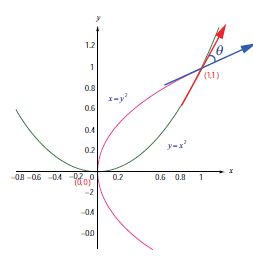
Find the angle between the rectangular hyperbola xy = 2 and the parabola x2 + 4y = 0
40.
Prove that the ellipse x2 + 4y2 = 8 and the hyperbola x2-2y2 = 4 intersect orthogonally.
41.
If the curves ax2+ by2 = 1 and cx2+ dy2 = 1 intersect each other orthogonally then, \(\frac{1}{a}-\frac{1}{b}=\frac{1}{c}-\frac{1}{d}\)
42.
43.
Find the angle between y = x2 and y = (x − 3)2.
44.
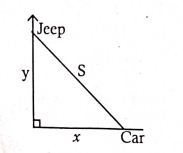
A police jeep, approaching an orthogonal intersection from the northern direction, is chasing a speeding car that has turned and moving straight east. When the jeep is 0.6 km north of the intersection and the car is 0.8 km to the east. The police determine with a radar that the distance between them and the car is increasing at 20 km/hr. If the jeep is moving at 60 km/hr at the instant of measurement, what is the speed of the car?
45.
A ladder 17 metre long is leaning against the wall. The base of the ladder is pulled away from the wall at a rate of 5 m/s. When the base of the ladder is 8 metres from the wall.
46.
A ladder 17 metre long is leaning against the wall. The base of the ladder is pulled away from the wall at a rate of 5 m/s. When the base of the ladder is 8 metres from the wall.
(i) How fast is the top of the ladder moving down the wall?
(ii) At what rate, the area of the triangle formed by the ladder, wall and the floor is changing?
47.
48.
A beacon makes one revolution every 10 seconds. It is located on a ship which is anchored 5 km from a straight shore line. How fast is the beam moving along the shore line when it makes an angle of 45° with the shore?
49.
A particle moves along a line according to the law s(t) = 2t3 − 9t2 +12t − 4, where t ≥ 0.
50.
A particle moves along a line according to the law s(t) = 2t3 − 9t2 +12t − 4, where t ≥ 0.
51.
A particle moves along a line according to the law s(t) = 2t3 − 9t2 +12t − 4, where t ≥ 0.
(i) At what times the particle changes direction?
(ii) Find the total distance travelled by the particle in the first 4 seconds.
(iii) Find the particle’s acceleration each time the velocity is zero.
52.
A camera is accidentally knocked off an edge of a cliff 400 ft high. The camera falls a distance of s =16t2 in t seconds
53.
A camera is accidentally knocked off an edge of a cliff 400 ft high. The camera falls a distance of s =16t2 in t seconds
What is the average velocity with which the camera falls during the last 2 seconds?
54.
A camera is accidentally knocked off an edge of a cliff 400 ft high. The camera falls a distance of s = 16t2 in t seconds.
(i) How long does the camera fall before it hits the ground?
(ii) What is the average velocity with which the camera falls during the last 2 seconds?
(iii) What is the instantaneous velocity of the camera when it hits the ground?
55.
A road running north to south crosses a road going east to west at the point P. Car A is driving north along the first road, and car B is driving east along the second road. At a particular time car A 10 kilometres to the north of P and traveling at 80 km/hr, while car B is 15 kilometres to the east of P and traveling at 100 km/hr. How fast is the distance between the two cars changing?
56.
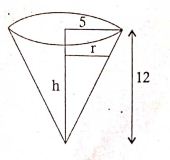
Salt is poured from a conveyer belt at a rate of 30 cubic metre per minute forming a conical pile with a circular base whose height and diameter of base are always equal. How fast is the height of the pile increasing when the pile is 10 metre high?
57.
If we blow air into a balloon of spherical shape at a rate of 1000 cm3 per second. At what rate the radius of the baloon changes when the radius is 7cm? Also compute the rate at which the surface area changes.
58.
A particle moves along a horizontal line such that its position at any time t ≥ 0 is given by s(t) = t3 − 6t2 +9 t +1, where s is measured in metres and t in seconds?
(1) At what time the particle is at rest?
(2) At what time the particle changes its direction?
(3) Find the total distance travelled by the particle in the first 2 seconds.
59.
Expand sin x in ascending powers x - \(\frac{\pi}{4}\) upto three non-zero terms.
60.
Suppose that for a function f(x), f'(x) ≤ 1for all 1 ≤ x ≤ 4. Show that f(4) - f(1) ≤ 3.
61.
A race car driver is racing at 20th km. If his speed never exceeds 150 km/hr, what is the maximum kilometer he can reach in the next two hours.
62.
Show that the value in the conclusion of the mean value theorem for
f(x) = Ax2 + Bx + c on any interval [a, b] is \(\frac{a+b}{2}\)
63.
Show that the value in the conclusion of the mean value theorem for
\(f(x)=\frac{1}{x}\) on a closed interval of positive numbers [a, b] is \(\sqrt{ab} \)
64.
Using the Lagrange’s mean value theorem determine the values of x at which the tangent is parallel to the secant line at the end points of the given interval:
f (x) = (x − 2)(x − 7), x ∈ [3,11]
65.
Using the Lagrange’s mean value theorem determine the values of x at which the tangent is parallel to the secant line at the end points of the given interval:
f(x) = x3 − 3x + 2, x ∈ [-2, 2]
66.
67.
Find the equations of the tangents to the curve y = \(\frac{x+1}{x-1}\) which are parallel to the line x + 2y = 6.
68.
Find the equations of the tangents to the curve y = 1 + x3 for which the tangent is orthogonal with the line x +12y = 12.
69.
Find the points on the curve y2 - 4xy = x2 + 5 for which the tangent is horizontal.
70.
Find the points on the curve y = x3 − 6x2 + x + 3 where the normal is parallel to the line x + y = 1729.
71.
Find the equation of the tangent and normal to the Lissajous curve given by x = 2cos 3t and y = 3sin 2t, t ∈ R
1.
(i) At the maximum height, the velocity v(t) of the particle is zero.
Now, we find the velocity of the particle at time t.
\(v(t)=\frac{ds}{dt}=128-32t\)
\(v(t)=0 \Rightarrow 128-32t=0 \Rightarrow t=4.\)
After 4 seconds, the particle reaches the maximum height.
The height at t = 4 is s(4) = 128(4) - 16(4)2 = 256 ft.
(ii) When the particle hits the ground then s = 0 .
s = 0 ⇒ 128t −16t2 = 0
⇒ t = 0, 8 seconds.
The particle hits the ground at t = 8 seconds. The velocity when it hits the ground v(8) = –128 ft /s.
2.
(1) The domain of f (x) is R \{−1,1}.
(2) Since f (−x,−y) = f (x, y) , the curve is symmetric about the origin.
(3) Putting y = 0, we get x = 0 . Hence the x -intercept is (0, 0).
(4) Putting x = 0, we get y = 0. Hence the y -intercept is (0, 0).
(5) To determine monotonicity, we find the first derivative as \(f'(x)\frac { -3\left( { x }^{ 2 }+1 \right) }{ { ({ x }^{ 2 }-1) }^{ 2 } } \)
Hence, f'( x) does not exist at x = −1,1. Therefore, critical numbers are x = −1, 1. The intervals of monotonicity is tabulated
| Interval | (-\(\infty\), -1) | (-1, 1) | (1, \(\infty\)) |
| Sign of f'(x) | - | - | - |
| Monotonicity | strictly decreasing | strictly decreasing | strictly decreasing |
6) Since there is no sign change in f'( x) when passing through critical numbers. There is no local extrema.
(7) To determine the concavity, we find the second derivative as \(f"(x)=\frac { 6x({ x }^{ 2 }-3) }{ { ({ x }^{ 2 }-1) }^{ 3 } } \) f"( x) = 0\(\Rightarrow\) x = 0 and f"(x) does not exist at x = −1, 1.
The intervals of concavity is tabulated.
| Interval | (-\(\infty\),-1) | (-1, 0) | (0,1) | (1,\(\infty\)) |
| Sign of f'(x) | - | + | - | + |
| Concavity | concave down |
concave up | concave down |
concave up |
(8) As x = −1 and 1are not in the domain of f(x) and at x = 0, the second derivative is zero and f"(x) changes its sign from positive to negative when passing through x = 0. Therefore, the point of inflection is (0, f (0)) = (0,0) .
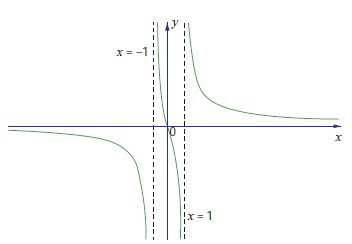
(9) \(\underset { x\rightarrow \pm \infty }{ lim } f(x)=\underset { x\rightarrow \pm }{ lim } \cfrac { 3x }{ { x }^{ 2 }-1 } =\underset { x\rightarrow \pm \infty }{ lim } \cfrac { 3 }{ x\frac { 1 }{ x } } =0\) Therefore y = 0 is a horizontal asymptote.
Since the denominator is zero, when x = 士1.\(\underset { x{ \rightarrow -1 }^{ - } }{ lim } \frac { 3x }{ { x }^{ 2 }-1 } -\infty ,\underset { x{ \rightarrow -1 }^{ + } }{ lim } \frac { 3x }{ { x }^{ 2 }-1 } =\infty ,\underset { x{ \rightarrow 1 }^{ - } }{ lim } \frac { 3x }{ { x }^{ 2 }-1 } -\infty ,\underset { x{ \rightarrow 1 }^{ + } }{ lim } \frac { 3x }{ { x }^{ 2 }-1 } =\infty .\)
Therefore x = −1 and x = 1 are vertical asymptotes.
The rough sketch of the curve is shown on the right side.
3.
Let the price of low-grade steel be Rs. p per tonne. Then the price of high-grade steel is Rs. 2p per tonne.
The total receipt per day is given by \(R=px+py=px+2p\left( \frac { 40-5x }{ 10-x } \right) \). Hence the problem is to maximise R . Now, simplifying and differentiating R with respect to x , we get
\(R=p\left( \frac { 80-{ x }^{ 2 } }{ 10-x } \right) \)
\(\frac { dR }{ dx } =p\left( \frac { { x }^{ 2 }-20x+80 }{ (10-x)^{ 2 } } \right) \)
\(\frac { dR }{ dx } =-\frac { 40P }{ \left( 10-x \right) ^{ 3 } } \)
Now, \(\frac { dR }{ dx } =0\Rightarrow { x }^{ 2 }-20x+80=0\) and hence \(x=10\pm 2\sqrt { 5 } \)
At \(x=10-2\sqrt { 5 } ,\frac { { d }^{ 2 }R }{ { dx }^{ 2 } } <0\) and hence R will be maximum. If x \(x=10-2\sqrt { 5 } \) then \(y=5-\sqrt { 5 } \)
Therefore the steel plant must produce low-grade and high-grade steels respectively in tonnes per day are \(10-2\sqrt { 5 } \) and \(5-5\sqrt { 5 } \)
4.
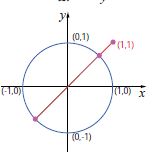
The distance from the point (1, 1) to any point (x, y) is d =\(\sqrt { { \left( x-1 \right) }^{ 2 }+{ \left( y-1 \right) }^{ 2 } } \). Instead of extremising d, for convenience we extremise D = d2 = (x−1)2+ (y− 1)2 subject to the condition, x2 + y2 = 1 Now, \(\frac { dD }{ dx } \) = 2( x −1)+2(y −1) \(\times\) \(\frac { dy }{ dx } \) where the \(\frac { dy }{ dx } \) will be computed by differentiating x2 y2 + = 1 with respect to x . Therefore we get, 2x + 2y \(\frac { dy }{ dx } \) = 0 which gives \(\frac { dy }{ dx } \) = -\(\frac { x }{ y } \)
Substituting this, we get \(\frac { dD }{ dx } \) = 2(x −1) +2(y −1)\(\left(- \frac { x }{ y } \right) \)
= \(\frac { 2\left[ xy-y-xy+x \right] }{ y } \)
Substituting this, we get \(\frac { dD }{ dx } \) =2\(\left[ \frac { x-y }{ y } \right] \)=0
⇒x = y
Since (x, y) lie on the circle x2 + y2 + =1 we get, 2x2 = 1 gives x = 土\(\frac { 1 }{ \sqrt { 2 } } \).
Hence the points at which the extremum distance occur are \(\left( \frac { 1 }{ \sqrt { 2 } } ,\frac { 1 }{ \sqrt { 2 } } \right) \), \(\left( -\frac { 1 }{ \sqrt { 2 } } ,-\frac { 1 }{ \sqrt { 2 } } \right) \)
To find the extrema, we apply second derivative test. So,
\(\frac { { d }^{ 2 }D }{ { dx }^{ 2 } } =2\frac { { y }^{ 2 }+{ x }^{ 2 } }{ { y }^{ 3 } } \)
The value of \({ \left( \frac { { d }^{ 2 }D }{ { dx }^{ 2 } } \right) }_{ \left( \frac { 1 }{ \sqrt { 2 } } ,\frac { 1 }{ \sqrt { 2 } } \right) }>0;{ \left( \frac { { d }^{ 2 }D }{ { dx }^{ 2 } } \right) }_{ \left( -\frac { 1 }{ \sqrt { 2 } } ,-\frac { 1 }{ \sqrt { 2 } } \right) }<0\)
This implies the nearest and farthest points are \(\left( \frac { 1 }{ \sqrt { 2 } } ,\frac { 1 }{ \sqrt { 2 } } \right) \) and \(\left( -\frac { 1 }{ \sqrt { 2 } } ,-\frac { 1 }{ \sqrt { 2 } } \right) \)
Therefore, the nearest and the farthest distances are respectively \(\sqrt { 2 } \)-1 and \(\sqrt { 2 } \)+1
5.
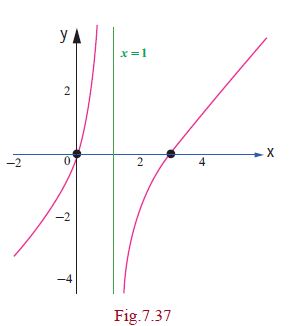
Factorising the given function we have
\(y=f(x)\frac { { x(x }-3x) }{ (x-1) } \)
(1) The domain and the range of f (x) are respectively R \{1} and the entire real line.
(2) Putting y = 0 we get the x = 0, 3. Therefore the x -intercept is (3,0). Putting x = 0, we get y = 0. Therefore the curve passes through the origin.
(3) \(f'(x)\frac { { x }^{ 2 }-2x+3 }{ { (x-1) }^{ 2 } } \) and hence the critical point of the curve occurs at x =1 as f′(1) does not exist. But x2 -x − 2 + 3 = 0 has no real solution. Hence the only critical point occurs at x = 1.
(4) x =1 is not in the domain of the function and f'(x) ≠0 ∀x ∈R \{1}, there is no local maximum or local minimum.
(5) \(f"(x)=-\frac { 4 }{ { (x-1) }^{ 3 } } \)∀x∈R\{1}. Therefore when x <1, f"(x)>0the curve is concave upwards in (-∞,1) and x>1, f"(x)<0 the curve is concave downwards in (1,∞). Since f"(x} ≠ 0 ∈ R\{1} there is no point of infection for f(x).
(6) Since, \(\underset { x\rightarrow { 1 }^{ - } }{ lim } \frac { { x }^{ 2 }-3x }{ (x-1) } =+\infty \ and\ \underset { x\rightarrow { 1 }^{ + } }{ lim } \frac { { x }^{ 2 }-3x }{ (x-1) } =-\infty ,\ x=1\) is a vertical asymptote.
The rough sketch is shown.
6.
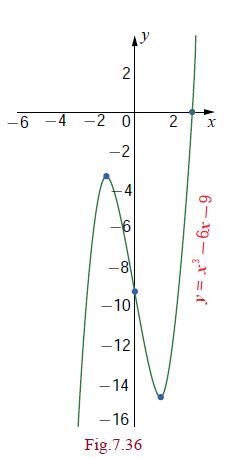
Factorising the given function, we have
y = f (x) = (x − 3)(x2 + 3x + 3).
(1) The domain and the range of the given function f(x) are the entire real line.
(2) Putting y = 0, we get the x = 3. The other two roots are imaginary. Therefore, the x -intercept is (3, 0) . Putting x = 0, we get y = −9. Therefore, the y-intercept is (0, −9)
(3) f'(x) = 3(x2 -2) and hence the critical points of the curve occur at x = \(\pm \sqrt { 2 } \)
(4) f"(x) = 6x. Therefore at x =\(\sqrt{2}\) the curve has a local minimum because f"(\(\sqrt{2}\)) = 6\(\sqrt{2}\) > 0. Then local minimum is f(\(\sqrt{2}\)) = -4\(\sqrt{2}\)-9.
Similarly x = -\(\sqrt{2}\) the curve has a local maximum because f"(-\(\sqrt{2}\)) = -6\(\sqrt{2}\) < 0. The local maximum is f (-\(\sqrt{2}\)) = 4\(\sqrt{2}\) - 9.
(5) Since f "(x) = 6x > 0, ∀x > 0 the function is concave upward in the positive real line. As f"(x) = 6x < 0,∀x < 0 the function is concave downward in the negative real line.
(6) Since f"(x) = 0 at x = 0 and f′′(x) changes its sign when passing through x = 0. Therefore the point of inflection is (0, f (0)) = (0, 9).
(7) The curve has no asymptotes.
The rough sketch of the curve is shown on the right side.
7.
Let x, y be the sides of the rectangle. Hence the area of the rectangle is xy = k (given). The perimeter of the rectangle P is 2(x+ y). So the problem is to minimize 2(x+ y) suject to the condition xy = k. Let \(P(x)=2\left( x+\frac { k }{ x } \right) \)
\(P'(x)=2\left( 1-\frac { k }{ { x }^{ 2 } } \right) \)
P'(x) = 0 gives \(\left( 1-\frac { k }{ { x }^{ 2 } } \right) =0\)
As x, y are sides of the rectangle, \(x=\sqrt { k } \) is a critical number.
Now, P''(x) = \(\frac{4k}{x^3}\) and P''(\(\sqrt k\)) >0 \(\Rightarrow\) p(x) and has its minimum value at \(\sqrt k\)
Substituting \(x=\sqrt { k } \) in xy = k we get \(y=\sqrt { k } \) . Therefore the minimum perimeter rectangle of a given area is a square.
8.
Differentiating with respect to x, we get
f'(x) = 24x5-24x3
= 24x3(x2-1)
= 24x3(x+1)(x-1)
f'(x) = 0 ⇒ x = −1, 0, 1.
Hence the critical numbers are x = −1, 0, 1
Now, f''(x) = 120x4-72x2 = 24x2(5x2-3)
⇒ f''(-1) = 48, f''(0) = 0, f''(1) = 48.
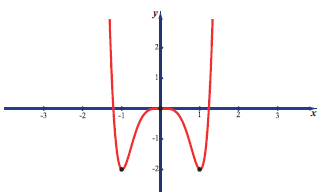
As f "(−1) and f "(1) are positive by the second derivative test, the function f (x) has local minimum. But at x = 0 , f "(0) = 0.
That is the second derivative test does not give any information about local extrema at x = 0. Therefore, we need to go back to the first derivative test. The intervals of monotonicity is tabulated in the table 7.8.
| Interval | (−∞,−1) | (−1,0) | (0,1) | (1,∞) |
| Sign of f'(x) | - | + | - | + |
| Monotonicity | strictly decreasing |
strictly increasing |
strictly decreasing |
strictly increasing |
 |
 |
|
|
By the first derivative test f(x) has local minimum at x = −1, its local minimum value is −2.
At x = 0 , the function f(x) has local maximum at x = 0 , and its local maximum value is 0. At x = 1, the function f (x) has local minimum at x = 1, and its local minimum value is −2.
Remark
When the second derivative vanishes, we have no information about extrema. We have used the first derivative test to find out the extrema of the function!
9.
The given function is defined and differentiable at all \(x\in (-\infty, \infty) \), As
\(f(x)=\frac{x }{1+x^{2}}\)
\(f'(x)=\frac{1-x^{2} }{(1+x^{2})^{2}}\)
The stationary points are give by 1-x2 = 0 that is \(x=\pm1\).
Hence the intervals of monotonicity are \((-\infty, -1) , (-1,1)\) and \((1,\infty)\)
| Interval | \((-\infty,-1)\) | (-1, 1) | \((1,\infty)\) |
| Sign of f'(x) | - | + | - |
| Monotonicity | strictly decreasing | strictly increasing | strictly decreasing |
Therefore, f (x) strictly increasing on \((-\infty,-1)\) and \((1,\infty)\) strictly decreasing on (-1, 1).
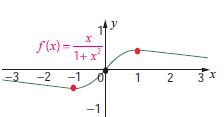
Since f′(x) changes from negative to positive when passing through x = −1, the first derivative test tells us there is a local minimum at x = −1 and the local minimum value is \(f(-1)=-\frac{1}{2}\). As f′(x) changes from positive to negative when passing through x = 1, the first derivative test tells us there is a local maximum at x = 1 and the local maximum value is \(f(1)=\frac{1}{2}\).
10.
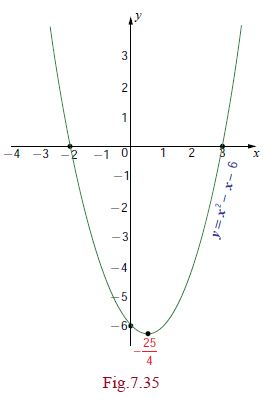
Factorising the given function, we have
y = f (x) = (x − 3)(x + 2) .
(1) The domain of the given function f (x) is the entire real line.
(2) Putting y = 0 we get x = −2, 3. Therefore the x -intercepts are (−2, 0) and (3, 0) putting x = 0 we get y = −6. Therefore the y -intercept is (0, −6).
(3) f'(x) = 2x −1 and hence the critical point of the curve occurs at x = \(\frac{1}{2}\).
(4) f"(x) = 2 > 0,∀x . Therefore at xTherefore at x = \(\frac{1}{2}\) the curve has a local minimum which is \(f\left( \frac { 1 }{ 2 } \right) =-\frac { 25 }{ 4 } .\)
(5) The range of the function is \(y\ge-\frac{25}{4}\)
(6) Since f"(x) = 2 > 0,∀x the function is concave upward in the entire real line.
(7) Since f(x) = 2 ≠ 0, ∀x the curve has no points of inflection
(8) The curve has no asymptotes.
The rough sketch of the curve is shown on the right side.
11.
The given function is a polynomial of degree 4. Now,
f′(x) = (x −1)3 + 3(x −1)2 . (x − 5)
= 4(x-1)2.(x-4)
f"(x) = 4(x-1)2+2(x-1).(x-4)
= 12(x −1) (x − 3)
Now,
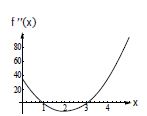
f''(x) = 0 ⇒ x = 1, x = 3
The intervals of concavity are tabulated in the table 7.7.
| Interval | (-∞, 1) | (1, 3) | (3, ∞) |
| Sign of f'(x) | + | - | + |
| Concavity | concave up | concave down | concave up |
 |
 |
 |
The curve is concave upwards on (∞, 1) and (3, ∞) .
The curve is concave downwards on (1, 3) .
As f′′(x) changes its sign when it passes through x = 1 and x = 3, (1, f(1)) = (1, 0) and (3, f(3)) = (3, −16) are points of inflection for the graph y = f(x). This may be observed from the adjoining figure of the curve f′′(x) .
12.
We have , f(x) = \(x^\frac{2}{3}\) then \(f'(x)=\frac{2}{3}x^{-\frac{1}{3}}\)\(=\frac{2}{3x^{\frac{1}{3}}}, f'(x)\ne 0 \forall x \in R\) and f'(x) does not exist at x = 0.
Therefore, there are no stationary points but there is a critical point at x = 0.
| Interval | \((-\infty,0)\) | \((0,\infty)\) |
| Sign of f'(x) | - | + |
| Monotonicity | strictly decreasing | strictly increasing |
| \(\searrow \) | ↗️ |
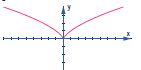
Because f'(x) changes its sign from negative to positive when passing through x = 0 for the function it has a local minimum at x = 0. The local minimum value is f(0) = 0. Note that here the local minimum occurs at a critical point which is not a stationary point.
13.
Given f(x) = 4x3 + 3x2- 6x + 1
f'(x) = 12x2 + 6x - 6
f"(x) = 24x + 6
f'(x) = 0
⇒12x2 + 6x - 6 = 0
⇒ 2x2 + x - 1 = 0
⇒ (x + 1)(2x - 1) = 0
\(\Rightarrow x=-1,\frac { 1 }{ 2 } \)
The critical numbers are -1, \(\frac { 1 }{ 2 } \)
The possible intervals of monotonicity are
\(\left( -\infty ,-1 \right) \left( -1,\frac { 1 }{ 2 } \right) \left( \frac { 1 }{ 2 } ,\infty \right) \)
| Interval | (∞,-1) | \(\left( -1,\frac { 1 }{ 2 } \right) \) | \(\left( \frac { 1 }{ 2 } ,\infty \right) \) |
| Sign of f'(x) | Say x = -2 12(-2)2 + 6 (-2)-6 = +ve |
Say x = 0 = -6 -ve |
Say x = 1 I2(1)2 + 6(1) - 6 = +ve |
| Monoto nicity | strictly increasmg | Strictly decreasing | Strictly increasing |
∴ f(x) is strictly increasing in \(\left( -\infty ,-1 \right) \left( \frac { 1 }{ 2 } ,\infty \right) \) and strictly decreasing in \(\left( -1,\frac { 1 }{ 2 } \right) \)
f"(x) = 0
\(\Rightarrow 24x+6=0\Rightarrow 24x=-6\)
\(x=\frac { -6 }{ 24 } =\frac { -1 }{ 4 } \)
The possible intervals of concavity are \(\left( -\infty ,\frac { -1 }{ 4 } \right) \left( \frac { -1 }{ 4 } ,\infty \right) \)
| Interval | \(\left( -\infty ,\frac { -1 }{ 4 } \right) \) | \(\left( \frac { -1 }{ 4 } ,\infty \right) \) |
| Sign of f'(x) | Say x = -1 24(-1) + 6 = -ve |
Say x = 0 +ve |
| Concavity | Concave down | Concave up |
ஃf(x) concave down in \(\left( -\infty ,\frac { -1 }{ 4 } \right) \) and concave up in \(\left( \frac { -1 }{ 4 } ,\infty \right) \)
As f"(x) changes its sign when it passes through
\(x=\frac { -1 }{ 4 } \), the point of inflection is \(\left( -\frac { 1 }{ 4 } ,f\left( -\frac { 1 }{ 4 } \right) \right) \)
Now \(f\left( \frac { -1 }{ 4 } \right) =\left( -\frac { 1 }{ 4 } \right) ^{ 3 }+3\left( \frac { -1 }{ 4 } \right) ^{ 2 }-6\left( \frac { -1 }{ 4 } \right) +1\)
= \(4\left( \frac { -1 }{ 4 } \right) +\frac { 3 }{ 16 } +\frac { 6 }{ 4 } +1\)
= \(\frac { -1 }{ 16 } +\frac { 3 }{ 16 } +\frac { 3 }{ 22 } +1=\frac { 1 }{ 8 } +\frac { 3 }{ 2 } +1\)
= \(\frac { 1+12+8 }{ 8 } =\frac { 21 }{ 8 } \)
ஃ Point of inflection. \(\left( \frac { -1 }{ 4 } ,\frac { 21 }{ 8 } \right) \)
Since f'(x) changes its sign from positive to negative at x = -1, it has a local maximum at x = -1.
ஃf (-1) = 4 (-1)3 + 3 (-1)2 - 6(-1) + 1
Since f'(x) changes its sign from negative to positive at \(x=\frac { 1 }{ 2 } \) it has a local minimum at \(x=\frac { 1 }{ 2 } \)
\(\therefore f\left( \frac { 1 }{ 2 } \right) =4\left( \frac { 1 }{ 2 } \right) ^{ 3 }+3\left( \frac { 1 }{ 2 } \right) ^{ 2 }-6\left( \frac { 1 }{ 2 } \right) +1\)
= \(\frac { 4 }{ 8 } +\frac { 3 }{ 4 } -\frac { -3 }{ 2 } +1=\frac { 1 }{ 2 } +\frac { 3 }{ 4 } -\frac { 3 }{ 2 } +1\)
= \(\frac { 2+3-6+4 }{ 4 } =\frac { 3 }{ 4 } \)
14.
\(\underset { x\rightarrow { 0 }^{ + } }{ lim } { x }^{ x }\)
This is an indeterminate of the form 00
Let g(x) xx
Taking logarithm, we get
\(log \ g(x)=log({ x }^{ 2 })=xlogx=\frac { log\quad x }{ \frac { 1 }{ x } } \)
\(\therefore \underset { x\rightarrow { 0 }^{ + } }{ lim } log \ g(x)={ \left[ \frac { logx }{ \frac { 1 }{ x } } \right] }=\frac { \infty }{ \infty } \)
\(=\underset { x\rightarrow { 0 }^{ + } }{ lim } \left( \frac { \frac { 1 }{ x } }{ -\frac { 1 }{ { x }^{ 2 } } } \right) \) [by L' Hopital rule]
= \(\underset { x\rightarrow { 0 }^{ + } }{ lim } \frac { 1 }{ x } \times \frac { { x }^{ 2 } }{ 1 } =\underset { x\rightarrow { 0 }^{ + } }{ lim } -x\)
= 0
But \(\underset { x\rightarrow { 0 }^{ + } }{ lim } (log(g(x))=log(\underset { x\rightarrow { 0 }^{ + } }{ lim } (g(x))\)
ஃ \(\underset { x\rightarrow { 0 }^{ + } }{ lim } (log(g(x))=0\)
\(\Rightarrow { e }^{ log }(\underset { x\rightarrow { 0 }^{ + } }{ lim } log(g(x))={ e }^{ 0 }\)
\(\Rightarrow \underset { x\rightarrow { 0 }^{ + } }{ lim } g(x)=1\)
\(\therefore \underset { x\rightarrow { 0 }^{ + } }{ lim } { x }^{ x }=1\)
15.
Let f(x) = \(y=\frac { 1 }{ 1+{ e }^{ -x } } \)
1. The domain of y is R
2. It is not symmetric
3. Putting y = 0, we get x does not exist
∴ It has no X intercept
4. Putting x = 0, we get \(y=\frac { 1 }{ 1+{ e }^{ o } } =\frac { 1 }{ 1+1 } =\frac { 1 }{ 2 } \)
∴ Y-intercept is \(\left( 0,\frac { 1 }{ 2 } \right) \)
5. \(f'(x)=\frac { d }{ dx } \left( 1+e^{ -x } \right) ^{ -1 }=-1\left( 1+{ e }^{ -x } \right) \left( -e^{ -x } \right) \)
= \(\frac { { e }^{ -x } }{ \left( 1+e^{ -x } \right) ^{ 2 } } ={ e }^{ -x }\left( 1+{ e }^{ -x } \right) ^{ -2 }\)
\(f'(x)=0\Rightarrow { e }^{ -x }0\Rightarrow -x=log0\Rightarrow x=\infty \)
Also, f(x) > 0 ∀ X ∈ R
6. Since there is no sign change inf'(x), it has no local extreme.
7. f"(x) = e-x(-2)(1+e-x)-3(_e-x)+(1+e-x)-2(_e-x)
= 2e-2x (I+e-x )-3 -e-x ( 1+e-x )-2
= e-2x (1+e-x r3 [2 - e-x (1+e-x)]
= e-2X(I+e-xr3[2-ex -1]
= \(\frac { { e }^{ -2x }\left( 1-{ e }^{ x } \right) }{ \left( 1+{ { e }^{ x } } \right) ^{ 3 } } \)
f"(x) = 0 ⇒ x = 0
The intervals of concavity is tabulated as follows.
| Interval | (-∞,0) | (0,∞) |
|---|---|---|
| Sign of f"(x) | + | - |
| Concavity | Concave up | Concave down |
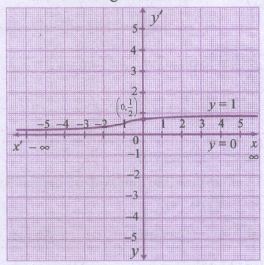
8.\(\underset { x\rightarrow \infty }{ lim } \frac { 1 }{ 1+{ e }^{ -x } } =1\)
⇒ y = 1 is the horizontal asymptote and
\(\underset { x\rightarrow \infty }{ lim } \frac { 1 }{ 1+{ e }^{ -x } } =0\)
⇒ y = 0 is the horizontal asymptote
ஃ The rough sketch is
16.
1. The domain of f(x) is R {-2,2}
2. Since I (x, y) = I (-x, y) the curve is symmetric about Y-axis.
3. Putting y = 0, we get \({ x }^{ 2 }=-1\Rightarrow x=\pm \sqrt { -1 } \) is not possible
ஃ No X - intercept
4. Putting x = 0, we get \(y=\frac { -1 }{ 4 } \)
ஃ Y - Intercept is \(\left( 0,\frac { -1 }{ 4 } \right) \)
5. \(f'(x)=\frac { \left( { x }^{ 2 }-4 \right) (2x)-\left( { x }^{ 2 }+1 \right) \left( 2x \right) }{ \left( { x }^{ 2 }-4 \right) ^{ 2 } } \)
= \(\frac { { 2x }^{ 3 }-8x-{ 2x }^{ 3 }-2x }{ \left( { x }^{ 2 }-4 \right) ^{ 2 } } =\frac { -10x }{ \left( { x }^{ 2 }-4 \right) ^{ 2 } } \)
f'(x) = 0⇒ x = 0and the curve does not exist at x = -2, 2.
ஃ The critical numbers are 0, -2, 2.
ஃ The intervals of monotonicity are
(-∞, -2)(-2, 0)(0, 2)(2, ∞)
| Interval | (-∞,-2) | (-2,0) | (0,2) | (2,∞) |
|---|---|---|---|---|
| Sign of f'(x) | Sayx = -3, f'(x) is + ve |
Say x = -1, f'(x) is + ve |
Say x = 1, f'(x) is - ve |
Say x = -3, f'(x) is - ve |
| Monotonicity | Increasing | Increasing | Decreasing | Decreasing |
6. Since f'(x) changes it sign from positive to negative at x = 0, it has local maximum at x =0,
7. \(f''(x)=-10\left[ \frac { \left( { x }^{ 2 }-4 \right) ^{ 2 }(1)-x(2)\left( { x }^{ 2 }-4 \right) (2x) }{ \left( { x }^{ 2 }-4 \right) ^{ 4 } } \right] \)
= \(-10\left[ \frac { \left( { x }^{ 2 }-4 \right) ^{ 2 }-4{ x }^{ 2 }\left( { x }^{ 2 }-4 \right) }{ \left( { x }^{ 2 }-4 \right) ^{ 4 } } \right] \)
= \(-10\left( { x }^{ 2 }-4 \right) \left[ \frac { { x }^{ 2 }-4-{ 4x }^{ 2 } }{ \left( { x }^{ 2 }-4 \right) ^{ 2 } } \right] \)
= \(-10\left( \frac { -3{ x }^{ 2 }-4 }{ \left( { x }^{ 2 }-4 \right) ^{ 3 } } \right) =\frac { 10\left( { 3x }^{ 2 }+4 \right) }{ ({ x }^{ 2 }-4) } \)
\(\therefore f"(x)=0\Rightarrow { 3x }^{ 2 }+4=0\Rightarrow { x }^{ 2 }=\frac { -4 }{ 3 } \)
which is not possible and f "(x) does not exist at x = -2, 2.
The intervals of concavity is tabulated as follows
| Interval | (-∞,-2) | (-2,2) | (2,∞) |
|---|---|---|---|
| Sign of f"(x) | + | - | + |
| Concavity | Concave up | Concave down | Concave up |
Since the curve does not exist at x = 2, x = - 2 are the vertical asymptotes and the horizontal asymptote is y = 1
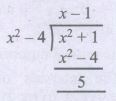
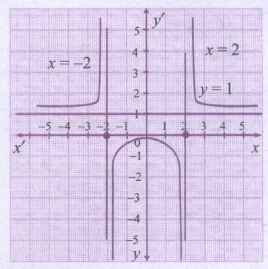
1. The domain of f(x) is R {-2, 2}
2. Since f(x, y) = I (-x, y) the curve is symmetric about Y-axis.
3. Putting y = 0, we get \({ x }^{ 2 }=-1\Rightarrow x=\pm \sqrt { -1 } \) is not possible
4. Putting x = 0, we get \(y=\frac { -1 }{ 4 } \)
ஃY - Intercept is \(\left( 0,\frac { -1 }{ 4 } \right) \)
5.\(f'(x)=\frac { \left( { x }^{ 2 }-4 \right) \left( 2x \right) -\left( { x }^{ 2 }+1 \right) \left( 2x \right) }{ ({ x }^{ 2 }-4)^{ 2 } } \)
= \(\frac { { 2x }^{ 3 }-8x-{ 2x }^{ 3 }-2x }{ ({ x }^{ 4 }-4)^{ 2 } } =\frac { -10x }{ \left( { x }^{ 2 }-4 \right) ^{ 2 } } \)
f'(x) = 0⇒ x = 0 and the curve does not exist at x = -2, 2.
ஃThe critical numbers are 0,-2, 2.
ஃThe intervals of monotonicity are (-∞, -2)(2, 0)(0, 2)(2, ∞)
| Interval | (-∞,-2) | (-2,0) | (0,2) | (2,∞) |
| Sign of f'(x) | Sayx = -3, f'(x) is + ve |
Say x = -1, f'(x) is + ve |
Say x = 1, f'(x) is - ve |
Say x = -3, f'(x) is - ve |
| Monotonicity | Increasing | Increasing | Decreasing | Decreasing |
6. Since f'(x) changes it sign from positive to • negative at x = 0, it has local maximum at x =0,
7. \(f''(x)=-10\left[ \frac { \left( { x }^{ 2 }-4 \right) ^{ 2 }(1)-x(2)\left( { x }^{ 2 }-4 \right) (2x) }{ \left( { x }^{ 2 }-4 \right) ^{ 2 } } \right] \)
= \(-10\left[ \frac { \left( { x }^{ 2 }-4 \right) ^{ 2 }-4{ x }^{ 2 }\left( { x }^{ 2 }-4 \right) }{ \left( { x }^{ 2 }-4 \right) ^{ 4 } } \right] \)
= \(-10\left( { x }^{ 2 }-4 \right) \left[ \frac { { x }^{ 2 }-4-{ 4x }^{ 2 } }{ \left( { x }^{ 2 }-4 \right) ^{ 4 } } \right] \)
= \(10\left( \frac { -3{ x }^{ 2 }-4 }{ \left( { x }^{ 2 }-4 \right) ^{ 3 } } \right) =\frac { 10(3{ x }^{ 2 }+4) }{ \left( { x }^{ 2 }-4 \right) ^{ 3 } } \)
\(\therefore f''(x)=0\Rightarrow { 3x }^{ 2 }+4=0\Rightarrow { x }^{ 2 }=\frac { -4 }{ 3 } \)
which is not possible.
ஃ There is no concavity.
8.Since the curve does not exist at x = 2, x = - 2 are the vertical asymptotes and the horizontal asymptote is y = 1.
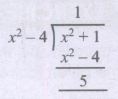
17.
⇒y2 = x2(4-x)
1. The domain of f(x) is {x∈R/-∞
2. Puttingy = 0, we get \(0=x\sqrt { 4-x } \)
⇒x = 0.4
ஃ The X-intercept is (4,0) and the curve passes through the origin.
3. Putting x = 0, we get y=0
∴ Y - intercept is (0,0)
4.\(f'(x)=x\left( \frac { 1 }{ 2 } \right) \left( 4-x \right) ^{ -\frac { 1 }{ 2 } }\left( -1 \right) +\sqrt { 4-x\left( 1 \right) } \)
\(f'(x)=\frac { -4 }{ 2\sqrt { 4-x } } +\sqrt { 4-x } \)
\(\frac { -x+2(4-x) }{ 2\sqrt { 4-x } } =\frac { -3x+8 }{ 2\sqrt { 4 } -x } \)
⇒ f'(x) = 0
⇒ -3x+8 = 0
⇒ -3x = -8
\(\Rightarrow x=\frac { 8 }{ 3 } \)
ஃ The possible interval are \(\left( -\infty ,\frac { 8 }{ 3 } \right) \left( \frac { 8 }{ 3 } ,4 \right) \)
| Interval | \(\left( -\infty ,\frac { 8 }{ 3 } \right) \) | \(\left( \frac { 8 }{ 3 } ,4 \right) \) |
|---|---|---|
| Sign of f'(x) | Say x= 0 \(f'(x)=\sqrt { 4 } =+ve\) |
Say x = 3, f'(x) = - ve |
| Monotonicity | Increasing | Decreasing |
5. As f'(x) changes from positive to negative, it has local maximum at \(x=\frac { 8 }{ 3 } \)
6. There is no asymptote fer the curve
ஃ The rough sketch of the function is
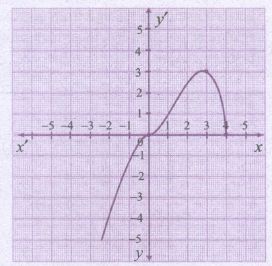
18.
Given\(y=-\frac { 1 }{ 3 } \left( { x }^{ 3 }-3x+2 \right) \)
Factorising the given function, we have
\(y=f(x)=-\frac { 1 }{ 3 } \left( x-1 \right) \left( { x }^{ 2 }+x-2 \right) \)
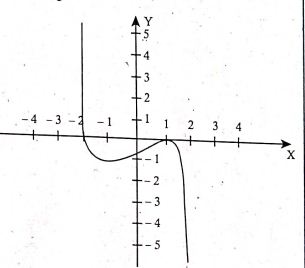
1. The domain and the range of the given function fix) are the entire real time.
2. Putting y = 0, we get x = 1. The other two roots are imaginary.
ஃ X intercept is (1, 0)
Putting x = 0, we get \(y=-\frac { 2 }{ 3 } \)
∴Y intercept is \(\left( 0,-\frac { 2 }{ 3 } \right) \)
3. \(f'\left( x \right) =\frac { -1 }{ 3 } \left( { 3x }^{ 2 }-3 \right) =-{ x }^{ 2 }+1\)
f'(x) = 0
\(\Rightarrow -{ x }^{ 2 }=-1\)
\(\Rightarrow x=\pm 1\)
ஃThe critical points are at x = 1, x = -1.
4. \(f''(x)=\frac { -1 }{ 3 } (6x)=-2x\)
f''(1) = -2, f''(-1) = 2.
∴f (x) is local minimum at x = 1,
\(f(1)=\frac { -1 }{ 3 } \left( 1-3+2 \right) \)
\(\Rightarrow f(1)=\frac { -1 }{ 3 } \left( 0 \right) =0\)
f (x) is local minimum at x = -1,
\(\Rightarrow f(-1)=\frac { -1 }{ 3 } \left( -1+3+2 \right) =\frac { -4 }{ 3 } \)
∴The critical points are at x = 1, x = -1.
5. Since f"(x) = -2x<0∀x>0, the function is concave downward in the positive real line and f''(x) = -2x > 0∀<0,the function is concave upward in the negative real line.
6. f''(x) = 0 at x = 0 and f''(x) changes its sign when x = 0, the point of inflection is \(\left( 0,f(0) \right) =\left( 0,\frac { -2 }{ 3 } \right) \)
7. The curve has no asymptotes.
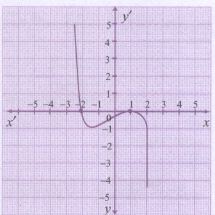
19.
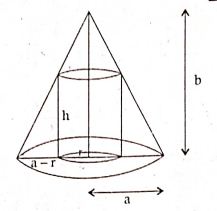
20.
Given r + h = 6
⇒ h = 6 - r ...(1)
Let f(r) = V = πr2h
= πr2(6-r) = π(6r2 -r3)
f'(r) = π (12r - 3r2)
∴f'(r) = 0
⇒π (12r- 3r2) = 0
⇒ 12r-3r2 = 0
⇒ 3r(4-r) = 0
⇒ r = 0 or r = 4
ஃThe critical numbers are 0, 4
f"(r) = π (12 - 6r)
When r = 4, f"(r) = π(12 - 24) < 0
ஃ f(r) maximum when r = 4
When r = 4, h = 6 - 4 = 2
When r = 0, h = 6 - 0 = 6
ஃ Volume of the cylinder V = πr2 h = π (4)2 (2)
= 32 πCu. units
or volume of the cylinder V = π (02) (6) = 0
Cu. Units.
21.
Since the open box has square area, let the length, breadth and height of the box be I, l and b cm respectively.
ஃ Surface area = l2 + 41b = 108
\(\Rightarrow l+4b=\frac { 108 }{ l } \)
\(\Rightarrow 4b=\frac { 108 }{ l } -1\)
\(\Rightarrow b=\frac { 108 }{ 4l } -\frac { l }{ 4 } \)
\(\Rightarrow b=\frac { 27 }{ l } -\frac { l }{ 4 } \)
Let f(1) = Volume of the box = 1 \(\times\) 1\(\times\) b = l2 b
= \({ l }^{ 2 }\left( \frac { 27 }{ l } -\frac { l }{ 4 } \right) \)
\(f(1)=27l-\frac { { l }^{ 3 } }{ 4 } \)
\(f'(l)=27-\frac { { 3l }^{ 2 } }{ 4 } \)
f'(1) = 0
\(\Rightarrow 27-\frac { 3{ l }^{ 2 } }{ 4 } =0\)
\(\Rightarrow \frac { 3l^{ 2 } }{ 4 } =27\)
\(\Rightarrow l^{2}=\not 27 \times \frac{4}{\not 3}=36\)
\(\Rightarrow 1=\pm 6\)
\(\Rightarrow 1=6\)
ஃThe critical number is 6
\(f''(l)=\frac { 6l }{ 4 } =\frac { 3l }{ 2 } \)
\(\therefore f''(6)=-\frac { 3(6) }{ 2 } <0\)
ஃ f"(1) is maximum when l = 6
When l = 6,\(b=\frac { 27 }{ 6 } -\frac { 6 }{ 4 } \)
= \(\frac { 9 }{ 2 } -\frac { 3 }{ 2 } =\frac { 6 }{ 2 } =3cm\)
Hence the dimensions of the required box are 6 cm, 6 cm and 3 cm respectively.
22.
Let us take the semi circle with center (0, 0) an radius r
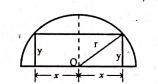
x = r cos θ,
y = r sin θ
ஃ Length of the rectangle = 2x = 2r cos θ
Breadth of the rectangle = y = r sin θ
ஃ Area = 2xy = 2r2 cos θ sin θ
= r2 sin 2θ
Letf'(θ) = r2 2 cos 2θ
f(θ) = r2cosθ sinθ
⇒ 2r2 cos 2θ = 0
\(\Rightarrow cos2\theta =0=cos\frac { \pi }{ 2 } \)
\(\Rightarrow 2\theta =\frac { \pi }{ 2 } \)
\(\Rightarrow \theta =\frac { \pi }{ 4 } \)
\(f''={ 2r }^{ 2 }(2)-(-sin2\theta )\)
= \(-4{ r }^{ 2 }sin2\theta \)
\(\therefore f''\left( \frac { 4\pi }{ 4 } \right) =-4{ r }^{ 2 }sin2\left( \frac { \pi }{ 4 } \right) \)
= \(-4{ r }^{ 2 }sin\frac { \pi }{ 2 } ={ 4r }^{ 2 }<0\)
ஃ f(θ) is maximum when \(\theta =\frac { \pi }{ 4 } \)
ஃ Length of the rectangle \((x)=2ros\frac { \pi }{ 4 } \)
= \(2r\times \frac { 1 }{ \sqrt { 2 } } =\sqrt { 2 } r\)
ஃ Breadth of the rectangle = y = r sin θ
= \(rsin\frac { \pi }{ 4 } =\frac { r }{ \sqrt { 2 } } \)
23.
Let x and y be the length and breadth of the rectangle.
ஃ Perimeter P = 2x + 2y
\(\Rightarrow 2y=P-2x\Rightarrow y=\frac { P-2x }{ 2 } \)
Let \(f(x)=Area=xy=x\left( \frac { P-2x }{ 2 } \right) \)
\(f(x)=\frac { Px-{ 2x }^{ 2 } }{ 2 } \)
\(f'(x)=\frac { 1 }{ 2 } \left[ P-4x \right] \)
f'(x) = 0
\(\Rightarrow \frac { 1 }{ 2 } \left[ P-4x \right] =0\)
\(\Rightarrow P=4x\)
\(\Rightarrow x=\frac { P }{ 4 } \)
∴The critical number is \(\frac { P }{ 4 } \)
Now,\(f''\left( \frac { P }{ 4 } \right) =-2<0\)
ஃf(x) is maximum when \(x=\frac { P }{ 4 } \)
When \(x=\frac { P }{ 4 } \)
\(\Rightarrow y=\frac { P-2\left( \frac { P }{ 4 } \right) }{ 2 } =\frac { P-\frac { P }{ 2 } }{ 2 } =\frac { P }{ 4 } \)
\(\therefore x=y=\frac { P }{ 4 } \)
ஃThe rectangle is a square when the area is maximum for a given perimeter.
24.
Let the point on the circle be
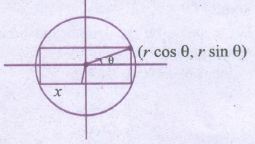
Let the length of the rectangle be 'x' cm
Breadth of the rectangle be 'y' cm
\(
x^{2}+y^{2} =(20)^{2}
\)
\(y^{2} =400-x^{2}\)
[radius of the circle is 10 cm]
\(y=\sqrt{400-x^{2}}\)
Now, Area of the rectangle A = xy
\(
A =x \sqrt{400-x^{2}}
\)
\(\frac{d A}{d x} =x \frac{(-2 x)}{2 \sqrt{400-x^{2}}}+\sqrt{400-x^{2}}
\) .....(1)
\(=\frac{-x^{2}+400-x^{2}}{\sqrt{400-x^{2}}}=\frac{-2 x^{2}+400}{\sqrt{400-x^{2}}}\)
For maximum or minimum,
\(
\frac{d A}{d x} =0 \Rightarrow \frac{-2 x^{2}+400}{\sqrt{400-x^{2}}}=0
\)
\(x^{2} =200 \)
\(x =\pm 10 \sqrt{2}
\)
\(x =-10 \sqrt{2} \) (is not possible)
\(\therefore x =10 \sqrt{2}
\)
Now, \( \frac{d^{2} A}{d x^{2}}=
\frac{\sqrt{400-x^{2}}(-4 x)-\left(-2 x^{2}+400\right)\left(-\frac{2 x}{2 \sqrt{400-x^{2}}}\right)}{400-x^{2}} \)
\(=\frac{2 x^{3}-1200 x}{\left(400-x^{2}\right) \sqrt{400-x^{2}}}\)
At \(x=10 \sqrt{2}, \quad \frac{d^{2} A}{d x^{2}}<0\)
Area of the rectangle is maximum when x \(=10 \sqrt{2}\)
\(y=\sqrt{400-200}=\sqrt{200}=10 \sqrt{2}\)
\(\therefore x=y=10 \sqrt{2}\)
Length of the rectangls = 10\(\sqrt{2}\) cm
Breadth of the rectangls = 10\(\sqrt{2}\) cm
25.
Let \(f(x)=\frac{1}{x}\). then the Taylor series of f (x) is
\(f(x)=\sum^{n=\infty}_{n=0}a_{n}(x-2)^{n},\) where \(a_{n}=\frac{f^{(n)}(2)}{n!}\)
Various derivatives of the function f (x) evaluated at x = 2 are given below.
| Functions and its derivatives |
\(\frac{1}{x}\)and its derivatives |
value at x = 2 |
| f(x) | \(\frac{1}{x}\) | \(\frac{1}{2}\) |
| f'(x) | \(-\frac{1}{x^{2}}\) | \(-\frac{1}{4}\) |
| f''(x) | \(\frac{2}{x^{3}}\) | \(\frac{1}{4}\) |
| f'''(x) | \(-\frac{6}{x^{4}}\) | \(-\frac{3}{8}\) |
Substituting these values, we get the required expansion of the function as:
\(\frac{1}{x}=\frac{1}{2}-\frac{1}{4}\frac{(x-2)}{1!}+\frac{1}{4}\frac{(x-2)^{2}}{2!}-\frac{3}{8}\frac{3(x-2)^{3}}{3!}+...\)
which is, \(\frac{1}{x}=\frac{1}{2}-\frac{(x-2)}{4}+\frac{(x-2)^{2}}{8}-\frac{(x-2)^{3}}{16}+...\)
26.
Let f (x) = tan x, then the Mclaurin series of f (x) is
\(f(x)=\sum^{n=\infty}_{n=0} a_{n}x^{n}\), where , \(a_{n}=\frac{f^{(n)}(0)}{n!}\).
Various derivative’s of the function f (x) evaluated at x = 0 is given below :
Now,
\(f'(x)=\frac{d}{dx}(tanx)=sec^{2}(x)\)
\(f''(x)=\frac{d}{dx}sec^{2}(x))=2sec x.sec x.tan x= 2sec^{2}x.tanx\)
\(f'''(x)=\frac{d}{dx}(2sec^{2}(x).tan x)= 2sec^{2}(x).sec^{2}x+tan x.4secx.secx.tanx\)
=\(2sec^{4}x+4sec^{2}x.tan^{2}x\)
\(f^{(iv)}(x)=8sec^{3}(x).secx+tan x+4sec^{2}x.2tanx sec^{2}x+8secx.secx.tanx.tan^{2}x\)
=\(16sec^{4}xtanx+8sec^{2}x.tan^{3}x\)
\(f^{(v)}(x)=16sec^{4}x.sec^{2}x+64sec^{3}x.sec x.tan x.tan x+8 sec^{2}x.3tan^{2}x.sec^{2}x+16secx.secx.tanx.tan^{3}x\)
=\(16sec^{6}x+88sec^{4}x.tan^{2}x+16sec^{2}x.tan^{4}x\).
| Function and its derivatives | tan x and its derivatives | value at x = 0 |
| f(x) | tan x | 0 |
| f'(x) | sec2x | 1 |
| f''(x) | 2sec2x tanx | 0 |
| f'''(x) | 2sec4x+4sec2x.tan2x | 2 |
| f(iv)(x) | 16sec4x.tanx+8sec2x.tan3x | 0 |
| f(v)(x) | 16sec6x+88sec4x.tan2x+16sec2x.tan4x | 16 |
Substituting the values and on simplification we get the required expansion of the function as
\(tan x=x+\frac{1}{3}x^{3}+\frac{2}{15}x^{5}+...; -\frac{\pi}{2}
27.
Let x be the length of the rectangular pasture and y be the breadth of the rectangular pasture.
Given xy = 1,80,000
\(\Rightarrow y=\frac { 1,80,000 }{ x } \)
Since fencing is not needed along the river side,
Perimeter = 2x + y
Letf(x) = 2x+y
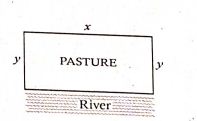
= \(2x+\frac { 1,80,000 }{ x } \)
\(f'(x)=2-\frac { 1,80,000 }{ { x }^{ 2 } } \)
f'(x) = 0
\(\Rightarrow 2=\frac { 1,80,000 }{ { x }^{ 2 } } \)
\(\Rightarrow { x }^{ 2 }=90,000\)
\(\Rightarrow x=\pm 300\)
ஃ The critical number is 300, -300
\(f''(x)=-1,80,000\left( \frac { -2 }{ { x }^{ 3 } } \right) =\frac { 360000 }{ { x }^{ 3 } } \)
\(f''\left( 300 \right) =\frac { 360000 }{ \left( 300 \right) ^{ 3 } } >0\)
From (1), when x = 300, \(y=\frac { 1,80,000 }{ 300 } =600\)
ஃ Length of the minimum needed fencing material = 2x + y
= 2(300) + 600 = 600 + 600 = 1200 m
28.
Let f(x) = log(1+x) then the Maclaurin series of f (x) is f (x) \(\sum _{ n=0 }^{ n=\infty }{ { a }_{ n }{ x }^{ n } } \) where, \(a_{n}=\frac{f^{n}(0)}{n!}\) f(x) various derivatives of the function f(x) evaluated at x = 0 are given below:
| Function and its derivatives |
log(1+ x) and its derivatives |
value at x = 0 |
| f(x) | log(1+x) | 0 |
| f'(x) | \(\frac{1}{1+x}\) | 1 |
| f''(x) | \(-\frac{1}{(1+x)^{2}}\) | -1 |
| f'''(x) | \(\frac{2}{(1+x)^{3}}\) | 2 |
| f(iv)(x) | \(-\frac{6}{(1+x)^{4}}\) | -6 |
Substituting the values and on simplification we get the required expansion of the function given by,
\((log(1+x)=x-\frac{x^{2}}{2}+\frac{x^{3}}{3}+\frac{x^{4}}{4}+... -1\)
29.
Let f(x) = e-x, x ∈ [a, b]
a) e-x is continuous in [a, b]
b) e-x is differentiable in (a, b)
c) f(b) = e-b, f(a) = e-a
By Lagrange's mean value I theorem, there exerise c ∈ [a, b] such that f'(c) = \(\frac { f(b)-f(a) }{ b-a } \)
⇒ -e-c =\(\frac { { e }^{ -b }-{ e }^{ -a } }{ b-a } \)
⇒ -e-c = \(\frac { { e }^{ -a }-{ e }^{ -b} }{ b-a } \)
⇒ |e-c| = \(\left| \frac { { e }^{ -b }-{ e }^{ -a } }{ b-a } \right| \)
⇒ \(\frac { \left| { e }^{ -a }-{ e }^{ -b } \right| }{ \left| a-b \right| } \) < 1
[∵ |-a-c| < 1 for c ∊ [a, b] a > 0, b > 0]
⇒ |e-a - e-b| < |a -b|
Hence proved.
30.
Let x and y be the length, breadth of the printed rectangular page
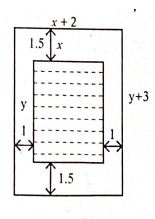
Given xy = 24
\(\Rightarrow y=\frac { 24 }{ x } \) ..(1)
Length of the page with margin
= x+1+1 = x+2
breadth of the page with margin
= y + 1.5 + 1.5 = y + 3
Area of the page = (x + 2) (y + 3)
Let f(x) = (x + 2) (y + 3)
= \((x+2)\left( \frac { 24 }{ x } +3 \right) \)
= \(24+3x+\frac { 48 }{ x } +30\)
= \(3x+\frac { 48 }{ x } +30\)
\(f'\left( x \right) =3-\frac { 48 }{ { x }^{ 2 } } \)
\(\Rightarrow { x }^{ 2 }=16\Rightarrow x=\pm 4\)
ஃ The critical number are 4,-4
\(f''\left( x \right) =-48\left( \frac { -2 }{ { x }^{ 3 } } \right) =\frac { 96 }{ { x }^{ 3 } } \)
\(f''\left( 4 \right) =\frac { 96 }{ 64 } >0\)
ஃ f(x) is minimum when x = 4
When \(x=4,y=\frac { 24 }{ 4 } =6\) [From (1)]
ஃ Length of the page = x + 2 = 4 + 2 = 9 cm
Breadth of the page = y + 3 = 6 + 3 = 6 cm
31.
Given f \(x(x+3){ e }^{ \frac { \pi }{ 2 } }\) -3 ≤ x ≤ 0
a) f(x) is continuous in [-3, 0] .
b) f(x) is differentiable in (-3,0)
c) f(0) = 0(0 + 3) \({ e }^{ \frac { \pi }{ 2 } }\) = 0
f(-3) = -3 (-3 + 3)\({ e }^{ \frac { \pi }{ 2 } }\) = 0
∴ By Rolle's theorem, there exists c ∈ [-3, 0] such that f'(c) = 0
(2c + 3)\({ e }^{ \frac { \pi }{ 2 } }\) = 0 [∵ f(x) = (x2 + 3x)\({ e }^{ \frac { \pi }{ 2 } }\) f'(x) = (2c + 3) \({ e }^{ \frac { \pi }{ 2 } }\)]
⇒ 2c + 3 = 0 f(x) = x (x + 3) e\(\frac{\pi}{2}\),
⇒ 2c = -3
⇒ c = \(\frac{-3}{2}\)
Hence, there exist a point on the curve f(x) = x (x + 3) e\(\frac{\pi}{2}\), -3 ≤ x ≤ 0 where the tangent is parallel to the X - axis.
32.
Given f(0) = -1, f(2) = 4
∴ f(x) is a continuous function in [0,2]
By Lagrange's mean value theorem,
f'(x) = \(\frac { f(b)-f(a) }{ b-a } \) = \(\frac{f(2)-f(0)}{2-0}\)
= \(\frac{4-(-1)}{2}\) = \(\frac{5}{2}\) = 2.5
= 2.5 ∉ [0, 2]
Since f'(x) cannot be 2.5 at any point in [0, 2], there does not exist a differentiable function f(x).
33.
f (x) is defined and differentiable for all x ∈ (0, 2π).
f'(x) = sin x (-sin x) + cos x (cos x)
= cos2 X - sin2 x
= cos2x
f'(x) = 0
\(\Rightarrow cosx=0cos=\frac { \pi }{ 2 } ,cos\frac { 3\pi }{ 2 } ,cos\frac { 5\pi }{ 2 } ,cos\frac { 7\pi }{ 2 } \)
\(\Rightarrow 2x=\frac { \pi }{ 2 } \frac { \pi }{ 2 } ,\frac { 3\pi }{ 2 } ,\frac { 5\pi }{ 2 } ,\frac { 7\pi }{ 2 } \)
\(\Rightarrow x=\frac { \pi }{ 4 } ,\frac { 3\pi }{ 4 } ,\frac { 5\pi }{ 4 } ,\frac { 7\pi }{ 4 } \)
The stationary points are at
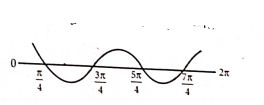
\(x=\frac { \pi }{ 4 } ,\frac { 3\pi }{ 4 } ,\frac { 5\pi }{ 4 } ,\frac { 7\pi }{ 4 } \)
\(\left( 0,\frac { \pi }{ 4 } \right) ,\left( \frac { \pi }{ 4 } ,\frac { 3\pi }{ 4 } \right) \left( \frac { 3\pi }{ 4 } ,\frac { 5\pi }{ 4 } \right) \left( \frac { 5\pi }{ 4 } ,\frac { 7\pi }{ 4 } \right) \left( \frac { 7\pi }{ 4 } ,2\pi \right) \)
| Interval | \(\left( 0,\frac { \pi }{ 4 } \right) ,\) | \(\left( \frac { \pi }{ 4 } ,\frac { 3\pi }{ 4 } \right) \) | \(\left( \frac { 3\pi }{ 4 } ,\frac { 5\pi }{ 4 } \right) \) | \(\left( \frac { 5\pi }{ 4 } ,\frac { 7\pi }{ 4 } \right) \) | \(\left( \frac { 7\pi }{ 4 } ,2\pi \right) \) |
| Sign of f'(x) | Say \(x=\frac { \pi }{ 6 } \) cos \(cos2\times \cfrac { \pi }{ 6 } \) = \(=cos\cfrac { \pi }{ 3 } =\cfrac { 1 }{ 2 } \) +ve |
Say \(x=\cfrac { \pi }{ 2 } \) \(cos2\times \cfrac { \pi }{ 2 } \) = \(cos\pi =-1-ve\) -ve |
Say y = π cos 2π = 1+ve |
Say \(x=\cfrac { 3\pi }{ 2 } \) \(cos2\times \cfrac { 3\pi }{ 2 } \) = cos 3π = -1 |
Say x = 3200 cos 2 x 3200 = cos 640 = cos (360 + 280) = cos 2800 = cos (270 + 10) = sin 100 =+ve |
| monotonicity | Strictly increasing | Strictly decreasing | Strictly increasing | Strictly decreasing | Strictly increasing |
\(\therefore\) f (x) is strictly increasing in \(\left( 0,\frac { \pi }{ 4 } \right) \)\(\left( \frac { 3\pi }{ 4 } ,5\frac { \pi }{ 4 } \right) \left( \frac { 7\pi }{ 4 } ,2\pi \right) \) and strictly decreasing in \(\left( \frac { \pi }{ 4 } ,\frac { 3\pi }{ 4 } \right) \left( \frac { 5\pi }{ 4 } ,\frac { 7\pi }{ 4 } \right) \)
Since f'(x) changes its positionfrom positive to negative at \(x=\frac { \pi }{ 4 } ,\frac { 5\pi }{ 4 } \) there is a local
maximum at \(x=\frac { \pi }{ 4 } ,\frac { 5\pi }{ 4 } \)
\(f\left( \frac { \pi }{ 4 } \right) =sin\frac { \pi }{ 4 } cos\frac { \pi }{ 4 } +5\)
= \(\frac { 1 }{ \sqrt { 2 } } .\frac { 1 }{ \sqrt { 2 } } +5=\frac { 1 }{ 2 } +5=\frac { 11 }{ 2 } \)
\(f\left( \frac { 5\pi }{ 4 } \right) =sin{ \frac { 5\pi }{ 4 } }cos\frac { \pi }{ 4 } +5\)
= \(\left( \frac { -1 }{ \sqrt { 2 } } \right) \left( \frac { -1 }{ \sqrt { 2 } } \right) +5\)
= \(\frac { 1 }{ 2 } +5=\frac { 11 }{ 2 } \)
Also f'(x) changes its position from negative to positive at \(x=\frac { 3\pi }{ 4 } ,\frac { 7\pi }{ 4 } \) there is local mmimum
at \(x=\frac { 3\pi }{ 4 } ,\frac { 7\pi }{ 4 } \)
\(\therefore f\left( \frac { 3\pi }{ 4 } \right) =cos\frac { 3\pi }{ 4 } sin\frac { 3\pi }{ 4 } +5\)
= \(\left( \frac { -1 }{ \sqrt { 2 } } \right) \left( \frac { +1 }{ \sqrt { 2 } } \right) +5=5-\frac { 1 }{ 2 } =\frac { 9 }{ 2 } \)
\(f\left( \frac { 7\pi }{ 4 } \right) =cos\frac { 7\pi }{ 4 } sin\frac { 7\pi }{ 4 } +5\)
= \(cos\left( 2\pi -\frac { \pi }{ 4 } \right) sin\left( 2\pi -\frac { \pi }{ 4 } \right) +5\)
= \(\left( \frac { 1 }{ \sqrt { 2 } } \right) \left( \frac { -1 }{ \sqrt { 2 } } \right) +5\)
= \(\frac { -1 }{ 2 } +5=\frac { 9 }{ 2 } \)
= \(\frac { -1 }{ 2 } +5=\frac { 9 }{ 2 } \)
34.
f(x) is defined and differentiable for all x ∈ (0, ∞).
\(\therefore f'(x)=\frac { { 3x }^{ 2 } }{ 3 } -\frac { 1 }{ x } ={ x }^{ 2 }-\frac { 1 }{ x } \)
\(\Rightarrow { x }^{ 2 }-\frac { 1 }{ x } =0\Rightarrow \frac { { x }^{ 3 }-1 }{ x } =0\)
\(\Rightarrow { x }^{ 3 }-1=0\Rightarrow { x }^{ 3 }1\)
\(\Rightarrow\) x = 1
\(\therefore\) The Stationary point is at x = 1
The possible intervals are (0, 1) and (1, ∞).
| Interval | (0, 1) | (1, ∞) |
| Sign of f'(x) | Say \(x=\cfrac { 1 }{ 2 } \) \(f'(x)=\left( \cfrac { 1 }{ 2 } \right) ^{ 2 }-2\) = \(\cfrac { 1 }{ 4 } -2\) |
Say x = 2 \(f(x){ (2) }^{ 2 }-\cfrac { 1 }{ 2 } \) = \(4-\cfrac { 1 }{ 2 } \) |
| Monotonicity | Strictly decreasing | Strictly increasing |
Since f '(x) changes from negative to positive at x = 1, there is a local minimum at x = 1.
\(\therefore f'\left( 1 \right) =\frac { { 1 }^{ 3 } }{ 3 } -log1\)
= \(\frac { 1 }{ 3 } -o=\frac { 1 }{ 3 } \)
35.
f(x) is defined and differentiable in (-∞, ∞)
\(\therefore f'(x)=\frac { (1-{ e }^{ x }){ e }^{ x }-{ e }^{ x }\left( -{ e }^{ x } \right) }{ (1-{ e }^{ x })^{ 2 } } \)
= \(\frac { 1-{ e }^{ 2 }+{ e }^{ 2 }x }{ (1-{ e }^{ x })^{ 2 } } =\frac { 1 }{ \left( 1-{ e }^{ x } \right) ^{ 2 } } \)
\(f'\left( x \right) =0\Rightarrow \frac { 1 }{ (1-{ e }^{ x })^{ 2 } } \neq 0\)
Thus there is no stationary point
Since \(f'\left( x \right) =\frac { 1 }{ \left( 1-{ e }^{ x } \right) ^{ 2 } } >0\) for-all x ∈ (-∞, ∞)
Since there is no stationary print, the curve does not change its position.
Hence there is no local extremum.
36.
Given \(f(x)=\frac { x }{ x-5 } \)
f(x) is defined and differentiable for all x∈R-[5]
\(\therefore f'(x)=\frac { (x-5)(1)-x(1) }{ (x-5)^{ 2 } } \)
= \(\frac { x-5-x }{ (x-5)^{ 2 } } =\frac { -5 }{ (x-5)^{ 2 } } \)
f'(x) = 0
\(\Rightarrow \frac { -5 }{ (x-5)^{ 2 } } \neq 0\)
There is no stationary point. The possible intervals are (-∞, 5) and (5, ∞).
| Interval | (-∞, 5) | (5, ∞) |
| Sign of f'(x) | Say x = 0 \(\frac { -5 }{ (-5)^{ 2 } } =\frac { -5 }{ 25 } \) |
Say x = 6 \(\frac { -5 }{ (1)^{ 2 } } =-ve\) |
| monotonicity | Strictly decreasing | Strictly decreasing |
ஃ f (x) is strictly decreasing on (-∞, 5) and (5, ∞).
Since there is no stationary point, the curve does not changes its position.
Hence there is no local extremum.
37.

Given f(x) = 2.0 + 3x2 - 12x
The given function is defined and differentiable for all x ∈(-∞,∞)
f'(x) = 6x2 + 6x - 12
The stationary points are given by
6x2 + 6x - 12 = 0
\(\Rightarrow\) x2 +x-2 = 0
\(\Rightarrow\) (x + 2)(x - 1) = 0
\(\Rightarrow\) x = -2, 1
Hence the intervals of monotonicity are
(-∞, - 2), (-2, 1) and (1, ∞).
| Intervel | (-∞, - 2) | (-2, 1) | (1, ∞) |
| Sign of f'(x) |
Say x = -3 f'(x) = 6(-3)2+6 (-3) -12 = +ve |
Say x = 0 f'(0) = -12 = -ve |
Say x = 2 f'(x) = 6(2)2+ 6(2)-12 = +ve |
| monotoni city | Strictly increasing | Strictly decreasing | Strictly increasing |
ஃ f(x) is strictly increasing on (-∞, - 2)
(1, ∞) and strictly decreasing on (-2, 1).
Since f'(x) changes from positive to negative at x = -2, there is a local maximum at x = -2
\(\therefore\) f(-2) = 2 (2)3 + 3 (2)2 - 12 (-2)
= 2(-8) + 3(4) + 24
= -16+12+24 = 20
Also f'(x) changes from negative to positive at x = 1, there is a local minimum at x = 1.
ஃ f(1) = 2 (1)3 + 3 (1)2 - 12(1)
= 5 -12 = -7
38.
Equation of the given curves are x2 - y2 = r2
xy = c2
x2 - y2 = r2
⇒ 2x - 2y\(\frac{dy}{dx}\) = 0
⇒ 2x = 2y\(\frac{dy}{dx}\)
⇒ \(\frac{dy}{dx}=\frac{2x}{2y}=\frac{x}{y}\)
Let (x1, y1) be the point of intersection of the given curves
∴ Slope of tangent to the first curve m1 = \(\frac{x_1}{y_1}\) ..(1)
⇒ xy = c2
⇒ x.\(\frac{dy}{dx}\) = -y
⇒ \(\frac{dy}{dx}=\frac{-y}{x}\)
∴ Slope of the tangent to the first curve m2 = \(\frac{-y_1}{x_1}\)..(2)
Consider m1 m2 = \(\left( \frac { { x }_{ 1 } }{ { y }_{ 1 } } \right) \left( \frac { -{ y }_{ 1 } }{ { x }_{ 1 } } \right) =-1\)
Since m1 m2 = -1, the given two curves cut orthogonally.
39.
Equation of the rectangular hyperbola is xy = 2
⇒ y = \(\frac{2}{x}\)
⇒ x.\(\frac { dy }{ dx } \) + y(1) = 0
⇒ \(\frac { dy }{ dx } \) = \(\frac{-y}{x}\)
Slope of the tangent to the curve m1 =\(\frac{-y}{x}\)
Equation of the parabola is x2+ 4y = 0 ...(2)
⇒2x + 4\(\frac { dy }{ dx } \) = 0
\(\frac { dy }{ dx } \) = \(\frac{-2x}{4}=\frac{-x}{2}\)
Slope of the tangent to the curve m2 = \(\frac{-x}{2}\)
Substituting (1) in (2) we get,
x2 + 4 \((\frac{2}{x})\) = 0 ⇒ x2 + \(\frac{8}{x}\) = 0
⇒ x3 + 8 = 0
⇒ x3 = -8 = (-2)3 ⇒ x = -2
⇒ When x = -2, y = \(\frac{2}{-2}\) = -1
'∴ The point of intersection of RH and parabola is (-2, -2)
'∴ m1 = \(\frac { -y }{ x } =\frac { -(-1) }{ -2 } =\frac { -1 }{ 2 } \)
m2 = \(\frac { -x }{ 2 } =\frac { -(-2) }{ 2 } \) = 1
Let θ be the angle between rectangular hyperbola and parabola
tan \(\theta =\left| \frac { { m }_{ 1 }-{ m }_{ 2 } }{ 1+{ m }_{ 1 }{ m }_{ 2 } } \right| \left| \frac { -\frac { 1 }{ 2 } -1 }{ 1+\left( \frac { 1 }{ 2 } \right) (1) } \right| \)
= \(\left| \frac { -\frac { 3 }{ 2 } }{ 1-\frac { 1 }{ 2 } } \right| =\left| \frac { -\frac { 3 }{ 2 } }{ \frac { 1 }{ 2 } } \right| =\left| -3 \right| =3\)
∴ θ = tan-1 (3)
40.
Let the point of intersection of the two curves be (a,b) . Hence,
\(a^{2}+4b^{2}=8\) and \(a^{2}-2b^{2}=4\) ...(4)
It is enough if we show that the product of the slopes of the two curves evaluated at (a, b) is −1.
Differentiation of \(x^{2}+4y^{2}=8\) with respect x, gives
\(2x+8y=\frac{dy}{dx}=0\).
Therefore \(\frac{dy}{dx}= -\frac{-x}{4y}\),
\((\frac{dy}{dx})_{(a,b)}=m_{1}= -\frac{a}{4b}\)
Differentiation of x2-2y2 = 4 with respect to x, gives
\(2x-4y\frac{dy}{dx}=0\)
Therefore, \(\frac{dy}{dx}=\frac{x}{2y}\),
at \((a,b)(\frac{dy}{dx})=m_{2}= \frac{a}{4b}\).
Therefore, \(m_{1}\times m_{2}=(-\frac{a}{4b})\times (\frac{a}{2b})= -\frac{a^{2}}{8b^{2}}\) ...(5)
Applying the ratio of proportions in (4), we get
\(\frac{a^{2}}{-16-16}=\frac{b^{2}}{-8+4}=\frac{1}{-2-4}\)
Therefore, \(\frac{a^{2}}{b^{2}}=\frac{32}{4}=8\) Substituting in (5), we get \(m_{1}\times m_{2}=-1\) Hence, the curves cut orthogonally.
41.
Let the two curves intersect at a point (x0 , y0) This leads to (a-c)x02 + (b-d)y02 = 0
Let us now find the slope of the curves at the point of intersection (x0, y0). The slopes of the curves are as follows :
For the curve ax2 + by2 = 1, \(\frac{dy}{dx}= -\frac{ax}{by}\)
For the curve cx2 + dy2 = 1, \(\frac{dy}{dx}= -\frac{cx}{by}\)
Now, two curves cut orthogonally, if the product of their slopes intersection (x0, y0) is −1. Hence, for the above two curves to cut orthogonally at (x0, y0) if
\((-\frac{ax_{0}}{by_{0}})\times(-\frac{cx_{0}}{dy_{0}})=-1\)
That is, acx02 + bdy02 = 0,
together with \((a-c)x^{2}_{0}+(b-d)y_{0}^{2}=0\)
gives, \(\frac{a-c}{ac}=\frac{b-d}{bd}\)
That is, \(\frac{1}{c}-\frac{1}{a}=\frac{1}{d}-\frac{1}{b}\).
Hence, \(\frac{1}{a}-\frac{1}{b}=\frac{1}{c}-\frac{1}{d}\).
42.
43.
Let us now find the point of intersection of the two given curves. Equating x2 = (x - 3)2 we get, x = \(\frac32\). Therefore, the point of intersection is \({(\frac{3}{2},\frac{9}{4})}\). Let θ be the acute angle between the curves. The slopes of the curves are as follows:
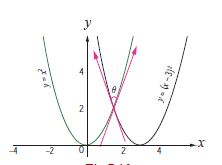
For the curve y = x2
\(\frac{dy}{dx}=2x\)
\(m_{1}=(\frac{dy}{dx})\ at\ {(\frac{3}{2},\frac{9}{4})}=3\).
For the curve y = (x-3)2
\(\frac{dy}{dx}=2(x-3)\)
\(m_{2}=(\frac{dy}{dx}) \ at \ {(\frac{3}{2},\frac{9}{4})}= -3\)
Using (3), we get
\(tan \theta=|\frac{3-(-3)}{1-9}|=\frac{3}{4}\)
Hence, \(\theta\) = \(tan^{-1}(\frac{3}{4})\).
44.
Let x represent the distance covered by the car, y represent the distance covered by the police jeep, and s represent the distance between the car and jeep.
ஃ Given = x = 0.8 km, y = 0.6 km,
\(\frac { dy }{ dt } \) = -60km/hr,
\(\frac { ds }{ dt } \) = 20 km/hr,
In ΔABC, S2 = x2 + y2 ......(1)
⇒ S2 = (0.8)2 + (0.6)2
= 0.64 + 0.36
⇒ S2 = 1
⇒ s = 1 ....(2)
Differentiating (1) with respect to 't' we get,
\(2s\frac { ds }{ dt } =2x\frac { dx }{ dt } +2y\frac { dy }{ dt } \)
⇒ \(s\frac { ds }{ dt } =x\frac { dx }{ dt } +y\frac { dy }{ dt } \) [Divided by 2]
⇒\(1\left( \frac { ds }{ dt } \right) =(0.8)\left( \frac { dx }{ dt } \right) +(0.6)(-60)\)
⇒ 1(20) = (0.8) \(\left( \frac { dx }{ dt } \right) \) + (0.6)(-60)
⇒ 20 = (0.8) \(\left( \frac { dx }{ dt } \right) \) - 36
⇒ 20 + 36 = (0.8) \(\frac { dx }{ dt } \)
⇒ \(\frac { dx }{ dt } =\frac { 56 }{ 0.8 } \) = 70km/hr.
⇒Speed of the car is 70 km/hr.
45.
46.
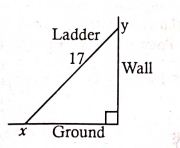
Let AB be the position of the ladder at any time t such that OA = x and OB = y
Then OA2 + OB2 = AB2
⇒ x2 + y2 = 172
Given \(\frac { dx }{ dt } \) = 5 and x = 8
When x = 8, 82 + y2 = 172
⇒ y2 = 289 - 64 = 225
⇒ y = 15
Differentiating (1) with respect to 't' we get,
\(2x\frac { dx }{ dt } +2y\frac { dy }{ dt } =0\)
⇒ 8(5) + 15 \(\frac { dy }{ dt } \) = 0 [∵ x = 8, \(\frac { dx }{ dt } \) = 15, y = 15]
⇒ 40 + 15\(\frac { dy }{ dt } \) = 0
⇒ \(\frac { dy }{ dt } =\frac { -40 }{ 15 } =\frac { -8 }{ 3 } \) m/sec
∴ The rate of top of the ladder moving down the wall is \(\frac{-8}{3}\) m/sec
(ii) The ladder, the wall and the floor forms a right angled triangle.
Area = \(\frac12\)xy
Differentiating with respect to 't' we get,
\(\frac { dA }{ dt } =\frac { 1 }{ 2 } \left[ x\frac { dy }{ dx } +y\frac { dx }{ dt } \right] \)
\(=\frac { 1 }{ 2 } \left[ 8\left( -\frac { 8 }{ 3 } \right) +15(5) \right] \)
= \(\frac { 1 }{ 2 } \left[ \frac { -64 }{ 3 } +75 \right] =\frac { 1 }{ 2 } \)
= \(\frac { 1 }{ 2 } \left[ \frac { -64+225 }{ 3 } \right] =\frac { 1 }{ 2 } \left( \frac { 161 }{ 3 } \right) \)
= \(\frac { dA }{ dt } \) = 26.83 sq.m/sec
47.
48.
Since the beacon makes one revolution (360°) in 10 sec.
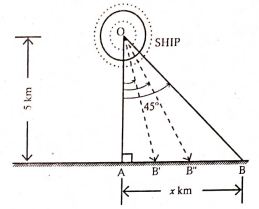
At the point of observation, let 0 be the angle of deviation of the beacon of light from OA.
Let AB x km,when \(\angle\)AOB = 0
\(\frac { d\theta }{ dt } =\frac { 2\pi }{ 10 } \)
\(=\frac { \pi }{ 5 } \) rad /sec.
Let AB = x
Then, tan θ \( =\frac { x }{ 5 } \)
x = 5 tan θ
We know that velocity = \(\frac { dx }{ dt } \)
Differentiating (1) with respect to 't' we get,
\(\frac { dx }{ dt } =5{ sec }^{ 2 }\theta ,\frac { d\theta }{ dt } \)
\(=5({ sec }^{ 2 }{ 45 }^{ o })\left( \frac { \pi }{ 5 } \right) \)
\(=5({ \sqrt { 2 } })^{ 2 }\left( \frac { \pi }{ 5 } \right) \)
\(=5(2)\left( \frac { \pi }{ 5 } \right) \)
= 2π km/sec.
49.
50.
Given s (t) = 2t3 − 9t2 + 12t ≥ 0
51.
Given s (t) = 2t3 − 9t2 + 12t ≥ 0
On differentiating we get
V(t) = 6t2-18t+ 12 ... (1)
= 6 (t2 - 3t+ 2)
= 6 (t - 1) (t - 2)
Now V(t) = 0
⇒ 6 (t-1)(t- 2) = 0
⇒ t = 1, 2
The particle changes direction when V(t) changes its sign.
If 0 ≤ t < 1 then both (t - 1) and (t - 2) < 0
⇒ V(t) > 0
If 1 < t < 2 then (t -1) > 0 and (t - 2) < 0
⇒ V(t) < 0
If t > 2 then both (t - 1) and (t - 2) > 0
⇒ V(t) > 0
∴ The particle changes direction when t = 1 and t = 2 sec.
(ii) Total distance travelled by the particle in the first 4 seconds is |s(0)- s (1)| + |s (1) - s (2)| + |s (2) -s (4)|
s(0) = -4
s(1) = 2(1)3 - 9(1)2 + 12 (1) - 4
= 2 - 9 + 12 - 4 = 1
s (2) = 2 \(\times\) 23 - 9 \(\times\) 22 + 12 \(\times\) 2 - 4
= 16 - 36 + 24 - 4
= 0
s (4) = 2(4)3 - 9(4)2 + 12 (4) - 4
= 128 - 144 + 48 - 4 = 28
∴ Is (0) -s (1)|+ Is (1) -s (2)|+ Is (2) -s(4)|
= |-4 - 1| + |1 - 0| + |0 - 28|
= |-5| + |1| + |0 - 28|
= 5 + 1 + 28 = 34 m
(iii) Given s (t) = 2t3 − 9t2 + 12t ≥ 0
[acceleration = \(\frac { dv }{ dt } \)]
When t = 1,
Acceleration = 12 (1) - 18 = -6 m/sec2
When t = 2
Acceleration = 12 (2) - 18 = 6 m/sec2
52.
53.
54.
Given s (t) = 16t2, height = 400 ft.
⇒ t2 = \(\frac { 400 }{ 16 } =\frac { 100 }{ 4 } \)
t2 = 25
t = 5 sec
(ii) Average velocity = \(\frac { ds }{ dt } \) = 32 t
When t = 2 sec
Average in the last
2 sec = \(\frac { V \ at \ t=3+V \ at \ t=5 }{ 2 } \)
= \(\frac { 32(3)+32(5) }{ 2 } \)
= \(\frac { 96+160 }{ 2 } =\frac { 256 }{ 2 } \)
= 128 f/sec
(iii) Instantaneous Velocity
=\(\frac { ds }{ dt } \) = 32t
When t = 5 sec
Velocity = \(\frac { ds }{ dt } \) = 32(5)
= 160 ft/sec
55.
Let a(t) be the distance of car A north of P at time t, and b (t) the distance of car B east of P at time t, and let c(t) be the distance from car A to car B at time t. By the Pythagorean Theorem, c(t)2 = a(t)2 + b(t)2
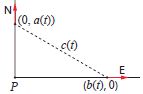
Taking derivatives, we get 2c(t)c'(t) = 2a(t)a'(t) + 2b(t)b'(t).
So, c′ = \(\frac { { aa }^{ ' }+{ bb }^{ ' } }{ c } =\frac { { aa }^{ ' }+{ bb }^{ ' } }{ \sqrt { { a }^{ 2 }+{ b }^{ 2 } } } \)
Substituting known values, we get
\(c' =\frac { (10\times 80)+(15\times 100) }{ \sqrt { { 10 }^{ 2 }+{ 15 }^{ 2 } } } =\frac { 460 }{ \sqrt { 13 } } \) ≈ 127.6 km/hr at the time of intersect
56.
Let h and r be the height and the base radius. Therefore h = 2r. Let V be the volume of the salt cone.
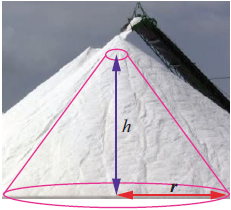
\(V=\frac{1}{3}\pi r^{2}h=\frac{1}{12}\pi h^{3}; \frac{dV}{dt}=30\) mtr3 / min.
Hence, \(\frac{dV}{dt}=\frac{1}{4}\pi h^{2}\frac{dh}{dt}\)
Therefore, \(\frac{dh}{dt}=4 \frac{dV}{dt}.\frac{1}{\pi h^{2}}\)
That is, \(\frac{dh}{dt}=4\times30\times \frac{1}{100 \pi}\)
=\(\frac{6}{5\pi}\) mtr / min.
57.
The volume of the baloon of radius r is \(V =\frac{4}{3}\pi r ^{3} \)
We are given \(\frac{dV }{dt }=1000 \) and we need to find \(\frac{dr }{dt} \) when r = 7. Now,
\(\frac{dV}{dt}=3\times\frac{4}{3}\pi r^{2}\times \frac{dr}{dt}\)
Substituting r = 7 an \(\frac{dV}{dt}\) = 1000, we get 1000 \(= 4\pi \times 49 \times \frac{dr}{dt}\)
Hence, \(\frac{dr}{dt}=\frac{1000}{4\times49\times \pi}=\frac{250}{49\pi}\)
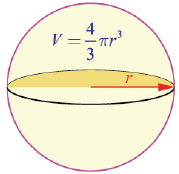
The surface area S of the baloon is S = 4ㅠr2. Therefore, \(\frac{dS}{dt}=8\pi \times r \times \frac{dr}{dt}\)
Substituting\(\frac{dr}{dt}=\frac{250}{49\pi}\) and r = 7, we get \(\frac{dS}{dt}=8\pi\times7\times \frac{250}{49\pi}=\frac{2000}{7}\)
Therefore, the rate of change of radius is \(\frac{250}{49 \pi}\) cm/sec and the change of surface area is \(\frac{2000}{7}\) cm2 / sec
58.
Given that s(t) = t3 − 6t2 + 9t + 1. On differentiating, we get v(t) = 3t2 -12t + 9 and a(t) = 6t −12.
(i) The particle is at rest when v(t) = 0 . Therefore, v(t) = 3(t −1)(t − 3) = 0 gives t = 1 and t = 3.
(ii) The particle changes direction when v (t) changes its sign. Now.
if 0 ≤ t < 1 then both (t −1) and (t − 3) < 0 and hence, v(t) > 0.
If 1< t < 3 then (t −1) > 0 and (t − 3) < 0 and hence, v(t) < 0.
If t > 3 then both (t −1) and (t − 3) > 0 and hence, v(t) > 0.
Therefore, the particle changes direction when t = 1 and t = 3.
(iii) The total distance travelled by the particle from time t = 0 to t = 2 is given by,
|s(0) − s(1)| + |s(1) − s(2)| = |1− 5 | + | 5 − 3| = 6 metres.
59.
Let (x) = sin x
fI(x) = cos x
fII(x) = - sin x
fIII(x) = -cos x
⇒ \(f\left( \frac { \pi }{ 4 } \right) =sin\frac { \pi }{ 4 } =\frac { 1 }{ \sqrt { 2 } } \)
\({ f }^{ 1 }\left( \frac { \pi }{ 4 } \right) =cos\frac { \pi }{ 4 } =\frac { 1 }{ \sqrt { 2 } } \)
\({ f }^{ II }\left( \frac { \pi }{ 4 } \right) =sin\frac { \pi }{ 4 } =-\frac { 1 }{ \sqrt { 2 } } \)
\({ f }^{ II }\left( \frac { \pi }{ 4 } \right) =-cos\frac { \pi }{ 4 } =-\frac { 1 }{ \sqrt { 2 } } \)
Taylors' series for f (x) at x = \(\frac { \pi }{ 4 } \) is
\(f(x)=f\left( \frac { \pi }{ 4 } \right) +\frac { { f }^{ I }\left( \frac { \pi }{ 4 } \right) }{ 1! } \left( x-\frac { \pi }{ 4 } \right) +\frac { { f }^{ II }\left( \frac { \pi }{ 4 } \right) }{ 2! } { \left( x-\frac { \pi }{ 4 } \right) }^{ 2 }+\frac { { f }^{ III }\left( \frac { \pi }{ 4 } \right) }{ 3! } { \left( x-\frac { \pi }{ 4 } \right) }^{ 3 }\)+...
\(sinx=\frac { 1 }{ \sqrt { 2 } } +\frac { 1 }{ \sqrt { 2 } } \left( x-\frac { \pi }{ 4 } \right) -\frac { 1 }{ \sqrt { 2 } } \frac { { \left( x-\frac { \pi }{ 4 } \right) }^{ 2 } }{ 2! } -\frac { 1 }{ \sqrt { 2 } } \frac { { \left( x-\frac { \pi }{ 4 } \right) }^{ 3 } }{ 3! } +...\)
\(=\frac { 1 }{ \sqrt { 2 } } \left[ 1+\left( x-\frac { \pi }{ 4 } \right) -\frac { 1 }{ 2! } { \left( x-\frac { \pi }{ 4 } \right) }^{ 2 }-\frac { 1 }{ 3! } { \left( x-\frac { \pi }{ 4 } \right) }^{ 3 }+..... \right] \)
\(sinx=\frac { \sqrt { 2 } }{ 2 } \left[ 1+\frac { 1 }{ 1! } \left( x-\frac { \pi }{ 4 } \right) -\frac { 1 }{ 2! } { \left( x-\frac { \pi }{ 4 } \right) }-\frac { 1 }{ 3! } { \left( x-\frac { \pi }{ 4 } \right) }+..... \right] \)
60.
f'(x) = ≤1 for all 1 ≤ x ≤ 4
Using Lagrange's mean value theorem,
f'(x) = \(\frac { f(b)-f(a) }{ b-a } \) [∵ f(x) is continuous in [1, 4] and differentiable in (1, 4)]
f'(x) = \(\frac{f(4)-f(1)}{4-1}\)
f'(x) = \(\frac { f(4)-f(1) }{ 3} \)
⇒ \(\frac { f(4)-f(1) }{ 3} \) = f'(s)
⇒ \(\frac { f(4)-f(1) }{ 3} \) ≤ 1[∵ f'(x) ≤ 1]
⇒ f(4) - f(1) ≤ 3
Hence proved
61.
Let f (t) represents the distance covered at 't' hour.
Given f(0) = 20 and f(2) = ?
Also speed = f' (t) ≥ 150
The distance function is continuous as well as differentiable.
By Lagrange's mean value theorem, there exists c such that
⇒ f'(c) = \(\frac { f(b)-f(a) }{ b-a } \)
⇒ f'(c) = \(\frac{f(2)-20}{2-0}\) ≥ 150 [Man speed is 150 km/hr and f' (c) represents speed]
⇒ \(\frac{f(2)-20}{2-0}\) ≥ 150
⇒ f(2) - 20 ≥ 300
⇒ f(2) ≥ 320
Hence, in the next two hours he can cover 320km.
62.
Given f(x) = Ax2 + Bx + C, x ∈ [a, b]
a) f (x) is continuous in [a, b]
b) f(x) is differentiate in (a, b)
c) f(b) = Ab2+ Bb + c,
f(a) = Aa2+ Ba + c
Using mean value theorem, there exists c ∈ [a, b] such that f'(c) = \(\frac { f(b)-f(a) }{ b-a } \)
2Ac + B = \(\frac { (A{ b }^{ 2 }+Bb+C)-(A{ a }^{ 2 }+Ba+C) }{ b-a } \)
\(=\frac{A b^{2}+B b+\not C-A a^{2}-B a-\not C}{b-a}\)
= \(\frac { a(b+a)(b-a)+B(b-a) }{ b-a } \)
\(=\frac{(\not b-a)[\mathrm{A}( b+a)+\mathrm{B}]}{\not b-a}\)
\(2 \mathrm{~A} c+\not \mathbf{B}=\mathrm{A}(a+b)+\not \mathrm{B}\)
⇒ 2Ac = A(a + b)
= \(\frac{a+b}{2}\) ∈ [a, b]
63.
Given \(f(x)=\frac{1}{x}\), x ∈ [a, b]
a) f(x) is continuous in [a, b]
b) f(x) is differentiable in (a, b)
c) f(b) = \(\frac1b\), f(b) = \(\frac1a\)
Using mean value theorem, there exists c ∈ [a, b] such that f'(c) = \(\frac { f(b)-f(a) }{ b-a } \)
\(\frac { -1 }{ { c }^{ 2 } } =\frac { \frac { 1 }{ b } -\frac { 1 }{ a } }{ b-a } \)
⇒ \(\frac { 1 }{ { c }^{ 2 } } =\frac { a-b }{ ab(b-a) } =-\frac { (b-a) }{ ab(b-a) } \)
= - \(\frac{1}{ab}\)
⇒ c2 = cb
⇒ c = 土 \(\sqrt { ab} \)
ஃ c = \(\sqrt { ab} \) ∈ [a, b]
[∵ c = - \(\sqrt { ab} \) ∈ [a, b]]
64.
Given f (x) = (x − 2)(x − 7), x ∈ [3,11]
a) f(x) is continuous in [3, 11]
b) f(x) is differentiable in (3, 11)
c) f(11) = (11-2)(11-7)
= (9) (4) = 36
f(3) = (3 - 2)(3 - 7)
= (1)(-4) = - 4
∴ By Lagrange's mean value theorem, there exists c ∈ [3,11] such that f'(c) = \(\frac { f(b)-f(a) }{ b-a } \)
\(\left[ \begin{matrix} f(x)\begin{matrix} = & (x \end{matrix}- & 2) & \begin{matrix} (x & - \end{matrix}7) \\ \begin{matrix} = & { x }^{ 2 } \end{matrix}- & 7x & -2x\begin{matrix} + & 14 \end{matrix} \\ \begin{matrix} = & { x }^{ 2 } \end{matrix}- & 9x & +\begin{matrix} 14 & \end{matrix} \end{matrix} \right] \)
⇒ 2c - 9 = \(\frac{36+4}{11-3}\)
⇒ 3c - 9 = \(\frac{40}{8}\) = 5
⇒ 2c = 14
⇒ c = 7 ∈ [3 , 11]
65.
f(x) = x3 − 3x + 2, x ∈ [-2, 2]
a) f(x) is continuous in [-2, 2]
b) f(x) is differentiable in (-2, 2)
f(-2) = (-2)3 - 3 (-2) + 2
= -8 + 6 + 2 = 0
f(2) = 23 - 3(2) +2
= 8 - 6 + 2 = 4
By Lagrange's mean value theorem, there exists c ∈ [-2,2] such that f'(c) = \(\frac { f(b)-f(a) }{ b-a } \)
⇒ 3c3 - 3 = \(\frac { 4-0 }{ 2-(-2) } =\frac { 4 }{ 4 } =1\)
⇒ 32-3 = 1
⇒ 32 =4 ⇒ c2 = \(\frac43\)
⇒ c = 土 \(\frac { 2 }{ \sqrt { 3 } } \) ∈ [-2, 2]
66.
67.
Given equation of curve is y = \(\frac{x+1}{x-1}\) and the line is x + 2y = 6
Slope of the tangent to the curve
m1 = \(\frac{dy}{dx}\)
= \(\frac { (x-1)(1)-(x-1)(1) }{ { (x-1) }^{ 2 } } \)
= \(\frac { x-1-x-1 }{ { (x-1) }^{ 2 } } =\frac { -2 }{ { (x-1) }^{ 2 } } \) [Quotient rule]
Slope of the line m2 = \(\frac{-1}{2}\) \(\left[ \frac { co-efficient\ of\ x }{ co-efficient\ of\ y } \right] \)
Since the tangent to the curve and the lines are parallel, m1 = m2
⇒ \(\frac { -2 }{ { (x-1) }^{ 2 } } =\frac { -1 }{ 2 } \)
⇒ 4 = (x - 1)2
⇒ x - 1 = 土 2
⇒ x-1 = 2 or x- 1 = -2
⇒ x = 3 or x = -1
⇒ When x = 3, y = \(\frac{3+1}{3-1}\) = \(\frac42\) = 2
⇒ When x = -1, y = \(\frac{-1+1}{-1-1}=\frac{0}{-2}\) = 0
∴ Equation of the tangent at (3, 2) is
y - 2 = \(\frac{-1}{2}\)(x - 3)
⇒ 2y - 4 = -x + 3
x + 2y -7 = 0
68.
Given equation of the curve is y = 1 + x3 and the line is x + 12y = 12
Slope of the tangent to the curve
m1 = \(\frac { dy }{ dx } \) = 3 x2 and the
Slope of the line = m2
= \(\frac{-1}{2}\) \(\left[ \because m=\frac { co-efficient\ of\ x }{ co-efficient\ of\ y } \right] \)
Since the slope of the tangent to the curve and the line are orthogonal, m1 m2 = - 1.
∴ 3x2\(\left( \frac { -1 }{ 2 } \right) \) = -1
⇒ \(\frac{x^2}{4}\) = 1
⇒ x2 = 4
⇒ x = ±2
When x = 2, y = 1 + 23 = 9
When x = -2, y = 1+ (-2)3
= 1-8 = -7
∴ Equation of the tangent at (2, 9) is
y-9 = 12(x-2) [∵ m1 = 3x2 = 3(2)2 = 12]
∴ y - 9 = 12x - 24
∴ 12x - y = 15
Equation of the tangent at (-2, -7) is
y+7= 12(x + 2)
⇒ y + 7 = 12x + 24
⇒ 12x-y+17 = 0
69.
Equation of the given curve is y2 - 4xy = x2 + 5..(1)
Differentiating with respect to 'x' we get,
\(2y\frac { dy }{ dx } -4\left[ x\frac { dy }{ dx } +y(1) \right] =2x\)
⇒ \(2y\frac { dy }{ dx } -4x\frac { dy }{ dx } -4y=2x\)
⇒ \(\frac { dy }{ dx } \) (2y -4x) = 2x + 4y
⇒ \(\frac { dy }{ dx } \) = \(\frac { x+2y }{ y-2x } \)
Since the tangent to the curve is horizontal, \(\frac { dy }{ dx } \) = 0
ஃ \(\frac { x+2y }{ y-2x } \) = 0
⇒ x+ 2y = 0
⇒ x = -2y .....(2)
Substituting (2) in (1) we get,
y2 - 4(-2y)y = (-1y)2 + 5
⇒ y2 + 8y2 = 4y2 + 5
⇒ y2 = 4y2 + 5
⇒ 5y2 = 5
⇒ y2 = 1
⇒ y = 土 1
From (2), When y = 1, x = - 2
When y = -1, x = 2
∴ The required points are (2, -1) and (-2,1)
70.
Given curve is y = x3 − x2 + x + 3 and the line is x + y = 1729
Slope of the tangent to the curve is
\(\frac { dy }{ dt } \) = 3x2 - 12 x + 1
Slope of the normal to the curve is
m1 = \(\frac { -1 }{ { 3x }^{ 2 }-12x+1 } \)
Slope of the line is
m2 = \(\frac{-1}{1}\) = -1
Since the slope of the normal to the curve and the lines are parallel, m1 = m2
⇒ \(\frac { -1 }{ { 3x }^{ 2 }-12x+1 } \) = -1
⇒ 3x2 - 12x + 1 = 1
⇒ 3x2 -12x = 0
⇒ 3x (x-4) = 0
⇒ x = 0 or x = 4,....(1)
When x = 0, y = 03 - 6(0)2 + 0 + 3
⇒ y = 3 [From (1)]
⇒ When x = 4, y = 43 - 6(4)2 + 4 + 3
= 64 - 96 + 7 = - 25
∴ (0, 3) and (4, -25) are the required points.
71.
Observe that the given curve is neither a circle nor an ellipse. For your reference the curve is shown in Figure.
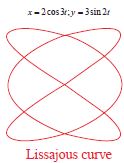
Now, \(\frac{dy}{dx}=\frac{\frac{dy}{dt} }{\frac{dx}{dt} } \)
= -\(\frac{6 cos2t}{6sin3t} = -\frac{cos2t}{sin3t} \).
Therefore, the tangent at any point is
\(y-3sin2t= -\frac{cos2t}{sin3t}(x-2cos3t)\)
That is, x cos 2t + y sin 3t = 3sin 2t sin 3t + 2cos 2t cos 3t.
The slope of the normal is the negative of the reciprocal of the tangent which in this case is \(\frac{sin3t}{cos2t}\). Hence, the equation of the normal is \(y-3sin2t=\frac{sin3t}{cos2t}(x-2cos3t)\).
That is, x sin 3t - y cos 2t = 2sin 3t cos3t 3sin 2t cos 2t = sin 6t - \(\frac{3}{2}\) sin 4t.

12th Standard Syllabus & Materials
12th Standard
TN 12th Computer Applications வலையமைப்பு வடமிடல் Sample Question Papers Study Material - QB365 Set A
NEW12th Standard
TN 12th Computer Applications களப்பெயர் முறைமை (DNS) Sample Question Papers Study Material - QB365 Set A
NEW12th Standard
TN 12th Computer Applications வலையமைப்பு எடுத்துக்காட்டுகள் மற்றும் நெறிமுறைகள் Sample Question Papers Study Material - QB365 Set A
NEW12th Standard
TN 12th Computer Applications கணினி வலையமைப்பு ஓர் அறிமுகம் Sample Question Papers Study Material - QB365 Set A



Tamilnadu Stateboard 12th Standard Subjects
Maths

Chemistry

Physics

Biology

Computer Science

Business Maths and Statistics

Economics

Commerce

Accountancy

History

Computer Applications
Biology
Computer Technology
Computer Applications
Computer Science
Business Maths and Statistics
Commerce
Economics
Maths
Chemistry
Physics
Computer Technology
History
Accountancy

Tamil

English

French
Tamilnadu Stateboard Standards

