
 100% FREE ACCESS
12th Standard Syllabus & Materials
12th Standard
TN 12th Computer Applications மின்னணு தரவு பரிமாற்றம் Sample Question Papers Study Material - QB365 Set A
NEW12th Standard
TN 12th Computer Applications மின் - வணிக பாதுகாப்பு அமைப்புகள் Sample Question Papers Study Material - QB365 Set A
NEW12th Standard
TN 12th Computer Applications மின்னணு செலுத்தல் முறைகள் Sample Question Papers Study Material - QB365 Set A
NEW12th Standard
TN 12th Computer Applications மின் - வணிகம் Sample Question Papers Study Material - QB365 Set A
NEW12th Standard
TN 12th Computer Applications திறந்த மூல கருத்துருக்கள் Sample Question Papers Study Material - QB365 Set A
NEW12th Standard
TN 12th Computer Applications வலையமைப்பு வடமிடல் Sample Question Papers Study Material - QB365 Set A

Published on: 02/02/2021
12th Standard Maths English Medium Applications Of Differential Calculus Reduced Syllabus Important Questions 2021
Download Tamil Nadu 12th Standard Maths question papers, model tests, one-mark questions, important questions, and public exam papers in PDF format. Free study materials and answer keys for TN State Board students.
Questions + Answers key
Take MCQ Maths Test1.
Prove that among all the rectangles of the given area square has the least perimeter.
2.
If an initial amount A0 of money is invested at an interest rate r compounded n times a year, the value of the investment after t years is \(A={ A }_{ 0 }{ \left( 1+\frac { r }{ n } \right) }^{ nt }\). If the interest is compounded continuously, (that is as n ➝∞), show that the amount after t years is A = Aoert.
3.
The volume of a cylinder is given by the formula V = πr2 h. Find the greatest and least values of V if r + h = 6.
4.
Find the intervals of monotonicities and hence find the local extremum for the following function:
f(x) = sin x cos x + 5, x ∈ (0,2π)
5.
A camera is accidentally knocked off an edge of a cliff 400 ft high. The camera falls a distance of s =16t2 in t seconds
6.
A road running north to south crosses a road going east to west at the point P. Car A is driving north along the first road, and car B is driving east along the second road. At a particular time car A 10 kilometres to the north of P and traveling at 80 km/hr, while car B is 15 kilometres to the east of P and traveling at 100 km/hr. How fast is the distance between the two cars changing?
7.
The price of a product is related to the number of units available (supply) by the equation Px + 3P −16x = 234, where P is the price of the product per unit in Rupees(Rs) and x is the number of units. Find the rate at which the price is changing with respect to time when 90 units are available and the supply is increasing at a rate of 15 units/week.
8.
A particle moves along a horizontal line such that its position at any time t ≥ 0 is given by s(t) = t3 − 6t2 +9 t +1, where s is measured in metres and t in seconds?
(1) At what time the particle is at rest?
(2) At what time the particle changes its direction?
(3) Find the total distance travelled by the particle in the first 2 seconds.
9.
For the function f(x) = x2, x∈ [0, 2] compute the average rate of changes in the subintervals [0, 0.5], [0.5, 1], [1, 1.5], [1.5, 2] and the instantaneous rate of changes at the points x = 0.5,1, 1.5, 2
10.
Verify Rolle’s theorem for f(x)=ex sinx,\(0\le x\le \pi \)
11.
The ends of a rod AB which is 5 m long moves along two grooves OX, OY which at the right angles. If A moves at a constant speed of \(\frac { 1 }{ 2 } \) m/sec, what is the speed of B, when it is 4m from O?
12.
Verify LMV theorem for f(x) = x3 - 2x2 - x + 3 in [0, 1].
13.
Evaluate: \(\underset{x\rightarrow 0^{+}}{lim}(\frac{1}{x}-\frac{1}{e^{x}-1})\).
14.
Suppose that for a function f(x), f'(x) ≤ 1for all 1 ≤ x ≤ 4. Show that f(4) - f(1) ≤ 3.
15.
A truck travels on a toll road with a speed limit of 80 km/hr. The truck completes a 164 km journey in 2 hours. At the end of the toll road the trucker is issued with a speed violation ticket. Justify this using the Mean Value Theorem.
16.
Prove using the Rolle’s theorem that between any two distinct real zeros of the polynomial \(a_{n}x^{n}+a_{n-1}x^{n-1}+...+a_{1}x+a_{0}\) there is a zero of the polynomial \(na_{n}x^{n-1}+(n-1)a_{n-1}x^{n-2}+...+a_{1}\)
17.
Find the equations of the tangents to the curve y = 1 + x3 for which the tangent is orthogonal with the line x +12y = 12.
18.
Find the angle of intersection of the curve y = sin x with the positive x -axis.
19.
Find the equation of the tangent and normal to the Lissajous curve given by x = 2cos 3t and y = 3sin 2t, t ∈ R
20.
Find the absolute extreme of the function f(x) = x2-2x+2 on the closed interval [0, 3]
21.
Evaluate the following limits, if necessary using L’Hopitalrule
(i) \(\underset { x\rightarrow 2 }{ lim } \cfrac { sin\pi x }{ 2-x } \)
(ii) \(\cfrac { lim }{ x\rightarrow 2 } \cfrac { { x }^{ n }-{ a }^{ n } }{ x-2 } \)
(iii) \(\underset { x\rightarrow \infty }{ lim } \cfrac { sin\frac { 2 }{ x } }{ \frac { 1 }{ x } } \)
(iv) \(\underset { x\rightarrow \infty }{ lim } \cfrac { { x }^{ 2 } }{ { e }^{ x } } \)
22.
Find the equation of the tangent to the curve y2=4x+5 and which is parallel to y=2x+7
23.
Find the intervals of increasing and decreasing function for f(x) = x3 + 2x2 - 1.
24.
A particle moves in a line so that x =\(\sqrt { t } \). Show that the acceleration is negative and proportional to the cube of the velocity.
25.
Evaluate the limit \(\underset{x\rightarrow 0^{+}}{lim} (\frac{sin \ x}{x^{2}})\)
26.
Evaluate the limit \(\underset{x\rightarrow 0}{lim}(\frac{sin \ mx}{x})\)
27.
Find the slope of the tangent to the following curves at the respective given points
y = x4 + 2x2 − x at x = 1
28.
The statement "If f has a local extremum at c and if f'(c) exists then f'(c) = 0" is ________
the extreme value theorem
Fermat's theorem
Law of mean
Rolle's theorem
29.
\(\underset { x\rightarrow 0 }{ lim } \frac { x }{ tanx } \) is _________
1
-1
0
∞
30.
The function -3x+12 is ________ function on R.
decreasing
strictly decreasing
increasing
strictly increasing
31.
The equation of the tangent to the curve x = t cost, y = t sin t at the origin is __________
x = 0
y = 0
x +y = 0
x + y = 7
32.
The critical points of the function f(x) = \((x-2)^{ \frac { 2 }{ 3 } }(2x+1)\) are __________
-1, 2
1, \(\frac { 1 }{ 2 } \)
1, 2
none
33.
The angle made by any tangent to the curve y = x5 + 8x + 1 with the X-axis is a __________
obtuse
right angle
acute angle
no angle
34.
The least value of a when f f(x) = x2 + ax + 1 is increasing on (1, 2) is __________
-2
2
1
-1
35.
Equation of the normal to the curve y = 2x2+3 sin x at x = 0 is __________
x + y = 0
3y = 0
x + 3y = 7
x + 3y = 0
36.
The number given by the Mean value theorem for the function \(\frac { 1 }{ x } \), x ∈ [1, 9] is
2
2.5
3
3.5
37.
The function sin4 x + cos4 x is increasing in the interval
\(\left[ \frac { 5\pi }{ 8 } ,\frac { 3\pi }{ 4 } \right] \)
\(\left[ \frac { \pi }{ 2 } ,\frac { 5\pi }{ 8 } \right] \)
\(\left[ \frac { \pi }{ 4 } ,\frac { \pi }{ 2 } \right] \)
\(\left[ 0,\frac { \pi }{ 4 } \right] \)
38.
What is the value of the limit \(\lim _{x \rightarrow 0}\left(\cot x-\frac{1}{x}\right) \text { is }\)
0
1
2
∞
39.
Angle between y2 = x and x2 = y at the origin is
\({ tan }^{ -1 }\cfrac { 3 }{ 4 } \)
\({ tan }^{ -1 }\left( \cfrac { 4 }{ 3 } \right) \)
\(\cfrac { \pi }{ 2 } \)
\(\cfrac { \pi }{ 4 } \)
40.
The slope of the line normal to the curve f(x) = 2cos 4x at \(x=\cfrac { \pi }{ 12 } \) is
\(-4\sqrt { 3 } \)
-4
\(\cfrac { \sqrt { 3 } }{ 12 } \)
\(4\sqrt { 3 } \)
41.
The abscissa of the point on the curve \(f\left( x \right) =\sqrt { 8-2x } \) at which the slope of the tangent is -0.25 ?
-8
-4
-2
0
42.
The volume of a sphere is increasing in volume at the rate of 3 πcm3 / sec. The rate of change of its radius when radius is \(\frac { 1 }{ 2 } \) cm
3 cm/s
2 cm/s
1 cm/s
\(\cfrac { 1 }{ 2 } cm/s\)
1.
Let x, y be the sides of the rectangle. Hence the area of the rectangle is xy = k (given). The perimeter of the rectangle P is 2(x+ y). So the problem is to minimize 2(x+ y) suject to the condition xy = k. Let \(P(x)=2\left( x+\frac { k }{ x } \right) \)
\(P'(x)=2\left( 1-\frac { k }{ { x }^{ 2 } } \right) \)
P'(x) = 0 gives \(\left( 1-\frac { k }{ { x }^{ 2 } } \right) =0\)
As x, y are sides of the rectangle, \(x=\sqrt { k } \) is a critical number.
Now, P''(x) = \(\frac{4k}{x^3}\) and P''(\(\sqrt k\)) >0 \(\Rightarrow\) p(x) and has its minimum value at \(\sqrt k\)
Substituting \(x=\sqrt { k } \) in xy = k we get \(y=\sqrt { k } \) . Therefore the minimum perimeter rectangle of a given area is a square.
2.
The amount after t years \((A)=\underset { x\rightarrow { \infty } }{ lim } { A }_{ 0 }{ \left( 1+\frac { r }{ n } \right) }^{ nt }\)
This is an indeterminate of the form 1∞.
Let g(x) = \({ \left( 1+\frac { r }{ n } \right) }^{ nt }\)
Taking logarithm we get,
log (g(x) = \(log{ \left( 1+\frac { r }{ n } \right) }^{ nt }\)
= \(\frac { log{ \left( 1+\frac { r }{ n } \right) } }{ \frac { 1 }{ nt } } \)
\(\therefore \underset { x\rightarrow { \infty } }{ lim } log(g(x)=\underset { x\rightarrow { \infty } }{ lim } \frac { log{ \left( 1+\frac { r }{ n } \right) } }{ \frac { 1 }{ nt } } \left( \frac { 0 }{ 0 } from \right) \)
\(=\underset { x\rightarrow { \infty } }{ lim } \frac { \frac { 1 }{ 1+\frac { r }{ n } } \left( \frac { -r }{ { n }^{ 2 } } \right) }{ -\frac { 1 }{ { n }^{ 2 }t } } \) [By L' Hôpital rule]
\(=\underset { x\rightarrow { \infty } }{ lim } \frac { 1 }{ 1+\frac { r }{ n } } \left( \frac { -r }{ { n }^{ 2 } } \right) \left( -\frac { { n }^{ 2 }t }{ 1 } \right) \)
= \(\underset { x\rightarrow { \infty } }{ lim } \frac { 1 }{ 1+\frac { r }{ n } } (rt)\)
= \(\left( \frac { 1 }{ 1+0 } \right) (rt)={ A }_{ 0 }rt\)
But \(\underset { x\rightarrow { \infty } }{ lim } log(g(x))=log(\underset { x\rightarrow { \infty } }{ lim } g(x))\)
\(\therefore log(\underset { x\rightarrow { \infty } }{ lim } g(x))=rt\)
\(\Rightarrow { e }^{ log(\underset { x\rightarrow { \infty } }{ lim } g(x)) }=rt\)
\(\Rightarrow \underset { x\rightarrow { \infty } }{ lim } g(x)={ e }^{ rt }\)
\(\Rightarrow \underset { x\rightarrow { \infty } }{ lim } { A }_{ 0 }{ \left( 1+\frac { r }{ n } \right) }^{ nt }={ A }_{ 0 }.{ e }^{ rt }\)
\(\Rightarrow A={ A }_{ 0 }.({ e }^{ rt })\)
Hence Proved.
3.
Given r + h = 6
⇒ h = 6 - r ...(1)
Let f(r) = V = πr2h
= πr2(6-r) = π(6r2 -r3)
f'(r) = π (12r - 3r2)
∴f'(r) = 0
⇒π (12r- 3r2) = 0
⇒ 12r-3r2 = 0
⇒ 3r(4-r) = 0
⇒ r = 0 or r = 4
ஃThe critical numbers are 0, 4
f"(r) = π (12 - 6r)
When r = 4, f"(r) = π(12 - 24) < 0
ஃ f(r) maximum when r = 4
When r = 4, h = 6 - 4 = 2
When r = 0, h = 6 - 0 = 6
ஃ Volume of the cylinder V = πr2 h = π (4)2 (2)
= 32 πCu. units
or volume of the cylinder V = π (02) (6) = 0
Cu. Units.
4.
f (x) is defined and differentiable for all x ∈ (0, 2π).
f'(x) = sin x (-sin x) + cos x (cos x)
= cos2 X - sin2 x
= cos2x
f'(x) = 0
\(\Rightarrow cosx=0cos=\frac { \pi }{ 2 } ,cos\frac { 3\pi }{ 2 } ,cos\frac { 5\pi }{ 2 } ,cos\frac { 7\pi }{ 2 } \)
\(\Rightarrow 2x=\frac { \pi }{ 2 } \frac { \pi }{ 2 } ,\frac { 3\pi }{ 2 } ,\frac { 5\pi }{ 2 } ,\frac { 7\pi }{ 2 } \)
\(\Rightarrow x=\frac { \pi }{ 4 } ,\frac { 3\pi }{ 4 } ,\frac { 5\pi }{ 4 } ,\frac { 7\pi }{ 4 } \)
The stationary points are at
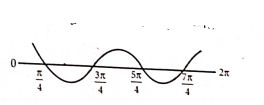
\(x=\frac { \pi }{ 4 } ,\frac { 3\pi }{ 4 } ,\frac { 5\pi }{ 4 } ,\frac { 7\pi }{ 4 } \)
\(\left( 0,\frac { \pi }{ 4 } \right) ,\left( \frac { \pi }{ 4 } ,\frac { 3\pi }{ 4 } \right) \left( \frac { 3\pi }{ 4 } ,\frac { 5\pi }{ 4 } \right) \left( \frac { 5\pi }{ 4 } ,\frac { 7\pi }{ 4 } \right) \left( \frac { 7\pi }{ 4 } ,2\pi \right) \)
| Interval | \(\left( 0,\frac { \pi }{ 4 } \right) ,\) | \(\left( \frac { \pi }{ 4 } ,\frac { 3\pi }{ 4 } \right) \) | \(\left( \frac { 3\pi }{ 4 } ,\frac { 5\pi }{ 4 } \right) \) | \(\left( \frac { 5\pi }{ 4 } ,\frac { 7\pi }{ 4 } \right) \) | \(\left( \frac { 7\pi }{ 4 } ,2\pi \right) \) |
| Sign of f'(x) | Say \(x=\frac { \pi }{ 6 } \) cos \(cos2\times \cfrac { \pi }{ 6 } \) = \(=cos\cfrac { \pi }{ 3 } =\cfrac { 1 }{ 2 } \) +ve |
Say \(x=\cfrac { \pi }{ 2 } \) \(cos2\times \cfrac { \pi }{ 2 } \) = \(cos\pi =-1-ve\) -ve |
Say y = π cos 2π = 1+ve |
Say \(x=\cfrac { 3\pi }{ 2 } \) \(cos2\times \cfrac { 3\pi }{ 2 } \) = cos 3π = -1 |
Say x = 3200 cos 2 x 3200 = cos 640 = cos (360 + 280) = cos 2800 = cos (270 + 10) = sin 100 =+ve |
| monotonicity | Strictly increasing | Strictly decreasing | Strictly increasing | Strictly decreasing | Strictly increasing |
\(\therefore\) f (x) is strictly increasing in \(\left( 0,\frac { \pi }{ 4 } \right) \)\(\left( \frac { 3\pi }{ 4 } ,5\frac { \pi }{ 4 } \right) \left( \frac { 7\pi }{ 4 } ,2\pi \right) \) and strictly decreasing in \(\left( \frac { \pi }{ 4 } ,\frac { 3\pi }{ 4 } \right) \left( \frac { 5\pi }{ 4 } ,\frac { 7\pi }{ 4 } \right) \)
Since f'(x) changes its positionfrom positive to negative at \(x=\frac { \pi }{ 4 } ,\frac { 5\pi }{ 4 } \) there is a local
maximum at \(x=\frac { \pi }{ 4 } ,\frac { 5\pi }{ 4 } \)
\(f\left( \frac { \pi }{ 4 } \right) =sin\frac { \pi }{ 4 } cos\frac { \pi }{ 4 } +5\)
= \(\frac { 1 }{ \sqrt { 2 } } .\frac { 1 }{ \sqrt { 2 } } +5=\frac { 1 }{ 2 } +5=\frac { 11 }{ 2 } \)
\(f\left( \frac { 5\pi }{ 4 } \right) =sin{ \frac { 5\pi }{ 4 } }cos\frac { \pi }{ 4 } +5\)
= \(\left( \frac { -1 }{ \sqrt { 2 } } \right) \left( \frac { -1 }{ \sqrt { 2 } } \right) +5\)
= \(\frac { 1 }{ 2 } +5=\frac { 11 }{ 2 } \)
Also f'(x) changes its position from negative to positive at \(x=\frac { 3\pi }{ 4 } ,\frac { 7\pi }{ 4 } \) there is local mmimum
at \(x=\frac { 3\pi }{ 4 } ,\frac { 7\pi }{ 4 } \)
\(\therefore f\left( \frac { 3\pi }{ 4 } \right) =cos\frac { 3\pi }{ 4 } sin\frac { 3\pi }{ 4 } +5\)
= \(\left( \frac { -1 }{ \sqrt { 2 } } \right) \left( \frac { +1 }{ \sqrt { 2 } } \right) +5=5-\frac { 1 }{ 2 } =\frac { 9 }{ 2 } \)
\(f\left( \frac { 7\pi }{ 4 } \right) =cos\frac { 7\pi }{ 4 } sin\frac { 7\pi }{ 4 } +5\)
= \(cos\left( 2\pi -\frac { \pi }{ 4 } \right) sin\left( 2\pi -\frac { \pi }{ 4 } \right) +5\)
= \(\left( \frac { 1 }{ \sqrt { 2 } } \right) \left( \frac { -1 }{ \sqrt { 2 } } \right) +5\)
= \(\frac { -1 }{ 2 } +5=\frac { 9 }{ 2 } \)
= \(\frac { -1 }{ 2 } +5=\frac { 9 }{ 2 } \)
5.
6.
Let a(t) be the distance of car A north of P at time t, and b (t) the distance of car B east of P at time t, and let c(t) be the distance from car A to car B at time t. By the Pythagorean Theorem, c(t)2 = a(t)2 + b(t)2
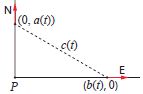
Taking derivatives, we get 2c(t)c'(t) = 2a(t)a'(t) + 2b(t)b'(t).
So, c′ = \(\frac { { aa }^{ ' }+{ bb }^{ ' } }{ c } =\frac { { aa }^{ ' }+{ bb }^{ ' } }{ \sqrt { { a }^{ 2 }+{ b }^{ 2 } } } \)
Substituting known values, we get
\(c' =\frac { (10\times 80)+(15\times 100) }{ \sqrt { { 10 }^{ 2 }+{ 15 }^{ 2 } } } =\frac { 460 }{ \sqrt { 13 } } \) ≈ 127.6 km/hr at the time of intersect
7.
We have, \(P=\frac{234+16x}{x+3}\)
Therefore, \(\frac{dP}{dt}= - \frac{186}{(x+3)^{2}}\times \frac{dx}{dt}\).
Substituting \(x=90, \frac{dx}{dt}=15\) we get\(\frac{dP}{dt}= -\frac{186}{93^{2}}\times 15= -\frac{10}{31}\approx -0.32\) repee/ week.
That is the price is changing, in fact decreasing at the rate of Rs. 0.32 per unit.
8.
Given that s(t) = t3 − 6t2 + 9t + 1. On differentiating, we get v(t) = 3t2 -12t + 9 and a(t) = 6t −12.
(i) The particle is at rest when v(t) = 0 . Therefore, v(t) = 3(t −1)(t − 3) = 0 gives t = 1 and t = 3.
(ii) The particle changes direction when v (t) changes its sign. Now.
if 0 ≤ t < 1 then both (t −1) and (t − 3) < 0 and hence, v(t) > 0.
If 1< t < 3 then (t −1) > 0 and (t − 3) < 0 and hence, v(t) < 0.
If t > 3 then both (t −1) and (t − 3) > 0 and hence, v(t) > 0.
Therefore, the particle changes direction when t = 1 and t = 3.
(iii) The total distance travelled by the particle from time t = 0 to t = 2 is given by,
|s(0) − s(1)| + |s(1) − s(2)| = |1− 5 | + | 5 − 3| = 6 metres.
9.
The average rate of change in an interval [a, b] is \(\frac { f(b)-f(a) }{ b-a } \) whereas, the instantaneous rate of change at a point x is f′(x) for the given function. They are respectively, b + a and 2x.
| a | b | x | Average rate is \(\frac { f(b)-f(a) }{ b-a } \) = b+a | Instantaneous rate is f'(x) = 2x |
| 0 | 0.5 | 0.5 | 0.5 | 1 |
| 0.5 | 1 | 1 | 1.5 | 2 |
| 1 | 1.5 | 1.5 | 2.5 | 3 |
| 1.5 | 2 | 2 | 3.5 | 4 |
10.
\(C=\frac { 3\pi }{ 4 } \)
11.
Let OA = x m, OB = y m
Then x2 + y2 = 25
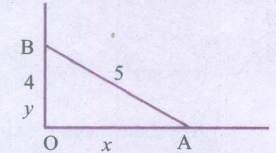
Differentiating, \(2x\frac { dx }{ dt } +2y\frac { dy }{ dt } \) = 0
⇒ \(\frac { dy }{ dx } =-\frac { x }{ y } \frac { dx }{ dt } \)
When \(\frac { dx }{ dt } =\frac { 1 }{ 2 } ,\frac { dy }{ dt } =\frac { -x }{ 2y } \)
When y = 4, x2 = 25-y2
⇒ x =\(\sqrt { 25-16 } \) = 3
Thus \(\frac { dy }{ dt } =-\frac { 3 }{ 2\times 4 } =\frac { -3 }{ 8 } \).
12.
f(x) = x3-2x2-x+3
f'(x) = 3x2 - 4x - 1
f'(c) = 3c2 - 4c- 1
f(a) = f(0) = 3
f(b) = f(1) = 13-2-1+3 = 1
Then, if atleast one C \(\in \) (0, 1) such that f'(c) = \(\frac { f(b)-f(a) }{ b-a } \)
⇒ 3c2-4c-1 = \(\frac { 1-3 }{ 1-0 } \)
⇒ 3c2-4c+1 = 0
⇒ c = \(\frac { 4\pm \sqrt { 16-4(3) } }{ 2(3) } \)
⇒ c = \(\frac { 4\pm 2 }{ 6 } =\frac { 6 }{ 6 } \) or \(\frac { 2 }{ 6 } \)
⇒ 1 or \(\frac { 1 }{ 3 } \).
13.
This is an indeterminate of the form \(\infty, -\infty\). To evaluate this limit we first simplify and bring it in the form \((\frac{0}{0})\) and applying the l’Hôpital Rule, we get
\(\frac{x\rightarrow 0^{+}}{lim}(\frac{1}{x}-\frac{1}{e^{x}-1})=\underset{x\rightarrow 0^{+}}{lim}(\frac{e^{x}-x-1}{x(e^{x}-1)})\) \((\frac{0}{0})\)
Now, \(\underset{x\rightarrow 0^{+}}{lim} (\frac{e^{x}-x-1}{x(e^{x}-1)})=\underset{x\rightarrow 0^{+}}{lim}(\frac{e^{x}-1}{xe^{x}+e^{x}-1})\) \((\frac{0}{0})\)
\(=\underset{x\rightarrow 0^{+}}{lim}(\frac{e^{x}}{xe^{x}+2e^{x}})=\frac{1}{2}\)
14.
f'(x) = ≤1 for all 1 ≤ x ≤ 4
Using Lagrange's mean value theorem,
f'(x) = \(\frac { f(b)-f(a) }{ b-a } \) [∵ f(x) is continuous in [1, 4] and differentiable in (1, 4)]
f'(x) = \(\frac{f(4)-f(1)}{4-1}\)
f'(x) = \(\frac { f(4)-f(1) }{ 3} \)
⇒ \(\frac { f(4)-f(1) }{ 3} \) = f'(s)
⇒ \(\frac { f(4)-f(1) }{ 3} \) ≤ 1[∵ f'(x) ≤ 1]
⇒ f(4) - f(1) ≤ 3
Hence proved
15.
Let f (t) be the distance travelled by the trucker in 't' hours. This is a continuous function in [0, 2] and differentiable in (0, 2). Now, f (0) = 0 and f (2) =164. By an application of the Mean Value Theorem, there exists a time c such that, \(f'(c)=\frac{164-0}{2-0}=82>80\)
Therefore at some point of time, during the travel in 2 hours the trucker must have travelled with a speed more than 80 km which justifies the issuance of a speed violation ticket.
16.
Let P(x) = \(a_{n}x^{n}+a_{n-1}x^{n-1}+...+a_{1}x+a_{0}\). Let \(\alpha<\beta \) be two real zeros of P(x). Therefore, \(P(\alpha)=P(\beta)=0.\) Since P(x) is continuous in \([\alpha, \beta]\) and differentiable in \((\alpha, \beta)\) by an application of Rolle’s theorem there exists \(\gamma \in (\alpha,\beta)\) such that \(P'(\gamma)=0\). Since,
\(P'(x)=na_{n}x^{n-1}+(n-1)a_{n-1}x^{n-2}+...+a_{1}\) which completes the proof.
17.
Given equation of the curve is y = 1 + x3 and the line is x + 12y = 12
Slope of the tangent to the curve
m1 = \(\frac { dy }{ dx } \) = 3 x2 and the
Slope of the line = m2
= \(\frac{-1}{2}\) \(\left[ \because m=\frac { co-efficient\ of\ x }{ co-efficient\ of\ y } \right] \)
Since the slope of the tangent to the curve and the line are orthogonal, m1 m2 = - 1.
∴ 3x2\(\left( \frac { -1 }{ 2 } \right) \) = -1
⇒ \(\frac{x^2}{4}\) = 1
⇒ x2 = 4
⇒ x = ±2
When x = 2, y = 1 + 23 = 9
When x = -2, y = 1+ (-2)3
= 1-8 = -7
∴ Equation of the tangent at (2, 9) is
y-9 = 12(x-2) [∵ m1 = 3x2 = 3(2)2 = 12]
∴ y - 9 = 12x - 24
∴ 12x - y = 15
Equation of the tangent at (-2, -7) is
y+7= 12(x + 2)
⇒ y + 7 = 12x + 24
⇒ 12x-y+17 = 0
18.
The curve y = sin x intersects the positive x -axis. When y = 0 which gives, x =
\( x=n\pi , n=1,2,3,...\)
Now, \(\frac{dy}{dx}=cos x\). The slpoe \(x=n\pi\) are \(cos(n\pi)=(-1)^{n}\).
Hence, the required angle of intersection is m2 = 0
\(tan \theta = \frac{(-1)^n - 0}{1+((-1)^n(0)} = 1 ∀ n\)
19.
Observe that the given curve is neither a circle nor an ellipse. For your reference the curve is shown in Figure.
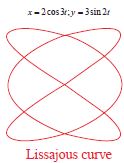
Now, \(\frac{dy}{dx}=\frac{\frac{dy}{dt} }{\frac{dx}{dt} } \)
= -\(\frac{6 cos2t}{6sin3t} = -\frac{cos2t}{sin3t} \).
Therefore, the tangent at any point is
\(y-3sin2t= -\frac{cos2t}{sin3t}(x-2cos3t)\)
That is, x cos 2t + y sin 3t = 3sin 2t sin 3t + 2cos 2t cos 3t.
The slope of the normal is the negative of the reciprocal of the tangent which in this case is \(\frac{sin3t}{cos2t}\). Hence, the equation of the normal is \(y-3sin2t=\frac{sin3t}{cos2t}(x-2cos3t)\).
That is, x sin 3t - y cos 2t = 2sin 3t cos3t 3sin 2t cos 2t = sin 6t - \(\frac{3}{2}\) sin 4t.
20.
Absolute minimum value = 1,
Absolute maximum value = 6
21.
(i) π
(ii) πX2n-1
(iii) 2
(iv) 0
22.
2x – y + 3 = 0
23.
f(x) = x3+ 2x2-1
f'(x) = 3x2 + 4x = 0
⇒ x (3x + 4) = 0
⇒ x = 0 or \(\frac { 4 }{ 3 } \)
The possible intervals are \(\left( -\infty ,-\frac { 4 }{ 3 } \right) \left( -\frac { 4 }{ 3 } ,0 \right) \) and (0, ∞).
| Interval | \(\left( -\infty ,-\frac { 4 }{ 3 } \right) \) | \(\left( -\frac { 4 }{ 3 } ,0 \right) \) | (0, ∞) |
| Sign of f'(x) | Say x = -2 3(-2)2+4(-2) = 4 +ve |
say x = -1 3(-1)2+4(-1) = -1 -ve |
say x = 1 3(1)2+4(1) = 7 +ve |
| Monotonicity | Strictly increasing | Strictly decreasing | Strictly increasing |
24.
x =\(\sqrt { t } \)
V = \(\frac { dx }{ dt } =\frac { 1 }{ 2 } t^{ -\frac { 1 }{ 2 } }\) ..(1)
Acceleration = \(\frac { { d }^{ 2 }x }{ { dt }^{ 2 } } =\frac { 1 }{ 2 } \left( -\frac { 1 }{ 2 } t^{ -\frac { 3 }{ 2 } } \right) =\frac { -t^{ -\frac { 3 }{ 2 } } }{ 4 } \)
∴ Acceleration is negative
Acceleration = \(-\frac { 1 }{ 4 } \left( { t }^{ -\frac { 1 }{ 2 } } \right) ^{ 3 }\)
= \(-2\left( \frac { 1 }{ 2 } t^{ -\frac { 1 }{ 2 } } \right) ^{ 3 }\) = 2V3 [using (1)]
Hence, acceleration is negative proportional to the cube of the velocity.
25.
If we directly substitute x = 0 we get an indeterminate form \(\frac{0}{0}\) and hence we apply the l’Hôpital’s rule to evaluate the limit as,
\(\underset{x\rightarrow 0^{+}}{lim}(\frac{sin \ x}{x^{2}})=\underset{x\rightarrow 0^{+}}{lim}(\frac{cos \ x}{2x})=\infty\)
\(\underset{x\rightarrow 0^{-}}{lim}(\frac{sin \ x}{x^{2}})=\underset{x\rightarrow 0^{-}}{lim}(\frac{cos \ x}{2x})=\infty\)
As the left limit and the right limit are not the same we conclude that the limit does not exist.
Remark
One may be tempted to use the l’Hôpital’s rule once again in \(\underset{x\rightarrow 0^{+}}{lim} (\frac{cos \ x}{2x})\) to conclude
\(\underset{x\rightarrow 0^{+}}{lim} (\frac{cos \ x}{2x})\)\(\underset{x\rightarrow 0^{+}}{lim} (\frac{-sin \ x}{2})\)=0
which is not true because it was not an indeterminate form.
26.
If we directly substitute x = 0 we get an indeterminate form \(\frac{0}{0}\) and hence we apply the l’Hôpital’s rule to evaluate the limit as
\(\underset{x\rightarrow 0}{lim}(\frac{sin \ mx}{x})\)=\(\underset{x\rightarrow 0}{lim}(\frac{m\times cos \ mx}{1})\)
= m
The next example tells that the limit does not exist.
27.
Given y = x4 + 2x2 - x
\(\frac { dy }{ dx } \) = 4x3 + 4x - 1
Slope of the tangent at x = 1 is
m = \(\left( \frac { dy }{ dx } \right) \)(x = 1)
= 4(1)3+ 4 (1) - 1
= 4+4-1 = 7
∴ m = 7
28.
(b)
Fermat's theorem
29.
(a)
1
30.
(b)
strictly decreasing
31.
(b)
y = 0
32.
(c)
1, 2
33.
(c)
acute angle
34.
(a)
-2
35.
(d)
x + 3y = 0
36.
(c)
3
37.
(c)
\(\left[ \frac { \pi }{ 4 } ,\frac { \pi }{ 2 } \right] \)
38.
(a)
0
39.
(c)
\(\cfrac { \pi }{ 2 } \)
40.
Given equation of the curve is y = 1 + x3 and the line is x + 12y = 12
Slope of the tangent to the curve
m1 = \(\frac { dy }{ dx } \) = 3x2 and the
Slope of the line = m2
= \(\frac{-1}{2}\) \(\left[ \because m=\frac { co-efficient\quad of\quad x }{ co-efficient\quad of\quad y } \right] \)
Since the slope of the tangent to the curve and the line are orthogonal, m1 m2 = - 1.
∴ 3x2\(\left( \frac { -1 }{ 2 } \right) \) = -1
⇒ \(\frac{x^2}{4}\) = 1
⇒ x2 = 4
⇒ x = ±2
When x = 2, y = 1 + 23 = 9
When x = -2, y = 1+ (-2)3
= 1-8 = -7
∴ Equation of the tangent at (2, 9) is
y-9 = 12(x-2) [∵ m1 = 3x2 = 3(2)2 = 12]
∴ y - 9 = 12x - 24
∴ 12x - y = 15
Equation of the tangent at (-2, -7) is
y + 7= 12(x + 2)
⇒ y + 7 = 12x + 24
⇒ 12x - y = -17
41.
(b)
-4
42.
(a)
3 cm/s

12th Standard Syllabus & Materials
12th Standard
TN 12th Computer Applications களப்பெயர் முறைமை (DNS) Sample Question Papers Study Material - QB365 Set A
NEW12th Standard
TN 12th Computer Applications வலையமைப்பு எடுத்துக்காட்டுகள் மற்றும் நெறிமுறைகள் Sample Question Papers Study Material - QB365 Set A
NEW12th Standard
TN 12th Computer Applications கணினி வலையமைப்பு ஓர் அறிமுகம் Sample Question Papers Study Material - QB365 Set A
NEW12th Standard
TN 12th Computer Applications PHP-உடன் MySQL-ஐ இணைத்தல் Sample Question Papers Study Material - QB365 Set A



Tamilnadu Stateboard 12th Standard Subjects
Maths

Chemistry

Physics

Biology

Computer Science

Business Maths and Statistics

Economics

Commerce

Accountancy

History

Computer Applications
Biology
Computer Technology
Computer Applications
Computer Science
Business Maths and Statistics
Commerce
Economics
Maths
Chemistry
Physics
Computer Technology
History
Accountancy

Tamil

English

French
Tamilnadu Stateboard Standards

