
 100% FREE ACCESS
12th Standard Syllabus & Materials
12th Standard
TN 12th Computer Applications மின்னணு தரவு பரிமாற்றம் Sample Question Papers Study Material - QB365 Set A
NEW12th Standard
TN 12th Computer Applications மின் - வணிக பாதுகாப்பு அமைப்புகள் Sample Question Papers Study Material - QB365 Set A
NEW12th Standard
TN 12th Computer Applications மின்னணு செலுத்தல் முறைகள் Sample Question Papers Study Material - QB365 Set A
NEW12th Standard
TN 12th Computer Applications மின் - வணிகம் Sample Question Papers Study Material - QB365 Set A
NEW12th Standard
TN 12th Computer Applications திறந்த மூல கருத்துருக்கள் Sample Question Papers Study Material - QB365 Set A
NEW12th Standard
TN 12th Computer Applications வலையமைப்பு வடமிடல் Sample Question Papers Study Material - QB365 Set A

Published on: 02/02/2021
12th Standard Maths English Medium Applications Of Differential Calculus Reduced Syllabus Important Questions With Answer Key 2021
Download Tamil Nadu 12th Standard Maths question papers, model tests, one-mark questions, important questions, and public exam papers in PDF format. Free study materials and answer keys for TN State Board students.
Questions + Answers key
Take MCQ Maths Test1.
The side of a square is equal to the diameter of a circle. If the side and radius change at the same rate then find the ratio of the change of their areas.
2.
A ball is thrown vertically upwards, moves according to the law s = 13.8 t - 4.9 t2 where s
is in metres and t is in seconds.
(i) Find the acceleration at t = 1
(ii) Find velocity at t = 1
(iii) Find the maximum height reached by the ball?
3.
Verify LMV theorem for f(x) = x3 - 2x2 - x + 3 in [0, 1].
4.
Write the Maclaurin series expansion of the following function
log(1 - x); -1 ≤ x < 1
5.
Suppose that for a function f(x), f'(x) ≤ 1for all 1 ≤ x ≤ 4. Show that f(4) - f(1) ≤ 3.
6.
Using the Rolle’s theorem, determine the values of x at which the tangent is parallel to the x -axis for the following functions:
f(x) = x2 − x, x ∈ [0, 1]
7.
Find the absolute extrema of the following functions on the given closed interval.
\(f(x)=2cosx+sin2x;\left[ 0,\frac { \pi }{ 2 } \right] \)
8.
Prove using the Rolle’s theorem that between any two distinct real zeros of the polynomial \(a_{n}x^{n}+a_{n-1}x^{n-1}+...+a_{1}x+a_{0}\) there is a zero of the polynomial \(na_{n}x^{n-1}+(n-1)a_{n-1}x^{n-2}+...+a_{1}\)
9.
Find the points on the curve y2 - 4xy = x2 + 5 for which the tangent is horizontal.
10.
Find the point on the curve y = x2 − 5x + 4 at which the tangent is parallel to the line 3x + y = 7.
11.
A particle moves along a straight line in such a way that after t seconds its distance from the origin is s = 2t2 + 3t metres.
12.
A point moves along a straight line in such a way that after t seconds its distance from the origin is s = 2t2 + 3t metres.
(i) Find the average velocity of the points between t = 3 and t = 6 seconds.
(ii) Find the instantaneous velocities at t = 3 and t = 6 seconds.
13.
A person learnt 100 words for an English test. The number of words the person remembers in t days after learning is given by W(t) = 100 × (1− 0.1t)2, 0 ≤ t ≤ 10. What is the rate at which the person forgets the words 2 days after learning?
14.
A manufacturer can sell x items at a price of rupees \(\left( 5-\frac { x }{ 100 } \right) \) each. The cost price of x items is Rs.\(\left( \frac { x }{ 5 } +500 \right) \) .Find the numbers of items he should sell to earn maximum profit.
15.
missle fired from ground level rises x metres vertically upwards in t seconds and \(x=100t-\frac { 25 }{ 2 } { t }^{ 2 }\). Find the
(i) initial velocity of the missile
(ii) the time when the height of the missile is maximum
(iii) the maximum height reached
(iv) the velocity which the missile strikes the ground.
16.
A police jeep, approaching an orthogonal intersection from the northern direction, is chasing a speeding car that has turned and moving straight east. When the jeep is 0.6 km north of the intersection and the car is 0.8 km to the east. The police determine with a radar that the distance between them and the car is increasing at 20 km/hr. If the jeep is moving at 60 km/hr at the instant of measurement, what is the speed of the car?
17.
A ladder 17 metre long is leaning against the wall. The base of the ladder is pulled away from the wall at a rate of 5 m/s. When the base of the ladder is 8 metres from the wall.
(i) How fast is the top of the ladder moving down the wall?
(ii) At what rate, the area of the triangle formed by the ladder, wall and the floor is changing?
18.
19.
A camera is accidentally knocked off an edge of a cliff 400 ft high. The camera falls a distance of s = 16t2 in t seconds.
(i) How long does the camera fall before it hits the ground?
(ii) What is the average velocity with which the camera falls during the last 2 seconds?
(iii) What is the instantaneous velocity of the camera when it hits the ground?
20.
Evaluate the following limits, if necessary using L’Hopitalrule
(i) \(\underset { x\rightarrow 2 }{ lim } \cfrac { sin\pi x }{ 2-x } \)
(ii) \(\cfrac { lim }{ x\rightarrow 2 } \cfrac { { x }^{ n }-{ a }^{ n } }{ x-2 } \)
(iii) \(\underset { x\rightarrow \infty }{ lim } \cfrac { sin\frac { 2 }{ x } }{ \frac { 1 }{ x } } \)
(iv) \(\underset { x\rightarrow \infty }{ lim } \cfrac { { x }^{ 2 } }{ { e }^{ x } } \)
21.
Using Rolle’s theorem find the value of c for f(x) = sin x in[0,2π]
22.
Find the point on the parabola y2=18x at which the ordinate increases at twice the rate of the abscissa.
23.
At what point on the curve y = x2 on [-2, 2] is the tangent parallel to X-axis?
24.
Explain why Rolle’s theorem is not applicable to the following functions in the respective intervals.
\(f(x)=x-2logx, x\in [2,7]\)
25.
Find the slope of the tangent to the following curves at the respective given points
y = x4 + 2x2 − x at x = 1
26.
A stone is dropped into a pond causing ripples in the form of concentric circles. The radius r of the outer ripple is increasing at a constant rate at 2 cm per second. When the radius is 5 cm find the rate of changing of the total area of the disturbed water?
27.
If the volume of a cube of side length x is v = x3. Find the rate of change of the volume with respect to x when x = 5 units.
28.
The statement "If f has a local extremum at c and if f'(c) exists then f'(c) = 0" is ________
the extreme value theorem
Fermat's theorem
Law of mean
Rolle's theorem
29.
\(\underset { x\rightarrow 0 }{ lim } \frac { x }{ tanx } \) is _________
1
-1
0
∞
30.
If the curves y = 2ex and y = ae-x intersect orthogonally, then a = _________
\(\frac { 1 }{ 2 } \)
-\(\frac { 1 }{ 2 } \)
2
2e2
31.
In LMV theorem, we have f'(x1) = \(\frac { f(b)-f(a) }{ b-a } \) then a < x1 _________
<b
≤b
=b
≠b
32.
The equation of the tangent to the curve x = t cost, y = t sin t at the origin is __________
x = 0
y = 0
x +y = 0
x + y = 7
33.
The critical points of the function f(x) = \((x-2)^{ \frac { 2 }{ 3 } }(2x+1)\) are __________
-1, 2
1, \(\frac { 1 }{ 2 } \)
1, 2
none
34.
Equation of the normal to the curve y = 2x2+3 sin x at x = 0 is __________
x + y = 0
3y = 0
x + 3y = 7
x + 3y = 0
35.
The point on the curve y = x2 is the tangent parallel to X-axis is __________
(1, 1)
(2, 2)
(4, 4)
(0, 0)
36.
37.
One of the closest points on the curve x2 - y2 = 4 to the point (6, 0) is
(2,0)
\(\left( \sqrt { 5 } ,1 \right) \)
\(\left( 3,\sqrt { 5 } \right) \)
\(\left( \sqrt { 13 } ,-\sqrt { 3 } \right) \)
38.
The number given by the Mean value theorem for the function \(\frac { 1 }{ x } \), x ∈ [1, 9] is
2
2.5
3
3.5
39.
The function sin4 x + cos4 x is increasing in the interval
\(\left[ \frac { 5\pi }{ 8 } ,\frac { 3\pi }{ 4 } \right] \)
\(\left[ \frac { \pi }{ 2 } ,\frac { 5\pi }{ 8 } \right] \)
\(\left[ \frac { \pi }{ 4 } ,\frac { \pi }{ 2 } \right] \)
\(\left[ 0,\frac { \pi }{ 4 } \right] \)
40.
What is the value of the limit \(\lim _{x \rightarrow 0}\left(\cot x-\frac{1}{x}\right) \text { is }\)
0
1
2
∞
41.
The tangent to the curve y2 - xy + 9 = 0 is vertical when
y = 0
\(\\ \\ y=\pm \sqrt { 3 } \)
\(y=\frac { 1 }{ 2 } \)
\(y=\pm 3\)
42.
1.
2:π
2.
s = 13.8 t - 4.9 t2
v = \(\frac { ds }{ dt } \) =13.8 - 4.9 (2t)
=13.8-9.8t
When t = 1, v = 13.8 - 9.8(1)
4 m/sec.
Acceleration = \(\frac { d^{ 2 }x }{ { dt }^{ 2 } } \) = -9.8 m/sec2
At maximum height, v = 0
∴ 13.8 - 9.8 t = 0
⇒ 13.8 = 9.8 t
⇒ t = \(\frac { 13.8 }{ 9.8 } \) = 1.40 sec
At t = 1.4 sec,
distance (s) = 13.8 (1.40) - 4.9 (1.40)2
= 19.32 - 9.604 = 9.716 m
3.
f(x) = x3-2x2-x+3
f'(x) = 3x2 - 4x - 1
f'(c) = 3c2 - 4c- 1
f(a) = f(0) = 3
f(b) = f(1) = 13-2-1+3 = 1
Then, if atleast one C \(\in \) (0, 1) such that f'(c) = \(\frac { f(b)-f(a) }{ b-a } \)
⇒ 3c2-4c-1 = \(\frac { 1-3 }{ 1-0 } \)
⇒ 3c2-4c+1 = 0
⇒ c = \(\frac { 4\pm \sqrt { 16-4(3) } }{ 2(3) } \)
⇒ c = \(\frac { 4\pm 2 }{ 6 } =\frac { 6 }{ 6 } \) or \(\frac { 2 }{ 6 } \)
⇒ 1 or \(\frac { 1 }{ 3 } \).
4.
| Function and its derivatives | log (1-x) cos x and its derivatives | Value at x = 0 |
| f(x) | log (1-x) | log 1 = 0 |
| fI(x) | \(\frac{-1}{1-x}\) = -1(1 - x)-1 | \(\frac{-1}{1}\) = -1 |
| fIl(x) | -1(1-x)-2 | -1 |
| fIIl(x) | -2(1-x)-3 | -2 |
| fIV(x) | -6 (1 - x)-4 | -6 |
| fV(x) | -24 (1 - x)-5 | -24 |
Meclaurin's expansion
\(f(x)=f(0)+\frac { { f }^{ 1 }(0) }{ 1! } x+\frac { { f }^{ II }(0) }{ 2! } { x }^{ 2 }+\frac { { f }^{ III }(0) }{ 3! } { x }^{ 3 }+\).................
log(1-x) = \(0-\frac { 1 }{ 1! } x-\frac { { x }^{ 2 } }{ 2! }- \frac { 2 }{ 3! } { x }^{ 3 }-\frac { { 6x }^{ 4 } }{ 4! } +.....\)
= \(-x-\frac { { x }^{ 2 } }{ 2 } +\frac { { x }^{ 3 } }{ 3 } +\frac { { x }^{ 4 } }{ 4 } \)+ .....
log(1 - x) = \(-\left( x+\frac { { x }^{ 2 } }{ 2 } +\frac { { x }^{ 3 } }{ 3 } +\frac { { x }^{ 4 } }{ 4 } +.... \right) \)
5.
f'(x) = ≤1 for all 1 ≤ x ≤ 4
Using Lagrange's mean value theorem,
f'(x) = \(\frac { f(b)-f(a) }{ b-a } \) [∵ f(x) is continuous in [1, 4] and differentiable in (1, 4)]
f'(x) = \(\frac{f(4)-f(1)}{4-1}\)
f'(x) = \(\frac { f(4)-f(1) }{ 3} \)
⇒ \(\frac { f(4)-f(1) }{ 3} \) = f'(s)
⇒ \(\frac { f(4)-f(1) }{ 3} \) ≤ 1[∵ f'(x) ≤ 1]
⇒ f(4) - f(1) ≤ 3
Hence proved
6.
Given f(x) = x2 − x, x ∈ [0, 1]
(i) f(x) is continuous in [0, 1]
(ii) f(x) is differentiable in (0, 1)
(iii) f(0) = 02 - 0 = 0
f(1) = 12-1 = 1-1 = 0
∴ f(0) = f(1)
By Rolle's theorem, there exists C ∈ [0, 1] such that
f'(c) = 0
⇒ 2c - 1 = 0
⇒ 2c = 1
⇒ c = \(\frac12\) ∈ [0, 1]
7.
f'(x) = -2 sin x + 2 cos 2x
f'(x) = 0
\(\Rightarrow\) 2 sin x + 2 cos 2x = 0
\(\Rightarrow\) 2 sin x + 2(1 - 2 sin2x) = 0
\(\Rightarrow\) 4 sin2x + 2 sin x - 2 = 0
\(\Rightarrow\) 4 sin2 x + 2 sin x - 2 = 0
\(\Rightarrow\) 2 sin2 x + sin x-1 = 0
\(\Rightarrow\) (sin x+1) (2sin x-1) = 0
\(\Rightarrow\) \(sinx=-1\ or\ sinx=\frac { 1 }{ 2 } \)
\(\Rightarrow\) \(sinx=-sin\frac { \pi }{ 2 } \) or
\(sinx=sin\frac { \pi }{ 6 } \)
\(\Rightarrow sinx=sin\left( -\frac { \pi }{ 2 } \right) \)
\(sinx=sin\frac { \pi }{ 6 } \)
\(\Rightarrow x=-\frac { \pi }{ 2 } or \ x=\frac { \pi }{ 6 } \)
\(\Rightarrow x=\frac { \pi }{ 6 } \)
\(\\ \\ \\ \\ \\ \\ \left[ \because x=-\frac { \pi }{ 2 }∉ \left[ 0.\frac { \pi }{ 2 } \right] \right] \)
\(\therefore\) The critical number is \(x=\frac { \pi }{ 6 } \)
Evaluating f(x) at the end points x = 0, \(x=\frac { \pi }{ 2 } \) and at the critical number \(x=\frac { \pi }{ 6 } \) we get.
f(0) = 2 cos0 + sin0 = 2
\(f(\frac { \pi }{ 2 } )=2cos\frac { \pi }{ 2 } +sin\pi =0\)
\(f\left( \frac { \pi }{ 6 } \right) =2cos\frac { \pi }{ 2 } +sin\frac { \pi }{ 3 } \)
\(2\left( \frac { \sqrt { 3 } }{ 2 } \right) +\frac { \sqrt { 3 } }{ 2 } =\frac { 3\sqrt { 3 } }{ 2 } \)
From these values, the absolute maximum is \(\frac { 3\sqrt { 3 } }{ 2 } \) which occurs at \(x=\frac { \pi }{ 6 } \) and the absolute minimum is 0 which occurs at \(x=\frac { \pi }{ 2 } \)
8.
Let P(x) = \(a_{n}x^{n}+a_{n-1}x^{n-1}+...+a_{1}x+a_{0}\). Let \(\alpha<\beta \) be two real zeros of P(x). Therefore, \(P(\alpha)=P(\beta)=0.\) Since P(x) is continuous in \([\alpha, \beta]\) and differentiable in \((\alpha, \beta)\) by an application of Rolle’s theorem there exists \(\gamma \in (\alpha,\beta)\) such that \(P'(\gamma)=0\). Since,
\(P'(x)=na_{n}x^{n-1}+(n-1)a_{n-1}x^{n-2}+...+a_{1}\) which completes the proof.
9.
Equation of the given curve is y2 - 4xy = x2 + 5..(1)
Differentiating with respect to 'x' we get,
\(2y\frac { dy }{ dx } -4\left[ x\frac { dy }{ dx } +y(1) \right] =2x\)
⇒ \(2y\frac { dy }{ dx } -4x\frac { dy }{ dx } -4y=2x\)
⇒ \(\frac { dy }{ dx } \) (2y -4x) = 2x + 4y
⇒ \(\frac { dy }{ dx } \) = \(\frac { x+2y }{ y-2x } \)
Since the tangent to the curve is horizontal, \(\frac { dy }{ dx } \) = 0
ஃ \(\frac { x+2y }{ y-2x } \) = 0
⇒ x+ 2y = 0
⇒ x = -2y .....(2)
Substituting (2) in (1) we get,
y2 - 4(-2y)y = (-1y)2 + 5
⇒ y2 + 8y2 = 4y2 + 5
⇒ y2 = 4y2 + 5
⇒ 5y2 = 5
⇒ y2 = 1
⇒ y = 土 1
From (2), When y = 1, x = - 2
When y = -1, x = 2
∴ The required points are (2, -1) and (-2,1)
10.
Given curve is y = x2 − 5x + 4 and the line is 3x + y = 7
Slope of the tangent to the curve
\({ m }_{ 1 }=\frac { dx }{ dt } \) = 2x - 5
Slope of the line = \({ m }_{ 2}=\frac { dx }{ dt } \) = -3
\(\left[ \because m=\frac { co-efficient \ of \ x }{ co-efficient \ of \ y } \right] \)
Since the tangent of the curve and the lines are parallel, their slopes are equal.
∴ m1 = m2
⇒ 2x - 5 = -3
⇒ 2x = 2
⇒ x = 1
Substituting x = 1 in y = x2 - 5x + 4 we get
y = 12-5(1)+4 = 0
∴ The required point is (1, 0).
11.
12.
Given s = 2t2 + 3t
s(3) = 2 \(\times\) 32 + 3 (3)
= 2\(\times\)9+9
= 27 m ....(1)
s(6) = 2\(\times\) 62 + 3 (6)
= 72 + 18 = 90m ... (2)
Average velocity = \(\frac { s(6)-s(3) }{ 6-3 } \)
= \(\frac { 90-27 }{ 3 } \) = 21 m/s
(ii) Instantaneous Velocity V(t) = \(\frac { ds }{ dt } \)
Instantaneous Velocity at t = 3
= V(3) = 15 m/sec
Instantaneous Velocity at t = 6
= V(6) = 27m/sec
13.
We have,
\(\frac{d}{dt}W(t)=-20\times(1-0.1t)\)
Therefore at t = 2, \(\frac{d}{dt}W(t)=-16\)
That is, the person forgets at the rate of 16 words after 2 days of studying.
14.
240
15.
100 m / s, t = 4 sec, 200 m / s, −100 m / s
16.
Let x represent the distance covered by the car, y represent the distance covered by the police jeep, and s represent the distance between the car and jeep.
ஃ Given = x = 0.8 km, y = 0.6 km,
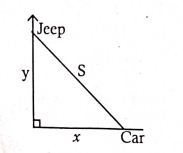
\(\frac { dy }{ dt } \) = -60km/hr,
\(\frac { ds }{ dt } \) = 20 km/hr,
In ΔABC, S2 = x2 + y2 ......(1)
⇒ S2 = (0.8)2 + (0.6)2
= 0.64 + 0.36
⇒ S2 = 1
⇒ s = 1 ....(2)
Differentiating (1) with respect to 't' we get,
\(2s\frac { ds }{ dt } =2x\frac { dx }{ dt } +2y\frac { dy }{ dt } \)
⇒ \(s\frac { ds }{ dt } =x\frac { dx }{ dt } +y\frac { dy }{ dt } \) [Divided by 2]
⇒\(1\left( \frac { ds }{ dt } \right) =(0.8)\left( \frac { dx }{ dt } \right) +(0.6)(-60)\)
⇒ 1(20) = (0.8) \(\left( \frac { dx }{ dt } \right) \) + (0.6)(-60)
⇒ 20 = (0.8) \(\left( \frac { dx }{ dt } \right) \) - 36
⇒ 20 + 36 = (0.8) \(\frac { dx }{ dt } \)
⇒ \(\frac { dx }{ dt } =\frac { 56 }{ 0.8 } \) = 70km/hr.
⇒Speed of the car is 70 km/hr.
17.
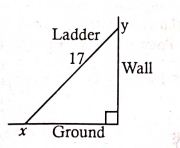
Let AB be the position of the ladder at any time t such that OA = x and OB = y
Then OA2 + OB2 = AB2
⇒ x2 + y2 = 172
Given \(\frac { dx }{ dt } \) = 5 and x = 8
When x = 8, 82 + y2 = 172
⇒ y2 = 289 - 64 = 225
⇒ y = 15
Differentiating (1) with respect to 't' we get,
\(2x\frac { dx }{ dt } +2y\frac { dy }{ dt } =0\)
⇒ 8(5) + 15 \(\frac { dy }{ dt } \) = 0 [∵ x = 8, \(\frac { dx }{ dt } \) = 15, y = 15]
⇒ 40 + 15\(\frac { dy }{ dt } \) = 0
⇒ \(\frac { dy }{ dt } =\frac { -40 }{ 15 } =\frac { -8 }{ 3 } \) m/sec
∴ The rate of top of the ladder moving down the wall is \(\frac{-8}{3}\) m/sec
(ii) The ladder, the wall and the floor forms a right angled triangle.
Area = \(\frac12\)xy
Differentiating with respect to 't' we get,
\(\frac { dA }{ dt } =\frac { 1 }{ 2 } \left[ x\frac { dy }{ dx } +y\frac { dx }{ dt } \right] \)
\(=\frac { 1 }{ 2 } \left[ 8\left( -\frac { 8 }{ 3 } \right) +15(5) \right] \)
= \(\frac { 1 }{ 2 } \left[ \frac { -64 }{ 3 } +75 \right] =\frac { 1 }{ 2 } \)
= \(\frac { 1 }{ 2 } \left[ \frac { -64+225 }{ 3 } \right] =\frac { 1 }{ 2 } \left( \frac { 161 }{ 3 } \right) \)
= \(\frac { dA }{ dt } \) = 26.83 sq.m/sec
18.
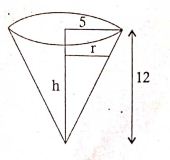
19.
Given s (t) = 16t2, height = 400 ft.
⇒ t2 = \(\frac { 400 }{ 16 } =\frac { 100 }{ 4 } \)
t2 = 25
t = 5 sec
(ii) Average velocity = \(\frac { ds }{ dt } \) = 32 t
When t = 2 sec
Average in the last
2 sec = \(\frac { V \ at \ t=3+V \ at \ t=5 }{ 2 } \)
= \(\frac { 32(3)+32(5) }{ 2 } \)
= \(\frac { 96+160 }{ 2 } =\frac { 256 }{ 2 } \)
= 128 f/sec
(iii) Instantaneous Velocity
=\(\frac { ds }{ dt } \) = 32t
When t = 5 sec
Velocity = \(\frac { ds }{ dt } \) = 32(5)
= 160 ft/sec
20.
(i) π
(ii) πX2n-1
(iii) 2
(iv) 0
21.
\(\theta =\frac { \pi }{ 2 } ,\frac { 2\pi }{ 2 } \varepsilon \left( 0,2\pi \right) \)
22.
\(\left( \frac { 9 }{ 8 } ,\frac { 9 }{ 2 } \right) \)
23.
Y = x2 is continuous on [-2, 2] and differentiable on [-2, 2]
f(a) = f(-2) = (-2)2 = 4
f(b) = f(2) = 22 = 4
∴ f(a) = f(b)
Since the tangent is parallel to X - axis, f'(c) = 0
⇒ 2c = 0
⇒ c = 0
∴ When c = 0, y = 0
∴ AE (0, 0) the tangent is parallel to X- axis.
24.
Given \(f(x)=x-2logx, x\in [2,7]\)
(i) f(x) is continuous in [2, 7]
(ii) f(x) is differentiable in (2, 7)
f(2) = 2 - 2 log 2
= 2 - log 22 = 2 - log 4
f (7) = 7 - 2 log 7
= 7 - log 72 = 7 - log 49
Since f(2) ≠ f (7), Rolle's theorem is not applicable.
25.
Given y = x4 + 2x2 - x
\(\frac { dy }{ dx } \) = 4x3 + 4x - 1
Slope of the tangent at x = 1 is
m = \(\left( \frac { dy }{ dx } \right) \)(x = 1)
= 4(1)3+ 4 (1) - 1
= 4+4-1 = 7
∴ m = 7
26.
Let r be the radius of the ripple and A be the area of the ripple.
GIven \(\frac { dr }{ dt } \) = 2 cm/sec and r = 5 cm ... (1)
We know A = πr2
Differentiating with respect to 't' we get,
\(\frac { dA }{ dt } \) = π(2r).\(\frac { dr }{ dt } \)
= π(2) (5) (2) [using (1)]
\(\frac { dA }{ dt } \) = 20 πsq.cm/sec.
27.
Given v = x3
Differentiating with respect to x we get,
\(\frac { dv }{ dt } \) = 3x2
When x = 5, \(\frac { dv }{ dt } \) = 3(52) = 75
∴ \(\frac { dv }{ dt } \) when x = 5 is 75 units.
28.
(b)
Fermat's theorem
29.
(a)
1
30.
(a)
\(\frac { 1 }{ 2 } \)
31.
(a)
<b
32.
(b)
y = 0
33.
(c)
1, 2
34.
(d)
x + 3y = 0
35.
(d)
(0, 0)
36.
(c)
37.
(c)
\(\left( 3,\sqrt { 5 } \right) \)
38.
(c)
3
39.
(c)
\(\left[ \frac { \pi }{ 4 } ,\frac { \pi }{ 2 } \right] \)
40.
(a)
0
41.
(d)
\(y=\pm 3\)
42.
(b)

12th Standard Syllabus & Materials
12th Standard
TN 12th Computer Applications களப்பெயர் முறைமை (DNS) Sample Question Papers Study Material - QB365 Set A
NEW12th Standard
TN 12th Computer Applications வலையமைப்பு எடுத்துக்காட்டுகள் மற்றும் நெறிமுறைகள் Sample Question Papers Study Material - QB365 Set A
NEW12th Standard
TN 12th Computer Applications கணினி வலையமைப்பு ஓர் அறிமுகம் Sample Question Papers Study Material - QB365 Set A
NEW12th Standard
TN 12th Computer Applications PHP-உடன் MySQL-ஐ இணைத்தல் Sample Question Papers Study Material - QB365 Set A



Tamilnadu Stateboard 12th Standard Subjects
Maths

Chemistry

Physics

Biology

Computer Science

Business Maths and Statistics

Economics

Commerce

Accountancy

History

Computer Applications
Biology
Computer Technology
Computer Applications
Computer Science
Business Maths and Statistics
Commerce
Economics
Maths
Chemistry
Physics
Computer Technology
History
Accountancy

Tamil

English

French
Tamilnadu Stateboard Standards

