
 100% FREE ACCESS
12th Standard Syllabus & Materials
12th Standard
TN 12th Computer Applications மின்னணு தரவு பரிமாற்றம் Sample Question Papers Study Material - QB365 Set A
NEW12th Standard
TN 12th Computer Applications மின் - வணிக பாதுகாப்பு அமைப்புகள் Sample Question Papers Study Material - QB365 Set A
NEW12th Standard
TN 12th Computer Applications மின்னணு செலுத்தல் முறைகள் Sample Question Papers Study Material - QB365 Set A
NEW12th Standard
TN 12th Computer Applications மின் - வணிகம் Sample Question Papers Study Material - QB365 Set A
NEW12th Standard
TN 12th Computer Applications திறந்த மூல கருத்துருக்கள் Sample Question Papers Study Material - QB365 Set A
NEW12th Standard
TN 12th Computer Applications வலையமைப்பு வடமிடல் Sample Question Papers Study Material - QB365 Set A

Published on: 02/09/2022
AQB365 provides a detailed and simple solution for every Possible Book Back Questions in Class 12 Maths Subject - Applications of Integration, English Medium. It will help Students to get more practice questions, Students can Practice these question papers in addition to score best marks.pplications of Integration 2 Mark Book Back Question Paper With Answer Key
Download Tamil Nadu 12th Standard Maths question papers, model tests, one-mark questions, important questions, and public exam papers in PDF format. Free study materials and answer keys for TN State Board students.
Questions + Answers key
Take MCQ Maths Test1.
Find, by integration, the volume of the solid generated by revolving about y-axis the region bounded by the curves y = log x, y = 0, x = 0 and y = 2.
2.
Show that Γ(n) = 2\(\int _{ 0 }^{ \infty }{ { e }^{ -{ x }^{ 2 } }{ x }^{ 2n-1 }dx } \)
3.
Evaluate \(\int _{ 1 }^{ 2 }{ \frac { x }{ (x+1)(x+2) } dx } \)
4.
Evaluate \(\int _{ 0 }^{ 1 }{ x^3dx } \), as the limit of a sum.
5.
Evaluate \(\int _{ 0 }^{ 1 }{ xdx } \), as the limit of a sum.
6.
Evaluate the following \(\int _{ 0 }^{ \pi /2 }{ { cos}^{ 7}x\quad dx } \)
7.
Evaluate the following
\(\int _{ 0 }^{ \pi /2 }{ { sin }^{ 10 }x\quad dx } \)
8.
Evaluate \(\int ^\frac {\pi}{2}_{0} \)( sin2 x + cos4 x ) dx
9.
Evaluate the following definite integrals:
\(\int _{ 3 }^{ 4 }{ \frac { dx }{ { x }^{ 2 }-4 } } \)
10.
Evaluate: \(\int ^{log 2}_{-log 2} e ^{-|x|}\) dx.
11.
Evaluate: \(\int ^{\frac{\pi}{2}}_{\frac{\pi}{2}}\)x cos x dx.
12.
Evaluate :\(\int _{ 0 }^{ 1 }{ [2x] } dx\) where [⋅] is the greatest integer function
13.
Evaluate \(\int _{ 0 }^{ \infty }{ { e }^{ -ax }{ x }^{ n }dx } \), where a > 0 .
14.
Evaluate the following
\(\int _{ 0 }^{ \frac { \pi }{ 2 } }{ { sin }^{ 3 }\theta { cos }^{ 5 }\theta d\theta } \)
15.
Evaluate the following
\(\int _{ 0 }^{ \frac { \pi }{ 2 } }{ { sin }^{ 2 }x{ cos }^{ 4 }xdx } \)
16.
Evaluate \(\int _{ 0 }^{ 1 }{ { x }^{ 3 }{ (1-x) }^{ 4 }dx } \)
17.
Find the values of the following:
\(\int _{ 0 }^{ \frac { \pi }{ 2 } }{ { sin }^{ 4 }x } x{ cos }^{ 6 }x\quad dx\)
18.
Find the values of the following:
\(\int ^\frac{\pi}{2}_{0}\)sin 5x cos4xdx
19.
Evaluate \(\int^\frac{\pi}{2}_0 \) \(\begin{vmatrix} { cos }^{ 4 }x & 7 \\ { sin }^{ 5 }x & 3 \end{vmatrix}\) dx
20.
Evaluate \(\int _{ b }^{ \infty }{ \frac { 1 }{ { a }^{ 2 }+{ x }^{ 2 } } dx,a>0,b\in R } \)
21.
Evaluate the following definite integrals:
\(\int _{ -1 }^{ 1 }{ \frac { dx }{ { x }^{ 2 }+2x+5 } } \)
22.
Evaluate :\(\int _{ 0 }^{ 9 }{ \frac { 1 }{ x+\sqrt { x } } dx } \)
23.
Evaluate :\(\int _{ 0 }^{ \frac { \pi }{ 3 } }{ \frac { sec\ x\ tan\ x }{ 1+{ sec }^{ 2 }x } dx } \)
1.
The region to be revolved is sketched.
Since revolution is made about the y-axis, the volume of the solid generated is given by
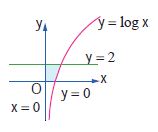
\(V=\pi \int _{ 0 }^{ 2 }{ { x }^{ 2 }dy=\pi \int _{ 0 }^{ 2 }{ { e }^{ y }dy } } \)
\(=\pi { \left[ { e }^{ y } \right] }_{ 0 }^{ 2 }=\pi ({ e }^{ 2 }-1)\)
2.
Using the substitution X = \(\sqrt u\), we get dx = \(\frac { 1 }{ 2\sqrt { u } } du\)
When x = 0, we get u = 0
When x = \(\infty\), we get u = \(\infty\)
\(\therefore \int _{ 0 }^{ \infty }{ { e }^{ -{ x }^{ 2 } }{ x }^{ 2n-1 }dx } =2\int _{ 0 }^{ \infty }{ { e }^{ -u }{ \left( \sqrt { u } \right) }^{ 2n-1 } } \frac { 1 }{ 2\sqrt { u } } du=\int _{ 0 }^{ \infty }{ { e }^{ -u }{ u }^{ n-1 }du } \) = Γ(n)
3.
Let I = \(\int _{ 1 }^{ 2 }{ \frac { x }{ (x+1)(x+2) } dx } \)
\(I=\int _{ 1 }^{ 2 }{ \left[ \frac { -1 }{ (x+1) } +\frac { 2 }{ x+2 } \right] } dx\) (Using partial fractions)
\(={ [-log(x+1)+2log(x+2)] }_{ 1 }^{ 2 }\)
\(=log{ \left[ \frac { { (x+2) }^{ 2 } }{ x+1 } \right] }_{ 1 }^{ 2 }\)
\(=log\frac { 16 }{ 3 } -log\frac { 9 }{ 2 } \)
\(=log\frac { 32 }{ 27 } \)
4.
Here f (x) = x3, a = 0 and b = 1. Hence, we get
\(\int _{ a }^{ b }{ f(x)dx } =\underset { n\rightarrow \infty }{ lim } \frac { 1 }{ n } \sum _{ r=1 }^{ n }{ f } \left( \frac { r }{ n } \right) \Rightarrow \int _{ 0 }^{ 1 }{ x^3dx } =\underset { n\rightarrow \infty }{ lim } \frac { 1 }{ n } \sum _{ r=1 }^{ n }{ \frac { r^3 }{ n^3 } } \)
\(=\underset { n\rightarrow \infty }{ lim } \frac { 1 }{ { n }^{ 4 } } [{ 1 }^{ 3 }+{ 2 }^{ 3 }+...+{ n }^{ 3 }]=\underset { n\rightarrow \infty }{ lim } \frac { 1 }{ { n }^{ 4 } } \frac { { n }^{ 2 }{ (n+1) }^{ 2 } }{ 4 } \)
\(=\underset { n\rightarrow \infty }{ lim } \frac { 1 }{ 4 } { \left( 1+\frac { 1 }{ n } \right) }^{ 2 }=\frac { 1 }{ 4 } \)
5.
Here f (x) = x, a = 0 and b = 1. Hence, we get
\(\int _{ a }^{ b }{ f(x)dx } =\underset { n\rightarrow \infty }{ lim } \frac { 1 }{ n } \sum _{ r=1 }^{ n }{ f } \left( \frac { r }{ n } \right) \Rightarrow \int _{ 0 }^{ 1 }{ xdx } =\underset { n\rightarrow \infty }{ lim } \frac { 1 }{ n } \sum _{ r=1 }^{ n }{ \frac { r }{ n } } \)
\(=\underset { n\rightarrow \infty }{ lim } \frac { 1 }{ { n }^{ 2 } } [1+2+...+n]\)
\(=\underset { n\rightarrow \infty }{ lim } \frac { 1 }{ { n }^{ 2 } } \frac { n(n+1) }{ 2 } =\underset { n\rightarrow \infty }{ lim } \frac { 1 }{ 2 } \left( 1+\frac { 1 }{ n } \right) =\frac { 1 }{ 2 } \)
6.
\({ I }_{ n }=\int _{ 0 }^{ \pi /2 }{ { cos }^{ 7 }xdx=\frac { n-1 }{ n } { I }_{ n-2 },n\ge 2 } \)
\(\therefore { I }_{ 7 }=\int _{ 0 }^{ \pi /2 }{ { cos }^{ 7 }xdx=\frac { 6 }{ 7 } \times \frac { 4 }{ 5 } \times \frac { 2 }{ 3 } \times 1 } =\frac { 16 }{ 35 } \)
7.
\({ I }_{ n }=\int _{ 0 }^{ \pi /2 }{ { sin }^{ n }x } =\frac { n-1 }{ n } { I }_{ n-2 },n\ge 2\)
\(Let\quad { I }_{ 10 }=\int _{ 0 }^{ \pi /2 }{ { sin }^{ 10 }xdx=\frac { 9 }{ 10 } { I }_{ 8 } } \)
\(=\frac { 9 }{ 10 } \times \frac { 7 }{ 8 } \times { I }_{ 6 }=\frac { 9 }{ 10 } \times \frac { 7 }{ 8 } \times \frac { 5 }{ 6 } \times { I }_{ 4 }\)
\(\\ =\frac { 9 }{ 10 } \times \frac { 7 }{ 8 } \times \frac { 5 }{ 6 } \times \frac { 3 }{ 4 } { I }_{ 2 }\)
\(=\frac { 9 }{ 10 } \times \frac { 7 }{ 8 } \times \frac { 5 }{ 6 } \times \frac { 3 }{ 4 } \times \frac { 1 }{ 2 } \times \frac { \pi }{ 2 } \)
\(=\frac { 315 }{ 1280 } \times \frac { \pi }{ 2 } =\frac { 63\pi }{ 256(2) } =\frac { 63\pi }{ 512 } \)
8.
Given that I =\(\int ^\frac {\pi}{2}_{0} \)( sin2x + cos4x)dx =\(\int ^\frac {\pi}{2}_{0} \) sin2x dx+\(\int ^\frac {\pi}{2}_{0} \)cos4x dx\(\frac {1}{2} \times \frac {\pi}{2} + \frac {3}{4} \times \frac {1}{2} \times \frac {\pi}{2} = \frac {7\pi}{16} \)
9.
\(\int _{ 3 }^{ 4 }{ \frac { dx }{ { x }^{ 2 }-4 } } \)
\(\int _{ 3 }^{ 4 }{ \frac { dx }{ { x }^{ 2 }-4 } } =\int _{ 3 }^{ 4 }{ \frac { dx }{ { x }^{ 2 }-{ 2 }^{ 2 } } } \)
\(\left[ \because \int { \frac { dx }{ { x }^{ 2 }-{ a }^{ 2 } } } =\frac { 1 }{ 2a } log\left| \frac { x-a }{ x+a } \right| +c\right] \)
\(=\frac { 1 }{ 4 } \left[ log\left( \frac { 4-2 }{ 4+2 } \right) -log\left( \frac { 3-2 }{ 3+2 } \right) \right] \)
\(=\frac { 1 }{ 4 } log\left[ \left( \frac { 2 }{ 6 } \right) - log \ \frac { 1 }{ 5 } \right] \\ =\frac { 1 }{ 4 } log\left( \frac { 1 }{ 3 } \times 5 \right) \)
\(=\frac { 1 }{ 4 } log\left( \frac { 5 }{ 3 } \right) \)
10.
Let f(x) = e-|-x| = e-|x| = f(x)
So f (x) is an even function.
Hence, \(\int ^{log 2}_{-log 2} e ^{-|x|}\)dx = 2\(\int ^{log 2}_{0} e ^{-|x|}\)dx = 2\(\int ^{log 2}_{0} e ^{-x}\) dx
= 2(-e-x)\(^{log2}_{0}\) = 2 (-e-log2 + e0) = 2 \((-e ^{log \frac{1}{2}} + 1)\)
= 2\((-\frac {1}{2}+1)=1\).
11.
Let f (x) = x cos x
Then f (−x) = (−x) cos(−x) = −x cos x = − f (x).
So f (x) = x cos x is an odd function.
Hence, applying the property, for odd function f(x), \(\int _{ -a }^{ a }{ f(x)dx=0 } \)
\(\therefore\) we get \(\int _{ -\frac { \pi }{ 2 } }^{ \frac { \pi }{ 2 } }{ xcosx } dx=0\)
12.
\(\int _{ 0 }^{ 1 }{ [2x]dx } =\int _{ 0 }^{ \frac { 1 }{ 2 } }{ [2x] } dx+\int _{ \frac { 1 }{ 2 } }^{ 1 }{ [2x]dx } =\int _{ 0 }^{ \frac { 1 }{ 2 } }{ 0dx+ } \int _{ \frac { 1 }{ 2 } }^{ 1 }{ 1 dx} = 0+[x]^1_{\frac{1}{2}} = 1 -\frac { 1 }{ 2 } =\frac { 1 }{ 2 } \)
13.
Making the substitution t = ax, we get dt = adx and x = 0 \(\Rightarrow\) t = 0 and x = \(\infty\) \(\Rightarrow\) t = \(\infty\)
Hence, we get
\(\int _{ 0 }^{ \infty }{ { e }^{ -ax }{ x }^{ n }dx } =\int _{ 0 }^{ \infty }{ { e }^{ -t } } { \left( \frac { t }{ a } \right) }^{ n }\frac{dt}{a}= \int^\infty_0 e^{-t }t^n dt\)
\(=\frac { 1 }{ { a }^{ n+1 } } \int _{ 0 }^{ \infty }{ { e }^{ -x }{ x }^{ n }dx } =\frac { n! }{ { a }^{ n+1 } } \)
Thus
\(\int _{ 0 }^{ \infty }{ { e }^{ -ax }{ x }^{ n }dx } =\frac { n! }{ { a }^{ n+1 } } \)
14.
\(I=\int _{ 0 }^{ \frac { \pi }{ 2 } }{ { sin }^{ 3 }\theta { cos }^{ 5 }\theta d\theta } \)
\( \mathrm{m}=3, \mathrm{n}=5 \)
\( \int_{0}^{\pi / 2} (cos ^5 \theta - cos^7 \theta) sin \theta d\theta\)
\(t = cos \theta\)
\(dt = -sin \theta d\theta\)
\(= \int ^0_1(t^2-t^7)(-dt)\\
= \int ^0_1(t^5-t^7)(dt)= [\frac{t^6}{6}-\frac{t^8}{8}]\)
\(\frac{1}{6}-\frac{1}{8}= \frac{8-6}{48}\)
\( =\frac{1}{24} \)
Aliter method:
\(I=\int _{ 0 }^{ \frac { \pi }{ 2 } }{ { sin }^{ 3 }\theta { cos }^{ 5 }\theta d\theta } \)
Here m = 3, which is odd and n = 5, which is odd
\(I=\int _{ 0 }^{ \frac { \pi }{ 2 } }{ { sin }^{ m }\theta { cos }^{n } }x dx \)
\( \frac{n-1}{m+n} \cdot \frac{n-3}{m+n-2} \cdot \frac{n-5}{m+n-4} \cdots \frac{2}{m+3} \cdot \frac{1}{m+1} \\ \)
\( \int_{0}^{\pi / 2} \sin ^{3} \theta \cos ^{5} \theta d \theta=\frac{A}{8} \times \frac{2}{6} \times \frac{1}{A} \\ =\frac{1}{24} \)
15.
\(Let\ I=\int _{ 0 }^{ \pi /2 }{ { sin }^{ 2 }x{ cos }^{ 4 }xdx } \)
\({ I }_{ m,n }=\int _{ 0 }^{ \pi /2 }{ { sin }^{ m } } x{ cos }^{ n }xdx=\frac { n-1 }{ m+n } { I }_{ m,m-2 }n\ge 2\)
\(=\left( \frac { m-1 }{ n+m } \right) \left( \frac { m-3 }{ n+m-2 } \right) \left( \frac { m-5 }{ m+m-4 } \right) ...\frac { 2 }{ n+3 } .\frac { 1 }{ n+1 } \)
Here m = 2, n = 4
\(\therefore I=\frac { 3 }{ 6 } \times \frac { 1 }{ 4 } \times \frac { 1 }{ 2 } \times \frac { \pi }{ 32 } \)
16.
\(\int _{ 0 }^{ 1 }{ { x }^{ m } } { (1-x) }^{ n }dx=\frac { m!\times n! }{ (m+n+1)! } \)
\(\therefore \int _{ 0 }^{ 1 }{ { x }^{ 3 }{ (1-x) }^{ 4 }dx } =\frac { 3!\times 4! }{ (3+4+1)! } =\frac { 3!\times 4! }{ 8! } =\frac { 3\times 2\times 1\times 4\times 3\times 2\times 1 }{ 8\times 7\times 6\times 5\times 4\times 3\times 2\times 1 } =\frac { 1 }{ 280 } \)
17.
\(\int _{ 0 }^{ \frac { \pi }{ 2 } }{ { sin }^{ 5 }x{ cos }^{ 4 }xdx= } \frac { (3) }{ (9) } \frac { (1) }{ (7) } \frac { (4) }{ (5) } \frac { (2) }{ (3) } =\frac { (4) }{ (9) } \frac { (2) }{ (7) } \frac { (1) }{ (5) } =\frac { 8 }{ 315 } \)
Also, \(\int _{ 0 }^{ \frac { \pi }{ 2 } }{ { sin }^{ 5 }x{ cos }^{ 4 }xdx } =\int _{ 0 }^{ \frac { \pi }{ 2 } }{ { sin }^{ 4 }x{ cos }^{ 5 }xdx } =\frac { (4) }{ (9) } \frac { (2) }{ (7) } \frac { (1) }{ (5) } =\frac { 8 }{ 315 } \)
18.
\(\int _{ 0 }^{ \frac { \pi }{ 2 } }{ { sin }^{ 4 }x{ cos }^{ 6 }xdx=\frac { (6-1) }{ (6+4) } .\frac { (6-3) }{ (6+4-2) } .\frac { (6-5) }{ (6+4-4) } .\frac { (4-1) }{ (4) } .\frac { (4-3) }{ (4-2) } .\frac { \pi }{ 2 } } \)
\(=\frac { (5) }{ (10) } \frac { (3) }{ (8) } \frac { (1) }{ (6) } \frac { (3) }{ (4) } \frac { (1) }{ (2) } \frac { \pi }{ 2 } =\frac { 3\pi }{ 512 } \)
Also, \(\int _{ 0 }^{ \frac { \pi }{ 2 } }{ { sin }^{ 4 }x{ cos }^{ 6 }xdx } =\int _{ 0 }^{ \frac { \pi }{ 2 } }{ { sin }^{ 6 }x{ cos }^{ 4 }xdx } =\frac { (3) }{ (10) } \frac { (1) }{ (8) } \frac { (5) }{ (6) } \frac { (3) }{ (4) } \frac { (1) }{ (2) } \frac { \pi }{ 2 } =\frac { 3\pi }{ 512 } \)
19.
I = \(\int ^\frac{\pi}{2} _0\)(3cos 4x-7sin5x)dx = 3\(\int ^\frac{\pi}{2} _0\)cos4 x dx-7\(\int ^\frac{\pi}{2} _0\)sin5 x dx
= 3 × \(\frac {3}{4}\) × \(\frac {1}{2}\) × \(\frac {\pi}{2}\) - 7 × \(\frac {4}{3}\) × \(\frac {2}{3}\)= \(\frac {9\pi}{16}\) - \(\frac {56}{15}\).
By applying the reduction formula III iteratively, we get the following results (stated without proof):
(i) If n is even and m is even,
\(\int ^\frac{\pi}{2}_{0}\) sin m x cos n x dx = \(\frac {(n-1)}{m+n}\) \(\frac {(n-3)}{m+n-2}\) \(\frac {(n-5)}{m+n-4}\) ......\(\frac {1}{m+2}\) \(\frac {m-1}{m}\) \(\frac {m-3}{m-2}\)\(\frac {m-5}{m-4}\) ... \(\frac {1}{2}\)\(\frac {\pi}{2}\)
(ii) If n is odd and m is any positive integer (even or odd), then
\(\int ^\frac{\pi}{2}_{0}\) sin m x cosnx dx = \(\frac {(n-1)}{m+n}\) \(\frac {(n-3)}{m+n-2}\) \(\frac {(n-5)}{m+n-4}\) ... \(\frac {2}{m+3}\)\(\frac {1}{m+1}\)
20.
\(\int _{ b }^{ \infty }{ \frac { 1 }{ { a }^{ 2 }+{ x }^{ 2 } } dx } ={ \left[ \frac { 1 }{ a } { tan }^{ -1 }\frac { x }{ a } \right] }_{ b }^{ \infty }=\frac { 1 }{ a } { tan }^{ -1 }\infty -\frac { 1 }{ a } { tan }^{ -1 }\frac { b }{ a } =\frac { 1 }{ a } \left[ \frac { \pi }{ 2 } -{ tan }^{ -1 }\frac { b }{ a } \right] \)
21.
\(\int _{ -1 }^{ 1 }{ \frac { dx }{ { x }^{ 2 }+2x+5 } } \)
\(=\int _{ -1 }^{ 1 }{ \frac { dx }{ { x }^{ 2 }+2x+1+4 } } =\int _{ -1 }^{ 1 }{ \frac { dx }{ { (x+1) }^{ 2 }{ 2 }^{ 2 } } } \)
\(\left[ \because \int { \frac { dx }{ { x }^{ 2 }-{ a }^{ 2 } } } =\frac { 1 }{ 2a } log\left| \frac { x-a }{ x+a } \right| \right] \)
\(={ \left[ \frac { 1 }{ 2 } { tan }^{ -1 }\left( \frac { x+1 }{ 2 } \right) \right] }_{ -1 }^{ 1 }\)
\(=\frac { 1 }{ 2 } \left[ { tan }^{ -1 }(1)-{ tan }^{ -1 }(0) \right] \)
\(\\ =\frac { 1 }{ 2 } \left[ \frac { \pi }{ 4 } \right] =\frac { \pi }{ 8 } \)
22.
Let \(\sqrt{x}\) = u
Then x = u2, and so dx = 2u du
When x = 0, u = 0
When x = 9, u = 3
\(\therefore \int _{ 0 }^{ 9 }{ \frac { 1 }{ x+\sqrt { x } } dx=\int _{ 0 }^{ 3 }{ \frac { 1 }{ { u }^{ 2 }+u } (2u)du=2\int _{ 0 }^{ 3 }{ \frac { 1 }{ 1+u } du=2{ \left[ log|1+u \right] }_{ 0 }^{ 3 }=2[log4-0]=log16 } } } \)
23.
Let I = \(\int _{ 0 }^{ \frac { \pi }{ 3 } }{ \frac { sec\ x\ tan\ x }{ 1+{ sec }^{ 2 }x } dx } \)
Put sec x = u. Then, sec x tan x dx = du.
When x = 0, u = sec0 = 1. When x = \(\frac{\pi}{3}, u=sec\frac{\pi}{2}=2\)
\(\therefore I=\int _{ 1 }^{ 2 }{ \frac { du }{ 1+{ u }^{ 2 } } ={ [{ tan }^{ -1 }u] }_{ 1 }^{ 2 }={ tan }^{ -1 }1={ tan }^{ -1 } } (2)-\frac { \pi }{ 4 } \)

12th Standard Syllabus & Materials
12th Standard
TN 12th Computer Applications களப்பெயர் முறைமை (DNS) Sample Question Papers Study Material - QB365 Set A
NEW12th Standard
TN 12th Computer Applications வலையமைப்பு எடுத்துக்காட்டுகள் மற்றும் நெறிமுறைகள் Sample Question Papers Study Material - QB365 Set A
NEW12th Standard
TN 12th Computer Applications கணினி வலையமைப்பு ஓர் அறிமுகம் Sample Question Papers Study Material - QB365 Set A
NEW12th Standard
TN 12th Computer Applications PHP-உடன் MySQL-ஐ இணைத்தல் Sample Question Papers Study Material - QB365 Set A



Tamilnadu Stateboard 12th Standard Subjects
Maths

Chemistry

Physics

Biology

Computer Science

Business Maths and Statistics

Economics

Commerce

Accountancy

History

Computer Applications
Biology
Computer Technology
Computer Applications
Computer Science
Business Maths and Statistics
Commerce
Economics
Maths
Chemistry
Physics
Computer Technology
History
Accountancy

Tamil

English

French
Tamilnadu Stateboard Standards

