
 100% FREE ACCESS
12th Standard Syllabus & Materials
12th Standard
TN 12th Computer Applications மின்னணு தரவு பரிமாற்றம் Sample Question Papers Study Material - QB365 Set A
NEW12th Standard
TN 12th Computer Applications மின் - வணிக பாதுகாப்பு அமைப்புகள் Sample Question Papers Study Material - QB365 Set A
NEW12th Standard
TN 12th Computer Applications மின்னணு செலுத்தல் முறைகள் Sample Question Papers Study Material - QB365 Set A
NEW12th Standard
TN 12th Computer Applications மின் - வணிகம் Sample Question Papers Study Material - QB365 Set A
NEW12th Standard
TN 12th Computer Applications திறந்த மூல கருத்துருக்கள் Sample Question Papers Study Material - QB365 Set A
NEW12th Standard
TN 12th Computer Applications வலையமைப்பு வடமிடல் Sample Question Papers Study Material - QB365 Set A

Published on: 02/09/2022
QB365 provides a detailed and simple solution for every Possible Book Back Questions in Class 12 Maths Subject - Applications of Integration, English Medium. It will help Students to get more practice questions, Students can Practice these question papers in addition to score best marks.
Download Tamil Nadu 12th Standard Maths question papers, model tests, one-mark questions, important questions, and public exam papers in PDF format. Free study materials and answer keys for TN State Board students.
Questions + Answers key
Take MCQ Maths Test1.
A watermelon has an ellipsoid shape which can be obtained by revolving an ellipse with major-axis 20 cm and minor-axis 10 cm about its major-axis. Find its volume using integration.
2.
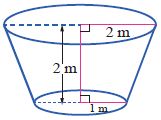
Find, by integration, the volume of the container which is in the shape of a right circular conical frustum.
3.
The region enclosed between the graphs of y = x and y = x2 is denoted by R, Find the volume generated when R is rotated through 360° about x-axis.
4.
Find, by integration, the volume of the solid generated by revolving about the y-axis, the region enclosed by x2 = 1+ y and y = 3.
5.
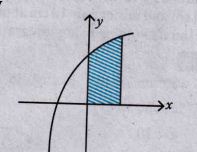
Find, by integration, the volume of the solid generated by revolving about the x-axis, the region enclosed by y = e−2x y = 0, x = 0 and x = 1
6.
Find the volume of the spherical cap of height h cut of from a sphere of radius r.
7.
Find the area of the region common to the circle x2 + y2 = 16 and the parabola y2 = 6x.
8.
The curve y = (x − 2)2 +1 has a minimum point at P. A point Q on the curve is such that the slope of PQ is 2. Find the area bounded by the curve and the chord PQ.
9.
Father of a family wishes to divide his square field bounded by x = 0, x = 4, y = 4 and y = 0 along the curve y2 = 4x and x2 = 4y into three equal parts for his wife, daughter and son. Is it possible to divide? If so, find the area to be divided among them.
10.
11.
Find the area of the region bounded by y = tan x, y = cot x and the lines x = 0, x = \(\frac{\pi}{2}\), y = 0
12.
Find the area of the region bounded between the curves y = sin x and y = cos x and the lines x = 0 and x = \(\pi\)
13.
Find the area of the region bounded by the line y = 2x + 5 and the parabola y = x2 − 2x.
14.
Find the area of the region bounded by the curve 2+x−x2+y = 0 , x-axis, x = −3 and x = 3.
15.
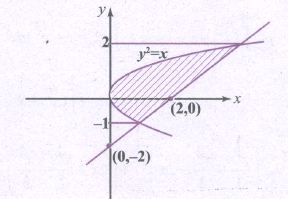
Find, by integration, the area of the region bounded by the lines 5x − 2y = 15, x + y + 4 = 0 and the x-axis
16.
Find the area of the region in the first quadrant bounded by the parabola y2 = 4x, the line x + y = 3 and y-axis.
17.
The region enclosed by the circle x2 + y2 = a2 is divided into two segments by the line x = h. Find the area of the smaller segment.
18.
Find the area of the region bounded by y = cos x, y = sin x, the lines x = \(\frac{\pi}{4}\) and x = \(\frac{5\pi}{4}\).
19.
Find the area of the region bounded between the parabola x2 = y and the curve y = |x|.
20.
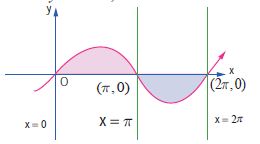
Find the area of the region bounded by x−axis, the sine curve y = sin x, the lines x = 0 and x = 2\(\pi\).
21.
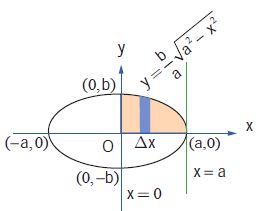
Find the area of the region bounded between the parabola y2 = 4ax and its latus rectum.
22.
23.
Evaluate \(\int _{ 0 }^{ \frac { \pi }{ 2 } }{ \frac { dx }{ 4{ sin }^{ 2 }x+5{ cos }^{ 2 }x } } \)
24.
Evaluate the following integrals using properties of integration:
\(\int _{ 0 }^{ \pi }{ x\left[ { sin }^{ 2 }(sinx)+{ cos }^{ 2 }(cosx) \right] } dx\)
25.
Evaluate the following integrals using properties of integration:
\(\int _{ 0 }^{ \pi }{ \frac { xsinx }{ 1+sinx } dx } \)
26.
Evaluate the following integrals using properties of integration:
\(\int _{ 0 }^{ 1 }{ \frac { log(1+x) }{ 1+{ x }^{ 2 } } } dx\)
27.
Evaluate \(\int ^{\pi}_{-\pi} \frac{cos ^2 x}{1+ a^x}\) dx
28.
Show that \(\int ^{1}_{0} (tan ^{-1} x + tan ^{-1}(1-x))\) dx = \(\frac {\pi}{2}\) - loge2
29.
Prove that \(\int ^\frac{\pi}{4}_{0}\) log(1+tan x)dx = \(\frac{\pi}{8}\) log2.
30.
Evaluate\(\int ^{\pi}_{0} \frac{x}{1+sin x}\) dx
31.
Evaluate : \(\int ^\frac{\pi}{4}_{0} \frac{1}{sin x+cos x}\) dx
32.
Show that \(\int ^\frac{\pi}{2}_0\) \(\frac {dx}{4+5 sin x}\) = \(\frac {1}{3}\) loge 2.
33.
Evaluate: \(\int ^4_{-4}\) |x+3| dx.
34.
Estimate the value of \(\int _{ 0 }^{ 0.5 }{ { x }^{ 2 } } dx\) using the Riemann sums corresponding to 5 subintervals of equal width and applying
(i) left-end rule
(ii) right-end rule
(iii) the mid-point rule.
35.
Find, by integration, the volume of the solid generated by revolving about the x-axis, the region enclosed by y = 2x2, y = 0 and x = 1.
36.
Find the area of the region bounded by 2x − y +1 = 0, y = −1, y = 3 and y-axis
37.
Find the area of the region bounded by the line 7x − 5y = 35, x−axis and the lines x = −2 and x = 3.
38.
Evaluate the following:
\(\int _{ 0 }^{ \frac { \pi }{ 2 } }{ \frac { dx }{ 1+5{ cos }^{ 2 }x } } \)
39.
Evaluate the following integrals using properties of integration:
\(\int _{ \frac { \pi }{ 8 } }^{ \frac { 3\pi }{ 8 } }{ \frac { 1 }{ 1+\sqrt { tanx } } dx } \)
40.
Evaluate \(\int ^{3}_{2} \frac{\sqrt {x}}{\sqrt {5-x}+\sqrt {x}}\)dx.
41.
Evaluate: \(\int_{0}^{a} \frac{f(x)}{f(x)+f(a-x)} d x\)
42.
Find the area of the region bounded by 3x − 2y + 6 = 0 , x = −3, x = 1 and x-axis.
1.
Given 2a = 20 cm \(\Rightarrow\) a = 10 cm;
2b = 10 cm \(\Rightarrow\)a = 5 cm
\(\therefore\) Equation of the ellipse is \(\frac { { x }^{ 2 } }{ { a }^{ 2 } } +\frac { { y }^{ 2 } }{ { b }^{ 2 } } =1\)
\(\Rightarrow \frac { { x }^{ 2 } }{ 100 } +\frac { { y }^{ 2 } }{ 25 } =1\Rightarrow \frac { { y }^{ 2 } }{ 25 } =1-\frac { { x }^{ 2 } }{ 100 } =\frac { 100-{ x }^{ 2 } }{ 100 } \)
\(\Rightarrow { y }^{ 2 }=\frac { 25 }{ 100 } (100-{ x }^{ 2 })\)
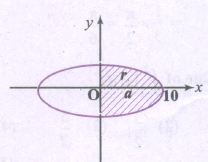
\(\therefore\) Required volume \(=2\pi \int _{ 0 }^{ 10 }{ { y }^{ 2 }dx } \)
\(=2\pi \int _{ 0 }^{ 10 }{ \frac { 25 }{ 100 } (100-{ x }^{ 2 })dx=\frac { 50\pi }{ 100 } \int _{ 0 }^{ 10 }{ (100-{ x }^{ 2 })dx } } \)
\(=\frac { \pi }{ 2 } { \left[ 100x-\frac { { x }^{ 3 } }{ 3 } \right] }_{ 0 }^{ 10 }=\frac { \pi }{ 2 } \left[ 100-\frac { 1000 }{ 3 } \right] \)
\(V=\frac { \pi }{ 2 } \left( \frac { 3000-1000 }{ 3 } \right) =\frac { \pi }{ 2 } \left( \frac { 2000 }{ 3 } \right) \)
\(=\frac { 1000\pi }{ 3 } \)
2.
Volume of the right circular conical frustum is obtained by revolving the line y = x between x = a and x = b around the x - axis
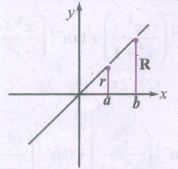
\(\therefore\) Height of the frustum h = b - a
\(\therefore\)Volume \(=\pi \int _{ a }^{ b }{ { x }^{ 2 }dx } =\pi { \left[ \frac { { x }^{ 3 } }{ 3 } \right] }_{ a }^{ b }\)
\(=\frac { \pi }{ 3 } [{ b }^{ 3 }-{ a }^{ 3 }]\)
\(=\frac { \pi }{ 3 } (b-a)({ b }^{ 2 }+ab+{ a }^{ 2 })\)
Now, substitute h = b - a, r = a and R = b we get Volume of the conical frustum
\(\frac { \pi }{ 3 } [h({ R }^{ 2 }+rR+{ r }^{ 2 })]\)
Given h = 2 m, r = 1 m, R = 2 m we get
Required volume \(=\frac { \pi }{ 3 } [2(4+2+1)]\)
\(=\frac { \pi }{ 3 } (14)\)
\(=\frac { 14\pi }{ 3 } \)
3.
Find the intersccting point of y = x and y = x2
x2 = x
x(x-1) = 0
x =0, x = 1
If x = 0, y = 0 and if x = 1, y = 1
Points of intersection are (0, 0) and (1, 1)
Equation of the given line is y = x and the parabola is y = x2
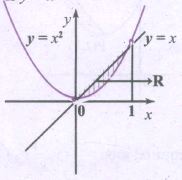
Volume V \(=\pi \int _{ 0 }^{ 1 }{ ({ x }^{ 2 }-{ x }^{ 4 }) } dx\)
\([\because y=x\Rightarrow { y }^{ 2 }={ x }^{ 2 },y={ x }^{ 2 }\Rightarrow { y }^{ 2 }={ x }^{ 4 }]\)
\(=\pi { \left[ \frac { { x }^{ 3 } }{ 3 } -\frac { { x }^{ 5 } }{ 5 } \right] }_{ 0 }^{ 1 }=\pi \left[ \frac { 1 }{ 3 } -\frac { 1 }{ 5 } \right] -0\)
\(=\pi \left[ \frac { 5-3 }{ 15 } \right] =\frac { 2\pi }{ 15 } \)cu.units
4.
Equation of the given curve is y + 1 = x2
\(\therefore\) The vertex of this open upward parabola is (0, -1)
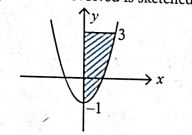
Required volume \(=\int _{ -1 }^{ 3 }{ { x }^{ 2 }dy } \)
\(=\pi \int _{ -1 }^{ 3 }{ (1+y)dy } \)
\(=\pi { \left[ y+\frac { { y }^{ 2 } }{ 2 } \right] }_{ -1 }^{ 3 }=\pi \left[ \left( 3+\frac { 9 }{ 2 } \right) -\left( -1+\frac { 1 }{ 2 } \right) \right] \)
\(=\pi \left[ \left( \frac { 6+9 }{ 2 } \right) -\left( -\frac { 1 }{ 2 } \right) =\pi \left( \frac { 15 }{ 2 } +\frac { 1 }{ 2 } \right) =\left( \frac { 16 }{ 2 } \right) \right] \)
V = 8\(\pi\)
5.
Equation of the given curve is y = e-2x
Required Volume = \(\pi \int _{ 0 }^{ 1 }{ { { (e }^{ -2x }) }^{ 2 }dx } \)
\(=\pi \int _{ 0 }^{ 1 }{ { e }^{ -4x } } dx=\pi { \left[ \frac { { e }^{ -4x } }{ -4 } \right] }_{ 0 }^{ 1 }\)
\(=\frac { -\pi }{ 4 } \left[ { e }^{ -4 }-{ e }^{ -0 } \right] =-\frac { \pi }{ 4 } \left( { e }^{ -4 }-1 \right) \)
\(V=\frac { \pi }{ 4 } (1-{ e }^{ -4 })\) cubic units
6.
If the region in the first quadrant bounded by the circle x2 + y2 = r2, the x-axis, the lines x = r − h and x = r is revolved about the x-axis, then the solid generated is a spherical cap of height h cut of from a sphere of radius r. Hence, the required volume is given by
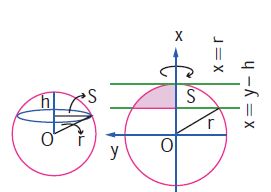
\(V=\pi \int _{ r-h }^{ r }{ { y }^{ 2 }dx=\pi \int _{ r-h }^{ r }{ \left( { r }^{ 2 }-{ x }^{ 2 } \right) dx } =\pi } { \left( { r }^{ 2 }x-\frac { { x }^{ 3 } }{ 3 } \right) }_{ r-h }^{ r }\)
\(=\pi \left( { r }^{ 2 }(r-(r-h)-\frac { \left( { r }^{ 3 }-{ (r-h) }^{ 3 } \right) }{ 3 } \right) =\pi \left( { r }^{ 2 }h-\frac { \left( { r }^{ 3 }-\left( { r }^{ 3 }-3{ r }^{ 2 }h+3{ rh }^{ 2 }-{ h }^{ 3 } \right) \right) }{ 3 } \right) \)
\(\\ =\pi \left( \frac { { 3rh }^{ 2 }-{ h }^{ 3 } }{ 3 } \right) =\frac { 1 }{ 3 } \pi { h }^{ 2 }(3r-h)\)
7.
Equation of the given circle is x2 + y2 = 16 ...(1)
and the parabola is y2 = 6x. ...(2)
Substituting (2) in (1) we get,
x2 + 6x - 16 = 0 \(\Rightarrow\) (x + 8) (x - 2) = 0
\(\Rightarrow\) (x-4) (x-2) = 0 \(\Rightarrow\) x = 2, 4
\(\Rightarrow\) x = -8, 2
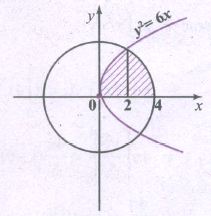
\(\therefore\) Required area = 2
\(\\ \\ \\ \\ \\ \\ \\ \int _{ 0 }^{ 2 }{ Area\ below\ the\ parabola } +\int _{ 2 }^{ 4 }{ Area\ below\ the\ circle } \)
\(=2\left[ \int _{ 0 }^{ 2 }{ \sqrt { 6x } } dx+\int _{ 2 }^{ 4 }{ \sqrt { 16-{ x }^{ 2 } } dx } \right] \)
\(=2\left[ { \left( \frac { \sqrt { 6 } .{ x }^{ \frac { 3 }{ 2 } } }{ \frac { 3 }{ 2 } } \right) }_{ 0 }^{ 2 }+{ \left( \frac { x }{ 2 } \sqrt { 16-{ x }^{ 2 } } +\frac { 16 }{ 2 } { sin }^{ -1 }\left( \frac { x }{ 4 } \right) \right) }_{ 0 }^{ 4 } \right] \)
\(=2\left[ \frac { 2 }{ 3 } \sqrt { 6. } 2\sqrt { 2 } +8{ sin }^{ -1 }\left( \frac { 1 }{ 2 } \right) \right] \)
\(=2\left[ \frac { 4\sqrt { 12 } }{ 3 } +8\left( \frac { \pi }{ 2 } \right) -\sqrt { 12 } -8\left( \frac { \pi }{ 6 } \right) \right] \)
\(=2\left[ \frac { 4\sqrt { 12 } }{ 3 } +4\pi -2\sqrt { 3 } -\frac { 4\pi }{ 3 } \right] \)
\(=2\left[ \frac { 8\sqrt { 3 } -6\sqrt { 3 } }{ 3 } +\frac { 12\pi -4\pi }{ 3 } \right] \)
\(=\left[ \frac { 2\sqrt { 3 } }{ 3 } +\frac { 8\pi }{ 3 } \right] =2\times \frac { 2 }{ 3 } \left[ \sqrt { 3 } +4\pi \right] \)
\(=\frac { 4 }{ 3 } \left[ 4\pi +\sqrt { 3 } \right] \)sq.units
8.
Given equation of the parabola is (y-1) = (x-2)2
\(\Rightarrow\) y = (x - 2)2 + 1
It vertex is (2, 1) which is the minimum point P. Let Q(x, y) be a point on the parabola given slope of PQ = 2
\(\Rightarrow \frac { y-1 }{ x-2 } =2\ \left[ \because slope=\frac { { y }_{ 2 }-{ y }_{ 1 } }{ { x }_{ 2 }-{ x }_{ 1 } } \right] \)
\(\Rightarrow\) y-1 = 2(x-2) \(\Rightarrow\) y-1 = 2x-4 \(\Rightarrow\) y = 2x-4+1
\(\Rightarrow\) y = 2x + 3
From (1) and (2), (x-2)2+1 = 2x-3
\(\Rightarrow\) x2-4x + 4 + 1 = 2x - 3 \(\Rightarrow\) x2- 6x + 8 = 0
\(\Rightarrow\) (x-4) (x-2) = 0 \(\Rightarrow\) x = 2, 4
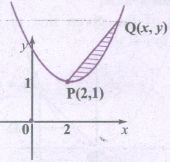
\(\therefore\) Required area \(=\int _{ 2 }^{ 4 }{ ({ y }_{ 1 }-{ y }_{ 2 }) } dx\)
\(=\int _{ 2 }^{ 4 }{ (2x-3)-{ (x-2) }^{ 2 }-1dx } \)
\(=\int _{ 2 }^{ 4 }{ (2x-3-{ x }^{ 2 }+4x-4-1)dx } \)
\(=\int _{ 2 }^{ 4 }{ (-{ x }^{ 2 }+6x-8)dx } \)
\({ \left[ \frac { -{ x }^{ 3 } }{ 3 } +3{ x }^{ 2 }-8x \right] }_{ 2 }^{ 4 }=\left( \frac { -64 }{ 3 } +48-32 \right) -\left( \frac { -8 }{ 3 } +12-16 \right) \)
\(=\left( \frac { -64 }{ 3 } +16 \right) -\left( -\frac { 8 }{ 3 } -4 \right) \)
\(=\left( \frac { -64+48 }{ 3 } \right) -\left( \frac { -8-12 }{ 3 } \right) \)
\(=\frac { 16 }{ 3 } \) sq.units
9.
Equation of the given curves are y2 = 4x and x2 = 4y
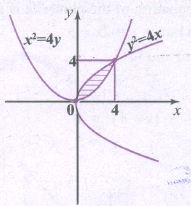
\(\therefore \) Required area \(=\int _{ 0 }^{ 4 }{ \left( \sqrt { 4x } -\frac { { x }^{ 2 } }{ 4 } \right) dx } \)
\(=\int _{ 0 }^{ 4 }{ \left( 2\sqrt { x } -\frac { { x }^{ 2 } }{ 4 } \right) dx } \)
\(={ \left[ \frac { { 2x }^{ \frac { 3 }{ 2 } } }{ \frac { 3 }{ 2 } } \right] }_{ 0 }^{ 4 }{ \left[ \frac { 4 }{ 3 } x\sqrt { x } -\frac { { x }^{ 3 } }{ 12 } \right] }_{ 0 }^{ 4 }\)
\(=\frac { 4 }{ 3 } (4)(2)-\frac { 64 }{ 12 } \)
\(=\frac { 32 }{ 3 } -\frac { 32 }{ 6 } =\frac { 64-32 }{ 6 } =\frac { 32 }{ 6 } \)
\(=\frac { 16 }{ 3 } \) sq.units
Yes the area can be divided into 3 equal parts and the area to the divided among his, wife daughter and son is \(=\frac { 16 }{ 3 } \)sq.units
10.
11.
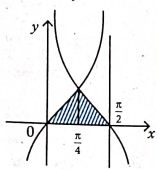
Given equation of the curves are y = tan x, y = cot x.
The intersection of y = tan x and y = cot x are
tan x = cot x \(\Rightarrow\) x = \(\frac{\pi}{2}\)
\(\therefore\) Required area \(=\int _{ 0 }^{ \frac { \pi }{ 4 } }{ (tan\ x-cot\ x)dx } \)
\(={ [-log\ sin\ x+log\ sec\ x] }_{ 0 }^{ \frac { \pi }{ 4 } }\)
\(=log{ \left[ \frac { sec\ x }{ sin\ x } \right] }_{ 0 }^{ \frac { \pi }{ 4 } }==log{ \left[ \frac { 1 }{ sin\ x\ cos\ x } \right] }_{ 0 }^{ \frac { \pi }{ 4 } }\)
\(=-log{ (sin\quad x\ cos\ x) }_{ 0 }^{ \frac { \pi }{ 4 } }\)
\(=-log\left( sin\frac { \pi }{ 4 } .cos\frac { \pi }{ 4 } \right) +log(sin0\quad cos0)\)
\(=-log\left( \frac { 1 }{ \sqrt { 2 } } .\frac { 1 }{ \sqrt { 2 } } \right) +0\)
\(=-log\left( \frac { 1 }{ 2 } \right) =-(log1-log2)=log2\)
12.
Equation of the given curves are y = sin x ..(1)
Y = cos x ...(2)
from (1) and (2), sin x = cos x
y = sin x
| x | 0 | \(\pi\)/2 |
| y | 0 | 1 |
y = cos x
| x | 0 | \(\pi\)/2 |
| y | 1 | 0 |
\(\Rightarrow x=\frac { \pi }{ 4 } \)
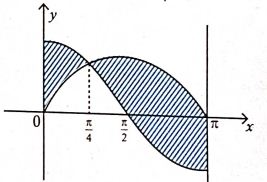
\(\therefore \) Required area = \(2\int _{ \frac { \pi }{ 4 } }^{ \frac { 3\pi }{ 4 } }{ (sinx-cosx)dx } \)
[\(\because\) the area is symmetrical about X - axis]
\(=2{ \left[ -cosx-sinx \right] }_{ \frac { \pi }{ 4 } }^{ \frac { 3\pi }{ 4 } }\)
\(=-2\left[ \left( cos\frac { 3\pi }{ 4 } +sin\frac { 3\pi }{ 4 } \right) -\left( cos\frac { \pi }{ 4 } +sin\frac { \pi }{ 4 } \right) \right] \)
= -2\(\left[ \left( -\frac { 1 }{ \sqrt { 2 } } +\frac { 1 }{ \sqrt { 2 } } \right) -\left( \frac { 1 }{ \sqrt { 2 } } +\frac { 1 }{ \sqrt { 2 } } \right) \right] \)
[cos 135o = cos(180o- 45) = -cos 45o sin135o = sin(180o- 45) = -sin 45o]
\(=-2\left[ \frac { -2 }{ \sqrt { 2 } } \right] =\frac { 4 }{ \sqrt { 2 } } \times \frac { \sqrt { 2 } }{ \sqrt { 2 } } =\frac { 4\sqrt { 2 } }{ 2 } =2\sqrt { 2 } \)
13.
Given equation of the parabola is y = x2-2x ...(1)
and the line is y = 2x + 5 ...(2)
From (1) and (2),
x2-2x = 2x+5
\(\Rightarrow\) x2-4x-5 = 0
\(\Rightarrow\)(x-5)(x+1) = 0
\(\Rightarrow\)x = 5, -1
For parabola
| x | 0 | 2 |
| y | 0 | 0 |
For the line
| x | 0 | -5/2 |
| y | 5 | 0 |
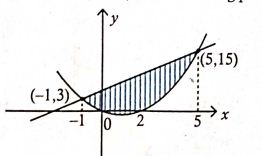
\(\therefore\) Required area \(=\int _{ -1 }^{ 5 }{ ({ y }_{ 1 }-{ y }_{ 2 })dx } \)
\(=\int _{ -1 }^{ 5 }{ (2x+5)-({ x }^{ 2 }-2x) } \)
\(=\int _{ -1 }^{ 5 }{ (2x+5-{ x }^{ 2 }+2x) } dx\)
\(=\int _{ -1 }^{ 5 }{ (4x5-{ x }^{ 2 })dx } \)
\(={ \left( \frac { { 4x }^{ 2 } }{ 2 } +5x-\frac { { x }^{ 3 } }{ 3 } \right) }_{ -1 }^{ 5 }\)
\(={ \left( { 2x }^{ 2 }+5x-\frac { { x }^{ 3 } }{ 3 } \right) }_{ -1 }^{ 5 }\)
\(=\left( 50+25-\frac { 125 }{ 3 } \right) -\left( 2-5+\frac { 1 }{ 3 } \right) \)
\(=\left( \frac { 100 }{ 3 } \right) -\left( \frac { -8 }{ 3 } \right) =\frac { 100 }{ 3 } +\frac { 8 }{ 3 } =\frac { 108 }{ 3 } \)
= 36 sq.units
14.
Equation of the given curve is 2+x-x2+y = 0
| x | 0 | 2 | -1 |
| y | -2 | 0 | 0 |
\(\Rightarrow\)y = x2-x-2
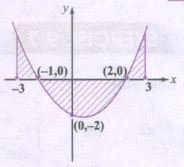
\(\therefore\) Required area= \(\int _{ -3 }^{ -1 }{ ydx } +\int _{ -1 }^{ 2 }{ -y } dx+\int _{ 2 }^{ 3 }{ ydx } \)
\(\\ =\int _{ -3 }^{ -1 }{ \left( { x }^{ 2 }-x-2 \right) } dx\int _{ -1 }^{ 2 }{ (2+x-{ x }^{ 2 })dx } +\int _{ 2 }^{ 3 }{ ({ x }^{ 2 }-x-2) } dx\)
\(={ \left( \frac { { x }^{ 3 } }{ 3 } -\frac { { x }^{ 2 } }{ 2 } -2x \right) }_{ -3 }^{ -1 }+{ \left( 2x+\frac { { x }^{ 2 } }{ 2 } -\frac { { x }^{ 3 } }{ 3 } \right) }_{ -1 }^{ 2 }+{ \left( \frac { { x }^{ 3 } }{ 3 } -\frac { { x }^{ 2 } }{ 2 } -2x \right) }_{ 2 }^{ 3 }\)
\(=\left( -\frac { 1 }{ 3 } -\frac { 1 }{ 2 } +2 \right) -\left( -9-\frac { 9 }{ 2 } +6 \right) +\left( 4+2-\frac { 8 }{ 3 } \right) -\left( -2+\frac { 1 }{ 2 } +\frac { 1 }{ 3 } \right) +\left( 9-\frac { 9 }{ 2 } -6 \right) -\left( \frac { 8 }{ 3 } -2-4 \right) \)
\(\\ =\left( \frac { -2-3+6 }{ 6 } \right) -\left( \frac { -6-9 }{ 2 } \right) +\left( \frac { 18-8 }{ 3 } \right) -\left( \frac { -12+3+2 }{ 6 } \right) +\left( \frac { 6-9 }{ 2 } \right) -\left( \frac { 8-24 }{ 3 } \right) \)
\(=\frac { 1 }{ 6 } +\frac { 15 }{ 2 } +\frac { 10 }{ 3 } +\frac { 7 }{ 6 } -\frac { 3 }{ 2 } +\frac { 16 }{ 3 } \)
\(=\frac { 1+45+20+7-9+32 }{ 6 } =\frac { 90 }{ 6 } =15
\)
15.
The lines 5x − 2y = 15, x + y + 4 = 0 intersect at (1, −5). The line 5x − 2y =15 meets the x-axis at (3, 0). The line x + y + 4 = 0 meets the x-axis at (−4, 0). The required area is shaded. It lies below the x-axis. It can be computed either by considering vertical strips or horizontal strips.
When we do by vertical strips, the region has to be divided into two sub-regions by the line x = 1. Then, we get
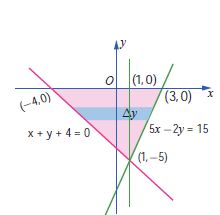
\(A=\left| \int _{ -4 }^{ 1 }{ ydx } \right| +\left| \int _{ 1 }^{ 3 }{ ydx } \right| \)
\(=\left| \int _{ -4 }^{ 1 }{ (-4-x)dx } \right| +\left| \int _{ 1 }^{ 3 }{ \left( \frac { 5x-15 }{ 2 } \right) dx } \right| \)
\(=\left| { \left( -4x-\frac { { x }^{ 2 } }{ 2 } \right) }_{ -4 }^{ 1 } \right| +\left| { \left( \frac { { 5x }^{ 2 } }{ 4 } -\frac { 15x }{ 2 } \right) }_{ 1 }^{ 3 } \right| \)
\(=\left| \left( -\frac { 9 }{ 2 } \right) -\left( 8 \right) \right| +\left| \left( -\frac { 45 }{ 4 } \right) -\left( -\frac { 25 }{ 4 } \right) \right| \)
\(=\frac { 25 }{ 2 } +5\)
\(=\frac { 35 }{ 2 } \)
When we do by horizontal strips, there is no need to subdivide the region. In this case, the area is bounded on the right by the line 5x − 2y = 15 and on the left by x + y + 4 = 0. So, we get
\(A=\int _{ -5 }^{ 0 }{ [{ x }_{ R }-{ x }_{ L }]dy } =\int _{ -5 }^{ 0 }{ \left[ \frac { 15+2y }{ 5 } -(-4-y) \right] dy } \)
\(=\int _{ -5 }^{ 0 }{ \left[ 7+\frac { 7y }{ 5 } \right] dy={ \left[ 7y+\frac { { 7y }^{ 2 } }{ 10 } \right] }_{ -5 }^{ 0 } } \)
\(\\ =0-\left[ -35+\frac { 35 }{ 2 } \right] =\frac { 35 }{ 2 } \)
16.
First, we find the points of intersection of x + y = 3 and y2 − 4x:
x + y = 3 ⇒ y = 3− x.
\(\therefore\) y2 = 4x ⇒ (3 -x)2 = 4x
⇒ x2 −10x + 9 = 0
⇒ x = 1, x = 9 .
\(\therefore\) x = 1 in x + y = 3 \(\Rightarrow\) y = 2, and x = 9 in x + y = 3 ⇒ y = −6 .
\(\therefore\) (1, 2) and (9,−6) are the points of intersection.
The line x + y = 3 meets the y -axis at (0, 3).
The required area is sketched
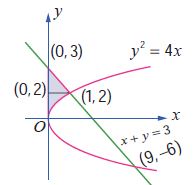
Viewing in the direction of y -axis, on the right bounding curve is given by
\(x=\begin{cases} \frac { { y }^{ 2 } }{ 4 } ,0\le y\le 2 \\ 3-y,2\le y\le 3 \end{cases}\)
\(\therefore A=\int _{ 0 }^{ 2 }{ xdy+\int _{ 2 }^{ 3 }{ xdy } =\int _{ 0 }^{ 2 }{ \frac { { y }^{ 2 } }{ 4 } dy+\int _{ 2 }^{ 3 }{ (3-y) } dy } } \)
\(={ \left( \frac { { y }^{ 3 } }{ 12 } \right) }_{ 0 }^{ 2 }+{ \left( 3y-\frac { { y }^{ 3 } }{ 2 } \right) }_{ 2 }^{ 3 }=\left( \frac { 8 }{ 12 } -0 \right) +\left( 9-\frac { 9 }{ 2 } \right) -\left( 6-\frac { 4 }{ 2 } \right) =\frac { 7 }{ 6 } \)
17.
The smaller segment is sketched. Here 0
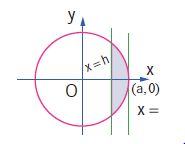
\(A=2\int _{ h }^{ a }{ \sqrt { { a }^{ 2 }-{ x }^{ 2 } } } dx=2{ \left[ \frac { x\sqrt { { a }^{ 2 }-{ x }^{ 2 } } }{ 2 } +\frac { { a }^{ 2 } }{ 2 } { sin }^{ -1 }\left( \frac { x }{ a } \right) \right] }_{ h }^{ a }\)
\(=2\left[ 0+\frac { { a }^{ 2 } }{ 2 } { sin }^{ -1 }(1) \right] -2\left[ \frac { h\sqrt { { a }^{ 2 }-{ h }^{ 2 } } }{ 2 } +\frac { { a }^{ 2 } }{ 2 } { sin }^{ -1 }\left( \frac { h }{ a } \right) \right] \)
\(={ a }^{ 2 }\left( \frac { \pi }{ 2 } \right) -h\sqrt { { a }^{ 2 }-{ h }^{ 2 } } -{ a }^{ 2 }{ sin }^{ -1 }\left( \frac { h }{ a } \right) \)
\(=a^{2}\left[\frac{\pi}{2}-\sin ^{-1}\left(\frac{h}{a}\right)\right]-h \sqrt{a^{2}-h^{2}}\)
\(={ a }^{ 2 }{ cos }^{ -1 }\left( \frac { h }{ a } \right) -h\sqrt { { a }^{ 2 }-{ h }^{ 2 } } \)
18.
The region is sketched. The upper boundary of the region is y = sin x for \(\\ \\ \frac { \pi }{ 4 } \le x\le \frac { 5\pi }{ 4 } \) and the lower boundary of the region is y = cos x for \(\frac { \pi }{ 4 } \le x\le \frac { 5\pi }{ 4 } \). So the required area A is given by
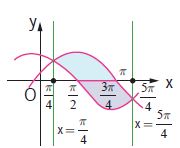
\(A=\int _{ \frac { \pi }{ 4 } }^{ \frac { 5\pi }{ 4 } }{ ({ y }_{ U }-{ y }_{ L })dx= } \int _{ \frac { \pi }{ 4 } }^{ \frac { 5\pi }{ 4 } }{ (sinx-cosx)dx={ [-cosx=sinx] }_{ \frac { \pi }{ 4 } }^{ \frac { 5\pi }{ 4 } } } \)
\(=\left( -sin\frac { 5\pi }{ 4 } -cos\frac { 5\pi }{ 4 } \right) -\left( -sin\frac { \pi }{ 4 } -cos\frac { \pi }{ 4 } \right) \)
\(=\left( -\left( -\frac { 1 }{ \sqrt { 2 } } \right) -\left( -\frac { 1 }{ \sqrt { 2 } } \right) -\left( -\left( \frac { 1 }{ \sqrt { 2 } } \right) -\left( \frac { 1 }{ \sqrt { 2 } } \right) \right) \right) \)
\(=\frac { 2 }{ \sqrt { 2 } } +\frac { 2 }{ \sqrt { 2 } } =2\sqrt { 2 } \)
19.
Both the curves are symmetrical about y -axis
The curve y = |x| is \(y=\begin{cases} x\quad if\quad x\ge 0 \\ -x\quad if\quad x\le 0 \end{cases}\)
It intersects the parabola x2 = y at (1, 1) and (−1, 1). The area of the region bounded by the curves is sketched. It lies in the first quadrant as well as in the second quadrant. By symmetry, the required area is twice the area in the first quadrant.
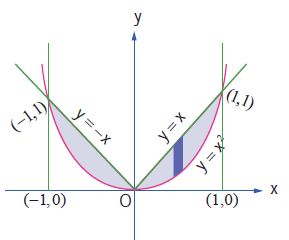
In the first quadrant, the upper curve is y = x, 0 \(\le x\le\)1 and the lower curve is y = x2 \(\le x\le\),0 1. Hence, the required area is given by
\(A=2\int _{ 0 }^{ 1 }{ \left[ { y }_{ U }-{ y }_{ L } \right] } dx=2\int _{ 0 }^{ 1 }{ \left[ x-{ x }^{ 2 } \right] dx } \)
\(=2{ \left[ \frac { { x }^{ 2 } }{ 2 } -\frac { { x }^{ 3 } }{ 3 } \right] }_{ 0 }^{ 1 }\)
\(=2\left( \frac { 1 }{ 2 } -\frac { 1 }{ 3 } \right) =\frac { 1 }{ 3 } \)
20.
The required area is sketched. One portion of the region lies above the x−axis between x = 0 and x = \(\pi\), and the other portion lies below x−axis between x = \(\pi\) and x = 2\(\pi\). So, the required area is given by
21.
The equation of the latus-rectum is x = a. It intersects the parabola at the points L(a, 2a) and L1 (a, −2). The required area is sketched. By symmetry, the required area A is twice the area bounded by the portion of the parabola
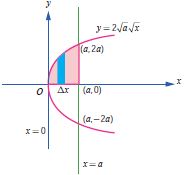
y = 2\(\sqrt a \sqrt x\), x -axis, x = 0 and x = a.
Hence, by taking vertical strips, we get
\(A=2\int _{ 0 }^{ a }{ ydx=2\int _{ 0 }^{ a }{ 2\sqrt { a } \sqrt { x } dx=4 } \sqrt { a } } { \left[ \frac { 2 }{ 3 } { x }^{ \frac { 3 }{ 2 } } \right] }_{ 0 }^{ a }\)
\(=4\sqrt { a } \times \frac { 2 }{ 3 } { a }^{ \frac { 3 }{ 2 } }=\frac { 8{ a }^{ 2 } }{ 3 } \)
22.
23.
\(Let\quad I=\int _{ 0 }^{ \frac { \pi }{ 2 } }{ \frac { dx }{ 4x{ sin }^{ 2 }x+5{ cos }^{ 2 }x } } \)
\(=\int _{ 0 }^{ \frac { \pi }{ 2 } }{ \frac { { sec }^{ 2 }x }{ 4{ tan }^{ 2 }x+5 } } dx\)
(Dividing both numerator and denominator by cos2 x).
Let u = tan x
Then du = sec2 x dx
When x = 0, u = tan 0 = 0
When x = \(\frac{\pi}{2}\), u = tan\(\frac{\pi}{2}\) = \(\infty\)
\(\therefore I=\int _{ 0 }^{ \infty }{ \frac { du }{ 4{ u }^{ 2 }+5 } } \) (This is an improper integral)
\(\frac { 1 }{ 4 } \int _{ 0 }^{ \infty }{ \frac { du }{ \left[ { u }^{ 2 }+\left( \frac { \sqrt { 5 } }{ 2 } \right) \right] } =\frac { 1 }{ 4 } \times \frac { 2 }{ \sqrt { 5 } } { \left[ { tan }^{ -1 }\left( \frac { u }{ \frac { \sqrt { 5 } }{ 2 } } \right) \right] }_{ 0 }^{ \infty } } =\frac { 1 }{ 2\sqrt { 5 } } \left( { tan }^{ -1 }\infty -{ tan }^{ -1 }0 \right) =\frac { 1 }{ 2\sqrt { 5 } } \left( \frac { \pi }{ 2 } \right) =\frac { \pi }{ 4\sqrt { 5 } } \)
24.
\(Let\ I=\int _{ 0 }^{ \pi }{ x\left[ { sin }^{ 2 }(sinx)+{ cos }^{ 2 }(cosx) \right] } dx\quad ...(1)\)
\(\left[ \because \int _{ 0 }^{ a }{ f(x)dx=\int _{ 0 }^{ a }{ f(a-x)dx } } \right] \)
\(I=\int _{ 0 }^{ \pi }{ (\pi -x) } [{ sin }^{ 2 }(sin(\pi -x))+{ cos }^{ 2 }(cos(\pi -x)]dx\)
\(=\int _{ 0 }^{ \pi }{ (\pi -x)[{ sin }^{ 2 }(sinx)+{ cos }^{ 2 }(-cosx)]dx } \)
\(=\int _{ 0 }^{ \pi }{ (\pi -x)[{ sin }^{ 2 }(sin\quad x)+{ cos }^{ 2 })(cosx)]dx } \)
\([\because cos(-x)=cos\quad x]\)
\(=\int _{ 0 }^{ \pi }{ \pi [{ sin }^{ 2 }(sinx)+{ cos }^{ 2 }(cosx)] } dx\)
\(-\int _{ 0 }^{ \pi }{ x[{ sin }^{ 2 }(sinx)+{ cos }^{ 2 }(cosx)] } dx\)
\(=\int _{ 0 }^{ \pi }{ \pi [{ sin }^{ 2 }(sinx)+{ cos }^{ 2 }(cosx)]dx-I } [from\quad (1)]\)
\(2I=\pi \int _{ 0 }^{ \pi }{ [{ sin }^{ 2 }(sinx)+{ cos }^{ 2 }(cosx)] } dx\)
\(I=\pi \int _{ 0 }^{ \pi /2 }{ \left[ { sin }^{ 2 }(sin\quad x)+{ cos }^{ 2 }(cos\quad x) \right] } dx\quad ...(2)\)
\(I=\pi \int _{ 0 }^{ \pi /2 }{ \left[ { sin }^{ 2 }(sin\frac { \pi }{ 2 } -x)+{ cos }^{ 2 }(cos\frac { \pi }{ 2 } -x) \right] dx } \)
\(I=\pi \int _{ 0 }^{ \pi /2 }{ [{ sin }^{ 2 }(cosx)+{ cos }^{ 2 }(sin\quad x)]dx] } ....(3)\)
Adding (2) and (3) we get,
\(2I=\pi \int _{ 0 }^{ \pi /2 }{ \left[ { sin }^{ 2 }(sinx)+{ cos }^{ 2 }(cosx) \right] dx } +{ sin }^{ 2 }(cosx)+{ cos }^{ 2 }(sin\quad x)]dx\)
\(I=\pi \int _{ 0 }^{ \pi /2 }{ (1+1)dx } \ [\because { sin }^{ 2 }\theta +{ cos }^{ 2 }\theta =1]\)
\(=\pi (2){ [x] }_{ 0 }^{ \frac { \pi }{ 2 } }=2\pi \left[ \frac { \pi }{ 2 } -0 \right] ={ \pi }^{ 2 }\ \)
\( \therefore I=\frac { { \pi }^{ 2 } }{ 2 } \)
25.
Let \(I=\int _{ 0 }^{ \pi }{ \frac { xsinx }{ 1+sinx } dx }...(1)\)
By the property, \(\left[ \because \int _{ 0 }^{ a }{ f(x)dx } =\int _{ 0 }^{ a }{ f(a-x)dx } \right] \)
we get \(I=\int _{ 0 }^{ \pi }{ \frac { (\pi -x)sin(\pi -x) }{ 1+sin(\pi -x) } } dx\)
\(=\int _{ 0 }^{ \pi }{ \frac { (\pi -x)sinx }{ 1+sinx } dx } ...(2)\)
\((1)+(2)\rightarrow \)
\(2I=\int _{ 0 }^{ \pi }{ \frac { xsinx }{ 1+sinx } dx+\int _{ 0 }^{ \pi }{ \frac { (\pi -x)sinx }{ 1+sinx } dx } } \)
\(=\int _{ 0 }^{ \pi }{ \frac { xsinx+(\pi -x)sinx }{ 1+sinx } dx } \)
\(=\int _{ 0 }^{ \pi }{ \frac { xsinx+(\pi -x)sinx }{ 1+sinx } dx } \)
\(=\int _{ 0 }^{ \pi }{ \frac { \pi sinx }{ 1+sinx } dx=\pi \int _{ 0 }^{ \pi }{ \frac { sinx(1-sinx) }{ (1+sinx)(1-sinx) } dx } } \)
\(=\pi \int _{ 0 }^{ \pi }{ \frac { sin\quad x-{ sin }^{ 2 }x }{ 1-{ sin }^{ 2 }x } } =\pi \int _{ 0 }^{ \pi }{ \frac { sinx-{ sin }^{ 2 } }{ { cos }^{ 2 }x } dx } \)
\(=\pi \int _{ 0 }^{ \pi }{ \frac { sinx }{ { cos }^{ 2 }x } dx-\pi \int _{ 0 }^{ \pi }{ \frac { { sin }^{ 2 } }{ { cos }^{ 2 } } dx } } \)
\(=\pi \int _{ 0 }^{ \pi }{ tanxsec\quad x\quad dx-\pi \int _{ 0 }^{ \pi }{ { tan }^{ 2 }xdx } } \)
\(=\pi { \left[ secx \right] }_{ 0 }^{ \pi }-\pi ({ sec }^{ 2 }x-1)dx\)
\(={ \pi \left[ sec-tan\quad x+x \right] }_{ 0 }^{ \pi }\)
\(=\pi [(sec\pi -tan\pi +\pi )-(sec0-tan0+0)]\)
\(=\pi [(-1-0+\pi )-(1-0+0)]\)
\(2I=\pi [\pi -2]\ \)
\(\therefore I=\frac { \pi }{ 2 } [\pi -2]\)
26.
Let x = tan \(\theta \Rightarrow\)dx = sec2\(\theta d \theta\)
| x | 0 | 1 |
| \(\theta\) | 0 | \(\frac{\pi}{4}\) |
\(\therefore I=\int _{ 0 }^{ \frac { \pi }{ 4 } }{ \frac { log(1+tan\theta ) }{ { sec }^{ 2 }\theta } } { sec }^{ 2 }\theta d\theta \)
\(=\int _{ 0 }^{ \frac { \pi }{ 4 } }{ log(1+tan\theta )d\theta } \quad ...(1)\)
Using property,
\(I=\int _{ 0 }^{ \frac { \pi }{ 4 } }{ log(1+tan(\frac { \pi }{ 4 } -\theta ))d\theta } \)
\(I=\int _{ 0 }^{ \frac { \pi }{ 4 } }{ log\left( \frac { 1+tan\theta +1-tan\theta }{ 1+tan\theta } \right) } d\theta \)
\(I=\int _{ 0 }^{ \frac { \pi }{ 4 } }{ log\left( \frac { 2 }{ 1+tan\theta } \right) } d\theta \quad ..(2)\)
(1)+(2)
\(2I=\int _{ 0 }^{ \frac { \pi }{ 4 } }{ log(1+tan\theta )d\theta } +\int _{ 0 }^{ \frac { \pi }{ 4 } }{ log\left( \frac { 2 }{ 1+tan\theta } \right) } d\theta \)
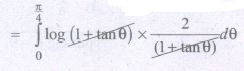
\(=\int _{ 0 }^{ \frac { \pi }{ 4 } }{ log2d\theta =log2{ [\theta ] }_{ 0 }^{ \frac { \pi }{ 4 } } } \)
\(2I=log2(\frac { \pi }{ 4 } -0)=\frac { \pi }{ 4 } log2\)
\(\therefore I=\frac { \pi }{ 8 } log2\)
27.
Let I = \(\int ^{\pi}_{-\pi} \frac{cos ^2 x}{1+ a^x} dx\)-- (1)
Using \(\int ^{b}_{a}\) f(x) dx =\(\int ^{b}_{a}\) f(a+b -x)dx we get,
I = \(\int ^{\pi}_{-\pi} \frac{cos ^2 (\pi -\pi - x)}{1+ a^{\pi -\pi - x}} dx\)
= \(\int ^{\pi}_{-\pi} \frac{cos ^2 (-x)}{1+ a^{-x}} dx\)
= \(\int ^{\pi}_{-\pi} a^x (\frac{cos ^2 x }{a^x+ 1} )dx\) --- (2)
Adding (1) and (2) we get
2I = \(\int ^{\pi}_{-\pi} \frac{cos ^2 x }{a^x+ 1}(a^x+ 1) dx\) = \(\int ^{\pi}_{-\pi} cos ^2 x dx\)
= 2 \(x =\int ^{\pi}_{-\pi} cos ^2 x dx\) (since cos2 x is an even function)
Hence, I = \(\int ^{\pi}_{0} (\frac{1 + cos2x }{2} )dx\)
= \(\frac {1}{2} [ x + \frac {sin 2x}{2}]^{x}_{0}\)
= \(\frac {1}{2} [\pi]\)
= \(\frac {\pi}{2}\)
28.
I =\(\int ^{1}_{0} (tan ^{-1} x + tan ^{-1}(1-x))\) dx
=\(\int ^{1}_{0} (tan ^{-1} x dx + \int ^{1}_{0} tan ^{-1}(1-x)) dx\)
= \(\int ^{1}_{0} (tan ^{-1} x dx + \int ^{1}_{0} tan ^{-1}(1-(1-x)) dx\), Since\(\int ^{a}_{0} f (x) dx = \int ^{a}_{0} f(a-x) dx \)
=\(\int ^{1}_{0} tan ^{-1} x dx + \int ^{1}_{0} tan ^{-1} x dx\)
= 2\(\int ^{1}_{0} tan^{-1} x dx\)
= \([2 \int udv]^1_0\) , Where u = tan-1 x and dν = dx
= 2\([uν - \int udv]^1_0,\) applying integration by parts
= 2\((x tan^{-1} x - \int x \frac{dx}{1+x^2})^{1}_{0}\)
= 2\((x tan^{-1} x - \frac {1}{2} log (1+x^2))^{1}_{0}\)
= \(\frac{\pi}{2} \)- log 2
29.
Let us put I = \(\int ^\frac{\pi}{4}_{0}\) log(1 + tan x) dx
Applying the property \(\int ^{a}_{0}\) f(x) dx =\(\int ^{a}_{0}\)f(a-x) dx in equation (1), we get
I = \(\int ^\frac{\pi}{4}_{0}\) log \([1+tan (\frac{\pi}{4}-x)]\)dx = \(\int ^\frac{\pi}{4}_{0}\) log\([1 + \frac{tan \frac {\pi}{4}- tan x}{1 + tan {\frac {\pi}{4} tan x}}]\) dx
=\(\int ^\frac{\pi}{4}_{0}\) log \([1 + \frac {1 - tan x}{1 + tan x}]\)dx = \(\int ^\frac{\pi}{4}_{0}\) log\([\frac {1+tan x +1 - tan x}{1 + tan x}]\) dx
=\(\int ^\frac{\pi}{4}_{0}\) log \([\frac{2}{1+tanx}]\) dx = \(\int ^\frac{\pi}{4}_{0}\) [log 2 - log (1+tan x)] dx
= log 2 \(\int ^\frac{\pi}{4}_{0}\) dx - \(\int ^\frac{\pi}{4}_{0}\)log (1+tan x)] dx
= \(\frac{\pi}{4}\)log 2 - I
So, we get 2I = \(\frac{\pi}{4}\)log 2.
Hence, we get I = \(\frac{\pi}{8}\)log 2.
30.
Let I =\(\int ^{\pi}_{0} \frac{x}{1+sin x}\)
= \(\int ^{\pi}_{0} x \frac{x}{1+sin x}\)dx
Let f (x) = \(\frac{1}{1+ sin x}\)
Then f(π-x) = \(\frac{1}{1+ sin (\pi - x)}\) = \(\frac{1}{1+ sin x}\) = f(x)
∴ \(\int ^{\pi}_{0} \frac{x}{1+sin x}\) dx = \(\frac{\pi}{2}\) \(\int ^{\pi}_{0} \frac{1}{1+sin x}\) dx, \((\because \int _{ 0 }^{ a }{ xf(x)dx=\frac { a }{ 2 } \int _{ 0 }^{ a }{ f(x)dx } if } f(a-x)=f(x))\)
= \(\pi\) \(\int ^{ \frac{\pi}{2}}_0 \frac{1}{1+sin x}\) dx, (∴ \(\int ^{\pi}_0\) g(sin x)dx = 2 \(\int ^{ \frac{\pi}{2}}_0\) g(sin x)dx)
= \(\pi\) \(\int ^{ \frac{\pi}{2}}_0 \frac{1}{1+sin (\frac{\pi}{2} -x)}\) dx (∴ \(\int ^{a}_{0} \) f(x) dx = \(\int ^{a}_{0} \) f(a-x)dx)
= \(\pi\) \(\int ^{ \frac{\pi}{2}}_0 \frac{1}{1+cos x}\) dx = \(\pi\) \(\int ^{ \frac{\pi}{2}}_0 \frac{1}{2cos^2 \frac{x}{2}}\) dx = \(\frac{\pi}{2}\) \(\int ^{ \frac{\pi}{2}}_0 sec ^2 \frac{x}{2}\) dx
= \(\pi\) \([tan \frac{x}{2}]^\frac{\pi}{2}_0\) = \(\pi\) \([tan \frac{\pi}{4} - tan 0]\) = \(\pi\)
31.
I = \(\int ^\frac{\pi}{4}_{0} \frac{1}{sin x+cos x}\) dx = \(\int ^\frac{\pi}{4}_{0} \frac{1} {\sqrt 2( \frac {1}{\sqrt 2}sin x+ \frac {1}{\sqrt 2}cos x)}\) dx
= \(\frac{1}{\sqrt 2}\int ^\frac{\pi}{4}_{0} \frac{1} {( cos \frac {\pi}{4}cos x+ sin \frac {\pi}{4}sin x)}\) dx = \(\frac{1}{\sqrt 2}\int ^\frac{\pi}{4}_{0} \frac{1} {cos (\frac{\pi}{4}- x)}\) dx
= \(\frac{1}{\sqrt 2}\int ^\frac{\pi}{4}_{0} \frac{1} {cos x}\)dx since\(\int ^{a}_{0}\) f(x) dx =\(\int ^{a}_{0}\) f (a-x)dx
\(=\frac { 1 }{ \sqrt { 2 } } \int _{ 0 }^{ \frac { \pi }{ 4 } } secxdx=\frac { 1 }{ \sqrt { 2 } } { \left[ log(secx+tanx) \right] }_{ 0 }^{ \frac { \pi }{ 4 } }\)
= \(\frac{1}{\sqrt 2} [log ( \sqrt {2} + 1) - log (1+0)]\)
= \(\frac{1}{\sqrt 2} [log ( \sqrt {2} + 1)\).
32.
Put u = tan \(\frac{x}{2}\)
Then, sin x = \(\frac{2 tan \frac {x}{2}}{1 + tan^2 \frac{x}{2}}\) = \(\frac{2u}{1+u^2}\), du = \(\frac{1}{2}\) sec2 \(\frac{x}{2}\) dx \(\Rightarrow \) dx = \(\frac {2du}{1+u^2}\)
When x = 0,u = tan 0 = 0
When x = \(\frac{\pi}{2},u=tan\frac{\pi}{4}=1\)
∴ I =\(\int ^\frac{\pi}{2}_0\) \(\frac{dx}{4+5 sin x}\) =\(\int ^{1}_0\) \(\frac{\frac {2du}{1+u^2}}{4+5 (\frac{2u}{1+u^2})}\) =\(\int ^{1}_0\) \(\frac {du}{2u^2+5u +2}\)=\(\frac{1}{2}\)\(\int ^{1}_{0}\) \(\frac {du}{u^2+\frac{5}{2}u +1}\)
\(\frac { 1 }{ 2 } \int _{ 0 }^{ 1 } \frac { du }{ (u+\frac { 5 }{ 4 } )^2-(\frac { 3 }{ 4 } )^{ 2 } } { \left[ \frac { 1 }{ 2 } \times \frac { 1 }{ 2\times \left( \frac { 3 }{ 4 } \right) } log\left( \frac { (u+\frac { 5 }{ 4 } )-\frac { 3 }{ 4 } }{ (u+\frac { 5 }{ 4 } )+\frac { 3 }{ 4 } } \right) \right] }_{ 0 }^{ 1 }
= \frac{1}{3} [log (\frac{u+\frac{1}{2}}{u+2})]
=\frac { 1 }{ 3 } log2\)
33.
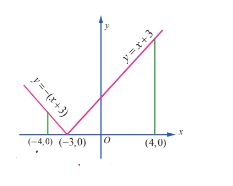
By definition, we have |x + 3| = \(\begin{cases} \begin{matrix} x+3 & x\ge -3 \\ -x-3 & x<-3 \end{matrix}\end{cases}\)
for the graph of y =| x + 3 | in −4 \(\le\) x \(\le\) 4.
∴ \(\int ^4_{-4}\)|x+3| dx = \(\int ^{-3}_{-4}\) |x+3| dx + \(\int ^{4}_{-3}\) |x+3| dx = \(\int ^{-3}_{-4}\)|-x-3| dx+ \(\int ^{4}_{-3}\)(x+3)dx
= \([- \frac {x^2}{2}-3x]^{-3}_{-4}\) + \([ \frac {x^2}{2}+3x]^{4}_{-3}\)
= \(( -\frac {9}{2}+9)\) - \(( -\frac {16}{2}+12)\) + \(( \frac {16}{2}+12)\) - \(( \frac {9}{2}-9)\) = \(( \frac {9}{2})\) - 4+20 + \(( \frac {9}{2})\) = 25
34.
Here a = 0, b = 0.5, n = 5, f(x) = x2
So, the width of each subinterval is \(h=\Delta x=\frac { b-a }{ n } =\frac { 0.5-0 }{ 5 } =0.1\)
The partition of the interval is given by the points
x0 = 0,
x1 = x0 + h = 0 + 0.1 = 0.1
x2 = x1 + h = 0.1+ 0.1 = 0.2
x3 = x2 + h = 0.2 + 0.1 = 0.3
x4 = x3 + h = 0.3+ 0.1 = 0.4
x5 = x4 + h = 0.4 + 0.1 = 0.5
(i) The left-end rule for Riemann sum with equal width \(\Delta\)x is
S = [f(x0) + f(x1) +....+f(xn-1)]\(\Delta x\)
\(\therefore\) S = [f(0) + f(0.1) + f(0.2) + f(0.3) + f(0.4)](0.1)
= [0.00 + 0.01+ 0.04 + 0.09 + 0.16](0.1) = 0.03
\(\therefore \int _{ 0 }^{ 0.5 }{ x^{ 2 } }\) dx is approximately 0.03.
(ii) The right-end rule for Riemann sum with equal width \(\Delta\)x is
S = [f(x1)+f(x2)+...+f(xn)]\(\Delta\)x
\(\therefore\) S = [f(0.1) + f(0.2) + f(0.3) + f(0.4) + f(0.5)](0.1)
= [0.01 + 0.04 + 0.09 + 0.16 + 0.25](0.1) = 0.055
\(\therefore \int _{ 0 }^{ 0.5 }{ x^{ 2 } }\) dx is approximately 0.055.
(iii) The mid-point rule for Riemann sum with equal width \(\Delta\)x is
\(S=\left[ f\left( \frac { { x }_{ 0 }+{ x }_{ 1 } }{ 2 } \right) +f\left( \frac { { x }_{ 1 }+{ x }_{ 2 } }{ 2 } \right) +..+f\left( \frac { { x }_{ n-1 }+{ x }_{ n } }{ 2 } \right) \right] \Delta x\)
\(\therefore\) S = [f[f(0.05) + f(0.15) + f(0.25) + f(0.35) + f(0.45)](0.1)
= [0.0025 + 0.0225 + 0.0625 + 0.1225 + 0.2025](0.1)
= 0.04125
\(\therefore \int _{ 0 }^{ 0.5 }{ { x }^{ 2 } } \) dx is approximately 0.04125
35.
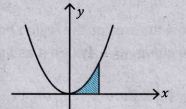
Equation of the given curve is y = 2x2
Volume \(=\pi \int _{ a }^{ b }{ { y }^{ 2 }dx } \)
\(=\pi \int _{ 0 }^{ 1 }{ { (2{ x }^{ 2 }) }^{ 2 } } dx=\pi \int _{ 0 }^{ 1 }{ { 4x }^{ 4 }dx } \)
\(=4\pi { \left[ \frac { { x }^{ 5 } }{ 5 } \right] }_{ 0 }^{ 1 }=\frac { 4\pi }{ 5 } (1-0)\)
\(v=\frac { 4\pi }{ 5 } \) cubic units
36.
Given equation of line is 2x - y + 1 = 0
| x | 0 | -1/2 |
| y | 1 | 0 |
\(\Rightarrow 2x=y-1\Rightarrow x=\frac { y-1 }{ 2 } \)
[\(\because\) the area is left of the x-axis]
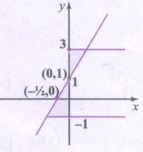
\(\therefore Area\ =\int _{ -1 }^{ 1 }{ -xdy+\int _{ 1 }^{ 3 }{ xdy } } \)
\(=-\frac { 1 }{ 2 } \int _{ -1 }^{ 1 }{ (y-1)dy } +\frac { 1 }{ 2 } \int _{ 1 }^{ 3 }{ (y-1)dy } \)
\(={ -\frac { 1 }{ 2 } { \left[ \frac { { y }^{ 2 } }{ 2 } -y \right] }_{ -1 }^{ 1 }{ +\frac { 1 }{ 2 } }\left[ \frac { { y }^{ 2 } }{ 2 } -y \right] }_{ 1 }^{ 3 }\)
\(=\frac { 1 }{ 2 } \left[ { \left( y-\frac { { y }^{ 2 } }{ 2 } \right) }_{ -1 }^{ 1 }+{ \left( \frac { { y }^{ 2 } }{ 2 } -y \right) }_{ 1 }^{ 3 } \right] \)
\(=\frac { 1 }{ 2 } \left[ \left( 1-\frac { 1 }{ 2 } \right) -\left( 1-\frac { 1 }{ 2 } \right) +\left( \frac { 9 }{ 2 } -3 \right) -\left( \frac { 1 }{ 2 } -1 \right) \right] \)
\(=\frac { 1 }{ 2 } \left[ \frac { 1 }{ 2 } +\frac { 3 }{ 2 } +\frac { 3 }{ 2 } +\frac { 1 }{ 2 } \right] =\frac { 1 }{ 2 } \left[ \frac { 8 }{ 2 } \right] =\frac { 1 }{ 2 } (4)\)
= 2 sq.units
37.
Solution the region is sketched. It lies below the x − axis. Hence, the required area is given by
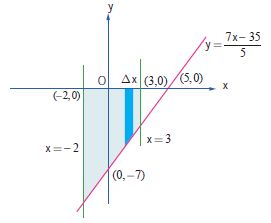
\(A=\left| \int _{ -2 }^{ 3 }{ ydx } \right| =\left| \int _{ -2 }^{ 3 }{ \left( \frac { 7x-35 }{ 5 } \right) dx } \right| \)
\(=\frac { 1 }{ 5 } \left| { \left( 7\left( \frac { { x }^{ 2 } }{ 2 } \right) -35x \right) }_{ -2 }^{ 3 } \right| \)
\(=\frac { 1 }{ 5 } \left| \left( \left( \frac { 63 }{ 2 } \right) -105 \right) -(84) \right| =\frac { 63 }{ 2 } \)
38.
\(Let\ I=\int _{ 0 }^{ \frac { \pi }{ 2 } }{ \frac { dx }{ 1+5{ cos }^{ 2 }x } } \)
Put U = tan x \(\Rightarrow\) du = sec 2x dx Dividing the numerator and denominator by cos2x we get,
\(I=\int _{ 0 }^{ \frac { \pi }{ 2 } }{ \frac { \frac { 1 }{ { cos }^{ 2 }x } }{ \frac { 1 }{ { cos }^{ 2 }x } +5 } } dx=\int _{ 0 }^{ \frac { \pi }{ 2 } }{ \frac { { sec }^{ 2 }x }{ { sec }^{ 2 }x+5 } dx } \)
\(=\int _{ 0 }^{ \frac { \pi }{ 2 } }{ \frac { { sec }^{ 2 }x }{ 1+{ tan }^{ 2 }+x+5 } dx } =\int _{ 0 }^{ \frac { \pi }{ 2 } }{ \frac { { sec }^{ 2 }x\quad dx }{ { tan }^{ 2 }x+6 } } \)
| x | 0 | \(\frac{\pi}{2}\) |
| u | 0 | \(\infty\) |
\(=\int _{ 0 }^{ \infty }{ \frac { du }{ { u }^{ 2 }+6 } } \)
\(=\int _{ 0 }^{ \infty }{ \frac { du }{ { u }^{ 2 }+{ (\sqrt { 6 } ) }^{ 2 } } } \)
\(I=\frac { \pi }{ 2\sqrt { 6 } } \left[ \because \int _{ 0 }^{ \infty }{ \frac { dx }{ { a }^{ 2 }+{ x }^{ 2 } } =\frac { \pi }{ 2a } ,Here\quad a=\sqrt { 6 } } \right] \)
39.
\(I=\int _{ \frac { \pi }{ 8 } }^{ \frac { 3\pi }{ 8 } }{ \frac { 1 }{ 1+\sqrt { tanx } } dx } \int _{ \frac { \pi }{ 8 } }^{ \frac { 3\pi }{ 8 } }{ \frac { 1 }{ 1+\frac { \sqrt { sin\quad x } }{ \sqrt { cos\quad x } } } dx } \)
\(=\int _{ \frac { \pi }{ 8 } }^{ \frac { 3\pi }{ 8 } }{ \frac { \sqrt { cos\quad x } }{ \sqrt { cos\quad x } +\sqrt { sin\quad x } } dx\quad \quad ..(1) } \)
By the property,\( \int _{ a }^{ b }{ f(x)dx=\int _{ a }^{ b }{ f(a+b-x)dx } } \)
we get \(I=\int _{ \frac { \pi }{ 8 } }^{ \frac { 3\pi }{ 8 } }{ \frac { \sqrt { cos(\frac { \pi }{ 8 } +\frac { 3\pi }{ 8 } -x) } }{ \sqrt { cos(\frac { \pi }{ 8 } +\frac { 3\pi }{ 8 } -x) } +\sqrt { sin(\frac { \pi }{ 8 } +\frac { 3\pi }{ 8 } -x) } } } dx\)
\(=\int _{ \frac { \pi }{ 8 } }^{ \frac { 3\pi }{ 8 } }{ \frac { \sqrt { cos(\frac { \pi }{ 2 } -x) } }{ \sqrt { cos(\frac { \pi }{ 2 } -x) } +\sqrt { sin(\frac { \pi }{ 2 } -x) } } } dx\)
\(=\int _{ \frac { \pi }{ 8 } }^{ \frac { 3\pi }{ 8 } }{ \frac { \sqrt { sin\quad x } }{ \sqrt { sin\quad x } +\sqrt { cos\quad x } } ...(2) } \)
\((1)+(2)\rightarrow \)
\(2I=\int _{ \frac { \pi }{ 8 } }^{ \frac { 3\pi }{ 8 } }{ \frac { \sqrt { cos\quad x } }{ \sqrt { cos\quad x } +\sqrt { sin\quad x } } dx+\int _{ \frac { \pi }{ 8 } }^{ \frac { 3\pi }{ 8 } }{ \frac { \sqrt { sin\quad x } }{ \sqrt { sin\quad x } +\sqrt { sin\quad x } } } } \)
\(=\int _{ \frac { \pi }{ 8 } }^{ 3\frac { \pi }{ 8 } }{ \frac { \sqrt { cos\quad x } +\sqrt { sin\quad x } }{ \sqrt { cos\quad x } +\sqrt { sin\quad x } } dx=\int _{ \frac { \pi }{ 8 } }^{ \frac { 3\pi }{ 8 } }{ dx={ [x] }_{ \frac { \pi }{ 8 } }^{ \frac { 3\pi }{ 8 } } } } \)
\(2I=\frac { 3\pi }{ 8 } -\frac { \pi }{ 8 } =\frac { 2\pi }{ 8 } =\frac { \pi }{ 4 } \)
\(\therefore I=\frac { \pi }{ 8 } \)
40.
Let us put I = \(\int ^{3}_{2} \frac{\sqrt {x}}{\sqrt {5-x}+\sqrt {x}}\) dx --- (1)
Applying the formula \(\int ^{a}_{b}\) f(x) dx =\(\int ^{a}_{b}\) f(a+b -x) dx, we get
I = \(\int ^{3}_{2} \frac{\sqrt {(2+3-x)}}{\sqrt {5-(2+3-x)}+\sqrt { {(2+3-x)}}}\) dx = \(\int ^{3}_{2} \frac{\sqrt {(5-x)}}{\sqrt {x}+\sqrt { {(5-x}}}\) dx -- (2)
Adding (1) and (2), we get
2I = \(\int ^{3}_{2} \frac{\sqrt {x} + \sqrt {5-x} }{\sqrt {x}+\sqrt { {5-x}}}\) dx =\(\int ^{3}_{2} \) dx = \([x]^{3}_{2}\) = 3 - 2 = 1
Hence, we get I = \(\frac{1}{2}\)
41.
Let I = \(\int ^{a}_{0} \frac{f(x)}{f(x)+f(a-x)}\) ------- (1)
Applying the formula \(\int ^{a}_{0}\) f(x) dx = \(\int ^{a}_{0}\)f(a-x)dx in equation (1), we get
I = \(\int ^{a}_{0} \frac{f{(a-x)}}{f{(a-x)}+f(a-(a-x))}\) dx
= \(\int ^{a}_{0} \frac{f{(a-x)}}{f{(x)}+f(a-x)}\) dx----- (2)
Adding equations (1) and (2), we get
2I = \(\int ^{a}_{0} \frac{f{(x)}}{f{(x)}+f(a-x)}\) dx + \(\int ^{a}_{0} \frac{f{(a-x)}}{f{(x)}+f(a-x)}\) dx
= \(\int ^{a}_{0} \frac{f(x) +f{(a-x)}}{f{(x)}+f(a-x)}\) dx
= \(\int ^{a}_{0} dx = a\)
Hence, we get I = \(\frac{a}{2}\)
42.
Given equation of line is 3x - 2y + 6 = 0
2y = 3x + 6 \(\Rightarrow\) y = \(\frac{3x+6}{2}\)
| x | 0 | -2 |
| t | 3 | 0 |
\(\therefore Area=\int _{ -3 }^{ -2 }{ -ydx+ydx } +\int _{ -2 }^{ 1 }{ ydx } \)
[\(\because\) the Area is below the x - axis]
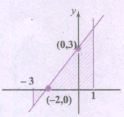
\(=\frac { -1 }{ 2 } \int _{ -3 }^{ -2 }{ (3x+6)dx+\frac { 1 }{ 2 } \int _{ -2 }^{ 1 }{ (3x+6)dx } } \)
\(={ \left[ \frac { { 3x }^{ 2 } }{ 2 } +6x \right] }_{ -3 }^{ -2 }+\frac { 1 }{ 2 } { \left[ \frac { { 3x }^{ 2 } }{ 2 } +6x \right] }_{ -2 }^{ 1 }\)
\(=-\frac { 1 }{ 2 } \left[ \left( \frac { 12 }{ 2 } -12 \right) -\left( \frac { 27 }{ 2 } -18 \right) \right] +\frac { 1 }{ 2 } \left[ \left( \frac { 3 }{ 2 } +6 \right) -\left( \frac { 12 }{ 2 } -12 \right) \right] \)
\(=-\frac { 1 }{ 2 } \left[ (-6)-\left( \frac { 27-36 }{ 2 } \right) \right] +\frac { 1 }{ 2 } \left[ \left( \frac { 3+12 }{ 2 } \right) -(-6) \right] \)
\(=-\frac { 1 }{ 2 } \left[ -6+\frac { 9 }{ 2 } \right] +\frac { 1 }{ 2 } \left[ \frac { 15 }{ 2 } +6 \right] \)
\(\\ =-\frac { 1 }{ 2 } \left[ \frac { -3 }{ 2 } \right] +\frac { 1 }{ 2 } \left[ \frac { 27 }{ 2 } \right] =\frac { 3 }{ 4 } +\frac { 27 }{ 4 } =\frac { 30 }{ 4 } =\frac { 15 }{ 2 } \)
\(\therefore\) A = 7.5 sq.units

12th Standard Syllabus & Materials
12th Standard
TN 12th Computer Applications களப்பெயர் முறைமை (DNS) Sample Question Papers Study Material - QB365 Set A
NEW12th Standard
TN 12th Computer Applications வலையமைப்பு எடுத்துக்காட்டுகள் மற்றும் நெறிமுறைகள் Sample Question Papers Study Material - QB365 Set A
NEW12th Standard
TN 12th Computer Applications கணினி வலையமைப்பு ஓர் அறிமுகம் Sample Question Papers Study Material - QB365 Set A
NEW12th Standard
TN 12th Computer Applications PHP-உடன் MySQL-ஐ இணைத்தல் Sample Question Papers Study Material - QB365 Set A



Tamilnadu Stateboard 12th Standard Subjects
Maths

Chemistry

Physics

Biology

Computer Science

Business Maths and Statistics

Economics

Commerce

Accountancy

History

Computer Applications
Biology
Computer Technology
Computer Applications
Computer Science
Business Maths and Statistics
Commerce
Economics
Maths
Chemistry
Physics
Computer Technology
History
Accountancy

Tamil

English

French
Tamilnadu Stateboard Standards

