
 100% FREE ACCESS
12th Standard Syllabus & Materials
12th Standard
TN 12th Computer Applications மின்னணு தரவு பரிமாற்றம் Sample Question Papers Study Material - QB365 Set A
NEW12th Standard
TN 12th Computer Applications மின் - வணிக பாதுகாப்பு அமைப்புகள் Sample Question Papers Study Material - QB365 Set A
NEW12th Standard
TN 12th Computer Applications மின்னணு செலுத்தல் முறைகள் Sample Question Papers Study Material - QB365 Set A
NEW12th Standard
TN 12th Computer Applications மின் - வணிகம் Sample Question Papers Study Material - QB365 Set A
NEW12th Standard
TN 12th Computer Applications திறந்த மூல கருத்துருக்கள் Sample Question Papers Study Material - QB365 Set A
NEW12th Standard
TN 12th Computer Applications வலையமைப்பு வடமிடல் Sample Question Papers Study Material - QB365 Set A

Published on: 02/09/2022
QB365 provides a detailed and simple solution for every Possible Book Back Questions in Class 12 Maths Subject - Applications of Vector Algebra, English Medium. It will help Students to get more practice questions, Students can Practice these question papers in addition to score best marks.
Download Tamil Nadu 12th Standard Maths question papers, model tests, one-mark questions, important questions, and public exam papers in PDF format. Free study materials and answer keys for TN State Board students.
Questions + Answers key
Take MCQ Maths Test1.
Find the angle between the planes \(\vec { r } .(\hat { i } +\hat { j } -2\hat { k } )\) = 3 and 2x - 2y + z =2
2.
Find the angle between the line \(\vec { r } =(2\hat { i } -\hat { j } +\hat { k } )+t(\hat { i } +2\hat { j } -2\hat { k } )\) and the plane \(\vec { r } =(6\hat { i } +3\hat { j } +2\hat { k } )=8\)
3.
A variable plane moves in such a way that the sum of the reciprocals of its intercepts on the coordinate axes is a constant. Show that the plane passes through a fixed point
4.
Find the vector and Cartesian equations of the plane passing through the point with position vector \(4\hat { i } +2\hat { j } -3\hat { k } \) and normal to vector \(2\hat { i } -\hat { j } +\hat { k } \)
5.
Find the vector and Cartesian form of the equations of a plane which is at a distance of 12 units from the origin and perpendicular to \(6\hat { i } +2\hat { j } -3\hat { k } \)
6.
If \(\hat { a } ,\hat { b } ,\hat { c } \) are three unit vectors such that \(\hat { b } \) and \(\hat { c } \) are non-parallel and \(\hat { a } \times \hat { b } \times \hat { c } =\frac { 1 }{ 2 } \hat { b } \) the angle between \(\hat { a } \) and \(\vec{ c } \).
7.
Prove that \([\vec { a } -\vec { b } ,\vec { b } -\vec { c } ,\vec { c } -\vec { a } ]\) = 0
8.
Let \(\vec { a } ,\vec { b } ,\vec { c } \) be three non-zero vectors such that \(\vec { c } \) is a unit vector perpendicular to both \(\vec { a } \) and \(\vec { b } \). If the angle between \(\vec { a } \) and \(\vec { b } \) is \(\frac { \pi }{ 6 } \), show that \({ [\vec { a } ,\vec { b } ,\vec { c } ] }^{ 2 }\) = \(\frac { 1 }{ 4 } { \left| \vec { a } \right| }^{ 2 }{ \left| \vec { b } \right| }^{ 2 }\)
9.
Prove by vector method that the parallelograms on the same base and between the same parallels are equal in area.
10.
Using vector method, prove that if the diagonals of a parallelogram are equal, then it is a rectangle
11.
Prove by vector method that the diagonals of a rhombus bisect each other at right angles.
12.
Prove by vector method that an angle in a semi-circle is a right angle.
13.
Prove by vector method that the median to the base of an isosceles triangle is perpendicular to the base.
14.
Prove by vector method that if a line is drawn from the centre of a circle to the midpoint of a chord, then the line is perpendicular to the chord.
15.
A particle is acted upon by the forces \((\hat { 3i } -\hat { 2j } +\hat { 2k } )\) and \((\hat { 2i } +\hat { j } -\hat { k } )\) is displaced from the point (1, 3, -1 ) to the point (4, -1, λ). If the work done by the forces is 16 units, find the value of λ.
16.
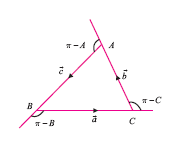
With usual notations, in any triangle ABC, prove the following by vector method.
(i) a = b cos C + c cos B
(ii) b = c cos A + a cos C
(iii) c = a cos B + b cos A
17.
With usual notations, in any triangle ABC, prove the following by vector method.
(i) a2 = b2 + c2 − 2bc cos A
(ii) b2 = c2 + a2 − 2ca cos B
(iii) c2 = a2 + b2 − 2ab cos C
18.
Verify whether the line \(\frac { x-3 }{ -4 } =\frac { y-4 }{ -7 } =\frac { z+3 }{ 12 } \) lies in the plane 5x-y+z = 8.
19.
If the Cartesian equation of a plane is 3x - 4y + 3z = -8, find the vector equation of the plane in the standard form.
20.
For any vector \(\vec { a } \), prove that \(\hat { i } \times (\vec { a } \times \hat { i } )+\hat { j } \times (\vec { a } \times \hat { j } )+\hat { k } \times \vec { a } \times \hat { k } =2\vec { a } \).
21.
If the vectors \(a\hat { i } +a\hat { j } +c\hat { k } ,\hat { i } +\hat { k } \) and \(c\hat { i } +c\hat { j } +b\hat { k } \) are coplanar, prove that c is the geometric mean of a and b.
22.
If \(\vec { a } =\hat { i } -\hat { k } ,\vec { b } =x\hat { i } +\hat { j } +(1-x)\hat { k } ,\vec { c } =y\hat { i } +x\hat { j } +(1+x+y)\hat { k } \) show that \([\vec { a } ,\vec { b } ,\vec { c } ]\) depends on neither x nor y.
23.
Find the volume of the parallelepiped whose coterminous edges are represented by the vectors \(-6\hat { i } +14\hat { j } +10\hat { k } ,14\hat { i } -10\hat { j } -6\hat { k } \) and \(2\hat { i } +4\hat { j } -2\hat { k } \)
24.
If \(\vec { a } =\hat { i } -2\hat { j } +3\hat { k }, \vec { b } =2\hat { i } +\hat { j } -2\hat { k }, \vec { c } =3\hat { i } +2\hat { j } +\hat { k } \) find \(\vec { a } .(\vec { b } \times \vec { c } )\).
25.
If \(\vec{ a } =\hat { -3i } -\hat { j } +\hat { 5k } \), \(\vec{b}=\hat{i}-\hat{2j}+\hat{k} \), \(\vec{c}=\hat{4j}-\hat{5k} \ \) find\( \ {\vec a } .(\vec { b } \times \vec { c } )\)
26.
For any four vectors \(\vec { a } ,\vec { b } ,\vec { c } ,\vec { d } \) we have \((\vec { a } \times \vec { b } )\times (\vec { c } \times \vec { d } )=[\vec { a } ,\vec { b } ,\vec { d } ]\vec { c } -[\vec { a } ,\vec { b } ,\vec { c } ]\vec { d } =[\vec { a } ,\vec { c } ,\vec { d } ]\vec { b } -[\vec { b } ,\vec { c } ,\vec { d } ]\vec { a } \)
1.
Given planes are \(\vec { r } .(\hat { i } +\hat { j } -2\hat { k } )\) and
\(2x-2y+z=2\Rightarrow \vec { r } .\left( 2\hat { i } -2\hat { j } +\hat { k } \right) =3\)
\(\therefore { \vec { n } }_{ 1 }=\hat { i } +\hat { j } -2\hat { k } \) and \({ \vec { n } }_{ 2 }=2\hat { i } -2\hat { j } +\hat { k } \)
Angle between the plane is'
\(cos\theta =\frac { { \vec { n } }_{ 1 }.{ \vec { n } }_{ 2 } }{ \left| { \vec { n } }_{ 1 } \right| \left| { { \vec { n } }_{ 2 } } \right| } =\frac { \left| 1(2)+1(-2)-2(1) \right| }{ \sqrt { { 1 }^{ 2 }+{ 1 }^{ 2 }+\left( -2 \right) ^{ 2 }.\sqrt { { 2 }^{ 2 }+\left( -2 \right) ^{ 2 }+{ 1 }^{ 2 } } } } \)
= \(\frac { \left| -2 \right| }{ \sqrt { 6 } .\sqrt { 9 } } =\frac { 2 }{ \sqrt { 6 } (3) } =\frac { 2 }{ 3\sqrt { 6 } } \)
\(\theta ={ { cos }^{ -1 }\left( \frac { 2 }{ 3\sqrt { 6 } } \right) }\)
2.
Equation of given plane is
\(\vec { r } .\left( 6\hat { i } +3\hat { j } +2\hat { k } \right) =8\)
\(\therefore { \vec { n } }_{ 1 }=6\hat { i } +3\hat { j } +2\hat { k } \)
and the line is \(\vec { r } =\left( 2\hat { i } -\hat { j } +\hat { k } \right) +t\left( \hat { i } +2\hat { j } -2\hat { k } \right) \)
\(\therefore \vec { b } =\hat { i } +2\hat { j } -2\hat { k } \)
Angle between a line and a plane is
\(sin\theta =\frac { \left| \vec { b } .\vec { n } \right| }{ \left| \vec { b } \right| \left| \vec { n } \right| } =\cfrac { \left| 6(1)+3(2)+2(-2) \right| }{ \sqrt { { 1 }^{ 2 }+{ 2 }^{ 2 }+\left( -2 \right) ^{ 2 }.\sqrt { { 6 }^{ 2 }+{ 3 }^{ 2 }+{ 2 }^{ 2 } } } } \)
= \(\frac { 6+6-4 }{ \sqrt { 9 } .\sqrt { 36+9+4 } } =\frac { 8 }{ \sqrt { 9 } .\sqrt { 49 } } =\frac { 8 }{ 3\left( 7 \right) } =\frac { 8 }{ 21 } \)
\(\therefore \theta ={ sin }^{ -1 }\left( \cfrac { 8 }{ 21 } \right) \)
3.
The equation of the plane having intercepts a, b, c on the x, y, z axes respectively is \(\frac { x }{ a } +\frac { y }{ b } +\frac { z }{ c } =1\).
Since the sum of the reciprocals of the intercepts on the coordinate axes is a constant, we have \(\frac { 1 }{ a } +\frac { 1 }{ b } +\frac { 1 }{ c } =k\), where k is a constant, and which can be written as \(\frac { 1 }{ a } \left( \frac { 1 }{ k } \right) +\frac { 1 }{ b } \left( \frac { 1 }{ k } \right) +\frac { 1 }{ c } \left( \frac { 1 }{ k } \right) =1\)
This shows that the plane \(\frac { x }{ a } +\frac { y }{ b } +\frac { z }{ c } =1\) passes through the fixed point \(\left( \frac { 1 }{ k } ,\frac { 1 }{ k } ,\frac { 1 }{ k } \right) \)
4.
If the position vector of the given point is \(\vec { a } =4\hat { i } +2\hat { j } -3\hat { k } \) and \(\vec { n } =2\hat { i } -\hat { j } +\hat { k } \), then the equation of the plane passing through a point and normal to a vector is given by \((\vec { r } -\vec { a } ).\vec { n } =0\) or \(\vec { r } .\vec { n } =\vec { a } .\vec { n } \)
Substituting \(\vec { a } =4\hat { i } +2\hat { j } -3\hat { k } \) and \(\vec { n } =2\hat { i } -\hat { j } +\hat { k } \) in the above equation, we get
\(\vec { r } .(2\hat { i } -\hat { j } +\hat { k } )=(4\hat { i } +2\hat { j } -3\hat { k } ).(2\hat { i } -\hat { j } +\hat { k } )\)
Thus, the required vector equation of the plane is \(\vec { r } .(2\hat { i } -\hat { j } +\hat { k } )\)= 3. If \(\vec { r } =x\hat { i } +y\hat { j } +z\hat { k } \) then
we get the Cartesian equation of the plane 2x − y + z = 3.
5.
Let \(\hat { d } =6\hat { i } +2\hat { j } -3\hat { k } \) and p = 12
If \(\hat { d } \) is the unit normal vector in the direction of the vector \(6\hat { i } +2\hat { j } -3\hat { k } \)
then \(\hat { d } =\frac { \hat { d } }{ \left| \hat { d } \right| } =\frac { 1 }{ 7 } (6\hat { i } +2\hat { j } -3\hat { k } )\)
If \(\hat { r } \) is the position vector of an arbitrary point (x, y, z) on the plane, then using \(\vec { r } .\hat { d } =p\), the vector equation of the plane in normal form is \(\vec { r } .\frac { 1 }{ 7 } (6\hat { i } +2\hat { j } -3\hat { k } )=12\)
Substituting \(\vec { r } =x\hat { i } +y\hat { j } +z\hat { k } \) in the above equation, we get \((x\hat { i } +y\hat { j } +z\hat { k } ).\frac { 1 }{ 7 } (6\hat { i } +2\hat { j } -3\hat { k } )=12\)
Applying dot product in the above equation and simplifying, we get 6x + 2y - 3z = 84, which is the Cartesian equation of the required plane.
6.
Given \(\hat { a } \times (\hat { b } \times \hat { c } )=\frac { 1 }{ 2 } \hat { b } \)
⇒ \((\hat { a } .\hat { c } )\hat { b } -(\hat { a } .\hat { b } )\hat { c } =\frac { 1 }{ 2 } \hat { b } \)
⇒ \(\lambda \hat { b } -\mu \hat { c } =\frac { 1 }{ 2 } \hat { b } \) [∵ put \(\lambda =\hat { a } .\hat { c } \) & \(\mu =\hat { a } .\hat { b } \)]
⇒ \(\left( \lambda -\frac { 1 }{ 2 } \right) \hat { b } -\mu \hat { c } \) = 0
Since \(\hat { b } \) and \(\hat { c } \) are non-collinear vectors
\(\lambda -\frac { 1 }{ 2 } \) = 0 and μ = 0
∴ \(\lambda =\frac { 1 }{ 2 } \)
⇒ \(\hat { a } .\hat { c } =\frac { 1 }{ 2 } \)
⇒ \(|\hat { a } ||\hat { c } |cos\theta =\frac { 1 }{ 2 } \) [∵ By the definition of scalar product]
⇒ (1) (1) \(cos\theta =\frac { 1 }{ 2 } \) \(\left[ \because |\vec { a } |=|\vec { c } |=1 \right] \)
⇒ cos θ = \(\frac{1}{2}\)
⇒ θ = 600 = \(\frac { \pi }{ 3 } \)
Hence angle between \(\vec { a } \) and \(\vec { c } \) is \(\frac { \pi }{ 3 } \).
7.
LHS = \([\vec { a } -\vec { b } ,\vec { b } -\vec { c } ,\vec { c } -\vec { a } ]\) = 0
[∵ cross product is distributive]
\((\vec { a } -\vec { b } ).[(\vec { b } -\vec { c } )\times (\vec { c } -\vec { a } )]\)
= \((\vec { a } -\vec { b } ).[(\vec { b } \times \vec { c } -\vec { b } \times \vec { a } -\vec { c } \times \vec { c } +\vec { c } \times \vec { a } )\)
= \((\vec { a } -\vec { b } ).[\vec { b } \times \vec { c } -\vec { b } \times \vec { a } -0+\vec { c } \times \vec { a } ]\)
\([\because \vec { c } \times \vec { c } =0]\)
= \([\vec { a } \vec { b } \vec { c } ]-[\vec { a } \vec { b } \vec { a } ]+[\vec { a } \vec { c } \vec { a } ]-[\vec { b } \vec { b } \vec { c } ]+[\vec { b } \vec { b } \vec { a } ]-[\vec { b } \vec { c } \vec { a } ]\)
= \([\vec { a } \vec { b } \vec { c } ]-0+0-0+0-[\vec { b } \vec { c } \vec { a } ]\)
= \([\because [\vec { a } \vec { b } \vec { a } ]=[\vec { b } \vec { b } \vec { c } ]=0]\)
= \([\vec { a } \vec { b } \vec { c } ]-[\vec { a } \vec { b } \vec { c } ]\)
= 0 = RHS.
8.
\(|\vec { c } |\) = 1 and \(\vec { c } \bot \vec { a } \) & \(\vec { b } \)
Also, angle between \(\vec { a } \) and \(\vec { b } \) is \(\frac { \pi }{ 6 } \)
Consider \([\vec { a } \vec { b } \vec { c } ]=\vec { a } .(\vec { b } \times \vec { c } )\)
= \((\vec { a } \times \vec { b } ).\vec { c } \)
[∵ angle between \(\vec { a } \) and \(\vec { b } \) is \(\frac { \pi }{ 6 } \). \(\vec { c } \) 丄 both a & b]
= \(|\vec { a } ||\vec { b } |sin\frac { \pi }{ 6 } .\vec { c } .\vec { c } \)
= \(|\vec { a } ||\vec { b } |.\frac { 1 }{ 2 } \)(1)
= \(|\vec { a } ||\vec { b } |.\frac { 1 }{ 2 } \) [∵ \(\vec { c } .\vec { c } \) = 1]
∴ \([\vec { a } \vec { b } \vec { c } ]^{ 2 }=|\vec { a } |^{ 2 }|\vec { b } |^{ 2 }.\frac { 1 }{ 4 } =\frac { 1 }{ 4 } |\vec { a } |^{ 2 }|\vec { b } |^{ 2 }\).
9.
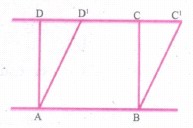
Let ABCD be the given parallelogram and ABC1 D1 be the new parallelogram with same base AB and between the same parallel lines AB and DC.
∴ Vector area of parallelogram
ABCD =\(\vec { AB } \times \vec { AD } \)
=\(\vec { AB } \times (A\vec { D^{ 1 } } +{ D }^{ 1 }\vec { D } )\)
[By Δ law of addition is ΔADD1]
= \((\vec { AB } \times \vec { AD^{ 1 } } )+(\vec { AB } \times D^{ 1 }\vec { D } )\) [∵ vector product is distributive]
= \((\vec { AB } \times \vec { AD } )\) +0 [∵ \(\vec { AB } \) and \(\vec { DD^{ 1 } } \) are parallel]
= Vector area of parallelogram ABC1D1
∴ Area of parallelogram ABCD = Area of parallelogram ABC1D1.
Hence, the parallelogram on the same base andabetween the same parallels are equal in area.
10.
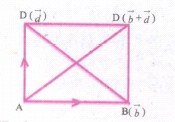
Let ABCD be a parallelogram such that its diagonals AC and BD are equal.
Taking A as the origin, let the p.v. of B and D be \(\vec { b } \)and \(\vec { d } \) respectively.
Then \(\vec { AB } =\vec { b } \) and \(\vec { AD } =\vec { d } \)
Using triangle law of addition of vectors is ΔABC, we get
\(\vec { AB } +\vec { BC } =\vec { AC } \)
⇒ \(\vec { AB } +\vec { AD } =\vec { AC } \)
⇒ \(\vec { b } +\vec { d } =\vec { AC } \)
Using triangle law of addition of vectors in ΔABD, we get \(\vec { AB } +\vec { BD } =\vec { AD } \)
⇒ \(\vec { b } +\vec { BD } =\vec { d } \)
⇒ \(\vec { BD } =\vec { d } -\vec { b } \)
In parallelogram ABCD we have AC = BD
⇒ \(|\vec { AC } |=|\vec { BD } |\)
⇒ \(|\vec { AC } |^{ 2 }=|\vec { BD } |^{ 2 }\)
⇒ \(|\vec { b } +\vec { d } |^{ 2 }=|\vec { d } -\vec { b } |^{ 2 }\)
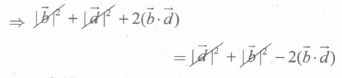
⇒ \(4(\vec { b } .\vec { d } )=0\Rightarrow \vec { b } .\vec { d } =0\)=0
⇒ \(\vec { b } \bot \vec { d } \)
⇒ \(\vec { AB } \bot \vec { AD } \)
Hence, ABCD is a rectangle.
11.
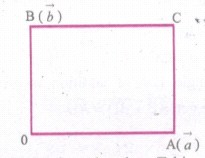
Let OACB be a rhombus. Taking O as the origin, let the position vectors of A and B be \(\vec { a } \) and \(\vec { b } \) respectively.
Then \(\vec { OA } =\vec { a } \) and \(\vec { OB } =\vec { b } \) [∵ \(\vec { AC } =\vec { OB } \)]
So, the p.v. of C is \(\vec { a } +\vec { b } \)
∴ Position vector O f the miid-point of OC is \(\frac { \vec { a } +\vec { b } }{ 2 } \)
Similarly, the position vector of mid-point of AB is \(\frac { \vec { a } +\vec { b } }{ 2 } \).
Hence, the mid-point of OC coincides with the mid-point of AB.
Now, \(\vec { OC } .\vec { AB } =(\vec { a } +\vec { b } ).(\vec { b } -\vec { a } )=|\vec { b } |^{ 2 }-|\vec { a } |^{ 2 }\)
= OB2- OA2 = 0 [∵ OB = OA]
⇒ \(\vec { OC } \bot \vec { AB } \).
Hence, the diagonals of a rhombus bisect each other at right angles.
12.
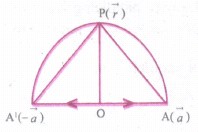
Let O be the centre of the semi-circle and AA1 be the diameter.
Let P be any point on the circumference of the semi circle.
Taking O as the origin, let the position vectors of A and P be a and \(\vec { r } \) respectively.
Let us prove that \(\angle A P B=90^{\circ}\)
W.K.T OA = OB = OP ( because of radius)
\(
\overrightarrow{P A} =\overrightarrow{P O}+\overrightarrow{O A}
\)
\(\overrightarrow{P B} =\overrightarrow{P O}+\overrightarrow{O B}
\)
\( =\overrightarrow{P O}-\overrightarrow{O A}
\)
\(\overrightarrow{P A} \cdot \overrightarrow{P B} =(\overrightarrow{P O}+\overrightarrow{O A})(\overrightarrow{P O}-\overrightarrow{O A})
\)
\( =\overrightarrow{P O}^{2}-\overrightarrow{O A}^{2}=0
\)
\(
\overrightarrow{P A} \perp \overrightarrow{P B}
\)
\( \Rightarrow \ \angle A P B=90^{\circ}
\). Hence proved.
13.
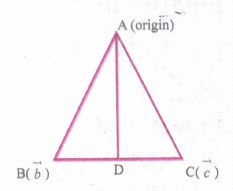
Let ABC be an isosceles triangle with AB = AC and let AD is the median
D is mid-point of BC.
\(
\overrightarrow{A D}=\frac{1}{2}(\overrightarrow{A B}+\overrightarrow{A C})
\)
\( \overrightarrow{B C}=\overrightarrow{B A}+\overrightarrow{A C}
\)
\( \overline{D A} \cdot \overrightarrow{D B}=-\overrightarrow{A D} \cdot\left(\frac{-1}{2} \overrightarrow{C B}\right)
\)
\(=-\overrightarrow{A D} \cdot\left(\frac{1}{2} \overrightarrow{B C}\right)
\)
\(=\frac{1}{2} \overrightarrow{A D} \cdot \overrightarrow{B C}
\)
\(=\frac{1}{4}(\overrightarrow{A B}+\overrightarrow{A C}) \cdot(\overrightarrow{B A}+\overrightarrow{A C})
\)
\(=\frac{1}{4}(\overrightarrow{A B}+\overrightarrow{A C}) \cdot(\overrightarrow{A C}-\overrightarrow{A B}) \)
\(=\frac{1}{4}[(\overrightarrow{A C} \cdot \overrightarrow{A C})-(\overrightarrow{A B} \cdot \overrightarrow{A B})]
\)
\(=\frac{1}{4}\left(A C^{2}-A B^{2}\right)
\)
\(=\frac{1}{4}(0)=0
\)
\(\overrightarrow{D A} \cdot \overrightarrow{D B}=0\)
\(\overrightarrow{D A} \perp \overrightarrow{D B}\)
14.
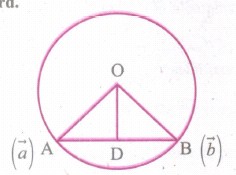
Let the position vectors of the parts A and B on the circle lie \(\vec { a } \) and \(\vec { b } \) respectively.
Since O is the centre of the circle
\(|\vec { OA } |=|\vec { OB } |\Rightarrow |\vec { a } |=|\vec { b } |\) ....(1)
Also D is the mid-point of AB,
⇒ \(\vec { OD } =\frac { \vec { a } +\vec { b } }{ 2 } \) (mid-point formula)
\(\left( \frac { \vec { a } +\vec { b } }{ 2 } \right) .(\vec { OB } -\vec { OA } )\)
=\(\left( \frac { \vec { a } +\vec { b } }{ 2 } \right) .(\vec { Ob } -\vec { Oa } )\)
= \(\frac { 1 }{ 2 } \left[ |\vec { b } |^{ 2 }-|\vec { a}| ^{ 2 } \right] \)
=\(\left[ \because (\vec { a } +\vec { b } ).(\vec { b } -\vec { a } )=|\vec { b } |^{ 2 }-|\vec { a } |^{ 2 } \right] \)
= \(\frac { 1 }{ 2 } \left[ |\vec { b } |^{ 2 }-|\vec { b| } ^{ 2 } \right] \) (using (1))
= \(\frac{1}{2}\)(0) = 0
⇒ \(\vec { OD } .\vec { AB } =0\Rightarrow \vec { OD } \bot \vec { AB } \)
Hence, if a line is drawn from the centre of a to the mid-point of a chord, then that line is perpendicular to the chord.
15.
Resultant of the given forces is \(\vec { F } \) = \((\hat { 3i } -\hat { 2j } +\hat { 2k } )\) + \((\hat { 2i } +\hat { j } -\hat { k } )\) = \(\hat { 5i } -\hat { j } +\hat { k } \)
The displacement of the particle is given by
\(\vec { d } \) = \((\hat { 4i } -\hat { j } +\hat { \lambda k } )-(\hat { i } +3\hat { j } -\hat { k } )\) = \((3\hat { i } -\hat { 4j } +(\lambda +1)\hat { k } )\)
As the work done by the forces is 16 units, we have
\(\vec { F } \).\(\vec { d } \) = 16
That is \((\hat { 5i } -\hat { j } +\hat { k } ).(3\hat { i } -\hat { 4j } +(\lambda +1))\hat { k } \) = 16 ⇒ λ + 20 = 16
So, λ = - 4
16.
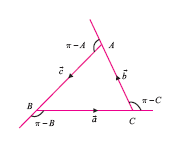
With usual notations in triangle ABC, let \(\vec { BC } =\vec { a } ,\vec { CA } =\vec { b } \) and \(\vec { AB } =\vec { c } \).
Then \(\left| \vec { BC } \right| =a\) , \(\left| \vec { CA } \right| =b\), \(\left| \vec { AB} \right| =c\), and \(\vec { BC } +\vec { CA } +\vec { AB } =\vec { 0 } \)
So, \(\vec { BC } =-\vec { CA } -\vec { AB } \)
Applying dot product, we get
\(\vec { BC } .\vec { BC } =-\vec { BC } .\vec { CA }-\vec { BC }. \vec { AB } \)
⇒ \({ \left| \vec { BC } \right| }^{ 2 }=-\left| \vec { BC } \right| \left| \vec { CA } \right| \) cos(兀-c)-\(\left| \vec { BC } \right| \left| \vec { AB} \right| \)cos(兀-B)
⇒ a2 = ab cos C + ac cos B
Therefore a = b cos C + c cos B
The results (ii) and (iii) are proved in a similar way
17.
With usual notations in triangle ABC, we have \(\vec { BC } =\vec { a } ,\vec { CA } =\vec { b } \) \(\vec { AB } =\vec { c } \).
Then \(\left| \vec { BC } \right| =a\) , \(\left| \vec { CA } \right| =b\), \(\left| \vec { AB} \right| =c\), and \(\vec { BC } +\vec { CA } +\vec { AB } =\vec { 0 } \)
So, \(\vec { BC } =-\vec { CA } -\vec { AB } \)
Then applying dot product, we get
\(\vec { BC } .\vec { BC } =(-\vec { CA } -\vec { AB } ).(-\vec { CA } -\vec { AB } )\)
⇒ \({ \left| \vec { BC } \right| }^{ 2 }={ \left| \vec { CA } \right| }^{ 2 }+{ \left| \vec { AB } \right| }^{ 2 }+\vec { 2CA } .\vec { AB } \)
⇒ a2 = b2+c2+2bc cos (\(\pi\) - A)
⇒ a2 = b2+c2−2bc cos A.
The results (ii) and (iii) are proved in a similar way.
18.
Here (x1, y1, z1) = (3, -4, -3) and direction ratios of the given straight line are (a, b, c) = (-4, -7, 12).
Direction ratios of the normal to the given plane are (A, B, C) = (5, -1, 1).
We observe that, the given point (x1, y1, z1) = (3, 4, -3) satisfies the given plane 5x-y+z = 8
Next, aA+bB+cC = (-4)(5)+(-7)(-1)+(12)(1) = -1 \(\neq \) 0.
So, the normal to the plane is not perpendicular to the line.
Hence, the given line does not lie in the plane.
19.
If \(\vec { r } =x\hat { i } +y\hat { j } +z\hat { k } \) is the position vector of an arbitrary point (x, y, z) on the plane, then the given equation can be written as \((x\hat { i } +y\hat { j } +z\hat { k } ).(3\hat { i } -4\hat { j } +3\hat { k } )=-8\) or \((x\hat { i } +y\hat { j } +z\hat { k } ).(-3\hat { i } +4\hat { j } -3\hat { k } )=8\).
That is, \(\hat { r } .(-3\hat { i } +4\hat { j } -3\hat { k } )=8\) which is the vector equation of the given plane in standard form.
20.
Let \(\vec { a } ={ a }_{ 1 }\hat { i } +{ a }_{ 2 }\hat { j } +{ a }_{ 3 }\hat { k } \)
∴ LHS = \(\hat { i } \times (\vec { a } \times \hat { i } )+\hat { j } \times (\vec { a } \times \hat { j } )+\hat { k } \times \vec { a } \times \hat { k }\)
\((\hat { i }. \hat { i } )\vec { a } -(\hat { i } .\hat { a } )\hat { i } +(\hat { j } .\hat { j } )\vec { a } -(\hat { j } .\vec { a } )\hat { j } +(\hat { k } .\hat { k } )\vec { a } -(\hat { k } .\vec { a } )\hat { k } \)
\([\because \vec { a } \times (\vec { b } \times \vec { c } )=(\vec { a } .\vec { c } )\vec { b } -(\vec { a } .\vec { b } )\vec { c } ]\)
\(1.\vec { a } -{ a }_{ 1 }\hat { i } +1.\vec { a } -{ a }_{ 2 }\hat { j } +1.\vec { a } -{ a }_{ 3 }\hat { k } ]\)
\([\because \hat { i } .\hat { i } =\hat { j } .\hat { j } =\hat { k } .\hat { k } =1\)and
\(\hat { i } \vec { a } =\hat { i } ({ a }_{ 1 }\hat { i } +{ a }_{ 2 }\hat { j } +{ a }_{ 3 }\hat { k } )={ a }_{ 1 }\hat { j } .\vec { a } ={ a }_{ 2 }\quad \hat { k } .\vec { a } ={ a }_{ 3 }\)
\(3\vec { a } -({ a }_{ 1 }\hat { i } +{ a }_{ 2 }\hat { j } +{ a }_{ 3 }\hat { k } )\)
= \(3\vec { a } -\vec { a } =2\vec { a } \)
= RHS .
∴ LHS = RHS. Hence proved
21.
\(\vec { a } \)= \(a\hat { i } +a\hat { j } +c\hat { k } , \vec{b}=\hat { i } +\hat { k } \), \(\vec { c } \)= \(c\hat { i } +c\hat { j } +b\hat { k } \)
Given \(\vec { a } ,\vec { b } \) and \(\vec { c } \) are co-planar
\(\vec { a } .(\vec { b } \times \vec { c } )\) = 0
⇒ \(\left| \begin{matrix} a & a & c \\ 1 & 0 & 1 \\ c & c & b \end{matrix} \right| \) = 0
⇒ \(a\left| \begin{matrix} 0 & 1 \\ c & b \end{matrix} \right| -a\left| \begin{matrix} 1 & 1 \\ c & b \end{matrix} \right| +c\left| \begin{matrix} 1 & 0 \\ c & c \end{matrix} \right| \) = 0
⇒ a(0-c)-a(b-c)+c(c-0) = 0
\(\Rightarrow-\not a c-a b+\not a c+c^{2}=0\)
⇒ c2 = ab ⇒ c =\(\sqrt { ab } \).
Hence c is the geometric mean of a and b.
22.
Given \(\vec { a } =\hat { i } -\hat { k } ,\vec { b } =x\hat { i } +\hat { j } +(1-x)\hat { k } ,\vec { c } =y\hat { i } +x\hat { j } +(1+x+y)\hat { k } \)
\([\vec { a } ,\vec { b } \vec { c } ]=\vec { a } .(\vec { b } \times \vec { c } )=\left| \begin{matrix} 1 & 0 & -1 \\ x & 1 & 1-x \\ y & x & 1+x-y \end{matrix} \right| \)
= \(1\left| \begin{matrix} 1 & 1-x \\ x & 1+x-y \end{matrix} \right| +0-y\left| \begin{matrix} x & y \\ y & x \end{matrix} \right| \)
= [(1+x-y)-x(1-x)]-[x2-y]
\(=1+\not x-\not y-\not x+\not x^{2}-\not x^{x}+\not y\)
= 1
∴ \([\vec { a } \vec { b } \vec { c } ]\) = 1 for all values of x and y
∴ \([\vec { a } \vec { b } \vec { c } ]\) depends on neither x nor y.
23.
Let \(\vec { a } =-6\hat { i } +14\hat { j } +10\hat { k } \), \(\vec { b } =14\hat { i } -10\hat { j } -6\hat { k } \) and \(\vec { c } =2\hat { i } +4\hat { j } -2\hat { k } \)
Volume of the parallelepiped having \(\vec { a } ,\vec { b } \) and \(\vec { c } \) as its co-terminus edges is \(\vec { a } .(\vec { b } \times \vec { c } )\).
∴ \(\vec { a } .(\vec { b } \times \vec { c } )=\left| \begin{matrix} -6 & 14 & 10 \\ 14 & -10 & -6 \\ 2 & 4 & -2 \end{matrix} \right| \)
= \(-6\left| \begin{matrix} -10 & -6 \\ 4 & -2 \end{matrix} \right| -14\left| \begin{matrix} 14 & -6 \\ 2 & -2 \end{matrix} \right| +10\left| \begin{matrix} 14 & -10 \\ 2 & 4 \end{matrix} \right| \)
= -6(20 + 24) - 14(-28 + 12) + 10(56 + 20)
= -6(44) -14(-16) + 10(76)
= -264 + 224 + 760 = 720.
∴ Volume of the required parallelepiped = 720 cubic units.
24.
Given \(\vec { a } =\hat { i } -2\hat { j } +3\hat { k }, \vec { b } =2\hat { i } +\hat { j } -2\hat { k }, \vec { c } =3\hat { i } +2\hat { j } +\hat { k } \)
∴ \(\vec { a } .(\vec { b } \times \vec { c } )=\left| \begin{matrix} 1 & -2 & 3 \\ 2 & 1 & -2 \\ 3 & 2 & 1 \end{matrix} \right| \)
= \(1\left| \begin{matrix} 1 & -2 \\ 2 & 1 \end{matrix} \right| +2\left| \begin{matrix} 2 & -2 \\ 3 & 1 \end{matrix} \right| +3\left| \begin{matrix} 2 & 1 \\ 3 & 2 \end{matrix} \right| \)
= 1(1+4)+2(2+6)+3(4-3)
= 1(5)+2(8)+3(1)
= 5+16+3 = 24
\(\vec { a } .(\vec { b } \times \vec { c } )\) = 24
25.
By the defination of scalar triple product of three vectors,
We find, \(\hat { a } .(\hat { b } \times \hat { c } )\) = \(\left| \begin{matrix} -3 & -1 & 5 \\ 1 & -2 & 1 \\ 0 & 4 & -5 \end{matrix} \right| =-3\)
26.
Taking \(\vec { p } =(\vec { a } \times \vec { b } )\) as a single vector and using the vector triple product expansion, we get
\((\vec { a } \times \vec { b } )\times(\vec{c}\times\vec{d})=\vec{p}\times(\vec{c}\times\vec{d})\)
= \((\vec { p } .\vec { d } )\vec { c } -(\vec { p } .\vec { c } )\vec { d } \)
= \(((\vec { a } \times \vec { b } ).\vec { d } )\vec { c } -((\vec { a } \times \vec { b } ).\vec { c } )\vec { d } =[\vec { a } ,\vec { b } ,\vec { d } ]\vec { c } -[\vec { a } \vec { b } \vec { c } ]\vec { d } \)
Similarly, taking \(\vec { q } \) = \(\vec { c } \times \vec { d } \)
\((\vec { a } \times \vec { b } )\times (\vec { c } \times \vec { d } )=(\vec { a } \times \vec { b } )\times \vec { q } \)
= \((\vec { a } .\vec { q } )\vec { b } -(\vec { b } .\vec { q } )\vec { a } \)
\(= [\vec { a } ,\vec { c }, \vec d ]\vec { b } -[\vec { b } ,\vec { c },\vec d ]\vec { a } \)

12th Standard Syllabus & Materials
12th Standard
TN 12th Computer Applications களப்பெயர் முறைமை (DNS) Sample Question Papers Study Material - QB365 Set A
NEW12th Standard
TN 12th Computer Applications வலையமைப்பு எடுத்துக்காட்டுகள் மற்றும் நெறிமுறைகள் Sample Question Papers Study Material - QB365 Set A
NEW12th Standard
TN 12th Computer Applications கணினி வலையமைப்பு ஓர் அறிமுகம் Sample Question Papers Study Material - QB365 Set A
NEW12th Standard
TN 12th Computer Applications PHP-உடன் MySQL-ஐ இணைத்தல் Sample Question Papers Study Material - QB365 Set A



Tamilnadu Stateboard 12th Standard Subjects
Maths

Chemistry

Physics

Biology

Computer Science

Business Maths and Statistics

Economics

Commerce

Accountancy

History

Computer Applications
Biology
Computer Technology
Computer Applications
Computer Science
Business Maths and Statistics
Commerce
Economics
Maths
Chemistry
Physics
Computer Technology
History
Accountancy

Tamil

English

French
Tamilnadu Stateboard Standards

