
 100% FREE ACCESS
12th Standard Syllabus & Materials
12th Standard
TN 12th Computer Applications மின்னணு தரவு பரிமாற்றம் Sample Question Papers Study Material - QB365 Set A
NEW12th Standard
TN 12th Computer Applications மின் - வணிக பாதுகாப்பு அமைப்புகள் Sample Question Papers Study Material - QB365 Set A
NEW12th Standard
TN 12th Computer Applications மின்னணு செலுத்தல் முறைகள் Sample Question Papers Study Material - QB365 Set A
NEW12th Standard
TN 12th Computer Applications மின் - வணிகம் Sample Question Papers Study Material - QB365 Set A
NEW12th Standard
TN 12th Computer Applications திறந்த மூல கருத்துருக்கள் Sample Question Papers Study Material - QB365 Set A
NEW12th Standard
TN 12th Computer Applications வலையமைப்பு வடமிடல் Sample Question Papers Study Material - QB365 Set A

Published on: 02/09/2022
QB365 provides a detailed and simple solution for every Possible Creative Questions in Class 12 Maths Subject - Applications of Vector Algebra, English Medium. It will help Students to get more practice questions, Students can Practice these question papers in addition to score best marks.
Download Tamil Nadu 12th Standard Maths question papers, model tests, one-mark questions, important questions, and public exam papers in PDF format. Free study materials and answer keys for TN State Board students.
Questions + Answers key
Take MCQ Maths Test1.
A force given by \(3 \hat{i}+2 \hat{j}-4 \hat{k}\) is applied at the point (1, -1, 2). Find the momment of the force about the point (2, -1, 3).
2.
Find the angle between the vectors \(2 \hat{i}+\hat{j}-\hat{k}\) and \(\hat{i}+2 \hat{j}+\hat{k}\) by using cross product.
3.
The work done by the force \(\vec{F}=a \hat{i}+\hat{j}+\hat{k}\) in moving the point of application from (1, 1, 1) to (2, 2, 2) along a straight line is given to be 5 units. Find the value of a,
4.
Find the work done in moving a particle from the point A with position vector \(2 \hat{i}-6 \hat{j}+7 \hat{k}\) to the point B, with position vector \(3 \hat{i}-\hat{j}-5 \hat{k}\), by a force \(\vec{F}=\hat{i}+3 \hat{j}-\hat{k}\)
5.
Find the vectors of magnitude 6 which are perpendicular to both the vectors \(4 \hat{i}-\hat{j}+3 \hat{k}\) and \(-2 \hat{i}+\hat{j}-2 \hat{k}\)
6.
If \(\vec{p}=-3 \hat{i}+4 \hat{j}-7 \hat{k}\) and \(\vec{q}=6 \hat{i}+2 \hat{j}-3 \hat{k}\) then find \(\vec{p} \times \vec{q}\). Verify that \(\vec p\) and \(\vec p \times \vec q\) are perpendicular to each other and also verify that \(\vec q\) and \(\vec{p} \times \vec{q}\) are perpendicular to each other,
7.
If the position vectors of three points A, B and, C arc respectively \(\hat{i}+2 \hat{j}+3 \hat{k}, 4 \hat{i}+\hat{i}+5 \hat{k}\) and \(7(\hat{i}+\hat{k})\). Find \(\overrightarrow{A B} \times \overrightarrow{A C}\). Interprer the result geometrically.
8.
For any three vectors \(\vec{a}, \vec{b}, \vec{c}\) prove that \([\vec{a}+\vec{b}, \vec{b}+\vec{c}, \vec{c}+\vec{a}]=2[\vec{a}, \vec{b}, \vec{c}]\)
9.
If \(\vec{a}=2 \hat{i}+3 \hat{j}-\hat{k}, \vec{b}=-2 \hat{i}+5 \hat{k}, \vec{c}=\hat{j}-3 \hat{k}\). Verify that \(\vec{a} \times(\vec{b} \times \vec{c})=(\vec{a} \cdot \vec{c}) \vec{b}-(\vec{a} \cdot \vec{b}) \vec{c}\)
10.
Find \((\vec{a} \times \vec{b}) \cdot(\vec{c} \times \vec{d})\) if \( \vec{a} m=\hat{i}+\hat{j}+\hat{k}\), \(\vec{b}=2 \hat{i}+\hat{k}, \ \vec{c}=2 \hat{i}+\hat{j}+\hat{k}, \ \vec{d}=\hat{i}+\hat{j}+2 \hat{k}\)
11.
Verify \((\vec{a} \times \vec{b}) \times(\vec{c} \times \vec{d})=[\vec{a}, \vec{b}, \vec{d}] \vec{c}-[\vec{a}, \vec{b}, \vec{c}] \vec{d}\) for \( \vec{a}=\hat{i}+\hat{j}+\hat{k}, \vec{b}=2 \hat{i}+\hat{k}, \vec{c}=2 \hat{i}+\hat{j}+\hat{k}, \) \( \vec{d}=\hat{i}+\hat{j}+2 \hat{k}\)
12.
Verify that \((\vec{a} \times \vec{b}) \cdot(\vec{c} \times \vec{d})+(\vec{b} \times \vec{c}) \cdot(\vec{a} \times \vec{d})+(\vec{c} \times \vec{a}) \cdot(\vec{b} \times \vec{d})=0\)
13.
Find the vector and cartesian equatio.n of a plane which is at a distance of 8 units from the orgin and which is normal to the vector \(3 \hat{i}+2 \hat{j}-2 \hat{k}\)
14.
The foot of perpendicular drawn from the origin to the plane is (4, -2, -5), find the equation of the Plane.
15.
Find the vector and Cartesian equations of the plane through the point (2, -1, -3) and parallel to the lines \(\frac{x-2}{3}=\frac{y-1}{2}=\frac{z-3}{-4} \text { and } \frac{x-1}{2}=\frac{y+1}{-3}=\frac{z-2}{2} \text {. }\)
16.
Find the vector and Cartesian equations of the plane passing through rhe points (2, 2, -11), (3, 4, 2) and (7, 0, 6).
17.
Find the non-parametric and Cartesian equations of the plane passing through the point (4, 2, 4) and is perpendicular to the planes 2x + 5y + 4z + 6 = 0 and 4x +7y +62 + 2 = 0.
18.
Find the shortest distance between the straight lines \(\frac{x-6}{1}=\frac{2-y}{2}=\frac{z-2}{2} \text { and } \frac{x-4}{3}=\frac{y}{-2}=\frac{1-z}{2}\)
19.
If \(\vec{a}=\hat{\mathrm{i}}+\hat{\mathrm{j}}-\hat{\mathrm{k}}, \hat{\mathrm{b}}=2 \hat{\mathrm{i}}+3 \hat{\mathrm{i}} \text { and } \overrightarrow{\mathrm{c}}=\hat{\mathrm{j}}-\hat{\mathrm{k}}\) verify that \(\vec{a} \times(\vec{b} \times \vec{c})=(\vec{a} \cdot \vec{c}) \vec{b}-(\vec{a} \cdot \vec{b}) \vec{c}\)
20.
Find the vector and Cartesian equation of the plane passing through the point (1,1, -1) and perpendicular to the planes x + 2y + 3z - 7 = 0 and 2x - 3y + 4z = 0
21.
Find the shortest distance between the following pairs of lines \(\frac { x-3 }{ 3 } =\frac { y-8 }{ -1 } =\frac { z-3 }{ 1 } \)and \(\frac { x+3 }{ -3 } =\frac { y+7 }{ 2 } =\frac { z-6 }{ 4 } \)
22.
If \(\left| \overset { \rightarrow }{ A } \right| =\overset { \wedge }{ i } +\overset { \wedge }{ j } +\overset { \wedge }{ k } \) and \(\overset { \wedge }{ i } =\overset { \wedge }{ j } -\overset { \wedge }{ k } \) are two given vector, then find a vector B satisfying the equations \(\overset { \rightarrow }{ A } \times \overset { \rightarrow }{ B } \)= \(\overset { \rightarrow }{ C } \) and \(\overset { \rightarrow }{ A } \).\(\overset { \rightarrow }{ B } \) = 3
23.
ABCD is a quadrilateral with \(\overset { \rightarrow }{ AB } =\overset { \rightarrow }{ \alpha } \) and \(\overset { \rightarrow }{ AD } =\overset { \rightarrow }{ \beta } \) and \(\overset { \rightarrow }{ AC } =2\overset { \rightarrow }{ \alpha } +3\overset { \rightarrow }{ \beta } \). If the area of the quadrilateral is λ times the area of the parallelogram with \(\overset { \rightarrow }{ AB } \) and \(\overset { \rightarrow }{ AD } \) as adjacent sides, then prove that \(\lambda =\frac { 5 }{ 2 } \)
24.
Show that the points A, B, C with position vector \(2\overset { \wedge }{ i } -\overset { \wedge }{ j } +\overset { \wedge }{ k } ,\overset { \wedge }{ i } -3\overset { \wedge }{ j } -5\overset { \wedge }{ k } \) and \(3\overset { \wedge }{ i } -4\overset { \wedge }{ j } +4\overset { \wedge }{ k } \) respectively are the vector of a right angled, triangle. Also, find the remaining angles of the triangle.
1.
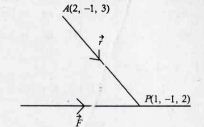
We have
\( \vec{F} =3 \hat{i}+2 \hat{j}-4 \hat{k} \)
\(\overrightarrow{O P} =\hat{i}-\hat{j}+2 \hat{k} \)
\(\overrightarrow{O A} =2 \hat{i}-\hat{j}+3 \hat{k} \)
\(\vec{r} =\overrightarrow{A P}=\overrightarrow{O P}-\overrightarrow{O A} \)
\( =(\hat{i}-\hat{j}+2 \hat{k})-(2 \hat{i}-\hat{j}+3 \hat{k}) \)
\(\vec{r} =-\hat{i}-\hat{k}\)
The moment \(\vec M\) of the force \(\vec F\) about the point A is given by
\(\vec{M}=\vec{r} \times \vec{F}=\left|\begin{array}{ccc} \hat{i} & \hat{j} & \hat{k} \\ -1 & 0 & -1 \\ 3 & 2 & -4 \end{array}\right|=2 \hat{i}-7 \hat{j}-2 \hat{k}\)
2.
Let \(\vec{a}=2 \hat{i}+\hat{j}-\hat{k} ; \vec{b}=\hat{i}+2 \hat{j}+\hat{k}\)
Let \(\theta\) be the angle between \(\vec a\ and\ \vec b\)
\(
\therefore \theta =\sin ^{-1}\left(\frac{\mid \vec{a} \times \vec{b}}{|\vec{a}| \mid \vec{b}} \mid\right)
\)
\(\vec{a} \times \vec{b} =\left|\begin{array}{ccc}
\hat{i} & \hat{j} & \hat{k} \\
2 & 1 & -1 \\
1 & 2 & 1
\end{array}\right|=3 \hat{i}-3 \hat{j}+3 \hat{k}
\)
\(|\vec{a} \times \vec{b}| =\sqrt{3^{2}+(-3)^{2}+3^{2}}=3 \sqrt{3}
\)
\(|\vec{a}| =\sqrt{2^{2}+1^{2}+(-1)^{2}}=\sqrt{6}
\)
\(|\vec{b}| =\sqrt{1^{2}+2^{2}+1^{2}}=\sqrt{6}
\)
\(\therefore \theta =\sin ^{-1}\left(\frac{3 \sqrt{3}}{\sqrt{6} \sqrt{6}}\right)
\)
\( =\sin ^{-1}\left(\frac{3 \sqrt{3}}{6}\right)
\)
\( =\sin ^{-1}\left(\frac{\sqrt{3}}{2}\right)
\)
\(\therefore \theta =\frac{\pi}{3}
\)
3.
\(\vec{F}=a \hat{i}+\hat{j}+\hat{k} ; \overrightarrow{O A}=\hat{i}+\hat{j}+\hat{k} ; \overrightarrow{O B}=2 \hat{i}+2 \hat{j}+2 \hat{k}\)
Work done = 5 units
\(\vec{d}=\overrightarrow{A B}=\overrightarrow{O B}-\overrightarrow{O A}=\hat{i}+\hat{j}+\hat{k}\)
Work done = \(\vec{F} \cdot \vec{d}\)
\(
5 =(a \hat{i}+\hat{j}+\hat{k}) \cdot(\hat{i}+\hat{j}+\hat{k})
\)
\(5 =a+1+1 \Rightarrow a=3
\)
\(|\vec{a} \times \vec{b}| =\sqrt{(-1)^{2}+(2)^{2}+(2)^{2}}=3
\)
Required vectors \( =6\left[\pm\left[\frac{\vec{a} \times \vec{b}}{|\vec{a} \times \vec{b}|}\right)\right]
\)
\( =\pm(-2 \hat{i}+4 \hat{j}+4 \hat{k})\)
4.
\(
\vec{F}=\hat{i}+3 \hat{j}-\hat{k} ; \overrightarrow{O A} =2 \hat{i}-6 \hat{j}+7 \hat{k} ; \overrightarrow{O B}=3 \hat{i}-\hat{j}-5 \hat{k}
\)
\(\vec{d} =\overrightarrow{A B}
\)
\( =\overrightarrow{O B}-\overrightarrow{O A}=\hat{i}+5 \hat{j}-12 \hat{k}
\)
Work done \( =\vec{F} \cdot \vec{d}
\)
\( =(\hat{i}+3 \hat{j}-\hat{k}) \cdot(\hat{i}+5 \hat{j}-12 \hat{k})
\)
\( =(1)(1)+3(5)+12=28
\)
5.
Let \(\vec{a}=4 \hat{i}-\hat{j}+3 \hat{k} ; \quad \vec{b}=-2 \hat{i}+\hat{j}-2 \hat{k}\)
\(
\vec{a} \times \vec{b}=\left|\begin{array}{ccc}
\hat{i} & \hat{j} & \hat{k} \\
4 & -1 & 3 \\
-2 & 1 & -2
\end{array}\right|=-\hat{i}+2 \hat{j}+2 \hat{k}
\)
\( |\vec{a} \times \vec{b}|=\sqrt{1+4+4}=\sqrt{9}=3
\)
\( \hat{\mathrm{n}}=\pm \frac{6(\vec{a} \times \vec{b})}{|\vec{a} \times \vec{b}|}
\)
\( =\pm \frac{^2\not6(-\hat{i}+2 \hat{j}+2 \hat{k})}{\not 3}=\pm 2(-\hat{i}+2 \hat{j}+2 \hat{k})
\)
6.
\(\vec{p} \times \vec{q}=\left|\begin{array}{ccc} \hat{i} & \hat{j} & \hat{k} \\ -3 & 4 & -7 \\ 6 & 2 & -3 \end{array}\right|=2 \hat{i}-51 \hat{j}-30 \hat{k}\)
Now, \(\vec{p} \cdot(\vec{p} \times \vec{q})=(-3 \hat{i}+4 \hat{j}-7 \hat{k}) \cdot(2 \hat{i}-51 \hat{j}-30 \hat{k})\)
= -6 - 204 + 210 = 0
Hence \(\vec q\) and \(\vec p \times \vec q\)are pefpendicular to each other.
Now, \(\vec{q} \cdot(\vec{p} \times \vec{q})=(-6 \hat{i}+2 \hat{j}-3 \hat{k}) \cdot(2 \hat{i}-51 \hat{j}-30 \hat{k})\)
= 12 - 102 + 90 = 0
Hence \(\vec q\) and \(\vec p \times \vec q\) are perpendicular to each other.
7.
\(\overrightarrow{O A}=\hat{i}+2 \hat{j}+3 \hat{k}; \overrightarrow{O B}=4 \hat{i}+\hat{j}+5 \hat{k} ; \overrightarrow{O C}=7 \hat{i}+7 \hat{k}\)
\( \overrightarrow{A B}=\overrightarrow{O B}-\overrightarrow{O A}=(4 \hat{i}+\hat{j}+5 \hat{k})-(\hat{i}+2 \hat{j}+3 \hat{k}) \)
\(\overrightarrow{A B}=3 \hat{i}-\hat{j}+2 \hat{k} \)
\(\overrightarrow{A C}=\overrightarrow{O C}-\overrightarrow{O A}=6 \hat{i}-2 \hat{j}+4 \hat{k} \)
\(\overrightarrow{A B} \times \overrightarrow{A C}=\left|\begin{array}{ccc} i & \hat{j} & \hat{k} \\ 3 & -1 & 2 \\ 6 & -2 & 4 \end{array}\right|=\overrightarrow{0} \)
The vectors \(\overline{AB}\) and \(\overline {AC}\) are parallel. But they have the point A as a common point.
\(\overline{AB}\) and \(\overline {AC}\) are along same line
\(\therefore\) A, B, C are collinear.
8.
\(
{[\vec{a}+\vec{b}, \vec{b}+\vec{c}, \vec{c}+\vec{a}]}
\)
\( =[\vec{a}, \vec{b}+\vec{c}, \vec{c}+\vec{a}]+[\vec{b}, \vec{b}+\vec{c}, \vec{c}+\vec{a}]
\)
\( =[\vec{a}, \vec{b}, \vec{c}+\vec{a}]+[\vec{a}, \vec{c}, \vec{c}+\vec{a}]+[\vec{b}, \vec{b}, \vec{c}+\vec{a}]+[\vec{b}, \vec{c}, \vec{c}+\vec{a}]
\)
\(=[\vec{a}, \vec{b}, \vec{c}]+[\vec{a}, \vec{b}, \vec{a}]+[\vec{a}, \vec{c}, \vec{c}]+[\vec{a}, \vec{c}, \vec{a}]+[\vec{b}, \vec{b}, \vec{c}]+[\vec{b}, \vec{b}, \vec{a}]+[\vec{b}, \vec{c}, \vec{c}]+[\vec{b}, \vec{c}, \vec{a}]
\)
\( =[\vec{a}, \vec{b}, \vec{c}]+0+0+0+0+0+0+[\vec{a}, \vec{b}, \vec{c}]
\)
\( =2[\vec{a}, \vec{b}, \vec{c}]
\)
9.
\(\vec{b} \times \vec{c}=\left|\begin{array}{lrr} \hat{i} & \hat{j} & \hat{k} \\ -2 & 0 & 5 \\ 0 & +1 & -3 \end{array}\right|=-5 \hat{i}-6 \hat{j}-2 \hat{k}\)
\(\vec{a} \times(\vec{b} \times \vec{c})=\left|\begin{array}{llr} \hat{i} & \hat{j} & \hat{k} \\ 2 & 3 & -1 \\ -5 & -6 & -2 \end{array}\right|=-12 \hat{i}+9 \hat{j}+3 \hat{k}\) ............(1)
\( \vec{a} \cdot \vec{c} =2(0)+3(1)+(-1)(-3)=6 \)
\(\vec{a} \cdot \vec{b} =2(-2)+3(0)+(-1)(5) \)
= -4 + 0 - 5 = -9
\( (\vec{a} \cdot \vec{c}) \vec{b} =-12 \hat{i}+30 \hat{k} \)
\((\vec{a} \cdot \vec{b}) \vec{c} =-9 \hat{j}+27 \hat{k}\)
\((\vec{a} \cdot \vec{c}) \vec{b}-(\vec{a} \cdot \vec{b}) \vec{c}=-12 \hat{i}+9 \hat{j}+3 \hat{k}\) .............(2)
From (1) & (2)
\(\vec{a} \times(\vec{b} \times \vec{c})=(\vec{a} \cdot \vec{c}) \vec{b}-(\vec{a} \cdot \vec{b}) \vec{c}\)
10.
\( (\vec{a} \times \vec{b}) \cdot(\vec{c} \times \vec{d}) =(\vec{a} \cdot \vec{c})(\vec{b} \cdot \vec{d})-(\vec{a} \cdot \vec{d})(\vec{b} \cdot \vec{c}) \)
\(\vec{a} \cdot \vec{c} =2+1+1=4 \)
\(\vec{b} \cdot \vec{d} =2+0+2=4 \)
\(\vec{a} \cdot \vec{d} =1+1+2=4 \)
\(\vec{b} \cdot \vec{c} =4+1=5\)
L.H.S. = (4)(4) -(4)(5) = -4
11.
\(\vec{a} \times \vec{b}=\left|\begin{array}{ccc}
\hat{i} & \hat{j} & \hat{k} \\
1 & 1 & 1 \\
2 & 0 & 1
\end{array}\right|=\hat{i}+\hat{j}-2 \hat{k}\)
\(\vec{c} \times \vec{d}=\left|\begin{array}{lll}
\hat{i} & \hat{j} & \hat{k} \\
2 & 1 & 1 \\
1 & 1 & 2
\end{array}\right|=\hat{i}-3 \hat{j}+\hat{k}\)
\((\vec{a} \times \vec{b}) \times(\vec{c} \times \vec{d})=\left|\begin{array}{ccc}
\hat{i} & \hat{j} & \hat{k} \\
1 & 1 & -2
\end{array}\right|=-5 \hat{i}-3 \hat{j}-4 \hat{k}\) .......(1)
\([\vec{a}, \vec{b}, \vec{c}]=\left|\begin{array}{ccc}
1 & 1 & 1 \\
2 & 0 & 1 \\
2 & 1 & 1
\end{array}\right|=1\)
\([\vec{a}, \vec{b}, \vec{c}]=\left|\begin{array}{lll}
1 & 1 & 1 \\
2 & 0 & 1 \\
1 & 1 & 2
\end{array}\right|=-2\)
\(
{[\vec{a}, \vec{b}, \vec{d}] \vec{c}-[\vec{a}, \vec{b}, \vec{c}] \vec{d} } =(-4 \hat{i}-2 \hat{j}-2 \hat{k})-(\hat{i}+\hat{j}+2 \hat{k})
\)
\( =-5 \hat{i}-3 \hat{j}-4 \hat{k}\) .........(2)
\( (1), (2) \Rightarrow(\vec{a} \times \vec{b}) \times(\vec{c} \times \vec{d})=[\vec{a}, \vec{b}, \vec{d}] \vec{c}-[\vec{a}, \vec{b}, \vec{c}] \vec{d}\)
12.
\((\vec{a} \times \vec{b}) \cdot(\vec{c} \times \vec{d})=\left|\begin{array}{ll}
\vec{a} \cdot \vec{c} & \vec{a} \cdot \vec{d} \\
\vec{b} \cdot \vec{c} & \vec{b} \cdot \vec{d}
\end{array}\right|=(\vec{a} \cdot \vec{c})(\vec{b} \cdot \vec{d})-(\vec{b} \cdot \vec{c})(\vec{a} \cdot \vec{d})\)
\((\vec{b} \times \vec{c}) \cdot(\vec{a} \times \vec{d})=\left|\begin{array}{ll}
\vec{b} \cdot \vec{a} & \vec{b} \cdot \vec{d} \\
\vec{c} \cdot \vec{a} & \vec{c} \cdot \vec{d}
\end{array}\right|=(\vec{b} \cdot \vec{a})(\vec{c} \cdot \vec{d})-(\vec{c} \cdot \vec{a})(\vec{b} \cdot \vec{d})\)
\((\vec{c} \times \vec{a}) \cdot(\vec{b} \times \vec{d})=\left|\begin{array}{ll}
\vec{c} \cdot \vec{b} & \vec{c} \cdot \vec{d} \\
\vec{a} \cdot \vec{b} & \vec{a} \cdot \vec{d}
\end{array}\right|=(\vec{c} \cdot \vec{b})(\vec{a} \cdot \vec{d})-(\vec{a} \cdot \vec{b})(\vec{c} \cdot \vec{d})\)
L.H.S
\(
=(\vec{a} \cdot \vec{c})(\vec{b} \cdot \vec{d})-(\vec{b} \cdot \vec{c})(\vec{a} \cdot \vec{d})+(\vec{b} \cdot \vec{a})(\vec{c} \cdot \vec{d})-(\vec{c} \cdot \vec{a})(\vec{b} \cdot \vec{d})+
(\vec{c} \cdot \vec{b})(\vec{a} \cdot \vec{d})-(\vec{a} \cdot \vec{b})(\vec{c} \cdot \vec{d})=0= \) R.H.S
13.
Here p = 8 and \(\vec{n}=3 \hat{i}+2 \hat{j}-2 \hat{k}\)
\(\therefore \hat{n}=\frac{\vec{n}}{|\vec{n}|}=\frac{3 \hat{i}+2 \hat{j}-2 \hat{k}}{\sqrt{9+4+4}}=\frac{3 \hat{i}+2 \hat{j}-2 \hat{k}}{\sqrt{17}}\)
Hence the required vector equation of the plane is
\(
\vec{r} \cdot \hat{n} =p
\)
\(\vec{r} \cdot \frac{3 \hat{i}+2 \hat{j}-2 \hat{k}}{\sqrt{17}} =8
\)
\(\vec{r} \cdot(3 \hat{i}+2 \hat{j}-2 \hat{k}) =8 \sqrt{17}\)
Cartesian form is \((x \hat{i}+x \hat{j}+z \hat{k}) \cdot(3 \hat{i}+2 \hat{j}-2 \hat{k})=8 \sqrt{17}\)
\(3 x+2 y-2 z=8 \sqrt{17}\)
14.
The required plane Passes through the point A(4, -2, -5) and is Perpendicular to \(\overrightarrow{O A}\)
\(\therefore \vec{a}=4 \hat{i}-2 \hat{j}-5 \hat{k} \text { and } \vec{n}=\overrightarrow{O A}=4 \hat{i}-2 \hat{j}-5 \hat{k}\)
The required equation of the plane is \(\vec{r} \cdot \overrightarrow{\mathrm{n}}=\vec{a} \cdot \vec{n}\)
\(\vec{r} \cdot(4 \hat{i}-2 \hat{j}-5 \hat{k})=(4 \hat{i}-2 \hat{j}-5 \hat{k}) \cdot(4 \hat{i}-2 \hat{j}-5 \hat{k})\)
= 16 + 4 + 25
\(\vec{r} \cdot(4 \hat{i}-2 \hat{j}-5 \hat{k})=45\)
Cartesian form:
\((x \hat{i}+y \hat{j}+z \hat{k}) \cdot(4 \hat{i}-2 \hat{j}-5 \hat{k})=45\)
4x -2y -5z = 45
15.
The required plane passes through A(2, -1, -3) and parallel to \(\vec{u}=3 \hat{i}+2 \hat{j}-4 \hat{k} \text { and } \vec{v}=2 \hat{i}-3 \hat{j}+2 \hat{k}\)
The required equation is \(\vec{r}=\vec{a}+s \vec{u}+t \vec{v}\)
Cartesian form:
\( \left(x_{1}, y_{1}, z_{1}\right)=(2,-1,-3) ;\left(l_{1}, m_{1}, n_{1}\right)=(3,2,-4) ; \left(l_{2}, m_{2}, n_{2}\right)=(2,-3,2) \)
The equation of the plane is
\(\left|\begin{array}{ccc} x-x_{1} & y-y_{1} & z-z_{1} \\ l_{1} & m_{1} & n_{1} \\ l_{2} & m_{2} & n_{2} \end{array}\right|=0\)
\(\text { i.e., }\left|\begin{array}{ccc} x-2 & y+1 & z+3 \\ 3 & 2 & -4 \\ 2 & -3 & 2 \end{array}\right|=0\)
\(\Rightarrow 8 x+14 y+13 z+37=0\)
This is the required Cartesian form.
16.
Vector equation of the plane passing through three given non-collinear points is
\(\vec{r}=(1-s-t) \vec{a}+s \vec{b}+t \vec{c}\) where s and t are scalars.
Here \( \vec{a}=2 \hat{i}+2 \hat{j}-\hat{k} ;\ \vec{b}=3 \hat{i}+4 \hat{j}+2 \hat{k} ;\ \vec{c}=7 \hat{i}+6 \hat{k} \)
\(\therefore \vec{r}=(1-s-t)(2 \hat{i}+2 \hat{j}-\hat{k})+s(3 \hat{i}+4 \hat{j}+2 \hat{k})+t(7 \hat{i}+6 \hat{k}) \)
Cartesian equation of the plane:
Here \( \left(x_{1}, y_{1}, z_{1}\right)\ is \ (2,2,-1) ;\left(x_{2}, y_{2}, z_{2}\right)\ is \ (3,4,2)\; \ \left(x_{3}, y_{3}, z_{3}\right)\ is \ (7,0,6)\)
The equation of the plane is
\(\left|\begin{array}{lll} x-x_{1} & y-y_{1} & z-z_{1} \\ x_{2}-x_{1} & y_{2}-y_{1} & z_{2}-z_{1} \\ x_{3}-x_{1} & y_{3}-y_{1} & z_{3}-z_{1} \end{array}\right|=0\)
\(\text { i.e., }\left|\begin{array}{ccc} x-2 & y-2 & z+1 \\ 1 & 2 & 3 \\ 5 & -2 & 7 \end{array}\right|=0\)
5x + 2y - 32 = 17
This is the Cartesian equation of the plane.
17.
Let \( \vec{a}=4 \hat{i}+2 \hat{j}+4 \hat{k} \)
\( \vec{b}=2 \hat{i}+5 \hat{j}+4 \hat{k} \)
\( \vec{d}=4 \hat{i}+7 \hat{j}+6 \hat{k} \)
\(\vec{b} \times \vec{d}=\left|\begin{array}{lll} \hat{i} & \hat{j} & \hat{k} \\ 2 & 5 & 4 \\ 4 & 7 & 6 \end{array}\right|\)
\( =\hat{i}(30-28)-\hat{j}(12-16)+\hat{k}(14-20) \)
\( =2 \hat{i}+4 \hat{j}-6 \hat{k} \)
Non Parametric vector Equation
\( (\vec{r}-\vec{a}) \cdot(\vec{b} \times \vec{d})=0 \)
\((\vec{r}-(4 \hat{i}+2 \hat{j}+4 \hat{k})) \cdot(2 \hat{i}+4 \hat{j}-6 \hat{k})=0 \)
\( \vec{r} \cdot(2 \hat{i}+4 \hat{j}-6 \hat{k})-(8+8-24) =0 \)
\(\vec{r} \cdot(2 \hat{i}+4 \hat{j}-6 \hat{k})+8 =0 \)
\(\vec{r} \cdot(2 \hat{i}+4 \hat{j}-6 \hat{k}) =-8 \)
Cartesian Equation
\( (x \hat{i}+y \hat{j}+z \hat{k}) \cdot(2 \hat{i}+4 \hat{j}-6 \hat{k}) =-8 \)
\(2 x+4 y-6 z =-8 \)
2x + 4y - 6z + 8 = 0
18.
\( \frac{x-6}{1}=\frac{2-y}{2}=\frac{z-2}{2} \ and \ \frac{x-4}{3}=\frac{y}{-2}=\frac{1-z}{2} \)
\(\frac{x-6}{1}=\frac{y-2}{-2}=\frac{z-2}{2} \text { and } \frac{x+4}{3}=\frac{y}{-2}=\frac{z-1}{-2} \)
\(\vec{r}=(6 \hat{i}+2 \hat{j}+2 \hat{k})+t(\hat{i}-2 \hat{j}+2 \hat{k}) \)
\( \overrightarrow{\mathrm{r}}=(-4 \hat{\mathrm{i}}+\hat{\mathrm{k}})+\mathrm{s}(3 \hat{\mathrm{i}}-2 \hat{\mathrm{j}}-2 \hat{\mathrm{k}}) \)
\( \vec{a}=6 \hat{i}+2 \hat{j}+2 \hat{k} ; \quad \vec{c}=-4 \hat{i}+\hat{k} \)
\( \vec{b}=\hat{i}+2 \hat{j}-2 \hat{k} ; \quad \vec{d}=3 \hat{i}+2 \hat{j}-2 \hat{k}\)
\(\delta=\frac{|(\vec{c}-\vec{a}) \cdot(\vec{b} \times \vec{d})|}{|(\vec{b} \times \vec{d})|}\)
\(\vec{b} \times \vec{d}=\left|\begin{array}{ccc} \hat{i} & \hat{j} & \hat{k} \\ 1 & -2 & 2 \\ 3 & -2 & -2 \end{array}\right|\)
\( =\hat{\mathrm{i}}(4+4)-\hat{\mathrm{j}}(-2-6)+\hat{\mathrm{k}}(-2+6) \)
\(\overrightarrow{\mathrm{b}} \times \overrightarrow{\mathrm{d}} =8 \hat{\mathrm{i}}+8 \hat{\mathrm{j}}+4 \hat{\mathrm{k}}(-2+6) \)
\(|\overrightarrow{\mathrm{b}} \times \mathrm{d}| =\sqrt{64+64+16}=\sqrt{144}=12\)
\( |(\vec{c}-\vec{a}) \cdot(\vec{b} \times d)| =|(-10 \hat{i}-6 \hat{j}-\hat{k}) \cdot(8 \hat{i}+8 \hat{j}+4 \hat{k})| \)
\(=|-80-48-4| \)
= 132
19.
\( \vec{a}=\hat{i}+\hat{j}-\hat{k}, \vec{b}=2 \hat{i}+3 \hat{j}, \vec{c}=\hat{j}-\hat{k} \\ \vec{b} \times \vec{c} =\left|\begin{array}{ccc} \hat{i} & \hat{j} & \hat{k} \\ 2 & 3 & 0 \\ 0 & 1 & -1 \end{array}\right| \)
\( =\hat{i}(-3)-\hat{j}(-2)+\hat{\mathrm{k}}(2) \)
\(\vec{b} \times \vec{c} =-3 \hat{i}+2 \hat{j}+2 \hat{k} \)
\(\vec{a} \times(\vec{b} \times \vec{c})=\left|\begin{array}{rrr} \hat{i} & \hat{j} & \hat{k} \\ 1 & 1 & -1 \\ -3 & 2 & 2 \end{array}\right|\)
\( =\hat{i}(2+2)-\hat{j}(2-3)+\hat{k}(2+3) \)
\(=4 \hat{i}+\hat{j}+5 \hat{k}\) .............(1)
\( \vec{a} \cdot \vec{c} =(\hat{i}+\hat{j}-\hat{k}) \cdot(\vec{j}-\hat{k}) \)
\( =0+1+1=2 \)
\(=(\vec{a} \cdot \vec{c}) \vec{b}=4 \hat{i}+6 \hat{j} \)
\(\vec{a} \cdot \vec{b} =(\hat{i}+\hat{j}-\hat{k}) \cdot(2 \hat{i}+3 \hat{j}) \)
\( =2+3+0 \)
\(\vec{a} \cdot \vec{b} =5\)
\( (\vec{a} \cdot \vec{b}) \vec{c} =5 \hat{j}-5 \hat{k} \)
\((\vec{a} \cdot \vec{c}) \vec{b}-(\vec{a} \cdot \vec{b}) \vec{c} =(4 \hat{i}+6 \hat{j})-(5 \hat{j}-5 \hat{k}) \)
\( =4 \hat{j}+\hat{j}+5 \hat{k}\) ...............(2)
From (1) and (2), we get
\(\vec{a} \times(\vec{b} \times \vec{c})=(\vec{a} \cdot \vec{c}) \vec{b}-(\vec{a} \cdot \vec{b}) \vec{c}\)
20.
The normal vector to the planes
x + 2y + 3z - 7 = 0, 2x - 3y + 4z = 0 are
\(\overset { \rightarrow }{ b } =\overset { \wedge }{ i } +2\overset { \wedge }{ j } +3\overset { \wedge }{ k } \) and \(\overset { \rightarrow }{ c } =2\overset { \wedge }{ i } -3\overset { \wedge }{ j } +4\overset { \wedge }{ k } \)
∴ The required planes passes through the point \(\overset { \rightarrow }{ a } =\overset { \wedge }{ i } +\overset { \wedge }{ j } +\overset { \wedge }{ k } \) and parallel to two vector 5 namely \(\overset { \rightarrow }{ b } \) and \(\overset { \rightarrow }{ c } \)
∴ The Parametric form of vectors equation of the plans is \(\overset { \rightarrow }{ r } =\overset { \rightarrow }{ a } +s\overset { \rightarrow }{ b } +t\overset { \rightarrow }{ c } \) s, t ∈ R
\(\overset { \rightarrow }{ r } =\left( \overset { \rightarrow }{ i } +\overset { \rightarrow }{ j } -\overset { \rightarrow }{ k } \right) +s\left( \overset { \rightarrow }{ i } +2\overset { \rightarrow }{ j } +3\overset { \rightarrow }{ k } \right) +t\left( 2\overset { \rightarrow }{ i } -3\overset { \rightarrow }{ j } +4\overset { \rightarrow }{ k } \right) ,\)
Cartesian equation is \(\left| \begin{matrix} x-{ x }_{ 1 } \\ { b }_{ 1 } \\ { c }_{ 1 } \end{matrix}\begin{matrix} y-{ { y }_{ 1 } } \\ { b }_{ 2 } \\ { c }_{ 2 } \end{matrix}\begin{matrix} z-{ { z }_{ 1 } } \\ { b }_{ 3 } \\ { c }_{ 3 } \end{matrix} \right| =0\)
\(\Rightarrow \left| \begin{matrix} x-1 \\ 1 \\ 2 \end{matrix}\begin{matrix} y-1 \\ 2 \\ -3 \end{matrix}\begin{matrix} z+1 \\ 3 \\ 4 \end{matrix} \right| =0\)
⇒ (x - 1) (8 + 9) - (y - 1)(4 - 6) + (z + 1)(-3 -4) = 0
⇒ 17 (x - 1) +2 (y - 1) -7 (z + 1) = 0
⇒ 17x - 17 + 2y - 2 - 7z - 7 = 0
⇒ 17x + 2y - 7z - 26 = 0
21.
From the line \(\frac { x-3 }{ 3 } =\frac { y-8 }{ -1 } =\frac { z-3 }{ 1 } \), we get
\(\overset { \rightarrow }{ a } =3\overset { \wedge }{ i } +8\overset { \wedge }{ j } +3\overset { \wedge }{ k } \), \(\overset { \rightarrow }{ b } =3\overset { \wedge }{ i } -\overset { \wedge }{ j } +\overset { \wedge }{ k } \)
From the line \(\frac { x+3 }{ -3 } =\frac { y+7 }{ 2 } =\frac { z-6 }{ 4 } \) we get
\(\overset { \rightarrow }{ c } =-3\overset { \wedge }{ i } -7\overset { \wedge }{ j } +6\overset { \wedge }{ k } \) and \(\overset { \rightarrow }{ d } =-3\overset { \wedge }{ i } +2\overset { \wedge }{ j } +4\overset { \wedge }{ k } \)
Since the given lines are not parallel, the shortest distance between the line is
\(d=\left| \frac { \left( \overset { \rightarrow }{ c } -\overset { \rightarrow }{ a } \right) .\left( \overset { \rightarrow }{ b } \times \overset { \rightarrow }{ d } \right) }{ \left| \overset { \rightarrow }{ b } \times \overset { \rightarrow }{ d } \right| } \right| \)
\(\overset { \rightarrow }{ c } -\overset { \rightarrow }{ a } =-6\overset { \wedge }{ i } -15\overset { \wedge }{ j } +3\overset { \wedge }{ k } \)
\(\overset { \rightarrow }{ b } \times \overset { \rightarrow }{ d } =\left| \begin{matrix} \overset { \wedge }{ i } \\ 3 \\ -3 \end{matrix}\begin{matrix} \overset { \wedge }{ j } \\ -1 \\ 2 \end{matrix}\begin{matrix} \overset { \wedge }{ k } \\ 1 \\ 4 \end{matrix} \right| \)
\(=\overset { \wedge }{ i } (-4-2)-\overset { \wedge }{ j } (12+3)+\overset { \wedge }{ k } (6-3)\\ \)
\(=-6\overset { \wedge }{ i } -15\overset { \wedge }{ j } +3\overset { \wedge }{ k } \)
\(\therefore \left| \overset { \rightarrow }{ b } \times \overset { \rightarrow }{ d } \right| =\sqrt { 36+225+9 } \)
\(=\sqrt { 270 } \)
\(\therefore \left( \overset { \rightarrow }{ c } -\overset { \rightarrow }{ a } \right) .\left( \overset { \rightarrow }{ b } \times \overset { \rightarrow }{ d } \right) =\left( -6\overset { \wedge }{ i } -15\overset { \wedge }{ j } +3\overset { \wedge }{ k } \right) .\left( -6\overset { \wedge }{ i } -15\overset { \wedge }{ j } +3\overset { \wedge }{ k } \right) \)
= -6 (-6) + 15 _(15) + 3(3)
= 270 ≠ 0
Since the given lines are neither intersecting, nor parallel they are skew lines
\(\therefore d=\frac { 270 }{ \sqrt { 270 } } =\sqrt { 270 } units\)
22.
Let \(\overset { \rightarrow }{ B } =x\overset { \wedge }{ i } +y\overset { \wedge }{ j } +z\overset { \wedge }{ k } \)
Given \(\overset { \rightarrow }{ A } \times \overset { \rightarrow }{ B } =\overset { \rightarrow }{ C } \Rightarrow \left| \begin{matrix} \overset { \wedge }{ i } \\ 1 \\ x \end{matrix}\begin{matrix} \overset { \wedge }{ j } \\ 1 \\ y \end{matrix}\begin{matrix} \overset { \wedge }{ k } \\ 1 \\ z \end{matrix} \right| =\overset { \wedge }{ j } -\overset { \wedge }{ k } \)
\(\Rightarrow \overset { \wedge }{ i } (z-y)-\overset { \wedge }{ j } (z-x)+\overset { \wedge }{ k } (y-x)\quad \overset { \wedge }{ j } -\overset { \wedge }{ k } \)
Equating the like components on both sides, we get
z - y = 0 .....(1)
x - y = 1 .....(2)
y - x = -1 .....(3)
Also, \(\overset { \rightarrow }{ A } .\overset { \rightarrow }{ B } =3\Rightarrow \left( \overset { \wedge }{ i } +\overset { \wedge }{ j } +\overset { \wedge }{ k } \right) .\left( x\overset { \wedge }{ i } +y\overset { \wedge }{ j } +z\overset { \wedge }{ k } \right) =3\)
⇒ x + y + z = 3 ....(4)
Solving (1), (2), (3) and (4), we get \(x=\frac { 5 }{ 3 } ,y=\frac { 2 }{ 3 } \)and \(z=\frac { 2 }{ 3 } \)
\(\therefore \overset { \rightarrow }{ B } =\frac { 5 }{ 3 } \overset { \wedge }{ i } +\frac { 2 }{ 3 } \overset { \wedge }{ j } +\frac { 2 }{ 3 } \overset { \wedge }{ k } \)
23.
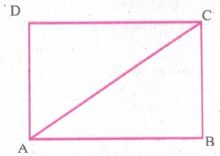
Given \(\overset { \rightarrow }{ AB } =\overset { \rightarrow }{ \alpha } \), \(\overset { \rightarrow }{ AD } =\overset { \rightarrow }{ \beta } \) and \(\overset { \rightarrow }{ AC } =2\overset { \rightarrow }{ \alpha } +3\overset { \rightarrow }{ \beta } \)
Area of the quadrilateral ABCD
∴ = are of ∆ ABC + area of ∆ ACD
\(=\frac { 1 }{ 2 } \left| \overset { \rightarrow }{ AB } \times \overset { \rightarrow }{ AC } \right| +\frac { 1 }{ 2 } \left| \overset { \rightarrow }{ AC } \times \overset { \rightarrow }{ AD } \right| \)
\(=\frac { 1 }{ 2 } \left| \overset { \rightarrow }{ \alpha } \times \left( 2\overset { \rightarrow }{ \alpha } +3\overset { \rightarrow }{ \beta } \right) \right| +\frac { 1 }{ 2 } \left| \left( 2\overset { \rightarrow }{ \alpha } +3\overset { \rightarrow }{ \beta } \right) \times \overset { \rightarrow }{ \beta } \right| \)
\(=\frac { 1 }{ 2 } \left| 2\left( \overset { \rightarrow }{ \alpha } \times \overset { \rightarrow }{ \alpha } \right) +3\left( \overset { \rightarrow }{ \alpha } \times \overset { \rightarrow }{ \beta } \right) \right| +\frac { 1 }{ 2 } \left| 2\left( \overset { \rightarrow }{ \alpha } \times \overset { \rightarrow }{ \beta } \right) +3\left( \overset { \rightarrow }{ \beta } \times \overset { \rightarrow }{ \beta } \right) \right| \)
\(=\frac { 1 }{ 2 } \left| 3\left( \overset { \rightarrow }{ \alpha } \times \overset { \rightarrow }{ \beta } \right) \right| +\frac { 1 }{ 2 } \left| 2\left( \overset { \rightarrow }{ \alpha } \times \overset { \rightarrow }{ \beta } \right) \right| \quad \quad \quad \left[ \because \overset { \rightarrow }{ \alpha } \times \overset { \rightarrow }{ \alpha } =\overset { \rightarrow }{ \beta } \times \overset { \rightarrow }{ \beta } =0 \right] \)
\(=\left( \frac { 3 }{ 2 } +\frac { 2 }{ 2 } \right) \left( \overset { \rightarrow }{ \alpha } \times \overset { \rightarrow }{ \beta } \right) =\left( \frac { 5 }{ 2 } \right) \left| \overset { \rightarrow }{ \alpha } \times \overset { \rightarrow }{ \beta } \right| \quad \quad (1)\)
Now, Area of the parallelogram with \(\overset { \rightarrow }{ AB } \) and \(\overset { \rightarrow }{ AD } \) as
adjacent sides = \(\left| \overset { \rightarrow }{ AB } \times \overset { \rightarrow }{ AD } \right| =\left| \overset { \rightarrow }{ \alpha } \times \overset { \rightarrow }{ \beta } \right| .... (2)\)
From (1) & (2), \(\frac { 5 }{ 2 } \left| \overset { \rightarrow }{ \alpha } \times \overset { \rightarrow }{ \beta } \right| =\lambda \left| \overset { \rightarrow }{ \alpha } \times \overset { \rightarrow }{ \beta } \right| \) [Given]
\(\lambda =\frac { 5 }{ 2 } \)
24.
Given \(\overset { \rightarrow }{ OA } =2\overset { \wedge }{ i } -\overset { \wedge }{ j } +\overset { \wedge }{ k } ,\overset { \rightarrow }{ OB } =\overset { \wedge }{ i } -3\overset { \wedge }{ j } -5\overset { \wedge }{ k } ,\) and \(\overset { \rightarrow }{ OC } =3\overset { \wedge }{ i } -4\overset { \wedge }{ j } +4\overset { \wedge }{ k } \)
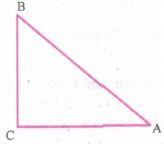
\(\therefore \overset { \rightarrow }{ AB } =\overset { \rightarrow }{ OB } -\overset { \rightarrow }{ OA } =-\overset { \wedge }{ i } -2\overset { \wedge }{ j } -6\overset { \wedge }{ k } \)
\(\overset { \rightarrow }{ BC } =\overset { \rightarrow }{ OC } -\overset { \rightarrow }{ OB } =2\overset { \wedge }{ i } -\overset { \wedge }{ j } +\overset { \wedge }{ k } \)
\(\overset { \rightarrow }{ CA } =\overset { \rightarrow }{ OA } -\overset { \rightarrow }{ OC } =\overset { \wedge }{ -i } +3\overset { \wedge }{ j } +5\overset { \wedge }{ k } \)
\(\overset { \rightarrow }{ AB } +\overset { \rightarrow }{ BC } +\overset { \rightarrow }{ CA } =\overset { \rightarrow }{ 0 } \)
Also, \(\overset { \rightarrow }{ BC } \). \(\overset { \rightarrow }{ CA } \)=\(\left( 2\overset { \wedge }{ i } -\overset { \wedge }{ j } +\overset { \wedge }{ k } \right) .\left( \overset { \wedge }{ -i } +3\overset { \wedge }{ j } +5\overset { \wedge }{ k } \right) \)
= -2 -3 + 5 = 0
\(\Rightarrow \overset { \rightarrow }{ BC } .\overset { \rightarrow }{ CA } \Rightarrow \angle BCA=\frac { \pi }{ 2 } \)
Hence, ABC is a right angled triangle.
\(\cos { A } =\frac { \overset { \rightarrow }{ AB } .\overset { \rightarrow }{ AC } }{ \left| \overset { \rightarrow }{ AB } \right| \left| \overset { \rightarrow }{ AC } \right| } \)
\(=\frac { \left( -\overset { \wedge }{ i } -2\overset { \wedge }{ j } -6\overset { \wedge }{ k } \right) .\left( \overset { \wedge }{ -i } -3\overset { \wedge }{ j } -5\overset { \wedge }{ k } \right) }{ \sqrt { 1+4+36 } .\sqrt { 1+9+25 } } \)
\(=\frac { 35 }{ \sqrt { 41 } .\sqrt { 35 } } =\sqrt { \frac { 35 }{ 41 } } =A={ Cos }^{ -1 }\left( \sqrt { \frac { 35 }{ 41 } } \right) \)
\(\cos { B } =\frac { \overset { \rightarrow }{ BA. } \overset { \rightarrow }{ BC } }{ \left| \overset { \rightarrow }{ BA } \right| \left| \overset { \rightarrow }{ BC } \right| } =\frac { \left( \overset { \wedge }{ i } +2\overset { \wedge }{ j } +6\overset { \wedge }{ k } \right) .\left( 2\overset { \wedge }{ i } -\overset { \wedge }{ j } +\overset { \wedge }{ k } \right) }{ \sqrt { 1+4+36 } +\sqrt { 4+1+1 } } \)
\(=\sqrt { \frac { 6 }{ 41 } } \Rightarrow B={ Cos }^{ -1 }\left( \sqrt { \frac { 6 }{ 41 } } \right) \)

12th Standard Syllabus & Materials
12th Standard
TN 12th Computer Applications களப்பெயர் முறைமை (DNS) Sample Question Papers Study Material - QB365 Set A
NEW12th Standard
TN 12th Computer Applications வலையமைப்பு எடுத்துக்காட்டுகள் மற்றும் நெறிமுறைகள் Sample Question Papers Study Material - QB365 Set A
NEW12th Standard
TN 12th Computer Applications கணினி வலையமைப்பு ஓர் அறிமுகம் Sample Question Papers Study Material - QB365 Set A
NEW12th Standard
TN 12th Computer Applications PHP-உடன் MySQL-ஐ இணைத்தல் Sample Question Papers Study Material - QB365 Set A



Tamilnadu Stateboard 12th Standard Subjects
Maths

Chemistry

Physics

Biology

Computer Science

Business Maths and Statistics

Economics

Commerce

Accountancy

History

Computer Applications
Biology
Computer Technology
Computer Applications
Computer Science
Business Maths and Statistics
Commerce
Economics
Maths
Chemistry
Physics
Computer Technology
History
Accountancy

Tamil

English

French
Tamilnadu Stateboard Standards

