
 100% FREE ACCESS
12th Standard Syllabus & Materials
12th Standard
TN 12th Maths Applications of Matrices and Determinants Sample Question Papers Study Material - QB365 Set A
NEW12th Standard
TN 12th Computer Applications மின்னணு தரவு பரிமாற்றம் Sample Question Papers Study Material - QB365 Set A
NEW12th Standard
TN 12th Computer Applications மின் - வணிக பாதுகாப்பு அமைப்புகள் Sample Question Papers Study Material - QB365 Set A
NEW12th Standard
TN 12th Computer Applications மின்னணு செலுத்தல் முறைகள் Sample Question Papers Study Material - QB365 Set A
NEW12th Standard
TN 12th Computer Applications மின் - வணிகம் Sample Question Papers Study Material - QB365 Set A
NEW12th Standard
TN 12th Computer Applications திறந்த மூல கருத்துருக்கள் Sample Question Papers Study Material - QB365 Set A

Published on: 01/09/2022
QB365 provides a detailed and simple solution for every Possible Book Back Questions in Class 12 Maths Subject - Complex Numbers, English Medium. It will help Students to get more practice questions, Students can Practice these question papers in addition to score best marks.
Download Tamil Nadu 12th Standard Maths question papers, model tests, one-mark questions, important questions, and public exam papers in PDF format. Free study materials and answer keys for TN State Board students.
Questions + Answers key
Take MCQ Maths Test1.
Find the modulus and principal argument of the following complex numbers.
\(\sqrt { 3 } \)-i
2.
Find the modulus and principal argument of the following complex numbers:
\(-\sqrt { 3 } -i\)
3.
Find the modulus and principal argument of the following complex numbers.
\(-\sqrt { 3 } +i\)
4.
Find the following \(\left| \frac { i(2+i)^{ 3 } }{ \left( 1+i \right) ^{ 2 } } \right| \)
5.
Find the following \(\left| \overline { (1+i) } (2+3i)(4i-3) \right| \)
6.
Simplify the following:
i i2i3...i40
7.
Simplify the following:
\(\sum _{ n=1 }^{ 102 }{ { i }^{ n } } \)
8.
Simplify the following:
i -1924+ i2018
9.
Simplify the following:
i 1729
10.
Find the square roots of
−5 −12i .
11.
Find the square roots of −6+8i
12.
Find the modulus of the following complex numbers
2i(3−4i)(4−3i).
13.
Find the modulus of the following complex numbers
(1-i)10
14.
Find the modulus of the following complex number \(\frac { 2-i }{ 1+i } +\frac { 1-2i }{ 1-i } \)
15.
Prove the following properties
\(Re\left( z \right) =\frac { z+\bar { z } }{ 2 } \) and Im\(\left( z \right) =\frac { z-\bar { z } }{ 2i } \)
16.
If z = x + iy , find the following in rectangular form.
Im(3z + 4\(\bar { z } \) − 4i)
17.
If z = x + iy, find the following in rectangular form.
Re\(\left( i\bar { z } \right) \)
18.
Write the following in the rectangular form:
\(\overline { 3i } +\frac { 1 }{ 2-i } \).
19.
Write the following in the rectangular form:
\(\cfrac { 10-5i }{ 6+2i } \)
20.
Evaluate the following if z = 5−2i and w = −1+3i
(z + w)2
21.
Evaluate the following if z = 5−2i and w = −1+3i
z2 + 2zw + w2
22.
Evaluate the following if z = 5−2i and w = −1+3i
z w
23.
Evaluate the following if z = 5−2i and w = −1+3i
2z + 3w
24.
Evaluate the following if z = 5−2i and w = −1+3i
z − iw
25.
Simplify the following
\(\sum _{ n=1 }^{ 10 }{ { i }^{ n+50 } } \).
26.
Simplify the following
i i 2i3...i2000
27.
Simplify the following
\({ i }^{ 59 }+\frac { 1 }{ { i }^{ 59 } } \)
28.
Simplify the following
\(\sum _{ n=1 }^{ 12 }{ { i }^{ n } } \)
29.
Simplify the following
i1948 -i -1869
30.
Find the modulus and principal argument of the following complex numbers.
\(\sqrt { 3 } +i\).
31.
Find the square roots of 4+3i
32.
If |z| = 3, show that \(7\le \left| z+6-8i \right| \le 13\).
33.
Find the modulus of the following complex numbers
\(\frac { 2i }{ 3+4i } \)
34.
Find the square root of 6−8i .
35.
Find the following \(\left| \frac { 2+i }{ -1+2i } \right| \)
36.
Prove the following properties z is real if and only if z = \(\bar { z } \)
37.
If zi = 2− i and z2 = -4+3i , find the inverse of z1z2 and \(\frac { { z }_{ 1 } }{ { z }_{ 2 } } \)
38.
39.
Write the following in the rectangular form:
\(\overline { \left( 5+9i \right) +\left( 2-4i \right) } \)
40.
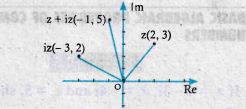
Given the complex number z = 2 + 3i, represent the complex numbers in Argand diagram z, iz , and z+iz
41.
Evaluate the following if z = 5−2i and w = −1+3i
z + w
42.
Simplify the following
i1947+ i1950
43.
Simplify the following i7
44.
Obtain the Cartesian form of the locus of z in in each of the following cases.
|2z - 3 - i| = 3
45.
Write in polar form of the following complex numbers
\(\frac { i-1 }{ cos\frac { \pi }{ 3 } +isin\frac { \pi }{ 3 } } \)
46.
Write in polar form of the following complex numbers
-2 - i2
47.
Write in polar form of the following complex numbers
\(3-i\sqrt { 3 } \)
48.
Obtain the Cartesian form of the locus of z = x + iy in each of the following cases:
\(\overline { z } =z^{ -1 }\)
49.
Obtain the Cartesian form of the locus of z = x + iy in each of the following cases:
|z + i| = |z - 1|
50.
Obtain the Cartesian form of the locus of z = x + iy in each of the following cases:
Im[(1−i)z+1] = 0
51.
Find the least value of the positive integer n for which \(\left( \sqrt { 3 } +i \right) ^{ n }\) purely imaginary
52.
Obtain the Cartesian form of the locus of z in each of the following cases.
|z| = |z - i|
53.
Write in polar form of the following complex numbers
\(2+i2\sqrt { 3 } \)
54.
Obtain the Cartesian form of the locus of z = x + iy in each of the following cases:
\(\left[ Re\left( iz \right) \right] ^{ 2 }=3\)
55.
If z = x + iy is a complex number such that \(\left| \frac { z-4i }{ z+4i } \right| =1\) show that the locus of z is real axis.
56.
Show that the equation z2 = \(\bar { z } \) has four solutions.
57.
Which one of the points i, −2 + i, and 3 is farthest from the origin?
58.
Find the least value of the positive integer n for which \(\left( \sqrt { 3 } +i \right) ^{ n }\) real
59.
If z1, z2 and z3 are complex numbers such that |z1| = |z2| = |z3| = |z1+z2+z3| = 1 find the value of \(\left| \frac { 1 }{ { z }_{ 1 } } +\frac { 1 }{ z_{ 2 } } +\frac { 1 }{ { z }_{ 3 } } \right| \)
1.
\(\sqrt { 3 } -i\)
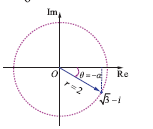
r = 2 and \(-\alpha =\frac { \pi }{ 6 } \)
Since the complex number lies in the fourth quadrant, has the principal value
\(\theta =-\alpha =-\frac { \pi }{ 6 } \)
Therefore, the modulus and principal argument of
\(-\sqrt { 3 } -i\) are 2 and \(\frac { \pi }{ 6 } \)
2.
\(-\sqrt { 3 } -i\)
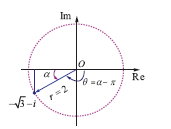
r = 2 and \(\alpha =\frac { \pi }{ 6 } \)
Since the complex number lies in the fourth quadrant, has the principal value
\(\theta =\alpha -\pi =\frac { \pi }{ 6 } -\pi =-\frac { 5\pi }{ 6 } \)
Therefore, the modulus and principal argument of \(-\sqrt { 3 } -i\) are 2 and -\(\frac { 5\pi }{ 6 } \) respectively.
3.
\(-\sqrt { 3 } +i\)
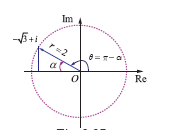
Modulus = 2 and
\(a={ tan }^{ -1 }\left| \frac { y }{ x } \right| ={ tan }^{ -1 }\frac { 1 }{ \sqrt { 3 } } =\frac { \pi }{ 6 } \)
Since the complex number \(-\sqrt { 3 } +i\) lies in the second quadrant has the principal value
\(\theta =\pi -\alpha =\pi -\frac { \pi }{ 6 } =\frac { 5\pi }{ 6 } \)
Therefore the modulus and principal argument of \(-\sqrt { 3 } +i\) are 2 and \(\frac { 5\pi }{ 6 } \) respectively.
4.
\(\left| \frac { i\left( 2+i \right) ^{ 2 } }{ \left( 1+i \right) ^{ 2 } } \right| =\frac { \left| i \right| \left| \left( 2+i \right) ^{ 3 } \right| }{ \left| \left( 1+i \right) ^{ 2 } \right| } =\frac { \left( \sqrt { 4+1 } \right) ^{ 3 } }{ \left( \sqrt { 2 } \right) ^{ 2 } } \) \(\left( \because \left| \frac { { z }_{ 1 } }{ { z }_{ 2 } } \right| =\left| \frac { { z }_{ 1 } }{ { z }_{ 2 } } \right| ,{ z }_{ 2 }\neq 0 \right) \)
= \(\frac { \left( \sqrt { 5 } \right) ^{ 3 } }{ 2 } =\frac { 5\sqrt { 5 } }{ 2 } \).
5.
\(\left| \left( \overline { 1+i } \right) \left( 2+3i \right) \left( 4i-3 \right) \right| =\left| \left( \overline { 1+i } \right) \right| \left| 2+3i \right| \left| 4i-3 \right| \) (\(\because \) |z1z2z3|=|z1|z2||z3|)
= |1+i| |2+3i| |-3+4i| \(\left( \because |z|=\left| \overline { z } \right| \right) \)
= \(\left( \sqrt { { 1 }^{ 2 }+{ 1 }^{ 2 } } \right) \left( \sqrt { { 2 }^{ 2 }+{ 3 }^{ 2 } } \right) \left( \sqrt { \left( 3 \right) ^{ 2 }+{ 4 }^{ 2 } } \right) \).
\(=(\sqrt{2})(\sqrt{13})(\sqrt{25})=5 \sqrt{26}\)
6.
i2i3...i40 = i1+2+3...+40 = \(i^{\frac{40 \times 41}{2}}=i^{820}=i^{0}=1 .\)
7.
\(\sum _{ n=1 }^{ 102 }{ { i }^{ n } } \) = (i1+i2+i3+i4)+(i5+i6+i7+i8)+....+(i97+i98+i99+i100)+i101+i102
= (i1+i2+i3+i4)+(i1+i2+i3+i4)+...+(i1+i2+i3+i4)+i-1+i-2
= {i+(-1)+(-i)+1}+{i+(-1)+(-i)}+......+{i+(-1)+(-i)+1}+i+(-1)
= 0+0+...0+i-1
= -1+i
8.
(i)-1924+ (i)2018 = (i)-1924 + 0 + (i)2016 + 2 = (i)0 + (i)2 = 1 - 1 = 0
9.
i1729 = i1728 i1 = i
10.
-5 -12i
Let z = -5 -12i
⇒ \(\sqrt { { (-5) }^{ 2 }+(-12)^{ 2 } } \)
= \(\sqrt { 25+144 } =\sqrt { 169 } \) = 13
\(\sqrt { a+ib } =\pm \left( \sqrt { \frac { |z|+a }{ 2 } } +i\frac { b }{ |b| } \sqrt { \frac { |z|-a }{ 2 } } \right) \)
\(\sqrt { -5-12i } \pm \left( \sqrt { \frac { 13-5 }{ 2 } } +i\frac { (-12) }{ |-12| } \sqrt { \frac { 13+5 }{ 2 } } \right) \)
\(\pm \left( \sqrt { \frac { 8 }{ 2 } } +i\sqrt { 9 } \right) \)
[∵ |-12| = 12]
\(\pm (\sqrt { 4 }- i3)\) = ±(2 - 3i)
Aliter :
Square root of -5 -12i
Let a + ib = -5 -12i
a = -5, b = -12
\(|z|=\sqrt{5^{2}+12^{2}}=\sqrt{169}=13\)
\(\left.\sqrt{a+i b}=\pm \sqrt{\frac{\sqrt{a^{2}+b^{2}}+a}{2}}+i \frac{b}{|b|} \sqrt{\frac{\sqrt{a^{2}+b^{2}}-a}{2}}\right]\)
\(=\pm\left[\sqrt{\frac{13-5}{2}}-i \sqrt{\frac{13+5}{2}}\right]\) [\(\because\) b is negative]
\(=\pm(2-3 i)\)
11.
Let z = -6+8i
|z| =\(\sqrt { (-6)^{ 2 }+8^{ 2 } } \)
= \(\sqrt { 36+64 } =\sqrt { 100 } \) = 10
\(\sqrt { a+ib } =\pm \left( \sqrt { \frac { |z|+a }{ 2 } } +i\frac { b }{ |b| } \sqrt { \frac { |z|-a }{ 2 } } \right) \)
[Here |z| = 10, a = -6, b = 8]
\(\sqrt { -6+8i } \pm \left( \sqrt { \frac { 10-6 }{ 2 } } +i\frac { 8 }{ |8| } \sqrt { \frac { 10+6 }{ 2 } } \right) \)
= \(\pm \left( \sqrt { \frac { 4 }{ 2 } } +i\sqrt { \frac { 16 }{ 2 } } \right) \)
= \(\pm (\sqrt { 2 } +i\sqrt { 8 } )\)
= \(\\ \pm (\sqrt { 2 } +i2\sqrt { 2 } )\)
Aliter :
Square root of -6 + 8i
Let a + ib = - 6 + 8i
a = -6, b = 8
\(|z|=\sqrt{6^{2}+8^{2}}=\sqrt{100}=10\)
\(\sqrt{a+i b}=\pm\left[\sqrt{\frac{\sqrt{a^{2}+b^{2}}+a}{2}}+i \frac{b}{|b|} \sqrt{\frac{\sqrt{a^{2}+b^{2}}-a}{2}}\right]\)
\(=\pm\left[\sqrt{\frac{10-6}{2}}+i \sqrt{\frac{10+6}{2}}\right]\)
\(=\pm[\sqrt{2}+i \quad 2 \sqrt{2}]\)
12.
2i(3−4i)(4−3i)
Let z = 2i(3−4i)(4−3i).
∴ |z| = |2i(3-4i)(4-3i)|
= |2i| |3-4i| |4-3i|
= \(\sqrt { { 2 }^{ 2 } } \sqrt { { 3 }^{ 2 }+(-4)^{ 2 } } \sqrt { { 4 }^{ 2 }+(-3)^{ 2 } } \)
= \(\\ 2.\sqrt { 9+16 } \sqrt { 16+9 } =2.\sqrt { 25 } .\sqrt { 25 } \)
= 2(5)(5) = 50
13.
(1-i)10
Let z = (1- i)10
|z| = |1- i|10 = \(\left[ \sqrt { { 1 }^{ 2 }+(-1)^{ 2 } } \right] ^{ 10 }\)
= \(\left[ \sqrt { 2 } \right] ^{ 10 }\) = 21/2 x 10 = 25 = 32
14.
\(\frac { 2-i }{ 1+i } +\frac { 1-2i }{ 1-i } \)
Let z = \(\frac { 2-i }{ 1+i } +\frac { 1-2i }{ 1-i } \)
= \(\frac { (2-i)(1-i)+(1-2i)(1+i) }{ (1+i)(1-i) } \)
= \(\frac { 2-2i-i+{ i }^{ 2 }+1+i-2i-2i^{ 2 } }{ { 1 }^{ 2 }-{ i }^{ 2 } } \)
= \(\\ \frac { 2-i-1+1-i+2 }{ 2 } =\frac { 4-4i }{ 2 } \)
= \(\frac { 2(2-2i) }{ 2 } \) = 2 - 2i
∴ |z| = \(\sqrt { { 2 }^{ 2 }+(-2)^{ 2 } } =\sqrt { 4+4 } =\sqrt { 8 } =2\sqrt { 2 } \)
15.
\(Re\left( z \right) =\frac { z+\bar { z } }{ 2 } \) and Im\(\left( z \right) =\frac { z-\bar { z } }{ 2i } \)
Let z = x+iy where x is the Re(x) and y is the Im (z)
Then \(\bar { z } \) = x-iy
z+\(\bar { z } \) = x + iy + x - iy = 2x
∴ \(\frac { z+\bar { x } }{ 2 } \) = x
\(\frac { z+\bar { x } }{ 2 } \) = Re(z)
Also z-\(\bar { z } \) = x+iy-(x-iy)
= x+iy-x+iy = 2iy
\(\frac { z-\bar { z } }{ 2i } \) = y
∴ \(\frac { z-\bar { z } }{ 2i } \) = Im(z)
Hence proved
16.
Im(3z+4\(\bar { z } \)−4i)
= Im (3(x+iy)+4(x-iy)-4i)
= Im (3x+i3y+4x-i4y-4i)
= Im (3x+4x+i(3y-4y-4)
= Im (7x+i(-y-4))
∴ Imaginary part is -y - 4
17.
Re(i\(\bar { z } \))
= Re (i(x - iy))
[∵ when z = x + iy, \(\bar { z } \) = x - iy]
= Re (ix - i2y)
= Re (ix + y) [∵ i2 = -1]
= Re (y + ix)
∴ Real part is y
18.
\(\overline { 3i } +\frac { 1 }{ 2-i } \)
= - 3i + \(\frac { 1 }{ 2-i } \times \frac { 2+i }{ 2+i } \)
[∴ Conjugate of 3i is -3i]
= - 3i + \(\frac { 2+i }{ 2^{ 2 }-{ i }^{ 2 } } =-3i+\frac { 2+i }{ 4+1 } \)
= - 3i + \(\frac { 2+i }{ 5 } \)
= \(\frac { -15i+2+i }{ 5 } =\frac { -14i+2 }{ 5 } \)
\(=\frac { 2 }{ 5 } -\frac { 14}{ 5 }i \).
19.
\(\cfrac { 10-5i }{ 6+2i } \)
\(\frac { 10-5i }{ 6+2i } \times \frac { 6-2i }{ 6-2i } \)
[Multiply and divided by the conjugate of the denominator]
= \(\frac { 60-20i-30i+10{ i }^{ 2 } }{ { 6 }^{ 2 }-(2i)^{ 2 } } =\frac { 60-50i-10 }{ 36+4 } \)
= \(\frac { 50-50i }{ 40 } =\frac { 50(1-i) }{ 40 } \)
\(=\frac { 5 }{ 4 } \)(1 - i)
20.
(z+w)2
= [(5-2i)+(-1+ 3i)]2 = (4+ i)2
= 16 + i2+ 8i =16 -1+8i
= 15+ 8i
21.
z2+ 2zw +w2
(5-2i)2+2(5-2i)(-1+3i)+(-1+3i)2
= 25 + 4i2- 20i + 2 [-5 + 15i + 2i - 6i2] + 1 + 9i2-6i [∴ i2 = -1]
= 25 - 4 - 20i + 2(-5 + 17i + 6) +1-9 -6i
= 21- 20i + 2(1+17i) -8 -6i
= 21- 20i + 2 + 34i -8 -6i
= 15 + 8i
22.
z w
= (5-2i)(-1+3i)
= -5+15i+2i-6i2
= -5+17i-6(-1)
= -5+17i+6
= 1+17i
23.
2z+3w
= 2(5-2i)+3(-1+3i)
= 10-4i-3+9i
= (10-3)+ i(-4+9)
= 7+5i
24.
z-iw
= (5-2i) - i(-1+3i)
= (5-2i) + (+1-3i2)
5 - 2i + i - 3(-1) = 5 - i + 3 = 8 - i
25.
i1+50 + i2+50 + ....+ i10+50
= i51+ i52+ ....+ i60
Taking i50 common we get,
i50 [i + i2+ i3+ i4) + (i5+ i6+ i7+ i8) + i9+ i10]
= i50[0 + (i4+1+ i4+2+ i4+3+ i4+4) + (i8+1 + i8+2)]
= i50 [0 + 0 + i + i2] [∵ i + i2+ i3+ i4 = 0]
= i50 [i-1] = i48+2(i-1)
= i2(i-1) [∴ i48 = 1]
= -1(i-1) = -i+1 = 1-i
26.
i i2 i3 ....i2000
= i1+2+3+.....+2000
= \({ i }^{ \frac { 2000\times 2001 }{ 2 } }\)
[∴ 1+2+3+....n = \(\frac { n(n+1) }{ 2 } \)]
= i1000 x 2001
= i2001000
= 1
[∴ 2001000 is divisible by 4 as its last two digits are divisible by 4]
27.
\({ i }^{ 59 }+\frac { 1 }{ { i }^{ 59 } } \)
i4 \(\times\) 14 + 3 + i-(4 \(\times\) 14 + 3)
= (i4)14.i3 + (i4)-14.i-3
= 1.i3+1.i-3 [∵ i4 = 1]
= -i + i [∴ i3 = -i and i-3= i]
= 0
28.
\(\overset { 12 }{ \underset { n-1 }{ \Sigma } } \)in
\(\overset { 12 }{ \underset { n-1 }{ \Sigma } } \)in = (i1+i2+i3+i4)+(i5+i6+i7+i8)+(i9+i10+i11+i12)
= (i-1-i+1)+(i4+1+i4+2+i4+3+(i4)2+(i8+1+i8+2+i8+3+(i4)3)
= 0+(i+i2+i3+i4)+(i1+i2+i3+i4)
[∴ i2 = -1, i3 = -i, i4 = 1]
= 0 +(i-1-i+1)+(i-1-i+1)
= 0+0+0 = 0
29.
i1948-i-1869
(i4)487-[i-1868.i-1]
= 1487-\(\left[ (i^{ 4 })^{ -467 }.\frac { 1 }{ i } \right] \) [i4 = 1]
= 1 - [1.(-i)] [∴ i-1 = \(\frac { 1 }{ i } \) = -i]
[One power any number is 1]
= 1 + i
30.
\(\sqrt { 3 } +i\)
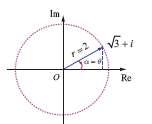
Modulus = \(\sqrt { { x }^{ 2 }+{ y }^{ 2 } } =\sqrt { \left( \sqrt { 3 } \right) ^{ 2 }+{ 1 }^{ 2 } } =\sqrt { 3+1 } =2\)
\(\alpha =tan^{ -1 }\left| \frac { y }{ x } \right| =tan^{ -1 }\frac { 1 }{ \sqrt { 3 } } =\frac { \pi }{ 6 } \)
Since the complex number \(\sqrt { 3+ } i\) lies in the first quadrant, has the principal value
\(\theta =\alpha =\frac { \pi }{ 6 } \)
Therefore, the modulus and principal argument of \(\sqrt { 3+ } i\) are 2 and \(\frac { \pi }{ 6 } \) respectively.
31.
let z = |4+3i|
= \(\\ \sqrt { { 4 }^{ 2 }+{ 3 }^{ 2 } } =\sqrt { 16+9 } =\sqrt { 25 } \)
\(\sqrt { a+ib } =\pm \sqrt { \frac { |z|+a }{ 2 } } +i\frac { b }{ |b| } \sqrt { \frac { |z|-a }{ 2 } } \)
[Here |z| = 5, a = 4, b = 3]
\(\sqrt { 4+3i } =\pm \sqrt { \frac { 5+4 }{ 2 } } +i\frac { 3 }{ |3| } \sqrt { \frac { 5-4 }{ 2 } } \)
= \(\pm \sqrt { \frac { 9 }{ 2 } } +i\frac { 3 }{ 3 } \sqrt { \frac { 1 }{ 2 } } \)
= \(\pm \frac { 3 }{ \sqrt { 2 } } + \frac { i }{ \sqrt { 2 } } \)
Aliter :
Square root of 4 + 3i
Formula method
\(\sqrt{a+i b}=\pm\left[\sqrt{\frac{\sqrt{a^{2}+b^{2}}+a}{2}}+i \frac{b}{|b|} \sqrt{\frac{\sqrt{a^{2}+b^{2}}-a}{2}}\right]\)
Now, \(|4+3 i|=\sqrt{4^{2}+3^{2}}=\sqrt{16+9}=\sqrt{25}=5\)
\(\therefore \sqrt{4+3 i}=\pm\left[\sqrt{\frac{5+4}{2}}+i \sqrt{\frac{5-4}{2}}\right]\)
\(=\pm\left[\frac{3}{\sqrt{2}}+i \frac{1}{\sqrt{2}}\right]\)
32.
Given |z| = 3
Show that 7 ≤ |z+6-8i| ≤ 13
|z+6-8i| ≤ |z|+|6-8i|
[Triangle law of inequality]
\(\le 3\sqrt { { 6 }^{ 2 }+({ -8) }^{ 2 } } \le 3+\sqrt { 36+64 } \le +\sqrt { 1w } \)
|z+6-8i| ≤3+10 ≤ 13 ............... (1)
Also ||z+6-8i| ≥ |x|-|6-8i| ≥ \(|3-\sqrt { { 6 }^{ 2 }+(-8)^{ 2 } } |\)
≥ \(|3-\sqrt { 36+84 } |\) ≥ |3-10| ≥ |-7| ≥ 7 ............... (2)
From (1) and (2) we get,
7 ≤ |z+6-8i| ≤ 13.
33.
\(\frac { 2i }{ 3+4i } \)
Let z = \(\frac { 2i }{ 3+4i } \)
|z| = \(\left| \frac { 2i }{ 3+4i } \right| =\frac { |2i| }{ |3+4i| } =\frac { \sqrt { 2^{ 2 } } }{ \sqrt { { 3 }^{ 2 }+{ 4 }^{ 2 } } } =\frac { 2 }{ \sqrt { 9+16 } } \)
= \(\frac { 2 }{ \sqrt { 25 } } =\frac { 2 }{ 5 } \).
34.
We compute \(\left| 6-8i \right| =\sqrt { { 6 }^{ 2 }+\left( -8 \right) ^{ 2 } } =10\)
and applying the formula for square root, we get
\(\sqrt { 6-8i } =\pm \left( \sqrt { \frac { 10+6 }{ 2 } } -i\sqrt { \frac { 10-6 }{ 2 } } \right) \) (\(\therefore\) b is negative\( \frac{b}{|b|}=-1 \))
= \(\pm \left( \sqrt { 8 } +i\sqrt { 2 } \right) \)
= \(\pm \left( 2\sqrt { 2 } -i\sqrt { 2 } \right) \)
35.
\(\left| \frac { 2+i }{ -1+2i } \right| =\frac { \left| 2+i \right| }{ \left| -1+2i \right| } =\frac { \sqrt { { 2 }^{ 2 }+{ 1 }^{ 2 } } }{ \sqrt { \left( -1 \right) ^{ 2 }+{ 2 }^{ 2 } } } =1\) \(\left( \because \left| \frac { { z }_{ 1 } }{ { z }_{ 2 } } \right| =\left| \frac { { z }_{ 1 } }{ { z }_{ 2 } } \right| ,{ z }_{ 2 }\neq 0 \right) \)
36.
Prove the following properties
Z is real if and only if z =\(\bar { z } \)
Let z = x+iy
Then \(\bar { z } \) = x+iy
z = \(\bar { z } \)
⇔ x + iy = x-iy
⇔ x + iy - x + iy = 0
⇔ 2iy = 0
⇔ y = 0
[∴ 2 and i are constants]
when y = 0, z = x which is real
∴ z is purely ⇔ z = \(\bar { z } \)
37.
Given z1= 2 - i and z2= -4+3i
z1z2 = (2-i)(-4+3i)
= -8 + 6i + 4i - 3i2
= -8 +10i - 3(-1)
= -8 +10i + 3 = -5 +10i
Inverse of z1z1 is \(\frac { 1 }{ { z }_{ 1 }{ z }_{ 2 } } \)
= \(\frac { 1 }{ -5+10i } \times \frac { -5-10i }{ -5-10i } \)
= \(\frac { -5-10i }{ (-5)^{ 2 }-(10i)^{ 2 } } \)
= \(\frac { -5-10i }{ 25-100i^{ 2 } } \)
= \(\frac { -5-10i }{ 25+100 } \) [∵ i2 = -1]
\(=\frac{\not{5}(-1-2 i)}{\not{5}\langle(2 5)}=\frac{-1-2 i}{25}\)
∴ Inverse of z1z2 is \(\frac { 1 }{ 25 } \) (-1-2i)
Inverse of \(\frac { { z }_{ 1 } }{ { z }_{ 2 } } \) is \(\frac { 1 }{ \frac { { z }_{ 1 } }{ { z }_{ 2 } } } =\frac { { z }_{ 2 } }{ { z }_{ 2 } } \)
∴ Inverse of \(\frac { { z }_{ 1 } }{ { z }_{ 2 } } =\frac { { z }_{ 2 } }{ { z }_{ 1 } } =\frac { -4+3i }{ 2-i } \times \frac { 2+i }{ 2+i } \)
= \(\frac { -4+3i }{ 2-i } \times \frac { 2+i }{ 2+i } \)
= \(\frac { -8-4i+6i+3i^{ 2 } }{ 2^{ 2 }-({ i }^{ 2 }) } \)
= \(\frac { -8+2i-3 }{ 4+1 } =\frac { -11+2i }{ 5 }\)
\( =\frac { 1 }{ 5 } \)(-11 + 2i)
∴ Inverse of \(\frac { { z }_{ 1 } }{ { z }_{ 2 } } \) is \(\frac { -11+2i }{ 5 }\)or \(\frac { 1 }{ 5 } \)(-11 + 2i)
38.
39.
\(\overline { \left( 5+9i \right) +\left( 2-4i \right) } \)
= \(\overline { (5+2)+(9i-4i) } =\overline { 7+5i } \)
= 7 - 5i [∵ Conjugate of 7 + 5i is 7 - 5i]
40.
Represent z, iz and z + iz in the Argand diagram.
z = 2 + 3i can be represented as (2,3)
iz = i(2 + 3i)
= 2i + 3i2
= 2i-3
= -3 + 2i can be represented as (-3, 2)
z + iz = 2 + 3i - 3 + 2i = -1 + 5i can be represented as (-1, 5) in the argand diagram.
41.
(z+w)
= (5-2i) + (-1+3i)
= (5-1) + i(-2+3)
= 4+i(1)
= 4+i
42.
i1947+ i1950
i1947+i1950 = i1944.i3+i1948.i2
[∴ 1944 is a multiple of 4, or 1948 is also a multiple of 4]
= (i4)486.i2.i1+(i4)487.i2 [i4 = 1]
= (1486)(-1) + (1)487(-1) [i2= -1]
= -i-1
= -(1- i)
43.
(i)7= (i)4+3 = (i)3 = -i
44.
We have |2z-3-i| = 3
|2(x + iy)-3 - i| = 3
Squaring on both sides, we get
|(2x - 3) + (2y - 1)i|2 = 9
\(\Rightarrow\) (2x - 3)2 + (2y - 1)2 = 9
\(\Rightarrow\) 4x2 + 4y2 -12x - 4y + 1 = 0, the locus of z in Cartesian form
45.
\(\frac { i-1 }{ cos\frac { \pi }{ 3 } +isin\frac { \pi }{ 3 } } \)
Let x+iy = \(\frac { i-1 }{ cos\frac { \pi }{ 3 } +isin\frac { \pi }{ 3 } } \)
Consider i-1 = -1+i = r
(cos θ+isin θ)
r = \(\sqrt { (-1)^{ 2 }+{ 1 }^{ 2 } } =\sqrt { 2 } \)
θ = \(tan^{ -1 }\left| \frac { y }{ x } \right| =tan^{ -1 }\left| \frac { 1 }{ -1 } \right| \)
= tan-1(1) = \(\frac { \pi }{ 4 } \)
Since (-1+i) lies in the II quadrant
[x is -ve and y is +ve]
Its principal value θ = \(\\ \pi -\frac { \pi }{ 4 } =\frac { 3\pi }{ 4 } \)
∴ i-1 = \(\sqrt { 2 } \left[ cos\left( \frac { 3\pi }{ 4 } \right) +isin\left( \frac { 3\pi }{ 4 } \right) \right] \)
∴ x+iy = \(\frac { \sqrt { 2 } \left[ cos\left( \frac { 3\pi }{ 4 } \right) +isin\left( \frac { 3\pi }{ 4 } \right) \right] }{ cos\frac { \pi }{ 4 } +isin\frac { \pi }{ 3 } } \)
[∵ \(\frac { cos{ \theta }_{ 1 }+isin{ \theta }_{ 1 } }{ cos\theta _{ 2 }+isin\theta _{ 2 } } \) = cos(θ1 - θ2) + i sin(θ1 - θ2)]
= \(\sqrt { 2 } \left[ cos \right] \left( \frac { 3\pi }{ 4 } -\frac { \pi }{ 3 } \right) +isin\left( \frac { 3\pi }{ 4 } -\frac { \pi }{ 3 } \right) \)
= \(\sqrt { 2 } \left[ cos\frac { 5\pi }{ 12 } +isin\frac { 5\pi }{ 12 } \right] \)
Hence the polar form is math where
\(\sqrt { 2 } \left[ cos\left( 2k\pi +\frac { 5\pi }{ 12 } \right) +isin\left( 2k\pi +\frac { 5\pi }{ 12 } \right) \right] \)where k \(\in \) Z.
46.
2-i2
Let x + iy = -2-2i = r(cos θ + isin θ)
r =\(\sqrt { { x }^{ 2 }+{ y }^{ 2 } } =\sqrt { (-2)^{ 2 }+(-2)^{ 2 } } =\sqrt { 4+4 } \)
= \(\sqrt { 8 } =2\sqrt { 2 } \)
α = \(tan^{ -1 }\left| \frac { y }{ x } \right| =tan^{ -1 }\left| \frac { -2 }{ -2 } \right| =tan^{ -1 }(1)=\frac { \pi }{ 4 } \)
Since the complex number -2-2i lies in the III quadrant [x is -ve, y is -ve]
Its principal value θ = α-π
⇒ θ =\(\frac { \pi }{ 4 } -\pi =\frac { \pi -4\pi }{ 4 } =-\frac { 3\pi }{ 4 } \)
Its polar form is
-2-2i = 2\(\sqrt { 2 } \)\(\left[ cos\left( 2k\pi -\frac { 3\pi }{ 4 } \right) +isin\left( 2k\pi -\frac { 3\pi }{ 4 } \right) \right] ,k\in Z\).
47.
\(3-i\sqrt { 3 } \)
Let x + iy = \(3-i\sqrt { 3 } \)
= r(cos θ + i sin θ)
r = \(\\ \sqrt { { x }^{ 2 }+{ y }^{ 2 } } =\sqrt { 3^{ 2 }+(\sqrt { 3 } )^{ 2 } } =\sqrt { 9+3 } \)
= \(\sqrt { 12 } =2\sqrt { 3 } \)
α = \(tan^{ -1 }\left| \frac { y }{ x } \right| =tan^{ -1 }\left| \frac { -\sqrt { 3 } }{ 3 } \right| =tan^{ -1 }\left| \frac { 1 }{ \sqrt { 3 } } \right| =\frac { \pi }{ 6 } \)
Since the complex number \(3-i\sqrt { 3 } \) lies in the IV quadrant, [∵ x ⟶ +ve y ⟶ -ve]
Its principal value θ = -α
⇒ θ = \(\frac { \pi }{ 6 } \)
∴ Its polar form is
\(3-i\sqrt { 3 } \) = 2\(\sqrt { 3 } \)\(\left[ cos\left( 2k\pi -\frac { \pi }{ 6 } \right) +isin\left( 2k\pi -\frac { \pi }{ 6 } \right) \right] ,k\in Z\)
48.
\(\overline { z } \) = z-1
⇒ \(\overline { z } \) =\(\frac{1}{z}\)
⇒ z\(\overline { z } \) = 1
⇒ |z|2 = 1
⇒ x2 + y2 = 1 which is the required Cartesian equation.
Aliter :
\( \bar{z} =z^{-1} \)
\(x-i y =\frac{1}{x+i y} \)
\(x-i y =\frac{1}{x+i y} \times \frac{x-i y}{x-i y} \)
\(x-i y =\frac{x-i y}{x^{2}+y^{2}} \)
\(x^{2}+y^{2} =1\)
49.
|z+i| = |z-1|
⇒ |x + iy +i| = |x + iy-1|
⇒ |x + i(y + 1)| = |(x - 1) + iy|
⇒ \(\sqrt { { x }^{ 2 }+(y+1)^{ 2 } } =\sqrt { (x-1)^{ 2 }+y^{ 2 } } \)
⇒ x2 + (y + 1)2 =(x- 1)2 + y2
[ squaring both sides]
\(\Rightarrow \not x^{2}+ \not y^{2}+2 y+ \not1= \not x^{2}-2x+ \not 1+ \not y^2\)
⇒ 2y + 2x = 0
⇒ x + y = 0
Hence, the Cartesian equation is x + y = 0
50.
Im[(1−i)z + 1] = 0
(1-i)z + 1 = (1-i)( x + iy) +1
= x + iy-ix-i2y+1
= x+iy-ix+y+1
= (x + y + 1) + i(y - x)
∴ Im[(1-i)z + 1] = y-x = 0
⇒ x - y = 0
Hence, the Cartesian equation is x - y = 0
51.
Since z is purely imaginary
z = -\(\overline { z } \)
∴ 2n\(\left[ cos\frac { n\pi }{ 6 } +isin\frac { n\pi }{ 6 } \right] \)
= -2n\(\left[ cos\frac { n\pi }{ 6 } +isin\frac { n\pi }{ 6 } \right] \) [From (1) & (2)]
\(\Rightarrow \cos \frac{n \pi}{6}+ i{\not \sin \frac{m \pi}{6}}=-\cos \frac{n \pi}{6}+i {\not\sin \frac{m \pi}{6}}\)
⇒ 2cos\(\frac { n\pi }{ 6 } \) = 0
⇒ \(cosn\frac { \pi }{ 6 } =0=cos\frac { \pi }{ 2 } \)
[∴ cos \(\frac { \pi }{ 2 } \) = 0]
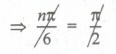
⇒ n = \(\frac{6}{2}\)
⇒ n = 3
Hence z is purely imaginary
52.
We have |z| - |z - i|
\(\Rightarrow\)|x + iy| = |x + iy - i|
\(\Rightarrow\) \(\sqrt { { x }^{ 2 }+{ y }^{ 2 } } =\sqrt { { x }^{ 2 }+\left( y-1 \right) ^{ 2 } } \)
\(\Rightarrow x^{2}+y^{2}=x^{2}+y^{2}-2 y+1\)
\(\Rightarrow\) 2y -1 = 0
53.
2 +i2\(\sqrt { 3 } \)
Let 2+i2\(\sqrt { 3 } \) = x + iy = r (cosθ + i sinθ)
r = modulus =\(\\ \sqrt { { x }^{ 2 }+{ y }^{ 2 } } \)
=\(\\ \sqrt { { 2 }^{ 2 }+(2\sqrt { 3 } )^{ 2 } } \)
= \(\sqrt { 4+12 } =\sqrt { 16 } \) = 4
α = tan-1\(\left| \frac { y }{ x } \right| =tan^{ -1 }\left| \frac { 2\sqrt { 3 } }{ 2 } \right| \)
= \(tan^{ -1 }(\sqrt { 3 } )=\frac { \pi }{ 3 } \)
Since the complex number 2+i2 \(\sqrt { 3 } \) lies in the I quadrant, [x, y both +ve] its principal value θ = α = \(\frac { \pi }{ 3 } \)
∴ Its polar form is 2+i2\(\sqrt { 3 } \)
= 4\(\left[ cos\left( 2k\pi +\frac { \pi }{ 3 } \right) +isin\left( 2k\pi +\frac { \pi }{ 3 } \right) \right] ,k\in Z\).
54.
\(\left[ Re\left( iz \right) \right] ^{ 2 }=3\)
iz = i(x + iy) = ix + i2y = ix - y = -y + ix
⇒ Re(iz) = -y
[Re(iz)]2 = -y
⇒ (-y)2 = 3
⇒ y2 = 3
Hence, the Cartesian equation is y2 = 3
55.
Given z = x + iy
Consider \(\left| \frac { z-4i }{ z+4i } \right| =1\Rightarrow \left| \frac { x+iy-4i }{ x+iy+4i } \right| \)=1
⇒ \(\left| \frac { x+i(y-4) }{ x+i(y+4) } \right| \)
⇒ \(\frac { \sqrt { { x }^{ 2 }+(y-4)^{ 2 } } }{ \sqrt { { x }^{ 2 }+((y+4)^{ 2 } } } \) = 1
⇒ \(\sqrt { { x }^{ 2 }+(y-4)^{ 2 } } =\sqrt { { x }^{ 2 }+(y+4)^{ 2 } } \)
Squaring both sides we get,
x2+(y-4)2 = x2+(y+4)2
\(\Rightarrow \not x^{2}+\not y^{2}-8 y+\not 16=\not x^{2}+\not y^{2}+8 y+\not 16\)
⇒ 8y+8y = 0
⇒ 16y = 0
⇒ y = 0 [∵ 16 ≠ 0]
y = 0 is the equation of real axis Locus of z is the real axis.
56.
We have, \({ z }^{ 2 }=\bar { z } \)
\(\Rightarrow|z|^{2}=|z|\)
\(\left| z \right| \left( \left| z \right| -1 \right) =0\)
\(\Rightarrow \left| z \right| =0,or\left| z \right| =1\)
\(|z|=0 \Rightarrow z=0\) is a solution \(\left| z \right| =1\Rightarrow z\bar { z } =1\Rightarrow \bar { z } =\frac { 1 }{ z } \)
Given \({ z }^{ 2 }=\bar { z } \Rightarrow { z }^{ 2 }=\frac { 1 }{ z } \Rightarrow { z }^{ 3 }=1\)
It has 3 non-zero solutions. Hence including zero solution, there are four solutions.
57.
The distance between origin to z = i, −2 + i, and 3 are
|z| = |i| = 1
|z| = |−2+i| = \(\sqrt { \left( -2 \right) ^{ 2 }+{ 1 }^{ 2 } } =\sqrt { 5 }\)
|z| = |3| = 3
Since \(1<\sqrt { 5 } <3\), the farthest point from the origin is 3 .
58.
Let x = \(\left( \sqrt { 3 } +i \right) ^{ n }\)
x = \((\sqrt { 3 } +i)^{ n }=\left[ 2\left( \frac { \sqrt { 3 } +i }{ 2 } \right) \right] ^{ n }\)
= 2n\(\left[ \frac { \sqrt { 3 } }{ 2 } +\frac { i }{ 2 } \right] ^{ n }\)
[Multiply and divide by 2]
= 2n\(\left[ cos\frac { \pi }{ 6 } +isinn\frac { \pi }{ 6 } \right] ^{ n }\)
= 2n\(\left[ cosn\frac { \pi }{ 6 } +isinn\frac { \pi }{ 6 } \right] \)...(1)
\(\overline { z } \) = 2n\(\left[ cos\frac { \pi }{ 6 } -isinn\frac { \pi }{ 6 } \right] \) ....(2)
Since z is real, z = \(\overline { z } \)
⇒ 2n\(\left[ cos\ n\frac { \pi }{ 6 } +i\ sin\ n\frac { \pi }{ 6 } \right] \)
= 2n\(\left[ cos\ n\frac { \pi }{ 6 } -i\ sin \ n\frac { \pi }{ 6 } \right] \)
[From (1) and (2)]
⇒ 2i sin n\(\frac { \pi }{ 6 } \)= 0 ⇒ sin n \(\frac { \pi }{ 6 } \)= 0
⇒ sin n\(\frac { \pi }{ 6 } \) = sinπ [∴ sin π = 0]
⇒ \(\frac { n\pi }{ 6 } =\pi \Rightarrow \frac { n }{ 6 } \)=1 ⇒ n = 6
59.
Since,\(\left| { z }_{ 1 } \right| =\left| { z }_{ 2 } \right| =\left| { z }_{ 3 } \right| =1\)
\(\left| { z }_{ 1 } \right| ^{ 2 }=1\Rightarrow { z }\bar { { z }_{ 1 } } =1,\left| { z }_{ 2 } \right| ^{ 2 }=1\Rightarrow { z }_{ 2 }\bar { { z }_{ 2 } } =1\ \)
Therefore, \(\bar { { z }_{ 1 } } =\frac { 1 }{ { z }_{ 1 } } ,\bar { { z }_{ 2 } } =\frac { 1 }{ { z }_{ 3 } } \) and hence
\(\left| \frac { 1 }{ { z }_{ 1 } } +\frac { 1 }{ { z }_{ 2 } } +\frac { 1 }{ { z }_{ 3 } } \right| =\left| \bar { { z }_{ 1 } } +\bar { { z }_{ 2 } } +{ \bar { z } }_{ 3 } \right| \)
= \(\left| \overline { { z }_{ 1 }+\left| { z }_{ 2 }+{ z }_{ 3 } \right| } \right| ={ { z }_{ 1 }+{ z }_{ 2 }+{ z }_{ 3 } }=1\)

12th Standard Syllabus & Materials
12th Standard
TN 12th Computer Applications வலையமைப்பு வடமிடல் Sample Question Papers Study Material - QB365 Set A
NEW12th Standard
TN 12th Computer Applications களப்பெயர் முறைமை (DNS) Sample Question Papers Study Material - QB365 Set A
NEW12th Standard
TN 12th Computer Applications வலையமைப்பு எடுத்துக்காட்டுகள் மற்றும் நெறிமுறைகள் Sample Question Papers Study Material - QB365 Set A
NEW12th Standard
TN 12th Computer Applications கணினி வலையமைப்பு ஓர் அறிமுகம் Sample Question Papers Study Material - QB365 Set A



Tamilnadu Stateboard 12th Standard Subjects
Maths

Chemistry

Physics

Biology

Computer Science

Business Maths and Statistics

Economics

Commerce

Accountancy

History

Computer Applications
Biology
Computer Technology
Computer Applications
Computer Science
Business Maths and Statistics
Commerce
Economics
Maths
Chemistry
Physics
Computer Technology
History
Accountancy

Tamil

English

French
Tamilnadu Stateboard Standards

