
 100% FREE ACCESS
12th Standard Syllabus & Materials
12th Standard
TN 12th Maths Applications of Matrices and Determinants Sample Question Papers Study Material - QB365 Set A
NEW12th Standard
TN 12th Computer Applications மின்னணு தரவு பரிமாற்றம் Sample Question Papers Study Material - QB365 Set A
NEW12th Standard
TN 12th Computer Applications மின் - வணிக பாதுகாப்பு அமைப்புகள் Sample Question Papers Study Material - QB365 Set A
NEW12th Standard
TN 12th Computer Applications மின்னணு செலுத்தல் முறைகள் Sample Question Papers Study Material - QB365 Set A
NEW12th Standard
TN 12th Computer Applications மின் - வணிகம் Sample Question Papers Study Material - QB365 Set A
NEW12th Standard
TN 12th Computer Applications திறந்த மூல கருத்துருக்கள் Sample Question Papers Study Material - QB365 Set A

Published on: 02/02/2021
12th Standard Maths English Medium Complex Numbers Reduced Syllabus Important Questions 2021
Download Tamil Nadu 12th Standard Maths question papers, model tests, one-mark questions, important questions, and public exam papers in PDF format. Free study materials and answer keys for TN State Board students.
Questions + Answers key
Take MCQ Maths Test1.
Find the values of the real number x and y if 3x + (2x - 3y) i = 6 + 3i9.
2.
If z1 and z2 are 1-i, -2+4i then find Im\(\left( \frac { { z }_{ 1 }{ z }_{ 2 } }{ \bar { { z }_{ 1 } } } \right) \).
3.
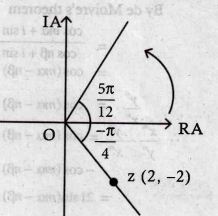
If z = 2−2i, find the rotation of z by θ radians in the counter clockwise direction about the origin when \(\theta =\frac { 2\pi }{ 3 } \).
4.
Show that the following equations represent a circle, and, find its centre and radius
\(\left| 2z+2-4i \right| =2\)
5.
Find the modulus of the following complex number \(\frac { 2-i }{ 1+i } +\frac { 1-2i }{ 1-i } \)
6.
Write the following in the rectangular form:
\(\overline { 3i } +\frac { 1 }{ 2-i } \).
7.
Evaluate the following if z = 5−2i and w = −1+3i
z w
8.
9.
Write the following in the rectangular form:
\(\overline { \left( 5+9i \right) +\left( 2-4i \right) } \)
10.
If z1= 3 - 2i and z2 = 6 + 4i, find \(\frac { { z }_{ 1 } }{ z_{ 2 } } \) in the rectangular form.
11.
If \(\frac { z+3 }{ z-5i } =\frac { 1+4i }{ 2 } \), find the complex number z in the rectangular form
12.
Verify that 2 arg(-1) ≠ arg(-1)2
13.
Show that \(\left( \frac { i+\sqrt { 3 } }{ -i+\sqrt { 3 } } \right) ^{ 2\omega }+\left( \frac { i-\sqrt { 3 } }{ i+\sqrt { 3 } } \right) ^{ 2\omega }\) = -1
14.
If z = x + iy and arg\(\left( \frac { z-1 }{ z+1 } \right) =\frac { \pi }{ 2 } \), then show that x2 + y2 = 1.
15.
Prove that the values of \(\sqrt [ 4 ]{ -1 } arr\ \pm \frac { 1 }{ \sqrt { 2 } } \left( 1\pm i \right) \). Let z = (-1)
16.
If z = x + iy and arg \(\left( \frac { z-i }{ z+2 } \right) =\frac { \pi }{ 4 } \), then show that x2 + y2 + 3x - 3y + 2 = 0
17.
If z1, z2, and z3 are three complex numbers such that |z1| = 1, |z2| = 2|z3| = 3 and |z1 + z2 + z3| = 1, show that⏐9z1z2 +4z1z3 +z2z3 ⏐ = 6
18.
If z = 1-cos θ + i sin θ, then |z| = _____________
2 sin\(\frac { 1 }{ 3 } \)
2 cos\(\frac { \theta }{ 2 } \)
2|sin\(\frac { \theta }{ 2 } \)|
2|cos\(\frac { \theta }{ 2 } \)|
19.
If \(\omega \neq 1\) is a cubic root of unity and \(\left| \begin{matrix} 1 & 1 & 1 \\ 1 & { -\omega }^{ 2 }-1 & { \omega }^{ 2 } \\ 1 & { \omega }^{ 2 } & { \omega }^{ 7 } \end{matrix} \right| \) = 3k, then k is equal to
1
-1
\(\sqrt { 3i } \)
\(-\sqrt { 3i } \)
20.
21.
If \(\alpha \) and \(\beta \) are the roots of x2+x+1 = 0, then \({ \alpha }^{ 2020 }+{ \beta }^{ 2020 }\) is
-2
-1
1
2
22.
23.
The principal argument of \(\cfrac { 3 }{ -1+i } \) is
\(\cfrac { -5\pi }{ 6 } \)
\(\cfrac { -2\pi }{ 3 } \)
\(\cfrac { -3\pi }{ 4 } \)
\(\cfrac { -\pi }{ 2 } \)
24.
If z = x + iy is a complex number such that |z+2| = |z−2|, then the locus of z is
real axis
imaginary axis
ellipse
circle
25.
If z is a complex number such that \(z \in \mathbb{C} \backslash \mathbb{R}\) and \(z+\frac { 1 }{ z } \epsilon R\), then |z| is
0
1
2
3
26.
If |z1| = 1, |z2| = 2, |z3| = 3 and |9z1z2 + 4z1z3 + z2z3| = 12, then the value of |z1+z2+z3| is
1
2
3
4
27.
28.
If |z| = 1, then the value of \(\frac { 1+z }{ 1+\overline { z } }\) is
z
\(\bar { z } \)
\(\cfrac { 1 }{ z } \)
1
29.
If |z - 2 + i | ≤ 2, then the greatest value of |z| is
\(\sqrt { 3 } -2\)
\(\sqrt { 3 } +2\)
\(\sqrt { 5 } -2\)
\(\sqrt { 5 } +2\)
30.
If z is a non zero complex number, such that 2iz2 = \(\bar { z } \) then |z| is
\(\cfrac { 1 }{ 2 } \)
1
2
3
31.
If \(z=\cfrac { \left( \sqrt { 3 } +i \right) ^{ 3 }\left( 3i+4 \right) ^{ 2 } }{ \left( 8+6i \right) ^{ 2 } } \) , then |z| is equal to
0
1
2
3
32.
in+in+1+in+2+in+3 is
0
1
-1
i
33.
If \(\frac { (a+i)^{ 2 } }{ 2a-i } \) = p + iq, show that p2+q2 = \(\frac { ({ a }^{ 2 }+i)^{ 2 } }{ 4a^{ 2 }+1 } \).
34.
Find the locus of z if |3z - 5| = 3 |z + 1| where z = x + iy.
35.
Show that the complex numbers 3 + 2i, 5i, -3 + 2i and -i form a square.
36.
Explain the falacy:
37.
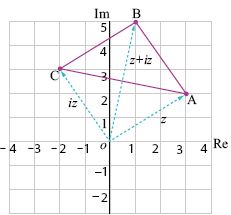
Given the complex number z = 3 + 2i, represent the complex numbers z, iz, and z + iz in one Argand diagram. Show that these complex numbers form the vertices of an isosceles right triangle.
38.
If \(\omega \neq 1\) is a cube root of unity, show that \(\left( 1+\omega \right) \left( 1+{ \omega }^{ 2 } \right) \left( 1+{ \omega }^{ 4 } \right) \left( 1+{ \omega }^{ 8 } \right) ...\left( 1+{ \omega }^{ { 2 }^{ 11 } } \right) =1\).
39.
Obtain the Cartesian form of the locus of z = x + iy in each of the following cases:
|z + i| = |z - 1|
40.
Obtain the Cartesian form of the locus of z = x + iy in each of the following cases:
Im[(1−i)z+1] = 0
41.
If z1 = 1-3i, z2 = - 4i, and z3 = 5, show that (z1z2)z3 = z1(z2z3)
42.
Show that \(\left( \frac { \sqrt { 3 } }{ 2 } +\frac { i }{ 2 } \right) ^{ 5 }+\left( \frac { \sqrt { 3 } }{ 2 } -\frac { i }{ 2 } \right) ^{ 5 }=-\sqrt { 3 } \)
1.
⇒ 3x + (2x - 3y)i = 6 + 3i9
⇒ 3x + (2x - 3y)i = 6 + 3 . i4 . i4 . i1
⇒ 3x + (2x - 3y)i = 6 + 3i
Equating the real and imaginary parts we get,
3x = 6 ⇒ x = 2
2x - 3y = 3 ⇒ 2(2) - 3y = 3
⇒ 4 - 3y = 3
⇒ 4 - 3 = 3y
⇒ 3y = 1 ⇒ y = \(\frac{1}{3}\)
∴ x = 2, y = \(\frac{1}{3}\).
2.
z1z2 = (1 - i)(-2 + 4i) = -2 + 4i + 2i - 4i2
= -2 + 6i + 4 = 2 + 6i
\(\bar { { z }_{ 1 } } \) = 1+i
∴ \(\frac { { z }_{ 1 }{ z }_{ 2 } }{ \bar { { z }_{ 1 } } } =\frac { 2+6i }{ 1+6i } \times \frac { 1-i }{ 1-i } =\frac { 2(1-i+3i-i^{ 2 }) }{ 1+1 } \)
= 1 + 2i + 3
= 4 + 2i
∴ Im\(\left( \frac { { z }_{ 1 }{ z }_{ 2 } }{ \bar { { z }_{ 1 } } } \right) \) = 2
3.
\(\theta =\frac { 2\pi }{ 3 } \)
When θ = \(\frac { \pi }{ 3 } \)
Roration of z is \(ze^{ i\theta }=ze^{ i2\frac { \pi }{ 3 } }\) [using (1)]
= \(2\sqrt { 2 } e^{ -i\frac { \pi }{ 4 } }.{ e }^{ i2\frac { \pi }{ 3 } }\) [using (1)]
= \(2\sqrt { 2 } e^{ i\left( i\frac { \pi }{ 3 } -\frac { \pi }{ 4 } \right) }=2\sqrt { 2 } e^{ i5\frac { \pi }{ 12 } }\)
4.
\(\left| 2z+2-4i \right| =2\)
2|z+1-2i| = 2
⇒ |z-(-1+2i)| = 1
It is of the form |z - z0| = r and so it represents a circle.
Its centre is (-1+2i) and radius is 1.
5.
\(\frac { 2-i }{ 1+i } +\frac { 1-2i }{ 1-i } \)
Let z = \(\frac { 2-i }{ 1+i } +\frac { 1-2i }{ 1-i } \)
= \(\frac { (2-i)(1-i)+(1-2i)(1+i) }{ (1+i)(1-i) } \)
= \(\frac { 2-2i-i+{ i }^{ 2 }+1+i-2i-2i^{ 2 } }{ { 1 }^{ 2 }-{ i }^{ 2 } } \)
= \(\\ \frac { 2-i-1+1-i+2 }{ 2 } =\frac { 4-4i }{ 2 } \)
= \(\frac { 2(2-2i) }{ 2 } \) = 2 - 2i
∴ |z| = \(\sqrt { { 2 }^{ 2 }+(-2)^{ 2 } } =\sqrt { 4+4 } =\sqrt { 8 } =2\sqrt { 2 } \)
6.
\(\overline { 3i } +\frac { 1 }{ 2-i } \)
= - 3i + \(\frac { 1 }{ 2-i } \times \frac { 2+i }{ 2+i } \)
[∴ Conjugate of 3i is -3i]
= - 3i + \(\frac { 2+i }{ 2^{ 2 }-{ i }^{ 2 } } =-3i+\frac { 2+i }{ 4+1 } \)
= - 3i + \(\frac { 2+i }{ 5 } \)
= \(\frac { -15i+2+i }{ 5 } =\frac { -14i+2 }{ 5 } \)
\(=\frac { 2 }{ 5 } -\frac { 14}{ 5 }i \).
7.
z w
= (5-2i)(-1+3i)
= -5+15i+2i-6i2
= -5+17i-6(-1)
= -5+17i+6
= 1+17i
8.
9.
\(\overline { \left( 5+9i \right) +\left( 2-4i \right) } \)
= \(\overline { (5+2)+(9i-4i) } =\overline { 7+5i } \)
= 7 - 5i [∵ Conjugate of 7 + 5i is 7 - 5i]
10.
Using the given value for z1 and z2 the value of \(\frac { { z }_{ 1 } }{ { z }_{ 2 } } =\frac { 3-2i }{ 6+4 } =\frac { 3-2i }{ 6+4i } \times \frac { 6-4i }{ 6-4i } \)
= \(\frac { \left( 18-8 \right) +i\left( 12-12 \right) }{ { 6 }^{ 2 }+{ 4 }^{ 2 } } =\frac { 10-24i }{ 52 } =\frac { 10 }{ 52 } =\frac { 24i }{ 52 } \)
= \(\frac { 5 }{ 26 } -\frac { 6 }{ 13 } i\)
11.
We have = \(\frac { z+3 }{ z-5i } =\frac { 1+4i }{ 2 } \)
\(\Rightarrow\) 2(z + 3) = (1 + 4i) (z− 5i)
\(\Rightarrow\) 2z + 6 = (1 + 4i)z + 20−5i
\(\Rightarrow\) (2−1−4i)z = 20− 5i− 6
\(\Rightarrow\) \(z=\frac { 14-5i }{ 1-4i } =\frac { \left( 14-5i \right) \left( 1+4i \right) }{ \left( 1-4i \right) \left( 1+4i \right) } =\frac { 34+51i }{ 17 } =2+3i\)
12.
LHS = 2 arg (-1)
= 2 arg (cos π + i sin π) = 2π
RHS = arg (-1)2 = arg (1)
= arg (cos θ + isin θ) = 0
∴ LHS ≠ RHS
13.
LHS = \(\left( \frac { i+\sqrt { 3 } }{ -i+\sqrt { 3 } } \right) ^{ 2\omega }+\left( \frac { i-\sqrt { 3 } }{ i+\sqrt { 3 } } \right) ^{ 2\omega }\)
= \(\left( \frac { \sqrt { 3 } +i }{ \sqrt { 3 } -i } \times \frac { \sqrt { 3 } +i }{ \sqrt { 3 } +i } \right) ^{ 2\omega }+\left( \frac { -\sqrt { 3 } +i }{ \sqrt { 3 } +i } \times \frac { \sqrt { 3 } -i }{ \sqrt { 3 } -1 } \right) ^{ 2\omega }\)
= \(\left( \frac { 3-1+2\sqrt { 3 } i }{ 3+1 } \right) ^{ 2\omega }+\left( \frac { -3+1+2\sqrt { 3 } i }{ 3+1 } \right) ^{ 2\omega }\)
= \(\left( \frac { 2+2\sqrt { 3 } i }{ 4 } \right) ^{ 2\omega }+\left( \frac { -2+2\sqrt { 3 } i }{ 4 } \right) ^{ 2\omega }\)
= \(\left( \frac { 1+\sqrt { 3 } i }{ 2 } \right) ^{ 2\omega }+\left( \frac { -2+2\sqrt { 3 } i }{ 2 } \right) ^{ 2\omega }\)
=\(\left[ -\left( \frac { -1-\sqrt { 3 } i }{ 2 } \right) \right] ^{ 2\omega }+\left[ \frac { -1+\sqrt { 3 } i }{ 2 } \right] ^{ 2\omega }\)
= (-ω2)2ω+(ω)2ω
[∴ ω = \(\frac { -1+i\sqrt { 3 } }{ 2 } \), ω2 = \(\frac { -1-i\sqrt { 3 } }{ 2 } \)]
= ω4ω+ω2ω
= (ω3)133. ω1 + (ω3)66.ω2
= 1.ω+1.ω2 [∴ 1+ω+ω2 = 0 & ω3 = 1]
= ω + ω2
= -1 = RHS
14.
Now, \(\frac { z-1 }{ z+1 } =\frac { x+iy-1 }{ x+iy+1 } =\frac { \left( x-1 \right) +iy }{ \left( x+1 \right) +iy } =\frac { \left[ \left( x-1 \right) +iy \right] \left[ \left( x+1 \right) -iy \right] }{ \left[ \left( x+1 \right) +iy \right] \left[ \left( x+1 \right) -iy \right] } \)
\(\Rightarrow \frac { z-1 }{ z+1 } =\frac { \left( { x }^{ 2 }+{ y }^{ 2 }-1 \right) +i\left( 2y \right) }{ \left( x+1 \right) ^{ 2 }+{ y }^{ 2 } } \)
Since, arg \(\left( \frac { z-1 }{ z+2 } \right) =\frac { \pi }{ 2 } \Rightarrow { tan }^{ -1 }\left( \frac { 2y }{ { x }^{ 2 }+{ y }^{ 2 }-1 } \right) \)= \(\frac { \pi }{ 2 } \)
\(\Rightarrow \frac { 2y }{ { x }^{ 2 }+{ y }^{ 2 }-1 } =tan\frac { \pi }{ 2 } \) ⇒ x2+ y2 − 1 = 0
\(\Rightarrow { x }^{ 2 }+{ y }^{ 2 }=1\)
15.
Let z = \((-1)^{ \frac { 1 }{ 4 } }\)
⇒ z = (cosπ+i sinπ)1/4
[∵ cos π = -1 and sin π = 0]
⇒ z = \(cos\frac { 1 }{ 4 } (2k\pi +\pi )+isin\frac { 1 }{ 4 } (2k\pi +\pi )\)
k = 0, 1, 2, 3
When k = 0
z = \(cos\frac { \pi }{ 4 } +isin\frac { \pi }{ 4 } =\frac { 1 }{ \sqrt { 2 } } +\frac { i }{ \sqrt { 2 } } =\frac { 1 }{ \sqrt { 2 } } (1+i)\)
When k = 1
z = \(cos\frac { 3\pi }{ 4 } +isin\frac { 3\pi }{ 4 } =cos\left( \pi -\frac { \pi }{ 4 } \right) +isin\left( \pi -\frac { \pi }{ 4 } \right) \)
= \(-cos\frac { \pi }{ 4 } +isin\frac { \pi }{ 4 }\)
[∵ \(\left( \pi -\frac { \pi }{ 4 } \right) \) is in the II quad and cosθ is -ve and sinθ is +ve]
= \(-\frac { 1 }{ \sqrt { 2 } } +\frac { i }{ \sqrt { 2 } } =\frac { 1 }{ \sqrt { 2 } } (-1+i)\)
When k = 2,
z = \(cos5\frac { \pi }{ 4 } +isin\frac { \pi }{ 4} \)
= \(cos\left( \pi +\frac { \pi }{ 4 } \right) +isin\left( \pi +\frac { \pi }{ 4 } \right) \)
= \(-cos\frac { \pi }{ 4\\ } -isin\frac { \pi }{ 4\\ } \)
[∵ \(\left( \pi +\frac { \pi }{ 4 } \right) \) is in the III quadrant Where cosθ and sinθ are -ve]
= \(-\frac { 1 }{ \sqrt { 2 } } -\frac { i }{ \sqrt { 2 } } =\frac { 1 }{ \sqrt { 2 } } (-1-i)\)
When k = 3
z = \(cos7\frac { \pi }{ 4\\ } +isin7\frac { \pi }{ 4\\ } \)
= \(cos\left( 2\pi \frac { \pi }{ 4 } \right) -isin\left( 2\pi -\frac { \pi }{ 4 } \right) \)
= \(cos\frac { \pi }{ 4 } -isin\frac { \pi }{ 4 } \)
[∵ \(\left( 2\pi -\frac { \pi }{ 4 } \right) \) is in the IV quadrant Where cosθ is +ve and sinθ is -ve]
\(-\frac { 1 }{ \sqrt { 2 } } -\frac { i }{ \sqrt { 2 } } =\frac { 1 }{ \sqrt { 2 } } (1-i)\)
Hence the four roots are
\(\frac { 1 }{ \sqrt { 2 } } (1+i),\frac { 1 }{ \sqrt { 2 } } (-1+i),\frac { 1 }{ \sqrt { 2 } } (-1-i),\frac { 1 }{ \sqrt { 2 } } (1-i)\)
\(\pm \frac { 1 }{ \sqrt { 2 } } \)(1±i)
16.
Given z = x + iy and arg\(\left( \frac { z-i }{ z+2 } \right) =\frac { \pi }{ 4 } \)
⇒ arg(z-i) - arg(z+2) = \(\frac { \pi }{ 4 } \)
⇒ arg(x + iy-i) - arg(x+iy+2) = \(\frac { \pi }{ 4 } \)
⇒ arg(x+i(y-1)-arg((x+2)+iy) = \(\frac { \pi }{ 4 } \)
⇒ \(tan^{ -1 }\left( \frac { y-1 }{ x } \right) -tan^{ -1 }\left( \frac { y }{ x+2 } \right) \) = \(\frac { \pi }{ 4 } \)
⇒ \(tan^{ -1 }\left( \frac { \frac { y-1 }{ x } -\frac { y }{ x+2 } }{ 1+\frac { y-1 }{ x } .\frac { y }{ x+2 } } \right) \)
= \(\frac { \pi }{ 4 } \)\(\left[ \because tan^{ -1 }x-tan^{ -1 }y=tan^{ -1 }\left( \frac { x-y }{ 1+xy } \right) \right] \)
\(\Rightarrow \frac{\left(\frac{(x+2)(y-1)- x y}{\not {x (\not x+\not2)}}\right)}{\left(\frac{x(x+2)+y(y-1)}{\not x(\not x+\not 2)}\right)}=\tan \frac{\pi}{4}=1\)
⇒ \(\frac { (x+2)(y-1)-xy }{ x(x+2)+y(y-1) } \) = 1
⇒ -x + 2y-2 = x2+ 2x + y2-y
⇒ x2 + 2x + y2-y + x-2y + 2 = 0
⇒ x2 + y2+3x-3y + 2 = 0
Hence proved.
17.
Given |z1| = 1, |z2|= 2, |z3| = 3, |z1 + z2 + z3| = 1
|z1|2 = 12 ⇒ z1 \(\overline { { z }_{ 1 } } \) = 1 ⇒ z1 = \(\frac { 1 }{ { z }_{ 1 } } \)
|z2|2 = 4 ⇒ z2 \(\overline { { z }_{ 2 } } \) = 1 ⇒ z2 = \(\frac { 4 }{ { z }_{ 2 } } \)
|z3|2 = 9 ⇒ z3 \(\overline { { z }_{ 3 } } \) = 1 ⇒ z3 = \(\frac { 9 }{ { z }_{ 3 } } \)
∴ \(\left| 9,\frac { 1 }{ \overline { { z }_{ 1 } } } .\frac { 4 }{ \overline { { z }_{ 2 } } } +4.\frac { 1 }{ \overline { { z }_{ 1 } } } .\frac { 9 }{ \overline { { z }_{ 3 } } } +\frac { 4 }{ \overline { { z }_{ 2 } } } .\frac { 9 }{ \overline { z_{ 3 } } } \right| \)
\(\left| \frac { 36 }{ \overline { { z }_{ 1 } } \overline { { z }_{ 2 } } } +\frac { 36 }{ \overline { { z }_{ 1 } } \overline { { z }_{ 3 } } } +\frac { 36 }{ \overline { { z }_{ 2 } } \overline { { z }_{ 3 } } } \right| =\left| 36\left( \frac { \overline { { z }_{ 3 } } +\overline { { z }_{ 2 } } +\overline { { z }_{ 1 } } }{ \overline { { z }_{ 1 } } \overline { { z }_{ 2 } } \overline { { z }_{ 3 } } } \right) \right| \)
\(\\ \left[ \because |\overline { z_{ 1 } } +\overline { { z }_{ 2 } } +\overline { { z }_{ 3 } } |=|\overline { { z }_{ 1 }+{ z }_{ 2 }+{ z }_{ 3 } } | \right] \)
=\(\frac { 36|\overline { { z }_{ 1 }+{ z }_{ 2 }+{ z }_{ 3 } } | }{ |\overline { { z }_{ 1 } } ||\overline { { z }_{ 2 } } ||\overline { { z }_{ 3 } } | } =36\frac { |\overline { \overline { { z }_{ 1 } } +\overline { z_{ 2 } } +\overline { z_{ 3 } } | } }{ |\overline { { z }_{ 1 } } ||\overline { { z }_{ 2 } } ||\overline { { z }_{ 3 } } | } \)
\(\left[ \because |\overline { { z }_{ 1 } } |=|{ z }_{ 1 }|,|\overline { { z }_{ 2 } } =|{ z }_{ 21 }|,|\overline { { z }_{ 3 } } |=|\overline { { z }_{ 3 } } | \right] \)
\(=\frac{36(1)}{1(2)(3)}=\frac{\not 36}{\not 6}=6\)
∴ |9z1 + z2 + 4z1z3 + z2z3| = 6
18.
(c)
2|sin\(\frac { \theta }{ 2 } \)|
19.
(d)
\(-\sqrt { 3i } \)
20.
(b)
21.
(b)
-1
22.
(b)
23.
(c)
\(\cfrac { -3\pi }{ 4 } \)
24.
(b)
imaginary axis
25.
(b)
1
26.
(b)
2
27.
(b)
28.
(a)
z
29.
(d)
\(\sqrt { 5 } +2\)
30.
(a)
\(\cfrac { 1 }{ 2 } \)
31.
(c)
2
32.
(a)
0
33.
Given p+iq = \(\frac { (a+i)^{ 2 } }{ 2a-i } \) ...........(1)
Taking conjugate both sides we get,
p-iq =\(\frac { (a+i)^{ 2 } }{ 2a+i } \) ..........(2)
Multiplying (1) and (2) we get,
(p+iq)(p-iq) = \(\frac { (a+i)^{ 2 } }{ 2a-i } \times \frac { (a-i)^{ 2 } }{ 2a+i } \)
p2+q2 = \(\frac { [(a+i)(a-i)^{ 2 }] }{ 4a^{ 2 }+1 } =\frac { ({ a }^{ 2 }+1)^{ 2 } }{ 4a^{ 2 }+1 } \).
Hence proved
34.
Given |3z - 5| = 3 |z + 1
⇒ |3(x+iy)-5| = 3|x+iy+1|
⇒ |(3x-5)+3y| = 3|(x+1)+iy|
⇒ \(\sqrt { (3x-5)^{ 2 }+3^{ 2 } } =3\left[ \sqrt { (x+1)^{ 2 }+{ y }^{ 2 } } \right] \)
Squaring both sides we get,
(3x - 5)2 + 9 = 9 [(x + 1)2 + y2]
⇒ 9x2 - 30x + 25 + 9 = 9 [x2 + 2x + 1 + y2]
⇒ 48x - 16 = 0
⇒ 3x-1 = 0
35.
AB = |(3+2i) - (0+5i)| = |3-3i|
=\(\sqrt { 9+9 } =\sqrt { 18 } =3\sqrt { 2 } \)
BC = |(0+5i) - (-3+2i)| = |3+3i|
= \(\sqrt { 9+9 } =\sqrt { 18 } =3\sqrt { 2 } \)
CD = |(-3+2i) - (0-i) = |-3+i|
= \(\sqrt { 9+9 } =\sqrt { 18 } =3\sqrt { 2 } \)
DA = |(0-i) - (3+2i)| = |-3-3i|
=\(\sqrt { 9+9 } =\sqrt { 18 } =3\sqrt { 2 } \)
∴ AB = BC = CD = DA
Also AC = |(3+2i) - (-3+2i)|
= |6| = \(\sqrt { 36 } \) = 6
∴ AC = BD
Hence ABCD is a square
36.
-1 = i2 = i \(\times\) i =\(\sqrt { -1 } \times \sqrt { -1 } =\sqrt { (-1) } \times \sqrt { (-1) } \)
= \(\sqrt { 1 } \)
⇒ -1 = i
In the above proof we have used \(\sqrt { -1 } \times \sqrt { -1 } \)
= \(\sqrt { (-1)(-1) } \) which is wrong
Since \(\sqrt { ab } =\sqrt { a } .\sqrt { b } \) is true only at least one of a and b is non-negative.
37.
Given that z = 3 + 2i.
Therefore, iz = i(3 + 2i) = −2 + 3i
z + iz = (3 + 2i) + i(3 + 2i) = 1 + 5i
Let A,B, and C be z, z + iz, and iz respectively
\({ AB }^{ 2 }={ \left| (z+iz)-z \right| }^{ 2 }={ \left| -2+3i \right| }^{ 2 }=13\)
\({ BC }^{ 2 }{ =\left| iz-(z+iz) \right| }^{ 2 }={ \left| -3-2i \right| }^{ 2 }=13\)
\({ CA }^{ 2 }={ \left| z-iz \right| }^{ 2 }={ \left| 5-i \right| }^{ 2 }=26\)
Since AB2 + BC2 = CA2 and AB = BC ΔABC is an isosceles right triangle.
38.
(1+ω)(1+ω2)(1+ω4)(1+ω8).........(1+ω2)11 = 1
LHS = (1+ω)(1+ω2)(1+ω4)(1+ω8)...........2(1+ω2)11
\((1+{ \omega }^{ 2^{ 0 } })^{ 6 }((1+{ \omega }^{ 2^{ 1 } })(1+{ \omega }^{ { 2 }^{ 2 } })((1+{ \omega }^{ { 2 }^{ 11 } })\)
[∵ ω4 = ω3.ωω8 = ω6.ω2]
There are 12 terms
= (1+ω)(1+ω2)(1+ω)(1+\({ \omega }^{ { 2 }^{ n } }\)).......... upto 12 terms
= (1+ω)6(1+ω2)6(-ω)6(-ω2)6
= (ω3)6 = 16 = 1 = RHS.
39.
|z+i| = |z-1|
⇒ |x + iy +i| = |x + iy-1|
⇒ |x + i(y + 1)| = |(x - 1) + iy|
⇒ \(\sqrt { { x }^{ 2 }+(y+1)^{ 2 } } =\sqrt { (x-1)^{ 2 }+y^{ 2 } } \)
⇒ x2 + (y + 1)2 =(x- 1)2 + y2
[ squaring both sides]
\(\Rightarrow \not x^{2}+ \not y^{2}+2 y+ \not1= \not x^{2}-2x+ \not 1+ \not y^2\)
⇒ 2y + 2x = 0
⇒ x + y = 0
Hence, the Cartesian equation is x + y = 0
40.
Im[(1−i)z + 1] = 0
(1-i)z + 1 = (1-i)( x + iy) +1
= x + iy-ix-i2y+1
= x+iy-ix+y+1
= (x + y + 1) + i(y - x)
∴ Im[(1-i)z + 1] = y-x = 0
⇒ x - y = 0
Hence, the Cartesian equation is x - y = 0
41.
(z1+ z2)z3 = z1(z2z3)
LHS = (z1 z2)z3
= [(1-3i)(-4i)]5
= [-4i + 12i2]5
= (-4i-12)5
= -20i - 60
RHS = z1(z2z3)
= (1-3i) [-4i)5
= (1-i) (-20i)
= -20i + 60i2
= -20i - 60
LHS = RHS
∴ (z1z2)z3 = z1(z2z3)
42.
Let \(\frac { \sqrt { 3 } }{ 2 } +\frac { i }{ 2 } \) = r(cos θ + i sin θ)
r = \(\sqrt { \left( \frac { \sqrt { 3 } }{ 2 } \right) ^{ 2 }+\left( \frac { 1 }{ 2 } \right) ^{ 2 } } =\sqrt { \frac { 3 }{ 4 } +\frac { 1 }{ 4 } } =\sqrt { \frac { 4 }{ 4 } } \)=1
α = \(tan^{ -1 }\left| \frac { y }{ x } \right| =tan^{ -1 }\left| \frac { \frac { 1 }{ 2 } }{ \frac { \sqrt { 3 } }{ 2 } } \right| =tan^{ -1 }\left( \frac { 1 }{ \sqrt { 3 } } \right) =\frac { \pi }{ 6 } \)
Since \(\frac { \sqrt { 3 } }{ 2 } +\frac { i }{ 2 } \) lies is the I quadrant, θ = α
∴ \(\frac { \sqrt { 3 } }{ 2 } +\frac { i }{ 2 } =1\left( cos\frac { \pi }{ 6 } +isin\frac { \pi }{ 6 } \right) \)
∴ \(\left( \frac { \sqrt { 3 } }{ 2 } +\frac { i }{ 2 } \right) ^{ 5 }=1^{ 5 }\left( cos\frac { \pi }{ 6 } +isin\frac { \pi }{ 6 } \right) ^{ 5 }\)
= \(cos\frac { 5\pi }{ 6 } +isin\frac { 5\pi }{ 6 } \) ....(1) [De moivres theorem]
Similarly \(\frac { \sqrt { 3 } }{ 2 } +\frac { i }{ 2 } =1\left( cos\frac { \pi }{ 6 } -isin\frac { \pi }{ 6 } \right) \)
∴ \(\left( \frac { \sqrt { 3 } }{ 2 } -\frac { i }{ 2 } \right) ^{ 5 }=1^{ 5 }\left[ cos\frac { \pi }{ 6 } +isin\frac { \pi }{ 6 } \right] ^{ 5 }\)
= \(cos\frac { 5\pi }{ 6 } -isin\frac { 5\pi }{ 6 } \) ....(2)
Adding (1) and (2) we get,
\(\left( \frac { \sqrt { 3 } }{ 2 } +\frac { i }{ 2 } \right) ^{ 5 }+\left( \frac { \sqrt { 3 } }{ 2 } -\frac { i }{ 2 } \right) ^{ 5 }\)

= \(2cos\frac { 5\pi }{ 6 } =2cos\left( \pi -\frac { \pi }{ 6 } \right) \)
= \(-2cos\ \frac { \pi }{ 6 } \) [∵ \(\frac { 5\pi }{ 6 } \) lies in the II quard]
= \(-2\left( \frac { \sqrt { 3 } }{ 2 } \right) =-\sqrt { 3 } \).

12th Standard Syllabus & Materials
12th Standard
TN 12th Computer Applications வலையமைப்பு வடமிடல் Sample Question Papers Study Material - QB365 Set A
NEW12th Standard
TN 12th Computer Applications களப்பெயர் முறைமை (DNS) Sample Question Papers Study Material - QB365 Set A
NEW12th Standard
TN 12th Computer Applications வலையமைப்பு எடுத்துக்காட்டுகள் மற்றும் நெறிமுறைகள் Sample Question Papers Study Material - QB365 Set A
NEW12th Standard
TN 12th Computer Applications கணினி வலையமைப்பு ஓர் அறிமுகம் Sample Question Papers Study Material - QB365 Set A



Tamilnadu Stateboard 12th Standard Subjects
Maths

Chemistry

Physics

Biology

Computer Science

Business Maths and Statistics

Economics

Commerce

Accountancy

History

Computer Applications
Biology
Computer Technology
Computer Applications
Computer Science
Business Maths and Statistics
Commerce
Economics
Maths
Chemistry
Physics
Computer Technology
History
Accountancy

Tamil

English

French
Tamilnadu Stateboard Standards

