
 100% FREE ACCESS
12th Standard Syllabus & Materials
12th Standard
TN 12th Maths Applications of Matrices and Determinants Sample Question Papers Study Material - QB365 Set A
NEW12th Standard
TN 12th Computer Applications மின்னணு தரவு பரிமாற்றம் Sample Question Papers Study Material - QB365 Set A
NEW12th Standard
TN 12th Computer Applications மின் - வணிக பாதுகாப்பு அமைப்புகள் Sample Question Papers Study Material - QB365 Set A
NEW12th Standard
TN 12th Computer Applications மின்னணு செலுத்தல் முறைகள் Sample Question Papers Study Material - QB365 Set A
NEW12th Standard
TN 12th Computer Applications மின் - வணிகம் Sample Question Papers Study Material - QB365 Set A
NEW12th Standard
TN 12th Computer Applications திறந்த மூல கருத்துருக்கள் Sample Question Papers Study Material - QB365 Set A

Published on: 02/02/2021
12th Standard Maths English Medium Complex Numbers Reduced Syllabus Important Questions With Answer Key 2021
Download Tamil Nadu 12th Standard Maths question papers, model tests, one-mark questions, important questions, and public exam papers in PDF format. Free study materials and answer keys for TN State Board students.
Questions + Answers key
Take MCQ Maths Test1.
Find the values of the real number x and y if 3x + (2x - 3y) i = 6 + 3i9.
2.
If 1, ω, ω2 are the cube roots of unity show that (1+ω2)3 - (1+ω)3 = 0
3.
If z1 and z2 are two complex numbers, such that |z1| = Iz2|, then is it necessary that z1 = z2?
4.
Find the modulus and principal argument of the following complex numbers.
\(-\sqrt { 3 } +i\)
5.
Find the following \(\left| \overline { (1+i) } (2+3i)(4i-3) \right| \)
6.
Simplify the following:
\(\sum _{ n=1 }^{ 102 }{ { i }^{ n } } \)
7.
If z = 2−2i, find the rotation of z by θ radians in the counter clockwise direction about the origin when \(\theta =\frac { 2\pi }{ 3 } \).
8.
Show that the following equations represent a circle, and, find its centre and radius
|3z-6+12i| = 8
9.
Show that the following equations represent a circle, and, find its centre and radius
\(\left| 2z+2-4i \right| =2\)
10.
Find the product \(\frac { 3 }{ 2 } \left( cos\frac { \pi }{ 3 } +isin\frac { \pi }{ 3 } \right) .6\left( cos\frac { 5\pi }{ 6 } +isin\frac { 5\pi }{ 6 } \right) \)in rectangular from
11.
If z1 = 3 + 4i, z2 = 5 -12i, and z3 = 6 + 8i, find |z1|, |z2|, |z3|, |z1+z2|, |z2-z3| and |z1+z3|
12.
Find z−1, if z = (2 + 3i) (1− i).
13.
Find the locus of z if Re\(\\ \left( \frac { \bar { z } +1 }{ \bar { z } -i } \right) \) = 0.
14.
Show that the complex numbers 3 + 2i, 5i, -3 + 2i and -i form a square.
15.
Find the circle roots of -27.
16.
If \(2cos\alpha=x+\frac { 1 }{ x } \) and \(2cos\ \beta =y+\frac { 1 }{ y } \), show that \({ x }^{ m }{ y }^{ n }+\frac { 1 }{ { x }^{ m }{ y }^{ n } } =2cos(m\alpha +n\beta )\)
17.
Obtain the Cartesian equation for the locus of z = x + iy in each of the following cases:
|z - 4| = 16
18.
If z = x + iy is a complex number such that \(\left| \frac { z-4i }{ z+4i } \right| =1\) show that the locus of z is real axis.
19.
Show that the equation \({ z }^{ 3 }+2\bar { z } =0\) has five solutions
20.
Which one of the points 10 − 8i, 11+ 6i is closest to 1 + i.
21.
The complex numbers u, v, and w are related by \(\frac { 1 }{ u } =\frac { 1 }{ v } +\frac { 1 }{ w } \) If v = 3−4i and w = 4+3i, find u in rectangular form.
22.
Show that \(\left( \frac { 19+9i }{ 5-3i } \right) ^{ 15 }-\left( \frac { 8+i }{ 1+2i } \right) ^{ 15 }\) is purely imaginary.
23.
Verify that arg(1+i) + arg(1-i) = arg[(1+i) (1-i)]
24.
Verify that 2 arg(-1) ≠ arg(-1)2
25.
Show that \(\left( \frac { i+\sqrt { 3 } }{ -i+\sqrt { 3 } } \right) ^{ 2\omega }+\left( \frac { i-\sqrt { 3 } }{ i+\sqrt { 3 } } \right) ^{ 2\omega }\) = -1
26.
If z = x + iy and arg\(\left( \frac { z-1 }{ z+1 } \right) =\frac { \pi }{ 2 } \), then show that x2 + y2 = 1.
27.
If z = x + iy is a complex number such that Im \(\left( \frac { 2z+1 }{ iz+1 } \right) =0\) show that the locus of z is 2x2+ 2y2+ x - 2y = 0
28.
29.
30.
If x = cos θ + i sin θ, then xn + \(\frac { 1 }{ { x }^{ n } } \) is ______
2 cos nθ
2 i sin nθ
2n cosθ
2n i sinθ
31.
If a = cos α + i sin α, b = -cos β + i sin β then \(\left( ab-\frac { 1 }{ ab } \right) \) is _________
-2i sin(α - β)
2i sin(α - β)
2 cos(α - β)
-2 cos(α - β)
32.
\(\frac { (cos\theta +isin\theta )^{ 6 } }{ (cos\theta -isin\theta )^{ 5 } } \) = ________
cos 11θ - isin 11θ
cos 11θ + isin 11θ
cosθ + i sinθ
\(cos\frac { 6\theta }{ 5 } +isin\frac { 6\theta }{ 5 } \)
33.
If ω is the cube root of unity, then the value of (1-ω) (1-ω2) (1-ω4) (1-ω8) is _________
9
-9
16
32
34.
35.
The value of (1+i)4 + (1-i)4 is __________
8
4
-8
-4
36.
If x + iy = \(\frac { 3+5i }{ 7-6i } \), they y = ___________
\(\frac { 9 }{ 85 } \)
-\(\frac { 9 }{ 85 } \)
\(\frac { 53 }{ 85 } \)
none of these
37.
If a = 3 + i and z = 2 - 3i, then the points on the Argand diagram representing az, 3az and - az are ___________
Vertices of a right angled triangle
Vertices of an equilateral triangle
Vertices of an isosceles
Collinear
38.
39.
40.
If \(\alpha \) and \(\beta \) are the roots of x2+x+1 = 0, then \({ \alpha }^{ 2020 }+{ \beta }^{ 2020 }\) is
-2
-1
1
2
41.
If |z - 2 + i | ≤ 2, then the greatest value of |z| is
\(\sqrt { 3 } -2\)
\(\sqrt { 3 } +2\)
\(\sqrt { 5 } -2\)
\(\sqrt { 5 } +2\)
42.
If z is a non zero complex number, such that 2iz2 = \(\bar { z } \) then |z| is
\(\cfrac { 1 }{ 2 } \)
1
2
3
1.
⇒ 3x + (2x - 3y)i = 6 + 3i9
⇒ 3x + (2x - 3y)i = 6 + 3 . i4 . i4 . i1
⇒ 3x + (2x - 3y)i = 6 + 3i
Equating the real and imaginary parts we get,
3x = 6 ⇒ x = 2
2x - 3y = 3 ⇒ 2(2) - 3y = 3
⇒ 4 - 3y = 3
⇒ 4 - 3 = 3y
⇒ 3y = 1 ⇒ y = \(\frac{1}{3}\)
∴ x = 2, y = \(\frac{1}{3}\).
2.
LHS = (1+ω2)3 - (1+ω)3
= (-ω)3 - (-ω2)3
[∴ 1 + ω + ω2 = 0]
= -ω3 + ω6 [∴ ω3 = 1]
= -1 + 1 = 0
3.
Let z1 = a+ib and z2 = c+id
Given |z1| = Iz2|
⇒ \(\sqrt { { a }^{ 2 }+{ b }^{ 2 } } =\sqrt { { c }^{ 2 }+{ d }^{ 2 } } \)
Squaring both sides we get, a2 + b2 = c2 + d2
This cannot imply that a = c and b = d
∴ z1 and z2 need not be equal
4.
\(-\sqrt { 3 } +i\)
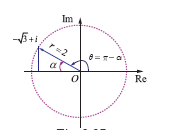
Modulus = 2 and
\(a={ tan }^{ -1 }\left| \frac { y }{ x } \right| ={ tan }^{ -1 }\frac { 1 }{ \sqrt { 3 } } =\frac { \pi }{ 6 } \)
Since the complex number \(-\sqrt { 3 } +i\) lies in the second quadrant has the principal value
\(\theta =\pi -\alpha =\pi -\frac { \pi }{ 6 } =\frac { 5\pi }{ 6 } \)
Therefore the modulus and principal argument of \(-\sqrt { 3 } +i\) are 2 and \(\frac { 5\pi }{ 6 } \) respectively.
5.
\(\left| \left( \overline { 1+i } \right) \left( 2+3i \right) \left( 4i-3 \right) \right| =\left| \left( \overline { 1+i } \right) \right| \left| 2+3i \right| \left| 4i-3 \right| \) (\(\because \) |z1z2z3|=|z1|z2||z3|)
= |1+i| |2+3i| |-3+4i| \(\left( \because |z|=\left| \overline { z } \right| \right) \)
= \(\left( \sqrt { { 1 }^{ 2 }+{ 1 }^{ 2 } } \right) \left( \sqrt { { 2 }^{ 2 }+{ 3 }^{ 2 } } \right) \left( \sqrt { \left( 3 \right) ^{ 2 }+{ 4 }^{ 2 } } \right) \).
\(=(\sqrt{2})(\sqrt{13})(\sqrt{25})=5 \sqrt{26}\)
6.
\(\sum _{ n=1 }^{ 102 }{ { i }^{ n } } \) = (i1+i2+i3+i4)+(i5+i6+i7+i8)+....+(i97+i98+i99+i100)+i101+i102
= (i1+i2+i3+i4)+(i1+i2+i3+i4)+...+(i1+i2+i3+i4)+i-1+i-2
= {i+(-1)+(-i)+1}+{i+(-1)+(-i)}+......+{i+(-1)+(-i)+1}+i+(-1)
= 0+0+...0+i-1
= -1+i
7.
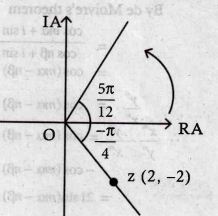
\(\theta =\frac { 2\pi }{ 3 } \)
When θ = \(\frac { \pi }{ 3 } \)
Roration of z is \(ze^{ i\theta }=ze^{ i2\frac { \pi }{ 3 } }\) [using (1)]
= \(2\sqrt { 2 } e^{ -i\frac { \pi }{ 4 } }.{ e }^{ i2\frac { \pi }{ 3 } }\) [using (1)]
= \(2\sqrt { 2 } e^{ i\left( i\frac { \pi }{ 3 } -\frac { \pi }{ 4 } \right) }=2\sqrt { 2 } e^{ i5\frac { \pi }{ 12 } }\)
8.
|3z-6+12i| = 8
⇒ 3|z-2+4i| = 8
⇒ |z-(2 - 4i) = \(\frac{8}{3}\).
It is of the form |z - z0| = r and so it represents a circle.
Its centre is (2 - 4i) and radius is \(\frac{8}{3}\).
9.
\(\left| 2z+2-4i \right| =2\)
2|z+1-2i| = 2
⇒ |z-(-1+2i)| = 1
It is of the form |z - z0| = r and so it represents a circle.
Its centre is (-1+2i) and radius is 1.
10.
\(\frac { 3 }{ 2 } \left( cos\frac { \pi }{ 3 } +isin\frac { \pi }{ 6 } \right) .6\left( cos\frac { 5\pi }{ 6 } +\frac { 5\pi }{ 6 } \right) \)
= \(\left( \frac { 3 }{ 2 } \right) \left( 6 \right) \left( cos\left( \frac { \pi }{ 3 } +\frac { 5\pi }{ 6 } \right) +isin\left( \frac { \pi }{ 3 } +\frac { 5\pi }{ 6 } \right) \right) \)
= \(9\left( cos\left( \frac { 7\pi }{ 6 } \right) +isin\left( \frac { 7\pi }{ 6 } \right) \right) \)
= \(9\left( cos\left( \pi +\frac { \pi }{ 6 } \right) +isin\left( \pi +\frac { \pi }{ 6 } \right) \right) \)
= \(9\left( -cos\left( \frac { \pi }{ 6 } \right) -isin\left( \frac { \pi }{ 6 } \right) \right) \)
= \(9\left( -\frac { \sqrt { 3 } }{ 2 } -\frac { i }{ 2 } \right) =\frac { 9\sqrt { 3 } }{ 2 } -\frac { 9i }{ 2 } \)
11.
Using the given values for z1, z2 and z3 we get |z1| = |3+4i| =\(\sqrt { { 3 }^{ 2 }+{ 4 }^{ 2 } } =5\)
|z2| = |5-12i| = \(\sqrt { { 5 }^{ 2 }+(-12)^{ 2 } } =13\)
|z3| = |6+8i| = \(\sqrt { { 6 }^{ 2 }+{ 8 }^{ 2 } } =10\)
|z1+z2| = |(3+4i)+(5-12i)| = |8-8i| = \(\sqrt { 128 } =8\sqrt { 2 } \)
|z2-z3| = |(5-12i)-(6+8i)| = |1-20i| = \(\sqrt { 401 } \)
|z1+z3| = |(3+4i)+(6+8i)| = |9+12i| = \(\sqrt { 225 } =15\)
Note that the triangle inequality is satisfied in all the cases
|z1+z3| = |z1|+|z3| = 15
12.
We have z = (2+3i)(1−i) = (2+3)+(3−2)i = 5+i
\(\Rightarrow\) \({ z }^{ -1 }=\frac { 1 }{ z } =\frac { 1 }{ 5+i } \)
Multiplying the numerator and denominator by the conjugate of the denominator, we get
\({ z }^{ -1 }=\frac { \left( 5-i \right) }{ \left( 5+i \right) \left( 5-i \right) } =\frac { 5-i }{ { 5 }^{ 2 }+{ I }^{ 2 } } =\frac { 5 }{ 26 } -i\frac { 1 }{ 26 } \)
\(\Rightarrow\)\({ z }^{ -1 }=\frac { 5 }{ 26 } -i\frac { 1 }{ 26 } \)
13.
Let z = x+iy ⇒ \(\bar { z } \) = x+iy
∴ \(\\ \frac { \bar { z } +1 }{ z-1 } =\frac { z-iy+1 }{ x-iy-i } =\frac { (x+1)iy }{ x-i(y+1) }\)
= \(\frac { (x+1)-iy }{ x-i(y+1) } \times \frac { x+i(y+1) }{ x+i(y+1) } \)
Choosing the real part alone we get,
\(\frac { x(x+1)+y(y+1) }{ { x }^{ 2 }+(y+1)^{ 2 } } \) = 0
⇒ x(x+1) + y(y+1) = 0
⇒ x2+x+y2+y = 0 which is the locus of z.
14.
AB = |(3+2i) - (0+5i)| = |3-3i|
=\(\sqrt { 9+9 } =\sqrt { 18 } =3\sqrt { 2 } \)
BC = |(0+5i) - (-3+2i)| = |3+3i|
= \(\sqrt { 9+9 } =\sqrt { 18 } =3\sqrt { 2 } \)
CD = |(-3+2i) - (0-i) = |-3+i|
= \(\sqrt { 9+9 } =\sqrt { 18 } =3\sqrt { 2 } \)
DA = |(0-i) - (3+2i)| = |-3-3i|
=\(\sqrt { 9+9 } =\sqrt { 18 } =3\sqrt { 2 } \)
∴ AB = BC = CD = DA
Also AC = |(3+2i) - (-3+2i)|
= |6| = \(\sqrt { 36 } \) = 6
∴ AC = BD
Hence ABCD is a square
15.
Let x = \((-27)^{ \frac { 1 }{ 3 } }=3^{ 3\times \frac { 1 }{ 3 } }(-1)^{ \frac { 1 }{ 3 } }\)
= 3\((cos\pi +isin\pi )^{ \frac { 1 }{ 3 } }\)
= 3\(\left[ cos\frac { 1 }{ 3 } (2k\pi +\pi )+isin\frac { 1 }{ 3 } (2k\pi +\pi ) \right] \), k = 0, 1, 2..
∴ The roots of -27 are
When k = 0, 3\(\left[ cos\frac { \pi }{ 3 } +isin\frac { \pi }{ 3 } \right] =3\ c\ is\ \frac { \pi }{ 3 } \)
When k = 1, -3
When k = 2, 3 c is\(\frac { 5\pi }{ 3 } \).
16.
Given 2cos α = x+\(\frac { 1 }{ x } \)
⇒ 2cos α = \(\frac { { x }^{ 2 }+1 }{ x } \)
⇒ x2+1 = 2xcos α
⇒ x2-2x cos α+1 = 0
⇒ \(\frac { 2cos\alpha \pm \sqrt { (-2cos\alpha )^{ 2 }-4(1)(1) } }{ 2 } \)
= \(\frac { 2cos\alpha \pm \sqrt { 4cos^{ 2 }\alpha -4 } }{ 2 } \) \(\left[ \because \frac { b\pm \sqrt { { b }^{ 2 }-4ac } }{ 2a } \right] \)
= \(\frac { 2cos\alpha \pm \sqrt { -sin^{ 2 }\alpha } }{ 2 } \)
= \(\frac { 2cos\alpha \pm isin\alpha }{ 2 } \) [∵ sin2α+cos2α = 1]
⇒ x2 = cos α ± sin α
Also, 2cos β = y+\(\frac { 1 }{ y } \)
⇒ 2cos β = \(\frac { { y }^{ 2 }+1 }{ y } \)
⇒ y2-2y cos β+1 = 0
⇒ \(\frac { 2cos\beta \pm \sqrt { (-2cos^{ 2 }\beta ^{ 2 }-4(1)(1) } }{ 2 } \)
=\(\frac { 2cos\beta \pm \sqrt { 4cos^{ 2 }\beta } -4 }{ 2 } =\frac { 2cos\beta \pm 2isin\beta }{ 2 } \)
⇒ y = cosβ ± i sinβ
\({ x }^{ m }{ y }^{ n }+\cfrac { 1 }{ { x }^{ m }{ y }^{ n } } =2cos(m\alpha +n\beta )\)
xmyn = (cos α + i sin mα) (cos nβ + i sin nβ)
cos(mα+nβ)+i sin(mα+nβ)
\(\frac { 1 }{ { x }^{ m }{ y }^{ n } } \) = cos(mα+nβ)-i sin(mα+nβ)
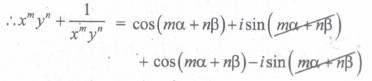
= 2cos(mα+nβ)
17.
|z-4| = 16
Given z = x + iy
|z - 4| = 16
⇒ |x + iy - 4| = 16
⇒ |(x- 4) + iy| = 16
⇒ \(\\ \sqrt { (x-4)^{ 2 }+{ y }^{ 2 } } \) = 16
⇒ (x - 4)2 + y2 = 162
[Squaring both sides]
⇒ x2-8x + 16 + y2 = 256
⇒ x2-8x + y2+ 16-256 = 0
⇒ x2-8x + y2-240 = 0 Which is the required Cartesian equation.
The locus of the point is a circle.
18.
Given z = x + iy
Consider \(\left| \frac { z-4i }{ z+4i } \right| =1\Rightarrow \left| \frac { x+iy-4i }{ x+iy+4i } \right| \)=1
⇒ \(\left| \frac { x+i(y-4) }{ x+i(y+4) } \right| \)
⇒ \(\frac { \sqrt { { x }^{ 2 }+(y-4)^{ 2 } } }{ \sqrt { { x }^{ 2 }+((y+4)^{ 2 } } } \) = 1
⇒ \(\sqrt { { x }^{ 2 }+(y-4)^{ 2 } } =\sqrt { { x }^{ 2 }+(y+4)^{ 2 } } \)
Squaring both sides we get,
x2+(y-4)2 = x2+(y+4)2
\(\Rightarrow \not x^{2}+\not y^{2}-8 y+\not 16=\not x^{2}+\not y^{2}+8 y+\not 16\)
⇒ 8y+8y = 0
⇒ 16y = 0
⇒ y = 0 [∵ 16 ≠ 0]
y = 0 is the equation of real axis Locus of z is the real axis.
19.
Given z3+2\(\overline { z } \) = 0
⇒ z3 = -2\(\overline { z } \)
Taking modulus, |z3| = |-2\(\overline { z } \)|
⇒ |z|3 = 2|z|
⇒ |z| [|z|2-2] = 0
|z| = 0 or |z|2-2 = 0
⇒ |z| = 0
⇒ z = 0 is a solution ....(1)
|z2| = 2
⇒ |z2| = 2 ⇒ (z\(\overline { z } \))2 = 2
⇒ z\(\overline { z } \) = \(\sqrt { 2 } \Rightarrow \overline { z } \frac { \sqrt { 2 } }{ z } \)
Given z + 2\(\overline { z } \) = 0
⇒ z3+2\(\frac { \sqrt { 2 } }{ z } \) = 0
⇒ z4+2\(\sqrt { 2 } \) = 0
If has 4 non-zero solutions
Hence from (1) and (2), z3+2\(\overline { z } \) has 5 solutions.
20.
Let the points be A (10 - 8i), B (11 + 6i) and C(1-i)
Distance between A and C is |(10-8i)-(1+i)|
= |10-8i-1-i| = |9-9i|
= \(\sqrt { { 9 }^{ 2 }+{ (-9) }^{ 2 } } =\sqrt { 81+81 } =\sqrt { 2\times 81 } =\sqrt { 162 } \)
= 9\(\sqrt{2}\)
Distance between Band C is s |(11+6i)-(1+i)|
= |11 + 6i-1-i| = |10 + 5i|
=\(\sqrt { { 10 }^{ 2 }+{ 5 }^{ 2 } } =\sqrt { 100+25 } =\sqrt { 125 } \)
=\(\sqrt { 25\times 5 } =5\sqrt { 5 } \)
Since \(5\sqrt { 5 } <9\sqrt {2 } \) , B is closest to C.
∴ 11 + 6i is closet to 1 + i.
21.
Given v = 3-4i, w = 4+3i and \(\frac { 1 }{ u } =\frac { 1 }{ v } +\frac { 1 }{ w } \)
∴ \(\frac { 1 }{ u } =\frac { 1 }{ 3-4i } +\frac { 1 }{ 4+3i } \)
= \(\frac { 3+4i }{ (3-4i)(3+4i) } +\frac { 4-3i }{ (4+3i)(4-3i) } \)
= \(\\ \frac { 3+4i }{ 9-(4i)^{ 2 } } +\frac { 4-3i }{ 16-(3i)^{ 2 } } =\frac { 3+4i }{ 9+16 } +\frac { 4-3i }{ 16+9 } \)
= \(\frac { 3+4i }{ 25 } +\frac { 4-3i }{ 25 } =\frac { 3+4i+4-3i }{ 25 } \)
\(\frac { 1 }{ u } =\frac { 7+i }{ 25 } \)
∴ u = \(\frac { 25 }{ 7+i } \times \frac { 7-i }{ 7-i } =\frac { 25(7-i }{ 7^{ 2 }-({ i }^{ 2 }) } \)
= \(\frac { 25(7-i) }{ 49+1 } =\frac { 25(7-i) }{ 50 } =\frac { 1 }{ 2 } \)(7-i)
∴ u = \(\frac { 1 }{ 2 } \)(7-i) or \(\frac { 7 }{ 2 } \) - \(\frac { i }{ 2 } \)
22.
Let z =\(\left( \frac { 19+9i }{ 5-3i } \right) ^{ 15 }-\left( \frac { 8+i }{ I+2i } \right) ^{ 15 }\)
Here, \(\frac { 19+9i }{ 5-3i } =\frac { (19+9i)(5+3i) }{ (5-3i)(5+3i) } \)
= \(\frac { (95-27)+i(45+57) }{ { 5 }^{ 2 }+{ 3 }^{ 2 } } =\frac { 68+102i }{ 34 } \)
= 2 + 3i ................(1)
and \(\frac { 8+i }{ 1+2i } =\frac { (8+i)(1-2i) }{ (1+2i)(1-2i) } \)
= \(\frac { (8+2)+i(1-16) }{ { 1 }^{ 2 }+{ 2 }^{ 2 } } =\frac { 10-15i }{ 5 } \)
= 2 - 3i .............. (2)
Now z =\(\left( \frac { 19+9i }{ 5-3i } \right) ^{ 15 }-\left( \frac { 8+i }{ 1+2i } \right) ^{ 15 }\)
⇒ z = (2 + 3i)15 - (2 - 3i)15 (by (1) and (2))
Then by definition, \(\bar { z } =\left( \overline { (2+3i)^{ 15 }-(2-3i)^{ 15 } } \right) \)
= \(\left( \overline { 2+3i } \right) ^{ 15 }-\left( \overline { 2-3i } \right) ^{ 15 }\) (using properties of conjugates)
= (2 - 3i)15 - (2 + 3i)15 = -((2 + 3i)15 - (2-3i)15)
⇒ \(\\ \overline { z } \) = -z
Therefore, \(\left( \frac { 19+9i }{ 5-3i } \right) ^{ 15 }-\left( \frac { 8+i }{ 1+2i } \right) ^{ 15 }\) is purely imaginary.
23.
arg(1+i) + arg(1-i) = arg[(1+i) (1-i)]
LHS = arg (1+i) + arg(1-i)
1+i = \(\sqrt { 2 } \left( \frac { 1 }{ \sqrt { 2 } } +\frac { i }{ \sqrt { 2 } } \right) \)
= \(\sqrt { 2 } \left( cos\frac { \pi }{ 4 } +isin\frac { \pi }{ 4 } \right) \)
∴ arg (1+i) = π/4
-1+i =\(\sqrt { 2 } \left( \frac { -1 }{ \sqrt { 2 } } +\frac { i }{ \sqrt { 2 } } \right) \)
= \(\sqrt { 2 } \left( cos3\frac { \pi }{ 4 } +isin3\frac { \pi }{ 4 } \right) \)
∴ (-1+i) = 3\(\frac { \pi }{ 4 } \)
∴ LHS = \(\frac { \pi }{ 4 } +\frac { 3\pi }{ 4 } =\frac { 4\pi }{ 4 } =\pi \)
RHS = arg[(1+i) (-1+i)]
= arg[-1-i + i + i2]
= (-1-i + i-1) = arg(-2)
= arg(2) - (1) = 2 arg(-1)
= 2 (cos π + isin π) = π
∴ LHS = RHS
24.
LHS = 2 arg (-1)
= 2 arg (cos π + i sin π) = 2π
RHS = arg (-1)2 = arg (1)
= arg (cos θ + isin θ) = 0
∴ LHS ≠ RHS
25.
LHS = \(\left( \frac { i+\sqrt { 3 } }{ -i+\sqrt { 3 } } \right) ^{ 2\omega }+\left( \frac { i-\sqrt { 3 } }{ i+\sqrt { 3 } } \right) ^{ 2\omega }\)
= \(\left( \frac { \sqrt { 3 } +i }{ \sqrt { 3 } -i } \times \frac { \sqrt { 3 } +i }{ \sqrt { 3 } +i } \right) ^{ 2\omega }+\left( \frac { -\sqrt { 3 } +i }{ \sqrt { 3 } +i } \times \frac { \sqrt { 3 } -i }{ \sqrt { 3 } -1 } \right) ^{ 2\omega }\)
= \(\left( \frac { 3-1+2\sqrt { 3 } i }{ 3+1 } \right) ^{ 2\omega }+\left( \frac { -3+1+2\sqrt { 3 } i }{ 3+1 } \right) ^{ 2\omega }\)
= \(\left( \frac { 2+2\sqrt { 3 } i }{ 4 } \right) ^{ 2\omega }+\left( \frac { -2+2\sqrt { 3 } i }{ 4 } \right) ^{ 2\omega }\)
= \(\left( \frac { 1+\sqrt { 3 } i }{ 2 } \right) ^{ 2\omega }+\left( \frac { -2+2\sqrt { 3 } i }{ 2 } \right) ^{ 2\omega }\)
=\(\left[ -\left( \frac { -1-\sqrt { 3 } i }{ 2 } \right) \right] ^{ 2\omega }+\left[ \frac { -1+\sqrt { 3 } i }{ 2 } \right] ^{ 2\omega }\)
= (-ω2)2ω+(ω)2ω
[∴ ω = \(\frac { -1+i\sqrt { 3 } }{ 2 } \), ω2 = \(\frac { -1-i\sqrt { 3 } }{ 2 } \)]
= ω4ω+ω2ω
= (ω3)133. ω1 + (ω3)66.ω2
= 1.ω+1.ω2 [∴ 1+ω+ω2 = 0 & ω3 = 1]
= ω + ω2
= -1 = RHS
26.
Now, \(\frac { z-1 }{ z+1 } =\frac { x+iy-1 }{ x+iy+1 } =\frac { \left( x-1 \right) +iy }{ \left( x+1 \right) +iy } =\frac { \left[ \left( x-1 \right) +iy \right] \left[ \left( x+1 \right) -iy \right] }{ \left[ \left( x+1 \right) +iy \right] \left[ \left( x+1 \right) -iy \right] } \)
\(\Rightarrow \frac { z-1 }{ z+1 } =\frac { \left( { x }^{ 2 }+{ y }^{ 2 }-1 \right) +i\left( 2y \right) }{ \left( x+1 \right) ^{ 2 }+{ y }^{ 2 } } \)
Since, arg \(\left( \frac { z-1 }{ z+2 } \right) =\frac { \pi }{ 2 } \Rightarrow { tan }^{ -1 }\left( \frac { 2y }{ { x }^{ 2 }+{ y }^{ 2 }-1 } \right) \)= \(\frac { \pi }{ 2 } \)
\(\Rightarrow \frac { 2y }{ { x }^{ 2 }+{ y }^{ 2 }-1 } =tan\frac { \pi }{ 2 } \) ⇒ x2+ y2 − 1 = 0
\(\Rightarrow { x }^{ 2 }+{ y }^{ 2 }=1\)
27.
Given z = x + iy
Im \(\left( \frac { 2z+1 }{ iz+1 } \right) \)= 0
⇒ Im\(\left( \frac { 2(x+iy)+1 }{ i(x+iy)+1 } \right) \)= 0
⇒ Im\(\left( \frac { (2x+1)+2iy }{ ix+i^{ 2 }y+1 } \right) \)
⇒ Im\(\left( \frac { (2x+1)+2iy }{ ix-y+1 } \right) \)
\(\left( \frac { (2x+1)+iy }{ (1-y)+ix } \right) \)
Multiply and divide by the conjugate of the denominator
We get Im\(\left( \frac { (2x+1)+2iy }{ (1-y)+ix } \times \frac { (1-y)-ix }{ (1-y)-ix } \right) \)=0
⇒ Im\(\left( \frac { (2x+1)+2iy\times (1-y)-ix }{ (1-y)^{ 2 }+{ x }^{ 2 } } \right) \)
Choosing the imaginably part we get,
\(\frac { (2x+1)(-x)+2y(1-y) }{ (1-y)^{ 2 }+{ x }^{ 2 } } \)
⇒ (2x+1)-x+2y(1-y) = 0
⇒ -2x2-x+2y-2y2 = 0
⇒ 2x2+2y2+x-2y = 0
Hence, locus of z is 2x2+2y2+x-2y = 0
28.
(c)
29.
(b)
30.
(a)
2 cos nθ
31.
(a)
-2i sin(α - β)
32.
(b)
cos 11θ + isin 11θ
33.
(a)
9
34.
(c)
35.
(c)
-8
36.
(c)
\(\frac { 53 }{ 85 } \)
37.
(d)
Collinear
38.
(c)
39.
(b)
40.
(b)
-1
41.
(d)
\(\sqrt { 5 } +2\)
42.
(a)
\(\cfrac { 1 }{ 2 } \)

12th Standard Syllabus & Materials
12th Standard
TN 12th Computer Applications வலையமைப்பு வடமிடல் Sample Question Papers Study Material - QB365 Set A
NEW12th Standard
TN 12th Computer Applications களப்பெயர் முறைமை (DNS) Sample Question Papers Study Material - QB365 Set A
NEW12th Standard
TN 12th Computer Applications வலையமைப்பு எடுத்துக்காட்டுகள் மற்றும் நெறிமுறைகள் Sample Question Papers Study Material - QB365 Set A
NEW12th Standard
TN 12th Computer Applications கணினி வலையமைப்பு ஓர் அறிமுகம் Sample Question Papers Study Material - QB365 Set A



Tamilnadu Stateboard 12th Standard Subjects
Maths

Chemistry

Physics

Biology

Computer Science

Business Maths and Statistics

Economics

Commerce

Accountancy

History

Computer Applications
Biology
Computer Technology
Computer Applications
Computer Science
Business Maths and Statistics
Commerce
Economics
Maths
Chemistry
Physics
Computer Technology
History
Accountancy

Tamil

English

French
Tamilnadu Stateboard Standards

