
 100% FREE ACCESS
12th Standard Syllabus & Materials
12th Standard
TN 12th Maths Applications of Matrices and Determinants Sample Question Papers Study Material - QB365 Set A
NEW12th Standard
TN 12th Computer Applications மின்னணு தரவு பரிமாற்றம் Sample Question Papers Study Material - QB365 Set A
NEW12th Standard
TN 12th Computer Applications மின் - வணிக பாதுகாப்பு அமைப்புகள் Sample Question Papers Study Material - QB365 Set A
NEW12th Standard
TN 12th Computer Applications மின்னணு செலுத்தல் முறைகள் Sample Question Papers Study Material - QB365 Set A
NEW12th Standard
TN 12th Computer Applications மின் - வணிகம் Sample Question Papers Study Material - QB365 Set A
NEW12th Standard
TN 12th Computer Applications திறந்த மூல கருத்துருக்கள் Sample Question Papers Study Material - QB365 Set A

Published on: 02/09/2022
QB365 provides a detailed and simple solution for every Possible Book Back Questions in Class 12 Maths Subject - Differentials and Partial Derivatives, English Medium. It will help Students to get more practice questions, Students can Practice these question papers in addition to score best marks.
Download Tamil Nadu 12th Standard Maths question papers, model tests, one-mark questions, important questions, and public exam papers in PDF format. Free study materials and answer keys for TN State Board students.
Questions + Answers key
Take MCQ Maths Test1.
W(x, y, z) = xy + yz + zx, x = u - v, y = uv, z = u + v, u ∈ R. Find \(\frac { \partial W }{ \partial u } ,\frac { \partial W }{ \partial v } \), and evaluate them at \(\left( \frac { 1 }{ 2 } ,1 \right) \)
2.
If w(x, y) = xy + sin (xy), then prove that \(\frac { { \partial }^{ 2 }w }{ \partial y\partial x } =\frac { { \partial }^{ 2 }w }{ \partial x\partial y } \)
3.
If V(x,y) = ex(x cos y - y siny), then prove that \(\frac { { \partial }^{ 2 }V }{ \partial { x }^{ 2 } } =\frac { { \partial }^{ 2 }V }{ \partial { y }^{ 2 } } \) = 0
4.
Let w(x, y, z) = \(\frac { 1 }{ \sqrt { { x }^{ 2 }+{ y }^{ 2 }+{ z }^{ 2 } } } ,(x,y,z)\neq (0,0,0)\). Show that \(\frac { { \partial }^{ 2 }w }{ \partial { x }^{ 2 } } +\frac { { \partial }^{ 2 }w }{ \partial { y }^{ 2 } } +\frac { { \partial }^{ 2 }w }{ \partial { z }^{ 2 } } =0\)
5.
Let f(x, y) = sin(xy2) + \(e^{{x^3}+5y}\) for all ∈ R2. Calculate \(\frac { \partial f }{ \partial x } ,\frac { \partial f }{ \partial y } ,\frac { { \partial }^{ 2 }f }{ { \partial y\partial x } } \)and \(\frac { { \partial }^{ 2 }f }{ { \partial x\partial y } } \)
6.
Let F(x, y) = x3 y + y2x + 7 for all (x, y)∈ R2. Calculate \(\frac { \partial F }{ \partial x } \)(-1, 3) and \(\frac { \partial F }{ \partial y } \)(-2, 1).
7.
The relation between the number of words y a person learns in x hours is given by y = 52 \(\sqrt { x } \), 0, ≤ x ≤ 9. What is the approximate number of words learned when x changes from
8.
The trunk of a tree has diameter 30 cm. During the following year, the circumference grew 6cm.
9.
The trunk of a tree has diameter 30 cm. During the following year, the circumference grew 6cm.
(i) Approximately, how much did the tree's diameter grow?
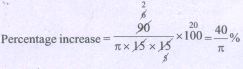
(ii) What is the percentage increase in area of the tree's cross-section?
10.
A right circular cylinder has radius r =10 cm. and height h = 20 cm. Suppose that the radius of the cylinder is increased from 10 cm to 10. 1 cm and the height does not change. Estimate the change in the volume of the cylinder. Also, calculate the relative error and percentage error.
11.
Let W(x, y, z) = x2 - xy + 3 sin z, x, y, z ∈ R. Find the linear approximation for U at (2, -1, 0).
12.
A coat of paint of thickness 0.2 cm is applied to the faces of a cube whose edge is 10 cm. Use the differentials to find approximately how many cubic centimeters of paint is used to paint this cube. Also calculate the exact amount of paint used to paint this cube.
13.
A circular plate expands uniformly under the influence of heat. If it’s radius increases from 10.5 cm to 10.75 cm, then find an approximate change in the area and the approximate percentage change in the area.
14.
In a newly developed city, it is estimated that the voting population (in thousands) will increase according to V(t) = 30 + 12t2 - t3, 0 ≤ t ≤ 8 where t is the time in years. Find the approximate change in voters for the time change from 4 to 4\(\frac16\) year
15.
Show that the percentage error in the nth root of a number is approximately \(\frac1n\) times the percentage error in the number.
16.
The time T, taken for a complete oscillation of a single pendulum with length l, is given by the equation T = 2ㅠ\(\sqrt { \frac { 1 }{ g } } \), where g is a constant. Find the approximate percentage error in the calculated value of T corresponding to an error of 2 percent in the value of l.
17.
A sphere is made of ice having radius 10 cm. Its radius decreases from 10 cm to 9.8 cm. Find approximations for the following:
(i) change in the volume
(ii) change in the surface area
18.
The radius of a circular plate is measured as 12.65 cm instead of the actual length 12.5 cm.find the following in calculating the area of the circular plate:
Percentage error
19.
The radius of a circular plate is measured as 12.65 cm instead of the actual length 12.5 cm. Find the following in calculating the area of the circular plate:
Relative error
20.
The radius of a circular plate is measured as 12.65 cm instead of the actual length 12.5 cm. find the following in calculating the area of the circular plate:
Absolute error
21.
A firm produces two types of calculators each week, x number of type A and y number of type B. The weekly revenue and cost functions (in rupees) are R(x, y) = 80x + 90y + 0.04xy − 0.05x2 − 0.05y2 and C(x, y) = 8x + 6y + 2000 respectively
(i) Find the profit function P(x, y)
(ii) Find \(\frac { { \partial P } }{ \partial { x } } \) (1200, 1800) and \(\frac { \partial v }{ \partial y} \) (1200, 1800)
22.
The relation between the number of words y a person learns in x hours is given by y = 52 \(\sqrt { x } \), 0, ≤ x ≤ 9. What is the approximate number of words learned when x changes from
(i) 1 to 1.1 hour?
(ii) 4 to 4.1 hour?
1.
W(x, y, z) = xy + yz + zx, x =u -v, y = uv, z = u + v; y = uv; z = u
\(\frac { \partial W }{ \partial x }\) = y + z; \(\frac { \partial W }{ \partial y }\) = x + z
∴ \(\frac { \partial W }{ \partial x }\) = uv + u + v;
\(\frac { \partial W }{ \partial y}\) = u - v + u + v;
\(\frac { \partial W }{ \partial z}\) = uv + u - v
\(\frac { dx }{ du } =1;\frac { dy }{ du } =v;\frac { dz }{ du } =1\)
\(\frac { dx }{ dv } =1;\frac { dy }{ dv } =v;\frac { dz }{ dv} =1\)
By chain rule
\(\frac { \partial W }{ \partial u } =\frac { \partial w }{ \partial x } .\frac { dx }{ du } +\frac { \partial w }{ \partial y } .\frac { dy }{ du } +\frac { \partial w }{ \partial z } .\frac { dz }{ du }\)
= (uv +u +v) (1) +2u (v) + (uv +u - v)(1)
\(=u v+u+b+2 u v+u v+u-b\)
\(\frac { \partial W }{ \partial u }\) = 4uv + 2u = 12u (2v + 1)
\({ \left( \frac { \partial W }{ \partial u } \right) }_{ \left( \frac { 1 }{ 2 } ,1 \right) }\) = 2 x \(\frac12\) (2+ 1) = 1(2+ 1) = 3
= (uv + u + v) (-1) + (2u) (u) + (uv + u - v)(1)
\(=-w-u-v+2 u^2+w+u-v\)
= 2u2 - 2v = 2 (u2 - v)
∴ \({ \left( \frac { \partial W }{ \partial v } \right) }_{ \left( \frac { 1 }{ 2 } ,1 \right) }\) = \(2\left( \frac { 1 }{ 4 } -1 \right) =2\left( -\frac { 3 }{ 4 } \right) =-\frac { 3 }{ 2 }\)
2.
Given w (x, y) = xy + sin (xy)
\(\frac { \partial w }{ \partial x } \) = y (1) + (cos (xy) [y (1)]
= y + y cos (xy)
\(\frac { \partial w }{ \partial y } \) = x (1) + cos (xy) (x)
= x + x cos (xy)
\(\frac { { \partial }^{ 2 }w }{ \partial y\partial x } \) = \(\frac { { \partial } }{ \partial { y } } \left( \frac { \partial w }{ \partial x } \right) \)
= 1 + y (- sin (xy)) (x) + cos (xy)
= 1 -xy sin (xy) + cos (xy) ... (1)
\(\frac { { \partial } }{ \partial { x } } \left( \frac { \partial w }{ \partial y } \right) \)
= 1 + x (- sin (xy)) (y) + cos (xy)
= 1 - xy sin (xy) + cos (xy) ... (2)
∴ From (1) and (2),
\(\frac { { \partial }^{ 2 }w }{ \partial x\partial y } =\frac { { \partial }^{ 2 }w }{ \partial x\partial y } \)
3.
Given V(x, y) = ex(x cos y - y sin y)
\(\frac { \partial V }{ \partial x } \) = ex (cos y) +(x cos y - y sin y)ex
= ex (cos y + x cos y - y sin y)
\(\frac { { \partial }^{ 2 }V }{ \partial { x }^{ 2 } } \) = ex(0 + cos y - 0) + (cos y +x cos y.- y sin y)ex
= ex(2 cos y + x cos y - y sin y) ... (1)
\(\frac { \partial V }{ \partial y } \) = ex(-x sin y- y cos y- sin y)
\(\frac { { \partial }^{ 2 }V }{ \partial { y }^{ 2 } } \) = ex (-x cos y - (-y sin y + cos y) - cos y)
= ex(- x cos y + y sin y - cos y - cos y)
= ex (- x cos y + y sin y - 2 cos y) ... (2)
(1)+(2)➝
\(\frac { { \partial }^{ 2 }V }{ \partial { x }^{ 2 } } \) + \(\frac { { \partial }^{ 2 }V }{ \partial { y }^{ 2 } } \) = ex(2 cos y + x cos y - y sin y - x cos y + y sin y - 2 cos y]
= ex (0) = 0
Hence proved
4.
Given w(x, y, z) = \(\frac { 1 }{ \sqrt { { x }^{ 2 }+{ y }^{ 2 }+{ z }^{ 2 } } }\)
= (x2 + y2 + z2) -\(\frac12\)
\(\frac { \partial w }{ \partial x } =\frac { -1 }{ 2 } ({ x^{ 2 }+{ y }^{ 2 }+{ z }^{ 2 }) }^{ -\frac { 3 }{ 2 } }(2x)\)
= (-x2 + y2 + z2) -\(\frac12\)
\(\frac { { \partial }^{ 2 }w }{ \partial { x }^{ 2 } } =\frac { \partial }{ \partial x } \left( \frac { \partial w }{ \partial x } \right) \)
= -[x\(\left( \frac { -3 }{ 2 } \right) \)( x2 + y2 +z2)\(-\frac32\)
\((\not 2 x)+\left(x^{2}+y^{2}+z^{2}\right)^{\frac{3}{2}}\)
= (x2 + y2 + z2)-\(\frac52\) [-3x2 + x2 +y + z2]
= - (x2 + y2 + z2)-\(\frac52\) [y2 + z2 - 2x2] ....(1)
\(\frac { \partial w }{ \partial y } =\frac { -1 }{ 2 } ({ x^{ 2 }+{ y }^{ 2 }+{ z }^{ 2 }) }^{ -\frac { 3 }{ 2 } }(2y)\)
= -y(x2 +y2 + z2)-\(\frac32\)
\(\frac { { \partial }^{ 2 }w }{ \partial { y }^{ 2 } } =\frac { \partial }{ \partial y } \left( \frac { \partial w }{ \partial y } \right) \)
\(=-\left[y\left(\frac{-3}{\not 2}\right)\left(x^{2}+y^{2}+z^{2}\right)^{\frac{5}{2}}(\not 2 y)+\left(x^{2}+y^{2}+z^{2}\right)^{\frac{3}{2}}(1)\right]\)
= -(x2 + y2 + z2)-\(\frac52 \)
= -(x2 + y2 + z2)-\(\frac52 \) [3y2 + x2 + y2 + z2]
= -(x2 + y2 + z2)-\(\frac52 \) [x2 + y2 + 2z2] ....(2)
Now \(\frac { \partial w }{ \partial z } =\frac { -1 }{ 2 } ({ x^{ 2 }+{ y }^{ 2 }+{ z }^{ 2 }) }^{ -\frac { 3 }{ 2 } }(2z)\)
= -z(x2 + y2 + z2)-\(\frac32 \)
∴ \(\frac { { \partial }^{ 2 }w }{ \partial { z }^{ 2 } } \) = -(x2 + y2 + z2)-\(\frac52 \) [x2 + y2 - 2z2] ...(3)
(1)+(2)+(3)⟶
∴ \(\frac { { \partial }^{ 2 }w }{ \partial { x }^{ 2 } } +\frac { { \partial }^{ 2 }w }{ \partial { y }^{ 2 } } +\frac { { \partial }^{ 2 }w }{ \partial { y }^{ 2 } } \) = -(x2 + y2 + z2)-\(\frac52 \) [y2 + z2 - 2x2 + x2 + z2 - 2y + x2+ y-2z2]
= -(x2 + y2 + z2)-\(\frac52 \)(0) = 0
Hence proved
5.
First we shall calculate \(\frac { \partial f }{ \partial x } \) (x, y). Note that f is a sum of two functions and so
\(\frac { \partial f }{ \partial x } =\frac { \partial }{ \partial x } sin({ xy }^{ 2 })+\frac { \partial }{ \partial x } \left( { e }^{ { x }^{ 3 }+5y } \right) \)
\(=cos(x{ y }^{ 2 })\frac { \partial }{ \partial x } (x{ y }^{ 2 })+{ e }^{ { x }^{ 3 }+5y }\frac { \partial }{ \partial x } \left( { x }^{ 3 }+5y \right) \)
= cos(xy2 ) y2 + \({ e }^{ { x }^{ 3 }+5y }\) 3x2
Similarly,
\(\frac { { \partial }^{ }f }{ { \partial y\ } } =\frac { \partial }{ \partial y } sin(x{ y }^{ 2 })+\frac { \partial }{ \partial y } \left( { e }^{ { x }^{ 3 }+5y } \right) \)
\(=cos(x{ y }^{ 2 })\frac { \partial }{ \partial y } (x{ y }^{ 2 })+{ e }^{ { x }^{ 3 }+5y }\frac { \partial }{ \partial y } \left( { x }^{ 3 }+5y \right) \)
= cos(xy2)2xy + 5\({ e }^{ { x }^{ 3 }+5y }\)
Next we consider,
\(\frac { { \partial }^{ 2 }f }{ { \partial y\partial x } } =\frac { \partial }{ \partial y } \left( \frac { \partial f }{ \partial x } \right) =\frac { \partial }{ \partial y } ({ y }^{ 2 }cos(x{ y }^{ 2 })+3{ x }^{ 2 }{ e }^{ { x }^{ 3 }+5y })\)
\(=\frac { \partial }{ \partial y } ({ y }^{ 2 }cos(x{ y }^{ 2 }))+\frac { \partial }{ \partial y } ({ 3x }^{ 2 }{ e }^{ { x }^{ 3 }+5y })\)
= 2y cos(xy2)+y2(-sin(xy2)2xy) + 3x2 \({ e }^{ { x }^{ 3 }+5y }\) 5
= 2y cos(xy2)+2xy3 sin(xy2)+15 x2 \({ e }^{ { x }^{ 3 }+5y }\)
Finally,
\(\frac { { \partial }^{ 2 }f }{ { \partial x\partial y } } =\frac { \partial }{ \partial y } \left( \frac { \partial f }{ \partial x } \right) =\frac { \partial }{ \partial y } (cos(x{ y }^{ 2 })2xy+5{ e }^{ { x }^{ 3 }+5y })\)
= -sin(xy2)y22xy+cos(xy2)2y+5\({ e }^{ { x }^{ 3 }+5y }\) 3x2
= 2y cos(xy2)- 2xy3 sin(xy2)+15x2\({ e }^{ { x }^{ 3 }+5y }\)
Note that we have first used sum rule, then in the next step we have used chain rule. In the third step, product rule is used. Also, we see that fxy = fyx Is it a coincidence? or is it always true? Actually, there are functions for which fxy ≠ fyz at some points. The following theorem gives conditions under which fxy = fyz.
6.
First we shall calculate \(\frac { \partial F }{ \partial x } \)(x, y) then we evaluate it at (−1, 3) As we have already observed we find the derivative with respect to x holding y as a constant. That is,
\(\frac { \partial f }{ \partial x } (x,y)=\frac { \partial \left( { x }^{ 3 }y+{ y }^{ 2 }x+7 \right) }{ \partial x } =\frac { \partial \left( { x }^{ 3 }y \right) }{ \partial x } +\frac { \partial \left( { y }^{ 2 }x \right) }{ \partial x } +\frac { \partial (7) }{ \partial x } \)
= 3x2 y + y2 +0
= 3x2 y + y2 .
so, \(\frac { \partial F }{ \partial x } \) ( -1, 3) = 3( -1)2 3 + 32 = 18.
Next similarly we find partial derivative with respect to y.
\(\frac { \partial F }{ \partial y } \) (x, y) = \(\frac { \partial \left( { x }^{ 3 }y+{ y }^{ 2 }x+7 \right) }{ \partial y } =\frac { \partial \left( { x }^{ 3 }y \right) }{ \partial y } +\frac { \partial \left( { y }^{ 2 }x \right) }{ \partial y } +\frac { \partial (7) }{ \partial y } \)
= x3 + 2yx + 0
= x3 + 2yx.
Hence we have \(\frac { \partial F }{ \partial y } \) (-2, 1) = (-2)3 + 2(1)( -2) = -12.
Note that in the above example \(\frac { \partial F }{ \partial x } \) (x, y) = 3x2 y + y2 which is again a function of two variables.
So, we can take the partial derivative of this function with respect to x or y.
For instance, if we take G(x, y) = 3x2 y+y2 then we find \(\frac { \partial F }{ \partial x } \) = 6xy. Since G(x, y) = \(\frac { \partial F }{ \partial x } \), we have \(\frac { \partial G }{ \partial x } \)=\(\frac { \partial }{ \partial x } \)\(\left( \frac { \partial f }{ \partial x } \right) \) = 6xy.
We denote this as \(\frac { { \partial }^{ 2 }F }{ { \partial x }^{ 2 } } \) which is called the second order partial derivative of F with respect to x.
Also, \(\frac { \partial F }{ \partial y } \) = 3x2 + 2y. Since G (x, y) = \(\frac { \partial F }{ \partial x } \) we have \(\frac { \partial G }{ \partial y } =\frac { \partial }{ \partial y } \left( \frac { \partial F }{ \partial x } \right) \) = 3x2 + 2y.
We denote this as \(\frac { { \partial }^{ 2 }F }{ \partial y\partial x } \) which is called the mixed partial derivative of F with respect to x, y.
Similarly we can also calculate \(\frac { \partial }{ \partial x } \left( \frac { \partial F }{ \partial y } \right) \) = 3x2+2y.
Also, if we differentiate \(\frac { \partial F }{ \partial y } \) partially with respect to y we obtain \(\frac { { \partial }^{ 2 }F }{ { \partial y }^{ 2 } } \) which is called the second order partial derivatives of F with respect to y.
So for any function F defined on any subset {(x, y) | a < x < b, c < y < d} ⊂ R2 we have the following notation
\(\frac { { \partial }^{ 2 }F }{ { \partial x }^{ 2 } } =\frac { \partial }{ \partial x } \left( \frac { \partial F }{ \partial x } \right) ={ F }_{ xx' }\frac { { \partial }^{ 2 }F }{ { \partial x\partial y } } =\frac { \partial }{ \partial y } \left( \frac { \partial F }{ \partial y } \right) ={ F }_{ xy }\)
\(\frac { { \partial }^{ 2 }F }{ { \partial y\partial x } } =\frac { \partial }{ \partial y } \left( \frac { \partial F }{ \partial x } \right) ={ F }_{ yx' }\frac { { \partial }^{ 2 }F }{ { { \partial y }^{ 2 } } } =\frac { \partial }{ \partial y } \left( \frac { \partial F }{ \partial y } \right) ={ F }_{ yy }\)
All the above are called second order partial derivatives of F.
Similarly we can define higher order partial derivatives.
For example, \(\frac { { \partial }^{ 2 }F }{ { \partial y\partial x } } =\frac { \partial }{ \partial y } \left( \frac { \partial }{ \partial y } \left( \frac { \partial F }{ \partial x } \right) \right) \) and \(\frac { { \partial }^{ 2 }F }{ { \partial x\partial y\partial x } } =\frac { \partial }{ \partial x } \left( \frac { \partial F }{ \partial y } \left( \frac { \partial F }{ \partial x } \right) \right) \)
Next we shall see more examples on partial differentiation.
7.
When x = 4, dx = 4.1-4 = 0.1
8.
9.
Diameter = 30 cm
Radius = 15 cm
Circumference (c) = 2πr
\(\frac{dc}{dr}\) = 2π(3) = 6πcm
dc = 2πdr
\(\frac{6}{2π}\) cm = dr
\(\frac{3}{π}\) cm = dr
Approximate growth of the diameter
= 2dr = 2 \(\times\) \(\frac{3}{π}\) cm = \(\frac{6}{2π}\)cm
(ii) A = πr2
dA = π 2r dr
\(d \mathrm{~A}=\not \pi 2(15) \frac{3}{\not \pi} \mathrm{cm}^{2}\)
dA = 90 cm2
Area = πr2 = π \(\times\)15 \(\times\) 15 cm2
10.
Recall that volume of a right circular cylinder is given by V = \(\pi \)r2h where r is the radius and h is the height. So we have V (r) = \(\pi \)r2h = 20\(\pi \)r2
V (10.1) −V (10)≈ \(\frac { dV }{ dr } { { | }_{ r=10 } }\) (10.1 10) = 20\(\pi \)2(10(0.1))
Thus the estimate for the change in the volume is 40 \(\pi \) cm3
Exact calculation of the volume change gives
V (10.1) −V (10) = 2040.2\(\pi \) -2000\(\pi \) = 40.2\(\pi \) cm3.
So relative error = \(\frac { 40.2\pi -40\pi }{ 40.2\pi } \) = \(\frac { 1 }{ 201 } \) = 0.00497 and hence
the percentage error = relative error x 100 = \(\frac { 1 }{ 201 } \)x100 = 0.497%
11.
Given W(x, y, z) = x2 - xy + 3 sin z, x, y, z ∈ R
W(x0, y0, z0) = W (2, -1, 0)
= 22-2(-1)+3 sin 0
\(\frac { \partial W }{ \partial x } \) = 2x - y + 0 = 2x - y
\(\left( \frac { \partial W }{ \partial x } \right) _{(2, -1, 0)}\)= 2(2)-(-1) = 5
\(\frac { \partial W }{ \partial y } \) = 0-x + 0 = -x
\(\left( \frac { \partial W }{ \partial y } \right) _{(2, -1, 0)}\) = -2
\(\frac { \partial W }{ \partial z } \) = 0 - 0 + 3 cos z
\(\left( \frac { \partial W }{ \partial z} \right) _{(2, -1, 0)}\)= 3 cos 0 = 3(1) = 3.
Linear approximation is given by
L(x, y, z) = w(x0, y0, z0) + \(\left( \frac { \partial W }{ \partial x } \right) _{(x_0, y_0, z_0)}\) (x - x0) + \(\left( \frac { \partial W }{ \partial y} \right) _{(x_0, y_0, z_0)}\) (y - y0) + \(\left( \frac { \partial W }{ \partial z} \right) _{(x_0, y_0, z_0)}\)(z0 - z0)
∴ L(x,y,z) = 6 + 5(x - 2) - 2(y+1) + 3(z - 0)
= 6 + 5x - 10 - 2y - 2 + 3z
L (x, y, z) = 5x - 2y + 3z - 6
12.
Given a = edge of the circle
= 10 cm and da
= 0.2 cm
Volume of cube = a3
Approximate amount of cubic centimeters of paint is used to paint this cube = 3a2 da
= 3(102)(0.2)
= 300 \(\left( \frac { 2 }{ 10 } \right) \) = 60 cm3
Exact amount of paint used = f(x + ∆x) - f(x)
= f(10.2) - f(10)
= 10.23 -103
= 1061.208 - 1000
= 61.208 cm2
13.
Given r = 10.5 cm
dr = 10.75 - 10.5 = 0.25
Area = πr2
Approximate change in area = π(2r) dr
= 2π(10.5)(0.25)
= 5.25 π cm2
Approximate percentage change in the area
= \(\frac{5.25 π}{π(10.5)(10.5)}\) x 100
= \(\frac{5.25}{110.25}\) x 100
= 0.0476 x 100 = 4.765%
14.
V(t) = 30 + 12t2 - t3, 0 ≤ t ≤ 8
Given t = 4, dt = 4\(\frac16\) - 4 = \(\frac16\)
Approximate change in voters = (24t -3t2)dt
= [24(4) - 3(4)2] = \(\frac16\)
= (96 - 48)\(\frac16\) = \(\frac{48}{6}\) = 8
Since the function is given in thousands approximate change in voters = 8000
15.
Let x be the number
Let y = f(x) = \(x^\frac{1}{n}\)
Then log y = \(\frac1n\) log x
Taking differential on both sides we get,
\(\frac { 1 }{ y } dy=\frac { 1 }{ n } \times \frac { 1 }{ x } dx\)
i.e. \(\frac { \Delta y }{ y } \simeq \frac { dy }{ y } =\frac { 1 }{ n } .\frac { dx }{ x } \)
\(\therefore \frac { \Delta y }{ y } \times 100\simeq \frac { 1 }{ n } \left( \frac { dx }{ x } \times 100 \right) \)
\(\simeq \frac { 1 }{ n } \) times the percentage error in the number. Hence, percentage error in the nth root of a number is approximately \(\frac1n\) times the percentage error in the number
16.
Given absolute error = 2%
⇒ \(\frac { dl }{ l } =2 \% =\frac { 2 }{ 100 } =0.02\)
Given T = 2ㅠ\(\sqrt { \frac { 1 }{ g } } \)
Taking logarithm on both sides,
log T = log 2ㅠ + \(\frac12\) log l - \(\frac12\) log g
Taking differential on both sides we get,
\(\frac{1}{T}dT=0+\frac{1}{2}.\frac{1}{l}.dl\)
\(\frac { \Delta T }{ T } =\frac { 1 }{ 2 } (.02)\)
\(\frac { \Delta T }{ T } =0\)
ஃ Percentage error = \(\frac { \Delta T }{ T } \times100=.01\times100=1 \%\)
17.
Volume of sphere = \(\frac43\)πr2
Given r = 10 cm
\(\frac{dr}{dt}\) = - 0.2
V = \(\frac43\)πr3
Change in Volume
= \(\frac{4}{\not 3} \pi . \not 3 r^{2} \frac{d r}{d t}\)
= 4π(10)2 (-0.2)
= 400 π (-0.2) = -80 πcm3
∴ Volume decreases by 80 π cm3
Surface area of sphere = 4πr2
Change 10 surrace area = 4 π2r\(\frac{dr}{dt}\)
= 8π(10) (-0.2)
= -\(\frac{80π\times2}{10}\) = -16 π cm2
∴ Surface area decreases by 16 π cm2
18.
Actual value = 12.5 cm,
Approximate value = 12.65 cm
Area of the circular plate = πr2
Percentage error = 0.024 x 100 = 2.4%
Volume of sphere = \(\frac43\)πr2
19.
Actual value = 12.5 cm,
Approximate value = 12.65 cm
Area of the circular plate = πr2
Relative error = \(\frac{160.225π-156.25π}{160.0225π}\)
= \(\frac{3.7725π}{160.0225π}\)= 0.024 cm
20.
Actual radius of the circular plate = 12.5 cm
Measured radius of the circular plate = 12.65
dr = 12.65-12.5
= 0.15
\( \mathrm{A} =\pi \mathrm{r}^{2} \\ \mathrm{dA} =2 \pi \mathrm{rdv} \)
Change in Area
A(12.65)-A(12.5) = dA
\( =2 \pi \times 12.5 \times 0.15 \)
\(=3.75 \pi \)
Absolute error = 3.7725\(\pi\) - 3.75\(\pi\)
:0.0225\(\pi\) cm2
21.
Given R (x, y) = 80 x + 90 y + 0.04xy - 0.05 x2 + 0.05 y2 and
(x,y) = 8x + 6y + 2000
Profit function P (x,y) = Revenue - cost
P (x,y) = R (x,y) - C (x,y)
= -80 x + 90 y + 0.04xy - 0.05 x2 - 0.05y2 - 8x - 6y - 2000
P (x, y) = 72x + 84y + 0.04 xy - 0.05 x2 - 0.05y2 - 2000
(ii) \(\frac { { \partial P } }{ \partial { x } } \) = 72 + 0 + 0.04y - 0.05(2x) - 0 - 0
= 72 + 0.04y- 0.1x
∴ \(\frac { { \partial P } }{ \partial { x } } \) (1200, (1800)
= 72+ 0.04 (1800) - 0.1(1200)
= 72 + 72 - 120 = 24 .......(1)
\(\frac { \partial v }{ \partial y} \) = 0 + 84+ 0.4x-0-0.5(2y) - 0
= 84 + 0.04x - 0.1y
= 84 + 0.04 (1200) - 0.1(1800)
∴ \(\frac { \partial v }{ \partial y} \)(1200,1800) = 84 + 48 - 180 = - 48 .......(2)
From (1) and (2), keeping y constant and 4 increasing x then increases profit.
22.
y = 52 \(\sqrt { x } \), 0, ≤ x ≤ 9
Give x = 1, dx = 1.1-1 = 0.1
Approximate number of words learned
= \(52.\frac { 1 }{ 2 } { x }^{ \frac { 1 }{ 2 } -1 }\) = \(\frac { 26 }{ \sqrt { x } } \) dx
= \(\frac { 26 }{ \sqrt { 1 } } \) (0.1) = 2.6
≃ 3 words
(ii) Then approximate number of words learned
= \(\frac { 26 }{ \sqrt { x } } \)dx = \(\frac { 26 }{ \sqrt { 4} } \)(0.1) = \(\frac{26}{4}\)(0.1)
= 13 (0.1) = 1.3
≃ 1 word

12th Standard Syllabus & Materials
12th Standard
TN 12th Computer Applications வலையமைப்பு வடமிடல் Sample Question Papers Study Material - QB365 Set A
NEW12th Standard
TN 12th Computer Applications களப்பெயர் முறைமை (DNS) Sample Question Papers Study Material - QB365 Set A
NEW12th Standard
TN 12th Computer Applications வலையமைப்பு எடுத்துக்காட்டுகள் மற்றும் நெறிமுறைகள் Sample Question Papers Study Material - QB365 Set A
NEW12th Standard
TN 12th Computer Applications கணினி வலையமைப்பு ஓர் அறிமுகம் Sample Question Papers Study Material - QB365 Set A



Tamilnadu Stateboard 12th Standard Subjects
Maths

Chemistry

Physics

Biology

Computer Science

Business Maths and Statistics

Economics

Commerce

Accountancy

History

Computer Applications
Biology
Computer Technology
Computer Applications
Computer Science
Business Maths and Statistics
Commerce
Economics
Maths
Chemistry
Physics
Computer Technology
History
Accountancy

Tamil

English

French
Tamilnadu Stateboard Standards

