
 100% FREE ACCESS
12th Standard Syllabus & Materials
12th Standard
TN 12th Maths Applications of Matrices and Determinants Sample Question Papers Study Material - QB365 Set A
NEW12th Standard
TN 12th Computer Applications மின்னணு தரவு பரிமாற்றம் Sample Question Papers Study Material - QB365 Set A
NEW12th Standard
TN 12th Computer Applications மின் - வணிக பாதுகாப்பு அமைப்புகள் Sample Question Papers Study Material - QB365 Set A
NEW12th Standard
TN 12th Computer Applications மின்னணு செலுத்தல் முறைகள் Sample Question Papers Study Material - QB365 Set A
NEW12th Standard
TN 12th Computer Applications மின் - வணிகம் Sample Question Papers Study Material - QB365 Set A
NEW12th Standard
TN 12th Computer Applications திறந்த மூல கருத்துருக்கள் Sample Question Papers Study Material - QB365 Set A

Published on: 31/12/2022
QB365 provides a detailed and simple solution for every Possible Questions in Class 12 Maths Subject - Important 2 Mark English Medium. It will help Students to get more practice questions, Students can Practice these question papers in addition to score best marks.
Download Tamil Nadu 12th Standard Maths question papers, model tests, one-mark questions, important questions, and public exam papers in PDF format. Free study materials and answer keys for TN State Board students.
Questions + Answers key
Take MCQ Maths Test1.
Evaluate \(\int_{0}^{4}|x-1| d x\)
2.
Compute P(X = k) for the binomial distribution, B(n, p) where
\(n=10, p=\frac{1}{5}, k=4\)
3.
Find the area bounded by y=x2+2,x-x-axis, x=1 and x=2
4.
Evaluate \(\int _{ 0 }^{ \infty }{ \left( { a }^{ -x }-{ b }^{ -x } \right) } dx\)
5.
Determine whether ∗ is a binary operation on the sets given below.
a*b = min (a, b) on A = {1, 2, 3, 4, 5}
6.
Examine the binary operation (closure property) of the following operations on the respective sets (if it is not, make it binary)
\(a*b=\left( \frac { a-1 }{ b-1 } \right) ,\forall a,b\in Q\)
7.
Examine the binary operation (closure property) of the following operations on the respective sets (if it is not, make it binary)
a*b = a + 3ab − 5b2; ∀a,b∈Z
8.
For each of the following differential equations, determine its order, degree (if exists)
\({ { \left( \frac { { d }^{ 2 }y }{ d{ x }^{ 2 } } \right) } }^{ 2 }+{ \left( \frac { dy }{ dx } \right) }^{ 2 }=xsin\left( \frac { { d }^{ 2 }y }{ d{ x }^{ 2 } } \right) \)
9.
For each of the following differential equations, determine its order, degree (if exists)
\({ \left( \frac { { d }^{ 3 }y }{ d{ x }^{ 3 } } \right) }^{ \frac { 2 }{ 3 } }-3\frac { { d }^{ 2 }y }{ d{ x }^{ 2 } } +5\frac { dy }{ dx } +4=0\)
10.
If adj(A) = \(\left[ \begin{matrix} 0 & -2 & 0 \\ 6 & 2 & -6 \\ -3 & 0 & 6 \end{matrix} \right] \), find A−1.
11.
If zi = 2− i and z2 = -4+3i , find the inverse of z1z2 and \(\frac { { z }_{ 1 } }{ { z }_{ 2 } } \)
12.
13.
Find the principal value of cos−1\(\left( \frac { \sqrt { 3 } }{ 2 } \right) \)
14.
Find the principal value of
\({ Sin }^{ -1 }\left( \frac { 1 }{ \sqrt { 2 } } \right) \)
15.
Find the general equation of a circle with centre (-3, -4) and radius 3 units.
16.
Find the values of the following:
\(\int ^\frac{\pi}{2}_{0}\)sin 5x cos4xdx
17.
Consider g(x,y) = \(\frac { 2{ x }^{ 2 }y }{ { x }^{ 2 }+{ y }^{ 2 } } \), if (x, y) ≠ (0, 0) and g(0, 0) = 0 Show that g is continuous on R2
18.
Evaluate the following definite integrals:
\(\int _{ -1 }^{ 1 }{ \frac { dx }{ { x }^{ 2 }+2x+5 } } \)
19.
20.
A point moves along a straight line in such a way that after t seconds its distance from the origin is s = 2t2 + 3t metres.
(i) Find the average velocity of the points between t = 3 and t = 6 seconds.
(ii) Find the instantaneous velocities at t = 3 and t = 6 seconds.
21.
If adj(A) = \(\left[ \begin{matrix} 2 & -4 & 2 \\ -3 & 12 & -7 \\ -2 & 0 & 2 \end{matrix} \right] \), find A.
22.
If α, β and γ are the roots of the cubic equation x3+2x2+3x+4 = 0, form a cubic equation whose roots are, 2α, 2β, 2γ
23.
With usual notations, in any triangle ABC, prove the following by vector method.
(i) a = b cos C + c cos B
(ii) b = c cos A + a cos C
(iii) c = a cos B + b cos A
24.
With usual notations, in any triangle ABC, prove the following by vector method.
(i) a2 = b2 + c2 − 2bc cos A
(ii) b2 = c2 + a2 − 2ca cos B
(iii) c2 = a2 + b2 − 2ab cos C
25.
Find the equation of the circle described on the chord 3x + y + 5 = 0 of the circle x2 + y2 = 16 as diameter.
26.
Let f (x, y) = 0 if xy ≠ 0 and f (x, y) = 1 if xy = 0.
Calculate: \(\frac { \partial f }{ \partial x } (0,0),\frac { \partial f }{ \partial y } (0,0).\)
27.
Evaluate \(\int _{ 0 }^{ 1 }{ x^3dx } \), as the limit of a sum.
28.
Evaluate \(\int _{ 0 }^{ 1 }{ xdx } \), as the limit of a sum.
29.
For the function f(x) = x2, x∈ [0, 2] compute the average rate of changes in the subintervals [0, 0.5], [0.5, 1], [1, 1.5], [1.5, 2] and the instantaneous rate of changes at the points x = 0.5,1, 1.5, 2
30.
If p is real, discuss the nature of the roots of the equation 4x2+ 4px + p + 2 = 0 in terms of p.
1.
Let I \( =\int_{0}^{4}|x-1| d x
\)
Clearly \(
|x-1| =\left\{\begin{array}{rr}
(x-1) \text { if } x \geq 1
-(x-1) \text { if } x<1
\end{array}\right.
\)
\(I =\int_{0}^{1}|x-1| d x+\int_{1}^{4}|x-1| d x
\)
\( =\int_{0}^{1}-(x-1) d x+\int_{1}^{4}(x-1) d x
\)
\( =\left[-\frac{x^{2}}{2}+x\right]_{0}^{1}+\left[\frac{x^{2}}{2}-x\right]_{1}^{4}\)
\(
=\left[-\frac{1}{2}+1-0\right]+\left[\frac{16}{2}-4-\frac{1}{2}+1\right]
\)
\( =\frac{1}{2}+\frac{15}{2}-3
\)
\( =\frac{1+15-6}{2}=\frac{10}{2}=5
\)
2.
\( \therefore q =1-p=1-\frac{1}{5}=\frac{4}{5} \)
\(\mathrm{P}(\mathrm{X}=x) =n \mathrm{C}_{x} p^{x} q^{n-x}, x=0,1,2, \ldots \ldots n \)
\(\mathrm{P}(\mathrm{X}=k) =\mathrm{P}(\mathrm{X}=4) \)
\(=10 \mathrm{C}_{4}\left(\frac{1}{5}\right)^{4}\left(\frac{4}{5}\right)^{10-4}=210\left(\frac{1}{5^{4}}\right)\left(\frac{4^{6}}{5^{6}}\right)=210\left(\frac{1}{5}\right)^{4}\left(\frac{4}{5}\right)^{6} \)
3.
\(\frac { 13 }{ 3 } \)
4.
\(\frac { 1 }{ loga } -\frac { 1 }{ logb } \)
5.
a *b = min (a, b) on A = {1,2,3,4, 5} Let a,b ∈A
A = {1,2, 3, 4, 5}
a*b = min {(a, b)}
Now, 1,2 ∈ A \(\Rightarrow\)1 * 2 = 1 ∈ A
3, 5 ∈ A \(\Rightarrow\) 3 * 5 = 3 ∈ A
Hence * is a binary operation on A
6.
In this problem a ∗ b is in the quotient form. Since the division by 0 is undefined, the denominator b -1 must be nonzero.
It is clear that b −1 = 0 if b = 1. As 1∈Q, ∗ is not a binary operation on the whole of Q. However it can be found that by omitting 1 from Q, the output a ∗b exists in Q\{1}. Hence ∗ is a binary operation on Q\{1}.
7.
Since × is binary operation on Z, a,b ∈ Z⇒ a × b = ab∈Z and b × b = b2∈Z ...(1)
The fact that + is binary operation on Z and (1) ⇒ 3ab = (ab + ab + ab) ∈Z and 5b2= (b2+b2+b2+b2+b2)∈Z ...(2)
Also a∈Z and 3ab ∈Z implies a+3ab∈Z ...(3)
(2),(3), the closure property of -on Z yield a * b = (a+3ab-5b2)∈Z. Since a * b belongs to Z, * is a binary operation on Z.
8.
\({ { \left( \frac { { d }^{ 2 }y }{ d{ x }^{ 2 } } \right) } }^{ 2 }+{ \left( \frac { dy }{ dx } \right) }^{ 2 }=xsin\left( \frac { { d }^{ 2 }y }{ d{ x }^{ 2 } } \right) \)
The highest derivative is 2
∴ Order 2
The given differential equation is not a polynomial equation in its derivative and so its degree is not defined.
9.
\({ \left( \frac { { d }^{ 3 }y }{ d{ x }^{ 3 } } \right) }^{ \frac { 2 }{ 3 } }-3\frac { { d }^{ 2 }y }{ d{ x }^{ 2 } } +5\frac { dy }{ dx } +4=0\)
Given differential equation is
\({ \left( \frac { { d }^{ 3 }y }{ d{ x }^{ 3 } } \right) }^{ \frac { 2 }{ 3 } }-3\left( \frac { { d }^{ 2 }y }{ d{ x }^{ 2 } } \right) +5\frac { dy }{ dx } +4=0\)
\(\Rightarrow { \left( \frac { { d }^{ 3 }y }{ d{ x }^{ 3 } } \right) }^{ \frac { 2 }{ 3 } }=3\left( \frac { { d }^{ 2 }y }{ d{ x }^{ 2 } } \right) -5\left( \frac { dy }{ dx } \right) -4\)
Taking power 3 both sides,
\(\Rightarrow { \left( \frac { { d }^{ 3 }y }{ d{ x }^{ 3 } } \right) }^{ 2 }={ \left( 3\left( \frac { { d }^{ 2 }y }{ d{ x }^{ 2 } } \right) -5\left( \frac { dy }{ dx } \right) -4 \right) }^{ 3 }\)
The highest derivative is 3 and its power is 2.
∴ Order 3, degree 2.
10.
Given adj (A) =\(\left[ \begin{matrix} 0 & -2 & 0 \\ 6 & 2 & -6 \\ -3 & 0 & 6 \end{matrix} \right] \)
We know that A-1 = ±\(\frac { 1 }{ \sqrt { |adjA| } } \) (adj A) ...............(1)
|adj A| = 0 + 2\(\left| \begin{matrix} 6 & -6 \\ -3 & 6 \end{matrix} \right| \) + 0
[Expanded along R1]
= 2(36-18) = 2(18) = 36
∴ A-1 = \(\pm \frac { 1 }{ \sqrt { 36 } } \left[ \begin{matrix} 0 & -2 & 0 \\ 6 & 2 & -6 \\ -3 & 0 & 6 \end{matrix} \right] \)
= \(\pm \frac { 1 }{ 6 } \left[ \begin{matrix} 0 & -2 & 0 \\ 6 & 2 & -6 \\ -3 & 0 & 6 \end{matrix} \right] \).
11.
Given z1= 2 - i and z2= -4+3i
z1z2 = (2-i)(-4+3i)
= -8 + 6i + 4i - 3i2
= -8 +10i - 3(-1)
= -8 +10i + 3 = -5 +10i
Inverse of z1z1 is \(\frac { 1 }{ { z }_{ 1 }{ z }_{ 2 } } \)
= \(\frac { 1 }{ -5+10i } \times \frac { -5-10i }{ -5-10i } \)
= \(\frac { -5-10i }{ (-5)^{ 2 }-(10i)^{ 2 } } \)
= \(\frac { -5-10i }{ 25-100i^{ 2 } } \)
= \(\frac { -5-10i }{ 25+100 } \) [∵ i2 = -1]
\(=\frac{\not{5}(-1-2 i)}{\not{5}\langle(2 5)}=\frac{-1-2 i}{25}\)
∴ Inverse of z1z2 is \(\frac { 1 }{ 25 } \) (-1-2i)
Inverse of \(\frac { { z }_{ 1 } }{ { z }_{ 2 } } \) is \(\frac { 1 }{ \frac { { z }_{ 1 } }{ { z }_{ 2 } } } =\frac { { z }_{ 2 } }{ { z }_{ 2 } } \)
∴ Inverse of \(\frac { { z }_{ 1 } }{ { z }_{ 2 } } =\frac { { z }_{ 2 } }{ { z }_{ 1 } } =\frac { -4+3i }{ 2-i } \times \frac { 2+i }{ 2+i } \)
= \(\frac { -4+3i }{ 2-i } \times \frac { 2+i }{ 2+i } \)
= \(\frac { -8-4i+6i+3i^{ 2 } }{ 2^{ 2 }-({ i }^{ 2 }) } \)
= \(\frac { -8+2i-3 }{ 4+1 } =\frac { -11+2i }{ 5 }\)
\( =\frac { 1 }{ 5 } \)(-11 + 2i)
∴ Inverse of \(\frac { { z }_{ 1 } }{ { z }_{ 2 } } \) is \(\frac { -11+2i }{ 5 }\)or \(\frac { 1 }{ 5 } \)(-11 + 2i)
12.
13.
Let cos−1\(\left( \frac { \sqrt { 3 } }{ 2 } \right) \) = y. Then, cos y = \( \frac { \sqrt { 3 } }{ 2 } \)
The range of the principal values of y = cos−1x is [0, \(\pi\)].
So, let us find y in [0, \(\pi\)] such that cos y =\( \frac { \sqrt { 3 } }{ 2 } \)
But, cos\(\frac{\pi}{6}=\frac{\sqrt3}{2} and \frac{\pi}{6}\in[0,\pi]\). Therefore, y = \(\frac{\pi}{6}\)
Thus, the principal value of cos-1 \(\left( \frac { \sqrt { 3 } }{ 2 } \right) is\frac { \pi }{ 6 } \)
14.
We know that sin-1: [-1, 1] \(\rightarrow \left[ -\frac { \pi }{ 2 } ,\frac { \pi }{ 2 } \right] \)is given by
sin−1x = y if and only if x = sin y for −1\(\le x\le \) and -\(\frac { \pi }{ 2 } \le y \le \frac { \pi }{ 2 } \). Thus,
\({ Sin }^{ -1 }\left( \frac { 1 }{ \sqrt { 2 } } \right) \)= \(\frac{\pi}{4}\), Since \(\frac{\pi}{4}\)\(\in \left[ -\frac { \pi }{ 2 } ,\frac { \pi }{ 2 } \right] \)and sin \(\frac { \pi }{ 4 } =\frac { 1 }{ \sqrt { 2 } } \)
15.
Equation of the circle in standard form is (xr − h)2 + (y − k)2 = r2
\( \Rightarrow (x-(-3))^{2}+(y-(-4))^{2} =3^{2} \)
\( \Rightarrow (x+3)^{2}+(y+4)^{2} =3^{2} \)
\( \Rightarrow x^{2}+y^{2}+6 x+8 y+16 =0 .\)
16.
\(\int _{ 0 }^{ \frac { \pi }{ 2 } }{ { sin }^{ 4 }x{ cos }^{ 6 }xdx=\frac { (6-1) }{ (6+4) } .\frac { (6-3) }{ (6+4-2) } .\frac { (6-5) }{ (6+4-4) } .\frac { (4-1) }{ (4) } .\frac { (4-3) }{ (4-2) } .\frac { \pi }{ 2 } } \)
\(=\frac { (5) }{ (10) } \frac { (3) }{ (8) } \frac { (1) }{ (6) } \frac { (3) }{ (4) } \frac { (1) }{ (2) } \frac { \pi }{ 2 } =\frac { 3\pi }{ 512 } \)
Also, \(\int _{ 0 }^{ \frac { \pi }{ 2 } }{ { sin }^{ 4 }x{ cos }^{ 6 }xdx } =\int _{ 0 }^{ \frac { \pi }{ 2 } }{ { sin }^{ 6 }x{ cos }^{ 4 }xdx } =\frac { (3) }{ (10) } \frac { (1) }{ (8) } \frac { (5) }{ (6) } \frac { (3) }{ (4) } \frac { (1) }{ (2) } \frac { \pi }{ 2 } =\frac { 3\pi }{ 512 } \)
17.
Observe that the function g is defined for all (x, y)∈R2 It is easy to check, as in the above examples, that g is continuous at all point (x, y) ≠ (0, 0). Next, we shall check the continuity of g at (0, 0). For that we see if g has a limit L at (0, 0) and if L = g(0, 0) = 0. So we consider
\(\left| g\left( x,y \right) -g\left( 0,0 \right) \right| =\left| \frac { 2{ x }^{ 2 }y }{ { x }^{ 2 }+{ y }^{ 2 } } -0 \right| =\frac { 2\left| { x }^{ 2 }y \right| }{ \left| { x }^{ 2 }+{ y }^{ 2 } \right| } =\frac { 2\left| xy \right| \left| x \right| }{ { x }^{ 2 }+{ y }^{ 2 } } \le \frac { \left( { x }^{ 2 }+{ y }^{ 2 } \right) \left| x \right| }{ { x }^{ 2 }+{ y }^{ 2 } } \le \left| x \right| \) ...(9)
Note that in the final step above we have used 2 \(\left| xy \right| \) \(\le \) x2 + y2 (which follows by considering 0\(\le \) (x - y)2 for all x, y∈ R . Note that (x, y)→(0, 0) implies |x| → 0. Then from (9) it follows that \(\underset { (x,y)\longrightarrow (0,0) }{ lim } \) \(\frac { 2{ x }^{ 2 }y }{ { x }^{ 2 }+{ y }^{ 2 } } \) = 0 = g (0, 0) which proves that g is continuous at (0, 0). So g is continuous at every point of R2
18.
\(\int _{ -1 }^{ 1 }{ \frac { dx }{ { x }^{ 2 }+2x+5 } } \)
\(=\int _{ -1 }^{ 1 }{ \frac { dx }{ { x }^{ 2 }+2x+1+4 } } =\int _{ -1 }^{ 1 }{ \frac { dx }{ { (x+1) }^{ 2 }{ 2 }^{ 2 } } } \)
\(\left[ \because \int { \frac { dx }{ { x }^{ 2 }-{ a }^{ 2 } } } =\frac { 1 }{ 2a } log\left| \frac { x-a }{ x+a } \right| \right] \)
\(={ \left[ \frac { 1 }{ 2 } { tan }^{ -1 }\left( \frac { x+1 }{ 2 } \right) \right] }_{ -1 }^{ 1 }\)
\(=\frac { 1 }{ 2 } \left[ { tan }^{ -1 }(1)-{ tan }^{ -1 }(0) \right] \)
\(\\ =\frac { 1 }{ 2 } \left[ \frac { \pi }{ 4 } \right] =\frac { \pi }{ 8 } \)
19.
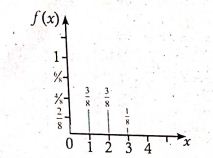
20.
Given s = 2t2 + 3t
s(3) = 2 \(\times\) 32 + 3 (3)
= 2\(\times\)9+9
= 27 m ....(1)
s(6) = 2\(\times\) 62 + 3 (6)
= 72 + 18 = 90m ... (2)
Average velocity = \(\frac { s(6)-s(3) }{ 6-3 } \)
= \(\frac { 90-27 }{ 3 } \) = 21 m/s
(ii) Instantaneous Velocity V(t) = \(\frac { ds }{ dt } \)
Instantaneous Velocity at t = 3
= V(3) = 15 m/sec
Instantaneous Velocity at t = 6
= V(6) = 27m/sec
21.
Given adj A =\(\left[ \begin{matrix} 2 & -4 & 2 \\ -3 & 12 & -7 \\ -2 & 0 & 2 \end{matrix} \right] \)
We know that A = \(\pm \frac { 1 }{ \sqrt { |adjA| } } \) adj (adj A)..(1)
|adj A| = \(2\left| \begin{matrix} 12 & -7 \\ 0 & 2 \end{matrix} \right| +4\left| \begin{matrix} -3 & -7 \\ -2 & 2 \end{matrix} \right| +2\left| \begin{matrix} -3 & 12 \\ -2 & 0 \end{matrix} \right| \)
[Expanded along R1]
= 2(24-0)+4(-6-14)+2(0+24)
= 2(24)+4(-20)+2(24) = 48-80+48
= 96-80 = 16
Now, adj (adj A)
=\(\left[ \begin{matrix} +\left| \begin{matrix} 12 & -7 \\ 0 & 2 \end{matrix} \right| & -\left| \begin{matrix} -3 & -7 \\ -2 & 2 \end{matrix} \right| & +\left| \begin{matrix} -3 & 12 \\ -2 & 0 \end{matrix} \right| \\ -\left| \begin{matrix} -4 & 2 \\ 0 & 2 \end{matrix} \right| & +\left| \begin{matrix} 2 & 2 \\ -2 & 2 \end{matrix} \right| & -\left| \begin{matrix} 2 & -4 \\ -2 & 0 \end{matrix} \right| \\ +\left| \begin{matrix} -4 & 2 \\ 12 & -7 \end{matrix} \right| & -\left| \begin{matrix} 2 & 2 \\ -3 & -7 \end{matrix} \right| & +\left| \begin{matrix} 2 & -4 \\ -3 & 12 \end{matrix} \right| \end{matrix} \right] ^{ T }\)
=\(\left[ \begin{matrix} +(24-0)-(6-14)+(0+24) \\ -(-8-0)+(4+4)-(0-8) \\ +(28-24)-(-14+6)+(24-12) \end{matrix} \right] ^{ T }\)
=\(\left[ \begin{matrix} 24 & 20 & 24 \\ 8 & 8 & 8 \\ 4 & 8 & 12 \end{matrix} \right] ^{ T }=\left[ \begin{matrix} 24 & 8 & 4 \\ 20 & 8 & 8 \\ 24 & 8 & 12 \end{matrix} \right] \)
= \(4\left[ \begin{matrix} 6 & 2 & 1 \\ 5 & 2 & 2 \\ 6 & 2 & 3 \end{matrix} \right] \)
Substituting (2) and (3) in (1) we get,
A = \(\frac { 1 }{ \sqrt { 16 } } .4\left[ \begin{matrix} 6 & 2 & 1 \\ 5 & 2 & 2 \\ 6 & 2 & 3 \end{matrix} \right] \)
A = \(\pm \frac { 4 }{ 4 } \left[ \begin{matrix} 6 & 2 & 1 \\ 5 & 2 & 2 \\ 6 & 2 & 3 \end{matrix} \right] =\pm \left[ \begin{matrix} 6 & 2 & 1 \\ 5 & 2 & 2 \\ 6 & 2 & 3 \end{matrix} \right] \)
22.
The roots of x3+2x2+3x+4 = 0 are ∝, β, ૪
∴ ∝+β+૪ = -co-efficient of x2 = -2 ...(1)
∝β + β૪ + ૪∝ = co-effficient of x = 3 ....(2)
-∝β૪ = +4 ⇒ ∝β૪ = -4 ...(3)
Form a cubic equation whose roots are 2∝, 2β, 2૪
2∝+2β+2૪ = 2(∝+β+૪) = 2(-2) = -4 [from (1)]
4∝β+4β૪+4૪∝ = 4(∝β+β૪+୪∝) = 4(3) = 12 [from (2)]
(2∝)(2β)(2૪) = 8(∝β૪) = 8(-4) = -32 [from (3)]
∴ The required cubic equation is
x3-(2∝+2β+2૪)x2 + (2∝β+2β૪+2୪∝)x - (2∝)(2β)(2૪) = 0
⇒ x3+(-4)x2+12x+32 = 0
⇒ x3+4x2+12x+32 = 0
23.
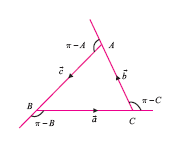
With usual notations in triangle ABC, let \(\vec { BC } =\vec { a } ,\vec { CA } =\vec { b } \) and \(\vec { AB } =\vec { c } \).
Then \(\left| \vec { BC } \right| =a\) , \(\left| \vec { CA } \right| =b\), \(\left| \vec { AB} \right| =c\), and \(\vec { BC } +\vec { CA } +\vec { AB } =\vec { 0 } \)
So, \(\vec { BC } =-\vec { CA } -\vec { AB } \)
Applying dot product, we get
\(\vec { BC } .\vec { BC } =-\vec { BC } .\vec { CA }-\vec { BC }. \vec { AB } \)
⇒ \({ \left| \vec { BC } \right| }^{ 2 }=-\left| \vec { BC } \right| \left| \vec { CA } \right| \) cos(兀-c)-\(\left| \vec { BC } \right| \left| \vec { AB} \right| \)cos(兀-B)
⇒ a2 = ab cos C + ac cos B
Therefore a = b cos C + c cos B
The results (ii) and (iii) are proved in a similar way
24.
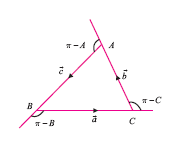
With usual notations in triangle ABC, we have \(\vec { BC } =\vec { a } ,\vec { CA } =\vec { b } \) \(\vec { AB } =\vec { c } \).
Then \(\left| \vec { BC } \right| =a\) , \(\left| \vec { CA } \right| =b\), \(\left| \vec { AB} \right| =c\), and \(\vec { BC } +\vec { CA } +\vec { AB } =\vec { 0 } \)
So, \(\vec { BC } =-\vec { CA } -\vec { AB } \)
Then applying dot product, we get
\(\vec { BC } .\vec { BC } =(-\vec { CA } -\vec { AB } ).(-\vec { CA } -\vec { AB } )\)
⇒ \({ \left| \vec { BC } \right| }^{ 2 }={ \left| \vec { CA } \right| }^{ 2 }+{ \left| \vec { AB } \right| }^{ 2 }+\vec { 2CA } .\vec { AB } \)
⇒ a2 = b2+c2+2bc cos (\(\pi\) - A)
⇒ a2 = b2+c2−2bc cos A.
The results (ii) and (iii) are proved in a similar way.
25.
Equation of the circle passing through the points of intersection of the chord and circle by
Theorem is x2 + y2−16+\(\lambda \)(3x + y + 5) = 0 .
The chord 3x + y + 5 = 0 is a diameter of this circle if the centre\(\left( \frac { -3\lambda }{ 2 } \frac { -\lambda }{ 2 } \right) \) lies on the chord.
So we have 3\(\left( \frac { -3\lambda }{ 2 } \right) \)-\(\frac { -\lambda }{ 2 } \)+5 = 0,
\(\frac { -9\lambda }{ 2 } \)-\(\frac { \lambda }{ 2 } \)+5 = 0,
−5λ + 5 = 0 ,
λ = 1.
Therefore, the equation of the required circle is x2 + y2+3x + y −11 = 0.
26.
Note that the function f takes value 1 on the x, y-axes and 0 everywhere else on R2. So let us calculate
\(\frac { \partial f }{ \partial x } (0,0)\) = \(\underset { h\longrightarrow 0 }{ lim } \) \(\frac { f\left( 0+h,0 \right) -f(0,0) }{ h } =\underset { h\longrightarrow 0 }{ lim } \frac { 1-1 }{ h } =0;\)
\(\frac { \partial f }{ \partial y } (0,0)\) = \(\underset { k\longrightarrow 0 }{ lim } \) \(\frac { f\left( 0,0+k \right) -f(0,0) }{ k } =\underset { k\longrightarrow 0 }{ lim } \frac { 1-1 }{ k } =0\)
This completes (i).
27.
Here f (x) = x3, a = 0 and b = 1. Hence, we get
\(\int _{ a }^{ b }{ f(x)dx } =\underset { n\rightarrow \infty }{ lim } \frac { 1 }{ n } \sum _{ r=1 }^{ n }{ f } \left( \frac { r }{ n } \right) \Rightarrow \int _{ 0 }^{ 1 }{ x^3dx } =\underset { n\rightarrow \infty }{ lim } \frac { 1 }{ n } \sum _{ r=1 }^{ n }{ \frac { r^3 }{ n^3 } } \)
\(=\underset { n\rightarrow \infty }{ lim } \frac { 1 }{ { n }^{ 4 } } [{ 1 }^{ 3 }+{ 2 }^{ 3 }+...+{ n }^{ 3 }]=\underset { n\rightarrow \infty }{ lim } \frac { 1 }{ { n }^{ 4 } } \frac { { n }^{ 2 }{ (n+1) }^{ 2 } }{ 4 } \)
\(=\underset { n\rightarrow \infty }{ lim } \frac { 1 }{ 4 } { \left( 1+\frac { 1 }{ n } \right) }^{ 2 }=\frac { 1 }{ 4 } \)
28.
Here f (x) = x, a = 0 and b = 1. Hence, we get
\(\int _{ a }^{ b }{ f(x)dx } =\underset { n\rightarrow \infty }{ lim } \frac { 1 }{ n } \sum _{ r=1 }^{ n }{ f } \left( \frac { r }{ n } \right) \Rightarrow \int _{ 0 }^{ 1 }{ xdx } =\underset { n\rightarrow \infty }{ lim } \frac { 1 }{ n } \sum _{ r=1 }^{ n }{ \frac { r }{ n } } \)
\(=\underset { n\rightarrow \infty }{ lim } \frac { 1 }{ { n }^{ 2 } } [1+2+...+n]\)
\(=\underset { n\rightarrow \infty }{ lim } \frac { 1 }{ { n }^{ 2 } } \frac { n(n+1) }{ 2 } =\underset { n\rightarrow \infty }{ lim } \frac { 1 }{ 2 } \left( 1+\frac { 1 }{ n } \right) =\frac { 1 }{ 2 } \)
29.
The average rate of change in an interval [a, b] is \(\frac { f(b)-f(a) }{ b-a } \) whereas, the instantaneous rate of change at a point x is f′(x) for the given function. They are respectively, b + a and 2x.
| a | b | x | Average rate is \(\frac { f(b)-f(a) }{ b-a } \) = b+a | Instantaneous rate is f'(x) = 2x |
| 0 | 0.5 | 0.5 | 0.5 | 1 |
| 0.5 | 1 | 1 | 1.5 | 2 |
| 1 | 1.5 | 1.5 | 2.5 | 3 |
| 1.5 | 2 | 2 | 3.5 | 4 |
30.
The discriminant Δ =((4p)2 - 4(4)(p+2) = 16(p2-p-2) = 16(p+1)(p-2). So we get
Δ < 0 if -1
Δ = 0 if p = -1 or p = 2
Δ >0 if \(\infty\).
imaginary roots if -1 < p < 2
equal real roots if p = −1 or p = 2;
distinct real roots if -\(\infty\) < p < -1 or 2 < p < \(\infty\)

12th Standard Syllabus & Materials
12th Standard
TN 12th Computer Applications வலையமைப்பு வடமிடல் Sample Question Papers Study Material - QB365 Set A
NEW12th Standard
TN 12th Computer Applications களப்பெயர் முறைமை (DNS) Sample Question Papers Study Material - QB365 Set A
NEW12th Standard
TN 12th Computer Applications வலையமைப்பு எடுத்துக்காட்டுகள் மற்றும் நெறிமுறைகள் Sample Question Papers Study Material - QB365 Set A
NEW12th Standard
TN 12th Computer Applications கணினி வலையமைப்பு ஓர் அறிமுகம் Sample Question Papers Study Material - QB365 Set A



Tamilnadu Stateboard 12th Standard Subjects
Maths

Chemistry

Physics

Biology

Computer Science

Business Maths and Statistics

Economics

Commerce

Accountancy

History

Computer Applications
Biology
Computer Technology
Computer Applications
Computer Science
Business Maths and Statistics
Commerce
Economics
Maths
Chemistry
Physics
Computer Technology
History
Accountancy

Tamil

English

French
Tamilnadu Stateboard Standards

