
 100% FREE ACCESS
12th Standard Syllabus & Materials
12th Standard
TN 12th Computer Applications மின்னணு தரவு பரிமாற்றம் Sample Question Papers Study Material - QB365 Set A
NEW12th Standard
TN 12th Computer Applications மின் - வணிக பாதுகாப்பு அமைப்புகள் Sample Question Papers Study Material - QB365 Set A
NEW12th Standard
TN 12th Computer Applications மின்னணு செலுத்தல் முறைகள் Sample Question Papers Study Material - QB365 Set A
NEW12th Standard
TN 12th Computer Applications மின் - வணிகம் Sample Question Papers Study Material - QB365 Set A
NEW12th Standard
TN 12th Computer Applications திறந்த மூல கருத்துருக்கள் Sample Question Papers Study Material - QB365 Set A
NEW12th Standard
TN 12th Computer Applications வலையமைப்பு வடமிடல் Sample Question Papers Study Material - QB365 Set A

Published on: 31/12/2022
QB365 provides a detailed and simple solution for every Possible Questions in Class 12 Maths Subject - Important 3 Mark English Medium. It will help Students to get more practice questions, Students can Practice these question papers in addition to score best marks.
Download Tamil Nadu 12th Standard Maths question papers, model tests, one-mark questions, important questions, and public exam papers in PDF format. Free study materials and answer keys for TN State Board students.
Questions + Answers key
Take MCQ Maths Test1.
Write each of the following sentences in symbolic form using statement variables p and q.
(i) 19 is not a prime number and all the angles of a triangle are equal.
(ii) 19 is a prime number or all the angles of a triangle are not equal
(iii) 19 is a prime number and all the angles of a triangle are equal
(iv) 19 is not a prime number
2.
Show that \(\int ^\frac{2\pi}{0}_{0}\) g(cos x)dx = 2 \(\int ^{\pi}_{0}\) g(cosx)dx where g(cos x) is a function of cos x
3.
Find the acute angle between the planes \(\vec { r } .(2\hat { i } +2\hat { j } +2\hat { k } )\) and 4x-2y+2z = 15.
4.
If α and β are the roots of the quadratic equation 17x2+43x−73 = 0 , construct a quadratic equation whose roots are α + 2 and β + 2.
5.
The probability that an event A happens in one treat of an experiment is 0.4. Three independent treats of the experiment are performed. Find the probability that the event A happens atleast once?
6.
The p.d.f. of X is given by
| x | -2 | 2 | 5 |
| P(X-x) | \( \frac{1}{4} \) | \( \frac{1}{4} \) | \( \frac{1}{2}\) |
then find 4E(X²) - var(2X)
7.
If \(2cos\ \alpha=x+\frac { 1 }{ x } \) and \(2cos\ \beta =y+\frac { 1 }{ y } \), show that \(\frac { { x }^{ m } }{ { y }^{ n } } -\frac { { y }^{ n } }{ { x }^{ m } } =2isin\left( m\alpha -n\beta \right) \)
8.
By using the properties of definite integrals, I evaluate \(\int_{0}^{1}|x-1| d x\)
9.
In a continuous distribution the p.d.f of x is \(f(x)=\left\{\begin{array}{c} \frac{3}{4} x(2-x), 0
10.
The acute angle \(\theta\) between the two planes \(\vec{r} \cdot \vec{n}_{1}=p_{1} \text { and } \vec{r} \cdot \vec{n}_{2}=p_{2}\) is given by \(\theta=\cos ^{-1}\left(\frac{\left|\vec{n}_{1} \cdot \vec{n}_{2}\right|}{\left|\vec{n}_{1}\right|\left|\vec{n}_{2}\right|}\right)\)
11.
The position of a point P(x1 , y 1) with respect to a given circle x2 + y2 + 2gx + 2 fy + c = 0 in the plane containing the circle is outside or on or inside the circle according as
\(x_{1}^{2}+y_{1}^{2}+2 g x_{1}+2 f y_{1}+c \text { is } \begin{cases}>0 & \text { or } \\ =0 & \text { or } \\ <0 & \end{cases}\)
12.
Let p and q be rational numbers such that \(\sqrt{q}\) is irrational. If p + \(\sqrt{q}\) is a root of a quadratic equation with rational coefficients, then p − \(\sqrt{q}\) is also a root of the same equation.
13.
If A is non-singular, then
\((i)\ \left|A^{-1}\right|=\frac{1}{|A|} \)
\((ii)\ \left(A^{T}\right)^{-1}=\left(A^{-1}\right)^{T} \)
\((iii)\ (\lambda A)^{-1}=\frac{1}{\lambda} A^{-1},\)
where is \(\lambda\) non-zero scalar
14.
Solve:\(\frac { dy }{ dx } =\frac { 1-cosx }{ 1+cosx } \)
15.
Evaluate \(\int _{ 0 }^{ \frac { \pi }{ 2 } }{ { cos }^{ 10 }xdx } \)
16.
Two balls are chosen randomly from an urn containing 6 white and 4 black balls. Suppose that we win Rs. 30 for each black ball selected and we lose Rs. 20 for each white ball selected. If X denotes the winning amount, then find the values of X and number of points in its inverse images.
17.
Let U(x, y, z) = x2 − xy + 3 sin z, x, y, z ∈ R Find the linear approximation for U at (2,−1,0).
18.
Evaluate the following:
\(\int _{ 0 }^{ \frac { 1 }{ 2 } }{ \frac { { e }^{ { a\ sin }^{ -1x } }{ sin }^{ -1 }x }{ \sqrt { 1-{ x }^{ 2 } } } dx } \)
19.
Show that f(x, y) = \(\frac { { x }^{ 2 }-{ y }^{ 2 } }{ { y }^{ 2 }+1 } \) is continuous at every (x, y) ∈ R2
20.
Find ∆f and df for the function f for the indicated values of x, ∆x and compare
(1) f(x) = x3 - 2x2 ; x = 2, ∆ x = dx = 0.5
(2) f(x) = x2 + 2x + 3; x = -0.5, ∆x = dx = 0.1
21.
Let \(f(x)=\sqrt [ 3 ]{ x } \). Find the linear approximation at x = 27. Use the linear approximation to approximate \(\sqrt [ 3 ]{ 27.2 } \)
22.
Using the Rolle’s theorem, determine the values of x at which the tangent is parallel to the x -axis for the following functions:
\(f(x)=\sqrt{x}-\frac{x}{3}, x\in [0,9]\)
23.
Find the differential equation of the family of circles passing through the points (a, 0) and (−a, 0).
24.
Solve: 3x+ay = 4, 2x + ay = 2, a ≠ 0 by Cramer's rule.
25.
Find the value of
\(cos\left( { sin }^{ -1 }\left( \frac { 4 }{ 5 } \right) -{ tan }^{ -1 }\left( \frac { 3 }{ 4 } \right) \right) \)
26.
Find the inverse (if it exists) of the following:
\(\left[ \begin{matrix} 5 & 1 & 1 \\ 1 & 5 & 1 \\ 1 & 1 & 5 \end{matrix} \right] \)
27.
Find the rectangular form of the complex numbers
\(\left( cos\frac { \pi }{ 6 } +isin\frac { \pi }{ 6 } \right) \left( cos\frac { \pi }{ 12 } +isin\frac { \pi }{ 12 } \right) \)
28.
Find the inverse of the matrix \(\left[ \begin{matrix} 2 & -1 & 3 \\ -5 & 3 & 1 \\ -3 & 2 & 3 \end{matrix} \right] \).
29.
Evaluate the following limit, if necessary use l ’Hôpital Rule
\(\underset { x\rightarrow \infty }{ lim } \ { \left( 1+\frac { 1 }{ x } \right) }^{ x }\)
30.
Solve the equation
2x3 - 9x2 + 10x = 3
1.
Let p: 19 is a prime number.
q: All the angles of a triangle are equal be two simple statements.
(i) 19 is not a prime number and all the angles of a triangle are equal.
~p ∧ q
(ii) 19 is a prime number or all the angles of a triangle are not equal.
p ∧ ~q
(iii) 19 is a prime number and all the angles of a triangle are equal.
p ∧ q
(iv) 19 is not a prime number.
~p.
2.
Take 2a = 2\(\pi\) and f(x) = g(cosx)
Then, f (2a−x) = f(2\(\pi\)-x) = g(cos(2\(\pi\)-x)) = g(cos x) = f(x)
\(\therefore \int _{ 0 }^{ 2a }{ f(x)dx=2 } \int _{ 0 }^{ a }{ f(x)dx } \)
\(\therefore \int _{ 0 }^{ 2\pi }{ g(cosx)dx=2\int _{ 0 }^{ \pi }{ g(cosx)dx } } \)
3.
The normal vectors of the two given planes \(\vec { r } .(2\hat { i } +2\hat { j } +2\hat { k } )\)= 11 and 4x+2y+2z = 15 are \(\vec { { n }_{ 1 } } =2\hat { i } +2\hat { j } +2\hat { k } \) and \(\vec { { n }_{ 2 } } =4\hat { i } -2\hat { j } +2\hat { k } \) respectively.
If θ is the acute angle between the planes, then we have
\(\theta =cos^{ -1 }\left( \frac { |\vec { { n }_{ 1 } } .\vec { { n }_{ 2 } } | }{ |\vec { { n }_{ 1 } } .\vec { { n }_{ 2 } } | } \right) =cos^{ -1 }\left( \frac { |((2\hat { i } +2\hat { j } +2\hat { k } ).(4\hat { i } -2\hat { j } +2\hat { k } ))| }{ |(2\hat { i } +2\hat { j } +2\hat { k } )||4\hat { i } -2\hat { j } +2\hat { k } | } \right) =cos^{ -1 }\left( \frac { \sqrt { 2 } }{ 3 } \right) \).
4.
Since α and β are the roots of 17x2+ 43x −73 = 0 , we have α + β =\(\frac { -43 }{ 17 } \) and αβ =\(\frac { -73 }{ 17 } \).
We wish to construct a quadratic equation with roots α + 2 and β + 2. Thus, to construct such a quadratic equation, calculate
the sum of the roots = α + β + 4 = \(\frac { -4 }{ 17 } +4=\frac { 25 }{ 17 } \) and
the product of the roots = αβ + 2(α+β)+4 = \(\frac { -73 }{ 17 } +2\left( \frac { -43 }{ 17 } \right) +4=\frac { -91 }{ 17 } \)
Hence a quadratic equation with required roots is x2-\(\frac { 25 }{ 17 } x-\frac { 91 }{ 17 } \) = 0
Multiplying this equation by 17, gives 17x2−25x−91 = 0
which is also a quadratic equation having roots α + 2 and β + 2
5.
Given p = 0.4, n = 3
q = 1-0.4-0.6
\( \mathrm{P}(\mathrm{X} \geq 1)=\mathrm{P}(\mathrm{X}=1)+\mathrm{P}(\mathrm{X}=2) \)
\(=3 \mathrm{C}_{1}(0.4)^{1}(0.6)^{2}+3 \mathrm{C}_{2}(0.4)^{2}(0.6)^{1}+\mathrm{P}(\mathrm{X}=3) \)
\(=3 \times\left(\frac{4}{10}\right)\left(\frac{36}{100}\right)+3\left(\frac{16}{100}\right)\left(\frac{6}{10}\right)+\frac{64}{100} \)
\(=\frac{1}{1000}(432+288+64)=\frac{784}{1000}=0.784\)
6.
\( \mathrm{E}(\mathrm{X}) =\Sigma x p(x) \)
\(=-2\left(\frac{1}{4}\right)+2\left(\frac{1}{4}\right)+5\left(\frac{1}{2}\right) \)
\( =\frac{5}{2} \)
\(4 \cdot \mathrm{E}\left(\mathrm{X}^{2}\right)-\operatorname{Var}(2 \mathrm{X}) =4 \mathrm{E}\left(\mathrm{X}^{2}\right)-4\left[\mathrm{E}\left(\mathrm{X}^{2}\right)-\left(\mathrm{E}\left(\mathrm{X}_{1}\right)^{2}\right)\right] \)
\( =4 \mathrm{E}\left(\mathrm{X}^{2}\right)-4 \mathrm{E}\left(\mathrm{X}^{2}\right)+4[\mathrm{E}(\mathrm{X})]^{2} \)
\( =4[\mathrm{E}(\mathrm{X})]^{2} \)
\( =4\left(\frac{5}{2}\right)^{2}=4\left(\frac{25}{4}\right)=25 \)
7.
Given 2cos α = x + \(\frac { 1 }{ x } \)
⇒ 2cos α = \(\frac { { x }^{ 2 }+1 }{ x } \)
⇒ x2+1 = 2x cos α
⇒ x2-2x cos α+1 = 0
⇒ \(\frac { 2cos\alpha \pm \sqrt { (-2cos\alpha )^{ 2 }-4(1)(1) } }{ 2 } \)
= \(\frac { 2cos\alpha \pm \sqrt { 4cos^{ 2 }\alpha -4 } }{ 2 } \) \(\left[ \because \frac { b\pm \sqrt { { b }^{ 2 }-4ac } }{ 2a } \right] \)
= \(\frac { 2cos\alpha \pm \sqrt { -sin^{ 2 }\alpha } }{ 2 } \)
= \(\frac { 2cos\alpha \pm isin\alpha }{ 2 } \) [∵ sin2α + cos2α = 1]
⇒ x2 = cos α ± sin α
Also, 2cos β = y + \(\frac { 1 }{ y } \)
⇒ 2cos β = \(\frac { { y }^{ 2 }+1 }{ y } \)
⇒ y2-2y cos β + 1 = 0
⇒ \(\frac { 2cos\beta \pm \sqrt { (-2cos^{ 2 }\beta ^{ 2 }-4(1)(1) } }{ 2 } \)
= \(\frac { 2cos\beta \pm \sqrt { 4cos^{ 2 }\beta } -4 }{ 2 } =\frac { 2cos\beta \pm 2isin\beta }{ 2 } \)
⇒ y = cos β ±i sin β
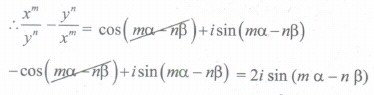
\(\frac { { x }^{ m } }{ { y }^{ n } } -\frac { { y }^{ n } }{ { x }^{ m } } =2isin\left( m\alpha -n\beta \right) \)
xm = (cos α+sin α)m = cos mα + i sin mα [By De moivre's theorem]
yn = (cos β + i sin β)n = cos nβ+i sin nβ
∴ \(\frac { { x }^{ m } }{ { y }^{ n } } =\frac { cosm\alpha +isinm\alpha }{ cosn\beta +isinn\beta } \)
= cos(mα-nβ) +i sin(mα+nβ)
and \(\frac { { y }^{ n } }{ { x }^{ m } } =\frac { \frac { 1 }{ { x }^{ m } } }{ { y }^{ n } } \)
= cos(mα-nβ)-i sin(mα-nβ)
8.
\(
\mathrm{f}(x)=|x-1|=\left\{\begin{array}{cc}
-(x-1) \text { if } x<1 \\
x-1 & \text { if } x \geq 1
\end{array}\right.
\)
\( I=\int_{0}^{1}|x-1| d x
\)
\( =\int_{0}^{1}-(x-1) d x=-\left(\frac{x^{2}}{2}-x\right)_{0}^{1}
\)
\( =-\left(\frac{1}{2}-1-0\right)=-\left(\frac{-1}{2}\right)=\frac{1}{2}
\)
9.
Mean:
\( \mathrm{E}(\mathrm{X}) =\int_{-\infty}^{\infty} x f(x) d x \)
\( =\int_{0}^{2} x \frac{3}{4} x(2-x) d x \)
\( =\frac{3}{4} \int_{0}^{2} x^{2}(2-x) d x \)
\( =\frac{3}{4} \int_{0}^{2}\left(2 x^{2}-x^{3}\right) d x \)
\( =\frac{3}{4}\left[2 \frac{x^{3}}{3}-\frac{x^{4}}{4}\right]_{0}^{2}=\frac{3}{4}\left[\frac{2}{3}(8)-\frac{16}{4}\right]\)
Mean = 1
Variance:
\( \mathrm{E}\left(\mathrm{X}^{2}\right) =\int_{-x}^{x} x^{2} f(x) d x=\int_{0}^{2} x^{2} \frac{3}{4} x(2-x) d x \)
\( =\frac{3}{4} \int_{0}^{2}\left(2 x^{3}-x^{4}\right) d x \)
\( =\frac{3}{4}\left[2 \cdot \frac{x^{4}}{4}-\frac{x^{5}}{5}\right]_{0}^{2} \)
\( =\frac{3}{4}\left[\frac{16}{2}-\frac{32}{5}\right]=\frac{6}{5} \)
Variance \(=E\left(X^{2}\right)-[E(X)]^{2} \)
\(=\frac{6}{5}-1=\frac{1}{5} \)
10.
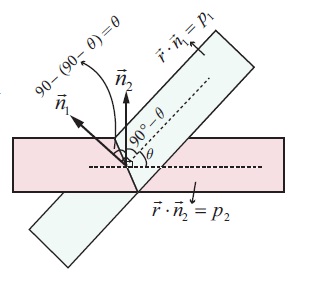
If θ is the acute angle between two planes \(\vec{r} \cdot \vec{n}_{1}=p_{1} \text { and } \vec{r} \cdot \vec{n}_{2}=p_{2}\) then \(\theta\) is the acute angle between their normal vectors \(\vec{n}_{1} \text { and } \vec{n}_{2}\) .
Therefore, \(\cos \theta=\left(\frac{\left|\vec{n}_{1} \cdot \vec{n}_{2}\right|}{\left|\vec{n}_{1}\right|\left|\vec{n}_{2}\right|}\right) \Rightarrow \theta=\cos ^{-1}\left(\frac{\left|\vec{n}_{1} \cdot \vec{n}_{2}\right|}{\left|\vec{n}_{1}\right|\left|\vec{n}_{2}\right|}\right)\)
11.
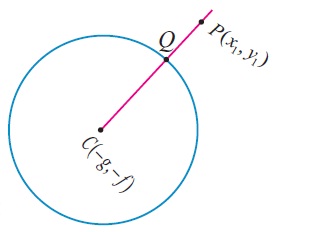
Equation of the circle is x2 + y2 + 2gx + 2 fy + c = 0 with centre C (-g, - f ) and radius \(r=\sqrt{g^{2}+f^{2}-c}\)
Let P(x1, y1) be a point in the plane. Join CP and let it meet the circle at Q. Then the point P is outside, on or within the circle according as
\(|C P| \text { is } \begin{cases}>|C Q| & \text { or, } \\ =|C Q| & \text { or, } \\ <|C Q| . & \end{cases}\)
\(\Rightarrow \quad C P^{2} \text { is } \begin{cases}>r^{2} & \text { or, } \\ =r^{2} & \text { or } \quad\{C Q=r\}, \\ <r^{2} .\end{cases}\)
\(\Rightarrow\left(x_{1}+g\right)^{2}+\left(y_{1}+f\right)^{2} \text { is } \begin{cases}>g^{2}+f^{2}-c & \text { or, } \\ =g^{2}+f^{2}-c & \text { or, } \\ <g^{2}+f^{2}-c\end{cases}\)
\(\Rightarrow \quad x_{1}^{2}+y_{1}^{2}+2 g x_{1}+2 f y_{1}+c \text { is } \begin{cases}>0 & \text { or, } \\ =0 & \text { or, } \\ <0 & \end{cases}\)
12.
We prove the theorem by assuming that the quadratic equation is a monic polynomial equation. The result for non-monic polynomial equation can be proved in a similar way.
Let p and q be rational numbers such that \(\sqrt{q}\) is irrational. Let p + \(\sqrt{q}\) be a root of the equation x2 + bx + c = 0 where b and c are rational numbers.
Let α be the other root. Computing the sum of the roots, we get
α + p + \(\sqrt{q}\) = −b
and hence \(\alpha+\sqrt{q}=-b-p \in \mathbb{Q}\). Taking − b − p as s, we have α + \(\sqrt{q}\) = s
This implies that
α = s −\(\sqrt{q}\)
Computing the product of the roots, we get
(s − \(\sqrt{q}\))( p + \(\sqrt{q}\)) = c
and hence \((s p-q)+(s-p) \sqrt{q}=c \in \mathbb{Q}\) . Thus s − p = 0 . This implies that s = p and hence we get α = p − \(\sqrt{q}\) . So, the other root is p − \(\sqrt{q}\) .
13.
Let A be non-singular. Then \(|A| \neq 0\) and A−1 exists. By definition
\(A A^{-1}=A^{-1} A=I_{n}\)
(i) By (1), we get \(\left|A A^{-1}\right|=\left|A^{-1} A\right|=\left|I_{n}\right|\)
Using the product rule for determinants, we get \(|A|\left|A^{-1}\right|=\left|I_{n}\right|=1\)
Hence, \(\left|A^{-1}\right|=\frac{1}{|A|}\)
(ii) From (1), we get \(\left(A A^{-1}\right)^{T}=\left(A^{-1} A\right)^{T}=\left(I_{n}\right)^{T} .\)
Using the reversal law of transpose, we get \(\left(A^{-1}\right)^{T} A^{T}=A^{T}\left(A^{-1}\right)^{T}=I_{n}\). Hence \(\left(A^{T}\right)^{-1}=\left(A^{-1}\right)^{T}\)
(iii) Since λ is a non-zero scalar, from (1), we get \((\lambda A)\left(\frac{1}{\lambda} A^{-1}\right)=\left(\frac{1}{\lambda} A^{-1}\right)(\lambda A)=I_{n}\)
\(\text { So, }(\lambda A)^{-1}=\frac{1}{\lambda} A^{-1}\)
14.
\(y=2tan\frac { x }{ 2 } -x+c\)
15.
\(\int _{ 0 }^{ 50 }{ \left[ x-\left| x \right| \right] dx } \)
16.
The possible events of selection are
(i) both balls may be black, or
(ii) one white and one black or
(iii) both are white.
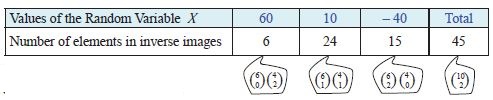
Therefore X is a random variable that take the values,
X (both are black balls) = Rs. 2(30) = Rs. 60
X (one black and one white ball) = Rs. 30 − Rs. 20 = Rs. 10
X (both are white balls) = Rs. 2( − 20) = - Rs. 40
Therefore X takes on the values 60,10, and − 40.
17.
By (14), Linear approximation is given by
L (x, y, z) = U(x0, y0, z0) + \({ \frac { { \partial }U }{ { \partial x } } | }_{ { x }_{ 0 },{ y }_{ 0 },{ z }_{ 0 } }\) (x-x0)+\({ \frac { { \partial }U }{ { \partial y } } | }_{ { x }_{ 0 },{ y }_{ 0 },{ z }_{ 0 } }\) (y-y0)+\({ \frac { { \partial }U }{ { \partial z } } | }_{ { x }_{ 0 },{ y }_{ 0 },{ z }_{ 0 } }\) (z-z0)
Now Ux = 2x -y, Uy = -xand Uz = 3cos z.
Here (x0, y0, z0) = (2,−1,0 )
hence Ux (2, −1,0) = 5, Uy (2, −1,0) = −2 and Uz (2,-1,0) = 3.
Thus L(x, y, z) = 6 + 5(x − 2) − 2( y +1) + 3(z − 0) = 5x − 2y + 3z − 6 is the required linear approximation for U at (2,−1,0).
18.
\(put\ t={ sin }^{ -1 }x\Rightarrow dt=\frac { dx }{ \sqrt { 1-{ x }^{ 2 } } } \)
\(\therefore \int _{ 0 }^{ \frac { \pi }{ 4 } }{ { e }^{ at }t\quad dt=\int _{ 0 }^{ \frac { \pi }{ 4 } }{ t } { e }^{ at }dt } \)
\( u=t\ \ v={ e }^{ at }dt\)
\(u'=1\quad { v }_{ 1 }= e ^t\)
\(u'' = 0 \ \ { v }_{ 2 }=e^t\)
\(\int { uvdx } ={ uv }_{ 1 }-u'{ v }_{ 2 }\)
\(\int _{ 0 }^{ \frac { \pi }{ 4 } }{ t{ e }^{ at }dt } ={ \left[ t\frac { { e }^{ at } }{ a } -1\frac { { e }^{ at } }{ { a }^{ 2 } } \right] }_{ 0 }^{ \frac { \pi }{ 4 } }\)
\(dt = \frac{1}{\sqrt 1-x^2}dx\)
I = \(\int ^\frac{\pi}{4}_0 e^t t \ dt\)
\([t e^t-t]^{\frac{\pi}{4}}_0\)
\(=\frac { { e }^{ \frac { \pi }{ 4 } } }{ { a }^{ 2 } } \left( \frac { a\pi }{ 4 } -1 \right) -\frac { { e }^{ 0 } }{ { a }^{ 2 } } (-1)\)
\(=1+ e ^ \frac { \pi }{ 4 } (\frac { \pi }{ 4 }-1) \)
19.
Let (a, b) ∈ R2 an arbitrary point we shall investigate continuity of f at (a,b).
That is, we shall check if all the three conditions for continuity hold for f at (a, b).
(i) f(a, b) = \(\frac { { a }^{ 2 }-{ b }^{ 2 } }{ b^{ 2 }+1 } \) is defined
(ii) \(\begin{matrix} lim \\ (x,y)\rightarrow (a,b) \end{matrix}=\frac { \begin{matrix} lim \\ (x,y)\rightarrow (a,b) \end{matrix}{ x }^{ 2 }-{ y }^{ 2 } }{ \begin{matrix} lim \\ (x,y)\rightarrow (a,b) \end{matrix}{ y }^{ 2 }+1 } \) = L exists
= \(\frac { { a }^{ 2 }-{ b }^{ 2 } }{ b^{ 2 }+1 } \) = L exists
(iii) Also, f(a, b) = \(\frac { { a }^{ 2 }-{ b }^{ 2 } }{ b^{ 2 }+1 } \)
∴ \(\begin{matrix} lim \\ (x,y)\rightarrow (a,b) \end{matrix}\)= L = f(a, b)
Hence f satisfies all the three conditions since (a, b) is an arbitrary point on R2, we conclude that f is continuous at every point of R2.
20.
Given f(x) = x3 - 2x2 ; x = 2, ∆ x = dx = 0.5
(1) df = f'(x).∆x = (3.x2 - 4x) ∆x
= [3(2)2 - 4(2)] (0.5)
= 4(0.5) = 2.0
∆f = f(x + ∆x) - f(x)
= f(2.5) - f(2)
= [(2.5)3 - 2 (2.5)2] - [23 - 2(22)]
= 15.625 -12.5 -0 = 3.125
(2) df = f'(x) ∆x (2x + 2) (∆x)
x = -0.5, ∆x = dx = 0.1
= (2(-0.05) + 2) = 0.1
∆f = f(x + ∆x) - f(x)
= f(-0.5 + 0.1) - f(-0.5)
= f(0.4) - f(-0.5)
= [(-0.4)2 + 2(-0.4) + 3] - [(-0.5)2 + 2(-0.5) + 3]
= (16 - 0.8 + 3) - (0.25 - 1 + 3)
= 2.36 - 2.25 = 0.11
21.
Given \(f(x)=\sqrt [ 3 ]{ x } \)
Let x0 = 27 and \(\triangle x=0.2\)
We know L(x) = \(f({ x }_{ 0 })+{ f }^{ ' }({ x }_{ o })\) (x - x0) ∀ x ∈ (a, b)
∴ \(\sqrt [ 3 ]{ 27.2 } =f(27)+{ f }^{ ' }(27)(0.2)\) .. (1)
Now f(27) = \(\sqrt [ 3 ]{ 27 } =3\)
\({ f }^{ ' }(27)=\frac { 1 }{ 3 } x^{ \frac { 1 }{ 3 } -1 }=\frac { 1 }{ 3 } { x }^{ \frac { 2 }{ 3 } }=\frac { 1 }{ { 3x }^{ \frac { 2 }{ 3 } } } \)
\(\therefore \) becomes,
\(\sqrt [ 3 ]{ 27.2 } =3+\frac { 1 }{ 27 } (0.2)\)
= 3 + .0074 = 3.0074
\(\therefore \) \(\sqrt [ 3 ]{ 27.2 } =3.0074\)
22.
a) f(x) is continuous in [0, 9]
b) f(x) is differentiable in (0, 9)
c) f(0) = 0
\(f(9)=\sqrt { 9 } -\frac { 9 }{ 3 } =3-3=0\)
∴ f(0) = f(9)
∴ By Rolle's theorem, there exists C ∈ [0, 9] such that f'(c) = 0
⇒ \({ \frac { 1 }{ 2 } c }^{ \frac { 1 }{ 2 } -1 }-\frac { 1 }{ 3 } =0\)
⇒ \({ \frac { 1 }{ 2 } c }^{ \frac { 1 }{ 2 } -1 }=\frac { 1 }{ 3 } \)
⇒ \(\frac { 1 }{ 2\sqrt { c } } =\frac { 1 }{ 3 } \)
⇒ \(\frac { 1 }{ \sqrt { c } } =\frac { 2 }{ 3 } \)
⇒ \(\sqrt { c } =\frac { 2 }{ 3 } \)
Squaring both sides, c = \(\frac94\) ∈ [0, 9]
23.
A circle passing through the points (a, 0) and (−a, 0) has its centre on y - axis.
Let (0, b) be the centre of the circle. S o, the radius of the circle is \(\sqrt { { a }^{ 2 }+{ b }^{ 2 } } \) .
Therefore the equation of the family of circles passing through the points (a, 0) and (−a, 0) is x2 + ( y − b)2 = a2 + b2, b is an arbitrary constant. ...(1)
Differentiating both sides of (1) with respect to x, we get
\(2x+2(y-b)\frac { dy }{ dx } =0\Rightarrow y-b=\frac { x }{ \frac { dy }{ dx } } \Rightarrow b=\frac { x }{ \frac { dy }{ dx } } +y\)
Substituting the value of b in equation (1), we get
\(2x+2(y-b)\frac { dy }{ dx } =0\Rightarrow y-b=\frac { x }{ \frac { dy }{ dx } } \Rightarrow b=\frac { x }{ \frac { dy }{ dx } } +y\)
\({ x }^{ 2 }+\frac { { x }^{ 2 } }{ { \left( \frac { dy }{ dx } \right) }^{ 2 } } ={ a }^{ 2 }+{ \left[ \frac { x }{ \frac { dy }{ dx } } +y \right] }^{ 2 }\)
\(\Rightarrow { x }^{ 2 }{ \left( \frac { dy }{ dx } \right) }^{ 2 }+{ x }^{ 2 }={ a }^{ 2 }{ \left( \frac { dy }{ dx } \right) }^{ 2 }+{ \left[ x+y{ \left( \frac { dy }{ dx } \right) }^{ 2 } \right] }^{ 2 }\)
\(\Rightarrow ({ x }^{ 2 }-{ y }^{ 2 }-{ a }^{ 2 })\frac { dy }{ dx } -2xy=0\)
which is the required differential equation
24.
Δ = \(\left| \begin{matrix} 3 & a \\ 2 & a \end{matrix} \right| \) = 3a - 2a = a
Δ1 =\(\left| \begin{matrix} 4 & a \\ 2 & a \end{matrix} \right| \) = 4a - 2a = 2a
Δ2 = \(\left| \begin{matrix} 3 & 4 \\ 2 & 2 \end{matrix} \right| \)= 6 - 8 = -2
\(\therefore x=\frac{\Delta_{1}}{\Delta}=\frac{2 \not a}{\not a}=2=y y=\frac{\Delta_{2}}{\Delta}=\frac{-2}{a}\)
∴ Solution set is {2,\(\frac { -2 }{ a } \)}
25.
\(cos\left( { sin }^{ -1 }\left( \frac { 4 }{ 5 } \right) -{ tan }^{ -1 }\left( \frac { 3 }{ 4 } \right) \right) \)
\(\Rightarrow \frac { 4 }{ 5 } =sinx\)
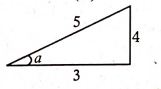
\(\therefore cosx=\frac { adj }{ hyp } =\frac { 3 }{ 5 } \)
Let \({ tan }^{ -1 }\left( \frac { 3 }{ 4 } \right) =y\)
\(\Rightarrow tany=\frac { 3 }{ 4 } \)
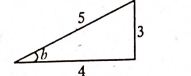
\(\Rightarrow siny=\frac { opp }{ hyp } =\frac { 3 }{ 5 } \ cosy=\frac { adj }{ hup } =\frac { 4 }{ 5 } \)
\(\therefore cos\left( { sin }^{ -1 }\left( \frac { 4 }{ 5 } \right) \right) -{ tan }^{ -1 }\left( \frac { 3 }{ 4 } \right) \)
= cos (x - y) = cos x cos y + sin x sin y
= \(\frac { 3 }{ 5 } .\frac { 4 }{ 5 } +\frac { 4 }{ 5 } .\frac { 3 }{ 5 } \)
= \(\frac { 12 }{ 25 } +\frac { 12 }{ 25 } =\frac { 24 }{ 25 } \)
= \(\frac { 24 }{ 25 } \)
26.
\(\left[ \begin{matrix} 5 & 1 & 1 \\ 1 & 5 & 1 \\ 1 & 1 & 5 \end{matrix} \right] \)
Let A =\(\left[ \begin{matrix} 5 & 1 & 1 \\ 1 & 5 & 1 \\ 1 & 1 & 5 \end{matrix} \right] \)
Expending along R1,
|A| = \(5\left| \begin{matrix} 5 & 1 \\ 1 & 5 \end{matrix} \right| -1\left| \begin{matrix} 1 & 1 \\ 1 & 5 \end{matrix} \right| +1\left| \begin{matrix} 1 & 5 \\ 1 & 1 \end{matrix} \right| \)
= 5 (25 - 1)-1 (5 - 1)+ 1 (1 - 5)
= 5 (24) - 1(4) + 1(- 4)
= 120 - 4 - 4 = 120 - 8 = 112 ≠ 0
Since A is non singular, A-1 exit
adj A =\(\left[ \begin{matrix} +\left| \begin{matrix} 5 & 1 \\ 1 & 5 \end{matrix} \right| & -\left| \begin{matrix} 1 & 1 \\ 1 & 5 \end{matrix} \right| & +\left| \begin{matrix} 1 & 5 \\ 1 & 1 \end{matrix} \right| \\ -\left| \begin{matrix} 1 & 1 \\ 1 & 5 \end{matrix} \right| & +\left| \begin{matrix} 5 & 1 \\ 1 & 5 \end{matrix} \right| & -\left| \begin{matrix} 5 & 1 \\ 1 & 1 \end{matrix} \right| \\ +\left| \begin{matrix} 1 & 1 \\ 5 & 1 \end{matrix} \right| & -\left| \begin{matrix} 5 & 1 \\ 1 & 1 \end{matrix} \right| & +\left| \begin{matrix} 5 & 1 \\ 1 & 5 \end{matrix} \right| \end{matrix} \right] ^{ T }\)
=\(\left[ \begin{matrix} +(25-1)-(5-1)+(1-5) \\ -(5-1)+(25-1)-(5-1) \\ +(1-5)+(5-1)+(25-1) \end{matrix} \right] ^{ T }\)
=\(\left[ \begin{matrix} 24 & -4 & -4 \\ -4 & 24 & -4 \\ -4 & -4 & 24 \end{matrix} \right] ^{ T }=\left[ \begin{matrix} 24 & -4 & -4 \\ -4 & 24 & -24 \\ -4 & -4 & 24 \end{matrix} \right] \)
Taking 4 common from every entry we get,
adj A = \(4\left[ \begin{matrix} 6 & -1 & -1 \\ -1 & 6 & -1 \\ -1 & -1 & 6 \end{matrix} \right] \)
∴ A-1 = \(\frac { 1 }{ |A| } adjA=\frac { 1 }{ 112 } .4\left[ \begin{matrix} 6 & -1 & -1 \\ -1 & 6 & -1 \\ -1 & -1 & 6 \end{matrix} \right] \)
= \(\frac { 1 }{ 28 } \left[ \begin{matrix} 6 & -1 & -1 \\ -1 & 6 & -1 \\ -1 & -1 & 6 \end{matrix} \right] \).
27.
\(\left( cos\frac { \pi }{ 6 } +isin\frac { \pi }{ 6 } \right) \left( cos\frac { \pi }{ 12 } +isin\frac { \pi }{ 12 } \right) \)
[∵ (cosθ1+isinθ1)(cosθ2+isonθ2)
= cos(θ1+θ2)+isin(θ1+θ2)
= \(cos\left( \frac { 2\pi +\pi }{ 12 } \right) +isin\left( \frac { 2\pi +\pi }{ 12 } \right) \)
\(cos\left( \frac { 3\pi }{ 12 } \right) +isin\left( \frac { 3\pi }{ 12 } \right) \)
\(cos\left( \frac { \pi }{ 4 } \right) +isin\left( \frac { \pi }{ 4 } \right) \)
\(\frac { 1 }{ \sqrt { 2 } } +i\frac { 1 }{ \sqrt { 2 } } =\frac { 1 }{ \sqrt { 2 } } \)(1+i)
Aliter:
\( \left(\cos \frac{\pi}{6}+i \sin \frac{\pi}{6}\right)\left(\cos \frac{\pi}{12}+i \sin \frac{\pi}{12}\right) \)
\( =\cos \left(\frac{\pi}{6}+\frac{\pi}{12}\right)+i \sin \left(\frac{\pi}{6}+\frac{\pi}{12}\right) \)
\( =\left(\cos \frac{3 \pi}{12}+i \sin \frac{3 \pi}{12}\right) \)
\( =\cos \frac{\pi}{4}+i \sin \frac{\pi}{4} \)
\( =\frac{1}{\sqrt{2}}+\frac{i}{\sqrt{2}}=\frac{1+i}{\sqrt{2}} \)
28.
Let A = \(\left[ \begin{matrix} 2 & -1 & 3 \\ -5 & 3 & 1 \\ -3 & 2 & 3 \end{matrix} \right] \). Then |A| = \(\left| \begin{matrix} 2 & -1 & 3 \\ -5 & 3 & 1 \\ -3 & 2 & 3 \end{matrix} \right| \) = 2(7) + (-12) + 3(-1) = -1 ≠ 0.
Therefore, A−1 exists. Now, we get
adj A = \({ \left[ \begin{matrix} +\left| \begin{matrix} 3 & 1 \\ 2 & 3 \end{matrix} \right| & -\left| \begin{matrix} -5 & 1 \\ -3 & 3 \end{matrix} \right| & +\left| \begin{matrix} -5 & 3 \\ -3 & 2 \end{matrix} \right| \\ -\left| \begin{matrix} -1 & 3 \\ 2 & 3 \end{matrix} \right| & +\left| \begin{matrix} 2 & 3 \\ -3 & 3 \end{matrix} \right| & -\left| \begin{matrix} 2 & -1 \\ -3 & 2 \end{matrix} \right| \\ +\left| \begin{matrix} -1 & 3 \\ 3 & 1 \end{matrix} \right| & -\left| \begin{matrix} 2 & 3 \\ -5 & 1 \end{matrix} \right| & +\left| \begin{matrix} 2 & -1 \\ -5 & 3 \end{matrix} \right| \end{matrix} \right] }^{ T }={ \left[ \begin{matrix} 7 & 12 & -1 \\ 9 & 15 & -1 \\ -10 & -17 & 1 \end{matrix} \right] }^{ T }=\left[ \begin{matrix} 7 & 9 & -10 \\ 12 & 15 & -17 \\ -1 & -1 & 1 \end{matrix} \right] \).
Hence, A-1 = \(\frac { 1 }{ \left| A \right| } \)(adj A) = \(\frac { 1 }{ \left( -1 \right) } \left[ \begin{matrix} 7 & 9 & -10 \\ 12 & 15 & -17 \\ -1 & -1 & 1 \end{matrix} \right] =\left[ \begin{matrix} -7 & -9 & 10 \\ -12 & -15 & 17 \\ 1 & 1 & -1 \end{matrix} \right] \).
29.
This an indeterminate of the form 1∞
Let \(g(x)={ \left( 1+\frac { 1 }{ x } \right) }^{ x }\)
Taking logarithm, we get,
\(log(g(x))=log{ \left( 1+\frac { 1 }{ x } \right) }^{ x }\)
\(=xlog{ \left( 1+\frac { 1 }{ x } \right) }\)
\(=\frac { { \left( 1+\frac { 1 }{ x } \right) } }{ \frac { 1 }{ x } } \)
\(\therefore \underset { x\rightarrow \infty }{ lim } log(g(x))=\underset { x\rightarrow \infty }{ lim } \frac { { \left( 1+\frac { 1 }{ x } \right) } }{ \frac { 1 }{ x } } =\left( \frac { 0 }{ 0 } form \right) \)
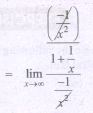
\(=\underset { x\rightarrow \infty }{ lim } \frac { { 1 } }{ \left( 1+\frac { 1 }{ x } \right) } =1\)
But \(\underset { x\rightarrow \infty }{ lim } log(g(x))=log\underset { x\rightarrow \infty }{ lim } g(x)\)
\(\therefore log(\underset { x\rightarrow \infty }{ lim } g(x))=1\)
\({ e }^{ log }(\underset { x\rightarrow \infty }{ lim } g(x))={ e }^{ 1 }=e\Rightarrow (\underset { x\rightarrow \infty }{ lim } g(x))=e\)
\(\Rightarrow \underset { x\rightarrow \infty }{ lim } { \left( 1+\frac { 1 }{ x } \right) }^{ x }=e\)
30.
Since the sum of the co-efficients is
2 - 9 + 10 - 3 = 12 - 12 = 0
⇒ x = 1 is a root of (x)
∴ (x - 1) is a factor of (x)
To find the other factor, let us divide f(x) by x-1
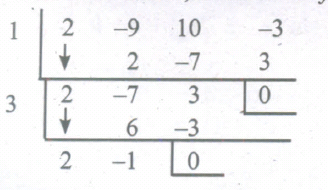
[Using synthetic division]
f(x) = (x-1)(x - 3)(2x - 1) = 0
⇒x - 1 = 0, x - 3 = 0 or 2x - 1 = 0
⇒ x = 1, x = 3x, x = \(\frac{1}{2}\)
Hence the roots are 1, 3, \(\frac{1}{2}\).

12th Standard Syllabus & Materials
12th Standard
TN 12th Computer Applications களப்பெயர் முறைமை (DNS) Sample Question Papers Study Material - QB365 Set A
NEW12th Standard
TN 12th Computer Applications வலையமைப்பு எடுத்துக்காட்டுகள் மற்றும் நெறிமுறைகள் Sample Question Papers Study Material - QB365 Set A
NEW12th Standard
TN 12th Computer Applications கணினி வலையமைப்பு ஓர் அறிமுகம் Sample Question Papers Study Material - QB365 Set A
NEW12th Standard
TN 12th Computer Applications PHP-உடன் MySQL-ஐ இணைத்தல் Sample Question Papers Study Material - QB365 Set A



Tamilnadu Stateboard 12th Standard Subjects
Maths

Chemistry

Physics

Biology

Computer Science

Business Maths and Statistics

Economics

Commerce

Accountancy

History

Computer Applications
Biology
Computer Technology
Computer Applications
Computer Science
Business Maths and Statistics
Commerce
Economics
Maths
Chemistry
Physics
Computer Technology
History
Accountancy

Tamil

English

French
Tamilnadu Stateboard Standards

