
 100% FREE ACCESS
12th Standard Syllabus & Materials
12th Standard
TN 12th Computer Applications மின்னணு தரவு பரிமாற்றம் Sample Question Papers Study Material - QB365 Set A
NEW12th Standard
TN 12th Computer Applications மின் - வணிக பாதுகாப்பு அமைப்புகள் Sample Question Papers Study Material - QB365 Set A
NEW12th Standard
TN 12th Computer Applications மின்னணு செலுத்தல் முறைகள் Sample Question Papers Study Material - QB365 Set A
NEW12th Standard
TN 12th Computer Applications மின் - வணிகம் Sample Question Papers Study Material - QB365 Set A
NEW12th Standard
TN 12th Computer Applications திறந்த மூல கருத்துருக்கள் Sample Question Papers Study Material - QB365 Set A
NEW12th Standard
TN 12th Computer Applications வலையமைப்பு வடமிடல் Sample Question Papers Study Material - QB365 Set A

Published on: 03/09/2020
12th Standard Maths English Medium Important 5 Mark Book Back Questions (New Syllabus) 2020
Download Tamil Nadu 12th Standard Maths question papers, model tests, one-mark questions, important questions, and public exam papers in PDF format. Free study materials and answer keys for TN State Board students.
Questions + Answers key
Take MCQ Maths Test1.
Define an operation \(*\)on Q as follows: a * b =\(\left( \frac { a+b }{ 2 } \right) \); a,b ∈Q. Examine the closure, commutative, and associative properties satisfied by \(*\)on Q.
2.
If z(x, y) = x tan-1 (xy), x = t2, y = set, s, t ∈ R. Find \(\frac { \partial z }{ \partial s } \) and \(\frac { \partial z }{ \partial t } \) at s = t = 1
3.
Find the area of the region bounded by the curve 2+x−x2+y = 0 , x-axis, x = −3 and x = 3.
4.
A random variable X has the following probability mass function
| x | 1 | 2 | 3 | 4 | 5 | 6 |
| f(x) | k | 2k | 6k | 5k | 6k | 10k |
Find
(i) P(2 < X < 6)
(ii) P(2 ≤ X < 5)
(iii) P(X ≤4)
(iv) P(3 < X )
5.
Evaluate the following integrals using properties of integration:
\(\int _{ 0 }^{ { sin }^{ 2 }x }{ { sin }^{ -1 }\sqrt { t } dt+\int _{ 0 }^{ { cos }^{ 2 }x }{ { cos }^{ -1 }\sqrt { t } dt } } \)
6.
The probability density function of X is given
\(f(x)=\begin{cases} \begin{matrix} { Ke }^{ \frac { -x }{ 3 } } & \begin{matrix} for & x>0 \end{matrix} \end{matrix} \\ \begin{matrix} 0 & \begin{matrix} for & x\le 0 \end{matrix} \end{matrix} \end{cases}\)
Find
(i) the value of k
(ii) the distribution function.
(iii) P(X <3)
(iv) P(5 ≤X)
(v) P(X ≤ 4)
7.
Evaluate: \(\int ^4_{-4}\) |x+3| dx.
8.
A steel plant is capable of producing x tonnes per day of a low-grade steel and y tonnes per day of a high-grade steel, where \(y=\frac { 40-5x }{ 10-x } \). If the fixed market price of low-grade steel is half that of high-grade steel, then what should be optimal productions in low-grade steel and high-grade steel in order to have maximum receipts.
9.
Discuss the monotonicity and local extrema of the function \(f(x)=log(1+x)-\frac{x}{1+x},x>-1\) and hence find the domain where, \(log(1+x)>\frac{x}{1+x}\)
10.
At 10.00 A.M. a woman took a cup of hot instant coffee from her microwave oven and placed it on a nearby Kitchen counter to cool. At this instant the temperature of the coffee was 180o F, and 10 minutes later it was 160o F. Assume that constant temperature of the kitchen was 70oF.
(i) What was the temperature of the coffee at 10.15 A.M.? \(\left[\log \frac{9}{11}=-0.6061\right]\)
(ii) The woman likes to drink coffee when its temperature is between 130oF and 140oF between what times should she have drunk the coffee? \(\left[\log \frac{6}{11}=-0.2006\right]\)
11.
Evaluate the following limit, if necessary use l’Hôpital Rule
\(\underset { x\rightarrow { 0 }^{ + } }{ lim } { x }^{ x }\)
12.
13.
Write the Maclaurin series expansion of the following function:
cos2 x
14.
Solve the Linear differential equation:
\(\frac { dy }{ dx } +\frac { y }{ (1-x)\sqrt { x } } =1-\sqrt { x } \)
15.
Solve [y(1-x tan x)+x2 cosx] dx-dy = 0
16.
Find intervals of concavity and points of inflexion for the following function:
\(f(x)=\frac { 1 }{ 2 } \left( { e }^{ x }-{ e }^{ -x } \right) \)
17.
Solve the differential equation \({ ye }^{ \frac { x }{ y } }dx=\left( { xe }^{ \frac { x }{ y } }+y \right) dy\)
18.
Solve the following differential equations:
\(\\ \\ \\ \frac { dy }{ dx } ={ tan }^{ 2 }(x+y)\)
19.
20.
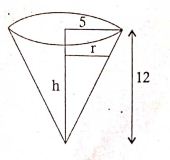
If we blow air into a balloon of spherical shape at a rate of 1000 cm3 per second. At what rate the radius of the baloon changes when the radius is 7cm? Also compute the rate at which the surface area changes.
21.
Solve the following systems of linear equations by Cramer’s rule:
3x + 3y − z = 11, 2x − y + 2z = 9, 4x + 3y + 2z = 25.
22.
Solve the following system of homogenous equations.
3x + 2y + 7z = 0, 4x − 3y − 2z = 0, 5x + 9y + 23z = 0
23.
Show that the straight lines \(\vec { r } =(5\hat { i } +7\hat { j } -3\hat { k } )+s(-4\hat { i } +4\hat { j } -5\hat { k } )\) and \(\vec { r } =(8\hat { i } +4\hat { j } +5\hat { k } )+t(7\hat { i } +\hat { j } +3\hat { k } )\)are coplanar. Find the vector equation of the plane in which they lie.
24.
Find all cube roots of \(\sqrt { 3 } +i\)
25.
26.
Find the value of k for which the equations
kx - 2y + z = 1, x - 2ky + z = -2, x - 2y + kz = 1 have
(i) no solution
(ii) unique solution
(iii) infinitely many solution
27.
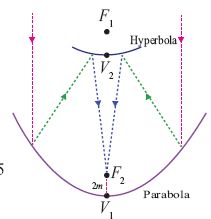
Certain telescopes contain both parabolic mirror and a hyperbolic mirror. In the telescope shown in figure the parabola and hyperbola share focus F1 which is 14m above the vertex of the parabola. The hyperbola’s second focus F2 is 2m above the parabola’s vertex. The vertex of the hyperbolic mirror is 1m below F1. Position a coordinate system with the origin at the centre of the hyperbola and with the foci on the y-axis. Then find the equation of the hyperbola.
28.
A boy is walking along the path y = ax2 + bx + c through the points (−6, 8), (−2, −12) and (3, 8). He wants to meet his friend at P(7, 60). Will he meet his friend? (Use Gaussian elimination method.)
29.
If a1, a2, a3, ... an is an arithmetic progression with common difference d, prove that tan\( \left[ tan^{ -1 }\left( \frac { d }{ 1+{ a }_{ 1 }{ a }_{ 2 } } \right) +tan^{ -1 }\left( \frac { d }{ 1+{ a }_{ 2 }{ a }_{ 3 } } \right) +....tan^{ -1 }\left( \frac { d }{ 1+{ a }_{ n }{ a }_{ n-1 } } \right) \right] =\frac { { a }_{ n }-{ a }_{ 1 } }{ 1+{ a }_{ 1 }{ a }_{ n } } \)
30.
If z = x + iy and arg \(\left( \frac { z-i }{ z+2 } \right) =\frac { \pi }{ 4 } \), then show that x2 + y2 + 3x - 3y + 2 = 0
31.
The prices of three commodities A, B and C are Rs. x, y and z per units respectively. A person P purchases 4 units of B and sells two units of A and 5 units of C. Person Q purchases 2 units of C and sells 3 units of A and one unit of B. Person R purchases one unit of A and sells 3 unit of B and one unit of C. In the process, P, Q and R earn Rs. 15,000, Rs. 1,000 and Rs. 4,000 respectively. Find the prices per unit of A, B and C. (Use matrix inversion method to solve the problem.)
32.
Find all zeros of the polynomial x6- 3x5- 5x4 + 22x3- 39x2- 39x + 135, if it is known that 1+2i and \(\sqrt{3}\) are two of its zeros.
33.
Find the equation of the ellipse whose eccentricity is \(\frac { 1 }{ 2 } \), one of the foci is(2, 3) and a directrix is x = 7. Also find the length of the major and minor axes of the ellipse.
34.
Form the equation whose roots are the squares of the roots of the cubic equation x3+ ax2+ bx + c = 0.
35.
Suppose that f (x) given below represents a probability mass function
| x | 1 | 2 | 3 | 4 | 5 | 6 |
| f(x) | c2 | 2c2 | 3c2 | 4c2 | c | 2c |
Find
(i) the value of c
(ii) Mean and variance.
36.
A retailer purchases a certain kind of electronic device from a manufacturer. The manufacturer, indicates that the defective rate of the device is 5%. The inspector of the retailer randomly picks 10 items from a shipment. What is the probability that there will be
(i) at least one defective item
(ii) exactly two defective items.
37.
Evaluate the following:
\(\int _{ 0 }^{ \frac { \pi }{ 2 } }{ { x }^{ 2 }cos2x\ dx } \)
38.
Find the tangent and normal to the following curves at the given points on the curve
x = cos t, y = 2sin t2 at t = \(\frac { \pi }{ 3 } \)
39.
Find the differential equation of the family of all the parabolas with latus rectum 4a and whose axes are parallel to the x-axis.
40.
Find the parametric form of vector equation of a straight line passing through the point of intersection of the straight lines \(\vec { r } =(\hat { i } +\hat { 3j } -\hat { k } )+t(2\hat { i } +3\hat { j } +2\hat { k } )\) and \(\frac { x-2 }{ 1 } =\frac { y-4 }{ 2 } =\frac { z+3 }{ 4 } \) and perpendicular to both straight lines.
41.
With usual notations, in any triangle ABC, prove by vector method that \(\frac { a }{ sinA } =\frac { b }{ sinB }=\frac { c }{ sinc }\)
42.
If A = \(\left[ \begin{matrix} 5 & 3 \\ -1 & -2 \end{matrix} \right] \), show that A2 - 3A - 7I2 = O2. Hence find A−1.
43.
Identify the valid statements from the following sentences.
1.
Given \(a*b=\frac { a+b }{ 2 } \forall \in Q\)
i) Closure property:
Let a, b ∈ Q
∴ a*b = \(\frac{a+b}{2}\)∈Q
[∵ addition and division are closed on Q]
* is closed on Q.
(ii) Commutative property:
Let a, b ∈ Q
Then a+b \(=\frac { a+b }{ 2 } =\frac { b+a }{ 2 } =b*a\)
∴ a*b = b*a ∀a,b∈Q
∴ * is commutative on Q.
(iii) Associative property :
Let a, b, c ∈ Q
a*(b*c) = (a*b)*c
Let a = 2, b = 3, c-5
∴ a*(b*c) = 2*(3*-5)
\(=*\left( \frac { 3-5 }{ 2 } \right) \)
\(=2*(-1)=\frac { 2+(-1) }{ 2 } \)
\(=\frac { 1 }{ 2 } \quad \quad ...(1)\)
Now (a*b)*c = (2*3)*(-5)
\(=\left( \frac { 2+3 }{ 2 } \right) *(-5)\)
\(=\frac { 5 }{ 2 } *-5=\frac { \frac { 5 }{ 2 } +(-5) }{ 2 } \)
\(=\frac { 5-10 }{ 4 } =\frac { -5 }{ 4 } ...(2)\)
From (1) & (2), a*(b*c) ≠ (a*b)*c
∴ * is not associative on Q.
2.
\(\frac { \partial z }{ \partial x } =x.\frac { 1 }{ 1+{ x }^{ 2 }{ y }^{ 2 } } (y)+{ tan }^{ -1 }(xy)\)
\(\frac { \partial z }{ \partial y } =x.\frac { 1 }{ 1+{ x }^{ 2 }{ y }^{ 2 } } \)(x)
\(\frac { \partial z }{ \partial z } =\frac { xy }{ 1+{ x }^{ 2 }{ y }^{ 2 } } \) + tan-1 (xy)
\(\frac { \partial z }{ \partial y } =\frac { x^2 }{ 1+{ x }^{ 2 }{ y }^{ 2 } } \)
\(\frac { \partial z }{ \partial y } =\frac { x^2 }{ 1+{ x }^{ 2 }{ y }^{ 2 } } \)
\(\frac { \partial z }{ \partial x } =\frac { { t }^{ 2 }{ se }^{ t } }{ 1+{ t }^{ 4 }{ s }^{ 2 }{ e }^{ 2t } } +{ tan }^{ -1 }({ t }^{ 2 }{ se }^{ 2 })\)
\(\frac { \partial z }{ \partial y } =\frac { { t }^{ 4 } }{ 1+{ t }^{ 4 }{ s }^{ 2 }{ e }^{ 2t } } \)
\(\frac { dx }{ dt } =2t;\frac { dy }{ dt } ={ s.e }^{ t }\)
Also, \(\frac { dx }{ ds } =0;\frac { dy }{ ds } ={ e }^{ t }\)
By chain rule
\(\frac { dw }{ ds } =\frac { \partial z }{ \partial x } .\frac { dx }{ ds } +\frac { \partial z }{ \partial y } .\frac { dy }{ ds } \)
= \(\frac { { t }^{ 2 }{ se }^{ t } }{ 1+{ t }^{ 4 }{ s }^{ 2 }{ e }^{ 2t } } (0)+\frac { { t }^{ 4 } }{ 1+{ t }^{ 4 }{ s }^{ 2 }{ e }^{ 2t } } { (e }^{ t })=\frac { { e }^{ t }{ t }^{ 4 } }{ 1+{ t }^{ 4 }{ s }^{ 2 }{ e }^{ 2t } } \)
\(\therefore { \left( \frac { \partial z }{ \partial s } \right) }_{ s=t=1 }=\frac { e(1) }{ 1+{ e }^{ 2 } } =\frac { e }{ 1+{ e }^{ 2 } } \)
By chain rule
= \(\frac { dz }{ dt } =\frac { \partial z }{ \partial x } .\frac { dx }{ dt } +\frac { \partial z }{ \partial y } .\frac { dy }{ dt } \)
\(\therefore { \left( \frac { \partial z }{ \partial t } \right) }_{ (s=t=1) }=\frac { e }{ 1+{ e }^{ 2 } } =\frac { e }{ 1+{ e }^{ 2 } } \)
= \(\frac { 2e+e }{ 1+{ e }^{ 2 } } =\frac { 3e }{ 1+{ e }^{ 2 } } \)+ 2 tan-1(e)
3.
Equation of the given curve is 2+x-x2+y = 0
| x | 0 | 2 | -1 |
| y | -2 | 0 | 0 |
\(\Rightarrow\)y = x2-x-2
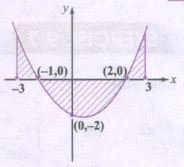
\(\therefore\) Required area= \(\int _{ -3 }^{ -1 }{ ydx } +\int _{ -1 }^{ 2 }{ -y } dx+\int _{ 2 }^{ 3 }{ ydx } \)
\(\\ =\int _{ -3 }^{ -1 }{ \left( { x }^{ 2 }-x-2 \right) } dx\int _{ -1 }^{ 2 }{ (2+x-{ x }^{ 2 })dx } +\int _{ 2 }^{ 3 }{ ({ x }^{ 2 }-x-2) } dx\)
\(={ \left( \frac { { x }^{ 3 } }{ 3 } -\frac { { x }^{ 2 } }{ 2 } -2x \right) }_{ -3 }^{ -1 }+{ \left( 2x+\frac { { x }^{ 2 } }{ 2 } -\frac { { x }^{ 3 } }{ 3 } \right) }_{ -1 }^{ 2 }+{ \left( \frac { { x }^{ 3 } }{ 3 } -\frac { { x }^{ 2 } }{ 2 } -2x \right) }_{ 2 }^{ 3 }\)
\(=\left( -\frac { 1 }{ 3 } -\frac { 1 }{ 2 } +2 \right) -\left( -9-\frac { 9 }{ 2 } +6 \right) +\left( 4+2-\frac { 8 }{ 3 } \right) -\left( -2+\frac { 1 }{ 2 } +\frac { 1 }{ 3 } \right) +\left( 9-\frac { 9 }{ 2 } -6 \right) -\left( \frac { 8 }{ 3 } -2-4 \right) \)
\(\\ =\left( \frac { -2-3+6 }{ 6 } \right) -\left( \frac { -6-9 }{ 2 } \right) +\left( \frac { 18-8 }{ 3 } \right) -\left( \frac { -12+3+2 }{ 6 } \right) +\left( \frac { 6-9 }{ 2 } \right) -\left( \frac { 8-24 }{ 3 } \right) \)
\(=\frac { 1 }{ 6 } +\frac { 15 }{ 2 } +\frac { 10 }{ 3 } +\frac { 7 }{ 6 } -\frac { 3 }{ 2 } +\frac { 16 }{ 3 } \)
\(=\frac { 1+45+20+7-9+32 }{ 6 } =\frac { 90 }{ 6 } =15
\)
4.
Since the given function is a probability mass function, the total probability is one. That is \(\underset { x }{ \Sigma } f(x)=1\)
From the given data k + 2k + 6k + 5k + 6k +10k+1
\(30k=1\Rightarrow k=\frac { 1 }{ 30 } \)
Therefore the probability mass function is
| x | 1 | 2 | 3 | 4 | 5 | 6 |
| f(x) | \(\cfrac { 1 }{ 30 } \) | \(\cfrac { 2 }{ 30 } \) | \(\cfrac { 6 }{ 30 } \) | \(\cfrac { 5 }{ 30 } \) | \(\cfrac { 6 }{ 30 } \) | \(\cfrac { 10 }{ 30 } \) |
(i) P(2 < X < 6) = f(3)+ f(4)+ f(5) = \(\frac { 6 }{ 30 } +\frac { 5 }{ 30 } +\frac { 6 }{ 30 } =\frac { 17 }{ 30 } \)
(ii) P(2≤X≤5) = f(2)+f(3)+f(4) = \(\frac { 2 }{ 30 } +\frac { 6 }{ 30 } +\frac { 5 }{ 30 } =\frac { 13 }{ 30 } \)
(iii) P(2≤4) = f(1)+f(2)+f(3)+f(4) = \(\frac { 1 }{ 30 } +\frac { 2 }{ 30 } +\frac { 6 }{ 30 } +\frac { 5 }{ 30 } =\frac { 14 }{ 30 } \)
(iv) P(3>X) = f(4)+f(5)+f(6) = \(\frac { 5 }{ 30 } +\frac { 6 }{ 30 } +\frac { 10 }{ 30 } =\frac { 21 }{ 30 } \)
5.
\(put\sqrt { t } =z\Rightarrow \frac { 1 }{ 2\sqrt { t } } dt=dz\)
\(\Rightarrow \frac { 1 }{ 2z } dt=dz\Rightarrow dt=2zdz\)
| t | 0 | sin2x |
| z | 0 | sin x |
| t | 0 | cos2x |
| z | 0 | cos x |
\(\therefore I=\int _{ 0 }^{ sin\quad x }{ 2z{ sin }^{ -1 }zdz } +\int _{ 0 }^{ cosx }{ 2z{ cos }^{ -1 }zdz } ...(1)\)
= I1+ I2
\(=2\int _{ 0 }^{ x }{ \theta sin\theta cos\theta d\theta +2\int _{ \frac { \pi }{ 2 } }^{ x }{ \theta cos\theta (-sin\theta )d\theta } } \)
\(=\int _{ 0 }^{ x }{ \theta 2sin\theta cos\theta d\theta -\int _{ \frac { \pi }{ 2 } }^{ x }{ \theta 1sin\theta cos\theta d\theta } } \)
\(=\int _{ 0 }^{ x }{ \theta sin2\theta d\theta -\int _{ \frac { \pi }{ 2 } }^{ x }{ \theta sin2\theta d\theta } } \)
\([\because sin2\theta =sin\theta cos\theta ]\)
\(=\int _{ 0 }^{ x }{ \theta sin2\theta d\theta \int _{ x }^{ \frac { \pi }{ 2 } }{ \theta sin2\theta d\theta } =\int _{ 0 }^{ \frac { \pi }{ 2 } }{ \theta sin2\theta d\theta } } \)
\(\left[ \because \int _{ a }^{ c }{ f(x)dx+\int _{ c }^{ b }{ f(x)dx=\int _{ a }^{ b }{ f(x)dx } } } \right] \)
\(={ \left[ -\frac { \theta cos2\theta }{ 2 } \right] }_{ 0 }^{ \frac { \pi }{ 2 } }+\int _{ 0 }^{ \frac { \pi }{ 2 } }{ \frac { cos2\theta }{ 2 } d\theta } \)
\(={ \left[ -\frac { \theta cos2\theta }{ 2 } +\frac { sin2\theta }{ 4 } \right] }_{ 0 }^{ \frac { \pi }{ 2 } }\)
\(=\frac { -\frac { \pi }{ 2 } cos\pi }{ 2 } +\frac { sin\pi }{ 4 } -(0+0)\)
\(=\frac { -\frac { \pi }{ 2 } (-1) }{ 2 } +\frac { 0 }{ 4 } =\frac { \pi }{ 4 } \)
6.
Given
\(f(x)=\begin{cases} \begin{matrix} { Ke }^{ \frac { -x }{ 3 } } & \begin{matrix} for & x>0 \end{matrix} \end{matrix} \\ \begin{matrix} 0 & \begin{matrix} for & x\le 0 \end{matrix} \end{matrix} \end{cases}\)
(i) Since f(x) is a probability density function
\(\int _{ -\infty }^{ \infty }{ f(x) } dx=1\)
\(\Rightarrow \int _{ 0 }^{ \infty }{ K.{ e }^{ \frac { -x }{ 3 } } } dx=1\Rightarrow k\frac { \left[ { e }^{ \frac { -x }{ 3 } } \right] ^{ \infty } }{ -\frac { 1 }{ 3 } } \)
\(\Rightarrow -3k\left[ { e }^{ -\infty }-{ e }^{ 0 } \right] =1\) [∵ e∞ = 0, e0 = 1]
\(\Rightarrow 3k=1\Rightarrow k=\frac { 1 }{ 3 } \)
\(\therefore k=\cfrac { 1 }{ 3 } \)
(ii) The distribution function F(x) = \(\int _{ -\infty }^{ x }{ f(u)du } \)
Case 1: x < 0,
\(F(x)=\int _{ -\infty }^{ x }{ f(x)dx=0 } \)
Case 2: x > 0,
\(f(x)=\int _{ -\infty }^{ x }{ f(x)dx } \)
= \(\int _{ -\infty }^{ 0 }{ f(x)dx+\int _{ 0 }^{ x }{ f(x) } dx } \)
= \(0+k\int _{ 0 }^{ x }{ { e }^{ \frac { -x }{ 3 } } } dx\)
= \(\frac { 1 }{ 3 } \left[ \cfrac { { e }^{ \frac { -x }{ 3 } } }{ -\frac { 1 }{ 3 } } \right] =-\left[ { e }^{ -\frac { x }{ 3 } }-{ e }^{ o } \right] \)
= \(-[{ e }^{ -\frac { x }{ 3 } }-1]\)
= \(1-{ e }^{ -\frac { x }{ 3 } }\)
\(\therefore F(x)=\begin{cases} \begin{matrix} 0 & x\le 0 \end{matrix} \\ \begin{matrix} 1-{ e }^{ \frac { -x }{ 3 } } & x>0 \end{matrix} \end{cases}\)
(iii) p(X < 3)
= \(\int _{ 0 }^{ 3 }{ ke^{ -\frac { x }{ 3 } } } dx=\cfrac { 1 }{ 3 } \int _{ 0 }^{ 3 }{ { e }^{ -\frac { x }{ 3 } }dx } \)
= \(\cfrac { 1 }{ 3 } \left[ \frac { { e }^{ -\frac { x }{ 3 } } }{ \frac { -1 }{ 3 } } \right] \)
= -[e-1-e0] = -[e-1-1]
(iv) \(p(5\le X)=p(X\ge 5)=\int _{ 5 }^{ \infty }{ f(x)dx } \)
= \(\int _{ 5 }^{ \infty }{ ke^{ -\frac { x }{ 3 } } } dx=\cfrac { 1 }{ 3 } \cfrac { \left[ { e }^{ -\frac { x }{ 3 } } \right] _{ 5 }^{ \infty } }{ \frac { -1 }{ 3 } } \)
= \(-\left[ { e }^{ -\infty }-e^{ \frac { -3 }{ 5 } } \right] =\left[ 0-{ e }^{ \frac { -5 }{ 3 } } \right] \)
= \({ e }^{ \frac { -5 }{ 3 } }\)
(v) \(p(X\le 4)=\int _{ -\infty }^{ 4 }{ f(x)dx } \)
= \(\int _{ -\infty }^{ 0 }{ f(x)dx+\int _{ 0 }^{ 4 }{ f(x)dx } } \)
= \(0+\int _{ 0 }^{ 4 }{ { ke }^{ -\frac { x }{ 3 } }dx } =k\left[ \frac { { e }^{ -\frac { x }{ 3 } } }{ -\frac { 1 }{ 3 } } \right] _{ 0 }^{ 4 }\)
= \(\cfrac { 1 }{ 3 } \cfrac { \left[ { e }^{ -\frac { x }{ 3 } } \right] _{ 0 }^{ 4 } }{ -\frac { 1 }{ 3 } } =-\left[ { e }^{ \frac { -4 }{ 3 } }-{ e }^{ o } \right] \)
= \(-\left[ { e }^{ \frac { -4 }{ 3 } }-1 \right] =1-{ e }^{ \frac { -4 }{ 3 } }\)
7.
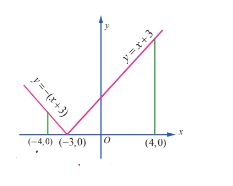
By definition, we have |x + 3| = \(\begin{cases} \begin{matrix} x+3 & x\ge -3 \\ -x-3 & x<-3 \end{matrix}\end{cases}\)
for the graph of y =| x + 3 | in −4 \(\le\) x \(\le\) 4.
∴ \(\int ^4_{-4}\)|x+3| dx = \(\int ^{-3}_{-4}\) |x+3| dx + \(\int ^{4}_{-3}\) |x+3| dx = \(\int ^{-3}_{-4}\)|-x-3| dx+ \(\int ^{4}_{-3}\)(x+3)dx
= \([- \frac {x^2}{2}-3x]^{-3}_{-4}\) + \([ \frac {x^2}{2}+3x]^{4}_{-3}\)
= \(( -\frac {9}{2}+9)\) - \(( -\frac {16}{2}+12)\) + \(( \frac {16}{2}+12)\) - \(( \frac {9}{2}-9)\) = \(( \frac {9}{2})\) - 4+20 + \(( \frac {9}{2})\) = 25
8.
Let the price of low-grade steel be Rs. p per tonne. Then the price of high-grade steel is Rs. 2p per tonne.
The total receipt per day is given by \(R=px+py=px+2p\left( \frac { 40-5x }{ 10-x } \right) \). Hence the problem is to maximise R . Now, simplifying and differentiating R with respect to x , we get
\(R=p\left( \frac { 80-{ x }^{ 2 } }{ 10-x } \right) \)
\(\frac { dR }{ dx } =p\left( \frac { { x }^{ 2 }-20x+80 }{ (10-x)^{ 2 } } \right) \)
\(\frac { dR }{ dx } =-\frac { 40P }{ \left( 10-x \right) ^{ 3 } } \)
Now, \(\frac { dR }{ dx } =0\Rightarrow { x }^{ 2 }-20x+80=0\) and hence \(x=10\pm 2\sqrt { 5 } \)
At \(x=10-2\sqrt { 5 } ,\frac { { d }^{ 2 }R }{ { dx }^{ 2 } } <0\) and hence R will be maximum. If x \(x=10-2\sqrt { 5 } \) then \(y=5-\sqrt { 5 } \)
Therefore the steel plant must produce low-grade and high-grade steels respectively in tonnes per day are \(10-2\sqrt { 5 } \) and \(5-5\sqrt { 5 } \)
9.
We have,
\(f(x)=log(1+x)-\frac{x}{1+x}\)
Therefore, \(f'(x)=\frac{1}{1+x}-\frac{1}{(1+x)^{2}}\)
= \(\frac{x}{(1+x)^{2}}\).
Hence, f′(x) is \(\begin{cases} <0 \ when-1
Therefore f (x) is strictly increasing for x > 0 and strictly decreasing for x < 0. Since f′(x) changes from negative to positive when passing through x = 0, the first derivative test tells us there is a local minimum at x = 0 which is f (0) = 0. Further, for x > 0, f(x) > f (0) = 0 gives
\(log(1+x)-\frac{x}{1+x}>0 \Rightarrow log(1+x)>\frac{x}{1+x}\).
10.
Let T be the temperature of the coffee at time t
and Tm' the temperature of the kitchen.
By Newton's law of cooling
\(\frac { dT }{ dt } =K(T-{ T }_{ m })\)
\(\Rightarrow \frac { dT }{ dt } =K(T-70)\)
\(\Rightarrow \int { \frac { dT }{ T-70 } =K\int { dt } } \)
\(\Rightarrow log(T-70)=kt+logC\)
\(\Rightarrow log(T-70)-logC=Kt\)
\(\Rightarrow log\left( \frac { T-70 }{ C } \right) =Kt\)
\(\Rightarrow \frac { T-70 }{ C } ={ e }^{ Kt }\)
\(\Rightarrow T-70={ Ce }^{ Kt }...(1)\)
\(\\ When\ t=0,\ T={ 180 }^{ o }F\)
\(\therefore { 180 }^{ o }-{ 70 }^{ o }={ Ce }^{ 0 }\)
\(\Rightarrow C={ 11 }0^{ 0 }\)
\(\\ \therefore (1)\Rightarrow T-70=110{ e }^{ Kt } ..(2)\)
\(When\ t=0,T=160\)
\(\therefore 160-70=110{ e }^{ 10K }\)
\(90=110{ e }^{ 10K }\)
\(\Rightarrow { e }^{ 10K }=\frac { 9 }{ 11 } \)
\(\Rightarrow { e }^{ K }={ \left( \frac { 9 }{ 11 } \right) }^{ \frac { 1 }{ 10 } }...(3)\)
(i) when t = 15, (2) becomes,
\(\Rightarrow T-70=110{ \left( \frac { 9 }{ 11 } \right) }^{ \frac { 1 }{ 10 } \times 15 }\)
\(=110{ \left( \frac { 9 }{ 11 } \right) }^{ \frac { 3 }{ 2 } }\)
\(=110\times { \left( \frac { 9 }{ 11 } \right) }\left( \sqrt { \frac { 9 }{ 11 } } \right) \)
\(=110\times \frac { 9 }{ 11 } \times \frac { 3 }{ \sqrt { 11 } } \)
\(=\frac { 270 }{ \sqrt { 11 } } =\frac { 270 }{ 3.32 } =81.33\)
\(\Rightarrow\) T=81.33+70=151.3F
\(\therefore\) T = 151.3F
\(\therefore\) The temperature of the coffee at 10.15 am is 151.3F
(ii) when T = 130F, (2) becomes
T-70 = 110ekt ...(2)
\(\Rightarrow\) 130-70 = 110ekt
60 = 110ekt
ekt = \(\frac{6}{11}\)
\({ \left( \frac { 9 }{ 11 } \right) }^{ \frac { t }{ 10 } }=\frac { 6 }{ 11 } \)
\(\frac { t }{ 10 } =\frac { log\left( \frac { 6 }{ 11 } \right) }{ log\left( \frac { 9 }{ 11 } \right) } \)
\(=\frac { log(0.545) }{ log(0.818) } =\frac { -0.264 }{ -0.087 } \)
= 3.34
t = 30.34min
T = 140F (2)becomes
140-70 = 110ekt ...(2)
\(\Rightarrow 70={ 110e }^{ kt }\)
\({ e }^{ kt }=\frac { 7 }{ 11 } \)
\({ \left( \frac { 9 }{ 11 } \right) }^{ \frac { t }{ 10 } }=\frac { 7 }{ 11 } \)
\(\frac { t }{ 10 } =\frac { log\left( \frac { 7 }{ 11 } \right) }{ log\left( \frac { 7 }{ 11 } \right) } =\frac { -0.197 }{ -0.087 } \)
= 2.26
t = 22.6min
\(\therefore\) Between 10.22 min to 10.30 min, the woman should have drunk the coffee.
11.
\(\underset { x\rightarrow { 0 }^{ + } }{ lim } { x }^{ x }\)
This is an indeterminate of the form 00
Let g(x) xx
Taking logarithm, we get
\(log \ g(x)=log({ x }^{ 2 })=xlogx=\frac { log\quad x }{ \frac { 1 }{ x } } \)
\(\therefore \underset { x\rightarrow { 0 }^{ + } }{ lim } log \ g(x)={ \left[ \frac { logx }{ \frac { 1 }{ x } } \right] }=\frac { \infty }{ \infty } \)
\(=\underset { x\rightarrow { 0 }^{ + } }{ lim } \left( \frac { \frac { 1 }{ x } }{ -\frac { 1 }{ { x }^{ 2 } } } \right) \) [by L' Hopital rule]
= \(\underset { x\rightarrow { 0 }^{ + } }{ lim } \frac { 1 }{ x } \times \frac { { x }^{ 2 } }{ 1 } =\underset { x\rightarrow { 0 }^{ + } }{ lim } -x\)
= 0
But \(\underset { x\rightarrow { 0 }^{ + } }{ lim } (log(g(x))=log(\underset { x\rightarrow { 0 }^{ + } }{ lim } (g(x))\)
ஃ \(\underset { x\rightarrow { 0 }^{ + } }{ lim } (log(g(x))=0\)
\(\Rightarrow { e }^{ log }(\underset { x\rightarrow { 0 }^{ + } }{ lim } log(g(x))={ e }^{ 0 }\)
\(\Rightarrow \underset { x\rightarrow { 0 }^{ + } }{ lim } g(x)=1\)
\(\therefore \underset { x\rightarrow { 0 }^{ + } }{ lim } { x }^{ x }=1\)
12.
13.
Let (x) = cos2 x
fI(x) = 2cos x (- sin x)
= - sin 2x ⇒ fl(0) = 0
fIl(x) = - 2 cos 2x ⇒ fIl(0) = -2
fIII(x) = + 4 sin 2 x ⇒ fIII(0) = 0
fIV(x) = 8 cos 2 x ⇒ fIV(0) = 8
fV(x) = -16 sin 2x ⇒ fV(0) = 0
fVI(x) = - 32 cos 2x ⇒ fVI(0) = -32
∴ Maclaurin's series
\(f(x)=f(0)+\frac { { f }^{ 1 }(0) }{ 1! } x+\frac { { f }^{ II }(0) }{ 2! } { x }^{ 2 }+\frac { { f }^{ III }(0) }{ 3! } { x }^{ 3 }+\) .......
∴ cos x = 1 - \(\frac { 2{ x }^{ 2 } }{ 2! } +\frac { 8{ x }^{ 4 } }{ 4! } +\frac { { 32x }^{ 6 } }{ 6! } \) + ...
= 1 - \(\frac { 2{ x }^{ 2 } }{ 2! } +\frac { { 2 }^{ 3 }{ x }^{ 4 } }{ 4! } +\frac { { { 2 }^{ 5 }x }^{ 6 } }{ 6! } \)+ ...
14.
The given linear differential euation is of the form
\(\frac{d y}{d x}+P y=Q \)
where \(\mathrm{P}=\frac{1}{(1-x) \sqrt{x}} ; \mathrm{Q}=1-\sqrt{x} \)
Take \(\sqrt{x}=\mathrm{t} \Rightarrow \mathrm{t}^2=x \)
\( x^{1 / 2}=\mathrm{t} \)
\( \frac{1}{2} x^{1 / 2-1} \mathrm{~d} x=\mathrm{dt} \Rightarrow \frac{1}{2} x^{-1 / 2} d x=\mathrm{dt} \)
\( \frac{1}{2 x^{1 / 2}} d x=\mathrm{dt} \Rightarrow \frac{1}{2 \sqrt{x}} d x=\mathrm{dt} \)
\( \frac{d x}{\sqrt{x}}=2 \mathrm{dt} \)
\( \text { I.F }=e^{\int P d x}=e^{\int \frac{1}{(1-x) \sqrt{x}} d x} \)
\( =e^{\int \frac{1}{1-t^{t^2} 2 d t}}=e^{\int \frac{2 d t}{1-1^2}} \)
\(\because \int \frac{d x}{a^2-x^2}=\frac{1}{2 x} \log \left|\frac{a+x}{a-x}\right| \)
\(\text { Here } a=1 ; x=t\)
\(=e^{\log \left(\frac{1+1}{1-t}\right)} \)
\(\mathrm{I} . \mathrm{F}=\frac{1+t}{1-t} \)
\({ I.F }=\frac{1+\sqrt{x}}{1-\sqrt{x}} \)
The solution is y\(\times \mathrm{I} . \mathrm{F}=\int \mathrm{Q} \times \mathrm{I}.Fd x+c\)
\( y\left(\frac{1+\sqrt{x}}{1-\sqrt{x}}\right)=\int(1-\sqrt{x}) \frac{1+\sqrt{x}}{1-\sqrt{x}} d x+c \)
\( =\int(1+\sqrt{x}) d x+c \)
\( y\left(\frac{1+\sqrt{x}}{1-\sqrt{x}}\right)=x+\frac{x^{3 / 2}}{3 / 2}+c \)
\( y\left(\frac{1+\sqrt{x}}{1-\sqrt{x}}\right)=x+\frac{2}{3} x^{3 / 2}+c \)
\( y\left(\frac{1+\sqrt{x}}{1-\sqrt{x}}\right)=x+\frac{2}{3} x \sqrt{x}+c \quad \because x^{3 / 2}=x \sqrt{x} \)
Which is the required solution
15.
The given equation can be rewritten as \(\frac { dy }{ dx } +\frac { (x\quad tan\quad x-1) }{ x } y=xcosx\)
This is a linear differential equation. Here \(P=\frac { (x\quad tan\quad x-1) }{ x } ;Q=xcosx\)
\(\int { Pdx } =\int { \frac { (xtanx-1) }{ x } } dx=-log|cosx|-log|x|=-log|xcosx|=log\frac { 1 }{ |xcosx| } \)
Thus, \(I.F.={ e }^{ \int { pdx } }={ e }^{ log\frac { 1 }{ |xcosx| } }=\frac { 1 }{ xcosx } \)
Hence the solution is \({ ye }^{ \int { Pdf } }=\int { Q{ e }^{ \int { Pdx } }dx+C } \)
i.e., \(y\frac { 1 }{ xcosx } =\int { (xcosx)\frac { 1 }{ xcosx } dx+C } \)
or \(\\ \\ \\ \\ y\frac { 1 }{ xcosx } =x+C\)
or y = x2 cos x + Cx cos x is the required solution.
16.
f (x) is defined and differentiable for all x∈(-∞, ∞)
\(f'\left( x \right) =\frac { 1 }{ 2 } \left( { e }^{ x }+{ e }^{ -x } \right) \)
\(f''(x)=\frac { 1 }{ 2 } \left( { e }^{ x }-{ e }^{ -x } \right) \)
f"(x) = 0
\(\Rightarrow \frac { 1 }{ 2 } \left( { e }^{ x }-{ e }^{ -x } \right) =0\Rightarrow { e }^{ x }-{ e }^{ -x }=0\)
\(\Rightarrow { e }^{ x }={ e }^{ -x }\Rightarrow { e }^{ x }=\frac { 1 }{ { e }^{ x } } \)
\(\Rightarrow { e }^{ 2x }=1\Rightarrow { e }^{ 2x }={ e }^{ 0 }\)
\(\Rightarrow 2x=0\Rightarrow x=0\)
The possible intervals are (-∞,0) and (0,∞)
| Intervel | (-∞, 0) | (0, ∞) |
| Sign of f"(x) | Say x = -1 \(\cfrac { 1 }{ 2 } \left( { e }^{ -1 }-{ e }^{ 1 } \right) =-ve\) |
Say x = 1 \(\cfrac { 1 }{ 2 } \left( { e }^{ -1 }-{ e }^{ 1 } \right) =+ve\) |
| Concavity | Concave down | Concave up |
ஃ f(x) is concave up in (0, ∞) and concave down in (∞, 0).
Since f"(x) changes its position from negative to positive, when it passes through x = 0 the points of inflection is (0,1(0))
\(f(0)=\frac { 1 }{ 2 } \left( { e }^{ o }-{ e }^{ o } \right) =\frac { 1 }{ 2 } \left( 1-1 \right) =0\)
ஃ (0, 0) is the point of inflection.
17.
\( y e^{\left(\frac{1}{r}\right)} \cdot d x =\left(x e^{\frac{1}{y}}+y\right) d y \)
\(\frac{d x}{d y} =\frac{x \cdot e^{\left(\frac{6}{y}\right)}+y}{y e^{\left(\frac{x}{y}\right)}} \)
\(\frac{d x}{d y} =\left(\frac{x}{y}\right)+\frac{1}{e^{\left(\frac{6}{y}\right)}}\)
Put x = \( \mathrm{vy}\) \( \Rightarrow\left(\frac{x}{y}\right)=\mathrm{v}\) and \(\frac{d x}{d y}=\cdot v+y \cdot \frac{d v}{d y} \)
\((1) \Rightarrow \ v+y \cdot \frac{d v}{d y}=v+\frac{1}{e^y} \)
\(\mathrm{e}^v \cdot \mathrm{dv}=\frac{d y}{y}\)
Integrating on both sides,
ie) \(\int e^v \cdot d v =\int \frac{d y}{y} \)
\(e^v =\log |y|+\log |c| \)
\(e^{\left(\frac{x}{y}\right)} =\log |c y|\)
18.
\(\\ \\ \\ \frac { dy }{ dx } ={ tan }^{ 2 }(x+y)...(1)\)
Take x + y = t
\(\Rightarrow 1+\frac { dy }{ dx } =\frac { dt }{ dx } \)
\(\Rightarrow \frac { dy }{ dx } =\frac { dt }{ dx } -1\)
∴ (1) becomes,
\(\frac { dt }{ dx } -1={ tan }^{ 2 }t\)
\(\Rightarrow \frac { dt }{ dx } ={ tan }^{ 2 }t1\)
\(\Rightarrow \frac { dt }{ dx } ={ sec }^{ 2 }(t)\)
\(\Rightarrow \frac { dt }{ { sec }^{ 2 }t } =dx\)
\(\Rightarrow { cos }^{ 2 }t\quad dt=dx\)
\(\left(\frac{1+\cos 2 t^{\circ}}{2}\right) d t=\mathrm{d} x \quad\left(\because \cos ^2 \theta=\frac{1+\cos 2 \theta}{2}\right)\)
\(\left[ cos\quad 2x=2{ cos }^{ 2 }x-1{ cos }^{ 2 }x=\frac { 1+cos2x }{ 2 } \right] \)
Taking integration on both sides, we get
\(\Rightarrow \left( \frac { 1+cos2\quad t }{ 2 } \right) dt=dx\)
\(\Rightarrow \frac { 1 }{ 2 } \int { (1+cos2t)dt=\int { dx } } \)
\(\Rightarrow \frac { 1 }{ 2 } \left[ t+\frac { sin2t }{ 2 } \right] =x+c\)
\(\Rightarrow \frac { 1 }{ 2 } \left[ t+\frac { 2sintcost }{ 2 } \right] =x+c\)
\(\Rightarrow \frac { 1 }{ 2 } [t+sin\ t\ cost]=x+c\ [\because t=x+y]\)
\(\Rightarrow \frac { 1 }{ 2 } [x+y+sin(x+y)cos(x+y)=x+c\)
19.
20.
The volume of the baloon of radius r is \(V =\frac{4}{3}\pi r ^{3} \)
We are given \(\frac{dV }{dt }=1000 \) and we need to find \(\frac{dr }{dt} \) when r = 7. Now,
\(\frac{dV}{dt}=3\times\frac{4}{3}\pi r^{2}\times \frac{dr}{dt}\)
Substituting r = 7 an \(\frac{dV}{dt}\) = 1000, we get 1000 \(= 4\pi \times 49 \times \frac{dr}{dt}\)
Hence, \(\frac{dr}{dt}=\frac{1000}{4\times49\times \pi}=\frac{250}{49\pi}\)
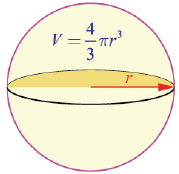
The surface area S of the baloon is S = 4ㅠr2. Therefore, \(\frac{dS}{dt}=8\pi \times r \times \frac{dr}{dt}\)
Substituting\(\frac{dr}{dt}=\frac{250}{49\pi}\) and r = 7, we get \(\frac{dS}{dt}=8\pi\times7\times \frac{250}{49\pi}=\frac{2000}{7}\)
Therefore, the rate of change of radius is \(\frac{250}{49 \pi}\) cm/sec and the change of surface area is \(\frac{2000}{7}\) cm2 / sec
21.
3x + 3y − z = 11, 2x − y + 2z = 9, 4x + 3y + 2z = 25.
Δ = \(\left| \begin{matrix} 3 & 3 & -1 \\ 2 & -1 & 2 \\ 4 & 3 & 2 \end{matrix} \right| \)
= \(3\left| \begin{matrix} -1 & 2 \\ 3 & 2 \end{matrix} \right| -3\left| \begin{matrix} 2 & 2 \\ 4 & 2 \end{matrix} \right| -1\left| \begin{matrix} 2 & -1 \\ 4 & 3 \end{matrix} \right| \)
= 3(-2-6)-3(4-8)-1(6+4)·
= 3(- 8) - 3(- 4) - 1(10)
= - 24 + 12 - 10 = - 22
Δ2 = \(\left| \begin{matrix} 11 & 3 & -1 \\ 9 & -1 & 2 \\ 25 & 3 & 2 \end{matrix} \right| \)
= \(11\left| \begin{matrix} -1 & 2 \\ 3 & 2 \end{matrix} \right| -3\left| \begin{matrix} 9 & 2 \\ 25 & 2 \end{matrix} \right| -1\left| \begin{matrix} 9 & -1 \\ 25 & 3 \end{matrix} \right| \)
= 11(-2-6)-3(18-50)-1(27+25)
= 11(-8)-3(-32)-1(52)
= -88+96-52 = -44
Δ2 = \(\left| \begin{matrix} 3 & 11 & -1 \\ 2 & 9 & 2 \\ 4 & 25 & 2 \end{matrix} \right| \)
= \(3\left| \begin{matrix} 9 & 2 \\ 25 & 2 \end{matrix} \right| -11\left| \begin{matrix} 2 & 2 \\ 4 & 2 \end{matrix} \right| -1\left| 2\begin{matrix} 2 & 9 \\ 4 & 25 \end{matrix} \right| \)
= 3(18 - 50) -11(4 - 8) - 1(50- 36)
= 3(- 32) - 11(- 4) - 1(14)
= -96+44-14 = - 66
Δ3 = \(\left| \begin{matrix} 3 & 3 & 11 \\ 2 & -1 & 9 \\ 4 & 3 & 25 \end{matrix} \right| \)
\(3\left| \begin{matrix} -1 & 9 \\ 3 & 25 \end{matrix} \right| -3\left| \begin{matrix} 2 & 9 \\ 4 & 25 \end{matrix} \right| -11\left| \begin{matrix} 2 & -1 \\ 4 & 3 \end{matrix} \right| \)
= 3(-25-27)-3(50-36)+ 11(6+4)
= 3(- 52) - 3(14) + 11(10)
= -156 - 42 + 110= - 88
∴ x = \(\frac { { \triangle }_{ 1 } }{ \triangle } =\frac { -44 }{ -22 } \) = 2
y = \(\frac { { \triangle }_{ 2 } }{ \triangle } =\frac { -66 }{ -22 } \) = 3
z = \(\frac { { \triangle }_{ 3 } }{ \triangle } =\frac { -88 }{ -22 } \) = 4
∴ Solution set is {2, 3, 4}
22.
3x + 2y + 7z = 0, 4x − 3y − 2z = 0, 5x + 9y + 23z = 0
Reducing the augmented matrix to row-echelon form we,
[A|0] =\(\left[ \begin{matrix} 3 & 2 & 7 \\ 4 & -3 & -2 \\ 5 & 9 & 23 \end{matrix}|\begin{matrix} 0 \\ 0 \\ 0 \end{matrix} \right] \overset { { R }_{ 2 }\rightarrow { R }_{ 2 }-\frac { 4 }{ 4 } { R }_{ 1 } }{ \longrightarrow } \left[ \begin{matrix} 3 & 2 & 7 \\ 0 & -\frac { 17 }{ 3 } & \frac { -34 }{ 3 } \\ 5 & 9 & 23 \end{matrix}|\begin{matrix} 0 \\ 0 \\ 0 \end{matrix} \right] \)
\(\overset { { R }_{ 3 }\rightarrow { R }_{ 3 }-\frac { 5 }{ 3 } { R }_{ 1 } }{ \longrightarrow } \left[ \begin{matrix} 2 & 2 & 7 \\ 0 & -\frac { 17 }{ 3 } & \frac { -34 }{ 3 } \\ 5 & \frac { 17 }{ 3 } & \frac { 34 }{ 3 } \end{matrix}|\begin{matrix} 0 \\ 0 \\ 0 \end{matrix} \right] \)
\(\overset { { R }_{ 3 }\rightarrow { R }_{ 3 }+{ R }_{ 2 } }{ \longrightarrow } \left[ \begin{matrix} 3 & 2 & 7 \\ 0 & -\frac { 17 }{ 3 } & \frac { -34 }{ 3 } \\ 5 & 0 & 0 \end{matrix}|\begin{matrix} 0 \\ 0 \\ 0 \end{matrix} \right] \)
\(\overset { { R }_{ 2 }\rightarrow { R }_{ 2 }\times \frac { -3 }{ 7 } }{ \longrightarrow } \left[ \begin{matrix} 3 & 2 & 7 \\ 0 & 1 & 2 \\ 0 & 0 & 0 \end{matrix}|\begin{matrix} 0 \\ 0 \\ 0 \end{matrix} \right] \)
Here \(\rho \)(A) = 2 and \(\rho \)[A|0] = 2
So, \(\rho \)(A) = \(\rho \)(A|0]) = 2<3 = number of unknowns
So put z = t where t \(\in \) R
writing the equations using the echelon form, we get
3x+2y+7z = 0 ............(1)
y+2z = 0 .............(2)
put z = t, (2) becomes
y+2t = 0
⇒ y = 2t
∴ (1) becomes, 3x+2(-2)+7t = 0
⇒ 3x-4t+7t = 0
⇒ 3x+3t = 0
⇒ 3x = -3t
⇒ x = -t
∴ Solution set is {-t, -2t, t} where t \(\in \) R
23.
\(\vec { r } =(5\hat { i } +7\hat { j } -3\hat { k } )+s(-4\hat { i } +4\hat { j } -5\hat { k } )\) and \(\vec { r } =(8\hat { i } +4\hat { j } +5\hat { k } )+t(7\hat { i } +\hat { j } +3\hat { k } )\)
Let \(\vec { a } =5\hat { i } +7\hat { j } -3\hat { k } ,\vec { b } =4\hat { i } +4\hat { j } -5\hat { k } \)
\(\vec { c } =8\hat { i } +4\hat { j } +5\hat { k } \ and\ \vec { d } =7\hat { i } +\hat { j } +3\hat { k } \)
We know that the two given lines are co-planar
if \(\left( \vec { c } -\vec { a } \right) .\left( \vec { b } \times \vec { d } \right) =0\)
\(\vec { b } \times \vec { d } =\left| \begin{matrix} \hat { i } & \hat { j } & \hat { k } \\ 4 & 4 & -5 \\ 7 & 1 & 3 \end{matrix} \right| \)
= \(\hat { i } \left( 12+5 \right) -\hat { j } \left( 12+35 \right) +\hat { k } \left( 4-28 \right) \)
= \(17\hat { i } -47\hat { j } -24\hat { k } \)
\(\left( \vec { c } -\vec { a } \right) =\left( 8-5 \right) \hat { i } +\left( 4-7 \right) \hat { j } +\left( 5+3 \right) \hat { k } \)
= \(3\hat { i } -3\hat { j } +8\hat { k } \)
Now,\(\left( \vec { c } -\vec { a } \right) .\left( \vec { b } \times \vec { d } \right) =\left( 3\hat { i } -3\hat { j } +8\hat { k } \right) \)
\(\left( 17\hat { i } -47\hat { j } -24\hat { k } \right) \)
= \(51+141-192=192-192=0\)
\(\therefore\) The two given lines are co-planar.
The plane containing the two given co-planar lines is
\(\left( \vec { r } -\vec { a } \right) .\left( \vec { b } \times \vec { d } \right) =0\)
\(\Rightarrow \left( \vec { r } -5\hat { i } +7\hat { j } -3\hat { k } \right) \times \left( 17\hat { i } -47\hat { j } -24\hat { k } \right) =0\)
\(\Rightarrow \vec { r } .\left( 17\hat { i } -47\hat { j } -24\hat { k } \right) -\left[ \left( 5\hat { i } +7\hat { j } -3\hat { k } \right) .\left( 17\hat { i } -47\hat { j } -24\hat { k } \right) \right] =0\)
\(\Rightarrow \vec { r } .\left( 17\hat { i } -47\hat { j } -24\hat { k } \right) =\left[ 85-329+72 \right] \)
\(\Rightarrow \vec { r } .\left( 17\hat { i } -47\hat { j } -24\hat { k } \right) =-172 \)
which is the required vector equation of the plane.
24.
We have to find \((\sqrt{3}+1)^{\frac{1}{3}}\). Let \(z=(\sqrt{3}+i)^{\frac{1}{3}}\). Then \({ z }^{ 3 }=\sqrt { 3 } +i=r\left( cos\theta +isin\theta \right) \)
Then, \(r=\sqrt { 3+1 } =2\) and \(\alpha =\theta =\frac { \pi }{ 6 } \) (\(\because \sqrt{3}+i\) lies in the first quadrant)
Therefore, \({ z }^{ 3 }=\sqrt { 3 } +i=2\left( cos\frac { \pi }{ 6 } +isin\frac { \pi }{ 6 } \right) \)
\(\Rightarrow z=\sqrt [ 3 ]{ 2 } \left( cos\left( \frac { \pi +12k\pi }{ 18 } \right) +isin\left( \frac { \pi +12k\pi }{ 18 } \right) \right) \), k = 0, 1, 2.
Taking k = 0, 1, 2, we get
k = 0, z \(={ 2 }^{ \frac { 1 }{ 3 } }\left( cos\frac { \pi }{ 18 } +sin\frac { \pi }{ 18 } \right) \)
k = 1, \(z={ z }^{ \frac { 1 }{ 3 } }\left( cos\frac { \pi }{ 18 } +sin\frac { \pi }{ 18 } \right) \)
k = 2, \(z={ 2 }^{ \frac { 1 }{ 3 } }\left( cos\frac { 25\pi }{ 18 } +sin\frac { 25\pi }{ 18 } \right) ={ 2 }^{ \frac { 1 }{ 3 } }\left( -cos\frac { 7\pi }{ 18 } -sin\frac { 7\pi }{ 18 } \right) \)
25.
.JPG)
26.
kx-2y+z = 1, -2ky+z = -2, x-2y+k = 1
The matrix form of the system is AX = B where
\(\left[ \begin{matrix} k & -2 & 1 \\ 1 & -2k & 1 \\ 1 & -2 & k \end{matrix} \right] ,X=\left[ \begin{matrix} x \\ y \\ z \end{matrix} \right] ,B=\left[ \begin{matrix} 1 \\ -2 \\ 1 \end{matrix} \right] \)
Applying elementary row operation on the augment matrix [A|B] we get
[A|B] =\(\left[ \begin{matrix} k & -2 & 1 \\ 1 & -2k & 1 \\ 1 & -2 & k \end{matrix}|\begin{matrix} 1 \\ -2 \\ 1 \end{matrix} \right] \overset { { R }_{ 1 }\leftrightarrow { R }_{ 3 } }{ \longrightarrow } \left[ \begin{matrix} 1 & -2 & k \\ 1 & -2k & 1 \\ k & -2 & k \end{matrix}|\begin{matrix} 1 \\ -2 \\ 1 \end{matrix} \right] \)
\(\overset { { R }_{ 2 }\rightarrow { R }_{ 2 }+{ R }_{ 1 }\\ { R }_{ 3 }\rightarrow { R }_{ 3 }-k{ R }_{ 1 } }{ \longrightarrow } \left[ \begin{matrix} 1 & -2 & k \\ 1 & -2k+2 & k \\ 0 & -2+2k & 1-k^{ 2 } \end{matrix}|\begin{matrix} 1 \\ - \\ 1-k \end{matrix} \right] \)
\(\overset { { R }_{ 3 }\rightarrow { R }_{ 3 }+{ R }_{ 2 } }{ \longrightarrow } \left[ \begin{matrix} 1 & -2 & k \\ 0 & -2k+2 & k \\ 0 & 0 & 1-k^{ 2 } \end{matrix}|\begin{matrix} 1 \\ -3 \\ 1-k \end{matrix} \right] \)
\(\rightarrow \left[ \begin{matrix} 1 & -2 & k \\ 0 & -2k+2 & 1-k \\ 0 & 0 & { k }^{ 2 }-k+2 \end{matrix}\begin{matrix} 1 \\ -3 \\ -k-2 \end{matrix} \right] \)
\(\rightarrow \left[ \begin{matrix} 1 & -2 & k \\ 0 & -2k+2 & 1-k \\ 0 & 0 & (k+2)(1-k) \end{matrix}|\begin{matrix} 1 \\ -3 \\ -k-2 \end{matrix} \right] \).........(1)
Case (i): when k = 1
\([A|B]\rightarrow \left[ \begin{matrix} 1 & -2 & 1 \\ 0 & 0 & 0 \\ 0 & 0 & 0 \end{matrix}\begin{matrix} 1 \\ -3 \\ -3 \end{matrix} \right] \overset { { R }_{ 3 }\rightarrow { R }_{ 3 }-{ R }_{ 2 } }{ \longrightarrow } \left[ \begin{matrix} 1 & -2 & 1 \\ 0 & 0 & 0 \\ 0 & 0 & 0 \end{matrix}|\begin{matrix} 1 \\ -3 \\ 0 \end{matrix} \right] \)
Here \(\rho \)(A) = 3 and \(\rho \)[A|B] = 3
So, \(\rho \)(A) ≠ \(\rho \)[A|B] ⇒ The system has no solution
Case (ii): when k ≠ 2, k ≠ -2
\(\left[ \begin{matrix} 1 & -2 & k \\ 0 & -2k+2 & 1-k \\ 0 & 0 & not\quad zero \end{matrix}|\begin{matrix} 1 \\ -3 \\ not\quad zero \end{matrix} \right] \)
⇒ \(\rho \)(A) = 3 and \(\rho \)[A|B] = 3
so, \(\rho \)(A) =\(\rho \)[A|B] = 3 = the number of unknowns Hence, the system has unique solution.
Case (iii): when k = -2
\(\rho [A|B]\rightarrow \left[ \begin{matrix} 1 \\ 1 \\ 0 \end{matrix}\begin{matrix} -2 \\ 6 \\ 0 \end{matrix}\begin{matrix} -2 \\ 3 \\ 0 \end{matrix}\begin{matrix} 1 \\ -3 \\ 0 \end{matrix} \right] \)
Here \(\rho \) (A) = 2 and \(\rho \)[A|B] = 2
∴ \(\rho \)(A) = \(\rho \)[A|B] = 2<3 the number of unknowns so the system is consistent with infinitely many solutions.
27.
Let V1 be the vertex of the parabola and
V2 be the vertex of the hyperbola.
\(\overset { \_ \_ \_ \_ \_ \_ }{ { F }_{ 1 }{ F }_{ 2 } } \) = 14−2 = 12m, 2c = 12, c = 6
The distance of centre to the vertex of the hyperbola is a = 6−1 = 5
b2 = c2 - a2
= 36−25 = 11.
Therefore the equation of the hyperbola is \(\frac { { y }^{ 2 } }{ 25 } -\frac { { x }^{ 2 } }{ 11 } =1\)
28.
Giveny = ax2 + bx + c .............(1)
(-6, 8) lies on (1)
⇒ 8 = a(-6)2+b(-6)+c
⇒ 8 = 36z-6b+c ..........(2)
(-2,12) lies on (1)
⇒ -12 = a(-2)2+b(-2)+c
⇒ -12 = 4a-2b+c ...........(3)
Also (3, 8) lies on (1)
⇒ 8 = a(3)2+b(3)+c
⇒ 8 = 9a+3b+c ............(4)
Reducing the augment matrix to an equivalent row-echelon form by using elementary. row operations, we get,
\(\left[ \begin{matrix} 36 & -6 & 1 \\ 4 & -2 & 1 \\ 0 & 3 & 1 \end{matrix}|\begin{matrix} 8 \\ -12 \\ 8 \end{matrix} \right] \overset { { R }_{ 2 }\rightarrow { 9R }_{ 2 }-{ R }_{ 1 }\\ { R }_{ 3 }\rightarrow 4{ R }_{ 3 }-{ R }_{ 1 } }{ \longrightarrow } \left[ \begin{matrix} 36 & -6 & 1 \\ 0 & -12 & 8 \\ 0 & 18 & 3 \end{matrix}|\begin{matrix} 8 \\ -116 \\ 24 \end{matrix} \right] \)
\(\overset { { R }_{ 2 }\rightarrow { R }_{ 2 }\div 4\\ { R }_{ 3 }\rightarrow { R }_{ 3 }\div 3 }{ \longrightarrow } \left[ \begin{matrix} 36 & -6 & 1 \\ 0 & -3 & 2 \\ 0 & 0 & 5 \end{matrix}|\begin{matrix} -8 \\ -29 \\ -8 \end{matrix} \right] \)
\(\overset { { R }_{ 3 }\rightarrow { R }_{ 3 }+2{ R }_{ 2 } }{ \longrightarrow } \left[ \begin{matrix} 36 & -6 & 1 \\ 0 & -3 & 2 \\ 0 & 0 & 5 \end{matrix}|\begin{matrix} -8 \\ -29 \\ -50 \end{matrix} \right] \)
Writing the equivalent equation from the row echelon matrix, we get
36a - 6b + c = 8 ........(1)
-3b+2c = -29 ....(2)
5c = -50
⇒ c = \(\frac{-50}{5}\) = -10
Substituting c = -10 in (2) we get,
-3b+2(-10)= -29
⇒ -3b+2(-10) = -29
⇒ -3b-20 = -29
⇒ -3b = -9
⇒ b = \(\frac{-9}{-3}\) = 3
Substituting b = 3 and c = -10 in (1) we get,
36a-6(3)-10 = 8
⇒ 36a-18-10 = 8
⇒ 36a-28 = 8
⇒ 6a = 8+28 = 36
⇒ a = \(\frac{36}{36}\) = 1
∴ a = 1, b = 3, c = -10
Hence the path of the boy is
y = 1(x2)+3(x)-10
⇒ y = x2+3x-10
Since his friend is at P(7, 60),
60 = (7)2+3(7)-10
⇒ 60 = 49+21-10
⇒ 60 = 70-10 = 60
⇒ 60 = 60
Since (7, 60) satisfies his path, he can meet his friend who is at P(7, 60)
29.
Now, \(tan^{ -1 }\left( \frac { d }{ 1+{ a }_{ 1 }{ a }_{ 2 } } \right) =tan^{ -1 }\frac { { a }_{ n }-{ a }_{ 1 } }{ 1+{ a }_{ 1 }{ a }_{ n } } =tan^{ -1 }{ a }_{ 2 }-tan^{ -1 }{ a }_{ 1 }\)
Similarly, \(tan^{ -1 }\left( \frac { d }{ 1+{ a }_{ 1 }{ a }_{ 2 } } \right) =tan^{ -1 }\left( \frac { { a }_{ n }-{ a }_{ 1 } }{ 1+{ a }_{ 1 }{ a }_{ n } } \right) =tan^{ -1 }{ a }_{ 3 }-tan^{ -1 }{ a }_{ 2 }\)
Continuing inductively, we get
\(tan^{ -1 }\left( \frac { d }{ 1+{ a }_{ n }{ a }_{ n-1 } } \right) =tan^{ -1 }\left( \frac { { a }_{ n }-{ a }_{ n-1 } }{ 1+{ a }_{ n }{ a }_{ n-1 } } \right) =tan^{ -1 }{ a }_{ n }-tan^{ -1 }{ a }_{ n-1 }\)
Adding vertically, we get
\(tan^{ -1 }\left( \frac { d }{ 1+{ a }_{ 1 }{ a }_{ 2 } } \right) +tan^{ -1 }\left( \frac { d }{ 1+{ a }_{ 2 }{ a }_{ 3 } } \right) +....+tan^{ -1 }\left( \frac { d }{ 1+{ a }_{ n }{ a }_{ n-1 } } \right) tan[tan^{ -1 }{ a }_{ n }-{ tan }^{ -1 }{ a }_{ 1 }]\\ \)
\(tan\left[ tan^{ -1 }\left( \frac { d }{ 1+{ a }_{ 1 }{ a }_{ 2 } } \right) +tan^{ -1 }\left( \frac { d }{ 1+{ a }_{ 2 }{ a }_{ 3 } } \right) +...+tan^{ -1 }\left( \frac { d }{ 1+{ a }_{ n }{ a }_{ n-1 } } \right) \right] =tan\left[ tan^{ -1 }{ a }_{ n }-tan^{ -1 }a_{ 1 } \right] \)\(=\left[ tan^{ -1 }\left( \frac { { a }_{ n }-{ a }_{ 1 } }{ 1+{ a }_{ 1 }{ a }_{ n } } \right) \right] =\frac { { a }_{ n }-{ a }_{ 1 } }{ 1+{ a }_{ 1 }{ a }_{ n } } \)
30.
Given z = x + iy and arg\(\left( \frac { z-i }{ z+2 } \right) =\frac { \pi }{ 4 } \)
⇒ arg(z-i) - arg(z+2) = \(\frac { \pi }{ 4 } \)
⇒ arg(x + iy-i) - arg(x+iy+2) = \(\frac { \pi }{ 4 } \)
⇒ arg(x+i(y-1)-arg((x+2)+iy) = \(\frac { \pi }{ 4 } \)
⇒ \(tan^{ -1 }\left( \frac { y-1 }{ x } \right) -tan^{ -1 }\left( \frac { y }{ x+2 } \right) \) = \(\frac { \pi }{ 4 } \)
⇒ \(tan^{ -1 }\left( \frac { \frac { y-1 }{ x } -\frac { y }{ x+2 } }{ 1+\frac { y-1 }{ x } .\frac { y }{ x+2 } } \right) \)
= \(\frac { \pi }{ 4 } \)\(\left[ \because tan^{ -1 }x-tan^{ -1 }y=tan^{ -1 }\left( \frac { x-y }{ 1+xy } \right) \right] \)
\(\Rightarrow \frac{\left(\frac{(x+2)(y-1)- x y}{\not {x (\not x+\not2)}}\right)}{\left(\frac{x(x+2)+y(y-1)}{\not x(\not x+\not 2)}\right)}=\tan \frac{\pi}{4}=1\)
⇒ \(\frac { (x+2)(y-1)-xy }{ x(x+2)+y(y-1) } \) = 1
⇒ -x + 2y-2 = x2+ 2x + y2-y
⇒ x2 + 2x + y2-y + x-2y + 2 = 0
⇒ x2 + y2+3x-3y + 2 = 0
Hence proved.
31.
Let the prices per unit for the commodities A, B and C be Rs. x, Rs. y and Rs. z.
By the given data,
2x - 4y + 5z = 15000
3x + y - 2z = 1000
-x + 3y + z = 4000
The matrix form of the system of equations is
\(\left[ \begin{matrix} 2 & -4 & 5 \\ 3 & 1 & -2 \\ -1 & 3 & 12 \end{matrix} \right] \left[ \begin{matrix} x \\ y \\ z \end{matrix} \right] =\left[ \begin{matrix} 15000 \\ 1000 \\ 4000 \end{matrix} \right] \)
AX = B where A =\(\left[ \begin{matrix} 2 & -4 & 5 \\ 3 & 1 & -2 \\ -1 & 3 & 1 \end{matrix} \right] ,X=\left[ \begin{matrix} x \\ y \\ z \end{matrix} \right] \)
and B =\(\left[ \begin{matrix} 15000 \\ 1000 \\ 4000 \end{matrix} \right] \)
⇒ X = A-1B
|A| = \(\left| \begin{matrix} 2 & -4 & 5 \\ 3 & 1 & -2 \\ -1 & 3 & 1 \end{matrix} \right| \)
= \(2\left| \begin{matrix} 1 & -2 \\ 3 & 1 \end{matrix} \right| +4\left| \begin{matrix} 3 & -2 \\ -1 & 1 \end{matrix} \right| +5\left| \begin{matrix} 3 & 1 \\ -1 & 3 \end{matrix} \right| \)
= 2 (1 + 6) + 4 (3 - 2) + 5 (9 + 1)
= 2 (7) + 4 (1) + 5(10) = 14 + 4 + 50 = 68.
adj A = \(\left[ \begin{matrix} +\left| \begin{matrix} 1 & -2 \\ 3 & 1 \end{matrix} \right| & -\left| \begin{matrix} 3 & -2 \\ -1 & 1 \end{matrix} \right| & +\left| \begin{matrix} 3 & 1 \\ -1 & 3 \end{matrix} \right| \\ -\left| \begin{matrix} -4 & 5 \\ 3 & 1 \end{matrix} \right| & +\left| \begin{matrix} 2 & 5 \\ -1 & 1 \end{matrix} \right| & -\left| \begin{matrix} 2 & -4 \\ -1 & 3 \end{matrix} \right| \\ +\left| \begin{matrix} -4 & 5 \\ 1 & -2 \end{matrix} \right| & -\left| \begin{matrix} 2 & 5 \\ 3 & -2 \end{matrix} \right| & +\left| \begin{matrix} 2 & -4 \\ 3 & 1 \end{matrix} \right| \end{matrix} \right] ^{ T }\)
= \(\left[ \begin{matrix} +(1+6) & -(3-2) & +(9+1) \\ -(-4-15) & +(2+5) & -(6-4) \\ +(8-5) & -(4-15) & +(2+12) \end{matrix} \right] \)
= \(\left[ \begin{matrix} 7 & -1 & 10 \\ 19 & 7 & -2 \\ 3 & 19 & 14 \end{matrix} \right] ^{ T }=\left[ \begin{matrix} 7 & 19 & 3 \\ -1 & 7 & 19 \\ 10 & -2 & 14 \end{matrix} \right] \)
∴ A-1 = \(\frac { 1 }{ |A| } adj=\frac { 1 }{ 68 } \left[ \begin{matrix} 7 & 19 & 3 \\ -1 & 7 & 19 \\ 10 & -2 & 14 \end{matrix} \right] \)
∴ X = A-1B = \(\frac { 1 }{ 68 } \left[ \begin{matrix} 7 & 19 & 3 \\ -1 & 7 & 19 \\ 10 & -2 & 14 \end{matrix} \right] \left[ \begin{matrix} 15000 \\ 1000 \\ 4000 \end{matrix} \right] \)
= \(\frac { 1 }{ 68 } \left[ \begin{matrix} 105000+19000+12000 \\ -15000+7000+76000 \\ 150000-2000+56000 \end{matrix} \right] \)
= \(\frac { 1 }{ 68 } \left[ \begin{matrix} 136000 \\ 68000 \\ 204000 \end{matrix} \right] =\left[ \begin{matrix} 2000 \\ 1000 \\ 3000 \end{matrix} \right] \)
∴ x = 2000, y = 1000, z = 3000
Hence the prices per unit of the commodities A, B and C are Rs. 2000, Rs. 1000 and Rs. 3000 respectively.
32.
Let f(x) x6-3x5-5x4+22x3-39x2-39x+135
Given (1+2i) is a root \(\Rightarrow\)(-2i) is also a root
Also \(\sqrt3\) is a root \(\Rightarrow\)-\(\sqrt3\) is also a root.
Hence, the factors of f(x) are [x - (1 + 2i)]
[x-(1-2i)] [x\(\sqrt3\)] [x+\(\sqrt3\)]
[(x-1)-2i] [(x-1)+2i] [x-\(\sqrt3\)][x+\(\sqrt3\)]
((x-1)2+22)(x2-3) = (x2-2x+1+4)(x2-3)
\(\Rightarrow\) factor of f(x) is (x2-2x+5)(x2-3)
\(\Rightarrow\)x4-3x2-2x3+6x+5x2-15
\(\Rightarrow\)(x4-3x2-2x3+6x-15) is a factor of f(x)
To find the other factor, let us divide f(x) by
x4 - 2x3 + 2x2 + 6x - 15
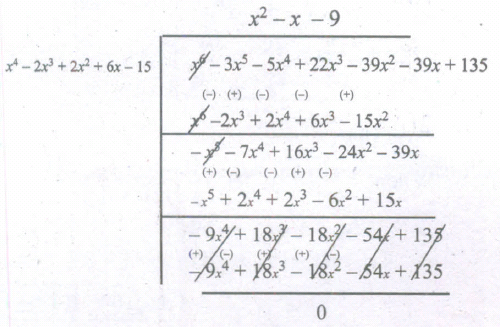
The other factor is x2 - x - 9
\(\Rightarrow x=\frac { 1\pm \sqrt { { (-1) }^{ 2 }-4(1)(-9) } }{ 2 } \left[ \because x=\frac { -b\pm \sqrt { { b }^{ 2 }-4ac } }{ 2a } \right] \)
\(\Rightarrow x=\frac { 1\pm \sqrt { 37 } }{ 2 } \)
Hence the roots are
1 - 2i, 1 + 2i, \(\sqrt { 3 }, -\sqrt { 3 }, \frac { 1+\sqrt { 37 } }{ 2 } ,\frac { 1-\sqrt { 37 } }{ 2 } \).
33.
By the definition of a conic \(\frac{SP}{PM}\)= e or SP2 = e2PM2
Then, (x−2)2 + (y−3)2 = \(\frac { 1 }{ 4 } \) (x-7)2
3x2+ 4y2−2x − 24y + 3 = 0
\({ 3\left( x-\frac { 1 }{ 3 } \right) }^{ 2 }+4(y-3)^{ 2 }=3\left( \frac { 1 }{ 9 } \right) +4\times 9-3=\frac { 100 }{ 3 } \)
\(\frac { { \left( x-\frac { 1 }{ 3 } \right) }^{ 2 } }{ \frac { 100 }{ 9 } } +\frac { (y-3{ ) }^{ 2 } }{ \frac { 100 }{ 12 } } \) = 1 which is in the standard form.
Therefore, the length of major axis = 2a = 2\(\sqrt { \frac { 100 }{ 9 } = } \frac { 20 }{ 3 } \) and
the length of minor axis = 2b = 2\(\sqrt { \frac { 100 }{ 12 } = } \frac { 10 }{ \sqrt { 3 } } \).
34.
Let α, β and γ be the roots of x3+ ax2+ bx + c = 0
Then, we get
Σ1 = α + β + γ = -a ....(1)
Σ2 = αβ + βγ + γα = b ...(2)
Σ3 = αβγ = -c ...(3)
We have to form the equation whose roots are α2, β2 and γ2.
Using (1), (2) and (3), we find the following
Σ1 = α2 + β2 + γ2 = (α + β + γ )2 - 2( αβ + βγ + γα) = (-a)2 -2(b) = a2-2b,
Σ2 = α2β2 + β2γ2 + γ2α2 = (αβ + βγ + γα)2 - 2((αβ)( βγ)(γα) + (γα)(αβ))
= (αβ + βγ + γα)2 - 2αβγ (β + γ + α) = (b)2 - 2(-c)(-a) = b2-2ca
Σ3 = α2β2γ2 = (αβγ)2 = (-c)2 = c2
Hence, the required equation is
x3-(α2 + β2 + γ2)x2 + (α2β2 + β2γ2 + γ2α2)x - α2β2γ2 = 0
That is, x3-(a2-2b)x2 + (b2-2ca)x-c2 = 0
35.
(i) Since f (x) is a probability mass function, f (x) ≥ 0 for all x , and d \(\sum_{x} f(x)=1\)
Thus, \(\sum_{x} f(x)=1\)
\(c^{2}+2 c^{2}+3 c^{2}+4 c^{2}+c+2 c=0\)
\(c=\frac{1}{5} \text { or }-\frac{1}{2}\)
Since f x( ) ≥ 0 for all x , the possible value of c is \(\frac{1}{5}\)
Hence, the probability mass function is
| x | 1 | 2 | 3 | 4 | 5 | 6 |
| f(x) | \( \frac{1}{25} \) | \( \frac{2}{25} \) | \( \frac{3}{25} \) | \(\frac{4}{25} \) | \(\frac{1}{5}\) | \( \frac{2}{5}\) |
(ii) To find mean and variance, let us use the following table
| x | f(x) | xf(x) | x2f(x) |
| 1 | \(\cfrac { 1 }{ 25 } \) | \(\cfrac { 2 }{ 25 } \) | \(\cfrac { 1 }{ 25 } \) |
| 2 | \(\cfrac { 2 }{ 25 } \) | \(\cfrac { 4 }{ 25 } \) | \(\cfrac { 8 }{ 25 } \) |
| 3. | \(\cfrac { 3 }{ 25 } \) | \(\cfrac { 9 }{ 25 } \) | \(\cfrac { 27 }{ 25 } \) |
| 4. | \(\cfrac { 4 }{ 25 } \) | \(\cfrac { 16 }{ 25 } \) | \(\cfrac { 64 }{ 25 } \) |
| 5. | \(\cfrac { 1 }{ 5 } \) | \(\cfrac { 5 }{ 5 } \) | \(\cfrac { 25 }{ 5 } \) |
| 6. | \(\cfrac { 2 }{ 25 } \) | \(\cfrac { 12 }{ 5 } \) | \(\cfrac { 72 }{ 5 } \) |
| \(\Sigma f(x)=1\) | \(\Sigma xf(x)=\cfrac { 115 }{ 25 } \) | \({ \Sigma x }^{ 2 }f(x)=\cfrac { 585 }{ 25 } \) |
Mean : \(E(X)=\Sigma xf(x)=\frac { 115 }{ 25 } =4.6\)
Variance : \(V(x)=E\left( x \right) ^{ 2 }=\Sigma { x }^{ 2 }f(x)-\left( \Sigma xf(x) \right) ^{ 2 }\)
= \(\frac { 585 }{ 25 } -\left( \frac { 115 }{ 25 } \right) ^{ 2 }=23.40-21.16=2.24\)
Therefore the mean and variance are 4.6 and 2.24 respectively.
36.
Let p be the probability that indicates the defective rate of an electronic device
n = 10
\(P=5\%=0.05 \)
q = 1 - p
n = 10, p = 0.05, X ~ B(n, p)
P(X = x) = nCx px qn-x, x = 0, 1,2, .., n
(i) Atleast 1 defective item
P(X ≥ 1) = 1 - P(X < 1)
= 1-P(X = 0)
= 1-10C0 (0.05)0 (0.95)10
P(X ≥1) = 1 - (0.95)10
(ii) Exactly two defective items
P(X = 2) =10C2(0.05)2 (0.95)8
37.
\(Let\ u={ x }^{ 2 }\ v=cos 2x\ dx\)
\(u'=2x\quad { v }_{ 1 }=\frac { sin2x }{ 2 } \)
\(u"=2\quad { v }_{ 2 }=-\frac { cos2x }{ 4 } \)
\(\\ { v }_{ 3 }=-\frac { sinx }{ 8 } \)
Bernoulli's' formula:
\(\int { uvdx } =u{ v }_{ 1 }-u'{ v }_{ 2 }+u''{ v }_{ 3 }\)
\(\therefore \int _{ 0 }^{ \pi /2 }{ { x }^{ 2 }cos2x\quad dx={ \left[ \frac { { x }^{ 2 }sin2x }{ 2 } +\frac { 2xcos2x }{ 4 } -\frac { 2sin2x }{ 8 } \right] }_{ 0 }^{ \frac { \pi }{ 2 } } } \)
\(=\left[ \frac { { \pi }^{ 2 } }{ 8 } sin\pi +\frac { 2\pi }{ 8 } cos\pi -\frac { sin\pi }{ 8 } \right] -[0+0-0]\)
\(=\frac {- 2\pi }{ 8 } (-1)=\frac { \pi }{ 4 }\quad [\because sin\pi =0,cos\pi =-1]\)
38.
Equation of the given curve is x = cos t; y = 2 sin2 t
\(\frac { dx }{ dt } \) = - sin t;
\(\frac { dy}{ dt } \) = 4 sin t cos t
\(\therefore \frac { dy }{ dx } =\frac { \frac { dy }{ dt } }{ \frac { dx }{ dt } } \) = \(\frac{4 \ sin \ t \ cos \ t}{-sin \ t}\)
= 4 cost
∴ Slope = m = \(\left( \frac { dy }{ dx } \right) \)t = \(\frac { \pi }{ 3 } \)
= -4 cos \(\frac { \pi }{ 3 } \) = -4 \(\left( \frac { 1 }{ 2 } \right) \)
Equation of the tangent is y - y1 = m (x - x1)
When t = \(\frac { \pi }{ 3 } \), x cos \(\frac { \pi }{ 3 } \) = \(\frac12\)
when t = \(\frac { \pi }{ 3 } \), y = 2 \({ \left( sin\ \frac { \pi }{ 3 } \right) }^{ 2 }\)
= 2 \({ \left( \frac { \sqrt { 3 } }{ 2 } \right) }^{ 2 }\) = 2 \(\frac34\) = \(\frac32\)
∴ Equating of the tangent is y - \(\frac32\) = -2 (x-\(\frac12\))
\(\Rightarrow \frac{2 y-3}{\not 2}=\frac{1}{2}\left(\frac{2 x-1}{\not 2}\right)\)
⇒ 2y - 3 = -4x + 2
⇒ 4x + 2y = 5
Equating of the normal is y - y1 = \(\frac{-1}{m}\) (x-x1)
⇒ y - \(\frac32\) = \(\frac12\)(x - \(\frac12\))
\(\Rightarrow \frac{2 y-3}{\not 2}=\frac{1}{2}\left(\frac{2 x-1}{\not 2}\right)\)
⇒ 4y-6 = 2x-1
⇒ 2x - 4y +5 = 0
39.
The equation of the family of parabolas with latus rectum (4a) and whose axes are parallel to the x-axis is shown in sketch
Let vertex 'V' be (h, k) and focus at 'F" and let
L-L' be latus rectum = 4a
Hence, FL = 2a and VF = a.
Thus 'F' is at (h+a, k).
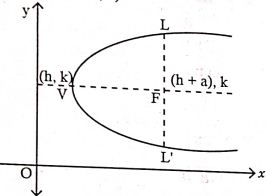
Equation of parabola with vertex at (h, k) and focal length 'a', latus rectum 4a' is
(y - k)2 = 4a(x - h) .......(1)
Differentiating with respect to 'x' we got
2(y - k) \(\frac{dy}{dx}\) = 4a
⇒ (y - k). \(\frac{dy}{dx}\) = 2a ....... (2)
Again differentiating with respect to x,
(y-k) y''+y'\(\times\) y' = 0 ............(3)
From(2),(y-k) = From(2),(y-k) = \(\frac{2a}{y'}\)
Putting in (3), we get
\((\frac{2a}{y'})y''+(y')^2=0 (or) 2ay'' +(y')^3 = 0\)
This is the required differential equation.
40.
The Cartesian equations of the straight line \(\vec { r } =(\hat { i } +\hat { 3j } -\hat { k } )+t(2\hat { i } +3\hat { j } +2\hat { k } )\) is
\(\frac { x-1 }{ 2 } =\frac { y-3 }{ 3 } =\frac { z+1 }{ 2 } \) = s(say)
Then any point on this line is of the form (2s + 1, 3s + 3, 2s -1) ...............(1)
The Cartesian equation of the second line is \(\frac { x-2 }{ 1 } =\frac { y-4 }{ 2 } =\frac { z+3 }{ 4 } =t\) (say)
Then any point on this line is of the form (t + 2, 2t + 4, 4t - 3)....(2)
If the given lines intersect, then there must be a common point. Therefore, for some s, t ∈ R
we have (2s + 1, 3s + 3, 2s −1 ) = (t + 2, 2t + 4, 4t − 3)
Equating the coordinates of x, y and z we get
2s − t = 1, 3s − 2t = 1 and s − 2t = −1.
Solving the first two of the above three equations, we get s = 1 and t = 1. These values of s and t satisfy the third equation. So, the lines are intersecting.
Now, using the value of s in (1) or the value of t in (2), the point of intersection (3,6,1) of these two straight lines is obtained.
If we take \(\vec{b}=(2\hat { i } +3\hat { j } +2\hat { k } )\) and \(\vec{d}=\hat { i } +\hat { 3j } -\hat { k } \),
then \(\vec { b } \times \vec { d } =\left| \begin{matrix} \hat { i } & \hat { j } & \hat { k } \\ 2 & 3 & 2 \\ 1 & 2 & 4 \end{matrix} \right| =8\hat { i } -6\hat { j } +\hat { k } \) is a vector perpendicular to both the given straight lines.
Therefore, the required straight line passing through (3,6,1)
and perpendicular to both the given straight lines is the same as the straight line passing through (3,6,1) and parallel to \(8\hat { i } -6\hat { j } +\hat { k } \). Thus, the equation of the required straight line is
\(\vec { r } =(\hat { 3i } +\hat { 6j } -\hat { k } )+m(8\hat { i } -6\hat { j } +\hat { k } )\), k ∈ R.
41.
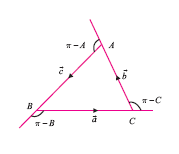
With usual notations in triangle, ABC let \(\vec { BC } =\vec { a } \), \(\vec { CA } =\vec { b } \) and \(\vec { AB } =\vec { c} \). Then \(|\vec { BC }| =\vec { a } \), \(|\vec { CA } |=\vec { b } \) and \(|\vec { AB }| =\vec { c } \)
Since in ΔABC, \(\vec { BC }+\vec { CA }+\vec { AB}=0\) we have \(\vec { BC }\times(\vec { BC }+\vec { CA }+\vec { AB })=\vec { 0 }\)
Simplifying, we get,
\(\vec { BC }\times\vec { CA }=\vec { AB }\times\vec { BC }\) ....(1)
Similarly, since \(\vec { BC }+\vec { CA }+\vec { AB}=\vec 0\), we have
\(\vec {CA} \times (\vec { BC }+\vec { CA }+\vec { AB})=\vec 0\) .... (2)
On Simplification, we obtain \(\vec { BC }\times\vec { CA }=\vec {CA }\times\vec {AB }\)
From equations (1) and (2), we get
\(\vec { AB }\times\vec {BC }\) = \(\vec { CA }\times\vec {AB }\)=\(\vec { BC}\times\vec {CA}\)
So, \(\left| \overrightarrow { AB} \times \overrightarrow { BC } \right| =\left| \overrightarrow { CA } \times \overrightarrow { AB } \right| =\left| \overrightarrow { BC } \times \overrightarrow { CA } \right| \). Then, we get
ca sin(π − B) = bc sin(π - A) = ab sin (π - C)
That is, ca sin B = bc sin A = absinC . Dividing by abc, we get
\(\frac { sinA }{ A } =\frac { sinB }{ b } =\frac { sinC }{ c } \) or \(\frac { a }{ sinA }= \frac { b }{ sinB } =\frac { c }{ sinC } \)
42.
Given A =\(\left[ \begin{matrix} 5 & 3 \\ -1 & -2 \end{matrix} \right] \)
A2 = \(\left[ \begin{matrix} 5 & 3 \\ -1 & -2 \end{matrix} \right] \left[ \begin{matrix} 5 & 3 \\ -1 & -2 \end{matrix} \right] =\left[ \begin{matrix} 25-3 & 15-6 \\ -5+2 & -3+4 \end{matrix} \right] \)
=\(\left[ \begin{matrix} 22 & 9 \\ -2 & 1 \end{matrix} \right] \)
∴ A2- 3A - 7I2
=\(\left[ \begin{matrix} 22 & 9 \\ -3 & 1 \end{matrix} \right] -3\left[ \begin{matrix} 5 & 3 \\ -1 & -2 \end{matrix} \right] -7\left[ \begin{matrix} 1 & 0 \\ 0 & 1 \end{matrix} \right] \)
=\(\left[ \begin{matrix} 22-15-7 & 9-9+0 \\ -3+3+0 & 1+6-7 \end{matrix} \right] =\left[ \begin{matrix} 0 & 0 \\ 0 & 0 \end{matrix} \right] \)= O2
Hence proved.
∴ A2-3A-7I2 = O2
Postmultiplying by A-1 we get,
A2-A-1-3AA-1-7I2A-1 = 0.A-1
⇒ A(AA-1)-3(AA-1)-7(A-1) = 0
[∵ I2A-1 = A-1 and | (0)A-1= 0]
⇒ AI-3I-7A-1 = 0 [∵ AA-1= 1]
⇒ AI-3I = 7A-1
⇒ A-1 = \(\frac { 1 }{ 7 } \)[A - 3I] [∴ AI = A]
⇒ A-1 = \(\frac { 1 }{ 7 } =\left[ \left[ \begin{matrix} 5 & 3 \\ -1 & -2 \end{matrix} \right] -3\left[ \begin{matrix} 1 & 0 \\ 0 & 1 \end{matrix} \right] \right] \)
⇒ A-1 = \(\frac { 1 }{ 7 } \left[ \begin{matrix} 5-3 & 3-0 \\ -1-0 & -2-3 \end{matrix} \right] =\frac { 1 }{ 7 } \left[ \begin{matrix} 2 & 3 \\ -1 & -5 \end{matrix} \right] \)
∴ A-1 = \(\frac { 1 }{ 7 } \left[ \begin{matrix} 2 & 3 \\ -1 & -5 \end{matrix} \right] \).
43.
(1) Mount Everest is the highest mountain of the world.
(2) 3+ 4 = 8 .
(3) 7 + 5 >10 .
(4) Give me that book.
(5) (10 − x) = 7.
(6) How beautiful this flower is!
(7) Where are you going?
(8) Wish you all success.
(9) This is the beginning of the end.
The truth value of the sentences (1) and (3) are T, while that of (2) is F. Hence they are statements.
The sentence (5) is true for x = 3 and false for x ≠ 3 and hence it may be true or false but not both. So it is also a statement.
The sentences (4), (6), (7), (8) are not statements, because (4) is a command, (6) is an exclamatory, (7) is a question while (8) is a sentence expressing one’s wishes and (9) is a paradox.

12th Standard Syllabus & Materials
12th Standard
TN 12th Computer Applications களப்பெயர் முறைமை (DNS) Sample Question Papers Study Material - QB365 Set A
NEW12th Standard
TN 12th Computer Applications வலையமைப்பு எடுத்துக்காட்டுகள் மற்றும் நெறிமுறைகள் Sample Question Papers Study Material - QB365 Set A
NEW12th Standard
TN 12th Computer Applications கணினி வலையமைப்பு ஓர் அறிமுகம் Sample Question Papers Study Material - QB365 Set A
NEW12th Standard
TN 12th Computer Applications PHP-உடன் MySQL-ஐ இணைத்தல் Sample Question Papers Study Material - QB365 Set A



Tamilnadu Stateboard 12th Standard Subjects
Maths

Chemistry

Physics

Biology

Computer Science

Business Maths and Statistics

Economics

Commerce

Accountancy

History

Computer Applications
Biology
Computer Technology
Computer Applications
Computer Science
Business Maths and Statistics
Commerce
Economics
Maths
Chemistry
Physics
Computer Technology
History
Accountancy

Tamil

English

French
Tamilnadu Stateboard Standards

