
 100% FREE ACCESS
12th Standard Syllabus & Materials
12th Standard
TN 12th Computer Applications மின்னணு தரவு பரிமாற்றம் Sample Question Papers Study Material - QB365 Set A
NEW12th Standard
TN 12th Computer Applications மின் - வணிக பாதுகாப்பு அமைப்புகள் Sample Question Papers Study Material - QB365 Set A
NEW12th Standard
TN 12th Computer Applications மின்னணு செலுத்தல் முறைகள் Sample Question Papers Study Material - QB365 Set A
NEW12th Standard
TN 12th Computer Applications மின் - வணிகம் Sample Question Papers Study Material - QB365 Set A
NEW12th Standard
TN 12th Computer Applications திறந்த மூல கருத்துருக்கள் Sample Question Papers Study Material - QB365 Set A
NEW12th Standard
TN 12th Computer Applications வலையமைப்பு வடமிடல் Sample Question Papers Study Material - QB365 Set A

Published on: 31/12/2022
QB365 provides a detailed and simple solution for every Possible Questions in Class 12 Maths Subject - Important 5 Mark English Medium. It will help Students to get more practice questions, Students can Practice these question papers in addition to score best marks.
Download Tamil Nadu 12th Standard Maths question papers, model tests, one-mark questions, important questions, and public exam papers in PDF format. Free study materials and answer keys for TN State Board students.
Questions + Answers key
Take MCQ Maths Test1.
The radius of a circular plate is measured as 12.65 cm instead of the actual length 12.5 cm.find the following in calculating the area of the circular plate:
Percentage error
2.
The radius of a circular plate is measured as 12.65 cm instead of the actual length 12.5 cm. Find the following in calculating the area of the circular plate:
Relative error
3.
An urn contains 5 mangoes and 4 apples. Three fruits are taken at randaom. If the number of apples taken is a random variable, then find the values of the random variable and number of points in its inverse images.
4.
In a pack of 52 playing cards, two cards are drawn at random simultaneously. If the number of black cards drawn is a random variable, find the values of the random variable and number of points in its inverse images.
5.
Show that y = ax + \(\frac { b }{ x } \), x ≠ 0 is a solution of the differential equation x2 y" + xy' - y = 0.
6.
Show that y = ae-3x + b, where a and b are arbitary constants, is a solution of the differential equation\(\frac { { d }^{ 2 }y }{ { dx }^{ 2 } } +3\frac { dy }{ dx } =0\)
7.
With usual notations, in any triangle ABC, prove by vector method that \(\frac { a }{ sinA } =\frac { b }{ sinB }=\frac { c }{ sinc }\)
8.
Find the value of tan−1(−1 ) + cos-1\((\frac{1}{2})+sin^-1(-\frac{1}{2})\)
9.
If A = \(\left[ \begin{matrix} 4 & 3 \\ 2 & 5 \end{matrix} \right] \), find x and y such that A2 + xA + yI2 = O2. Hence, find A-1.
10.
Verify (AB)-1 = B-1A-1 with A = \(\left[ \begin{matrix} 0 & -3 \\ 1 & 4 \end{matrix} \right] \), B = \(\left[ \begin{matrix} -2 & -3 \\ 0 & -1 \end{matrix} \right] \).
11.
If z1= 2 + 5i, z2 = -3 - 4i, and z3 = 1 + i, find the additive and multiplicative inverse of z1, z2 and z3
12.
Find the values of the real numbers x and y, if the complex numbers (3−i)x−(2−i)y+2i +5 and 2x+(−1+2i)y+3+ 2i are equal.
13.
Solve for \(x: \tan ^{-1} x+2 \cot ^{-1} x=\frac{2 \pi}{3}\)
14.
Define an operation \(*\)on Q as follows: a * b =\(\left( \frac { a+b }{ 2 } \right) \); a,b ∈Q. Examine the closure, commutative, and associative properties satisfied by \(*\)on Q.
15.
Verify the
(i) closure property,
(ii) commutative property,
(iii) associative property
(iv) existence of identity and
(v) existence of inverse for the arithmetic operation - on Z.
16.
Verify the
(i) closure property,
(ii) commutative property,
(iii) associative property
(iv) existence of identity and
(v) existence of inverse for the arithmetic operation + on Z.
17.
Evaluate : \(\int ^\frac{\pi}{4}_{0} \frac{1}{sin x+cos x}\) dx
18.
Show that \(\int ^\frac{\pi}{2}_0\) \(\frac {dx}{4+5 sin x}\) = \(\frac {1}{3}\) loge 2.
19.
Water at temperature 100oC cools in 10 minutes to 80oC in a room temperature of 25oC.
Find
(i) The temperature of water after 20 minutes
(ii) The time when the temperature is 40oC
\(\left[ { log }_{ e }\frac { 11 }{ 15 } =-0.3101;{ log }_{ e }5=1.6094 \right] \)
20.
In a murder investigation, a corpse was found by a detective at exactly 8 p.m. Being alert, the detective also measured the body temperature and found it to be 70oF. Two hours later, the detective measured the body temperature again and found it to be 60oF. If the room temperature is 50oF, and assuming that the body temperature of the person before death was 98.6oF, at what time did the murder occur? [log(2.43) = 0.88789; log(0.5)=-0.69315]
21.
Solve the differential equation \({ ye }^{ \frac { x }{ y } }dx=\left( { xe }^{ \frac { x }{ y } }+y \right) dy\)
22.
A particle moves along a horizontal line such that its position at any time t ≥ 0 is given by s(t) = t3 − 6t2 +9 t +1, where s is measured in metres and t in seconds?
(1) At what time the particle is at rest?
(2) At what time the particle changes its direction?
(3) Find the total distance travelled by the particle in the first 2 seconds.
23.
If \({ tan }^{ -1 }\left( \frac { \sqrt { 1+{ x }^{ 2 } } -\sqrt { 1-{ x }^{ 2 } } }{ \sqrt { 1+{ x }^{ 2 } } +\sqrt { 1-{ x }^{ 2 } } } \right) =a\) than prove that x2 = sin 2a
24.
Find the foci, vertices and length of major and minor axis of the conic 4x2 + 36y2 + 40x − 288y + 532 = 0
25.
Find the equation of the ellipse whose eccentricity is \(\frac { 1 }{ 2 } \), one of the foci is(2, 3) and a directrix is x = 7. Also find the length of the major and minor axes of the ellipse.
26.
Find the domain of f(x) = sin-1 \((\frac{|x|-2}{3})+ \) cos-1 \((\frac{1-|x|}{4})\)
27.
If the equations x2 + px + q = 0 and x2 + p'x + q' = 0 have a common root, show that it must be equal to \(\frac { pq'-p'q }{ q-q' } \) or \(\frac { q-q' }{ p'-p } \).
28.
If p and q are the roots of the equation I x2+ nx + n = 0, show that \(\sqrt{\frac{p}{q}}+\sqrt{\frac{q}{p}}+\sqrt{\frac{n}{i}}\) = 0
29.
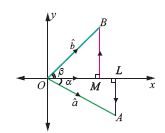
By vector method, prove that cos(α + β) = cos α cos β - sin α sin β
30.
A particle is fired straight up from the ground to reach a height of s feet in t seconds, where s(t) = 128t −16t2.
(1) Compute the maximum height of the particle reached.
(2) What is the velocity when the particle hits the ground?
1.
Actual value = 12.5 cm,
Approximate value = 12.65 cm
Area of the circular plate = πr2
Percentage error = 0.024 x 100 = 2.4%
Volume of sphere = \(\frac43\)πr2
2.
Actual value = 12.5 cm,
Approximate value = 12.65 cm
Area of the circular plate = πr2
Relative error = \(\frac{160.225π-156.25π}{160.0225π}\)
= \(\frac{3.7725π}{160.0225π}\)= 0.024 cm
3.
Let X be the random variable of getting apples Given 5 mangoes and 4 apples are in an urn
= {0, 1,2,3}
The sample space consists of 9C3 = 84
X = 0, X (3 mangoes) = 5C3 = 10
X = 1, X (2 mangoes and 1 apples) = 5C2 x 4C1 = 40
X = 2, X (1 mangoes and 2 apples) = 5C1 x 4C2 = 30
X = 3, X (apples) = 4C3 = 4
| Values of random variable | 0 | 1 | 2 | 3 | Total |
| No of points in inverse image | 10 | 40 | 30 | 4 | 84 |
4.
Let X be the random variable of number of black cards occur.
X = {0,1,2}
Sample space 52C2 = 1326
Let X denote the number of black cards drawn.
X = 0, X (both are red cards) = 26C2 = 325
X = 1 (1 black card and 1 red card) = 26C1 \(\times\) 26C1 = 676
X = 2 (both are black cards) = 26C2 = 325
∴ X takes the values 0, 1, 2
| Values of random variable X | 0 | 1 | 2 | Total |
| Number of elements in inverse images | 325 | 676 | 325 | 1326 |
5.
Given y = ax + \(\frac { b }{ x } \) .......(1)
Differentiating with respect to x
y' = ax - \(\frac { b }{ x ^2} \) ......(2)
Differentiating again with respect to x
\(y'' = \frac{-b(-2)}{x^3}= \frac{2b}{x^3}
\)
\(Now, x^2y'' + xy'-y
\)
\( = x^2 \times \frac{2b}{x^3}+x(a- \frac{b}{x^2})-(ax+\frac{b}{x})
\)
\(= 2\times (\frac{b}{x})+ax-(\frac{b}{x})-ax-(\frac{b}{x})\)
= 0
Hence, y = ax + b is the solution of the differential equation x2y"+xy'-y = 0.
6.
Given y = ae-3x+ b ........(1)
Differentiating cquation (1) w.r.t 'x', we get
\(\frac { d y }{ d x } =ae^{ -3x }(-3)+0\)
\(\frac { d y }{ d{ x } } =ae^{ -3x }(-3) \)
Again differentiating, we get
\(\Rightarrow \frac { d^{ 2 }y }{ d{ x }^{ 2 } } ={ ae^{-3 x } }(+9)\)
\(\Rightarrow \frac { d^{ 2 }y }{ d{ x }^{ 2 } } =-\frac{1}{3}\frac{dy}{dx}\times 9\)
\(\Rightarrow \frac { d^{ 2 }y }{ d{ x }^{ 2 } } = {-3}\frac{dy}{dx} \)
\(\Rightarrow \frac { d^{ 2 }y }{ d{ x }^{ 2 } } +3\frac{dy}{dx} \) = 0
Therefore, y = ae-3x + b is a solution of the given differential equation.
7.
With usual notations in triangle, ABC let \(\vec { BC } =\vec { a } \), \(\vec { CA } =\vec { b } \) and \(\vec { AB } =\vec { c} \). Then \(|\vec { BC }| =\vec { a } \), \(|\vec { CA } |=\vec { b } \) and \(|\vec { AB }| =\vec { c } \)
Since in ΔABC, \(\vec { BC }+\vec { CA }+\vec { AB}=0\) we have \(\vec { BC }\times(\vec { BC }+\vec { CA }+\vec { AB })=\vec { 0 }\)
Simplifying, we get,
\(\vec { BC }\times\vec { CA }=\vec { AB }\times\vec { BC }\) ....(1)
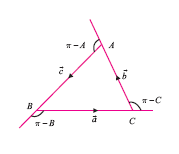
Similarly, since \(\vec { BC }+\vec { CA }+\vec { AB}=\vec 0\), we have
\(\vec {CA} \times (\vec { BC }+\vec { CA }+\vec { AB})=\vec 0\) .... (2)
On Simplification, we obtain \(\vec { BC }\times\vec { CA }=\vec {CA }\times\vec {AB }\)
From equations (1) and (2), we get
\(\vec { AB }\times\vec {BC }\) = \(\vec { CA }\times\vec {AB }\)=\(\vec { BC}\times\vec {CA}\)
So, \(\left| \overrightarrow { AB} \times \overrightarrow { BC } \right| =\left| \overrightarrow { CA } \times \overrightarrow { AB } \right| =\left| \overrightarrow { BC } \times \overrightarrow { CA } \right| \). Then, we get
ca sin(π − B) = bc sin(π - A) = ab sin (π - C)
That is, ca sin B = bc sin A = absinC . Dividing by abc, we get
\(\frac { sinA }{ A } =\frac { sinB }{ b } =\frac { sinC }{ c } \) or \(\frac { a }{ sinA }= \frac { b }{ sinB } =\frac { c }{ sinC } \)
8.
Let tan−1(−1) = y. Then, tan y = -1 = -tan\(\frac{\pi}{4}=tan(-\frac{\pi}{4})\)
As -\(\frac{\pi}{4}\in (-\frac{\pi}{2},\frac{\pi}{2}), tan^-1(-1)=-\frac{\pi}{ 3}\)
Now, cos-1\((\frac{1}{2})\) = y implies cos y = \(\frac{1}{2}\) = cos\(\frac{\pi}{3}\)
As \(\frac{\pi}{3}\)\(\in\)[0, \(\pi\)], cos-1 \((\frac{1}{2})=\frac{\pi}{3}\)
Now, sin-1\((-\frac{1}{2})\) = y implies sin y = -\(\frac{1}{2}\) = sin(-\(\frac{\pi}{3}\)).
As -\(\frac{\pi}{6}\in[-\frac{\pi}{2},\frac{\pi}{2}], sin^-1(-\frac{1}{2})=-\frac{\pi}{6}\)
Therefore, tan−1(−1)+cos-1\((\frac{1}{2})+sin^-1(-\frac{1}{2})=-\frac{\pi}{4}+\frac{\pi}{3}-\frac{\pi}{6}=-\frac{\pi}{12}\)
9.
Since A2 = \(\left[ \begin{matrix} 4 & 3 \\ 2 & 5 \end{matrix} \right] \left[ \begin{matrix} 4 & 3 \\ 2 & 5 \end{matrix} \right] =\left[ \begin{matrix} 22 & 27 \\ 18 & 31 \end{matrix} \right] \).
A2 + xA + yI2 = O2 ⇒ \(\left[ \begin{matrix} 22 & 27 \\ 18 & 31 \end{matrix} \right] +x\left[ \begin{matrix} 4 & 3 \\ 2 & 5 \end{matrix} \right] +y\left[ \begin{matrix} 1 & 0 \\ 0 & 1 \end{matrix} \right] =\left[ \begin{matrix} 0 & 0 \\ 0 & 0 \end{matrix} \right] \)
⇒ \(\left[ \begin{matrix} 22+4x+y & 27+3x \\ 18+2x & 31+5x+y \end{matrix} \right] =\left[ \begin{matrix} 0 & 0 \\ 0 & 0 \end{matrix} \right] \).
So, we get 22 + 4x + y = 0, 31 + 5x + y = 0, 27 + 3x = 0 and 18 + 2x = 0.
Hence x = −9 and y = 14. Then, we get A2 - 9A + 14I2 = O2.
Postmultiplying this equation by A-1, we get A - 9I2 + 14A-1 = O2. Hence, we get
A-1 = \(\frac { 1 }{ 14 } \) (9I2 - A) = \(\frac { 1 }{ 14 } \left( 9\left[ \begin{matrix} 1 & 0 \\ 0 & 1 \end{matrix} \right] -\left[ \begin{matrix} 4 & 3 \\ 2 & 5 \end{matrix} \right] \right) =\frac { 1 }{ 14 } \left[ \begin{matrix} 5 & -3 \\ -2 & 4 \end{matrix} \right] \).
10.
We get AB = \(\left[ \begin{matrix} 0 & -3 \\ 1 & 4 \end{matrix} \right] \left[ \begin{matrix} -2 & -3 \\ 0 & -1 \end{matrix} \right] =\left[ \begin{matrix} 0+0 & 0+3 \\ -2+0 & -3-4 \end{matrix} \right] =\left[ \begin{matrix} 0 & 3 \\ -2 & -7 \end{matrix} \right] \)
(AB)-1 = \(\frac { 1 }{ \left( 0+6 \right) } \left[ \begin{matrix} -7 & -3 \\ 2 & 0 \end{matrix} \right] =\frac { 1 }{ 6 } \left[ \begin{matrix} -7 & -3 \\ 2 & 0 \end{matrix} \right] \)...(1)
A-1 = \(\frac { 1 }{ \left( 0+3 \right) } \left[ \begin{matrix} 4 & 3 \\ -1 & 0 \end{matrix} \right] =\frac { 1 }{ 3 } \left[ \begin{matrix} 4 & 3 \\ -1 & 0 \end{matrix} \right] \)
B-1 = \(\frac { 1 }{ \left( 2-0 \right) } \left[ \begin{matrix} -1 & 3 \\ 0 & -2 \end{matrix} \right] =\frac { 1 }{ 2 } \left[ \begin{matrix} -1 & 3 \\ 0 & -2 \end{matrix} \right] \)
B-1A-1 = \(\frac { 1 }{ 2 } \left[ \begin{matrix} -1 & 3 \\ 0 & -2 \end{matrix} \right] \frac { 1 }{ 3 } \left[ \begin{matrix} 4 & 3 \\ -1 & 0 \end{matrix} \right] =\frac { 1 }{ 6 } \left[ \begin{matrix} -7 & -3 \\ 2 & 0 \end{matrix} \right] \) ...(2).
As the matrices in (1) and (2) are same, (AB)−1 = B−1A−1 is verified.
11.
Given z1 = 2 + 5i, z2 = -3 - 4i and z3 = 1 + i
Additive inverse of z1 is
-z1 = -(2 + 5i)
= -2 - 5i
Multiplicative inverse of z1 is
\(\frac { 1 }{ { z }_{ 1 } } =\frac { 1 }{ 2+5i } \times \frac { 2-5i }{ 2-5i } \)
[Multiply and divide by the conjugate of denominator]
= \(\frac { 2-5i }{ { 2 }^{ 2 }-(5i)^{ 2 } } =\frac { 2-5i }{ 4-25^{ 2 } } =\frac { 2-5i }{ 4+25 } \)
(z1)-1 = \(\frac { 1 }{ 29 } \)(2- 5i) [∴ i2 = -1]
Additive inverse of z2 is
-z2 = -(3 - 4i)
= 3 + 4i
Multiplicative inverse of z2 is
\(\frac { 1 }{ z_{ 2 } } =\frac { 1 }{ -3-4i } \times \frac { -3+4i }{ -3+4i } \)
= \(\frac { -3+4i }{ (-3)^{ 2 }-(4i)^{ 2 } } \)
= \(\frac { -3+4i }{ 9-16i^{ 2 } } =\frac { -3+4i }{ 9+16 } \)
(z2)-1 = \(\frac { 1 }{ 25 } \)(-3 + 4i)
Additive inverse of z3 is
-z3 = -(1 + i)
= -1- i
Multiplicative inverse of z3 is
\(\frac { 1 }{ { z }_{ 3 } } =\frac { 1 }{ 1+i } \times \frac { 1-i }{ 1-i } =\frac { 1-i }{ { 1 }^{ 2 }-({ i }^{ 2 }) } \)
= \(\frac { 1-i }{ 1+i } \)
(z3)-1 \(=\frac { 1 }{ 2 } \)(1 - i)
12.
Given (3 -i) x - (2 - i) y + 2i + 5
= 2x + (-1 + 2i) y + 3 + 2i
⇒ 3x - ix - 2y + iy + 2i + 5 = 2x - y + 2iy + 3 + 2i
choosing the real and imaginary parts
(3x-2y + 5) + i (-x + y + 2) = 2x - y + 3 + i (2y+ 2)
Equating the real and imaginary parts both sides, we get
3x- 2y+ 5 = 2x-y+3
⇒ 3x - 2y + 5 - 2x +y - 3 = 0
⇒ x-y = -2... (1)
-x+y+2 = 2y+2
⇒ -x+y+2-2y-2 = 0
⇒ -x-y = 0 ⇒ x+y = 0.. (2)
(1)-(2) we get,
| x - y | = -2 |
| x + y | = 0 |
| 2y | = -2 |
y = 1
Substituting y = 1 in (2) we get.
x+1 = 0 ⇒ x = -1
∴ x = -1 and y = 1
13.
\(
\tan ^{-1} x+2 \cot ^{-1} x =\frac{2 \pi}{3}
\)
\(\tan ^{-1} x+\cot ^{-1} x+\cot ^{1} x =\frac{2 \pi}{3}
\)
\(\frac{\pi}{2}+\cot ^{-1} x =\frac{2 \pi}{3}
\)
\(\cot ^{-1} x =\frac{2 \pi}{3}-\frac{\pi}{2}
\)
\(\cot ^{-1} x =\frac{4 \pi-3 \pi}{6}
\)
\(\cot ^{-1} x =\frac{\pi}{6}
\)
\(x =\cot \frac{\pi}{6}
\)
\(x =\sqrt{3} \in \mathrm{R}
\)
14.
Given \(a*b=\frac { a+b }{ 2 } \forall \in Q\)
i) Closure property:
Let a, b ∈ Q
∴ a*b = \(\frac{a+b}{2}\)∈Q
[∵ addition and division are closed on Q]
* is closed on Q.
(ii) Commutative property:
Let a, b ∈ Q
Then a+b \(=\frac { a+b }{ 2 } =\frac { b+a }{ 2 } =b*a\)
∴ a*b = b*a ∀a,b∈Q
∴ * is commutative on Q.
(iii) Associative property :
Let a, b, c ∈ Q
a*(b*c) = (a*b)*c
Let a = 2, b = 3, c-5
∴ a*(b*c) = 2*(3*-5)
\(=*\left( \frac { 3-5 }{ 2 } \right) \)
\(=2*(-1)=\frac { 2+(-1) }{ 2 } \)
\(=\frac { 1 }{ 2 } \quad \quad ...(1)\)
Now (a*b)*c = (2*3)*(-5)
\(=\left( \frac { 2+3 }{ 2 } \right) *(-5)\)
\(=\frac { 5 }{ 2 } *-5=\frac { \frac { 5 }{ 2 } +(-5) }{ 2 } \)
\(=\frac { 5-10 }{ 4 } =\frac { -5 }{ 4 } ...(2)\)
From (1) & (2), a*(b*c) ≠ (a*b)*c
∴ * is not associative on Q.
15.
i) Though - is not binary on N; it is binary on Z. To check the validity of any more properties satisfied by – on Z, it is better to check them for some particular simple values.
ii) Take m = 4 , n = 5 and (m− n) = (4 − 5) = −1and (n −m) = (5 − 4) = 1.
Hence (m− n) ≠ (n −m). So the operation - is not commutative on Z.
iii) In order to check the associative property, let us put m = 4, n = 5 and p = 7 in both (m- n) - p and m- (n - p).
(m−n)− p = (4−5)−7 = (−1−7) = −8 …(1)
m−(n− p) = 4−(5−7) = (4+2) = 6 …(2)
From (1) and (2), it follows that (m - n) - p m - (n - p).
Hence – is not associative on Z.
iv) Identity does not exist (why?).
v) Inverse does not exist (why?).
16.
(i) m + n∈Z, ∀m, n∈Z. Hence + is a binary operation on Z.
(ii) Also m + n = n + m,∀m, n∈Z. So the commutative property is satisfied
(iii) ∀m, n, p∈Z, m+ (n + p) = (m+ n) + p. Hence the associative property is satisfied.
(iv) m + e = e + m = m ⇒ e = 0. Thus ヨ 0∈Z⋺(m+ 0) = (0 + m) = m. Hence the existence of identity is assured.
(v) m + m' = m'+ m = 0 ⇒ m' = −m. Thus ∀∈Z,ョ−m∈Z ⋺ m+ (−m) = (−m) + m = 0. Hence, the existence of inverse property is also assured. Thus we see that the usual addition + on Z satisfies all the above five properties.
17.
I = \(\int ^\frac{\pi}{4}_{0} \frac{1}{sin x+cos x}\) dx = \(\int ^\frac{\pi}{4}_{0} \frac{1} {\sqrt 2( \frac {1}{\sqrt 2}sin x+ \frac {1}{\sqrt 2}cos x)}\) dx
= \(\frac{1}{\sqrt 2}\int ^\frac{\pi}{4}_{0} \frac{1} {( cos \frac {\pi}{4}cos x+ sin \frac {\pi}{4}sin x)}\) dx = \(\frac{1}{\sqrt 2}\int ^\frac{\pi}{4}_{0} \frac{1} {cos (\frac{\pi}{4}- x)}\) dx
= \(\frac{1}{\sqrt 2}\int ^\frac{\pi}{4}_{0} \frac{1} {cos x}\)dx since\(\int ^{a}_{0}\) f(x) dx =\(\int ^{a}_{0}\) f (a-x)dx
\(=\frac { 1 }{ \sqrt { 2 } } \int _{ 0 }^{ \frac { \pi }{ 4 } } secxdx=\frac { 1 }{ \sqrt { 2 } } { \left[ log(secx+tanx) \right] }_{ 0 }^{ \frac { \pi }{ 4 } }\)
= \(\frac{1}{\sqrt 2} [log ( \sqrt {2} + 1) - log (1+0)]\)
= \(\frac{1}{\sqrt 2} [log ( \sqrt {2} + 1)\).
18.
Put u = tan \(\frac{x}{2}\)
Then, sin x = \(\frac{2 tan \frac {x}{2}}{1 + tan^2 \frac{x}{2}}\) = \(\frac{2u}{1+u^2}\), du = \(\frac{1}{2}\) sec2 \(\frac{x}{2}\) dx \(\Rightarrow \) dx = \(\frac {2du}{1+u^2}\)
When x = 0,u = tan 0 = 0
When x = \(\frac{\pi}{2},u=tan\frac{\pi}{4}=1\)
∴ I =\(\int ^\frac{\pi}{2}_0\) \(\frac{dx}{4+5 sin x}\) =\(\int ^{1}_0\) \(\frac{\frac {2du}{1+u^2}}{4+5 (\frac{2u}{1+u^2})}\) =\(\int ^{1}_0\) \(\frac {du}{2u^2+5u +2}\)=\(\frac{1}{2}\)\(\int ^{1}_{0}\) \(\frac {du}{u^2+\frac{5}{2}u +1}\)
\(\frac { 1 }{ 2 } \int _{ 0 }^{ 1 } \frac { du }{ (u+\frac { 5 }{ 4 } )^2-(\frac { 3 }{ 4 } )^{ 2 } } { \left[ \frac { 1 }{ 2 } \times \frac { 1 }{ 2\times \left( \frac { 3 }{ 4 } \right) } log\left( \frac { (u+\frac { 5 }{ 4 } )-\frac { 3 }{ 4 } }{ (u+\frac { 5 }{ 4 } )+\frac { 3 }{ 4 } } \right) \right] }_{ 0 }^{ 1 }
= \frac{1}{3} [log (\frac{u+\frac{1}{2}}{u+2})]
=\frac { 1 }{ 3 } log2\)
19.
Let T be the temperature of water at any time t.
Then, by Newton's law of cooling,
\(\frac { dT }{ dt } \infty (T-{ 25 }^{ o })\)
\(\Rightarrow \frac { dT }{ dt } =-\lambda (T-25)\)
\(\Rightarrow \int { \frac { dT }{ T-25 } } =-\lambda \int { dt } \)
\(\Rightarrow log(T-25)=-\lambda t+C\) ...(1)
At t = 0, T = 1000e in (1) we get
\(\therefore(1)\Rightarrow\)log75 = 0+C
\(\Rightarrow\)C = log75
\(\therefore\)(1) becomes, log (T-25) = -\(\lambda\)t + log 75
\(\Rightarrow log\left( \frac { T-25 }{ 75 } \right) =-\lambda t...(2)\)
When t = 10, T = 80oC
\(\therefore log\left( \frac { 80-25 }{ 75 } \right) =-10|\)
\(\Rightarrow log\left( \frac { 11 }{ 15 } \right) =-10\lambda \)
\(\Rightarrow \lambda =-\frac { 1 }{ 10 } log\left( \frac { 11 }{ 15 } \right) \)
Substituting \(\lambda\) in (2) we get
\(log\left( \frac { T-25 }{ 75 } \right) =\frac { 1 }{ 10 } log\left( \frac { 11 }{ 15 } \right) t ...(3)\)
\(\Rightarrow log\left( \frac { T-25 }{ 75 } \right) =\frac { 1 }{ 10 } log\left( \frac { 11 }{ 15 } \right) \times 20\)
\(={ \left( \frac { 11 }{ 15 } \right) }^{ 2 }\)
\(\Rightarrow \frac { T-25 }{ 75 } ={ \left( \frac { 11 }{ 15 } \right) }^{ 2 }\)
\(\Rightarrow T-25=\frac { 121 }{ 225 } \times 75=\frac { 121 }{ 3 } =40.33\)
\(\Rightarrow T=40.33+25\)
\(\\ =65{ .33 }^{ 0 }C\)
So the temperature of water after 20 minutes is 65.33°C
(ii) putting T = 40oC in (3) we get
\(log\left( \frac { 40-25 }{ 75 } \right) =\frac { 1 }{ 10 } log\left( \frac { 11 }{ 15 } \right) t\)
\(\Rightarrow log\left( \frac { 1 }{ 5 } \right) =\frac { 1 }{ 10 } log\left( \frac { 11 }{ 15 } \right) t\)
\(t=\frac { 10log\left( \frac { 1 }{ 5 } \right) }{ log\left( \frac { 11 }{ 15 } \right) } =\frac { -10log5 }{ log\left( \frac { 11 }{ 15 } \right) } \)
\(=\frac { -10\times 1.6094 }{ -0.3101 } \)
\(\therefore\) t = 53.46 minutes
20.
Let T be the temperature of the body at any time t and with time 0 taken to be 8 p.m. By Newton’s law of cooling \(\frac { dT }{ dt } =k(T-50)or\frac { dT }{ T-50 } =dt\).
Integrating on both sides, we get log |50 −T| = kt + logC or 50 −T = Cekt.
When t = 0, T = 70, and so C = −20
When t = 2,T = 60, we have −10 = −20 ek2.
Thus, \(k=\frac { 1 }{ 2 } log\left( \frac { 1 }{ 2 } \right) \)
Hence, the solution is 50-T = -20e\(\frac{1}{2}\)tlog\((\frac{1}{2})\) or T = 50 + 20\((\frac{1}{2})^\frac{t}{2}\)
Now, we would like to find the value of t, for which T(t) = 98.6 , and t = 2\(\left( \frac { log\left( \frac { 48.6 }{ 20 } \right) }{ log\left( \frac { 1 }{ 2 } \right) } \right) \approx -2.56\)
It appears that the person was murdered at about 5.30 p.m.
21.
\( y e^{\left(\frac{1}{r}\right)} \cdot d x =\left(x e^{\frac{1}{y}}+y\right) d y \)
\(\frac{d x}{d y} =\frac{x \cdot e^{\left(\frac{6}{y}\right)}+y}{y e^{\left(\frac{x}{y}\right)}} \)
\(\frac{d x}{d y} =\left(\frac{x}{y}\right)+\frac{1}{e^{\left(\frac{6}{y}\right)}}\)
Put x = \( \mathrm{vy}\) \( \Rightarrow\left(\frac{x}{y}\right)=\mathrm{v}\) and \(\frac{d x}{d y}=\cdot v+y \cdot \frac{d v}{d y} \)
\((1) \Rightarrow \ v+y \cdot \frac{d v}{d y}=v+\frac{1}{e^y} \)
\(\mathrm{e}^v \cdot \mathrm{dv}=\frac{d y}{y}\)
Integrating on both sides,
ie) \(\int e^v \cdot d v =\int \frac{d y}{y} \)
\(e^v =\log |y|+\log |c| \)
\(e^{\left(\frac{x}{y}\right)} =\log |c y|\)
22.
Given that s(t) = t3 − 6t2 + 9t + 1. On differentiating, we get v(t) = 3t2 -12t + 9 and a(t) = 6t −12.
(i) The particle is at rest when v(t) = 0 . Therefore, v(t) = 3(t −1)(t − 3) = 0 gives t = 1 and t = 3.
(ii) The particle changes direction when v (t) changes its sign. Now.
if 0 ≤ t < 1 then both (t −1) and (t − 3) < 0 and hence, v(t) > 0.
If 1< t < 3 then (t −1) > 0 and (t − 3) < 0 and hence, v(t) < 0.
If t > 3 then both (t −1) and (t − 3) > 0 and hence, v(t) > 0.
Therefore, the particle changes direction when t = 1 and t = 3.
(iii) The total distance travelled by the particle from time t = 0 to t = 2 is given by,
|s(0) − s(1)| + |s(1) − s(2)| = |1− 5 | + | 5 − 3| = 6 metres.
23.
Given \({ tan }^{ -1 }\left( \frac { \sqrt { 1+{ x }^{ 2 } } -\sqrt { 1-{ x }^{ 2 } } }{ \sqrt { 1+{ x }^{ 2 } } +\sqrt { 1-{ x }^{ 2 } } } \right) =a\)
\(\Rightarrow \frac { \left( \sqrt { 1+{ x }^{ 2 } } -\sqrt { 1-{ x }^{ 2 } } \right) \left( \sqrt { 1+{ x }^{ 2 } } +\sqrt { 1-{ x }^{ 2 } } \right) }{ \left( \sqrt { 1+{ x }^{ 3 } } -\sqrt { 1-{ x }^{ 2 } } \right) \left( \sqrt { 1+{ x }^{ 2 } } +\sqrt { 1-{ x }^{ 2 } } \right) } \)
= \(\frac { tan\alpha +1 }{ tan\alpha -1 } \)
\(\Rightarrow \frac { 2\sqrt { 1+{ x }^{ 2 } } }{ -2\sqrt { 1-{ x }^{ 2 } } } =\frac { tan\alpha +1 }{ tan\alpha -1 } \)
\(\Rightarrow \sqrt { \frac { 1-{ x }^{ 2 } }{ 1+{ x }^{ 2 } } } =\frac { 1-tan\alpha }{ 1+tan\alpha } \)
\(\Rightarrow \sqrt { \frac { 1-{ x }^{ 2 } }{ 1+{ x }^{ 2 } } } =\frac { cos\alpha -sin\alpha }{ cos\alpha +sin\alpha } \)
\(\Rightarrow \frac { 1-{ x }^{ 2 } }{ 1+{ x }^{ 2 } } \left( \frac { cos\alpha -sin\alpha }{ cos\alpha +sin\alpha } \right) ^{ 2 }\)
\(\Rightarrow \frac { 1-{ x }^{ 2 } }{ 1+{ x }^{ 2 } } =\frac { 1-sin2\alpha }{ 1+sin2\alpha } \Rightarrow { x }^{ 2 }=sin2\alpha \)
24.
Completing the square on x and y of 4x2+36y2+40x−288y+532 = 0,
4(x2 + 10x + 25 − 25) + 36(y2 − 8y + 16 − 16) + 532 = 0 , gives
4(x2 + 10x + 25) + 36(y2 − 8y + 16) = −532 + 100 + 576
4(x + 5)2 + 36(y − 4)2 = 144.
Dividing both sides by 144, the equation reduces to \(\frac { { \left( x+5 \right) }^{ 2 } }{ 36 } \frac { { \left( y-4 \right) }^{ 2 } }{ 4 } =1\)
This is an ellipse with centre (-5, 4), major axis is parallel to x-axis, length of major axis is 12 and length of minor axis is 4. Vertices are (1, 4) and (-11, 4).
Now, c2 = a2−b2 = 36 − 4 = 32
and c = ±4 \(\sqrt { 2 } \)
Then the foci are (−5 − 4\(\sqrt { 2 } \), 4) and (−5 + 4\(\sqrt { 2 } \) , 4).
Length of the major axis = 2a = 12 units and
the length of the minor axis = 2b = 4 units.
25.
By the definition of a conic \(\frac{SP}{PM}\)= e or SP2 = e2PM2
Then, (x−2)2 + (y−3)2 = \(\frac { 1 }{ 4 } \) (x-7)2
3x2+ 4y2−2x − 24y + 3 = 0
\({ 3\left( x-\frac { 1 }{ 3 } \right) }^{ 2 }+4(y-3)^{ 2 }=3\left( \frac { 1 }{ 9 } \right) +4\times 9-3=\frac { 100 }{ 3 } \)
\(\frac { { \left( x-\frac { 1 }{ 3 } \right) }^{ 2 } }{ \frac { 100 }{ 9 } } +\frac { (y-3{ ) }^{ 2 } }{ \frac { 100 }{ 12 } } \) = 1 which is in the standard form.
Therefore, the length of major axis = 2a = 2\(\sqrt { \frac { 100 }{ 9 } = } \frac { 20 }{ 3 } \) and
the length of minor axis = 2b = 2\(\sqrt { \frac { 100 }{ 12 } = } \frac { 10 }{ \sqrt { 3 } } \).
26.
f(x) = sin-1 \((\frac{|x|-2}{3})+cos^-1(\frac{1-|x|}{4})\)
From the definition of sin-1
\(-1\le \frac { \left| x \right| -2 }{ 3 } \le 1\)
\(\Rightarrow -3\le \left| x \right| -2\le 3\)
\(\Rightarrow -3+2\le \left| x \right| \le \left| x \right| \le 3+2\)
\(\Rightarrow -1\le \left| x \right| \le 5\)
It reduces to
\(0\le \left| x \right| \le 5\)
\(\Rightarrow 0\le \left| x \right| and\left| x \right| \le 5\)
\(\Rightarrow \left| x \right| \ge 0and-5\le x\le 5\)
From the definition of cos-1x.
\(-1\le \frac { 1-\left| x \right| }{ 4 } \le 1\)
\(\Rightarrow -4\le 1-\left| x \right| \le 4\)
\(\Rightarrow -4-1\le \left| x \right| \le 4-1\)
\(\Rightarrow -5\le -\left| x \right| \le 3\)
\(\Rightarrow -3\le \left| x \right| >5\)
It reduces to
\(0\le \left| x \right| \le 5\)
\(-5\le |x|\le 5\)
From (1) & (2),
Domain is [-5, 5]
27.
Given equation are \({ x }^{ 2 }px+q=0\) ............(1)
and \({ x }^{ 2 }+p'x+q'=0\) ..........(2)
Let ∝ be the common root for (1) and (2)
∴ ∝2 + p∝ + q = 0 .........(3)
and ∝2+ p'∝ + q' = 0 .............(4)
Solving (3) and (4) by cross multiplication method we get
p q 1 p
p' q' 1 p'
\(\Rightarrow \frac { { \alpha }^{ 2 } }{ pq'-p'q } =\frac { \alpha }{ q-q' } =\frac { 1 }{ p'-p } \)
consider \(\frac { { \alpha }^{ 2 } }{ pq'-p'q } =\frac { \alpha }{ q-q' } \)
\(\Rightarrow \frac { { \alpha }^{ 2 } }{ \alpha } =\frac { pq'-p'q }{ q-q' } \)
\(\alpha =\frac { pq'-p'q }{ q-q } \)
Consider \(\frac { \alpha }{ q-q' } =\frac { 1 }{ p'-p } \Rightarrow \alpha =\frac { q-q' }{ p'-p } \)
Hence its roots are \(\frac { pq'-p'q }{ q-q' } or\quad \frac { q-q' }{ p'-p } \)
28.
Given p, q are the roots of lx2 + nx + n = 0
\(p+q=\frac { -b }{ a } =\frac { -n }{ l } ...(1)\)
\(pq=\frac { c }{ a } =\frac { n }{ l } ...(2)\)
L.H.S
\( \sqrt{\frac{p}{q}}+\sqrt{\frac{q}{p}}+\sqrt{\frac{n}{l}} =\frac{\sqrt{p}}{\sqrt{q}}+\frac{\sqrt{q}}{\sqrt{p}}+\frac{\sqrt{n}}{\sqrt{l}}=\frac{p+q}{\sqrt{p} \sqrt{q}}+\frac{\sqrt{n}}{\sqrt{l}} \)
\( =\frac{-\frac{n}{l}}{\sqrt{p q}}+\frac{\sqrt{n}}{\sqrt{l}}=\frac{-\frac{n}{l}}{\frac{\sqrt{n}}{\sqrt{l}}}+\frac{\sqrt{n}}{\sqrt{l}} \)
\(=\frac{-\frac{n}{l}+\frac{n}{l}}{\sqrt{\frac{n}{l}}}=0\) R.H.S
29.
Let \(\hat { a } =\vec { OA } \) and \(\hat { b } =\vec { OB } \) be the unit vectors and which make angles α and β, respectively, with positive x-axis, where A and B are as in the diagram.
Draw AL and BM perpendicular to the x-axis. Then \(\left| \vec { OL } \right| =\left| \vec { OA } \right| \) cos α = cos α, \(\left| \vec { LA } \right| =\left| \vec { OA } \right| \) sin α = sin α
So, \(\vec { OL } =\left| \vec { OL } \right| \)\(\hat { i } \) = cos,α \(\hat { i } \), \(\overrightarrow { LA } \) = sin α (-\(\hat { j } \))
Therefore, \(\hat { a } =\overrightarrow { OA} = \overrightarrow { OL } +\overrightarrow { LA } \) = cos α \(\hat { i } \) - sin α \(\hat { j } \) ..(1)
Similarly \(\hat { b } \) = cos β \(\hat { i } \)+ sin β \(\hat { j } \) ....(2)
The angle between \(\hat { a } \) and \(\hat{b}\) is α + β and so,
\(\hat { a } .\hat { b } =\left| \hat { a } \right| \left| \hat { b } \right| \) cos (α + β) = cos (α + β) ... (3)
On the other hand, from (1) and (2)
\(\hat { a } .\hat { b } =(cos\alpha \hat { i } -sina\hat { j } )(cos\beta \hat { i } -sin\beta \hat { j } )\) = cos α cos β - sin α sin β....(4)
From (3) and (4), we get cos(α + β) = cos α cos β - sin α sin β
30.
(i) At the maximum height, the velocity v(t) of the particle is zero.
Now, we find the velocity of the particle at time t.
\(v(t)=\frac{ds}{dt}=128-32t\)
\(v(t)=0 \Rightarrow 128-32t=0 \Rightarrow t=4.\)
After 4 seconds, the particle reaches the maximum height.
The height at t = 4 is s(4) = 128(4) - 16(4)2 = 256 ft.
(ii) When the particle hits the ground then s = 0 .
s = 0 ⇒ 128t −16t2 = 0
⇒ t = 0, 8 seconds.
The particle hits the ground at t = 8 seconds. The velocity when it hits the ground v(8) = –128 ft /s.

12th Standard Syllabus & Materials
12th Standard
TN 12th Computer Applications களப்பெயர் முறைமை (DNS) Sample Question Papers Study Material - QB365 Set A
NEW12th Standard
TN 12th Computer Applications வலையமைப்பு எடுத்துக்காட்டுகள் மற்றும் நெறிமுறைகள் Sample Question Papers Study Material - QB365 Set A
NEW12th Standard
TN 12th Computer Applications கணினி வலையமைப்பு ஓர் அறிமுகம் Sample Question Papers Study Material - QB365 Set A
NEW12th Standard
TN 12th Computer Applications PHP-உடன் MySQL-ஐ இணைத்தல் Sample Question Papers Study Material - QB365 Set A



Tamilnadu Stateboard 12th Standard Subjects
Maths

Chemistry

Physics

Biology

Computer Science

Business Maths and Statistics

Economics

Commerce

Accountancy

History

Computer Applications
Biology
Computer Technology
Computer Applications
Computer Science
Business Maths and Statistics
Commerce
Economics
Maths
Chemistry
Physics
Computer Technology
History
Accountancy

Tamil

English

French
Tamilnadu Stateboard Standards

